Science & Chemistry
Functional Groups Chart
Identify common organic functional groups from their bonding patterns, compare naming conventions and intermolecular behavior, and connect each group with the reaction families it commonly participates in.
This chart is a recognition and study reference. A functional-group label does not by itself determine an exact IUPAC name, pKa, solubility, reaction mechanism, or product.
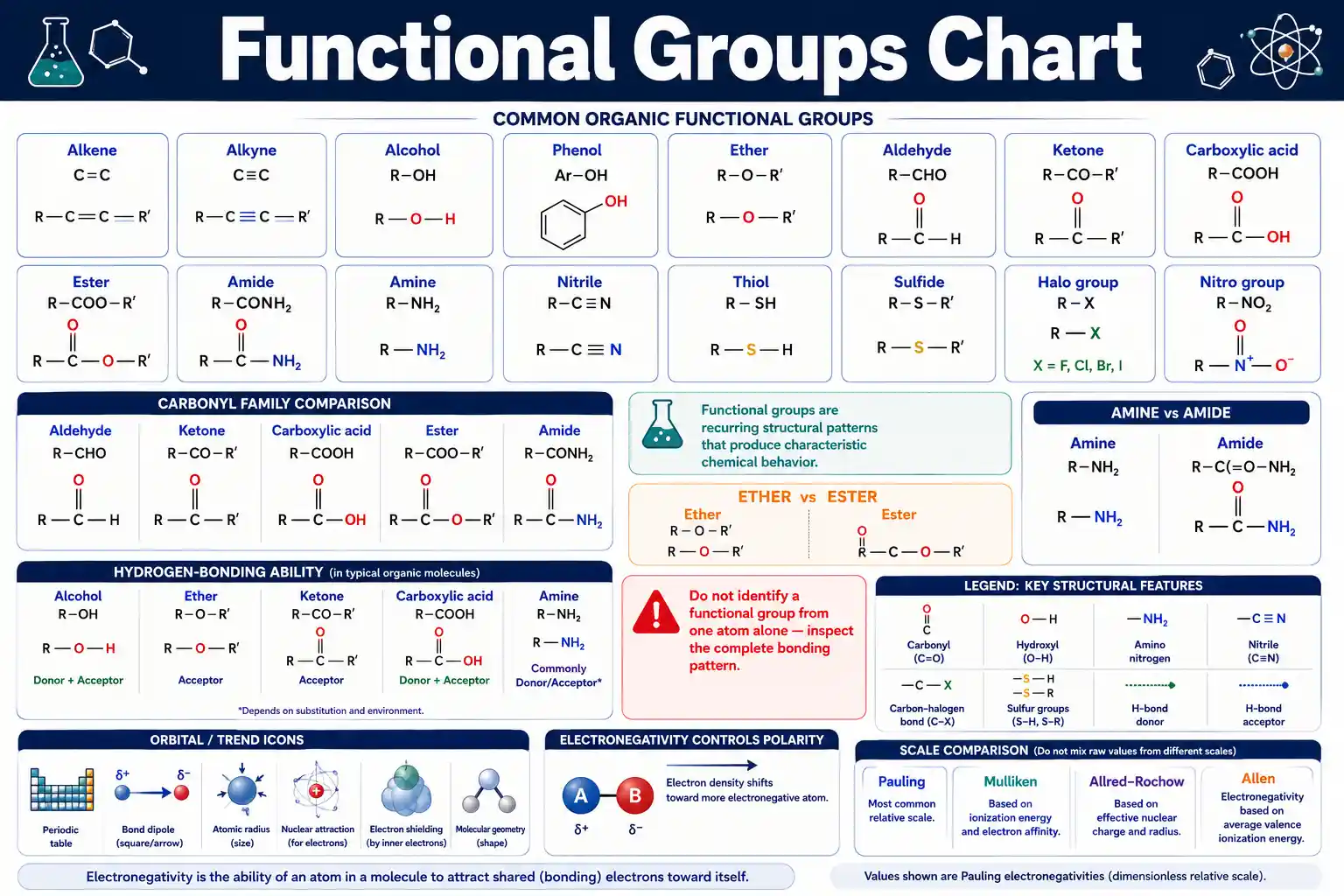
How functional groups organize organic chemistry
IUPAC defines a functional group as an atom or group of atoms that shows similar chemical properties when it occurs in different compounds. Functional groups are therefore a practical way to connect molecular structure with recurring physical and chemical behavior. See the IUPAC functional-group definition.
The fastest way to identify a group is to inspect the complete local bonding pattern. An oxygen atom alone does not tell you the class: R–OH is an alcohol, R–O–R′ is an ether, R–CHO is an aldehyde, and R–COO–R′ is an ester. Carbonyl chemistry is especially important because the atom attached to the C=O carbon changes both the name and reactivity.
Core idea
Structure predicts behavior
A functional group is a recurring local bonding pattern that gives related compounds characteristic chemical properties.
Recognition rule
Inspect the full motif
One atom is rarely enough. C=O can belong to aldehydes, ketones, acids, esters, amides, and other classes.
Physical properties
Groups change intermolecular forces
Hydrogen bonding, dipoles, charge, and polarizability can strongly affect boiling point, solubility, and chromatography.
Important limit
Context still matters
Functional groups suggest reaction families, but reagent, solvent, substitution, stereochemistry, and neighboring groups control outcomes.
A molecule can contain several functional groups simultaneously. Amino acids are a familiar example: most contain both an amine-type nitrogen functionality and a carboxylic acid group, while side chains can add alcohol, phenol, thiol, amide, or other functionality.
Functional Groups Chart — Common Organic Groups
A recognition-first reference to common organic functional groups. R and R′ represent carbon-containing groups; Ar represents an aromatic group; X represents a halogen.
Swipe horizontally inside the table to view every column.
| Functional group | General structure | Recognition feature | Typical compound class | Example |
|---|---|---|---|---|
| Alkene | C=C | Carbon–carbon double bond | Alkenes | Ethene |
| Alkyne | C≡C | Carbon–carbon triple bond | Alkynes | Ethyne |
| Halo group | R–X | C bonded to F, Cl, Br, or I | Haloalkanes / haloarenes | Chloroethane |
| Alcohol | R–OH | Hydroxyl on saturated carbon | Alcohols | Ethanol |
| Phenol | Ar–OH | Hydroxyl directly on aromatic ring | Phenols | Phenol |
| Ether | R–O–R′ | Oxygen between two carbon groups | Ethers | Ethoxyethane |
| Aldehyde | R–CHO | Terminal carbonyl carbon bonded to H | Aldehydes | Ethanal |
| Ketone | R–CO–R′ | Carbonyl carbon bonded to two carbons | Ketones | Propanone |
| Carboxylic acid | R–COOH | Carbonyl and hydroxyl on same carbon | Carboxylic acids | Ethanoic acid |
| Ester | R–COO–R′ | Carbonyl attached to O–carbon group | Esters | Ethyl ethanoate |
| Amide | R–CONH2 / R–CONHR / R–CONR2 | Carbonyl directly bonded to nitrogen | Amides | Ethanamide |
| Acyl halide | R–COX | Carbonyl directly bonded to halogen | Acyl halides | Ethanoyl chloride |
| Acid anhydride | R–CO–O–CO–R′ | Two acyl groups linked by oxygen | Carboxylic anhydrides | Ethanoic anhydride |
| Amine | R–NH2 / R2NH / R3N | Nitrogen bonded to carbon without adjacent carbonyl | Amines | Ethylamine |
| Nitrile | R–C≡N | Carbon triple-bonded to nitrogen | Nitriles | Ethanenitrile |
| Nitro group | R–NO2 | Carbon bonded to nitro nitrogen | Nitro compounds | Nitrobenzene |
| Thiol | R–SH | Sulfhydryl group | Thiols | Ethanethiol |
| Sulfide (thioether) | R–S–R′ | Sulfur between two carbon groups | Sulfides | Dimethyl sulfide |
| Sulfonic acid | R–SO3H | Sulfonyl group bearing hydroxyl | Sulfonic acids | Methanesulfonic acid |
| Imine | R2C=NR′ | Carbon–nitrogen double bond | Imines | Propan-2-imine-type motif |
Structures are condensed generic patterns, not complete molecular formulas.
- • One molecule can contain several functional groups at the same time.
- • Phenols and alcohols both contain O–H, but attachment to an aromatic ring changes acidity and reactivity enough that they are usually treated separately.
Download or export
Carbonyl Functional Groups Chart
Carbonyl-containing groups all contain C=O, but the atoms attached to the carbonyl carbon determine the compound class and strongly affect reactivity.
Swipe horizontally inside the table to view every column.
| Class | General structure | What is attached to C=O carbon? | Recognition shortcut | Typical reactivity theme |
|---|---|---|---|---|
| Aldehyde | R–CHO | Carbon group + H | Carbonyl at chain end with H | Addition; readily oxidized compared with ketones |
| Ketone | R–CO–R′ | Two carbon groups | Carbonyl within carbon skeleton | Nucleophilic addition |
| Carboxylic acid | R–COOH | Hydroxyl group | C=O and O–H on same carbon | Acid–base chemistry; acyl substitution after activation |
| Ester | R–COO–R′ | Alkoxy group | C=O next to O–carbon | Acyl substitution / hydrolysis / transesterification |
| Amide | R–CONR2 | Nitrogen group | C=O directly bonded to N | Relatively resonance-stabilized; hydrolysis requires suitable conditions |
| Acyl halide | R–COX | Halogen | C=O directly bonded to halogen | Highly useful acyl-transfer reagent |
| Acid anhydride | R–CO–O–CO–R′ | O linked to second acyl group | Two carbonyls separated by O | Acyl transfer / substitution |
Carbonyl = C=O.
- • Do not classify every C=O as a ketone. Aldehydes, acids, esters, amides, acyl halides, and anhydrides are separate carbonyl-containing classes.
Download or export
Carbonyl does not mean ketone
A carbonyl is simply a C=O unit. A ketone has that carbonyl carbon bonded to two carbon groups. If the carbonyl carbon is bonded to H, OH, OR, NR2, halogen, or another acyl-linked oxygen, the compound belongs to a different class such as aldehyde, carboxylic acid, ester, amide, acyl halide, or anhydride.
Oxygen-Containing Functional Groups
Oxygen-containing groups differ according to whether oxygen appears as O–H, C–O–C, C=O, or a combination of those motifs.
Swipe horizontally inside the table to view every column.
| Group | Core motif | Hydrogen-bond donor? | Hydrogen-bond acceptor? | Recognition note |
|---|---|---|---|---|
| Alcohol | R–OH | Usually yes | Usually yes | O–H on non-aromatic carbon framework |
| Phenol | Ar–OH | Yes | Yes | O–H directly attached to aromatic ring |
| Ether | R–O–R′ | No | Yes | O between two carbon groups |
| Aldehyde | R–CHO | No | Yes | Terminal carbonyl |
| Ketone | R–CO–R′ | No | Yes | Internal carbonyl |
| Carboxylic acid | R–COOH | Yes | Yes | Carbonyl + hydroxyl on same carbon |
| Ester | R–COO–R′ | No | Yes | Carbonyl + single-bond O connected to carbon |
Hydrogen-bond roles are broad neutral-molecule patterns; protonation, resonance, charge, and environment can change behavior.
- • A hydrogen-bond donor needs an appropriate X–H bond; an ether has oxygen lone pairs but no O–H bond, so it is an acceptor but not a donor.
Download or export
Nitrogen-Containing Functional Groups
Nitrogen functional groups can look similar at first glance, but bonding to carbonyl carbon, multiple bonding, formal charge, and resonance change their chemistry.
Swipe horizontally inside the table to view every column.
| Group | General motif | Recognition clue | Typical lone-pair behavior | Example class note |
|---|---|---|---|---|
| Primary amine | R–NH2 | N bonded to one carbon group | Lone pair often available for basicity/nucleophilicity | Amine |
| Secondary amine | R2NH | N bonded to two carbon groups | Lone pair often available | Amine |
| Tertiary amine | R3N | N bonded to three carbon groups | Lone pair often available | Amine; no N–H donor bond |
| Amide | R–CONR2 | N directly bonded to carbonyl carbon | Lone pair delocalized toward carbonyl; much less basic than amine | Amide |
| Nitrile | R–C≡N | C≡N terminus | Nitrogen is part of a triple bond | Nitrile |
| Nitro compound | R–NO2 | Carbon–nitro N linkage with resonance | Not treated like an amine lone pair | Nitro compound |
R may be alkyl or other carbon-containing substituent unless a more specific class is stated.
- • An amide is not simply an amine plus a nearby carbonyl: direct N–C(=O) bonding creates strong resonance effects.
Download or export
Sulfur and Halogen Functional Groups
Sulfur analogues and carbon–halogen groups are important recognition motifs in organic chemistry and often have reaction behavior distinct from their oxygen analogues.
Swipe horizontally inside the table to view every column.
| Group | General motif | Recognition clue | Common chemistry theme | Example |
|---|---|---|---|---|
| Haloalkane | R–X | sp3 carbon bonded to F, Cl, Br, or I | Substitution and elimination are common reaction families | Bromoethane |
| Aryl halide | Ar–X | Halogen directly on aromatic carbon | Reactivity differs from ordinary haloalkanes | Chlorobenzene |
| Thiol | R–SH | S–H group | Can form thiolates; oxidation can produce disulfides | Ethanethiol |
| Sulfide | R–S–R′ | S between two carbon groups | Can be oxidized to sulfoxides/sulfones | Dimethyl sulfide |
| Disulfide | R–S–S–R′ | S–S bond | Redox chemistry; important in protein structure | Cystine motif |
| Sulfonic acid | R–SO3H | S bonded to three oxygens including O–H | Strong acid functionality in many organic contexts | Methanesulfonic acid |
X = F, Cl, Br, or I in the halo-group shorthand used here.
- • Aryl halides and haloalkanes share C–X, but the hybridization and aromatic framework make their reaction behavior different.
Download or export
Interactive reference
Functional Group Finder
Choose a common group to review its recognition pattern, naming clue, intermolecular behavior, and common reaction families.
Alcohol
R–OH- Recognition
- Hydroxyl group on a non-aromatic carbon framework
- Naming clue
- Common principal suffix: -ol; prefix: hydroxy-
- Polarity / H-bonding
- Polar; usually H-bond donor and acceptor
- Reaction theme
- Oxidation, substitution, elimination, ester formation
Example: Ethanol
This is a lookup guide, not a structure-recognition engine. Real molecules can contain multiple groups, and neighboring groups can change reactivity and naming priority.
Functional Groups, Polarity and Hydrogen Bonding
Functional groups often dominate intermolecular forces. The table gives broad neutral-compound tendencies, not universal solubility predictions.
Swipe horizontally inside the table to view every column.
| Group | Typical polarity | H-bond donor? | H-bond acceptor? | Effect on intermolecular forces |
|---|---|---|---|---|
| Alkene | Low | No | No | Mostly dispersion; π electrons are polarizable |
| Halo group | Variable / polar bond | No | Not usually counted as conventional H-bond acceptor | C–X dipole can raise polarity |
| Alcohol | Polar | Yes | Yes | Strong hydrogen bonding when not sterically blocked |
| Phenol | Polar | Yes | Yes | Hydrogen bonding plus aromatic interactions |
| Ether | Polar | No | Yes | Dipole and acceptor interactions |
| Aldehyde | Polar | No | Yes | Strong carbonyl dipole |
| Ketone | Polar | No | Yes | Strong carbonyl dipole |
| Carboxylic acid | Strongly polar | Yes | Yes | Strong hydrogen bonding; dimers can form in suitable media |
| Ester | Polar | No | Yes | Carbonyl and ether-like oxygen contribute |
| Amide | Strongly polar | Often, if N–H present | Carbonyl O yes; amide N generally no | Strong dipole and hydrogen bonding |
| Amine | Polar | Primary/secondary yes | Usually yes | Hydrogen bonding and acid–base interactions |
| Nitrile | Polar | No | Yes | Large C≡N bond dipole |
Qualitative neutral-molecule comparison.
- • Whole-molecule solubility also depends on carbon skeleton size, charge, temperature, solvent, and the number of functional groups.
Download or export
Hydrogen-bond donors need the right X–H bond
Alcohols can both donate and accept hydrogen bonds because they contain O–H and oxygen lone pairs. Ethers can accept but cannot donate ordinary hydrogen bonds because they have no O–H bond. Primary and secondary amines can donate through N–H, while tertiary amines have no N–H donor bond.
Functional Groups and Acid–Base Behavior
A qualitative guide to common acid–base behavior. Actual pKa and protonation state depend on substituents, solvent, charge, and molecular environment.
Swipe horizontally inside the table to view every column.
| Group | Common acid/base role | Why | Recognition point |
|---|---|---|---|
| Carboxylic acid | Acidic | Conjugate carboxylate is resonance-stabilized | COOH motif |
| Sulfonic acid | Strongly acidic in many organic contexts | Sulfonate conjugate base is strongly stabilized | SO3H motif |
| Phenol | Weak acid | Phenoxide conjugate base gains resonance stabilization | Ar–OH |
| Alcohol | Very weak acid / weak base | Neutral O–H and oxygen lone pairs | R–OH |
| Amine | Basic | Nitrogen lone pair can accept a proton | N not directly acylated |
| Amide | Much less basic than analogous amine | Nitrogen lone pair is delocalized into carbonyl | C(=O)–N |
| Nitrile | Weak base | Nitrogen lone pair is on sp-hybridized N | C≡N |
| Carboxylate | Basic conjugate base | Negative charge delocalized over oxygen atoms | COO− |
Qualitative only; use measured or trusted pKa data for quantitative acid–base calculations.
- • Functional-group labels alone do not determine an exact pKa. Nearby electron-withdrawing groups, resonance, solvent, and charge can shift acidity substantially.
Download or export
An amide is much less basic than an amine
In an amide, the nitrogen lone pair is delocalized into the neighboring carbonyl system. That resonance changes both geometry and basicity. This is why simply spotting nitrogen is not enough to predict amine-like behavior.
Functional Group Naming Patterns
Common introductory substitutive-nomenclature patterns. Exact IUPAC names can change with parent selection, group seniority, ring systems, and retained names.
Swipe horizontally inside the table to view every column.
| Group | Common suffix when principal | Common prefix / substituent form | Example naming pattern |
|---|---|---|---|
| Alkene | -ene | enyl- in substituent contexts | hex-2-ene |
| Alkyne | -yne | ynyl- in substituent contexts | but-1-yne |
| Alcohol | -ol | hydroxy- | propan-2-ol |
| Aldehyde | -al | formyl- or oxo- depending on context | ethanal |
| Ketone | -one | oxo- | butan-2-one |
| Carboxylic acid | -oic acid | carboxy- | ethanoic acid |
| Ester | -oate in common alkyl alkanoate pattern | alkoxycarbonyl- in some contexts | ethyl ethanoate |
| Amide | -amide | carbamoyl- | propanamide |
| Nitrile | -nitrile | cyano- | propanenitrile |
| Amine | -amine | amino- | propan-1-amine |
| Halo group | No dedicated principal suffix in ordinary haloalkane naming | fluoro-, chloro-, bromo-, iodo- | 1-bromopropane |
| Nitro group | Usually prefix treatment | nitro- | nitrobenzene |
Naming examples are representative, not a complete nomenclature algorithm.
- • When several characteristic groups occur in one molecule, IUPAC seniority rules determine which group is expressed as the principal suffix.
- • Do not infer naming priority solely from a functional-group chart; use current nomenclature rules for polyfunctional compounds.
Download or export
Naming priority is a nomenclature rule, not a reactivity ranking
When a compound contains several characteristic groups, current IUPAC rules determine which group supplies the principal suffix and how other groups are expressed. The term characteristic group is used in nomenclature for structural features such as –OH, –NH2, –CHO, –C≡N, and –COOH. See the IUPAC characteristic-group definition.
Functional Groups and Common Reaction Families
Functional groups help predict likely reaction families because they concentrate electron density, bond polarity, acidity, basicity, or leaving-group behavior at recognizable sites.
Swipe horizontally inside the table to view every column.
| Functional group | Common reaction family | What changes | Important limitation |
|---|---|---|---|
| Alkene | Electrophilic addition | π bond becomes new σ bonds | Regio- and stereochemistry depend on reagents and substrate |
| Alkyne | Addition / reduction | Triple bond can be transformed stepwise | Product depends strongly on reagent and stoichiometry |
| Haloalkane | Substitution / elimination | C–X bond replaced or eliminated | Mechanism depends on substrate, nucleophile/base, solvent, and leaving group |
| Alcohol | Oxidation / substitution / elimination | O–H or C–O environment changes | Primary, secondary, and tertiary alcohols behave differently |
| Aldehyde | Nucleophilic addition / oxidation | Carbonyl carbon reacts; oxidation can give acid derivatives | Conditions determine product |
| Ketone | Nucleophilic addition / reduction | Carbonyl carbon is electrophilic | Ketones resist simple oxidation more than aldehydes |
| Carboxylic acid | Acid–base / condensation / derivative formation | O–H or acyl group reacts | Activation may be required for substitution |
| Ester | Hydrolysis / transesterification / reduction | Acyl–O framework is transformed | Rate depends on catalyst and structure |
| Amide | Hydrolysis / reduction | C–N acyl bond transformed | Resonance lowers electrophilicity relative to many acyl derivatives |
| Amine | Acid–base / alkylation / acylation | Nitrogen lone pair reacts | Sterics and substitution affect nucleophilicity/basicity |
| Thiol | Acid–base / oxidation / substitution | S–H or sulfur oxidation state changes | Thiolate formation strongly changes nucleophilicity |
| Nitrile | Hydrolysis / reduction / addition under suitable conditions | C≡N transformed to other nitrogen/oxygen functionality | Requires reagent-specific conditions |
Reaction-family summary only; not a substitute for reagent-specific mechanisms.
- • Functional groups suggest likely chemistry, but they do not guarantee a reaction under unspecified conditions.
Download or export
Functional groups predict reaction families, not guaranteed products
An alkene suggests addition chemistry, a haloalkane suggests substitution or elimination, and a carbonyl suggests reactions at an electrophilic carbon. The actual outcome still depends on the entire substrate plus reagent identity, solvent, temperature, stoichiometry, steric effects, stereochemistry, and competing functional groups.
Common Functional Group Identification Mistakes
Most identification errors come from focusing on one atom instead of the complete bonding pattern around that atom.
Swipe horizontally inside the table to view every column.
| Mistake | Incorrect shortcut | Better identification rule |
|---|---|---|
| Calling every O–H an alcohol | See OH → alcohol | Check what O is attached to; Ar–OH is phenol and C(=O)–OH is carboxylic acid |
| Calling every C=O a ketone | See carbonyl → ketone | Inspect both substituents on the carbonyl carbon |
| Confusing ether and ester | Both contain C–O–C | An ester also contains an adjacent carbonyl: C(=O)–O–C |
| Confusing amine and amide | Both contain N | An amide has N directly bonded to C=O carbon |
| Confusing nitrile and amine | Both contain N | Nitrile contains C≡N; amine contains C–N single bonds without direct acyl attachment |
| Treating COOH as alcohol + ketone | Split motif into two unrelated groups | Recognize the combined carboxyl group as one characteristic functionality |
| Ignoring aromatic attachment | Treat Ar–OH as ordinary alcohol | Aromatic attachment can define a distinct class and reactivity pattern |
| Assuming one molecule has one group | Choose only one label | Polyfunctional molecules can contain several functional groups simultaneously |
| Using R as a literal atom | Interpret R as element symbol | R is shorthand for an unspecified carbon-containing substituent |
| Using group identity as full reaction prediction | Functional group alone fixes products | Reagent, solvent, temperature, substitution, stereochemistry, and neighboring groups matter |
Recognition checklist for introductory organic chemistry.
- • Identify the complete local bonding pattern before assigning a functional-group name.
Download or export
A practical identification workflow
First look for C=O, C=C, C≡C, C≡N, aromatic rings, and heteroatoms. Next inspect what is directly bonded to those atoms. Finally check whether the motif is part of a larger combined group such as COOH, CONR2, or COO–R instead of labeling each atom separately.
IUPAC class terminology is structure-based, and a compound can belong to more than one class. The organization of compound classes around shared structural features is described in the IUPAC glossary of organic compound class names. See the IUPAC class glossary.
Frequently asked questions
What is a functional group?
A functional group is an atom or group of atoms that gives similar characteristic chemical behavior when it occurs in different organic compounds.
Can one molecule contain more than one functional group?
Yes. Polyfunctional molecules contain two or more functional groups, and each can influence naming, polarity, acidity, and reactivity.
Is a carbonyl group the same as a ketone?
No. Carbonyl means C=O. Ketones are one carbonyl-containing class; aldehydes, carboxylic acids, esters, amides, acyl halides, and anhydrides also contain carbonyl groups.
What is the difference between an alcohol and a phenol?
An alcohol has an –OH group on a non-aromatic carbon framework, while a phenol has –OH directly attached to an aromatic ring.
What is the difference between an ether and an ester?
An ether has R–O–R′. An ester contains a carbonyl next to that oxygen, R–C(=O)–O–R′.
What is the difference between an amine and an amide?
An amide has nitrogen directly bonded to a carbonyl carbon. An amine does not have that direct N–C(=O) linkage.
Which functional groups can donate hydrogen bonds?
Groups containing suitable O–H, N–H, or S–H bonds can often donate hydrogen bonds. Alcohols, phenols, carboxylic acids, primary and secondary amines, and many amides are common examples.
Do ethers form hydrogen bonds?
Ether oxygen can accept hydrogen bonds, but an ordinary ether cannot donate one because it has no O–H bond.
Which functional group is acidic?
Carboxylic acids and sulfonic acids are common acidic functional groups; phenols are also weak acids. Exact acidity depends on the entire molecular environment.
Which functional group is basic?
Amines are common basic functional groups because the nitrogen lone pair can accept a proton. Amides are much less basic because that lone pair is delocalized into the carbonyl system.
What does R mean in a functional-group formula?
R is a placeholder for an unspecified carbon-containing substituent. R and R′ can represent different groups.
What does Ar mean in organic structures?
Ar is commonly used as shorthand for an aromatic group, such as a phenyl group, when the exact aromatic substituent is not specified.
What does X mean in a halo-group formula?
X commonly represents a halogen such as fluorine, chlorine, bromine, or iodine.
Do functional groups determine boiling point and solubility?
They strongly influence intermolecular forces, but whole-molecule size, shape, charge, solvent, temperature, and the number of functional groups also matter.
Does a functional group always react the same way?
No. Functional groups create recognizable reaction patterns, but actual reaction rate, mechanism, and products depend on reagents, neighboring groups, sterics, solvent, temperature, and other conditions.
Is functional-group naming priority the same as reactivity?
No. Nomenclature seniority determines how a compound is named; it does not rank reaction rate, acidity, importance, or biological activity.
Related ChartsLoom references
Use the Amino Acid Chart to see several functional groups in biomolecules, the Electronegativity Chart to understand bond polarity inside groups, or the Density Chart to compare a bulk physical property affected by molecular structure.
Sources
International Union of Pure and Applied Chemistry — Gold Book — functional group
Defines a functional group as an atom or group of atoms that gives similar characteristic chemical properties in different compounds.
https://goldbook.iupac.org/terms/view/F02555
International Union of Pure and Applied Chemistry — Gold Book — characteristic group
Defines characteristic groups used in organic nomenclature, including examples such as –OH, –NH2, –CHO, –C≡N, and –COOH.
https://goldbook.iupac.org/terms/view/C00976
International Union of Pure and Applied Chemistry — A Brief Guide to the Nomenclature of Organic Chemistry
Summarizes modern IUPAC organic nomenclature principles and links to the current organic nomenclature guide.
https://iupac.org/what-we-do/nomenclature/brief-guides/
International Union of Pure and Applied Chemistry — Glossary of class names of organic compounds and reactive intermediates
Defines many organic compound classes by shared structural features and notes that compounds can belong to more than one class.
https://publications.iupac.org/pac/1995/pdf/6708x1307.pdf