Animals & Pets · Cats
Kitten Growth Chart: Weight, Development and Body Condition
Track weight by age, calculate change between weigh-ins, compare male and female growth-curve guidance, score body condition, and review feeding, neonatal care, development, teething and warning signs without claiming an exact adult weight.
Do not wait on a generic chart when a kitten is unwell. Confirmed weight loss, failure to gain, repeated vomiting or diarrhea, weakness, collapse, breathing difficulty, poor nursing or refusal to eat needs veterinary advice. Read the ChartsLoom Disclaimer.
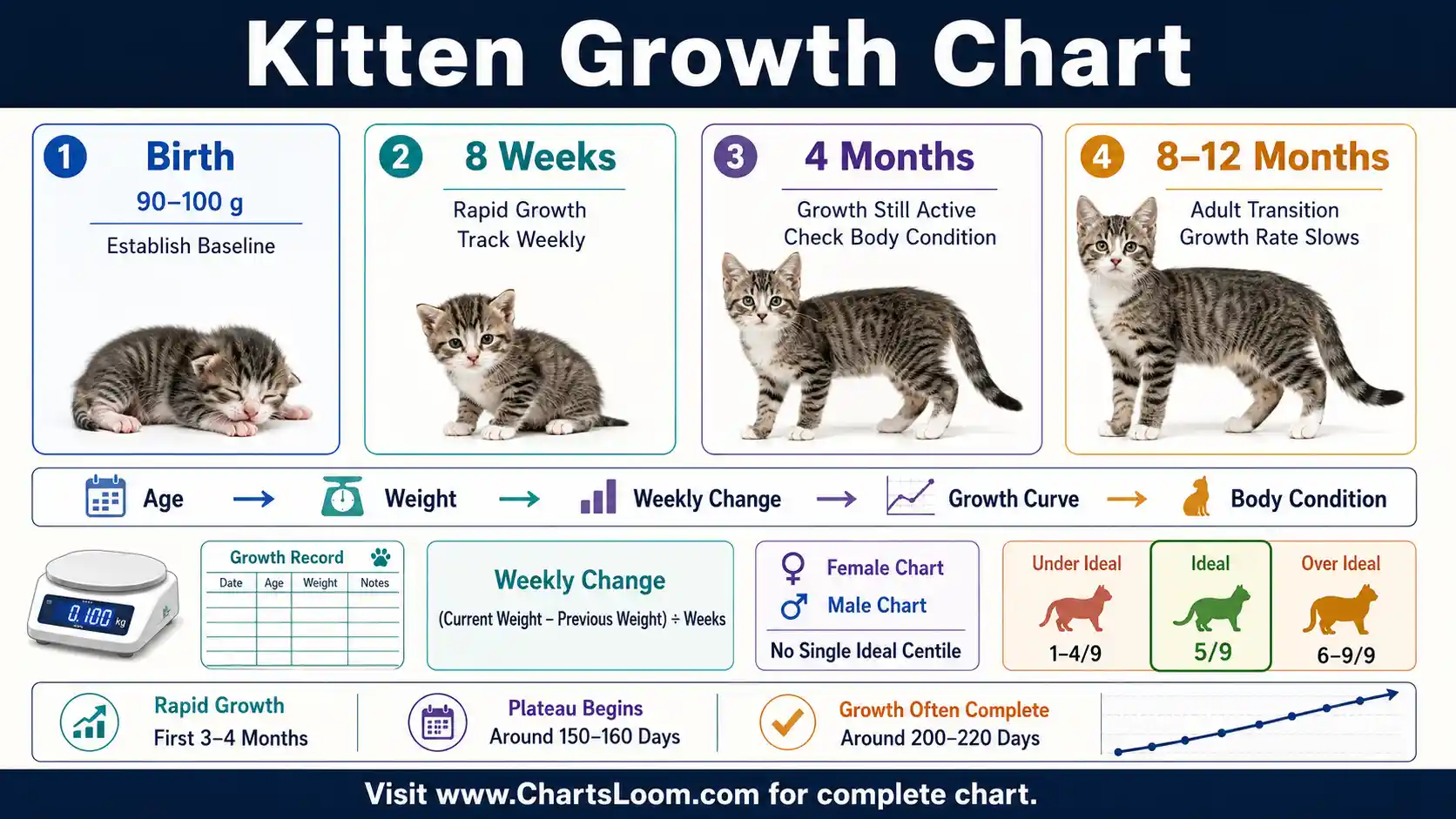
Kitten growth in practical terms
A useful kitten growth chart does not ask whether one weight is “right.” It asks whether accurately measured weights form a consistent trend for that kitten's age, sex-specific curve, body condition, diet, health and development. Record the original value and unit, use comparable scale conditions, and keep symptoms beside the numbers.
Merck describes especially rapid kitten growth during the first three to four months, with plateau commonly beginning around 150–160 days and growth often completed around 200–220 days. Waltham's male and female curves are intended for repeated plotting; no single centile line is automatically ideal.
Best measurement
Serial weight trend
Use the same scale, unit, time and feeding state whenever possible.
Body condition
5/9 is ideal
Feel the ribs and assess waist, abdominal tuck and fat pads.
Growth timing
Rapid for 3–4 months
Growth often begins plateauing around 150–160 days.
Core limitation
No exact adult-weight promise
Sex-specific curves show a path; they do not guarantee a final weight.
Questions at a glance
What is a kitten growth chart?
It is a serial record of age, weight, body condition and development used to follow a pattern rather than one target number.
How fast should a kitten grow?
Merck gives a broad early reference of 50–100 g per week during the first 3–4 months, but individual interpretation requires repeat measurements and clinical context.
How much should a newborn kitten weigh?
Merck lists a broad normal birth weight of about 90–100 g; the daily trend and the kitten’s condition matter more than one isolated value.
When does kitten growth slow?
Merck notes that growth commonly begins plateauing around 150–160 days and is often completed around 200–220 days.
Do male and female kittens use the same chart?
No. Waltham provides separate male and female growth charts.
Which centile is ideal?
No single centile line is inherently ideal. A consistent channel and healthy body condition are more useful.
Can current weight predict adult weight?
Not exactly. Sex, ancestry, body condition, adult frame and growth timing create too much variation for a simple multiplier.
What BCS is ideal?
The WSAVA nine-point feline chart places 5/9 in the ideal range; 4/9 is lean and categorized below ideal on the chart.
What if weight stops increasing?
Repeat the measurement and seek veterinary advice when no gain or loss is confirmed, especially in a young kitten.
When should kitten food stop?
Merck notes that adult-diet transition commonly occurs between 8 and 12 months, individualized to growth and body condition.
Can littermates weigh different amounts?
Yes. Compare each kitten with its own serial trend rather than treating litter rank as a diagnosis.
Can this calculator diagnose a growth disorder?
No. It reports arithmetic change and growth stage only; diagnosis requires veterinary examination.
Kitten Growth Stages by Week and Month
A chronological growth reference from birth through the first year. Age checkpoints organize monitoring; they do not assign one correct weight to every kitten.
Swipe horizontally inside the table to view every column.
| Age | Practical phase | Growth context | What to track |
|---|---|---|---|
| Birth | Neonatal | Rapid tissue and skill development | Birth weight, warmth, nursing and first trend |
| Week 1 | Neonatal | Rapid tissue and skill development | Daily weight, hydration, nursing strength and warmth |
| Week 2 | Neonatal to transitional | Rapid tissue and skill development | Weight trend, eyes and ears opening, crawling strength |
| Week 3 | Transitional | Rapid tissue and skill development | Mobility, elimination, nursing and early handling |
| Week 4 | Early kitten | Rapid tissue and skill development | Weight, first weaning foods, stool and coordination |
| Week 5 | Early kitten | Rapid tissue and skill development | Weekly weight, appetite, litter use and play |
| Week 6 | Early kitten | Rapid tissue and skill development | Weight trend, body condition, food intake and social behavior |
| Week 7 | Early kitten | Rapid tissue and skill development | Weekly weight, coordination, play and handling response |
| Week 8 | Rapid growth | Rapid tissue and skill development | Baseline home weight, diet transition and body condition |
| Week 9 | Rapid growth | Rapid tissue and skill development | Weight, appetite, stool, play and sleep |
| Week 10 | Rapid growth | Rapid tissue and skill development | Weekly weight, calorie needs and body condition |
| Week 11 | Rapid growth | Rapid tissue and skill development | Weight trend and any vomiting, diarrhea or poor appetite |
| Week 12 | Three-month checkpoint | Rapid tissue and skill development | Weight, body condition, diet calories and development |
| Week 13 | Rapid growth | Rapid tissue and skill development | Comparable weekly weight and food intake |
| Week 14 | Rapid growth | Rapid tissue and skill development | Weight, muscle, body proportions and activity |
| Week 15 | Rapid growth | Rapid tissue and skill development | Weight trend, body condition and measured portions |
| Week 16 | Four-month checkpoint | Growth-rate variation increases | Growth remains active but rate begins varying more |
| 5 months | Growth plateau and maturation | Merck notes plateau commonly begins around 150–160 days | Monthly weight, body condition, food energy and development |
| 6 months | Growth plateau and maturation | Use serial measurements and the correct sex-specific curve | Monthly weight, body condition, food energy and development |
| 7 months | Growth plateau and maturation | Growth is often largely complete around 200–220 days | Monthly weight, body condition, food energy and development |
| 8 months | Late kitten / adult transition | Adult-food transition is commonly considered between 8 and 12 months | Monthly weight, body condition, food energy and development |
| 9 months | Late kitten / adult transition | Adult-food transition is commonly considered between 8 and 12 months | Monthly weight, body condition, food energy and development |
| 10 months | Late kitten / adult transition | Adult-food transition is commonly considered between 8 and 12 months | Monthly weight, body condition, food energy and development |
| 11 months | Late kitten / adult transition | Adult-food transition is commonly considered between 8 and 12 months | Monthly weight, body condition, food energy and development |
| 12 months | Late kitten / adult transition | Adult-food transition is commonly considered between 8 and 12 months | Monthly weight, body condition, food energy and development |
| 18 weeks | Rapid juvenile growth | Use the trend rather than a single expected weight | Weight, BCS, diet, appetite and symptoms |
| 20 weeks | Rapid juvenile growth | Use the trend rather than a single expected weight | Weight, BCS, diet, appetite and symptoms |
| 22 weeks | Growth plateau and maturation | Use the trend rather than a single expected weight | Weight, BCS, diet, appetite and symptoms |
| 24 weeks | Growth plateau and maturation | Use the trend rather than a single expected weight | Weight, BCS, diet, appetite and symptoms |
| 26 weeks | Growth plateau and maturation | Use the trend rather than a single expected weight | Weight, BCS, diet, appetite and symptoms |
| 28 weeks | Growth plateau and maturation | Use the trend rather than a single expected weight | Weight, BCS, diet, appetite and symptoms |
| 30 weeks | Growth plateau and maturation | Use the trend rather than a single expected weight | Weight, BCS, diet, appetite and symptoms |
| 32 weeks | Growth plateau and maturation | Use the trend rather than a single expected weight | Weight, BCS, diet, appetite and symptoms |
| 34 weeks | Late kitten / adult transition | Use the trend rather than a single expected weight | Weight, BCS, diet, appetite and symptoms |
| 36 weeks | Late kitten / adult transition | Use the trend rather than a single expected weight | Weight, BCS, diet, appetite and symptoms |
| 40 weeks | Late kitten / adult transition | Use the trend rather than a single expected weight | Weight, BCS, diet, appetite and symptoms |
| 44 weeks | Late kitten / adult transition | Use the trend rather than a single expected weight | Weight, BCS, diet, appetite and symptoms |
| 48 weeks | Late kitten / adult transition | Use the trend rather than a single expected weight | Weight, BCS, diet, appetite and symptoms |
| 52 weeks | Late kitten / adult transition | Use the trend rather than a single expected weight | Weight, BCS, diet, appetite and symptoms |
- • Merck describes especially rapid growth during the first 3–4 months, a plateau beginning around 150–160 days, and growth commonly completed around 200–220 days.
- • Waltham growth charts should be used as serial curves, not as a single target-weight lookup.
Download or export
Kitten Weight References and Growth Interpretation
Broad reference points and interpretation rules for using kitten weights without turning population averages into personal prescriptions.
Swipe horizontally inside the table to view every column.
| Age or context | Reference | How to use it | Important limit |
|---|---|---|---|
| Birth | 90–100 g | Broad Merck reference | Confirm scale, warmth and nursing; individual and breed variation exists |
| First week | Daily trend is most important | Use same scale and time | A single reading cannot show direction |
| Weeks 2–4 | Steady gain expected | Compare with previous readings | Clinical signs override a reassuring number |
| Weeks 4–8 | Weaning and rapid growth | Track weekly at minimum in stable kittens | Diet and stool changes can affect trend |
| Weeks 8–12 | Rapid growth | Use age- and sex-appropriate curve | Do not compare one kitten directly with a littermate only |
| Months 3–4 | Often 50–100 g/week broad reference | Merck population-level guidance | Not a guaranteed personal target |
| Months 5–6 | Growth commonly begins slowing | Watch curve direction and BCS | Neutering and energy intake can change body condition |
| Months 7–8 | Maturation and plateau | Growth may be largely complete in many cats | Large-framed cats can continue changing |
| Months 8–12 | Adult-diet transition window | Confirm condition and veterinary plan | Birthday alone does not set the exact switch date |
| Female chart — Lower centiles | No fixed ideal line | Follow the same centile channel over time | Crossing channels or flattening needs context and remeasurement |
| Female chart — Middle centiles | No fixed ideal line | Follow the same centile channel over time | Crossing channels or flattening needs context and remeasurement |
| Female chart — Upper centiles | No fixed ideal line | Follow the same centile channel over time | Crossing channels or flattening needs context and remeasurement |
| Male chart — Lower centiles | No fixed ideal line | Follow the same centile channel over time | Crossing channels or flattening needs context and remeasurement |
| Male chart — Middle centiles | No fixed ideal line | Follow the same centile channel over time | Crossing channels or flattening needs context and remeasurement |
| Male chart — Upper centiles | No fixed ideal line | Follow the same centile channel over time | Crossing channels or flattening needs context and remeasurement |
| Purebred kitten | Use individual trend | Document age certainty, scale and health context | Do not force the kitten toward a generic average |
| Mixed-breed kitten | Use individual trend | Document age certainty, scale and health context | Do not force the kitten toward a generic average |
| Large-framed kitten | Use individual trend | Document age certainty, scale and health context | Do not force the kitten toward a generic average |
| Small-framed kitten | Use individual trend | Document age certainty, scale and health context | Do not force the kitten toward a generic average |
| Neutered kitten | Use individual trend | Document age certainty, scale and health context | Do not force the kitten toward a generic average |
| Intact kitten | Use individual trend | Document age certainty, scale and health context | Do not force the kitten toward a generic average |
| Rescue kitten with unknown birth date | Use individual trend | Document age certainty, scale and health context | Do not force the kitten toward a generic average |
| Orphaned bottle-fed kitten | Use individual trend | Document age certainty, scale and health context | Do not force the kitten toward a generic average |
| Kitten recovering from illness | Use individual trend | Document age certainty, scale and health context | Do not force the kitten toward a generic average |
| Kitten with diarrhea | Use individual trend | Document age certainty, scale and health context | Do not force the kitten toward a generic average |
| Kitten on a new diet | Use individual trend | Document age certainty, scale and health context | Do not force the kitten toward a generic average |
| Kitten weighed on a new scale | Use individual trend | Document age certainty, scale and health context | Do not force the kitten toward a generic average |
| Litter runt gaining steadily | Use individual trend | Document age certainty, scale and health context | Do not force the kitten toward a generic average |
- • Normal kittens vary in frame, sex, ancestry and adult size.
- • A confirmed loss, prolonged plateau or illness requires veterinary assessment rather than curve manipulation.
Download or export
Interactive tool
Kitten weight-trend calculator
Compare two accurately measured weights, calculate absolute and percentage change, review the kitten's current growth stage, and add body-condition context. The calculator does not predict an exact adult weight or define a medically normal rate.
Use weights from the same scale and similar feeding conditions. For a kitten weighed at 12 and 14 weeks, enter those exact whole-week ages.
Trend result
Trend
Weight increased
Growth stage
Rapid kitten growth
Total change
0.15 kg
Per week
0.07 kg
Percent change
11.5%
Body condition: Ideal (5/9)
Growth-curve guide: Plot serial weights on the Waltham female kitten chart; no centile line is automatically ideal.
Next step: Continue comparable serial weights and record body condition, diet, appetite and symptoms.
This result describes change between two measurements. It does not calculate a percentile, predict adult weight or decide whether the growth rate is medically normal.
What it does
Calculates change, percentage change and change per week between two comparable kitten weights.
Why it helps
It keeps age, unit, sex-specific chart and body condition beside the number instead of treating weight alone as health.
What it cannot do
It cannot predict exact adult weight, diagnose poor growth, calculate a Waltham percentile or replace a veterinarian.
How to Read Male and Female Kitten Growth Curves
Waltham provides separate male and female curves. This table explains what serial plotting can and cannot establish.
Swipe horizontally inside the table to view every column.
| Chart | Pattern | Interpretation | Record action |
|---|---|---|---|
| Female | First plotted weight | Baseline only; cannot show growth direction | Keep original measurements and note context |
| Female | Second comparable weight | Begins to show direction and rate | Keep original measurements and note context |
| Female | Three-point trend | More reliable than one interval | Keep original measurements and note context |
| Female | Stable centile channel | Consistent path; no one channel is automatically ideal | Keep original measurements and note context |
| Female | Gradual upward channel shift | Review calories, BCS, neuter status and measurement consistency | Keep original measurements and note context |
| Female | Gradual downward channel shift | Review intake, illness, parasites, age accuracy and scale consistency | Keep original measurements and note context |
| Female | Sharp channel crossing | Repeat measurement and seek veterinary interpretation | Keep original measurements and note context |
| Female | Long flat segment | May reflect plateau near maturity or a concern in a young kitten | Keep original measurements and note context |
| Female | Single outlier | Check scale, unit, age and feeding state before interpreting | Keep original measurements and note context |
| Female | Unknown age | Curve placement is unreliable without a credible birth date | Keep original measurements and note context |
| Female | Unknown sex | Use the correct sex-specific chart once known | Keep original measurements and note context |
| Female | Adult weight outside 2–7 kg | Waltham chart suitability may be limited | Keep original measurements and note context |
| Male | First plotted weight | Baseline only; cannot show growth direction | Keep original measurements and note context |
| Male | Second comparable weight | Begins to show direction and rate | Keep original measurements and note context |
| Male | Three-point trend | More reliable than one interval | Keep original measurements and note context |
| Male | Stable centile channel | Consistent path; no one channel is automatically ideal | Keep original measurements and note context |
| Male | Gradual upward channel shift | Review calories, BCS, neuter status and measurement consistency | Keep original measurements and note context |
| Male | Gradual downward channel shift | Review intake, illness, parasites, age accuracy and scale consistency | Keep original measurements and note context |
| Male | Sharp channel crossing | Repeat measurement and seek veterinary interpretation | Keep original measurements and note context |
| Male | Long flat segment | May reflect plateau near maturity or a concern in a young kitten | Keep original measurements and note context |
| Male | Single outlier | Check scale, unit, age and feeding state before interpreting | Keep original measurements and note context |
| Male | Unknown age | Curve placement is unreliable without a credible birth date | Keep original measurements and note context |
| Male | Unknown sex | Use the correct sex-specific chart once known | Keep original measurements and note context |
| Male | Adult weight outside 2–7 kg | Waltham chart suitability may be limited | Keep original measurements and note context |
- • There is no single ideal centile line; consistency and clinical context matter.
- • The Waltham charts are intended for cats with adult weights roughly 2–7 kg.
Download or export
Kitten Weighing Methods and Consistency Checks
Methods for obtaining repeatable kitten weights and documenting the context needed to interpret serial measurements.
Swipe horizontally inside the table to view every column.
| Method or check | Best use | How to do it | Limitation |
|---|---|---|---|
| Digital kitchen scale | Neonates and small kittens | Tare a stable container first | Never leave kitten unattended |
| Baby scale | Litters and growing kittens | Use nonslip towel and same position | Repeat if movement changes reading |
| Pet platform scale | Older kittens | Center all paws and wait for stable value | Use level floor |
| Veterinary floor scale | Any size | Use clinic reading as documented reference | Note carrier or harness |
| Carrier subtraction | Fearful or mobile kittens | Carrier plus kitten minus empty carrier | Use same carrier and bedding |
| Human scale subtraction | Larger kittens | Person plus kitten minus person | Too imprecise for small changes |
| Kilograms | Preferred calculation unit | Record exact scale output | Do not add false precision |
| Grams | Best for neonates | Use the same gram scale | Tiny changes matter more early |
| Pounds | Common household unit | Keep original and convert consistently | 1 kg = 2.20462 lb |
| Same time of day | Trend consistency | Choose repeatable time | Food and water can shift short-term weight |
| Same feeding state | Trend consistency | Compare before similar meal timing | Avoid pre-meal versus post-meal comparison |
| Same scale | Trend consistency | Use one scale when possible | Record equipment changes |
| Level hard surface | Scale accuracy | Avoid carpet unless approved | Confirm zero before use |
| Calm handling | Welfare | Use familiar towel and brief session | Stop if unsafe |
| Repeat reading | Quality check | Take two stable readings | Large disagreement means recheck |
| Daily weighing | Neonates or veterinary concern | Use at a consistent time | Follow veterinary frequency |
| Weekly weighing | Stable growing kittens | Useful through rapid growth | Increase frequency if concerned |
| Monthly weighing | Later kittenhood | Combine with body condition | Too infrequent for an acutely ill kitten |
| Record age in days | Neonatal accuracy | Use known birth date | Estimated dates reduce curve precision |
| Record age in weeks | First months | Use completed weeks consistently | Do not mix weeks and months silently |
| Carrier stress | Handling consideration | Prepare scale before bringing kitten | Minimize repeated restraint |
| Long coat | BCS limitation | Palpate ribs and waist | Weight alone cannot show fatness |
| Litter comparison | Context only | Compare trends, not rank | A smaller kitten can still grow consistently |
| Photo record | Optional support | Same angle monthly | Does not replace weighing or BCS |
- • Young or medically fragile kittens may need a veterinarian-directed schedule.
- • Use secure, low-stress handling and never leave a kitten unattended on an elevated scale.
Download or export
Interpret the number
Weight, growth-curve position and body condition answer different questions
Weight shows total mass. A growth curve shows direction over time. Body condition estimates fat stores through ribs, waist, abdominal tuck and fat pads. A kitten can remain smaller than a littermate while following a consistent individual path.
Kitten Body Condition Score Chart
The WSAVA nine-point feline body-condition framework. Assess ribs, waist, abdominal tuck and fat pads alongside the scale weight.
Swipe horizontally inside the table to view every column.
| Score | Category | Ribs and bones | Waist, tuck and fat |
|---|---|---|---|
| 1/9 — Needs review | Severely under ideal | Ribs, lumbar vertebrae and pelvis very obvious | No fat pads; severe abdominal tuck |
| 2/9 — Needs review | Under ideal | Ribs easily seen; lumbar vertebrae obvious | Pronounced tuck; no fat pads |
| 3/9 — Needs review | Under ideal | Ribs easily felt with minimal fat | Obvious waist; minimal abdominal fat |
| 4/9 — Under ideal | Under ideal | Ribs felt with minimal fat | Noticeable waist; slight abdominal tuck |
| 5/9 — Ideal range | Ideal | Well proportioned; ribs felt with slight fat | Waist visible; abdominal fat pad minimal |
| 6/9 — Needs review | Slightly over ideal | Ribs felt with slight excess fat | Waist and pad present; tuck absent |
| 7/9 — Needs review | Over ideal | Ribs not easily felt through moderate fat | Waist difficult to see; moderate abdominal pad |
| 8/9 — Needs review | Markedly over ideal | Ribs not felt due to excess fat | Waist absent; prominent pad and lower-back fat |
| 9/9 — Needs review | Severely over ideal | Ribs not felt under heavy fat | No waist; extensive abdominal and lumbar fat |
- • Score 5/9 is the WSAVA ideal point; score 4/9 is lean and categorized below ideal on the feline chart.
- • A growing kitten can gain weight while also gaining excess fat, so record BCS with serial weights.
Download or export
Kitten Weight-Trend Formulas and Interpretation
Simple calculations for comparing serial kitten weights. The math describes change; it does not diagnose whether the rate is healthy.
Swipe horizontally inside the table to view every column.
| Measure | Formula or method | Example | Meaning |
|---|---|---|---|
| Weight change | Current − previous | 1.45 − 1.30 = 0.15 kg | Absolute change |
| Elapsed weeks | Current age − previous age | 14 − 12 = 2 weeks | Time between readings |
| Change per week | Change ÷ elapsed weeks | 0.15 ÷ 2 = 0.075 kg/week | Average interval rate |
| Percent change | Change ÷ previous × 100 | 0.15 ÷ 1.30 × 100 = 11.5% | Proportional change |
| Kilograms to grams | kg × 1000 | 1.45 kg = 1450 g | Useful for early growth |
| Grams to kilograms | g ÷ 1000 | 1450 g = 1.45 kg | Keeps units consistent |
| Kilograms to pounds | kg × 2.20462 | 1.45 kg = 3.20 lb | Conversion only |
| Pounds to kilograms | lb ÷ 2.20462 | 3.2 lb = 1.45 kg | Round after calculation |
| No net change | Current = previous | 1.45 to 1.45 kg | Repeat and assess age/context |
| Weight decrease | Current < previous | 1.45 to 1.35 kg | Confirm and contact veterinarian when unexplained |
| Single reading | One weight only | 1.45 kg at 14 weeks | No trend can be calculated |
| Three-point trend | Three comparable weights | 1.15 → 1.30 → 1.45 kg | More informative than one interval |
| Scale offset | Different scales | Clinic 1.50; home 1.45 kg | Do not call offset biological change |
| Meal effect | Different feeding state | Before and after meal | Use consistent timing |
| Growth plus BCS | Weight rises; BCS stays 5/9 | Lean growth context | Still not proof of medical normality |
| Rising BCS | Weight rises; BCS 5 to 7/9 | Fat gain contributes | Review calories and treats |
| Early broad reference | 50–100 g/week first 3–4 months | Population-level Merck guidance | Not a personal target |
| Centile position | Plot age and weight | Follow one channel over time | No line is automatically ideal |
| Unknown age | Estimated date of birth | Curve position uncertain | Record confidence in age |
| Adult-weight prediction | Simple multiplier | Not used by this calculator | Too imprecise for individual care |
- • Use unrounded values for calculation and round only the displayed result.
- • Symptoms and clinical examination can outweigh a reassuring trend.
Download or export
Kitten Growth Record Fields
A complete record structure for turning isolated weights into a useful growth history.
Swipe horizontally inside the table to view every column.
| Field | When to record | What to enter | Why it matters |
|---|---|---|---|
| Date | Every entry | Calendar date | Creates context for interpreting the trend |
| Age | Every entry | Days or weeks from known birth date | Creates context for interpreting the trend |
| Weight | Every entry | Original number and unit | Creates context for interpreting the trend |
| Scale | When equipment varies | Device used | Creates context for interpreting the trend |
| Time | When possible | Approximate time of day | Creates context for interpreting the trend |
| Feeding state | When possible | Before or after meal | Creates context for interpreting the trend |
| Sex | Once confirmed | Male or female for Waltham curve | Creates context for interpreting the trend |
| Body condition | At least monthly | WSAVA 1–9 score | Creates context for interpreting the trend |
| Food product | After changes | Complete name and life-stage claim | Creates context for interpreting the trend |
| Food amount | Daily or weekly review | Grams, cans, pouches or cups | Creates context for interpreting the trend |
| Food calories | When available | kcal per unit | Creates context for interpreting the trend |
| Meals per day | After schedule changes | Number and times | Creates context for interpreting the trend |
| Treats | Daily or weekly summary | Type and amount | Creates context for interpreting the trend |
| Appetite | Each weigh-in | Normal, reduced or increased | Creates context for interpreting the trend |
| Stool | Each weigh-in | Normal, soft, diarrhea or constipation | Creates context for interpreting the trend |
| Vomiting | Whenever present | Count and timing | Creates context for interpreting the trend |
| Water intake | When changed | Normal, increased or decreased | Creates context for interpreting the trend |
| Activity | Each weigh-in | Usual or reduced | Creates context for interpreting the trend |
| Play and coordination | Weekly early on | Expected or changed | Creates context for interpreting the trend |
| Grooming | Weekly | Normal or reduced | Creates context for interpreting the trend |
| Medication | Whenever given | Product and date | Creates context for interpreting the trend |
| Parasite control | Whenever given | Product and date | Creates context for interpreting the trend |
| Vaccination | Whenever given | Date and record location | Creates context for interpreting the trend |
| Illness or procedure | Whenever relevant | Diagnosis or recovery | Creates context for interpreting the trend |
| Photo | Optional monthly | Same stance and angle | Creates context for interpreting the trend |
| Veterinary note | After examinations | Concerns and next review | Creates context for interpreting the trend |
- • Keep original measurements and units rather than replacing them after conversion.
- • Bring the record to veterinary visits when growth, nutrition or illness is discussed.
Download or export
Support steady development
Feed for growth and support safe development
A complete kitten diet, measured portions, ideal body condition, safe play and adequate rest are more useful than trying to force a particular curve. Neonatal and medically fragile kittens need individualized veterinary plans.
Kitten Meal Frequency by Age
Common feeding-pattern starting points across kittenhood. Food calories, body condition and veterinary advice determine the actual amount.
Swipe horizontally inside the table to view every column.
| Age band | Food format | Common pattern | Growth note |
|---|---|---|---|
| Birth to 3 weeks | Wet food | Queen’s milk or veterinary-directed milk replacer | Neonatal feeding is specialized |
| Birth to 3 weeks | Dry food | Queen’s milk or veterinary-directed milk replacer | Neonatal feeding is specialized |
| Birth to 3 weeks | Mixed feeding | Queen’s milk or veterinary-directed milk replacer | Neonatal feeding is specialized |
| 3–5 weeks | Wet food | Begin gradual weaning | Balanced kitten food is commonly introduced during this weaning window |
| 3–5 weeks | Dry food | Begin gradual weaning | Balanced kitten food is commonly introduced during this weaning window |
| 3–5 weeks | Mixed feeding | Begin gradual weaning | Balanced kitten food is commonly introduced during this weaning window |
| 5–8 weeks | Wet food | Several small meals | Use complete kitten food and monitor stool |
| 5–8 weeks | Dry food | Several small meals | Use complete kitten food and monitor stool |
| 5–8 weeks | Mixed feeding | Several small meals | Use complete kitten food and monitor stool |
| 8–12 weeks | Wet food | 3–4 measured meals | Rapid growth and small stomach capacity |
| 8–12 weeks | Dry food | 3–4 measured meals | Rapid growth and small stomach capacity |
| 8–12 weeks | Mixed feeding | 3–4 measured meals | Rapid growth and small stomach capacity |
| 3–4 months | Wet food | 3–4 meals | Merck describes rapid growth and 50–100 g/week broad gain |
| 3–4 months | Dry food | 3–4 meals | Merck describes rapid growth and 50–100 g/week broad gain |
| 3–4 months | Mixed feeding | 3–4 meals | Merck describes rapid growth and 50–100 g/week broad gain |
| 5–6 months | Wet food | 2–3 meals | Growth rate commonly begins slowing |
| 5–6 months | Dry food | 2–3 meals | Growth rate commonly begins slowing |
| 5–6 months | Mixed feeding | 2–3 meals | Growth rate commonly begins slowing |
| 7–8 months | Wet food | 2–3 meals | Monitor BCS as maturity approaches |
| 7–8 months | Dry food | 2–3 meals | Monitor BCS as maturity approaches |
| 7–8 months | Mixed feeding | 2–3 meals | Monitor BCS as maturity approaches |
| 9–12 months | Wet food | Usually 2–3 meals | Adult-diet transition is individualized |
| 9–12 months | Dry food | Usually 2–3 meals | Adult-diet transition is individualized |
| 9–12 months | Mixed feeding | Usually 2–3 meals | Adult-diet transition is individualized |
- • Meal frequency is not a calorie prescription.
- • Orphaned, ill, underweight or very young kittens require veterinarian-directed feeding.
Download or export
Kitten Growth-Diet Label Checklist
What to read on a commercial kitten-food label before translating package guidance into measured daily portions.
Swipe horizontally inside the table to view every column.
| Label item | What to find | How to use it |
|---|---|---|
| Nutritional adequacy statement | Statement showing intended life stage | Use it to support measured feeding and consistent tracking |
| Growth or all-life-stages wording | Suitable for kitten growth | Use it to support measured feeding and consistent tracking |
| Calorie statement | kcal per cup, can, pouch or kilogram | Use it to support measured feeding and consistent tracking |
| Feeding directions | Starting amount by age or weight | Use it to support measured feeding and consistent tracking |
| Serving unit | The exact unit used for calculation | Use it to support measured feeding and consistent tracking |
| Complete and balanced claim | Evidence it is intended as a main diet | Use it to support measured feeding and consistent tracking |
| Manufacturer contact | Support for nutrient and calorie questions | Use it to support measured feeding and consistent tracking |
| Lot code | Production identifier | Use it to support measured feeding and consistent tracking |
| Best-by date | Quality date | Use it to support measured feeding and consistent tracking |
| Storage instructions | Seal, refrigerate or discard guidance | Use it to support measured feeding and consistent tracking |
| Wet-food refrigeration | Time and temperature after opening | Use it to support measured feeding and consistent tracking |
| Dry-food measuring method | Prefer grams for repeatability | Use it to support measured feeding and consistent tracking |
| Treat allowance | Extras counted in total calories | Use it to support measured feeding and consistent tracking |
| Supplement warning | Avoid unsupervised calcium or vitamin additions | Use it to support measured feeding and consistent tracking |
| Food transition plan | Gradual change over several days | Use it to support measured feeding and consistent tracking |
| Ingredient list | Ingredients by weight | Use it to support measured feeding and consistent tracking |
| Guaranteed analysis | Selected nutrient minimums/maximums | Use it to support measured feeding and consistent tracking |
| Moisture content | Needed for dry-matter comparison | Use it to support measured feeding and consistent tracking |
| Adult-maintenance-only wording | May not meet growth needs | Use it to support measured feeding and consistent tracking |
| Veterinary therapeutic diet | Use for a diagnosed condition under direction | Use it to support measured feeding and consistent tracking |
- • A complete growth diet should provide required nutrients without routine unsupervised supplementation.
- • Package feeding directions are starting points; adjust through body weight, BCS and veterinary review.
Download or export
Neonatal Kitten Growth and Monitoring
A practical monitoring checklist for the highest-risk early period. It does not replace hands-on neonatal care instruction.
Swipe horizontally inside the table to view every column.
| Topic | Preferred action | Warning or record | Boundary |
|---|---|---|---|
| Birth weight | Weigh after drying and stabilization | Record grams and time | Veterinary guidance takes priority |
| Daily trend | Use same scale and time | Direction matters more than one target | Veterinary guidance takes priority |
| Warmth | Warm kitten before feeding | Cold neonates need urgent care | Veterinary guidance takes priority |
| Nursing | Observe latch and swallowing | Weak nursing needs prompt help | Veterinary guidance takes priority |
| Hydration | Watch mucous membranes and vigor | Dehydration can progress quickly | Veterinary guidance takes priority |
| Queen access | Confirm each kitten can nurse | Competition can hide poor intake | Veterinary guidance takes priority |
| Litter comparison | Use context only | Do not diagnose by rank | Veterinary guidance takes priority |
| Urination/defecation | Confirm normal elimination | Orphans may need specialized stimulation | Veterinary guidance takes priority |
| Crying | Persistent crying is concerning | Assess warmth, hunger, pain and illness | Veterinary guidance takes priority |
| Activity | Monitor strength and rooting | Weakness is urgent | Veterinary guidance takes priority |
| Daily loss | Repeat measurement promptly | Confirmed loss needs veterinary advice | Veterinary guidance takes priority |
| No gain | Recheck and escalate | Young kittens can deteriorate quickly | Veterinary guidance takes priority |
| Bottle feeding | Use veterinary-approved replacer | Do not use improvised recipes | Veterinary guidance takes priority |
| Feeding volume | Follow veterinary plan | Overfeeding can cause aspiration or diarrhea | Veterinary guidance takes priority |
| Feeding position | Natural sternal position | Never feed on the back | Veterinary guidance takes priority |
| Aspiration sign | Milk from nose or breathing change | Emergency veterinary care | Veterinary guidance takes priority |
| Diarrhea | Track frequency and hydration | Prompt assessment | Veterinary guidance takes priority |
| Vomiting | Not normal in neonates | Urgent assessment | Veterinary guidance takes priority |
| Umbilicus | Keep clean and observe | Swelling or discharge needs care | Veterinary guidance takes priority |
| Eyes | Opening timing varies | Discharge or swelling needs examination | Veterinary guidance takes priority |
| Parasites | Use veterinary schedule | Do not improvise dewormer dose | Veterinary guidance takes priority |
| Scale cleaning | Clean between litters | Reduce infection risk | Veterinary guidance takes priority |
| Record keeper | Assign one person when possible | Improves consistency | Veterinary guidance takes priority |
| Emergency plan | Know clinic and transport route | Do not wait for online tools | Veterinary guidance takes priority |
- • Neonatal kittens can deteriorate rapidly; warmth, feeding, hydration and medical assessment are time-sensitive.
- • The trend calculator is not a feeding-volume calculator and should not be used to manage a sick neonate.
Download or export
Kitten Physical and Behavioral Development Milestones
Typical checkpoints for growth, movement, feeding and environmental development during the first year.
Swipe horizontally inside the table to view every column.
| Age | Domain | Typical change | Interpretation |
|---|---|---|---|
| Birth | Physical growth | Eyes and ears closed; dependent on queen | Variation is expected; loss of ability or illness is not |
| Birth | Behavior and environment | Eyes and ears closed; dependent on queen | Variation is expected; loss of ability or illness is not |
| Week 1 | Physical growth | Crawling and nursing dominate | Variation is expected; loss of ability or illness is not |
| Week 1 | Behavior and environment | Crawling and nursing dominate | Variation is expected; loss of ability or illness is not |
| Week 2 | Physical growth | Eyes begin opening; mobility increases | Variation is expected; loss of ability or illness is not |
| Week 2 | Behavior and environment | Eyes begin opening; mobility increases | Variation is expected; loss of ability or illness is not |
| Week 3 | Physical growth | Walking improves; elimination becomes more independent | Variation is expected; loss of ability or illness is not |
| Week 3 | Behavior and environment | Walking improves; elimination becomes more independent | Variation is expected; loss of ability or illness is not |
| Week 4 | Physical growth | Play and weaning begin expanding | Variation is expected; loss of ability or illness is not |
| Week 4 | Behavior and environment | Play and weaning begin expanding | Variation is expected; loss of ability or illness is not |
| Week 5 | Physical growth | Coordination and social play grow | Variation is expected; loss of ability or illness is not |
| Week 5 | Behavior and environment | Coordination and social play grow | Variation is expected; loss of ability or illness is not |
| Week 6 | Physical growth | Running, pouncing and litter habits strengthen | Variation is expected; loss of ability or illness is not |
| Week 6 | Behavior and environment | Running, pouncing and litter habits strengthen | Variation is expected; loss of ability or illness is not |
| Week 7 | Physical growth | Motor skills and exploration improve | Variation is expected; loss of ability or illness is not |
| Week 7 | Behavior and environment | Motor skills and exploration improve | Variation is expected; loss of ability or illness is not |
| Week 8 | Physical growth | Common adoption and home-transition checkpoint | Variation is expected; loss of ability or illness is not |
| Week 8 | Behavior and environment | Common adoption and home-transition checkpoint | Variation is expected; loss of ability or illness is not |
| Weeks 9–12 | Physical growth | Rapid learning, play and physical growth | Variation is expected; loss of ability or illness is not |
| Weeks 9–12 | Behavior and environment | Rapid learning, play and physical growth | Variation is expected; loss of ability or illness is not |
| Months 3–4 | Physical growth | Rapid body growth and juvenile proportions | Variation is expected; loss of ability or illness is not |
| Months 3–4 | Behavior and environment | Rapid body growth and juvenile proportions | Variation is expected; loss of ability or illness is not |
| Months 4–6 | Physical growth | Teething and coordination continue | Variation is expected; loss of ability or illness is not |
| Months 4–6 | Behavior and environment | Teething and coordination continue | Variation is expected; loss of ability or illness is not |
| Months 6–8 | Physical growth | Growth begins slowing in many cats | Variation is expected; loss of ability or illness is not |
| Months 6–8 | Behavior and environment | Growth begins slowing in many cats | Variation is expected; loss of ability or illness is not |
| Months 8–12 | Physical growth | Late kitten maturation and adult transition | Variation is expected; loss of ability or illness is not |
| Months 8–12 | Behavior and environment | Late kitten maturation and adult transition | Variation is expected; loss of ability or illness is not |
| Unknown age | Age estimation | Use teeth and veterinary examination only as an estimate | Do not assign precise curve age from appearance alone |
| Any age | Regression | Loss of appetite, mobility, litter use or play | Seek veterinary assessment |
- • Milestones overlap and are not a diagnostic test.
- • A kitten that loses a previously acquired ability or becomes less responsive needs assessment.
Download or export
Kitten Teething and Oral Development
A broad timeline for deciduous and permanent teeth, plus safe-chewing guidance and signs requiring examination.
Swipe horizontally inside the table to view every column.
| Age or issue | Expected stage | What to know | Limit |
|---|---|---|---|
| Birth | No erupted teeth expected | Nursing | Timing varies by kitten |
| 2–3 weeks | Deciduous incisors begin emerging | Mouth sensitivity may increase | Timing varies by kitten |
| 3–4 weeks | Deciduous canines begin emerging | Weaning texture changes | Timing varies by kitten |
| 4–6 weeks | Deciduous premolars emerge | Chewing and play biting increase | Timing varies by kitten |
| 6–8 weeks | Most deciduous teeth present | Use safe kitten toys | Timing varies by kitten |
| 3–4 months | Permanent incisors begin replacing baby teeth | Small teeth may be found or swallowed | Timing varies by kitten |
| 4–5 months | Permanent canines and premolars progress | Chewing commonly increases | Timing varies by kitten |
| 5–6 months | Permanent molars and remaining teeth emerge | Adult dentition approaches completion | Timing varies by kitten |
| 6–7 months | Most permanent teeth present | Check retained baby teeth | Timing varies by kitten |
| Retained tooth | Baby and adult tooth together | Veterinary dental assessment | Timing varies by kitten |
| Broken tooth | Fracture or discoloration | Prompt examination | Timing varies by kitten |
| Bad breath | Persistent odor | Not explained by normal teething alone | Timing varies by kitten |
| Drooling | Marked or persistent | Assess mouth and health | Timing varies by kitten |
| Refusal to eat | Pain or illness possible | Prompt veterinary advice | Timing varies by kitten |
| Bleeding | More than a small transient spot | Veterinary advice | Timing varies by kitten |
| Hard chews | Can fracture teeth | Avoid very hard objects | Timing varies by kitten |
| String and yarn | Ingestion hazard | Never leave unattended | Timing varies by kitten |
| Hands and feet | Not chew toys | Redirect to toys | Timing varies by kitten |
| Tooth brushing | Introduce gradually | Use feline-safe products | Timing varies by kitten |
| Age estimate | Dentition provides broad clues | Not an exact birth-date test | Timing varies by kitten |
- • Eruption timing varies and cannot confirm an exact age.
- • Persistent pain, refusal to eat, swelling, fracture or retained teeth needs veterinary dental assessment.
Download or export
Kitten Growth Warning Signs
Weight, appetite, digestive, breathing, movement and body-condition changes that should override reassurance from a generic chart.
Swipe horizontally inside the table to view every column.
| Sign | Concern | Action |
|---|---|---|
| Confirmed weight loss | Why it matters | Next step: Repeat scale check and contact veterinarian |
| No gain in a neonatal kitten | Why it matters | Next step: Urgent veterinary advice |
| Prolonged plateau during early rapid growth | Why it matters | Next step: Veterinary assessment |
| Reduced appetite | Why it matters | Next step: Prompt review, especially in young kittens |
| Refusal to eat | Why it matters | Next step: Urgent assessment |
| Repeated vomiting | Why it matters | Next step: Prompt veterinary care |
| Persistent diarrhea | Why it matters | Next step: Prompt care and hydration assessment |
| Blood in stool or vomit | Why it matters | Next step: Urgent care |
| Weakness or collapse | Why it matters | Next step: Emergency care |
| Difficulty breathing | Why it matters | Next step: Emergency care |
| Cold, unresponsive neonate | Why it matters | Next step: Emergency warming and veterinary plan |
| Milk from nose | Why it matters | Next step: Aspiration risk; emergency care |
| Persistent crying | Why it matters | Next step: Assess warmth, hunger, pain and illness |
| Dehydration signs | Why it matters | Next step: Prompt veterinary care |
| Swollen abdomen with poor condition | Why it matters | Next step: Parasites or disease possible |
| Poor coat plus poor growth | Why it matters | Next step: Diet or disease concern |
| Limping or reluctance to move | Why it matters | Next step: Pain or orthopedic concern |
| Loss of coordination | Why it matters | Next step: Urgent assessment |
| BCS 1–3/9 | Why it matters | Next step: Under-ideal condition; veterinary nutrition review |
| BCS 6–9/9 | Why it matters | Next step: Over-ideal condition; portion review |
| Rapid rise in BCS | Why it matters | Next step: Fat gain may exceed lean growth |
| Excessive drinking or urination | Why it matters | Next step: Possible health problem |
| Eye or nasal discharge | Why it matters | Next step: Infection or other disease possible |
| Persistent mouth pain | Why it matters | Next step: Dental assessment |
| Scale result conflicts with appearance | Why it matters | Next step: Repeat and compare equipment |
| Owner concern despite chart | Why it matters | Next step: Trust observed change and seek advice |
- • Emergency signs require immediate veterinary care rather than online calculation.
- • Very young, orphaned and medically fragile kittens can deteriorate quickly.
Download or export
Kitten Growth Tracking Worked Examples
Worked examples showing weight change, rate, percentage, scale effects, sex-specific chart use and body-condition context.
Swipe horizontally inside the table to view every column.
| Example | Inputs | Change | Calculated result | Interpretation |
|---|---|---|---|---|
| 1 | 12 to 14 weeks; 1.30 to 1.45 kg | 0.15 kg over 2 weeks | 0.075 kg/week; 11.5% gain | Record BCS and continue serial tracking |
| 2 | 10 to 11 weeks; 0.95 to 0.95 kg | No net change | 0 kg/week | Repeat measurement and discuss promptly if confirmed |
| 3 | 8 to 10 weeks; 720 to 900 g | 180 g over 2 weeks | 90 g/week | Broad early reference context, not proof of normality |
| 4 | 20 to 24 weeks; 2.2 to 2.45 kg | 0.25 kg over 4 weeks | 62.5 g/week | Growth may be slowing |
| 5 | 28 to 32 weeks; 3.0 to 3.08 kg | 0.08 kg over 4 weeks | 20 g/week | Possible plateau; assess BCS and maturity |
| 6 | 8 to 9 weeks; 0.75 to 0.68 kg | 70 g loss | Negative trend | Confirm scale and seek prompt veterinary advice |
| 7 | Same kitten on two scales | Home 1.42 kg; clinic 1.48 kg | 60 g equipment difference | Do not label as biological gain |
| 8 | Pre-meal and post-meal | 1.80 and 1.86 kg | 60 g short-term difference | Use consistent feeding state |
| 9 | Weight rises; BCS remains 5/9 | Lean trend | Frame and tissue likely increasing | Still needs clinical context |
| 10 | Weight rises; BCS moves 5 to 7/9 | Condition above ideal | Fat contributes | Review calories and treats |
| 11 | Female kitten plotted on male curve | Wrong reference | Centile interpretation unreliable | Use correct sex-specific chart |
| 12 | Unknown birth date | Age estimated within weeks | Curve placement uncertain | Record age confidence |
| 13 | Single isolated weight | 1.9 kg at 16 weeks | No rate | Collect another comparable reading |
| 14 | Adult-size estimate from multiplier | Current weight × 2 | Not used | Too imprecise |
| 15 | Smaller littermate gains steadily | Stable individual channel | Size difference alone not disease | Use each kitten’s own trend |
| 16 | Long-haired kitten | Weight rises but shape unclear | Palpate BCS | Coat hides waist and ribs |
| 17 | Adult weight likely over 7 kg | Waltham chart outside stated suitability | Use veterinary interpretation | Do not extrapolate blindly |
| 18 | Eight-month stable weight | Plateau possible | Review diet transition and BCS | Confirm health and maturity |
- • Examples illustrate arithmetic and reasoning only; they are not target growth rates.
- • Use the kitten’s own serial record and veterinary assessment.
Download or export
Practical limitations
What this chart and calculator cannot establish
Exact adult weight
No simple multiplier accounts for every breed, mixed ancestry, body condition and growth pattern.
Normal medical growth rate
A calculated weekly gain is descriptive and needs clinical context.
Growth-curve percentile
This calculator does not reproduce or calculate a Waltham centile; plot measurements on the official sex-specific chart.
Diet prescription
The correct food and calories depend on the individual kitten and product.
Neonatal diagnosis
Poor nursing, chilling, dehydration, weakness or failure to gain requires hands-on assessment.
Behavior prediction
Weight and growth stage do not determine temperament, social confidence or behavior outcome.
Frequently asked questions
How fast should a kitten gain weight?
Merck gives a broad population reference of about 50–100 g per week during the first 3–4 months, but an individual kitten should be judged by repeated comparable measurements, body condition and health context.
How much should a newborn kitten weigh?
Merck lists a broad normal birth weight of about 90–100 g. Breed, litter and individual variation exists, so the early daily trend and clinical condition matter more than one number.
How often should I weigh a kitten?
Neonatal or medically fragile kittens may require daily or veterinarian-directed tracking. Stable older kittens can usually be weighed weekly during rapid growth and less often as the curve stabilizes.
When do kittens stop growing?
Merck notes that growth often begins plateauing around 150–160 days and is commonly completed around 200–220 days, although frame and individual development vary.
Do male and female kittens use the same growth chart?
Waltham publishes separate male and female kitten growth curves. Use the correct sex-specific chart and focus on serial position rather than one target line.
Is one kitten-growth percentile ideal?
No. Waltham states that there is no single ideal centile line. A consistent growth channel and clinical context are more useful than trying to reach the middle curve.
Can kitten weight predict adult weight exactly?
No. Simple multipliers do not account for sex, ancestry, body condition, adult frame or growth timing. This page intentionally reports trend without promising an adult weight.
What body condition score is ideal for a kitten?
The WSAVA nine-point feline chart places 5/9 at the ideal point; 4/9 is lean and categorized below ideal. Weight and BCS should be recorded together.
What if a kitten stops gaining weight?
Repeat the measurement on the same scale under comparable conditions. Confirmed loss or failure to gain—especially in a young kitten or with symptoms—needs prompt veterinary advice.
When should kitten food be changed to adult food?
Merck notes that transition commonly occurs between 8 and 12 months. The exact timing should reflect growth completion, body condition, diet and veterinary guidance.
Can I compare a kitten only with its littermates?
Littermates provide context but are not a diagnostic standard. Each kitten needs its own serial trend, body condition and health assessment.
Why did the plotted weight jump after changing scales?
Different scales can have different offsets. Record both devices, obtain an overlap reading when possible and avoid calling the difference biological growth without confirmation.
Can a kitten gain weight too quickly?
Yes. Rising weight with a rising body-condition score can indicate excess fat gain. Review measured calories, treats and neuter-related energy changes with the veterinary team.
Does this calculator diagnose failure to thrive?
No. It calculates weight change and growth stage only. Diagnosis requires history, physical examination and sometimes laboratory or parasite testing.
What is the best kitten growth chart?
Use a sex-specific validated curve with an accurate age, repeated measurements, body-condition scoring and veterinary interpretation. No chart should be used as a stand-alone diagnosis.
Sources
External URLs are displayed as plain text. Table source labels link only to these entries.
Waltham Petcare Science Institute — WALTHAM Kitten Growth Charts
Provides sex-specific kitten growth curves for male and female cats, explains that no single centile is inherently ideal, and recommends repeated measurements to assess whether an individual kitten follows a consistent growth path.
https://www.waltham.com/resources/kitten-growth-charts
Merck Veterinary Manual — Feeding Practices in Small Animals
Provides broad feline growth references including 90–100 g normal birth weight, 50–100 g weekly gain during the first 3–4 months, plateau beginning around 150–160 days, growth completion around 200–220 days, and adult-diet transition commonly between 8 and 12 months.
https://www.merckvetmanual.com/management-and-nutrition/nutrition-small-animals/feeding-practices-in-small-animals
World Small Animal Veterinary Association — Cat Body Condition Score
Provides the nine-point feline body-condition framework used to distinguish under-ideal, ideal and over-ideal condition through ribs, waist, abdominal tuck and fat-pad assessment.
https://wsava.org/wp-content/uploads/2025/06/WSAVA_BCSCat_BCSCat_Nutrition_250612.pdf