Fitness & Sports · Distance Running
Marathon Pace Chart for Mile, KM Splits and Finish Time
Convert a marathon goal into pace per mile, pace per kilometre, average speed, and cumulative race splits without treating a mathematical pace as proof that it is sustainable.
A pace chart performs arithmetic; it does not assess readiness. Training, health, course profile, weather, fueling, fluid needs, and event rules can change a safe and realistic goal. Read the ChartsLoom Disclaimer.
How do you calculate marathon pace?
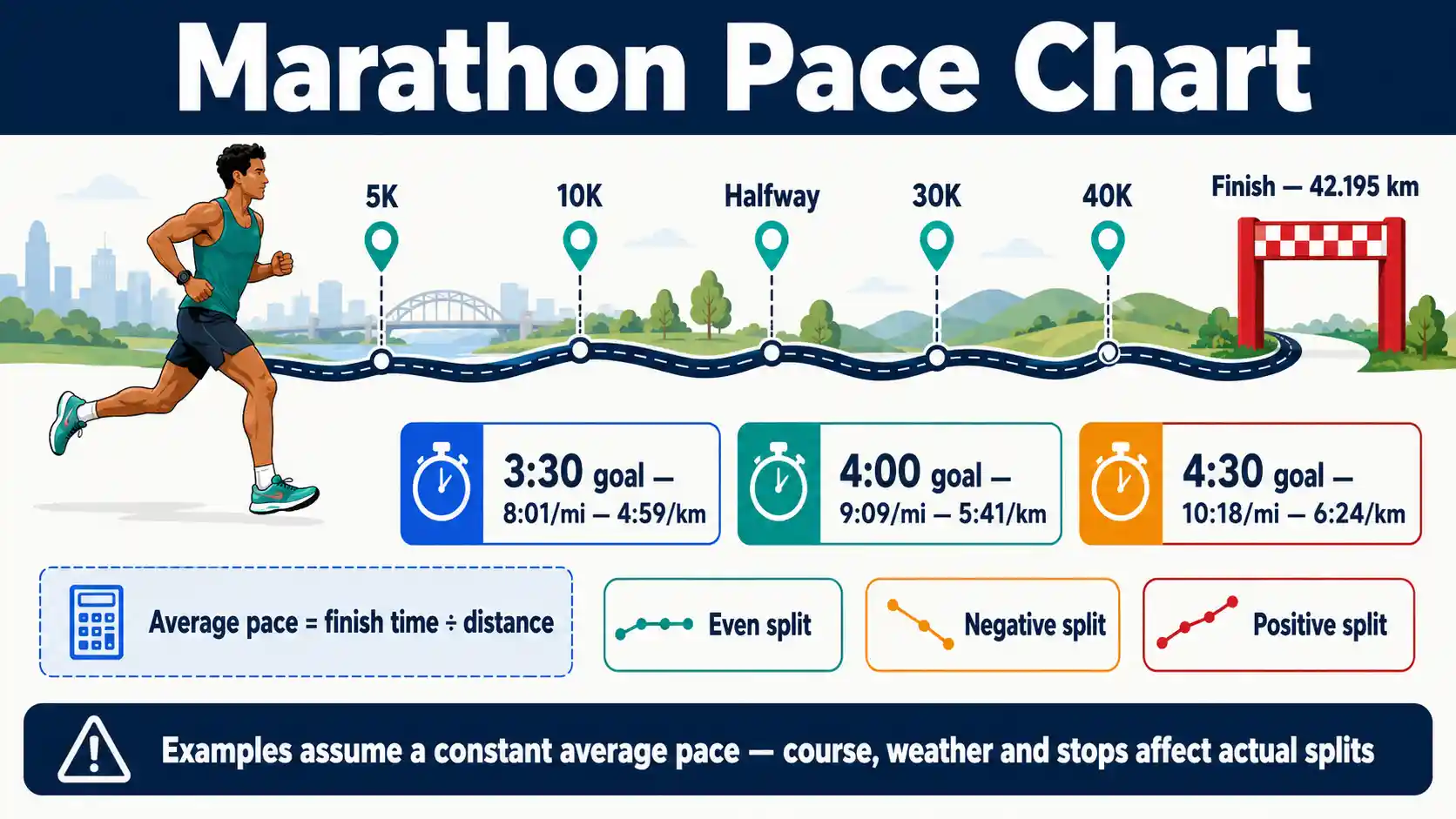
Divide the target finish time by 42.195 km for pace per kilometre, or by approximately 26.2188 miles for pace per mile. A four-hour target equals about 5:41.3 per kilometre or 9:09.3 per mile before rounding.
The World Athletics Competition and Technical Rules define the standard marathon distance as 42.195 km. This page uses that full distance, not the rounded label “26.2 miles.”
Official distance
42.195 km
Approximately 26.2188 miles, commonly written as 26 miles 385 yards.
Pace from goal
Finish time ÷ distance
Use seconds and keep the result unrounded until the final display.
Even halfway split
Finish goal ÷ 2
A four-hour even plan reaches halfway at exactly two hours.
Overall average
Include every minute
Walking, aid stations, toilets, and stops count when they occur after the start.
Marathon finish time and pace chart
Find the constant average pace, speed, and halfway split associated with common marathon finish-time targets.
Swipe horizontally inside the table to view every column.
| Goal finish time | Pace per mile | Pace per km | Average mph | Average km/h | Halfway split |
|---|---|---|---|---|---|
| 2:30:00 | 5:43 | 3:33 | 10.49 | 16.88 | 1:15:00 |
| 2:45:00 | 6:18 | 3:55 | 9.53 | 15.34 | 1:22:30 |
| 3:00:00 | 6:52 | 4:16 | 8.74 | 14.06 | 1:30:00 |
| 3:10:00 | 7:15 | 4:30 | 8.28 | 13.32 | 1:35:00 |
| 3:15:00 | 7:26 | 4:37 | 8.07 | 12.98 | 1:37:30 |
| 3:20:00 | 7:38 | 4:44 | 7.87 | 12.66 | 1:40:00 |
| 3:30:00 | 8:01 | 4:59 | 7.49 | 12.06 | 1:45:00 |
| 3:40:00 | 8:23 | 5:13 | 7.15 | 11.51 | 1:50:00 |
| 3:45:00 | 8:35 | 5:20 | 6.99 | 11.25 | 1:52:30 |
| 3:50:00 | 8:46 | 5:27 | 6.84 | 11.01 | 1:55:00 |
| 4:00:00 | 9:09 | 5:41 | 6.55 | 10.55 | 2:00:00 |
| 4:15:00 | 9:44 | 6:03 | 6.17 | 9.93 | 2:07:30 |
| 4:30:00 | 10:18 | 6:24 | 5.83 | 9.38 | 2:15:00 |
| 4:45:00 | 10:52 | 6:45 | 5.52 | 8.88 | 2:22:30 |
| 5:00:00 | 11:27 | 7:07 | 5.24 | 8.44 | 2:30:00 |
| 5:15:00 | 12:01 | 7:28 | 4.99 | 8.04 | 2:37:30 |
| 5:30:00 | 12:35 | 7:49 | 4.77 | 7.67 | 2:45:00 |
| 5:45:00 | 13:10 | 8:11 | 4.56 | 7.34 | 2:52:30 |
| 6:00:00 | 13:44 | 8:32 | 4.37 | 7.03 | 3:00:00 |
| 6:30:00 | 14:52 | 9:15 | 4.03 | 6.49 | 3:15:00 |
| 7:00:00 | 16:01 | 9:57 | 3.75 | 6.03 | 3:30:00 |
Paces use minutes:seconds per mile or kilometre. Finish and split times use hours:minutes:seconds.
- • Calculations use the official marathon distance of 42.195 km and the exact conversion 1 mile = 1.609344 km.
- • Each row assumes one constant average pace from the start line to the finish line. It does not add a start delay, stop time, course buffer, or late-race slowdown.
- • Displayed paces are rounded to the nearest second. Use the calculator for unrounded target calculations, especially when planning an under-time goal.
Table sources: World Athletics — Competition and Technical Rules — 2026 Edition
Download or export
Marathon pace, finish time, and split calculator
Convert a finish-time goal into exact average pace and cumulative splits, or convert a minutes-per-mile or minutes-per-kilometre pace into marathon time.
Calculate pace from finish time
Enter the total target from start to finish. Include expected walking and stopped time if those minutes must fit inside the goal.
Goal: 4:00:00
Average pace per mile9:09/miExact average 549.23 sec/mi
Average pace per kilometre5:41/kmExact average 341.27 sec/km
Average speed: 6.55 mph · 10.55 km/h
Even-pace cumulative splits
- 5K
- 28:26
- 10K
- 56:53
- Halfway
- 2:00:00
- 30K
- 2:50:38
- 40K
- 3:47:31
- Finish
- 4:00:00
Calculate finish time from pace
Enter a constant overall pace. The result does not predict whether that pace is sustainable for a particular runner or course.
Constant pace: 9:00/mi
Calculated marathon finish3:55:583 hr 55 min 58 sec
Equivalent mile pace9:00/mi
Equivalent kilometre pace5:36/km
Average speed: 6.67 mph · 10.73 km/h
Cumulative splits at this pace
- 5K
- 27:58
- 10K
- 55:55
- Halfway
- 1:57:59
- 30K
- 2:47:46
- 40K
- 3:43:42
Results use 42.195 km and 1 mile = 1.609344 km. They assume one overall average and round displayed times to the nearest second. Race timing, course line, GPS distance, terrain, weather, congestion, stops, and pacing strategy can change actual splits.
Marathon pace, time, and speed formulas
Pace from finish time
Pace = time ÷ distance
Convert the full goal to seconds. Divide by 42.195 for seconds per kilometre, or by 42.195 ÷ 1.609344 for seconds per mile.
Finish time from pace
Time = pace × distance
Multiply seconds per kilometre by 42.195, or seconds per mile by approximately 26.2188. Convert total seconds back to hours, minutes, and seconds.
Average speed
Speed = distance ÷ time
Express time in hours. A four-hour marathon averages 10.54875 km/h or about 6.55 mph across the official distance.
Cumulative split
Split = pace × checkpoint distance
A cumulative split runs from the start to that marker. A segment split covers only the distance between two markers. Do not compare them as if they mean the same thing.
Worked example: four-hour marathon goal
Four hours equals 14,400 seconds. Divide 14,400 by 42.195 to get 341.27 seconds per kilometre, or about 5:41/km. Divide 14,400 by 26.2188 to get 549.22 seconds per mile, or about 9:09/mi. At even pace, 10K is about 56:53, halfway is 2:00:00, and 40K is about 3:47:31.
Marathon pace chart by minute per mile
Convert a constant minutes-per-mile pace into its metric equivalent, 5K split, halfway split, and marathon finish time.
Swipe horizontally inside the table to view every column.
| Pace per mile | Pace per km | 5K split | Halfway split | Marathon finish |
|---|---|---|---|---|
| 5:00 | 3:06 | 15:32 | 1:05:33 | 2:11:06 |
| 5:30 | 3:25 | 17:05 | 1:12:06 | 2:24:12 |
| 6:00 | 3:44 | 18:38 | 1:18:39 | 2:37:19 |
| 6:30 | 4:02 | 20:12 | 1:25:13 | 2:50:25 |
| 7:00 | 4:21 | 21:45 | 1:31:46 | 3:03:32 |
| 7:30 | 4:40 | 23:18 | 1:38:19 | 3:16:38 |
| 8:00 | 4:58 | 24:51 | 1:44:53 | 3:29:45 |
| 8:30 | 5:17 | 26:24 | 1:51:26 | 3:42:52 |
| 9:00 | 5:36 | 27:58 | 1:57:59 | 3:55:58 |
| 9:30 | 5:54 | 29:31 | 2:04:32 | 4:09:05 |
| 10:00 | 6:13 | 31:04 | 2:11:06 | 4:22:11 |
| 10:30 | 6:31 | 32:37 | 2:17:39 | 4:35:18 |
| 11:00 | 6:50 | 34:11 | 2:24:12 | 4:48:24 |
| 11:30 | 7:09 | 35:44 | 2:30:45 | 5:01:31 |
| 12:00 | 7:27 | 37:17 | 2:37:19 | 5:14:38 |
| 12:30 | 7:46 | 38:50 | 2:43:52 | 5:27:44 |
| 13:00 | 8:05 | 40:23 | 2:50:25 | 5:40:51 |
| 13:30 | 8:23 | 41:57 | 2:56:59 | 5:53:57 |
| 14:00 | 8:42 | 43:30 | 3:03:32 | 6:07:04 |
| 14:30 | 9:01 | 45:03 | 3:10:05 | 6:20:10 |
| 15:00 | 9:19 | 46:36 | 3:16:38 | 6:33:17 |
Paces use minutes:seconds. Cumulative splits use minutes:seconds below one hour and hours:minutes:seconds at one hour or longer.
- • Finish time equals pace per mile multiplied by 42.195 ÷ 1.609344 miles.
- • The 5K and halfway values are cumulative clock times at the same constant pace.
- • A rounded goal pace can accumulate a small difference across 26.2 miles. Calculate from the full target time when a cutoff or under-time goal matters.
Table sources: World Athletics — Competition and Technical Rules — 2026 Edition
Download or export
Marathon pace chart by minute per kilometre
Convert a constant minutes-per-kilometre pace into its imperial equivalent, 5K split, halfway split, and marathon finish time.
Swipe horizontally inside the table to view every column.
| Pace per km | Pace per mile | 5K split | Halfway split | Marathon finish |
|---|---|---|---|---|
| 3:00 | 4:50 | 15:00 | 1:03:18 | 2:06:35 |
| 3:30 | 5:38 | 17:30 | 1:13:50 | 2:27:41 |
| 4:00 | 6:26 | 20:00 | 1:24:23 | 2:48:47 |
| 4:30 | 7:15 | 22:30 | 1:34:56 | 3:09:53 |
| 5:00 | 8:03 | 25:00 | 1:45:29 | 3:30:59 |
| 5:30 | 8:51 | 27:30 | 1:56:02 | 3:52:04 |
| 6:00 | 9:39 | 30:00 | 2:06:35 | 4:13:10 |
| 6:30 | 10:28 | 32:30 | 2:17:08 | 4:34:16 |
| 7:00 | 11:16 | 35:00 | 2:27:41 | 4:55:22 |
| 7:30 | 12:04 | 37:30 | 2:38:14 | 5:16:28 |
| 8:00 | 12:52 | 40:00 | 2:48:47 | 5:37:34 |
| 8:30 | 13:41 | 42:30 | 2:59:20 | 5:58:39 |
| 9:00 | 14:29 | 45:00 | 3:09:53 | 6:19:45 |
Paces use minutes:seconds. Cumulative splits use minutes:seconds below one hour and hours:minutes:seconds at one hour or longer.
- • Finish time equals pace per kilometre multiplied by 42.195 km.
- • The equivalent mile pace uses the exact factor 1 mile = 1.609344 km and is rounded only for display.
- • These are mathematical equivalents, not predictions that a runner can sustain the selected pace.
Table sources: World Athletics — Competition and Technical Rules — 2026 Edition
Download or export
Common marathon pace questions answered
Every answer uses the full 42.195 km distance. Finish targets use unrounded arithmetic; displayed paces and splits are rounded only after the calculation.
What pace is needed for a sub-3-hour marathon?
Faster than 6:51.9/mi or 4:15.9/km
Those are the unrounded three-hour thresholds. The chart displays 6:52 and 4:16, but an under-three finish needs a pace faster than the exact threshold plus any practical course buffer.
What pace is needed for a 3:15 marathon?
About 7:26/mi or 4:37/km
An even 3:15:00 target gives a halfway split of 1:37:30. Use the unrounded calculator result when planning a precise target.
What pace is needed for a sub-3:30 marathon?
Faster than 8:00.7/mi or 4:58.6/km
The nominal 3:30 pace rounds to 8:01 per mile and 4:59 per kilometre. A sub-3:30 attempt needs a small time margin rather than repeated rounded splits.
What pace is needed for a 3:45 marathon?
About 8:35/mi or 5:20/km
At even pace, the 10K split is 53:19, halfway is 1:52:30, and 40K is 3:33:18.
What pace is needed for a 4-hour marathon?
About 9:09/mi or 5:41/km
The exact averages are about 9:09.3 per mile and 5:41.3 per kilometre. Halfway is 2:00:00 at a mathematically even pace.
What pace is needed for a 4:30 marathon?
About 10:18/mi or 6:24/km
The even halfway split is 2:15:00. The 30K cumulative split is about 3:11:58.
What pace is needed for a 5-hour marathon?
About 11:27/mi or 7:07/km
An even five-hour plan reaches 10K near 1:11:06, halfway at 2:30:00, and 40K near 4:44:24.
What pace is needed for a 6-hour marathon?
About 13:44/mi or 8:32/km
A six-hour finish averages about 4.37 mph or 7.03 km/h, including any planned walk segments or aid-station time.
What marathon time is an 8-minute mile?
About 3:29:45
Multiplying 8:00 per mile by the official marathon distance gives 3:29:45 at a constant pace.
What marathon time is a 9-minute mile?
About 3:55:58
A constant 9:00 per mile reaches 5K near 27:58 and halfway near 1:57:59.
What marathon time is a 10-minute mile?
About 4:22:11
A constant 10:00 per mile equals about 6:13 per kilometre and reaches halfway near 2:11:06.
What marathon time is a 5-minute kilometre?
About 3:30:59
A constant 5:00 per km equals about 8:03 per mile, with a 25:00 5K split.
What marathon time is a 6-minute kilometre?
About 4:13:10
A constant 6:00 per km equals about 9:39 per mile, with a 30:00 5K split.
What is the halfway split for a 4-hour marathon?
2:00:00 at even pace
Halfway is 21.0975 km. An even split divides the full target time equally between the two halves.
What is the 10K split for a 3:30 marathon?
About 49:46
This is a cumulative start-to-10K time calculated from the unrounded 3:30 finish pace.
What is the 30K split for a 4-hour marathon?
About 2:50:38
The value assumes constant pace. Hills, wind, crowding, planned stops, or an intentional split strategy can change the actual checkpoint time.
How much does 10 seconds per mile change marathon time?
About 4 minutes 22 seconds
A 10-second change repeated across approximately 26.2188 miles changes the calculated finish by about 262 seconds.
How much does 10 seconds per kilometre change marathon time?
About 7 minutes 2 seconds
A 10-second change repeated across 42.195 km changes the calculated finish by about 422 seconds.
Marathon cumulative split chart by finish goal
Compare cumulative clock times at common course checkpoints when an even pace is maintained for the full marathon.
Swipe horizontally inside the table to view every column.
| Finish goal | 5K | 10K | Halfway | 30K | 40K | Finish |
|---|---|---|---|---|---|---|
| 3:00:00 | 21:20 | 42:40 | 1:30:00 | 2:07:59 | 2:50:38 | 3:00:00 |
| 3:15:00 | 23:06 | 46:13 | 1:37:30 | 2:18:39 | 3:04:51 | 3:15:00 |
| 3:30:00 | 24:53 | 49:46 | 1:45:00 | 2:29:18 | 3:19:05 | 3:30:00 |
| 3:45:00 | 26:40 | 53:19 | 1:52:30 | 2:39:58 | 3:33:18 | 3:45:00 |
| 4:00:00 | 28:26 | 56:53 | 2:00:00 | 2:50:38 | 3:47:31 | 4:00:00 |
| 4:15:00 | 30:13 | 1:00:26 | 2:07:30 | 3:01:18 | 4:01:44 | 4:15:00 |
| 4:30:00 | 32:00 | 1:03:59 | 2:15:00 | 3:11:58 | 4:15:57 | 4:30:00 |
| 4:45:00 | 33:46 | 1:07:33 | 2:22:30 | 3:22:38 | 4:30:10 | 4:45:00 |
| 5:00:00 | 35:33 | 1:11:06 | 2:30:00 | 3:33:18 | 4:44:24 | 5:00:00 |
| 5:30:00 | 39:06 | 1:18:12 | 2:45:00 | 3:54:37 | 5:12:50 | 5:30:00 |
| 6:00:00 | 42:40 | 1:25:19 | 3:00:00 | 4:15:57 | 5:41:16 | 6:00:00 |
All values are cumulative gun-to-checkpoint times in hours:minutes:seconds, except sub-hour values shown as minutes:seconds.
- • A cumulative split is elapsed time from the start, not the time required for only that segment.
- • Halfway is exactly 21.0975 km on a certified 42.195 km marathon course.
- • Use official course markers for race decisions. GPS distance and instantaneous pace can drift because of signal quality, route line, smoothing, and course geometry.
Table sources: World Athletics — Competition and Technical Rules — 2026 Edition; Heliyon — Pacing Strategies in Marathons: A Systematic Review
Download or export
Even, negative, and positive marathon splits
A split strategy describes how total time is distributed. It does not establish the correct target for an individual runner. A systematic review of marathon pacing found that pacing patterns vary with performance level, sex, age, course, weather, and other race factors; positive pacing was common in the included studies.
Even split
First half = second half
A four-hour even split is 2:00:00 and 2:00:00. Equal clock time does not mean equal physiological effort when terrain, wind, temperature, or fatigue changes.
Negative split
Second half is faster
A four-hour negative-split example is 2:01:00 followed by 1:59:00. Achieving it requires a goal, fitness, course, and conditions that leave sustainable capacity for the second half.
Positive split
Second half is slower
A four-hour positive-split example is 1:59:00 followed by 2:01:00. A small positive split can be planned or unplanned; a large slowdown may indicate an aggressive start, fatigue, conditions, fueling problems, illness, or another limiter.
Clock pace and effort are different. A rolling course may require slower uphill kilometres and faster downhill kilometres to keep effort more stable. Compare cumulative checkpoints, not one noisy instant-pace reading.
How to choose a realistic marathon goal pace
Choose a goal from current training and race evidence, then use the chart to calculate it. Do not choose a goal only because its finish time looks attractive.
- 1. Start with recent evidence. Review recent race results, long-run completion, marathon-specific sessions, recovery, and injury or illness history.
- 2. Match the event. Compare elevation, surface, turns, altitude, expected weather, start congestion, aid stations, and cutoff rules with the conditions behind your evidence.
- 3. Include nonrunning time. Decide whether walking, aid-station, toilet, gear, or planned stop time sits inside the goal. Overall pace must include it.
- 4. Set more than one plan. Define a primary goal, a conditions-adjusted goal, and a completion or safety plan before race day.
- 5. Test the system. Practice pace control, shoes, clothing, fuel, fluid, and any run-walk cycle during training. Race day should not be the first full test.
- 6. Reassess near the start. Change the target for illness, injury, poor recovery, heat, humidity, wind, air quality, or official race alerts.
What changes marathon pace and finish time?
A pace table holds distance and average speed constant. A real marathon combines the athlete, route, environment, timing method, and race execution. Record those modifiers before interpreting a pace difference.
Course elevation and gradient
Climbs usually slow pace, while descents do not always return the same time.
Grade changes muscular demand and running economy. Steep or technical descents can increase braking load and fatigue even when clock pace rises.
Plan: Review the official elevation profile and pace by sustainable effort when terrain changes.
Heat, humidity, sun, and cold
Environmental strain can make a familiar pace harder to sustain.
Heat and humidity raise cooling demands. Cold, rain, and wind can change comfort, clothing needs, footing, and energy cost.
Plan: Use the event forecast, follow race alerts, and adjust the goal rather than forcing a cool-weather pace.
Wind exposure
A headwind can slow pace at the same effort; a tailwind can raise it.
Direction, shelter, turns, runner spacing, and course layout determine how much wind affects each section.
Plan: Track effort and position safely; do not surge repeatedly only to restore a watch pace.
Turns, surface, and crowding
Congestion, sharp turns, uneven ground, and wet surfaces can add time.
Acceleration, deceleration, line choice, traction, and overtaking affect pace even when fitness is unchanged.
Plan: Allow early congestion and protect safe footing instead of weaving aggressively.
Course line and distance traveled
A runner can cover more than 42.195 km by taking wider lines.
Certified course distance follows the measured route. GPS error and a nonoptimal line can make the watch report extra distance.
Plan: Use official markers and run safe tangents where permitted; never cut the measured course.
Aid stations and planned stops
Walking, drinking, toilets, shoe adjustments, and medical stops add elapsed time.
A chart pace is an overall average unless the plan explicitly separates moving pace from stopped time.
Plan: Include expected stop time in the target or practice taking fuel and fluid without rushing.
Run-walk structure
Running pace and overall marathon pace are different when walk breaks are planned.
Overall pace combines every running segment, walking segment, transition, and stop across the full distance.
Plan: Calculate the full cycle average and practice the same run-walk timing in long training sessions.
Fuel, fluid, and gastrointestinal tolerance
Low carbohydrate availability, dehydration, overdrinking, or stomach symptoms can disrupt pace.
Needs and tolerance vary with duration, body size, sweat rate, intensity, products, temperature, and previous practice.
Plan: Use a practiced, individualized plan and follow event-specific medical and aid-station guidance.
Fatigue, health, and goal realism
Sustainable marathon pace depends on current preparation and health, not a chart alone.
Recent training, injury, illness, sleep, recovery, previous race performance, and accumulated fatigue all matter.
Plan: Base the target on current evidence from training and racing; revise it when health or conditions change.
Why GPS pace can differ from official marathon pace
The official course, the line you run, and the path estimated by a GPS watch are three different distance records.
Certified course distance
The marathon standard is 42.195 km along the measured course route. Official markers and event timing refer to that course, subject to the event’s published rules.
Distance actually run
Wide turns, weaving, moving around aid stations, and positioning can add distance. Safe tangents can reduce extra travel, but runners must stay on the permitted course.
GPS-estimated distance
Satellite geometry, buildings, tunnels, trees, sampling, smoothing, and turns can make the watch track longer or shorter than the path traveled.
Practical pace control
Compare elapsed time with official kilometre or mile markers. Use cumulative splits or manual laps when instant pace is unstable. Check whether the event uses gun time or chip time for your goal.
A watch showing 26.4 miles does not change the official marathon distance. It can mean the runner traveled farther than the measured line, the device overestimated distance, or both. Pace based on the watch’s distance may therefore differ from official finish-time pace.
How fueling and hydration affect a pace plan
Pace, carbohydrate availability, fluid balance, sodium losses, temperature, and gastrointestinal tolerance interact during a marathon. The World Athletics distance-running nutrition review describes competition strategies that include carbohydrate-rich preparation and, for the longest races, high in-race carbohydrate intakes such as 75–90 g per hour in appropriately trained athletes.
Do not copy a carbohydrate number blindly
A high intake is not automatically suitable. Product composition, dose, timing, gut tolerance, race duration, body size, intensity, and previous training matter. Practice the plan progressively and seek a qualified sports dietitian for individualized needs.
There is no universal fluid volume
Sweat rate and fluid needs vary widely. Heat, humidity, pace, body size, clothing, acclimatization, station spacing, and sodium loss all matter. Both excessive fluid deficit and overdrinking can be harmful.
Aid-station time belongs in elapsed pace
Eight 20-second slowdowns add 2 minutes 40 seconds. Either include that time in the finish goal or understand that moving pace must be faster than the overall average.
Practice the exact race system
Test product type, concentration, carrying method, station sequence, timing, and fluid access during training. Do not introduce an untested high intake, supplement, or unfamiliar product on race day.
How to use a marathon pace chart on race day
- 1. Confirm the timing basis. Know whether the relevant goal, pacer, qualification standard, award, or cutoff uses gun time, chip time, or a checkpoint rule.
- 2. Select cumulative checkpoints. Use 5K, 10K, halfway, 30K, and 40K times that can be checked against official markers. A shorter list is easier to read while moving.
- 3. Preserve exact goal arithmetic. Use a pace band or calculator built from the target finish, not repeated rounded mile or kilometre paces.
- 4. Expect controlled variation. Allow safe pace changes for hills, turns, wind, congestion, surface, and aid stations. Evaluate the trend over several kilometres.
- 5. Avoid early time chasing. A congested first kilometre does not always require an immediate surge. Recover small differences gradually if the plan and conditions still support the target.
- 6. Reassess effort and symptoms. Adjust for weather, unusual fatigue, stomach problems, pain, dizziness, confusion, or official medical advice. Completion time is secondary to safety.
Marathon pacing and safety
Never continue or accelerate only to protect a target time when symptoms, conditions, or race staff indicate that stopping or slowing is safer.
- Seek race medical help urgently for chest pressure or pain, fainting, confusion, loss of coordination, severe breathing difficulty, collapse, signs of heat illness, or another acute or rapidly worsening symptom.
- Do not ignore illness or injury. Fever, acute infection, significant pain, altered gait, or worsening symptoms can make a planned pace inappropriate.
- Follow official instructions. Heat flags, weather alerts, course changes, cutoff procedures, and medical-team directions override a pace chart.
- Discuss individual risk before the event. A clinician can address symptoms, medical conditions, medications, previous collapse, pregnancy, or other factors that require personalized advice.
Frequently asked questions
How long is a marathon?
A standard marathon is 42.195 kilometres. That is approximately 26.2188 miles and is commonly expressed as 26 miles 385 yards. The calculations on this page use 42.195 km rather than a rounded 26.2-mile value.
How do I calculate marathon pace from a finish time?
Convert the finish goal to seconds, then divide by 42.195 for seconds per kilometre or by approximately 26.2188 for seconds per mile. Convert the result back to minutes and seconds. Keep the unrounded result until the final display.
How do I calculate marathon finish time from pace?
Multiply seconds per kilometre by 42.195, or multiply seconds per mile by 42.195 ÷ 1.609344. The result assumes the entered pace is maintained as an overall average for the whole official distance.
Why does a rounded pace not reproduce the exact finish time?
A pace rounded to the nearest second gains or loses a fraction of a second at every mile or kilometre. That small difference accumulates across the marathon. Use the unrounded calculator value or aim slightly inside an under-time target.
What is an even marathon split?
An even split means the first and second halves take the same time. A four-hour even split is 2:00:00 plus 2:00:00. Even clock pace can still require changing effort on hills, into wind, or in heat.
What is a negative split in a marathon?
A negative split means the second half is faster than the first. A positive split means the second half is slower. Neither label proves that the target was suitable; course profile, weather, fitness, and race tactics affect the result.
Should marathon pace stay constant on hills?
Not necessarily. Forcing identical clock pace uphill can require a large increase in effort, while aggressively recovering every second downhill can add braking stress. Many runners use steadier effort and accept pace variation across terrain.
Why does my GPS show more than 42.195 km?
GPS position error, smoothing, buildings, tunnels, tree cover, turns, and the line you run can change recorded distance. A certified course is measured along a defined route, while a runner may travel farther by taking wide turns or weaving.
Are the chart splits gun time or chip time?
They are generic cumulative elapsed times from a chosen zero point. For personal planning, compare them with chip time if the event provides it and if your goal uses chip time. Official awards and cutoffs may use different timing rules, so check the event.
Can a run-walk plan use this marathon pace chart?
Yes, if pace means the overall average including every run segment, walk break, transition, and stop. The required running-segment pace will be faster than the overall target pace when walking time is included.
How should heat change a marathon pace goal?
There is no universal seconds-per-mile adjustment that fits every runner and condition. Use the forecast, humidity, sun exposure, acclimatization, course support, personal history, and race medical alerts. Slowing down may be necessary to control effort and heat strain.
When should a runner stop during a marathon?
Stop and seek race medical help for chest pressure or pain, fainting, confusion, loss of coordination, severe breathing difficulty, signs of heat illness, or another acute or rapidly worsening symptom. A pace target should never override a medical warning sign.
Sources
World Athletics — Competition and Technical Rules — 2026 Edition
https://worldathletics.org/download/download?filename=acdec6c6-1261-4c7f-96d2-92f712707e99.pdf&urlslug=Competition+and+Technical+Rules+%E2%80%93+2026+Edition
Heliyon — Pacing Strategies in Marathons: A Systematic Review
https://pmc.ncbi.nlm.nih.gov/articles/PMC11400961/
World Athletics — Contemporary Nutrition Strategies to Optimize Performance in Distance Runners and Race Walkers
https://worldathletics.org/download/download?filename=6babe10a-9969-407e-b0cd-f7d96df50f51.pdf&urlslug=Contemporary+Nutrition+Strategies+to+Optimize+Performance+in+Distance+Runners+and+Race+Walkers