Finance & Money
Mega Millions Payout Chart
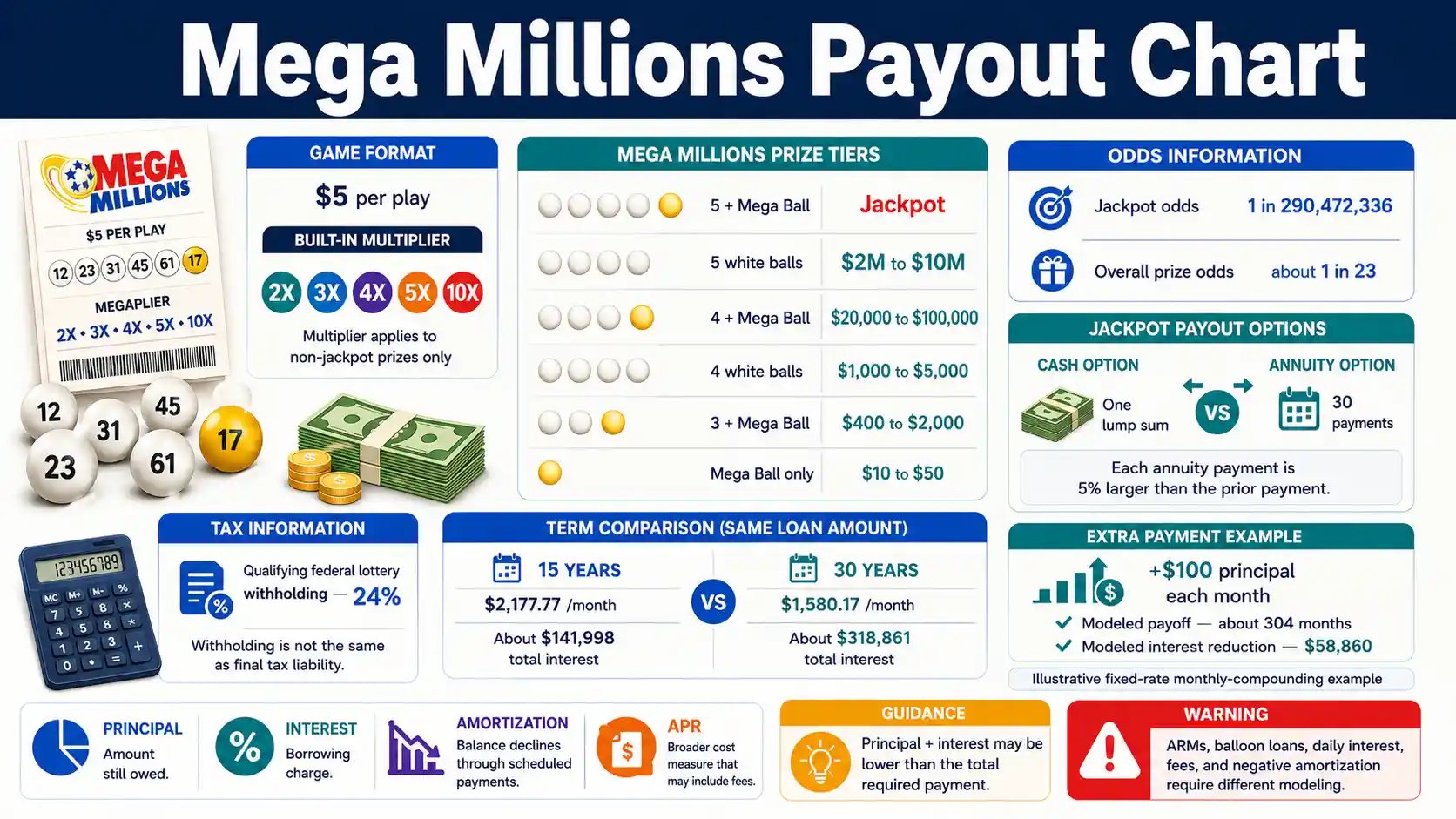
The current Mega Millions game has nine prize tiers. Each $5 play receives a built-in 2X, 3X, 4X, 5X, or 10X multiplier for non-jackpot prizes, so matching five white balls can pay from $2 million to $10 million while the jackpot remains a separate variable prize.
This page explains payouts and claim mechanics; it does not predict winning numbers or improve the odds of any play. Verify an actual ticket, prize amount, deadline, and tax treatment with the lottery that sold the ticket.
Play price
$5 per play
The current format includes one randomly assigned multiplier on every play.
Prize tiers
9 ways to win
Eight non-jackpot tiers plus the jackpot tier are available under the current matrix.
Overall odds
About 1 in 23
The jackpot itself remains far less likely at 1 in 290,472,336 per play.
Jackpot options
Cash or annuity
The annuity uses 30 total payments, each 5% larger than the prior payment.
Direct answers to common Mega Millions payout questions
How much is a Mega Millions play?
A current Mega Millions play costs $5 and includes a randomly assigned 2X, 3X, 4X, 5X, or 10X multiplier for non-jackpot prizes.
What is the minimum Mega Millions prize?
The minimum current prize is $10 when the Mega Ball-only base prize of $5 receives the minimum 2X multiplier.
What is the largest non-jackpot prize?
Matching five white balls can pay $10 million when the ticket receives the 10X multiplier.
What are the jackpot odds?
The odds of matching five white balls plus the Mega Ball are 1 in 290,472,336 per play.
What are the odds of winning any prize?
Mega Millions reports overall odds of about 1 in 23 per play under the current game matrix.
Does the multiplier increase the jackpot?
No. The built-in multiplier applies only to non-jackpot prize tiers.
How is the multiplier assigned?
Each $5 play receives a randomly assigned multiplier that is printed on the ticket.
What is the jackpot cash option?
The Cash Option is a one-time payment based on the cash available in the jackpot prize pool and actual sales.
How does the Mega Millions annuity work?
The Annuity Option pays an initial amount followed by 29 annual payments, with each payment 5% larger than the previous one.
Is the advertised jackpot the same as the cash value?
No. The advertised jackpot generally represents the annuity value, while the cash option is a separate, lower current cash amount.
Are lottery prizes taxable?
Yes. Lottery winnings are taxable, and federal withholding may apply before the final income-tax liability is determined.
Can prize rules differ by state?
Yes. Claim deadlines, privacy rules, taxes, and some prize calculations can vary by jurisdiction; California non-jackpot prizes are pari-mutuel.
Mega Millions Prize Chart by Match and Multiplier
Current non-jackpot prizes use a randomly assigned built-in multiplier. Jackpot wins are not multiplied.
Swipe horizontally inside the table to view every column.
| Match | Base prize | 2X | 3X | 4X | 5X | 10X |
|---|---|---|---|---|---|---|
| 5 + Mega Ball | Jackpot | Jackpot | Jackpot | Jackpot | Jackpot | Jackpot |
| 5 + 0 | $1,000,000 | $2,000,000 | $3,000,000 | $4,000,000 | $5,000,000 | $10,000,000 — Maximum current Match 5 non-jackpot prize |
| 4 + Mega Ball | $10,000 | $20,000 | $30,000 | $40,000 | $50,000 | $100,000 |
| 4 + 0 | $500 | $1,000 | $1,500 | $2,000 | $2,500 | $5,000 |
| 3 + Mega Ball | $200 | $400 | $600 | $800 | $1,000 | $2,000 |
| 3 + 0 | $10 | $20 | $30 | $40 | $50 | $100 |
| 2 + Mega Ball | $10 | $20 | $30 | $40 | $50 | $100 |
| 1 + Mega Ball | $7 | $14 | $21 | $28 | $35 | $70 |
| 0 + Mega Ball | $5 | $10 | $15 | $20 | $25 | $50 |
- • The built-in multiplier is randomly assigned to each $5 play and applies only to non-jackpot prizes.
- • California non-jackpot prize amounts can differ because California uses pari-mutuel prize calculations. Check the lottery where the ticket was purchased.
Download or export
The current prize matrix began in April 2025
The official Mega Millions prize matrix shows a $5 ticket with an embedded multiplier and non-jackpot prizes ranging from $10 to $10 million. Tickets for drawings from April 4, 2025 or earlier use the older prize structure.
Mega Millions Odds by Winning Match
Odds are based on the current 5-of-70 white-ball plus 1-of-24 Mega Ball game matrix.
Swipe horizontally inside the table to view every column.
| Match | Odds | Approximate chance per play | Prize type |
|---|---|---|---|
| 5 + Mega Ball | 1 in 290,472,336 — Current jackpot odds | 0.000000344% | Jackpot |
| 5 + 0 | 1 in 12,629,232 | 0.000007918% | $2M–$10M after multiplier |
| 4 + Mega Ball | 1 in 893,761 | 0.000111887% | $20K–$100K |
| 4 + 0 | 1 in 38,859 | 0.002573407% | $1K–$5K |
| 3 + Mega Ball | 1 in 13,965 | 0.007160759% | $400–$2K |
| 3 + 0 | 1 in 607 | 0.164744646% | $20–$100 |
| 2 + Mega Ball | 1 in 665 | 0.150375940% | $20–$100 |
| 1 + Mega Ball | 1 in 86 | 1.162790698% | $14–$70 |
| 0 + Mega Ball | 1 in 35 | 2.857142857% | $10–$50 |
| Any prize | About 1 in 23 | About 4.35% | Any winning tier |
- • These are game odds, not predictions for a specific drawing.
- • Buying more plays increases the number of entries but does not change the odds attached to any individual play.
Download or export
Built-In Mega Millions Multiplier Odds
Every current $5 play receives one randomly assigned multiplier that changes non-jackpot prizes.
Swipe horizontally inside the table to view every column.
| Multiplier | Assignment odds | Example $10,000 base prize | Example $1,000,000 base prize |
|---|---|---|---|
| 2X | 1 in 2.13 | $20,000 | $2,000,000 |
| 3X | 1 in 3.2 | $30,000 | $3,000,000 |
| 4X | 1 in 8 | $40,000 | $4,000,000 |
| 5X | 1 in 16 | $50,000 | $5,000,000 |
| 10X | 1 in 32 | $100,000 | $10,000,000 — Maximum current Match 5 prize with 10X multiplier |
- • Multiplier odds describe which multiplier is assigned to a play; they are separate from the odds of matching a prize tier.
- • The multiplier is printed on the ticket and does not multiply the jackpot.
Download or export
Browser-only educational tool
Mega Millions prize lookup and annuity pattern
Look up a non-jackpot prize using the multiplier printed on the ticket. The optional jackpot field illustrates the 30-payment annuity growth pattern; it does not estimate the cash option, taxes, or a live jackpot.
Non-jackpot payout
$2,000,000
$1,000,000 base prize × 2X multiplier.
Illustrative annuity payment 1
$1,505,144
Solved so 30 payments growing 5% annually add to the entered annuity total.
Illustrative annuity payment 30
$6,195,375
The 30th payment is 5% larger than the 29th under the official annuity pattern.
California non-jackpot prizes can differ. Jackpot cash values, tax outcomes, claim deadlines, and other rules vary. Verify any actual ticket with the lottery that sold it.
Mega Millions Jackpot Cash Option vs Annuity
Jackpot winners choose between the available cash in the prize pool and a 30-payment annuity based on the actual jackpot value.
Swipe horizontally inside the table to view every column.
| Feature | Cash option | Annuity option | Important detail |
|---|---|---|---|
| Payment timing | One lump sum | Initial payment + 29 annual payments | Claim rules vary by jurisdiction |
| Advertised jackpot | Not the same as advertised annuity amount | Advertised jackpot generally refers to annuity value | Final values depend on actual sales and interest rates |
| Annual growth | Not applicable | Each payment is 5% larger than the previous payment — Official annuity payment growth rule | Thirty total payments |
| Tax timing | Taxable winnings recognized under applicable tax rules | Payments are taxable as received under applicable tax rules | Withholding is not necessarily the final tax liability |
- • Mega Millions states that actual jackpot values can differ from estimates.
- • Use the official lottery claim package and a qualified tax professional for an actual jackpot decision.
Download or export
A jackpot annuity uses 30 increasing payments
Mega Millions states in its official FAQs that the annuity consists of an initial payment followed by 29 annual payments, each 5% larger than the prior payment. The cash option is a separate one-time amount based on cash in the jackpot prize pool and actual sales.
Illustrative 30-Payment Jackpot Annuity Pattern
This example shows how a hypothetical $100 million advertised annuity could be distributed when each annual payment grows 5%. It is not a current jackpot quote.
Swipe horizontally inside the table to view every column.
| Payment | Illustrative payment | Growth from prior payment | Running total |
|---|---|---|---|
| 1 | $1,505,143 | Starting payment | $1,505,143 |
| 5 | $1,829,511 | 5% each year | $8,316,868 |
| 10 | $2,334,972 | 5% each year | $18,931,533 |
| 20 | $3,803,423 | 5% each year | $49,769,006 |
| 30 | $6,195,375 — Illustrative final payment | 5% each year | $100,000,000 |
Hypothetical $100,000,000 annuity total. Rounded to nearest dollar.
- • The example solves for the first payment so that 30 payments growing 5% annually total $100 million.
- • Actual Mega Millions annuity amounts are determined from the actual jackpot cash value and applicable 30-year U.S. Treasury rates.
Download or export
Federal Lottery Withholding vs Final Tax Liability
Federal withholding is a prepayment of tax. It is not a promise that the amount withheld equals the winner’s final federal tax bill.
Swipe horizontally inside the table to view every column.
| Topic | Current federal rule | What it means | What to verify |
|---|---|---|---|
| Regular withholding | 24% for qualifying lottery proceeds over $5,000 | Payer may withhold 24% before payment | Current IRS W-2G rules and winner facts |
| Taxability | Gambling winnings are taxable income | Lottery winnings generally must be reported | Federal return and applicable state/local law |
| Final tax | Can differ from 24% withholding — Withholding is not the final federal tax rate | Other income and deductions affect final liability | Tax professional or current tax software |
| State/local tax | Varies by jurisdiction | Location can materially change net proceeds | Lottery where ticket was purchased and residency rules |
- • Do not use a 24% withholding estimate as a final after-tax payout.
- • Nonresident-alien rules and treaty treatment can differ from resident rules.
Download or export
Federal withholding is not the same as final tax
Current IRS W-2G instructions use a 24% regular withholding rate for qualifying lottery proceeds over $5,000. A winner can ultimately owe more or less after the full federal return is calculated, and state or local taxes can also apply.
Mega Millions Claim and Verification Checklist
Prize claims are administered by the lottery in the jurisdiction where the ticket was purchased.
Swipe horizontally inside the table to view every column.
| Step | What to do | Why it matters | Rule that can vary |
|---|---|---|---|
| Verify ticket | Check official winning numbers and ticket details | Prevents reliance on scams or unofficial claims | Validation procedures |
| Protect ticket | Follow your lottery’s ticket-security guidance | Unsigned or lost tickets can create ownership problems | Bearer-instrument and signature rules |
| Check deadline | Confirm the claim period immediately | Mega Millions says claim periods range from 90 days to one year — Missing the claim deadline can forfeit a prize | Exact deadline by jurisdiction |
| Confirm payout choice | Review cash versus annuity rules before claiming jackpot | The election can have long-term financial and tax consequences | Election deadline and procedures |
| Check disclosure rules | Review anonymity and public-record requirements | Winner identity rules differ by jurisdiction | Privacy law |
| Use official channel | Claim through the lottery that sold the ticket | Winning tickets generally must be redeemed where purchased | Claim location and mail options |
- • Mega Millions warns that legitimate prizes do not require sending money to strangers for advance taxes or fees.
- • For a large prize, consider independent legal, tax, and financial advice before signing documents or making irreversible choices.
Download or export
Important limits, exceptions, and scam warnings
California prizes can differ
California uses pari-mutuel calculations for non-jackpot prizes, so fixed prize amounts shown for other jurisdictions may not apply there.
Jackpot estimates can change
Advertised annuity and cash estimates can differ from final values because actual sales and interest rates determine the available jackpot.
Claim rules are jurisdiction-specific
Claim deadlines, anonymity rules, tax treatment, trust procedures, and claim locations can vary. Use the lottery that sold the ticket as the controlling source.
Real lotteries do not require advance scam payments
A message claiming you won without buying a valid ticket is a major warning sign. Do not send money or banking details to someone claiming to release a prize.
Mega Millions Payout Chart FAQs
How much does a Mega Millions ticket cost now?
A Mega Millions play costs $5 under the game format that began with the April 8, 2025 drawing. The price includes a randomly assigned multiplier for non-jackpot prizes.
What is the smallest Mega Millions prize?
The current minimum non-jackpot prize is $10 when a ticket matches only the Mega Ball and receives the 2X multiplier.
What is the largest non-jackpot Mega Millions prize?
Matching all five white balls without the Mega Ball can pay up to $10 million when the ticket carries the 10X multiplier.
Does the multiplier apply to the jackpot?
No. The built-in 2X, 3X, 4X, 5X, or 10X multiplier applies to non-jackpot prizes only.
What are the odds of winning the Mega Millions jackpot?
The current jackpot odds are 1 in 290,472,336 per play.
What are the overall odds of winning any Mega Millions prize?
Mega Millions states that the overall odds of winning any prize are about 1 in 23 per play.
What are the Mega Millions jackpot payout choices?
A jackpot winner can choose the Cash Option or the Annuity Option. The annuity provides an initial payment followed by 29 annual payments, with each payment 5% larger than the previous one.
Is the cash option equal to the advertised jackpot?
Usually no. The advertised jackpot is generally the annuity value, while the cash option reflects the cash available in the jackpot prize pool based on actual sales.
Are Mega Millions winnings taxable?
Yes. Mega Millions states that prizes are subject to income taxes, and federal, state, and local treatment can depend on the winner and jurisdiction.
Is 24% federal withholding the final tax on a lottery jackpot?
No. The 24% regular federal withholding rate for qualifying lottery proceeds is a withholding rule, not a calculation of the winner’s final federal income tax liability.
Do Mega Millions prizes vary in California?
Yes. Non-jackpot prize amounts in California can vary because California calculates those prizes on a pari-mutuel basis.
How long does a winner have to claim a Mega Millions prize?
Claim periods depend on the lottery that sold the ticket. Mega Millions says deadlines range from 90 days to one year from the drawing date.
Can a Mega Millions ticket be claimed in a different state?
Generally no. Mega Millions says a winning ticket must be redeemed in the state or jurisdiction where it was purchased.
Can a Mega Millions jackpot winner stay anonymous?
It depends on the jurisdiction. Public-disclosure and winner-privacy laws vary by state and lottery.
Does this chart show a live jackpot or winning numbers?
No. This page explains the current payout structure, odds, and payout mechanics. Check Mega Millions or the lottery that sold the ticket for current jackpot estimates, winning numbers, and official claim information.
Sources
Mega Millions — Mega Millions New Game Prize Matrix
Official prize matrix effective with the April 8, 2025 drawing, including base prizes and the built-in 2X, 3X, 4X, 5X, and 10X multipliers.
https://www.megamillions.com/Media-Center/MegaMillions_New_Prize_Matrix.aspx
Mega Millions — Mega Millions FAQs
Official rules summary covering ticket cost, jackpot cash and annuity options, claim periods, taxes, drawings, and the current game format.
https://www.megamillions.com/FAQs.aspx
Internal Revenue Service — Instructions for Forms W-2G and 5754
Current federal reporting and withholding guidance for lottery and other gambling winnings, including the 24% regular withholding rate for qualifying lottery proceeds.
https://www.irs.gov/instructions/iw2g