Science & Chemistry
Molecular Geometry Chart
Compare VSEPR electron-domain arrangements, molecular shapes, AXE notation, ideal bond angles, lone-pair effects, common molecule examples, and polarity patterns, then use the geometry finder for a fast first-pass prediction.
VSEPR predicts useful idealized shapes for many main-group molecules. It is not a substitute for measured or computed geometry, and it is often not the best predictive model for transition-metal complexes.
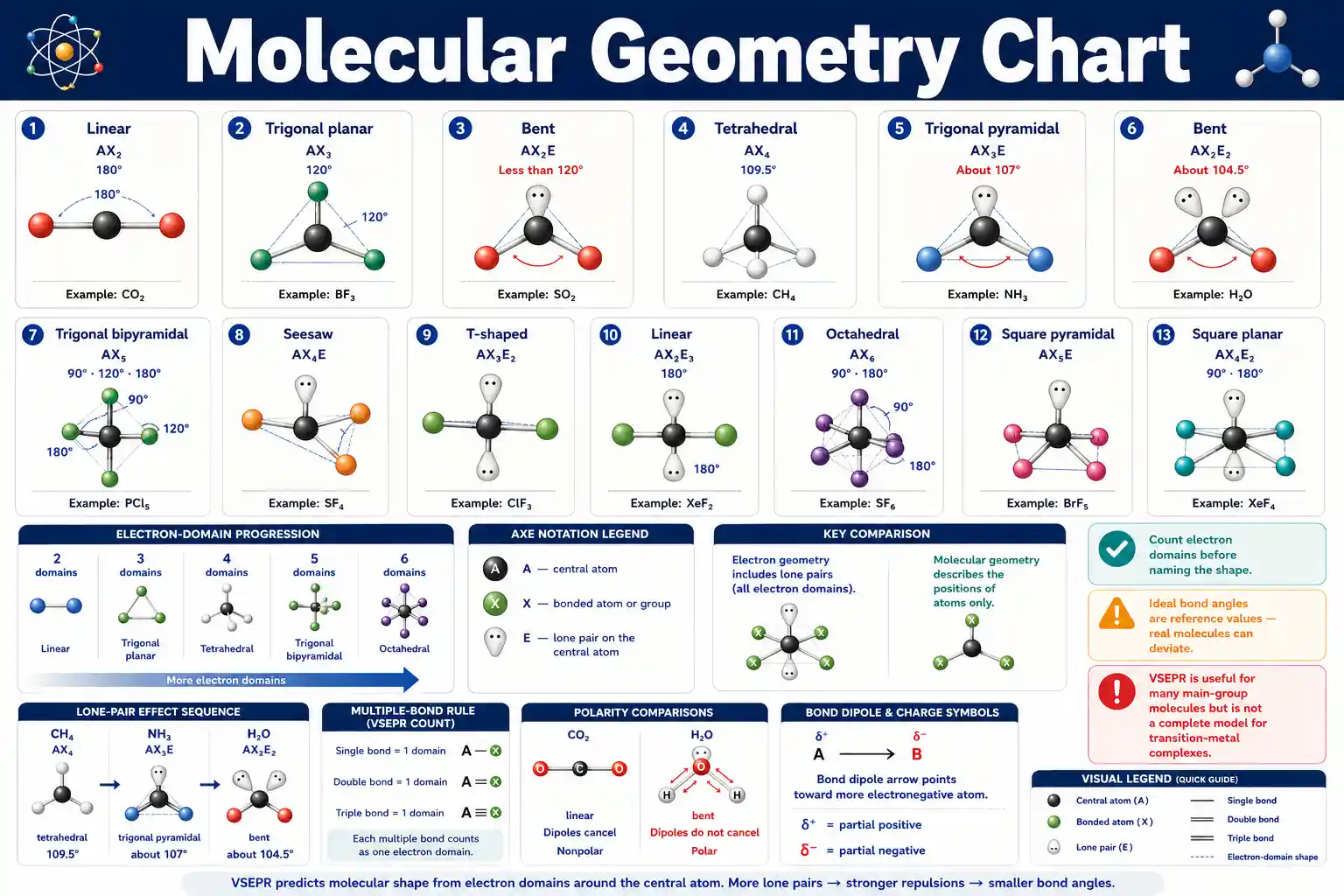
How molecular geometry and VSEPR fit together
Molecular geometry is the three-dimensional arrangement of atoms in a molecule. The IUPAC Gold Book treats molecular shape as an attribute describing spatial form or geometry. In introductory chemistry, VSEPR provides a practical way to predict that shape from regions of electron density around a central atom.
Electron geometry and molecular geometry are not always the same. Electron geometry includes bonded domains and central-atom lone pairs; molecular geometry names only the arrangement of bonded atoms. That is why NH₃ has tetrahedral electron geometry but trigonal pyramidal molecular geometry.
A single, double, or triple bond counts as one bonded electron domain in basic VSEPR. A lone pair also counts as one domain. Count the domains first, identify the parent electron geometry, then remove lone-pair positions when naming the molecular shape.
Two domains
Linear · 180°
Two electron domains around a central atom spread into opposite directions in the basic VSEPR model.
Four domains
Tetrahedral · 109.5°
Four domains form a tetrahedral electron geometry; lone pairs can change the visible molecular shape.
Lone pairs
Shape can change
NH₃ is trigonal pyramidal and H₂O is bent even though both start from tetrahedral electron geometry.
Angles
Ideal ≠ exact
Measured bond angles can shift because of lone pairs, multiple bonds, substituents, vibrations, and electronic structure.
Electron-Domain Geometry Chart
The ideal electron-domain arrangements used by VSEPR for two through six electron groups around one central atom.
Swipe horizontally inside the table to view every column.
| Electron domains | Electron-domain geometry | Ideal angles | AX form with no lone pairs | Representative example |
|---|---|---|---|---|
| 2 | Linear | 180° | AX₂ | CO₂ |
| 3 | Trigonal planar | 120° | AX₃ | BF₃ |
| 4 | Tetrahedral | 109.5° | AX₄ | CH₄ |
| 5 | Trigonal bipyramidal | 90°, 120°, 180° | AX₅ | PCl₅ |
| 6 | Octahedral | 90°, 180° | AX₆ | SF₆ |
Angles are ideal VSEPR reference angles, not guaranteed measured values.
- • A double or triple bond counts as one electron domain in basic VSEPR counting.
Download or export
VSEPR Molecular Shape Chart
Common molecular shapes generated when lone pairs are removed from the electron-domain framework when naming the molecular geometry.
Swipe horizontally inside the table to view every column.
| AXE notation | Domains | Lone pairs on A | Molecular geometry | Ideal or typical angle pattern |
|---|---|---|---|---|
| AX₂ | 2 | 0 | Linear | 180° |
| AX₃ | 3 | 0 | Trigonal planar | 120° |
| AX₂E | 3 | 1 | Bent | <120° in many cases |
| AX₄ | 4 | 0 | Tetrahedral | 109.5° |
| AX₃E | 4 | 1 | Trigonal pyramidal | <109.5°; NH₃ ≈107° |
| AX₂E₂ | 4 | 2 | Bent | <109.5°; H₂O ≈104.5° |
| AX₅ | 5 | 0 | Trigonal bipyramidal | 90°, 120°, 180° |
| AX₄E | 5 | 1 | Seesaw | Distorted from 90° and 120° |
| AX₃E₂ | 5 | 2 | T-shaped | Near 90° and 180° |
| AX₂E₃ | 5 | 3 | Linear | 180° |
| AX₆ | 6 | 0 | Octahedral | 90°, 180° |
| AX₅E | 6 | 1 | Square pyramidal | Near 90° and 180° |
| AX₄E₂ | 6 | 2 | Square planar | 90°, 180° |
AXE notation: A = central atom, X = bonded atom/group, E = lone pair on the central atom.
- • Molecular geometry names describe atom positions; electron-domain geometry includes lone-pair domains.
Download or export
The shape name follows atoms, not lone-pair positions
CH₄ is tetrahedral because all four tetrahedral positions contain hydrogen atoms. NH₃ has one of those four positions occupied by a lone pair, so its molecular shape is trigonal pyramidal. H₂O has two lone-pair positions and two O–H bonds, so its molecular shape is bent.
Common Molecules and Their Shapes
Representative molecules and ions showing how AXE notation maps to familiar molecular geometries.
Swipe horizontally inside the table to view every column.
| Species | AXE notation | Electron geometry | Molecular geometry | Angle reference |
|---|---|---|---|---|
| CO₂ | AX₂ | Linear | Linear | 180° |
| BF₃ | AX₃ | Trigonal planar | Trigonal planar | 120° |
| SO₂ | AX₂E | Trigonal planar | Bent | <120° |
| CH₄ | AX₄ | Tetrahedral | Tetrahedral | 109.5° |
| NH₃ | AX₃E | Tetrahedral | Trigonal pyramidal | ≈107° |
| H₂O | AX₂E₂ | Tetrahedral | Bent | ≈104.5° |
| PCl₅ | AX₅ | Trigonal bipyramidal | Trigonal bipyramidal | 90°, 120°, 180° |
| SF₄ | AX₄E | Trigonal bipyramidal | Seesaw | Distorted |
| ClF₃ | AX₃E₂ | Trigonal bipyramidal | T-shaped | Near 90°, 180° |
| XeF₂ | AX₂E₃ | Trigonal bipyramidal | Linear | 180° |
| SF₆ | AX₆ | Octahedral | Octahedral | 90°, 180° |
| XeF₄ | AX₄E₂ | Octahedral | Square planar | 90°, 180° |
Examples are idealized VSEPR descriptions unless an approximate measured angle is shown.
- • Real bond angles vary with substituents, lone pairs, multiple bonds, phase, and measurement method.
Download or export
Interactive VSEPR tool
Molecular Geometry Finder
Choose the total electron domains around one central atom and the number of central-atom lone pairs. The finder returns the common introductory VSEPR shape.
Count each single, double, or triple bond direction as one bonded domain. Then add lone-pair domains on the central atom.
Predicted geometry
Tetrahedral
AXE notation
AX₄
Electron geometry
Tetrahedral
Angle guide
109.5° ideal
Example
CH₄
This tool gives an idealized main-group VSEPR prediction. Actual molecular geometry and bond angles can differ, and transition-metal complexes often require other bonding models.
Lone Pairs and Molecular Geometry
Lone pairs occupy electron-domain space but are not included as atom positions when the molecular shape is named.
Swipe horizontally inside the table to view every column.
| Starting electron geometry | Lone pairs | Resulting shape | Key effect | Example |
|---|---|---|---|---|
| Trigonal planar | 1 | Bent | One vertex is occupied by a lone pair | SO₂ |
| Tetrahedral | 1 | Trigonal pyramidal | Bond angles often compress below 109.5° | NH₃ |
| Tetrahedral | 2 | Bent | Two lone pairs compress the X–A–X angle further | H₂O |
| Trigonal bipyramidal | 1 | Seesaw | Lone pair preferentially occupies an equatorial site in the simple model | SF₄ |
| Trigonal bipyramidal | 2 | T-shaped | Two equatorial lone pairs remain | ClF₃ |
| Trigonal bipyramidal | 3 | Linear | Three equatorial lone pairs leave two axial bonds | XeF₂ |
| Octahedral | 1 | Square pyramidal | One octahedral position is nonbonding | BrF₅ |
| Octahedral | 2 | Square planar | Opposite lone-pair positions leave four coplanar bonds | XeF₄ |
Lone-pair repulsions often distort bond angles away from the ideal parent geometry.
- • Repulsion trends are a qualitative VSEPR model, not a direct measurement of electron-pair size.
Download or export
Ideal bond angles are reference values
Linear, trigonal planar, tetrahedral, trigonal bipyramidal, and octahedral arrangements have familiar ideal angles. Real molecules can depart from those values. NIST geometry resources distinguish experimental and calculated structures and note that experimental geometries can also reflect vibrational averaging and method-specific assumptions.
For routine VSEPR problems, 180°, 120°, 109.5°, and 90° are the key anchors. For quantitative structure work, use experimental or high-quality computed geometry rather than assuming the ideal angle is exact.
Molecular Geometry Bond Angle Reference
Ideal VSEPR angles and well-known approximate examples used for quick shape recognition.
Swipe horizontally inside the table to view every column.
| Geometry | Ideal angle(s) | Approximate example | Why actual angles may differ |
|---|---|---|---|
| Linear | 180° | CO₂: 180° | Symmetry can preserve the ideal angle |
| Trigonal planar | 120° | BF₃: about 120° | Different substituents can distort angles |
| Bent from AX₂E | <120° | SO₂: near 120° but bent | Lone pair and multiple-bond repulsions matter |
| Tetrahedral | 109.5° | CH₄: about 109.5° | Equivalent bonds closely approach ideal geometry |
| Trigonal pyramidal | <109.5° | NH₃: about 107° | One lone pair compresses H–N–H angles |
| Bent from AX₂E₂ | <109.5° | H₂O: about 104.5° | Two lone pairs compress H–O–H further |
| Trigonal bipyramidal | 90°, 120°, 180° | PCl₅ idealized pattern | Axial and equatorial sites are inequivalent |
| T-shaped | Near 90°, 180° | ClF₃ | Lone pairs distort the 90° interactions |
| Octahedral | 90°, 180° | SF₆ | Equivalent positions give high symmetry |
| Square planar | 90°, 180° | XeF₄ | Opposite lone pairs leave a planar square |
Degrees (°).
- • Use ideal angles for first-pass VSEPR predictions; use measured data when precision matters.
Download or export
Molecular Geometry and Polarity Examples
Molecular polarity depends on both bond dipoles and their three-dimensional vector arrangement, not geometry alone.
Swipe horizontally inside the table to view every column.
| Species | Geometry | Polar bonds? | Dipoles cancel? | Overall polarity |
|---|---|---|---|---|
| CO₂ | Linear | Yes | Yes, with equivalent O atoms | Nonpolar molecule |
| BF₃ | Trigonal planar | Yes | Yes, in the symmetric molecule | Nonpolar molecule |
| SO₂ | Bent | Yes | No | Polar molecule |
| CH₄ | Tetrahedral | Slight C–H polarity | Symmetric cancellation | Usually treated as nonpolar |
| CH₃Cl | Tetrahedral around C | Yes | No | Polar molecule |
| NH₃ | Trigonal pyramidal | Yes | No | Polar molecule |
| H₂O | Bent | Yes | No | Polar molecule |
| PCl₅ | Trigonal bipyramidal | Yes | Yes for equivalent ligands | Nonpolar molecule |
| SF₆ | Octahedral | Yes | Yes for equivalent ligands | Nonpolar molecule |
| XeF₄ | Square planar | Yes | Yes for equivalent ligands | Nonpolar molecule |
Polarity descriptions assume the listed idealized species and equivalent ligands where stated.
- • A symmetric geometry can still be polar when the surrounding atoms or groups are not equivalent.
Download or export
Symmetry can cancel bond dipoles
CO₂ contains polar C=O bonds but is nonpolar overall because the two bond dipoles oppose each other in a linear symmetric molecule. H₂O is bent, so its O–H dipoles do not cancel. Geometry helps determine polarity, but ligand identity and bond polarity also matter.
Steric Number, Geometry and Hybridization Labels
A classroom comparison of electron-domain count with commonly taught hybridization labels. Modern bonding descriptions can be more nuanced, especially for hypervalent species.
Swipe horizontally inside the table to view every column.
| Steric number | Electron geometry | Common classroom label | Ideal angles | Typical example |
|---|---|---|---|---|
| 2 | Linear | sp | 180° | CO₂ central C |
| 3 | Trigonal planar | sp² | 120° | BF₃ central B |
| 4 | Tetrahedral | sp³ | 109.5° | CH₄ central C |
| 5 | Trigonal bipyramidal | sp³d (traditional label) | 90°, 120°, 180° | PCl₅ |
| 6 | Octahedral | sp³d² (traditional label) | 90°, 180° | SF₆ |
Steric number = bonded electron domains + lone-pair domains around the central atom.
- • Do not treat d-orbital hybridization labels as a complete modern explanation of hypervalent bonding.
Download or export
How Multiple Bonds Count in VSEPR
Single, double, and triple bonds each count as one bonded electron domain for basic geometry counting, even though their repulsive influence can differ.
Swipe horizontally inside the table to view every column.
| Central-atom connection | VSEPR domain count | Example | Domain total around central atom | Predicted parent geometry |
|---|---|---|---|---|
| One single bond | 1 domain | C–H in CH₄ | 4 around C | Tetrahedral |
| One double bond | 1 domain | C=O in CO₂ | 2 around C | Linear |
| One triple bond | 1 domain | C≡N in HCN | 2 around C | Linear |
| Two double bonds | 2 domains | O=C=O | 2 around C | Linear |
| Double bond + two single bonds | 3 domains | H₂C=O around C | 3 around C | Trigonal planar |
| Resonance-equivalent bonds | Count positions/domains | NO₃⁻ around N | 3 around N | Trigonal planar |
Domain count is based on regions of electron density around the central atom.
- • Multiple bonds can repel more strongly than single bonds, so measured angles may deviate from ideal values.
Download or export
Expanded and Less Common Coordination Geometries
Common extensions beyond the introductory two-through-six-domain VSEPR set. These are useful for heavier main-group molecules and coordination chemistry, but real structures may require more advanced models.
Swipe horizontally inside the table to view every column.
| Coordination/domains | Idealized geometry | Angle pattern | Representative species | Caution |
|---|---|---|---|---|
| 7 | Pentagonal bipyramidal | 72°, 90°, 180° | IF₇ | Common seven-coordinate idealization |
| 8 | Square antiprismatic | Multiple angles | Some eight-coordinate complexes | Not captured by one simple AXE rule |
| 8 | Dodecahedral | Multiple angles | Some eight-coordinate complexes | Competes with square-antiprismatic arrangements |
| 9 | Tricapped trigonal prismatic | Multiple angles | Some nine-coordinate complexes | Coordination chemistry terminology |
| 4 | Square planar | 90°, 180° | Many d⁸ metal complexes | Often explained by ligand-field/electronic structure rather than simple main-group VSEPR |
| 5 | Square pyramidal | Near 90°, 180° | Some transition-metal complexes | May arise from coordination chemistry rather than AX₅E main-group counting |
Idealized coordination geometry names; exact bond angles depend on the compound.
- • For transition-metal complexes, VSEPR is often not the best predictive model.
Download or export
Common Molecular Geometry Mistakes
A troubleshooting guide for Lewis-structure, electron-domain, molecular-shape, bond-angle, and polarity questions.
Swipe horizontally inside the table to view every column.
| Mistake | Why it fails | Better approach |
|---|---|---|
| Counting a double bond as two domains | VSEPR counts one region of electron density per bonded direction | Count each bonded atom/group as one domain |
| Ignoring central-atom lone pairs | Lone pairs change the electron geometry and often the named molecular shape | Include all central-atom lone pairs before naming geometry |
| Calling NH₃ tetrahedral | Its electron geometry is tetrahedral, but atom positions are trigonal pyramidal | Separate electron geometry from molecular geometry |
| Calling H₂O tetrahedral | Two tetrahedral positions contain lone pairs, not atoms | Name H₂O bent |
| Assuming ideal angles are exact measurements | Real structures vibrate and respond to substituents and bonding | Label ideal versus measured angles |
| Using shape alone to decide polarity | Bond dipoles and ligand identity also matter | Combine geometry with bond polarity and symmetry |
| Putting lone pairs randomly in trigonal bipyramidal geometry | Equatorial positions reduce 90° interactions in the simple model | Place lone pairs equatorially first when applying basic VSEPR |
| Using VSEPR as a full transition-metal bonding model | d-electron effects and ligand-field interactions can dominate | Use coordination and electronic-structure models when appropriate |
| Equating steric number with number of bonded atoms | Steric number includes lone-pair domains | Add bonded domains and lone-pair domains |
| Assuming resonance changes the basic domain count | Resonance redistributes bonding but often preserves bonded directions | Count electron-density regions in the resonance framework |
Use Lewis structure → domain count → electron geometry → molecular geometry as the basic workflow.
- • When a measured or computed structure is available, it takes priority over an idealized introductory model.
Download or export
How to determine molecular geometry step by step
1. Build the Lewis structure
Count valence electrons, choose the central atom, connect the skeleton, complete terminal octets where appropriate, and place remaining electrons.
2. Count central-atom domains
Each bonded direction counts as one domain, regardless of single, double, or triple bond order. Add each lone pair on the central atom.
3. Assign electron geometry
Two domains are linear, three trigonal planar, four tetrahedral, five trigonal bipyramidal, and six octahedral in the introductory VSEPR set.
4. Name the molecular shape
Ignore lone-pair positions when naming the arrangement of atoms. Then estimate bond angles and test whether bond dipoles cancel.
Where the simple model reaches its limit
VSEPR is strongest as a qualitative main-group shape model. Hypervalent bonding, delocalization, heavy-element effects, fluxional molecules, and transition-metal coordination can require molecular orbital, ligand-field, or computational descriptions. Experimental and calculated bond angles in the NIST CCCBDB are better references when an exact structure matters.
Molecular geometry FAQs
What is molecular geometry?
Molecular geometry describes the three-dimensional arrangement of the atoms in a molecule. Lone pairs influence that arrangement but are not themselves counted as atom positions in the molecular-shape name.
What is the difference between electron geometry and molecular geometry?
Electron geometry counts all electron domains around the central atom, including lone pairs. Molecular geometry describes the positions of the bonded atoms after lone-pair positions are omitted from the shape name.
What does AXE notation mean?
A represents the central atom, X represents atoms or groups bonded to it, and E represents lone pairs on the central atom.
What shape has two electron domains?
Two electron domains adopt a linear arrangement with an ideal angle of 180 degrees.
What shape has three electron domains?
Three electron domains adopt trigonal planar electron geometry with ideal 120-degree separations.
What shape has four electron domains?
Four electron domains adopt tetrahedral electron geometry with an ideal angle of about 109.5 degrees.
Why is ammonia trigonal pyramidal?
NH₃ has four electron domains around nitrogen: three N–H bonds and one lone pair. The parent electron geometry is tetrahedral, while the molecular shape is trigonal pyramidal.
Why is water bent?
H₂O has two O–H bonded domains and two lone-pair domains around oxygen. Its electron geometry is tetrahedral, but the two visible bond directions form a bent molecular geometry.
Do double bonds count as two electron domains?
No. A double bond counts as one bonded electron domain in basic VSEPR because it occupies one direction from the central atom.
What is the geometry of PCl5?
PCl₅ is commonly modeled as AX₅ trigonal bipyramidal, with equatorial angles of 120 degrees, axial-equatorial angles of 90 degrees, and axial bonds 180 degrees apart.
What is the geometry of SF6?
SF₆ is AX₆ octahedral. Adjacent S–F directions are ideally 90 degrees apart and opposite directions are 180 degrees apart.
What is square planar geometry?
Square planar geometry places four bonded atoms in one plane at approximately 90-degree intervals. XeF₄ is a main-group AX₄E₂ example, while many transition-metal complexes are also square planar for different electronic reasons.
Why are real bond angles different from ideal VSEPR angles?
Lone pairs, multiple bonds, different substituents, electronic structure, vibrations, and the measurement method can all shift a real bond angle away from an ideal VSEPR reference.
Does molecular shape determine polarity?
Shape is necessary but not sufficient. Molecular polarity depends on bond dipoles, ligand identity, and whether the dipole vectors cancel in the actual geometry.
Is VSEPR accurate for transition-metal complexes?
VSEPR can describe some arrangements but is often not the best predictive model for transition-metal complexes, where ligand-field and d-electron effects are important.
What is the best order for solving a molecular geometry problem?
Draw a defensible Lewis structure, count electron domains around the central atom, assign the electron geometry, remove lone-pair positions when naming molecular geometry, then estimate angles and assess polarity.
Related chemistry charts
Sources
The reference tables distinguish ideal VSEPR predictions from measured molecular geometry. Exact structures should be checked against experimental or high-quality computational data when precision matters.
International Union of Pure and Applied Chemistry
IUPAC Gold Book — molecular shape
Defines molecular shape as an attribute describing the spatial extension, form, framework, or geometry of a molecule.
https://goldbook.iupac.org/terms/view/MT06972
National Institute of Standards and Technology
CCCBDB Geometry Data
Provides experimental and calculated molecular geometry data, including bond lengths and bond angles, and explains why measured geometries can depend on method and vibrational averaging.
https://cccbdb.nist.gov/geometriesx.asp
Chemistry LibreTexts
Valence Shell Electron-Pair Repulsion
Educational reference for VSEPR electron-group geometries, ideal angles, lone-pair effects, and common AXE molecular shapes.
https://chem.libretexts.org/Bookshelves/Inorganic_Chemistry/Inorganic_Chemistry_(LibreTexts)/03%3A_Simple_Bonding_Theory/3.02%3A_Valence_Shell_Electron-Pair_Repulsion
A third educational reference for the introductory VSEPR arrangements is Chemistry LibreTexts: https://chem.libretexts.org/Bookshelves/Inorganic_Chemistry/Inorganic_Chemistry_(LibreTexts)/03%3A_Simple_Bonding_Theory/3.02%3A_Valence_Shell_Electron-Pair_Repulsion