Family & Parenting
Parenting Style Chart
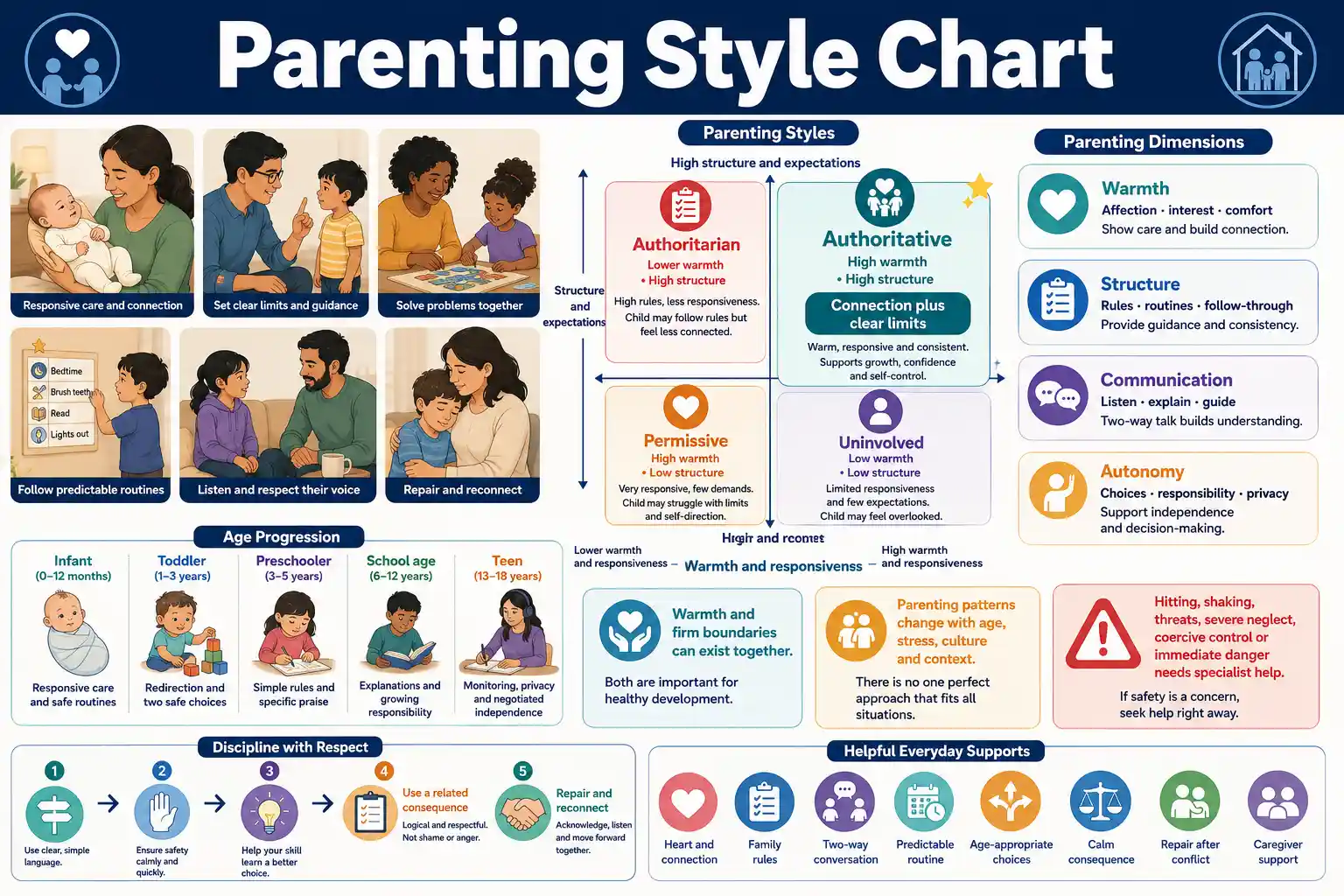
Compare authoritative, authoritarian, permissive, and uninvolved patterns through warmth, structure, communication, discipline, autonomy, context, and safety.
Parenting-style labels describe broad patterns; they do not diagnose a caregiver or predict one child’s future. Culture, stress, disability, safety, resources, and the child’s development affect what behavior means. Violence, severe neglect, coercive control, or immediate danger requires local professional and safeguarding help.
How should a parenting style chart be used?
Use the chart to examine specific recurring behaviors: connection, limits, explanations, monitoring, autonomy, consequences, and repair. The American Psychological Association parenting-style framework distinguishes patterns by responsiveness and control, while emphasizing that authoritative parenting combines support with firm limits.
Connection
Warm and responsive
Children need affection, interest, listening, comfort, play, and dependable reconnection after conflict.
Structure
Clear and predictable
Specific rules, age-matched expectations, monitoring, routines, and calm follow-through create security.
Communication
Listen and explain
Adults retain responsibility while giving children an appropriate voice, reasons, and chances to practice.
Balance
Firm without fear
Effective guidance combines limits with dignity and avoids violence, humiliation, threats, or emotional withdrawal.
Direct answers to common parenting-style questions
What is a parenting style?
A parenting style is a broad pattern of warmth, responsiveness, expectations, monitoring, communication, and discipline across repeated interactions.
What are the four main parenting styles?
The classic model describes authoritative, authoritarian, permissive, and uninvolved patterns.
What is authoritative parenting?
Authoritative parenting combines high warmth and responsiveness with clear expectations, explanations, monitoring, and consistent limits.
Is authoritative the same as authoritarian?
No. Authoritarian parenting emphasizes obedience and control, while authoritative parenting adds listening, explanation, flexibility, and emotional support.
What is permissive parenting?
Permissive parenting provides substantial warmth but too little consistent structure, monitoring, or follow-through.
Can a parent have more than one style?
Yes. Most caregivers blend behaviors and change across stress levels, children, ages, settings, and types of problem.
Which parenting approach is usually recommended?
Research often favors balanced warmth and structure, but specific practices, culture, context, resources, and child needs matter.
Does gentle parenting mean no boundaries?
No. Respectful parenting can include firm safety limits, related consequences, and calm follow-through.
How many rules should a preschooler learn at once?
Start with one to three specific rules that the child can understand and remember.
What makes a consequence useful?
A useful consequence is respectful, proportionate, predictable, age-appropriate, and related to the behavior when possible.
Should parents use spanking?
The American Academy of Pediatrics advises against spanking and recommends positive reinforcement, redirection, limit setting, and appropriate consequences.
When should a family seek help?
Seek support when harshness repeats, conflict impairs family life, a child feels unsafe, or a caregiver fears losing control.
Four Parenting Styles by Warmth and Structure
The classic model compares emotional responsiveness with expectations, monitoring, and follow-through. Real families often blend patterns.
Swipe horizontally inside the table to view every column.
| Style | Warmth / responsiveness | Structure / demands | Typical pattern | Useful reflection |
|---|---|---|---|---|
| Authoritative | High | High | Warm connection with clear limits, explanations, and consistent follow-through — Warmth plus clear limits | Keep expectations firm while listening and adapting to age and need |
| Authoritarian | Lower or less visible | High | Strict obedience, one-way communication, limited explanation, and punitive control | Add listening, explanation, repair, and proportionate teaching consequences |
| Permissive | High | Low | Warmth and freedom with few enforced boundaries or routines | Keep warmth while adding predictable limits and follow-through |
| Uninvolved | Low | Low | Limited monitoring, communication, responsiveness, and guidance | Increase dependable presence, supervision, routines, and practical support |
| Mixed or situational | Varies | Varies | The approach changes by stress, setting, child, issue, or caregiver | Identify repeated patterns instead of forcing one permanent label |
Warmth and structure are dimensions, not moral scores or diagnoses.
- • Authoritative and authoritarian sound similar but differ strongly in responsiveness, explanation, and flexibility.
- • A chart describes patterns; it cannot establish causation or predict one child’s outcome.
Download or export
Change dimensions, not identities
A caregiver can increase warmth, simplify rules, improve follow-through, or allow more age-appropriate independence without adopting a fixed label. Specific behavior gives families a practical starting point.
Parenting Dimensions Behind the Style Labels
Specific behaviors are easier to change than a broad identity label. Review each dimension separately.
Swipe horizontally inside the table to view every column.
| Dimension | Supportive end | Risk when too low | Risk when rigid or excessive |
|---|---|---|---|
| Warmth | Affection, interest, comfort, and enjoyment | Emotional distance and weak connection | Warmth without boundaries can become permissiveness |
| Responsiveness | Noticing needs and responding appropriately | Needs and signals may be missed | Immediate rescue can limit practice and independence |
| Clear expectations | Specific, realistic, age-matched rules | Confusion and inconsistent behavior | Too many rules can become controlling or impossible |
| Consistency | Predictable responses and follow-through — Predictability supports learning | Children cannot anticipate what happens next | Inflexibility can ignore context, disability, or legitimate need |
| Autonomy support | Choices and growing responsibility within safe limits | Dependence or learned helplessness | Freedom beyond readiness can become unsafe |
| Communication | Listening, explanation, and respectful dialogue | One-way control or emotional disconnection | Endless negotiation can erase necessary limits |
| Monitoring | Knowing activities, peers, risks, and support needs | Safety and problems may go unnoticed | Intrusive surveillance can damage trust and privacy |
| Repair | Apologizing, reconnecting, and changing the plan | Conflict remains unresolved | Repeated apology without behavior change is insufficient |
The practical target is balanced, developmentally appropriate behavior across dimensions.
- • Different children may need different forms of support while receiving equally clear expectations.
- • Stress can temporarily shift a caregiver toward harsher, looser, or more withdrawn responses.
Download or export
Look for repeated everyday patterns
One hard day does not define a family. Review how adults usually respond to disagreement, distress, mistakes, limits, privacy, and repair across weeks and settings.
Everyday Signs of Different Parenting Patterns
These examples describe repeated interaction patterns, not isolated moments during stress or emergencies.
Swipe horizontally inside the table to view every column.
| Situation | Balanced / authoritative response | More authoritarian response | More permissive response | More uninvolved response |
|---|---|---|---|---|
| Child breaks a rule | Restate the rule, use a related consequence, and teach repair — Teach and follow through | Demand obedience and punish without explanation | Drop the rule to avoid conflict | Ignore the behavior and its impact |
| Child disagrees | Listen, decide what is negotiable, and keep safety limits | Treat disagreement as disrespect | Let the child decide to end the conflict | Show little interest in the issue |
| Child is upset | Acknowledge emotion while limiting unsafe behavior | Dismiss emotion and demand immediate control | Remove every demand or boundary | Remain emotionally unavailable |
| Child makes a mistake | Coach, practice, and adjust support | Shame, threaten, or expect perfection | Fix the problem for the child | Leave the child without guidance |
| Family rule changes | Explain why, give notice, and follow through | Announce the change without discussion | Change it repeatedly under pressure | Do not communicate the change |
| Teen requests privacy | Increase privacy with safety-based monitoring | Use total control and little trust | Provide unrestricted freedom despite risk | Do not monitor wellbeing or safety |
| Caregiver loses patience | Pause, repair, apologize, and revise the response | Justify yelling or humiliation | Reverse every limit from guilt | Withdraw and avoid the child |
Emergency safety actions can be immediate and firm without defining the family’s overall style.
- • Look for frequency, intensity, context, and repair.
- • A single calm or difficult interaction does not establish a parenting style.
Download or export
Use discipline to teach safe behavior
Effective discipline stops harm, states the expected behavior, practices the missing skill, and uses proportionate follow-through. The CDC rule-setting guidance recommends specific realistic rules, reminders, labeled praise, consistent caregivers, and immediate consequences when needed.
Discipline Responses That Teach Skills
Discipline works best as teaching, not as fear, humiliation, pain, or unpredictable punishment.
Swipe horizontally inside the table to view every column.
| Behavior | Immediate response | Teaching step | Related follow-through |
|---|---|---|---|
| Hitting | Block harm and separate safely — Stop harm first | Practice safe hands and words | Repair harm and supervise the trigger situation |
| Throwing a toy | Remove the item briefly if unsafe | Practice using or placing it safely | Return it when the child is ready to try safely |
| Refusing a routine | Give one clear direction and limited choices | Break the task into steps | Follow through with the routine and reasonable consequence |
| Screen-time limit | End access at the agreed time | Use a timer and transition warning | Return access at the next planned opportunity |
| Homework avoidance | Reduce distractions and define the first step | Teach planning and help-seeking | Use a predictable work-before-leisure routine |
| Lying | Stay calm and gather facts | Explain trust and practice truthful repair | Use a consequence related to the hidden behavior |
| Sibling conflict | Stop aggression and lower intensity | Hear both perspectives and practice problem-solving | Repair damage and change the setup if needed |
| Teen breaks curfew | Confirm safety first | Review what happened and risk factors | Use a proportionate temporary change in independence |
Consequences should be immediate when practical, proportionate, predictable, and connected to the behavior.
- • Do not remove food, sleep, medical care, education, affection, or basic safety as punishment.
- • Avoid spanking, hitting, threatening, humiliating, or frightening a child.
Download or export
Increase autonomy as skills grow
Babies need responsive care rather than punishment. Young children need short directions and close supervision. Older children and teens need growing voice, privacy, responsibility, and opportunities to learn from manageable mistakes.
Parenting Approach by Age and Development
Warmth and limits remain important across childhood, but language, choices, monitoring, and responsibility should change with development.
Swipe horizontally inside the table to view every column.
| Age / stage | Connection | Limits and guidance | Autonomy support |
|---|---|---|---|
| Infancy | Responsive care, comfort, play, and predictable routines | Use environment and caregiver action rather than punishment | Allow safe exploration and follow cues |
| Ages 1–2 | Name feelings and reconnect quickly | Use brief rules, redirection, and close supervision | Offer two safe choices |
| Ages 3–5 | Play, listen, and use specific praise | Keep two or three simple rules and immediate consequences | Let the child help with routines and solutions |
| Ages 6–8 | Show interest in school, play, and friendships | Explain expectations and practice skills | Offer choices about order, method, and small responsibilities |
| Ages 9–12 | Protect regular conversation and shared time | Use collaborative planning with non-negotiable safety limits | Increase privacy and responsibility gradually |
| Ages 13–15 | Listen without turning every talk into a lecture | Monitor peers, online activity, transport, sleep, and risk | Negotiate growing independence within clear boundaries |
| Ages 16–18 | Stay emotionally available and respectful | Focus on safety, law, finances, school, work, and household expectations | Shift toward consultation and real-world responsibility |
| Developmental disability or delay | Use the child’s communication method and interests | Match demands to functional skill, not age alone — Match expectations to functional skill | Provide accessible choices, visual support, and extra practice |
Age bands are broad guides; temperament, disability, trauma, culture, and individual skill affect the approach.
- • Firmness should not increase simply because a child needs more support.
- • Teen autonomy grows alongside monitoring, trust, and demonstrated responsibility.
Download or export
Make rules specific and consequences credible
“Keep hands to yourself” is easier to follow than “be good.” Set fewer rules, prepare the child before predictable challenges, notice the desired behavior, and use only consequences adults can calmly enforce.
Clear Rules, Praise, and Consequences Chart
Rules are easier to follow when they are specific, visible, realistic, and supported consistently by every caregiver.
Swipe horizontally inside the table to view every column.
| Element | Effective example | Less effective example | Why it matters |
|---|---|---|---|
| Specific rule | Keep hands and feet to yourself | Be good | The child knows exactly what action is expected |
| Positive direction | Walk beside me in the car park | Do not be wild | States the replacement behavior |
| Age fit | Two or three rules for a preschooler | A long list of abstract rules | Working memory and understanding are limited |
| Reminder | Review the rule before the situation | Only mention it after a problem | Preparation improves success |
| Labeled praise | You put the blocks away when I asked — Specific praise | Good job | Names the behavior to repeat |
| Related consequence | Marker is put away after drawing on furniture | Cancel an unrelated birthday event | The result teaches the connection |
| Predictability | Caregivers use the same response | The response changes with adult mood | Consistency helps learning and security |
| Follow-through | Apply the stated consequence calmly | Threaten repeatedly without acting | Words become credible and predictable |
| Repair | Reconnect and practice after the consequence | Continue shame or withdrawal | The relationship remains safe while learning continues |
Young children may need pictures or visual rule charts instead of written text.
- • Praise should be genuine and specific rather than constant or exaggerated.
- • Consequences should never compromise basic care, dignity, or safety.
Download or export
Parenting approach reflection guide
Rate recurring behaviors rather than your identity. The guide highlights one practical area to strengthen without diagnosing a parenting style.
Repair after yelling or disconnection
Adults can own harmful behavior without abandoning an appropriate boundary. A useful repair names what happened, acknowledges impact, makes amends, and changes the next-step plan.
Repair After Yelling, Harshness, or Disconnection
Repair does not erase harm, but it models accountability and helps restore safety when behavior changes afterward.
Swipe horizontally inside the table to view every column.
| Step | What to do | Example language | What not to do |
|---|---|---|---|
| Regulate | Pause until the adult can speak safely | I need a moment to calm my body. | Continue arguing while activated |
| Reconnect | Return without demanding comfort from the child | I am ready to talk when you are. | Make the child reassure the adult |
| Own the action | Name the adult behavior directly | I yelled. That was not okay. — Own the adult behavior | Blame the child for causing it |
| Protect the boundary | Keep the original safe limit if it still applies | The rule still stands, and I can enforce it calmly. | Reverse every limit from guilt |
| Acknowledge impact | Listen to how the child experienced it | That may have felt scary or hurtful. | Argue about whether the child should feel hurt |
| Make amends | Repair practical or emotional harm | I will lower my voice and we can redo this. | Offer gifts instead of behavior change |
| Plan | Identify an earlier pause or support | Next time I will step away before I shout. | Promise it will never happen without a plan |
| Seek help | Get support when harshness repeats or safety is at risk | I need professional help to change this pattern. | Hide escalating behavior |
Repeated intimidation, violence, threats, or neglect requires safety-focused professional support, not only an apology.
- • Adults can be firm and accountable at the same time.
- • A child does not have to accept an apology immediately.
Download or export
Align caregivers on essential expectations
Caregivers do not need identical personalities. They do need clear shared plans for safety, serious behavior, school, health, handoffs, and communication that does not place the child between adults.
Co-Parenting and Caregiver Consistency Chart
Children benefit when adults align on core safety rules and responses, even if personalities and households differ.
Swipe horizontally inside the table to view every column.
| Topic | Agree on | Can differ | Planning question |
|---|---|---|---|
| Safety | Violence, supervision, transport, substances, online risks — Shared safety rules | Minor household preferences | What is non-negotiable everywhere? |
| Routines | Essential sleep, school, medicines, and handoffs | Exact sequence or meal traditions | Which routines need shared timing? |
| Rules | A short set of clear core expectations | Wording and visual format | Can every caregiver explain the same rule? |
| Consequences | Proportionate responses to serious behavior | Small privileges and incentives | Which consequences travel between homes? |
| Communication | No child as messenger or mediator | Preferred adult communication channel | How will adults exchange information privately? |
| Privacy | Respect and age-appropriate monitoring | Household device storage practices | What information must be shared for safety? |
| Conflict | Discuss disagreement away from the child | Different opinions | How will adults pause and revisit conflict? |
| Support needs | Medical, developmental, educational, and accessibility plans | Style of prompts and encouragement | What accommodations must remain consistent? |
Consistency means shared essentials, not identical personalities or homes.
- • Where violence, coercive control, or abuse is present, ordinary co-parenting negotiation may be unsafe.
- • Court orders and professional safety plans take priority over general chart guidance.
Download or export
Interpret style through context and culture
The four-style model is useful but incomplete. Cultural meaning, family structure, poverty, disability, trauma, migration, danger, caregiver mental health, and available support can alter behavior and how outsiders interpret it.
Context, Culture, Stress, and Parenting Style
The four-style model was developed in a particular research tradition and should not erase culture, resources, danger, or family circumstances.
Swipe horizontally inside the table to view every column.
| Context | How it may affect behavior | Avoid assuming | Better response |
|---|---|---|---|
| Culture and kinship | Values may emphasize interdependence, respect, autonomy, or collective care differently | One communication style has the same meaning everywhere | Ask how warmth, duty, respect, and safety are expressed |
| Poverty or housing stress | Time, privacy, transport, food, and routines may be constrained | Inconsistency equals lack of care | Address practical barriers and connect support |
| Caregiver mental health | Depression, anxiety, trauma, or burnout may reduce responsiveness or patience | The pattern is intentional | Support caregiver treatment, rest, and backup care |
| Disability or neurodivergence | Communication and regulation needs may change expectations | Standard behavior advice fits every child | Use accessible supports and functional assessment |
| Family violence | Fear and coercive control distort choices and safety | Both adults have equal freedom to negotiate | Use specialist safety planning — Specialist safety planning |
| Migration and separation | Loss, language, status, and divided caregiving can disrupt routines | The family lacks commitment | Build predictable connection across settings |
| Acute danger | A caregiver may need immediate directive control | Firm emergency action is the usual parenting style | Separate crisis response from everyday pattern |
| Parenting under public scrutiny | Bias may affect how behavior is judged | The same action is interpreted equally across groups | Use culturally responsive, behavior-specific assessment |
Labels should support reflection and services, not blame or cultural stereotyping.
- • Outcomes reflect many influences beyond parenting style.
- • Research associations do not prove that one style alone caused an outcome.
Download or export
Know when stress has become a safety concern
Repeated humiliation, threats, violence, severe neglect, inability to meet basic needs, substance-impaired supervision, or fear of losing control needs more than a style adjustment. The WHO parenting-intervention guideline supports evidence-based help that reduces harsh parenting and strengthens parent-child relationships.
Parenting Stress and Safety Warning Signs
Seek support early when stress repeatedly pushes the family toward fear, violence, neglect, or inability to meet basic needs.
Swipe horizontally inside the table to view every column.
| Sign | Why it matters | Action |
|---|---|---|
| Frequent yelling, insults, humiliation, or threats | Emotional harm and escalating conflict may occur | Pause the interaction and seek parenting or mental-health support |
| Spanking, hitting, shaking, burning, choking, or physical restraint used as punishment | Physical injury and child maltreatment risk | Protect the child and contact appropriate emergency or safeguarding services |
| Caregiver fears losing control | Risk can increase quickly during acute stress | Place the child safely, step away if age-appropriate, and call a trusted adult or crisis support |
| Child reports being afraid to go home | May indicate violence, threat, or severe instability | Listen calmly and contact appropriate child-protection or emergency services |
| Basic food, shelter, medical care, supervision, or education is not being met | The child’s immediate wellbeing may be compromised | Seek urgent practical and safeguarding support |
| Substance use affects supervision or safety | Judgment, availability, and response can be impaired | Arrange sober supervision and seek professional treatment support |
| Conflict between adults includes coercion or violence | Ordinary communication advice may increase danger | Use specialist domestic-violence safety planning |
| Caregiver has thoughts of harming self or child | Immediate safety risk | Contact emergency or crisis services and do not remain alone with the risk — Emergency help |
| Ongoing stress without danger | Burnout can erode warmth and consistency | Ask a pediatrician, family doctor, therapist, school, or community service for support |
Emergency numbers and safeguarding systems differ by country and region.
- • Do not confront an allegedly violent caregiver if doing so may increase danger.
- • A chart cannot investigate abuse, assess immediate risk, or replace local professionals.
Download or export
Frequently asked questions
What are the four main parenting styles?
The classic model describes authoritative, authoritarian, permissive, and uninvolved patterns using warmth or responsiveness and structure or demands.
What is authoritative parenting?
Authoritative parenting combines warmth, listening, and responsiveness with clear expectations, monitoring, explanations, and consistent limits.
Is authoritative the same as authoritarian?
No. Both may use firm limits, but authoritative parenting adds responsiveness, explanation, dialogue, and developmentally appropriate flexibility.
What is permissive parenting?
Permissive parenting usually provides substantial warmth and freedom but too little consistent structure, monitoring, or follow-through.
What is uninvolved parenting?
Uninvolved parenting describes a repeated pattern of low responsiveness and low guidance, although stress, illness, work, or lack of support may contribute.
Can one parent use more than one style?
Yes. Most caregivers blend behaviors and may respond differently by child, age, stress level, setting, or type of problem.
Which parenting style is best?
Research often associates balanced warmth and structure with favorable outcomes, but culture, context, child characteristics, resources, and specific practices matter.
Does gentle parenting mean no consequences?
No. A gentle or respectful approach can include firm safety limits, clear expectations, related consequences, and calm follow-through.
Should parents negotiate every rule?
No. Children can have input when appropriate, while adults retain responsibility for safety, health, law, and developmentally necessary boundaries.
How many rules should a preschooler have?
Start with one to three specific rules that the child can understand and remember, then add more after the first rules become familiar.
What makes a consequence effective?
An effective consequence is proportionate, predictable, respectful, age-appropriate, and logically or naturally connected to the behavior when possible.
Is spanking effective discipline?
The American Academy of Pediatrics advises against spanking and recommends positive reinforcement, redirection, limit setting, and appropriate consequences.
Can parents repair after yelling?
Yes. Calm down, own the behavior without blaming the child, acknowledge the impact, keep appropriate limits, and change the future plan.
How should parenting change for teenagers?
Teenagers need continued warmth and monitoring, but they also need increasing privacy, voice, responsibility, and independence within safety limits.
Do parenting styles apply equally across cultures?
No single label captures every cultural meaning or family context, so evaluate specific behaviors, relationships, safety, and outcomes without stereotyping.
When should a family seek professional parenting support?
Seek help when conflict is persistent, harshness repeats, family functioning is impaired, a child feels unsafe, or a caregiver fears losing control.
Sources
These psychology, pediatric, public-health, positive-discipline, parenting-intervention, and cultural-context references support the definitions and practical guidance used on this page.
American Psychological Association — Parenting Styles
https://www.apa.org/act/resources/fact-sheets/parenting-styles
Defines authoritative, authoritarian, permissive, and uninvolved patterns using responsiveness, support, limits, and control.
Centers for Disease Control and Prevention — Essentials for Parenting Toddlers and Preschoolers
https://www.cdc.gov/parenting-toddlers/about/index.html
Provides evidence-informed guidance for positive relationships, clear communication, routines, rules, praise, and consequences.
Centers for Disease Control and Prevention — Tips for Relying on Routines and Rules
https://www.cdc.gov/parenting-toddlers/structure-rules/index.html
Emphasizes consistency, predictability, follow-through, simple routines, and age-appropriate expectations.
Centers for Disease Control and Prevention — Tips for Creating Rules
https://www.cdc.gov/parenting-toddlers/structure-rules/rules.html
Explains how to make rules specific, realistic, visible, consistent across caregivers, and paired with praise and consequences.
American Academy of Pediatrics — What’s the Best Way to Discipline My Child?
https://www.healthychildren.org/English/family-life/family-dynamics/communication-discipline/Pages/Disciplining-Your-Child.aspx
Recommends positive discipline that teaches behavior through modeling, limits, redirection, praise, and appropriate consequences.
American Academy of Pediatrics — Where We Stand: Spanking
https://www.healthychildren.org/English/family-life/family-dynamics/communication-discipline/Pages/Where-We-Stand-Spanking.aspx
Advises against corporal punishment and supports positive reinforcement, limit setting, redirection, and future expectations.
World Health Organization — Guidelines on Parenting Interventions for Children Aged 0–17 Years
https://www.who.int/publications/i/item/9789240065505
Supports evidence-based parenting interventions that reduce harsh parenting, strengthen relationships, and improve family wellbeing.
UNICEF — Positive Parenting Tips for Children Ages 0–5
https://www.unicef.org/asia-pacific/place-for-parents/positive-parenting-ages-0-5
Describes positive parenting as combining connection, kindness, guidance, and clear age-appropriate boundaries.
National Center for Biotechnology Information — Types of Parenting Styles and Effects on Children
https://www.ncbi.nlm.nih.gov/books/NBK568743/
Reviews the four-style model while noting that parents often blend styles and adapt across situations and cultures.
Peer-Reviewed Systematic Review — Reassessing Baumrind’s Framework Across Cultural Contexts
https://pmc.ncbi.nlm.nih.gov/articles/PMC13000038/
Highlights limitations of fixed labels and the importance of cultural meaning, context, stress, and adaptive parenting behavior.