Family & Parenting
Pedigree Chart
Decode standardized person symbols, relationship lines, pregnancy outcomes, inheritance clues, health-history details, test notation, privacy, and referral needs.
A pedigree organizes family information; it does not diagnose a condition, prove biological relationships, or calculate personal inheritance risk on its own. Complex testing, reproductive decisions, or concerning family patterns should be reviewed by an appropriately trained healthcare professional or genetic counselor.
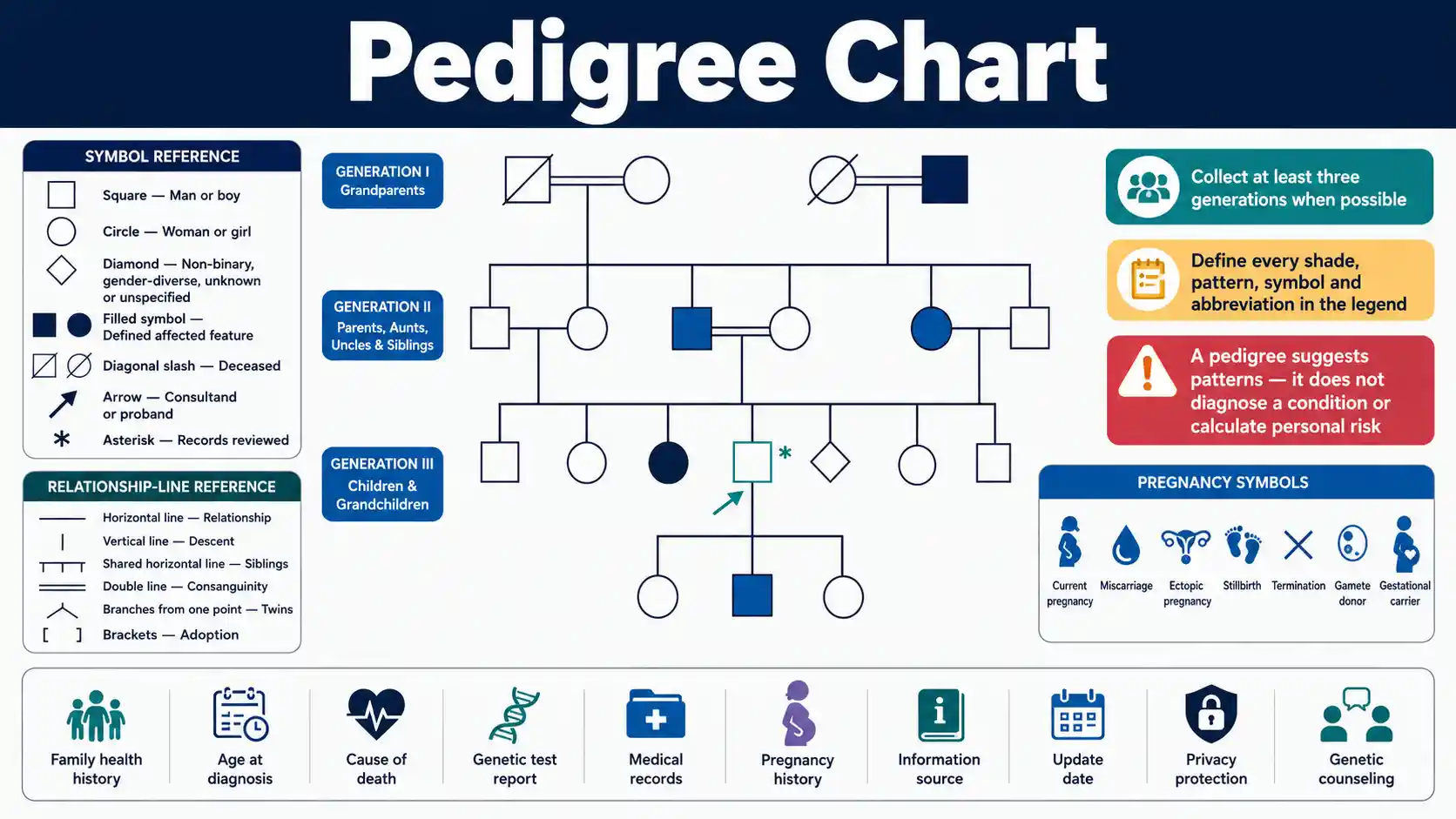
How do you read and build a pedigree chart?
Start with the person of interest, use standardized symbols, add both maternal and paternal branches, and record at least three generations when possible. The 2022 NSGC pedigree nomenclature revision clarifies symbols, relationship lines, inclusive gender documentation, carrier notation, privacy, adoption, pregnancy outcomes, and assisted reproduction.
Structure
Relationships across generations
Person symbols and standardized lines show parents, children, siblings, partners, twins, adoption, and other relevant family links.
Health data
Diagnosis plus age context
Record specific conditions, age at onset, current age, death information, pregnancy outcomes, and relevant test results.
Evidence
Reported versus documented
A useful chart separates family recollection from reviewed medical records, death records, pathology, and laboratory reports.
Interpretation
Pattern, not diagnosis
A pedigree can reveal clues, but it cannot confirm inheritance, biological relationships, a diagnosis, or personal recurrence risk by itself.
Direct answers to common pedigree questions
What is a pedigree chart?
A pedigree chart is a standardized diagram that maps family relationships and shows selected traits, health conditions, pregnancy outcomes, or genetic results across generations.
How many generations should a pedigree include?
A basic clinical pedigree usually includes at least three generations, although some conditions require a larger family history.
What does a square mean?
Current NSGC guidance uses a square for a man or boy.
What does a circle mean?
Current NSGC guidance uses a circle for a woman or girl.
What does a diamond mean?
A diamond can represent a non-binary or gender-diverse person or a person whose gender or sex is unknown or not specified; annotations clarify the intended meaning.
What does a filled symbol mean?
A filled or patterned symbol means the person has the trait, condition, test finding, or other feature defined in the legend.
What does a slash mean?
A diagonal slash through a person symbol means the person is deceased.
How are siblings ordered?
Place siblings from left to right in birth order, oldest to youngest.
How is consanguinity shown?
Use two parallel relationship lines and state the relatives’ degree of relationship when it is not obvious.
Does a pedigree prove inheritance?
No. A pedigree suggests hypotheses, but testing, diagnosis, penetrance, new variants, family size, and missing information can change the interpretation.
Does no family history rule out a genetic condition?
No. New variants, adoption, small families, late onset, incomplete records, and reduced penetrance can hide a genetic pattern.
When is genetics review useful?
Genetics review is useful for a known family variant, unusual or early disease, uncertain inheritance, consanguinity, complex reproductive history, or testing and pregnancy decisions.
Standard Pedigree Person Symbols and Status Marks
A symbol identifies a person or group, while shading, arrows, slashes, annotations, and a legend add clinical meaning.
Swipe horizontally inside the table to view every column.
| Symbol or mark | Standard meaning | How to use it | Important note |
|---|---|---|---|
| Square | Man or boy | Use as the base person symbol when this gender identity applies | Annotate sex assigned at birth only when clinically relevant and appropriate |
| Circle | Woman or girl | Use as the base person symbol when this gender identity applies | Do not use the symbol alone to infer chromosomes, anatomy, or reproductive capacity |
| Diamond | Non-binary or gender-diverse person, or gender/sex not known or not specified | Add clarifying annotation when needed | The legend and notes must explain the intended meaning |
| Filled or patterned symbol | Person with the trait, condition, test result, or other defined feature | Define every fill pattern in the legend — Define fill patterns in the legend | One symbol may be divided when several features must be shown |
| Diagonal slash through symbol | Deceased person | Add age or year of death and cause when known | A slash alone does not state cause of death |
| Arrow labeled P | Proband | Points to the affected person through whom the family came to attention | A consultand is different and may be unaffected |
| Arrow without P | Consultand or person seeking counseling | Point to the person receiving evaluation or counseling | Shade only if that person also has the defined feature |
| Number inside symbol | Several people represented together | Use a known number or n when the number is unknown | Group only people who can be represented accurately together |
| Asterisk beside symbol | Records or evaluation documented | Explain what was reviewed in the notes or legend | The 2022 revision removed the older E notation |
| Split or patterned symbol | Carrier status or multiple defined findings | Use distinct fill patterns and define each in the legend | The 2022 revision advises against relying on a generic center dot for carrier status |
Symbols must be interpreted with the pedigree legend and annotations.
- • A symbol should communicate only information relevant to the pedigree purpose.
- • Use respectful, person-centered language and ask how an individual wishes to be represented.
Download or export
Read relationship lines before interpreting shading
The same person shape can sit within many family structures. Confirm the relationship line, line of descent, sibling branch, adoption brackets, twin connection, and birth order before deciding how relatives are connected.
Pedigree Relationship and Descent Lines
Lines show partnerships, genetic descent, sibling groups, twins, adoption, and consanguinity. Layout should remain readable and unambiguous.
Swipe horizontally inside the table to view every column.
| Line or layout | Meaning | Drawing rule | Common mistake |
|---|---|---|---|
| Horizontal relationship line | Current or previous partner relationship relevant to the pedigree | Connect the two person symbols | Assuming the line alone proves marriage or cohabitation |
| Break in relationship line | The relationship no longer exists | Place a clear break through the relationship line | Using the break to imply loss of genetic relationship |
| Vertical line of descent | Genetic or defined parent-child connection | Drop from the relationship line to the sibship line or child | Drawing separate descent lines that obscure sibling relationships |
| Horizontal sibship line | Connects siblings from the same defined parental relationship | Place siblings left to right in birth order, oldest to youngest — Birth order runs left to right | Ordering siblings by gender or current age instead of birth order |
| Double relationship line | Consanguineous relationship | Use two parallel horizontal lines and state the relationship if not obvious | Treating shared ancestry as a diagnosis or moral judgment |
| Twin lines from one point | Twin or higher-order multiple pregnancy | Draw diagonal lines from the same point | Drawing twins as ordinary adjacent siblings |
| Twin connector bar | Monozygotic twins | Add a horizontal line between the twin branches | Assuming all twins are monozygotic when zygosity is unknown |
| Question mark over twin branches | Zygosity unknown | Place ? above the twin connection | Inventing zygosity from appearance or family report |
| Brackets around person symbol | Adopted individual | Use brackets and distinguish adoptive from biological descent lines | Removing biological or adoptive context that is relevant to the question |
| Dashed descent line | Adoptive parent-child connection | Use with adoption brackets and a legend | Using dashed lines without explaining them |
Line conventions describe relationships; they do not assign legal status, closeness, or family value.
- • Only include previous partners when they affect the genetic or clinical assessment.
- • Avoid crossed lines where a clearer layout or continuation marker is possible.
Download or export
Record pregnancy outcomes with neutral precision
Use the correct pregnancy symbol, add gestational age, and define affected shading in the legend. Reproductive information is sensitive, so collect only facts relevant to the clinical or educational purpose.
Pregnancy and Reproductive Outcome Symbols
Pregnancy outcomes require careful, neutral notation with gestational age and clinically relevant details when known.
Swipe horizontally inside the table to view every column.
| Outcome | Typical notation | Details to record | Interpretation limit |
|---|---|---|---|
| Current pregnancy | Person symbol containing P | Gestational age and how fetal sex was determined when relevant — Record gestational age | Do not infer sex or gender without reliable information |
| Spontaneous abortion or miscarriage | Triangle | Gestational age and known findings | A symbol does not establish the cause |
| Affected miscarriage | Filled or patterned triangle | Define the affected feature in the legend | Avoid implying recurrence risk without evaluation |
| Ectopic pregnancy | Triangle annotated ECT | Gestational age and relevant clinical facts | Do not merge ectopic pregnancy with miscarriage notation |
| Termination of pregnancy | Triangle with diagonal slash | Gestational age and relevant finding when voluntarily disclosed | Use neutral language and protect privacy |
| Stillbirth | Deceased person symbol with SB annotation | Gestational age, sex assigned at birth if known, and relevant findings | Definitions of stillbirth vary by jurisdiction and clinical system |
| Infertility | Relationship line with infertility marker and reason if known | Document only clinically relevant and consented details | Infertility may have multiple causes and does not define identity |
| No children by choice or reason unknown | Separate no-children notation | Clarify reason only when known and relevant | Do not label voluntary childlessness as infertility |
| Gamete donor | Donor symbol annotated D | Available genetic family history and type of gamete | Separate genetic contribution from parenting and relationship status |
| Gestational carrier or surrogate | Carrier symbol annotated S | Who provided gametes and who carried the pregnancy | Use clear lines and notes for genetic and gestational relationships |
Gestational age should be recorded under the relevant pregnancy symbol when known.
- • Pregnancy history can be sensitive; collect only information relevant to care and with respectful consent.
- • Assisted-reproduction pedigrees may require a genetic counselor or other trained professional.
Download or export
Collect diagnoses, ages, outcomes, and evidence
A symbol without age or diagnosis detail has limited value. The NLM family-history guide recommends collecting names or identifiers, birth information, health conditions and ages at diagnosis, deaths and causes, and pregnancy outcomes.
Information to Record for Each Family Member
A useful pedigree combines relationships with accurate health, age, testing, and source information.
Swipe horizontally inside the table to view every column.
| Information | What to record | Why it matters | How to handle uncertainty |
|---|---|---|---|
| Identity | Name or initials sufficient for identification within the record | Prevents confusion between relatives | Use privacy-preserving labels when full names are unnecessary |
| Age or birth date | Current age, year of birth, or date of birth as appropriate | Clarifies whether a person has passed the usual age of onset | Write approximate age when exact data are unavailable |
| Health condition | Specific diagnosis rather than a vague family label | Different diagnoses can have different inheritance implications | Mark as reported, suspected, or confirmed |
| Age at diagnosis | Age or approximate decade when symptoms or diagnosis began — Record age at onset | Early onset can change clinical interpretation | Use ranges when the family is unsure |
| Current health status | Living, deceased, affected, unaffected, or unknown for the defined feature | Separates present status from family rumor | Do not mark unaffected when status has not been assessed |
| Death information | Age or year and cause of death when known | May reveal unrecognized patterns | Record unknown rather than guessing |
| Pregnancy outcomes | Miscarriage, stillbirth, ectopic pregnancy, termination, infertility, and relevant findings | May be important for reproductive or chromosomal assessment | Collect sensitively and only when relevant |
| Genetic or laboratory results | Gene, variant classification, date, laboratory, and report status | Prevents misreading family recollections of testing | Distinguish a documented result from a verbal report |
| Ancestry or origin | Self-identified background when clinically relevant | Some conditions or testing strategies vary by ancestry | Avoid racial assumptions or outdated labels |
| Source and update date | Historian, records reviewed, recorder, and date collected or updated | Shows reliability and keeps a changing history current | Note conflicting sources explicitly |
A clinical pedigree should be updated when diagnoses, births, deaths, pregnancies, or test results change.
- • Family history is useful but can be incomplete or inaccurate.
- • A negative family history does not rule out a genetic condition because new variants, small families, adoption, and limited information can obscure patterns.
Download or export
Build outward from the person of interest
Start with the consultand or proband, then add siblings, children, parents, aunts, uncles, first cousins, and grandparents. Include unaffected and unknown relatives because family size and ages influence interpretation.
Three-Generation Pedigree Collection Order
Start with the person of interest, then move outward one generation at a time on both sides of the family.
Swipe horizontally inside the table to view every column.
| Step | Relatives to include | Key questions | Completion check |
|---|---|---|---|
| 1. Consultand or proband | Person seeking care and, when different, the affected person who brought the family to attention | Diagnosis, onset, testing, pregnancies, children, and reason for the pedigree | Clearly mark the arrow and legend |
| 2. Siblings and children | Full, maternal half, paternal half, adopted, donor-conceived, and other relevant relationships | Birth order, ages, diagnoses, deaths, pregnancies, and testing | Do not collapse different biological relationships |
| 3. Parents | Both genetic parents when known and relevant, plus family structure needed for care | Health, age, ancestry, testing, and cause of death | Keep maternal and paternal branches distinct |
| 4. Aunts and uncles | Siblings and half-siblings of each parent | Conditions, onset ages, deaths, children, and testing | Include unaffected and unknown relatives |
| 5. First cousins | Children of aunts and uncles | Major conditions, congenital differences, early deaths, and testing | Use grouped symbols only when details are equivalent |
| 6. Grandparents | All four genetic grandparents when known | Diagnoses, ages at onset, deaths, ancestry, and consanguinity | Confirm which branch each grandparent belongs to |
| 7. Pregnancy outcomes | Relevant outcomes across genetically related relatives | Gestational age, recurrence, and documented findings | Use neutral standardized symbols |
| 8. Verification | Medical records, death certificates, pathology, genetic reports, and reliable family informants | What is documented versus reported? — Separate documented from reported information | Mark records reviewed and conflicting information |
| 9. Update plan | New births, deaths, diagnoses, and test results | Who will update the chart and when? | Add the date and historian |
Three generations commonly include the person, parents and their siblings, grandparents, siblings, children, and first cousins.
- • More generations may be needed for late-onset, rare, or sparsely documented conditions.
- • A pedigree can be clinically useful even when some relatives or details are unknown.
Download or export
Pedigree symbol and notation guide
Choose the item you need to represent. The guide returns a standardized starting notation and the legend details that must accompany it.
Treat inheritance patterns as clues, not conclusions
Vertical transmission can suggest dominant inheritance, affected siblings with unaffected parents can suggest recessive inheritance, and absent father-to-son transmission can suggest an X-linked pattern. The MedlinePlus inheritance guide also describes Y-linked, mitochondrial, codominant, and multifactorial patterns. Real pedigrees may not show textbook patterns.
Inheritance Pattern Clues Seen in Pedigrees
These visual clues can suggest a hypothesis, but penetrance, variable expression, small families, new variants, and incomplete information can alter the pattern.
Swipe horizontally inside the table to view every column.
| Pattern | Possible pedigree clues | What can disrupt the pattern | Do not conclude |
|---|---|---|---|
| Autosomal dominant | Affected people may appear in successive generations; all genders can be affected; father-to-son transmission can occur | New variants, reduced penetrance, variable expression, late onset, or small family size | That every affected person has an affected parent |
| Autosomal recessive | Affected siblings may have unaffected carrier parents; the condition may skip generations | Founder effects, consanguinity, variable symptoms, or unrecognized carriers | That unaffected parents have no genetic risk |
| X-linked | No father-to-son transmission; patterns may differ by sex chromosomes and condition — No father-to-son X-linked transmission | Skewed X inactivation, variable expression, new variants, and limited family structure | That every X-linked condition is strictly dominant or recessive |
| Y-linked | A Y-chromosome variant may pass through a Y-bearing parent-child line | Infertility, small families, de novo variants, and incomplete records | That all traits seen only in men are Y-linked |
| Mitochondrial | A mitochondrial DNA variant can pass through the egg-contributing line but not through sperm | Heteroplasmy, variable tissue distribution, and nuclear-gene phenocopies | That every child will have the same symptoms or severity |
| Codominant | Two inherited alleles may both be expressed | Laboratory classification and phenotype variation | That a pedigree alone identifies the alleles |
| Multifactorial or polygenic | Several relatives may share a common condition without a simple Mendelian pattern | Shared environment, age, lifestyle, ancestry, and many genetic variants | A single-gene recurrence probability |
| De novo or mosaic | An affected person may appear without an obvious family history | Parental germline mosaicism or mildly affected relatives | That recurrence risk is always zero |
Pattern recognition is a starting point for assessment, not a diagnostic test or individualized risk calculation.
- • Confirm diagnoses and test reports before interpreting inheritance.
- • Genetic counseling can integrate pedigree findings with examination, testing, ancestry, and condition-specific evidence.
Download or export
Separate clinical status from test status
A person can be clinically affected, an asymptomatic carrier, negative for one known familial variant, or tested without an informative result. Record the exact gene, variant, classification, laboratory, date, and source rather than writing only positive or negative.
Genetic Testing, Carrier, and Affected Notation
Testing status, clinical status, and family report are separate facts and should not be merged into one ambiguous mark.
Swipe horizontally inside the table to view every column.
| Situation | Recommended documentation | Legend requirement | Avoid |
|---|---|---|---|
| Clinically affected | Fill or pattern the symbol for the defined condition | Name the condition and fill in the legend | Using one generic dark fill for several unrelated conditions |
| Confirmed pathogenic or likely pathogenic variant | Use a defined pattern, split symbol, or clear annotation | State the gene, variant, classification, and report status | Writing positive without naming what was tested |
| Carrier of a recessive condition | Use a defined split or patterned symbol and annotation | Identify the specific gene or condition | Using an unexplained center dot as the only carrier mark — Avoid an unexplained carrier dot |
| Negative familial-variant test | Annotate that the known familial variant was not detected | Identify the familial variant and test scope | Calling the person negative for all genetic risk |
| Uninformative negative test | Document the test and that no causative variant was found | Explain limitations in notes | Marking the person unaffected or risk-free |
| Variant of uncertain significance | Record VUS with gene, variant, and date | Use a separate legend code | Treating a VUS as disease-causing or using it for predictive testing without guidance |
| Reported family result without records | Mark as family-reported or unverified | State the information source | Copying the result as confirmed |
| Records reviewed | Place an asterisk beside the symbol and note what was reviewed | Define the asterisk | Using the retired E notation without explanation |
| Several conditions or variants | Divide the symbol or use distinct patterns and annotations | Define every segment or pattern | Stacking unexplained dots, colors, or initials |
Variant interpretation can change over time; record the laboratory report date and classification.
- • A genetic test result should be interpreted in the context of the tested person, test method, family variant, and clinical findings.
- • Do not calculate reproductive or disease risk from a symbol alone.
Download or export
Represent identity and family structure respectfully
Use symbols that affirm gender identity, annotate sex assigned at birth only when clinically relevant, and distinguish genetic, gestational, adoptive, donor, parenting, and social relationships without treating any one relationship as more legitimate.
Inclusive Family Structure and Identity Documentation
Pedigrees should preserve clinically relevant genetic and gestational information without erasing identity, parenting, adoption, donor conception, or chosen family.
Swipe horizontally inside the table to view every column.
| Situation | Documentation approach | Clinical question | Respectful practice |
|---|---|---|---|
| Transgender person | Use the symbol matching gender identity and annotate sex assigned at birth when clinically relevant — Use identity-affirming symbols and relevant annotations | Which anatomy, chromosomes, hormones, or reproductive history affect the assessment? | Ask rather than assume |
| Non-binary or gender-diverse person | Use a diamond with appropriate annotation | What information is relevant to this pedigree purpose? | Use the person’s language and pronouns |
| Sex or gender unknown or not specified | Use a diamond without unsupported assumptions | Can the needed fact be obtained respectfully? | Leave unknown when it is not known or relevant |
| Same-gender partners | Use the same relationship-line conventions | Which genetic, gestational, adoptive, or parenting links matter? | Do not create special relationship lines that stigmatize the family |
| Adopted person | Use brackets and distinct adoptive and biological descent lines | Which family histories are known and clinically relevant? | Recognize both adoptive and biological context |
| Donor conception | Mark donor D and genetic line to the pregnancy or child | What donor family history or test information is available? | Separate donor identity from parenting role |
| Gestational carrier | Mark surrogate or gestational carrier S and show gestational link | Who contributed gametes and who carried the pregnancy? | Use neutral, consented language |
| Unknown parentage | Use unknown symbols or notes without inventing a relationship | What evidence supports the connection? | Avoid pressuring disclosure or assigning blame |
| Chosen family or social parent | Record in notes or family structure when relevant to care | Does this relationship affect support, consent, or history? | Do not misrepresent it as a genetic relationship |
The pedigree symbol represents gender in the 2022 NSGC revision; sex assigned at birth is annotated separately when relevant.
- • Limit identifying information and explain why sensitive details are being collected.
- • Not every personal identity detail belongs on every pedigree.
Download or export
Protect relatives’ privacy and label uncertainty
A pedigree contains information about people who may not be present. Limit identifiers, explain sensitive questions, separate reported from documented data, define every symbol, and date every revision.
Pedigree Privacy, Accuracy, and Quality Checks
A pedigree is a health record containing information about several people, including relatives who may not be present or consented.
Swipe horizontally inside the table to view every column.
| Quality check | Good practice | Why it matters | Warning sign |
|---|---|---|---|
| Purpose | State the trait, condition, or clinical question | Prevents unnecessary data collection | Chart includes sensitive details unrelated to care |
| Legend | Define every shade, pattern, abbreviation, and special line | Allows another reader to interpret the chart | Symbols depend on guesswork |
| Privacy | Use the minimum identifying information needed — Minimize identifying information | Protects relatives and reduces disclosure risk | Full names and dates appear in public or teaching files |
| Consent and sensitivity | Explain why reproductive, identity, adoption, or family information is relevant | Supports trust and accurate disclosure | Questions are coercive or judgmental |
| Source quality | Label information as reported, documented, suspected, or unknown | Separates evidence from family recollection | Rumor is presented as diagnosis |
| Maternal and paternal branches | Collect both sides when known and relevant | Prevents one-sided risk assessment | Only the affected-looking branch is recorded |
| Age and onset | Record current age, age at diagnosis, and age at death | Supports penetrance and timing interpretation | Affected status has no age context |
| Testing details | Record gene, variant, classification, laboratory, and date | Avoids false certainty from vague positive or negative labels | A verbal report replaces the actual report |
| Update date | Date every intake and revision | Family histories change | Pedigree is treated as permanently complete |
| Professional review | Seek genetics expertise for complex inheritance, testing, or reproductive interpretation | Reduces errors and supports informed decisions | A family makes medical decisions from a chart alone |
Clinical records, school projects, research pedigrees, and public family trees have different privacy requirements.
- • De-identify teaching and publication pedigrees according to applicable policies.
- • Do not post a clinical pedigree publicly without appropriate authorization and privacy review.
Download or export
Correct errors before using a pedigree for decisions
Missing ages, absent unaffected relatives, vague diagnoses, one-sided family history, and unverified test reports can create false patterns. A trained genetics professional can review complex inheritance, testing, reproductive history, consanguinity, donor conception, or pregnancy questions.
Common Pedigree Errors and When to Seek Genetics Help
Correct structural and documentation errors before attempting inheritance or risk interpretation.
Swipe horizontally inside the table to view every column.
| Problem or situation | Why it matters | Better action | Urgency |
|---|---|---|---|
| No legend | Shading and abbreviations cannot be interpreted reliably | Add a complete legend before sharing the chart | Routine correction |
| Ages and onset missing | Late-onset conditions may appear absent in younger relatives | Add age, diagnosis age, and death information | Routine correction |
| Only affected relatives included | Family size and unaffected relatives are essential context | Add all relevant relatives and unknown status | Routine correction |
| Maternal or paternal side omitted | Risk may exist on either side | Collect both branches when available | Routine correction |
| Carrier dot used without explanation | The symbol may conflict with current standards or hide other findings | Use a defined split or pattern and annotation | Routine correction |
| Family report treated as confirmed testing | The wrong gene or result may be propagated through the family | Obtain the laboratory report or label as unverified | Prompt review before testing decisions |
| Complex adoption, donor, surrogacy, or unknown parentage | Genetic, gestational, legal, and social relationships can be confused | Use standardized notation and genetics expertise | Professional review recommended |
| Several relatives with early, rare, severe, or similar disease | May suggest an inherited condition requiring assessment | Discuss referral with a healthcare professional or genetic counselor | Prompt clinical review |
| Known pathogenic variant in the family | Testing strategy and interpretation depend on the exact familial result | Bring the report to genetics or the treating clinician — Bring the exact family report | Prompt clinical review |
| Pregnancy or reproductive decisions based on the pedigree | Recurrence estimates require condition-specific diagnosis and testing | Seek genetic counseling before making medical decisions | Professional review recommended |
| New neurologic, cardiac, metabolic, cancer, or developmental warning signs | Symptoms require direct clinical assessment | Contact an appropriate healthcare professional | Urgency depends on symptoms |
A pedigree cannot diagnose a condition, verify a biological relationship, or calculate personal risk without appropriate evidence.
- • Emergency symptoms require emergency care rather than pedigree analysis.
- • Genetic counseling supports informed choices but does not direct a person toward one reproductive or testing decision.
Download or export
Frequently asked questions
What is a pedigree chart?
A pedigree chart is a standardized family diagram that shows biological and other relevant relationships, traits, health conditions, pregnancy outcomes, and test information across generations.
How many generations should a medical pedigree include?
A basic clinical family history usually includes at least three generations, although more may be needed for late-onset, rare, or incompletely documented conditions.
What do squares, circles, and diamonds mean in a pedigree?
Current NSGC guidance uses a square for a man or boy, a circle for a woman or girl, and a diamond for a non-binary or gender-diverse person or when gender or sex is unknown or not specified.
What does a filled pedigree symbol mean?
A filled or patterned symbol means the person has the trait, condition, result, or feature defined in the pedigree legend.
What does a slash through a pedigree symbol mean?
A diagonal slash means the person is deceased; add age or year and cause of death when known.
What is the difference between a proband and a consultand?
The proband is the affected person who brought the family to attention, while the consultand is the person seeking counseling or evaluation and may be unaffected.
How are siblings arranged on a pedigree?
Siblings are generally placed from left to right in birth order, oldest to youngest, on a shared sibship line.
How is consanguinity shown?
A consanguineous relationship is shown with two parallel relationship lines, with the degree of relationship written above when it is not obvious.
How is adoption shown on a pedigree?
An adopted person is placed in brackets; adoptive and biological parent-child connections use different line styles that must be explained in the legend.
How are twins shown?
Twin branches arise from one point; a connector between the branches indicates monozygotic twins, while a question mark can show unknown zygosity.
Should a carrier be marked with a dot?
The 2022 NSGC revision recommends defined split or patterned symbols and annotations rather than relying on a generic center dot for carrier status.
Can a pedigree prove how a condition is inherited?
No. A pedigree can suggest an inheritance pattern, but diagnosis, testing, penetrance, new variants, small family size, and incomplete information can change the interpretation.
Does no family history rule out a genetic condition?
No. A condition can arise from a new variant, hidden carrier status, small family size, adoption, limited records, reduced penetrance, or late onset.
What health information should be recorded?
Record specific diagnoses, age at onset, current age, deaths and causes, pregnancy outcomes, genetic results, ancestry when relevant, information sources, and the update date.
How should transgender and non-binary relatives be represented?
Use the symbol that reflects gender identity, add sex assigned at birth only when clinically relevant, and use respectful annotations chosen with the individual whenever possible.
When should a genetic counselor review a pedigree?
Seek genetics review for a known family variant, unusual or early disease patterns, complex reproductive history, uncertain inheritance, donor conception, consanguinity, or testing and pregnancy decisions.
Sources
These genetics, genetic-counseling, family-history, inheritance, and cancer-risk references support the terminology, symbols, documentation rules, and interpretation limits used on this page.
National Human Genome Research Institute — Pedigree
https://www.genome.gov/genetics-glossary/Pedigree
Defines a pedigree as a chart that maps family relationships and shows how a trait or health condition appears across generations.
National Society of Genetic Counselors — Standardized Pedigree Nomenclature: 2022 Focused Revision
https://www.nsgc.org/Portals/0/J.E.D.I/Journal%20of%20Genetic%20Counseling%20-%202022%20-%20Bennett%20-%20Practice%20resourcefocused%20revision%20%20Standardized%20pedigree%20nomenclature.pdf
Updates standardized symbols, inclusive documentation of gender and sex assigned at birth, carrier notation, privacy, relationship lines, pregnancy outcomes, adoption, and assisted reproduction.
National Library of Medicine — Pedigree and Family History-Taking
https://www.ncbi.nlm.nih.gov/books/NBK115557/
Recommends collecting a basic three-generation family history with diagnoses, ages at onset, deaths, causes of death, and pregnancy outcomes.
National Cancer Institute — Standard Pedigree Nomenclature
https://www.ncbi.nlm.nih.gov/books/NBK65817.1/figure/CDR0000062865__1237/?report=objectonly
Shows common standardized pedigree symbols used to represent family members, relationships, and traits or conditions.
MedlinePlus Genetics — Inheritance Patterns
https://medlineplus.gov/genetics/understanding/inheritance/inheritancepatterns/
Explains autosomal dominant, autosomal recessive, X-linked, Y-linked, mitochondrial, codominant, and multifactorial inheritance patterns.
National Human Genome Research Institute — Family Health History
https://www.genome.gov/health/Family-Health-History
Explains how family health history can reveal inheritance patterns and help healthcare professionals identify possible risk factors.
National Cancer Institute — Cancer Genetics Risk Assessment and Counseling
https://www.cancer.gov/publications/pdq/information-summaries/genetics/risk-assessment-hp-pdq
Describes clinical use of a three-generation pedigree and cautions that family-history interpretation requires complete maternal and paternal information.
U.S. Surgeon General Family Health History Initiative — My Family Health Portrait
https://cbiit.github.io/FHH/html/index.html
Provides a free family health history collection tool that can generate a printable pedigree for discussion with healthcare professionals.