Science & Chemistry
pH Chart
Compare acidic, neutral, and basic pH values; understand the logarithmic scale; connect pH with hydrogen-ion activity, pOH, temperature, buffers, and measurement; and run common dilute-solution conversions with the calculator.
pH is not a complete safety rating or chemical identity. Strong oxidizers, toxic substances, solvents, and other hazards can exist across the pH scale, so use complete chemical and safety information for real materials.
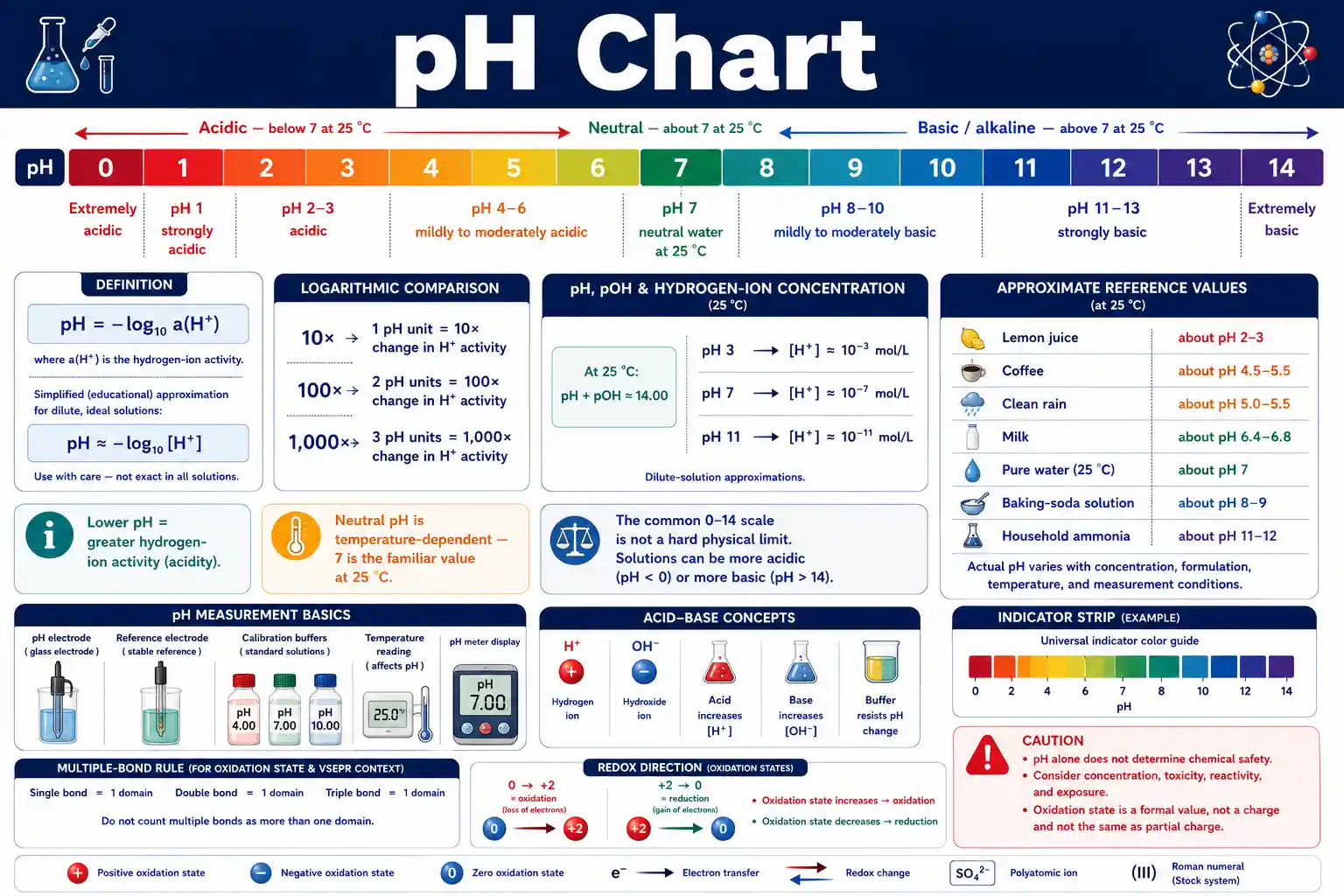
How pH works
The IUPAC Gold Book defines pH from the activity of hydrogen ions: pH = −log₁₀ a(H⁺). Activity describes effective chemical behavior, which is why pH = −log₁₀[H⁺] is best treated as a dilute-solution approximation rather than the exact general definition.
A lower pH means greater hydrogen-ion activity. Because the scale is logarithmic, pH 4 has ten times the hydrogen-ion activity of pH 5 and one hundred times that of pH 6. pH values therefore should not be interpreted like equally spaced linear concentration numbers.
At 25 °C, neutral water is near pH 7. Neutrality itself is defined by equal hydrogen- and hydroxide-ion activities, not by the number 7, so the numerical neutral pH moves as water autoionization changes with temperature.
Definition
pH = −log₁₀ a(H⁺)
The thermodynamic definition uses hydrogen-ion activity, not concentration alone.
One pH unit
10× activity ratio
A change of two pH units corresponds to a 100-fold hydrogen-ion activity ratio.
Neutral at 25 °C
About pH 7
Neutrality means hydrogen- and hydroxide-ion activities are equal; the neutral number changes with temperature.
Common scale
0–14 is not a limit
Values below 0 or above 14 can occur in concentrated or unusual systems.
pH Scale Chart
A classroom reference for acidic, neutral, and basic aqueous conditions. Neutrality depends on temperature, so pH 7 is specifically the familiar 25 °C reference case.
Swipe horizontally inside the table to view every column.
| pH | General description | Relative H⁺ activity vs pH 7 | Reference note |
|---|---|---|---|
| 0 | Strongly acidic reference | 10,000,000× greater | The pH scale is not fundamentally limited to 0–14 |
| 1 | Strongly acidic | 1,000,000× greater | A one-unit pH change is tenfold |
| 2 | Acidic | 100,000× greater | Typical of some strongly acidic solutions |
| 3 | Acidic | 10,000× greater | Acidic foods and laboratory solutions can fall near here |
| 4 | Moderately acidic | 1,000× greater | Acid rain can be near pH 4 |
| 5 | Mildly acidic | 100× greater | Clean rain is often mildly acidic |
| 6 | Slightly acidic | 10× greater | Near-neutral but still acidic at 25 °C |
| 7 | Neutral at 25 °C | Reference | Pure water is near pH 7 at 25 °C |
| 8 | Slightly basic | 10× lower | Near-neutral basic condition at 25 °C |
| 9 | Mildly basic | 100× lower | Weakly alkaline solutions can fall near here |
| 10 | Moderately basic | 1,000× lower | Basic laboratory solutions can fall near here |
| 11 | Basic | 10,000× lower | Some cleaners are strongly alkaline |
| 12 | Basic | 100,000× lower | Strong-base solutions may fall near here |
| 13 | Strongly basic | 1,000,000× lower | Approximate for 0.1 M strong base under ideal assumptions |
| 14 | Strongly basic reference | 10,000,000× lower | Not an absolute upper boundary |
pH is dimensionless. Relative activity comparisons assume the same temperature and reference state.
- • The 0–14 span is a convenient classroom range for ordinary aqueous solutions, not a universal hard limit.
Download or export
Approximate pH Reference Values
Illustrative ranges for familiar aqueous materials. Actual values vary with formulation, concentration, temperature, freshness, and measurement method.
Swipe horizontally inside the table to view every column.
| Material or solution | Approximate pH | Acidic/basic | Why value varies |
|---|---|---|---|
| Battery acid | about 0–1 | Acidic | Acid concentration and battery state |
| Stomach acid | about 1–3 | Acidic | Physiological conditions and timing |
| Lemon juice | about 2–3 | Acidic | Fruit variety and ripeness |
| Vinegar | about 2–3 | Acidic | Acetic-acid concentration |
| Tomato juice | about 4 | Acidic | Cultivar and processing |
| Coffee | about 4.5–5.5 | Acidic | Bean, roast, water, and brew method |
| Clean rain | about 5.0–5.5 | Acidic | Dissolved CO₂ and atmospheric chemistry |
| Milk | about 6.4–6.8 | Slightly acidic | Composition, temperature, and spoilage |
| Pure water at 25 °C | about 7 | Neutral | Neutral pH changes with temperature |
| Baking-soda solution | about 8–9 | Basic | Concentration and dissolved CO₂ |
| Seawater | about 8 | Basic | Location, depth, CO₂, biology, and temperature |
| Household ammonia solution | about 11–12 | Basic | Ammonia concentration |
| Household bleach | about 11–13 | Basic | Formulation and age |
Approximate pH ranges only; not product specifications or safety limits.
- • Never identify an unknown chemical or judge its safety from pH alone.
Download or export
A one-unit change is chemically large
Moving from pH 6 to pH 5 is a tenfold increase in hydrogen-ion activity, not a small one-step linear change. Moving from pH 7 to pH 4 is a thousandfold increase.
Logarithmic pH Difference Chart
A pH difference corresponds to a power-of-ten ratio in hydrogen-ion activity.
Swipe horizontally inside the table to view every column.
| pH difference | H⁺ activity ratio | Example | Interpretation |
|---|---|---|---|
| 1 unit | 10× | pH 5 vs pH 6 | The pH 5 solution has 10× greater H⁺ activity |
| 2 units | 100× | pH 3 vs pH 5 | Two units mean two factors of ten |
| 3 units | 1,000× | pH 2 vs pH 5 | Three powers of ten |
| 4 units | 10,000× | pH 3 vs pH 7 | Large chemical difference |
| 5 units | 100,000× | pH 2 vs pH 7 | Five powers of ten |
| 6 units | 1,000,000× | pH 1 vs pH 7 | Six powers of ten |
| 7 units | 10,000,000× | pH 0 vs pH 7 | Seven powers of ten |
Ratio = 10^(absolute pH difference), comparing hydrogen-ion activity.
- • A lower pH means greater hydrogen-ion activity.
Download or export
pH and Hydrogen-Ion Concentration Approximation
For sufficiently dilute ideal aqueous solutions, [H⁺] is often used as a classroom approximation to activity.
Swipe horizontally inside the table to view every column.
| pH | Approx. [H⁺] mol/L | Approx. pOH at 25 °C | Approx. [OH⁻] mol/L |
|---|---|---|---|
| 0 | 1 | 14 | 1×10⁻¹⁴ |
| 1 | 1×10⁻¹ | 13 | 1×10⁻¹³ |
| 2 | 1×10⁻² | 12 | 1×10⁻¹² |
| 3 | 1×10⁻³ | 11 | 1×10⁻¹¹ |
| 4 | 1×10⁻⁴ | 10 | 1×10⁻¹⁰ |
| 5 | 1×10⁻⁵ | 9 | 1×10⁻⁹ |
| 6 | 1×10⁻⁶ | 8 | 1×10⁻⁸ |
| 7 | 1×10⁻⁷ | 7 | 1×10⁻⁷ |
| 8 | 1×10⁻⁸ | 6 | 1×10⁻⁶ |
| 9 | 1×10⁻⁹ | 5 | 1×10⁻⁵ |
| 10 | 1×10⁻¹⁰ | 4 | 1×10⁻⁴ |
| 11 | 1×10⁻¹¹ | 3 | 1×10⁻³ |
| 12 | 1×10⁻¹² | 2 | 1×10⁻² |
| 13 | 1×10⁻¹³ | 1 | 1×10⁻¹ |
| 14 | 1×10⁻¹⁴ | 0 | 1 |
Approximate mol/L concentration relationships at 25 °C using pH + pOH ≈ 14.00.
- • Thermodynamic pH is defined using activity, so pH = −log₁₀[H⁺] is an approximation rather than the general definition.
Download or export
pH, pOH and concentration calculator
Convert between pH, pOH, hydrogen-ion concentration, and hydroxide-ion concentration using the familiar dilute-aqueous 25 °C approximation where pH + pOH = 14.00.
pH
7
pOH
7
[H⁺]
1.0000e-7 mol/L
[OH⁻]
1.0000e-7 mol/L
Important: the concentration conversions are classroom approximations for sufficiently dilute aqueous solutions. Thermodynamic pH is defined from hydrogen-ion activity, and pKw changes with temperature.
The concentration shortcut has limits
For dilute near-ideal solutions, chemistry courses often approximate pH with −log₁₀[H⁺]. In real solutions, activity coefficients account for interactions among ions. Concentrated solutions and unusual matrices can therefore depart noticeably from the simple concentration model.
Neutral pH and Temperature Chart
Neutrality occurs when hydrogen-ion and hydroxide-ion activities are equal. The corresponding numerical pH changes because water autoionization depends on temperature.
Swipe horizontally inside the table to view every column.
| Temperature | Neutral pH concept | Key point | Practical implication |
|---|---|---|---|
| Cold water | Neutral pH is above 7 | [H⁺] = [OH⁻] still defines neutrality | A neutral sample need not read exactly 7 |
| 25 °C | Neutral pH ≈ 7.00 | Familiar classroom reference | pH + pOH ≈ 14.00 in dilute aqueous calculations |
| Warm water | Neutral pH is below 7 | Water ionizes more as temperature rises over ordinary ranges | A pH below 7 can still be neutral at elevated temperature |
| Any temperature | Neutral means equal H⁺ and OH⁻ activities | Neutrality is chemical, not a fixed numeral | Record temperature with precision measurements |
Conceptual trend; exact neutral pH depends on temperature and thermodynamic conditions.
- • Temperature compensation in a meter corrects electrode response; it does not make every sample chemically equivalent to its 25 °C pH.
Download or export
Neutral does not always mean pH 7
At 25 °C, equal hydrogen- and hydroxide-ion activities correspond to about pH 7. At other temperatures the numerical neutral point shifts. A warm neutral sample can therefore have pH below 7 without being acidic relative to neutrality at that temperature.
pH Measurement Methods Chart
Different methods trade speed, cost, resolution, calibration requirements, and matrix sensitivity.
Swipe horizontally inside the table to view every column.
| Method | Typical use | Strength | Main limitation |
|---|---|---|---|
| Universal indicator | Fast visual estimate | Simple and inexpensive | Color matching is approximate |
| pH paper or strips | Field screening | Portable and fast | Limited resolution; colored samples interfere |
| Glass-electrode pH meter | Routine quantitative measurement | Good resolution when calibrated | Requires calibration, maintenance, and temperature awareness |
| Bench pH meter | Laboratory work | Stable setup and multiple calibration points | Requires proper electrodes and standards |
| Microelectrode | Small volumes or localized measurements | Works with tiny samples | More delicate and application-specific |
| Specialized electrode | Low ionic strength, high temperature, nonstandard matrices | Designed for difficult samples | Method must match sample chemistry |
Method selection depends on sample matrix and required uncertainty.
- • Practical pH measurement is operational and relies on traceable standards and suitable electrodes.
Download or export
Accurate pH is a measurement problem, not just a formula
The NIST pH metrology program supports traceability through primary measurements and Standard Reference Materials. Routine meters rely on calibrated electrodes and reference buffers; sample temperature, ionic strength, electrode condition, and matrix can all affect practical results.
Common pH Buffer Concepts Chart
Buffers resist pH change by combining a weak acid/base pair. Their useful range is centered near the relevant pKa.
Swipe horizontally inside the table to view every column.
| Concept | Meaning | Practical rule | Limitation |
|---|---|---|---|
| Buffer | Weak acid/base pair that resists pH change | Works best when both conjugate forms are present | Capacity is finite |
| pKa | Acid dissociation logarithm | Buffer pH is often near pKa | pKa depends on conditions |
| Half-neutralization | Acid and conjugate base are equal in ideal treatment | pH ≈ pKa | Activity effects can matter |
| Buffer capacity | Amount of acid/base the buffer can absorb before large pH shift | Higher total buffer concentration usually increases capacity | Not represented by pH alone |
| Dilution | Lowers concentrations of both buffer components | Ideal ratio may leave pH similar | Capacity drops with dilution |
| Temperature | Changes equilibrium constants | Calibrate and measure at controlled temperature for precision | Buffer pH can shift with temperature |
Conceptual guidance, not a universal recipe for buffer preparation.
- • A solution being near neutral does not automatically make it a buffer.
Download or export
pH, Acid Strength and Concentration Chart
pH, acid strength, and analytical concentration are related but are not interchangeable concepts.
Swipe horizontally inside the table to view every column.
| Concept | What it describes | What it does not tell alone | Example insight |
|---|---|---|---|
| pH | Hydrogen-ion activity | Total acid concentration | Two acids at the same concentration can have different pH |
| Strong acid | Extent of ionization is very high in dilute water | That the solution must have low pH at every concentration | A highly diluted strong acid can be only mildly acidic |
| Weak acid | Partial ionization equilibrium | That the solution is harmless or near neutral | Concentrated weak acid can still be strongly acidic |
| Concentration | Amount of solute per solution amount | Acid strength | 0.1 M weak acid behaves differently from 0.1 M strong acid |
| pKa | Acid equilibrium tendency | Actual sample pH by itself | Need composition and concentration to predict pH |
| Buffer capacity | Resistance to added acid/base | Initial pH alone | Two pH 7 solutions can have very different buffer capacities |
Keep thermodynamic strength, concentration, and measured pH conceptually separate.
- • Never infer corrosivity, toxicity, or chemical identity from pH alone.
Download or export
Strong acid and low pH are not synonyms
Acid strength describes ionization equilibrium. pH describes the resulting hydrogen-ion activity in a particular solution. Analytical concentration describes how much material is present. Keeping these three concepts separate prevents many acid–base errors.
Common pH Calculation Patterns
Introductory calculation templates for dilute aqueous systems. Real solutions may require activities, equilibria, and numerical methods.
Swipe horizontally inside the table to view every column.
| Problem type | Starting relation | Typical next step | Important caveat |
|---|---|---|---|
| Given pH | a(H⁺) = 10⁻ᵖᴴ | Convert to activity; concentration only by approximation | Activity is the thermodynamic quantity |
| Given ideal [H⁺] | pH ≈ −log₁₀[H⁺] | Take base-10 logarithm | Best for sufficiently dilute near-ideal solutions |
| Given pOH at 25 °C | pH + pOH ≈ 14.00 | Subtract pOH from 14.00 | pKw varies with temperature |
| Strong monoprotic acid | [H⁺] ≈ acid concentration | Then pH ≈ −log concentration | Fails when dilution and water autoionization matter |
| Strong monobasic base | [OH⁻] ≈ base concentration | Find pOH, then pH | Stoichiometry and temperature matter |
| Weak acid | Ka equilibrium | Solve equilibrium for H⁺ | Do not assume complete ionization |
| Buffer | Henderson–Hasselbalch approximation | Use conjugate-base/acid ratio | Requires appropriate buffer conditions |
| Mixture of strong acid/base | Neutralization stoichiometry first | Find excess reagent, then pH | Do not average starting pH values |
Base-10 logarithms are used in pH calculations.
- • A calculator result cannot replace checking the assumptions behind the chemical model.
Download or export
Common pH Mistakes Chart
Frequent interpretation and calculation errors and the correction for each one.
Swipe horizontally inside the table to view every column.
| Mistake | Why it is wrong | Better approach | Quick check |
|---|---|---|---|
| Treating pH as linear | pH is logarithmic | Use powers of ten for comparisons | 2 pH units = 100× H⁺ activity ratio |
| Saying pH must be 0–14 | The familiar range is not a fundamental boundary | Treat 0–14 as a common aqueous reference | Concentrated systems can lie outside |
| Saying neutral always means pH 7 | Neutral pH depends on temperature | Use equality of H⁺ and OH⁻ activities | pH 7 is the 25 °C reference |
| Using concentration as the exact definition | pH is activity-based | Call [H⁺] formulas approximations | Activity coefficients matter |
| Averaging two pH numbers | Logs cannot be averaged to model mixing chemistry | Do stoichiometry and equilibrium | Account for volumes and moles |
| Ignoring temperature | Electrode response and equilibria change | Record temperature and use proper standards | Calibration buffers are temperature dependent |
| Using an uncalibrated meter | Electrode response drifts | Calibrate with suitable standards | Bracket the expected sample pH when practical |
| Judging safety from pH only | Hazard depends on more than acidity/basicity | Use complete chemical and safety information | Oxidizers and solvents can be hazardous at many pH values |
| Calling strong acid the same as concentrated acid | Strength is ionization; concentration is amount | Keep the concepts separate | Dilute strong acid can have higher pH than concentrated weak acid |
| Ignoring sample matrix | Suspensions, low ionic strength, solvents, and high salt can complicate measurement | Use a method suited to the matrix | Report method and conditions for precision work |
Conceptual error-prevention chart.
- • Report pH with enough context for the intended use, especially temperature and measurement method.
Download or export
How to use a pH chart correctly
First decide whether you are interpreting a measured pH or solving a chemical-equilibrium problem. For measurement, note temperature, calibration, method, and sample matrix. For calculations, identify whether the system is a strong acid/base, weak acid/base, buffer, neutralization mixture, or another equilibrium problem before choosing an equation.
1. Identify the question
Are you comparing acidity, converting a value, predicting equilibrium, or interpreting a measurement?
2. Remember the logarithm
Each pH unit is a factor of ten in hydrogen-ion activity.
3. Check the temperature
pKw and neutral pH are temperature-dependent.
4. Separate strength from concentration
Strong/weak and concentrated/dilute describe different properties.
5. Use concentration formulas cautiously
The exact pH definition uses activity; simple concentration formulas are model assumptions.
6. Report measurement context
For precision work, record method, calibration, temperature, and relevant sample conditions.
For an accessible visualization of the logarithmic scale, the USGS pH scale notes that a decrease from pH 5 to pH 4 corresponds to a tenfold increase in acidity by its classroom description.
pH chart FAQs
What does pH measure?
pH expresses hydrogen-ion activity on a base-10 logarithmic scale. Lower pH means greater hydrogen-ion activity, while higher pH means lower hydrogen-ion activity.
Is pH 7 always neutral?
No. pH 7 is the familiar neutral value for water near 25 °C. Neutrality means hydrogen-ion and hydroxide-ion activities are equal, and the numerical neutral pH changes with temperature.
Is the pH scale limited to 0 through 14?
No. The 0–14 range is a convenient reference for many ordinary aqueous solutions. Concentrated or unusual systems can have pH values below 0 or above 14.
Why is pH logarithmic?
The logarithmic form compresses enormous changes in hydrogen-ion activity into a practical scale. A one-unit pH difference corresponds to a tenfold activity ratio.
How much more acidic is pH 3 than pH 5?
A pH difference of 2 corresponds to a 100-fold difference in hydrogen-ion activity, so pH 3 has about 100 times greater hydrogen-ion activity than pH 5.
Is pH exactly minus log of hydrogen-ion concentration?
Not generally. The thermodynamic definition uses hydrogen-ion activity. Using molar concentration in pH = −log[H⁺] is a useful dilute-solution approximation.
What is pOH?
pOH is the analogous logarithmic quantity for hydroxide. In common dilute aqueous calculations at 25 °C, pH + pOH is approximately 14.00.
Does pH plus pOH always equal 14?
No. The familiar 14.00 sum applies approximately at 25 °C for dilute aqueous calculations. The ionization constant of water changes with temperature.
Can a neutral solution have pH below 7?
Yes. At sufficiently elevated temperature, neutral water has a pH below 7 because water autoionization changes while hydrogen- and hydroxide-ion activities remain equal.
What is the best way to measure pH accurately?
For quantitative work, use a suitable pH meter and electrode calibrated with traceable buffer standards, control or record temperature, and follow a method appropriate for the sample matrix.
Are pH strips accurate?
pH strips are useful for approximate screening, but they normally offer less resolution than a properly calibrated pH meter and can be affected by sample color or interpretation.
Does a lower pH always mean a stronger acid?
No. pH describes a particular solution, while acid strength describes ionization equilibrium. Concentration and composition also determine the measured pH.
What makes a buffer resist pH changes?
A buffer contains a weak acid/base conjugate pair that consumes added base or acid. Its resistance is finite and depends strongly on composition and total concentration.
Can I average two pH values after mixing solutions?
Usually no. Because pH is logarithmic and mixing changes amounts and equilibria, calculate moles and reaction stoichiometry first, then determine the final hydrogen-ion activity or concentration model.
Does temperature compensation give the pH the sample would have at 25 °C?
Not automatically. Temperature compensation corrects the electrode response, but the sample chemistry itself may have a real temperature-dependent pH.
Can pH alone tell whether a solution is safe?
No. pH does not identify the chemical, concentration, oxidizing ability, toxicity, solvent hazard, or other risks. Use complete chemical and safety information.
Sources
Terminology and the activity-based pH definition are grounded in IUPAC. Measurement traceability is cross-checked with NIST, and the familiar logarithmic scale explanation is cross-checked with USGS. Final source URLs are shown as plain text.
International Union of Pure and Applied Chemistry — IUPAC Gold Book — pH
Defines pH from the activity of hydrogen(1+) ions and explains why practical pH measurement is operationally standardized.
https://goldbook.iupac.org/terms/view/P04524
National Institute of Standards and Technology — pH Metrology
Describes traceable pH measurement, primary Harned-cell measurements, and NIST pH Standard Reference Materials.
https://www.nist.gov/programs-projects/ph-metrology
U.S. Geological Survey — pH Scale
Explains the logarithmic character of pH and gives familiar aqueous examples such as water and rain.
https://www.usgs.gov/media/images/ph-scale