Health & Medical · Respiratory symptoms
Phlegm Color Chart for Mucus Meanings and Warning Signs
Compare clear, white, yellow, green, brown, black, pink, and bloody phlegm with texture, amount, symptom combinations, testing, chronic-lung changes, and care guidance.
Call local emergency services for severe breathing difficulty, blue or gray lips, fainting or confusion, significant blood, or pink froth with breathlessness. Color alone cannot diagnose the cause or show that antibiotics are needed. Read the ChartsLoom Disclaimer.
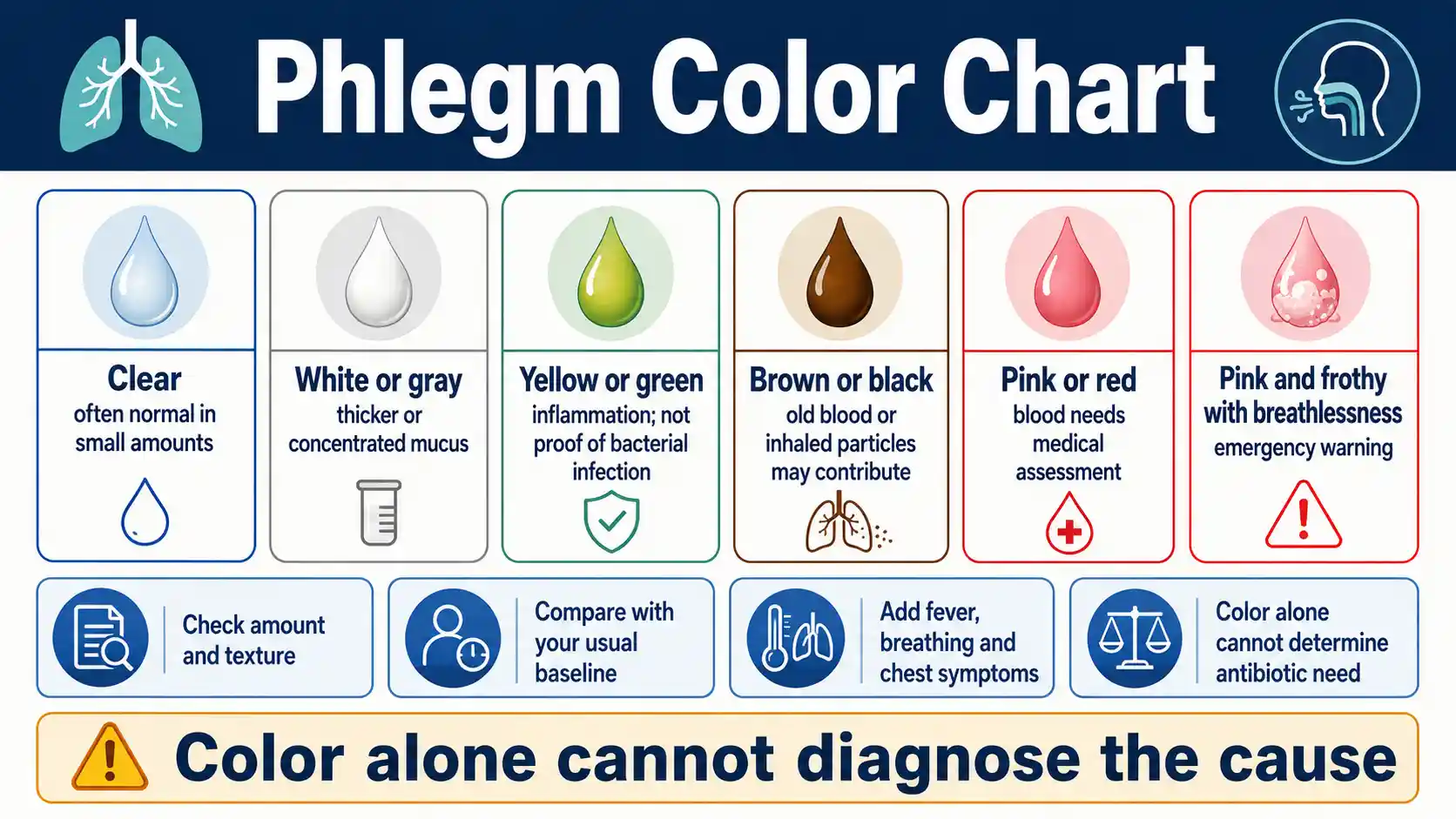
What does phlegm color tell you?
Phlegm color can show that respiratory mucus contains more immune cells, concentrated material, inhaled particles, or blood. It cannot identify the illness by itself.
The CDC guidance for acute bronchitis states that colored sputum does not indicate bacterial infection. Use color with breathing, fever, blood, pain, duration, amount, and the person’s usual baseline.
Most common
Clear is often normal
A small amount of clear mucus protects the airways; a new or increasing amount still needs context.
Best context
Color + symptoms
Breathing, blood, fever, chest pain, duration, amount, and change from usual matter more.
Urgent finding
Blood or pink froth
Blood should be checked, while larger amounts or pink froth with breathlessness can be emergencies.
Antibiotics
Color cannot decide
Yellow or green sputum can occur in viral and bacterial illness and does not prove either cause.
Phlegm Color Meaning Chart
Phlegm color can reflect normal mucus, immune cells, concentrated secretions, inhaled material, or blood. It narrows questions but cannot identify a diagnosis by itself.
Swipe horizontally inside the table to view every column.
| Color or appearance | What it may reflect | Useful context to check | Suggested response |
|---|---|---|---|
| Clear or transparent | Often normal airway mucus; increased clear sputum can occur with irritation or lung disease — Often normal in small amounts | Amount, frequency, allergies, smoke exposure, wheeze, and change from usual | Monitor a small stable amount; discuss persistent or increasing production |
| White or pale gray | Thicker or more concentrated mucus, airway irritation, or congestion | Hydration, viral symptoms, wheeze, amount, and whether it is new | Use symptoms and trend; color alone does not identify the cause |
| Yellow | Immune-cell activity and airway inflammation during an illness | Fever, duration, breathing, chest pain, odor, and overall trend | Do not assume bacterial infection or a need for antibiotics from color alone — Color does not decide antibiotic need |
| Green | Concentrated inflammatory material; can occur in viral or bacterial respiratory illness | Worsening breathlessness, fever, chest pain, chronic-lung baseline, and duration | Seek assessment when symptoms are significant, worsening, persistent, or different from usual |
| Brown or rust-colored | Old blood, inhaled dust or smoke, or material associated with some lung infections | Blood exposure, smoking, dust, fever, chest pain, and repeat episodes | Arrange clinical advice, especially when unexplained, recurrent, or accompanied by other symptoms |
| Black or very dark gray | Smoke, soot, coal or dust exposure; occasionally another lung process | Occupation, fire or smoke exposure, smoking, breathing change, and persistence | Avoid further exposure and seek assessment when new, unexplained, persistent, or symptomatic |
| Pink or red streaks | A small amount of blood mixed with sputum | Amount, recurrence, severe cough, chest or back pain, breathing, and medicines that affect bleeding | Obtain urgent clinical advice even for a few spots, flecks, or streaks |
| Bright red or more than streaks | Active airway or lung bleeding is possible | Amount, clots, breathing difficulty, chest or upper-back pain, dizziness, and fast heartbeat | Call local emergency services — Emergency action |
| Pink and frothy or bloody foam | Fluid and blood mixing in the airways; pulmonary edema is one possible emergency cause | Severe breathlessness, inability to lie flat, gurgling, sweating, confusion, or inability to speak normally | Call local emergency services now — Emergency action |
Color names are descriptive, not laboratory measurements or diagnoses.
- • Lighting, food or drink, tobacco, environmental particles, and small amounts of blood can change appearance.
- • Sputum is mucus coughed from the lower airways; saliva, nasal drainage, and vomit are different specimens.
- • Breathing difficulty, blood amount, associated symptoms, and change from usual are more important than color alone.
Download or export
How to read a phlegm color chart safely
Treat color as one observation—not a diagnosis. The pattern becomes more useful when you add the amount, texture, duration, change from usual, breathing symptoms, fever, pain, and medical history.
1
Describe the color
Use the closest color and note whether blood, spots, streaks, or pink froth is present.
2
Compare with baseline
Record what changed in color, thickness, odor, amount, frequency, and ease of clearing.
3
Add other symptoms
Breathlessness, chest pain, fever, wheeze, confusion, and oxygen changes carry more weight.
4
Use the care context
Blood or severe breathing symptoms can be urgent even when the mucus color seems mild.
A yellow or green color can occur with airway inflammation and with viral or bacterial illness. It does not decide whether an antibiotic is appropriate.
Yellow or green mucus is not a bacterial test
Immune cells and airway inflammation can make sputum yellow or green during both viral and bacterial illnesses. Antibiotic decisions require the full clinical picture, not a color match. Do not use leftover antibiotics or change a prescribed medicine because mucus looks darker.
Phlegm Color with Symptoms Chart
Color becomes more meaningful when paired with breathing, fever, pain, odor, duration, and the person’s usual respiratory baseline.
Swipe horizontally inside the table to view every column.
| Finding combination | Possible clinical context | What raises concern | What to do |
|---|---|---|---|
| Clear mucus + sneezing or itchy eyes | Allergy or upper-airway irritation may contribute | Wheeze, breathing difficulty, facial swelling, or symptoms that do not settle | Follow an established allergy plan and seek care for breathing or persistent symptoms |
| White mucus + congestion or cough | Thicker secretions can occur with a cold, dehydration, or airway inflammation | Increasing amount, worsening breathing, fever, or chronic-lung disease | Track the trend and contact a clinician if worsening or persistent |
| Yellow or green mucus + cold symptoms | Acute bronchitis and other viral illnesses can produce colored sputum | High-risk health history, breathlessness, chest pain, fever, confusion, or deterioration | Do not start antibiotics based only on color; seek assessment for concerning features — Antibiotics are not decided by color |
| Yellow or green mucus + fever + chest pain or breathlessness | Pneumonia or another significant lower-respiratory illness may need assessment | Rapid worsening, low oxygen, confusion, blue or gray lips, or severe breathing difficulty | Obtain prompt medical care; use emergency services for severe features — Prompt assessment |
| Large, foul-smelling sputum + chronic cough | Bronchiectasis or another chronic suppurative airway problem is possible | Blood, weight loss, fever, night sweats, or worsening shortness of breath | Arrange clinical assessment and follow any existing airway-clearance plan |
| Brown or black sputum + dust, smoke, or fire exposure | Inhaled particles may discolor mucus | Chemical exposure, chest tightness, severe cough, breathing difficulty, or persistence | Move away from exposure and seek poison, occupational, urgent, or emergency advice as appropriate |
| Blood-streaked mucus + severe or long cough | Airway irritation is possible, but infection and other causes must be considered | Repeated bleeding, more than streaks, breathlessness, chest or back pain, or fast heartbeat | Seek urgent advice for any blood; use emergency services for high-risk features |
| Pink froth + sudden breathlessness | Pulmonary edema is one possible life-threatening context | Air hunger, inability to lie flat, sweating, confusion, gurgling, or inability to speak | Call local emergency services immediately — Emergency action |
Combinations describe patterns that require clinical context; they do not confirm a disease.
- • Fever can be absent in serious illness, especially in older or immunocompromised people.
- • A normal-looking color does not rule out asthma, pneumonia, a blood clot, or another respiratory emergency.
- • Use the person’s baseline and full symptom pattern rather than comparing color with an online photo alone.
Download or export
Phlegm Symptom Note Builder
Build a clearer mucus-change summary
Combine color with amount, texture, duration, trend, blood, breathing, and other symptoms. The result is a communication note, not a diagnosis or treatment plan.
Safety reminder
No selected emergency warning
Continue to watch the full pattern and seek care if symptoms worsen, persist, recur, or differ from your usual baseline. This reminder cannot rule out a serious cause.
Generated summary
Phlegm symptom summary
Color: Clear
Amount: Small or occasional
Texture: Thin
Duration: Started today
Trend: New symptom
Blood: No blood seen
Breathing: No unusual breathing difficulty
Other selected symptom: None selected
Exposure or health context: Not specified
Safety reminder: No selected emergency warning.
Interpretation note: Color is one observation. It cannot identify the cause or show whether antibiotics are needed.
Do not wait on a color chart when breathing or bleeding warning signs appear. Call local emergency services for severe breathing difficulty, blue or gray lips, fainting or confusion, more than a few spots or streaks of blood, or blood with chest or upper-back pain, a very fast heartbeat, or difficulty breathing. Nothing entered here is stored or transmitted.
Phlegm Texture and Amount Chart
Texture, odor, amount, and ease of clearing can add clinically useful detail that a color label misses.
Swipe horizontally inside the table to view every column.
| Feature | What it describes | Possible context | What to record or report |
|---|---|---|---|
| Thin and slippery | Low-viscosity mucus that moves easily | Normal mucus, early irritation, or increased clear secretions | Color, total amount, triggers, and whether it is more than usual |
| Thick or sticky | Concentrated mucus that is harder to clear | Dehydration, infection, inflammation, or chronic airway disease | Hydration limits, wheeze, work of breathing, and difficulty clearing |
| Cloudy or opaque | Loss of the usual transparent appearance | Cells, proteins, and inflammatory material in mucus | Color, odor, symptoms, and trend rather than opacity alone |
| Foamy or frothy | Many small air bubbles mixed through mucus | Air mixing with secretions; pink or bloody froth is especially concerning — Pink froth can be an emergency | Color, breathing difficulty, lying-flat symptoms, and sudden onset |
| Plug-like or chunky | Dense pieces or casts that may block smaller airways | Very thick mucus in asthma or chronic lung disease, among other causes | Wheeze, chest tightness, inability to clear, and oxygen or breathing change |
| Foul-smelling | Noticeably unpleasant odor beyond usual | Retained secretions or a significant airway or lung infection may be possible | Duration, fever, dental or swallowing issues, and amount |
| Large volume or much more than usual | A meaningful increase from the person’s baseline | Bronchiectasis flare, infection, or another change in airway secretions | Approximate volume, frequency, color, odor, blood, and associated symptoms — Compare with baseline |
| Hard to cough up | Mucus is present but clearance is difficult | Thick secretions, weak cough, narrowed airways, or dehydration | Breathing effort, fatigue, neuromuscular condition, and prescribed clearance plan — Breathing difficulty changes urgency |
Amount is best compared with the same person’s normal daily pattern.
- • Do not measure sputum by touching it. Use a disposable tissue or a clinician-provided sample container.
- • People with bronchiectasis, cystic fibrosis, or COPD should follow their individualized action and airway-clearance plans.
- • Sudden inability to clear mucus with breathing difficulty needs urgent or emergency assessment.
Download or export
Respiratory mucus normally protects the airways
Mucus traps dust, allergens, microorganisms, and other inhaled material. Cilia and coughing help move it out. A small clear amount can be normal; a change in volume, thickness, odor, color, or ease of clearing provides the useful comparison.
Common Causes of Phlegm Chart
Many infectious and noninfectious conditions can increase or change phlegm. Similar colors can occur across different causes.
Swipe horizontally inside the table to view every column.
| Context or condition | Typical mucus pattern | Other clues | Important distinction |
|---|---|---|---|
| Normal airway defense | Usually a small amount of clear, slippery mucus | No new cough, breathing difficulty, fever, or major change | Mucus normally traps particles and helps protect airway tissue |
| Common cold or viral respiratory infection | Clear mucus may become white, yellow, or green | Nasal symptoms, sore throat, cough, fatigue, and gradual improvement | Colored mucus can occur without bacterial infection — Color can occur in viral illness |
| Acute bronchitis | Cough may bring up clear, yellow, or green sputum | Chest congestion, fatigue, wheeze, mild fever, or shortness of breath | Most uncomplicated cases are viral; color does not decide antibiotic use |
| Pneumonia | Sputum may be yellow, green, rust-colored, or blood-streaked | Fever, chills, chest pain with breathing, breathlessness, fatigue, or confusion | Diagnosis needs clinical assessment and sometimes imaging or testing |
| Asthma or allergic airway inflammation | Clear or white mucus; plugs can occur in some people | Wheeze, chest tightness, cough, triggers, or variable airflow symptoms | A normal color does not make breathing difficulty safe |
| COPD or bronchiectasis | Chronic sputum with a personal baseline for color, amount, and thickness | Increasing breathlessness, fatigue, fever, odor, or a change from usual | A baseline change can matter more than the absolute color |
| Pulmonary edema | Pink, blood-tinged, or bloody froth may occur | Sudden severe breathlessness, difficulty lying flat, sweating, gurgling, or confusion | This pattern can be an emergency — Emergency pattern |
| Smoke, dust, soot, or occupational exposure | Gray, brown, or black particles may discolor mucus | Known exposure, irritation, cough, chest tightness, headache, or breathing change | Chemical or fire exposure can require urgent poison or emergency advice |
| Tuberculosis or another chronic lung infection | Persistent sputum may contain blood; color is variable | Long cough, fever, night sweats, weight loss, exposure risk, or immune suppression | Testing—not appearance—identifies the organism — Testing is needed |
These patterns are educational associations, not diagnostic criteria.
- • Several causes can be present at the same time, such as a viral infection triggering asthma or COPD symptoms.
- • Phlegm from the lungs is different from mucus draining from the nose or sinuses, although both can trigger cough.
- • A clinician may use history, examination, oxygen measurement, imaging, and laboratory tests to distinguish causes.
Download or export
Blood in phlegm should be checked
The NHS coughing-up-blood guidance recommends urgent advice for even a few small spots, flecks, or streaks. Call local emergency services for more than a few spots or streaks, or when blood occurs with breathing difficulty, a very fast heartbeat, or chest or upper-back pain.
Blood in Phlegm Action Chart
Blood coughed from the respiratory tract is called hemoptysis. Even small spots or streaks should be checked; larger amounts or associated breathing and chest symptoms can be emergencies.
Swipe horizontally inside the table to view every column.
| Blood finding | Action | Why it matters | Key details to report |
|---|---|---|---|
| No blood seen | Continue to monitor the complete symptom pattern | Color without blood still needs context from breathing, fever, duration, and baseline | Color, amount, texture, duration, and other symptoms |
| A few small spots, flecks, or streaks | Obtain urgent clinical advice — Urgent assessment | Forceful coughing can irritate an airway, but infection and more serious causes are possible | First episode or recurrent, estimated amount, cough severity, and medicines |
| Repeated small amounts | Arrange prompt assessment even if each episode seems minor | Recurrent bleeding needs a cause identified | Frequency, duration, triggers, smoking, infections, weight loss, and exposures |
| More than a few spots or streaks | Call local emergency services — Emergency action | Significant respiratory bleeding can worsen or block the airway | Approximate amount, clots, onset, and whether bleeding continues |
| Blood + difficulty breathing, chest or upper-back pain, or very fast heartbeat | Call local emergency services now — Emergency action | A blood clot in the lung or another serious problem is possible | Onset, pain location, breathing, heart symptoms, and recent clot risks |
| Pink or bloody froth + severe breathlessness | Call local emergency services now — Emergency action | Pulmonary edema is one possible life-threatening cause | Ability to speak, lying-flat symptoms, swelling, sweating, and confusion |
| Blood after a known lung procedure | Follow the procedure team’s written instructions and seek urgent help if limits are exceeded | Expected minor bleeding and emergency thresholds depend on the procedure | Procedure, date, amount, clots, pain, dizziness, and breathing |
Emergency numbers and urgent-care pathways vary by country.
- • Blood from the nose, mouth, gums, or stomach can look different from blood coughed from the lower airways.
- • Do not drive yourself when severe breathing difficulty, significant bleeding, faintness, or another emergency symptom is present.
- • Tell the clinician about anticoagulants, antiplatelet medicines, recent procedures, clot risks, tuberculosis exposure, and smoking history.
Download or export
Phlegm Warning Signs and Care Timing Chart
Urgency depends on breathing, bleeding, associated symptoms, vulnerability, trend, and baseline—not on a single color.
Swipe horizontally inside the table to view every column.
| Situation | Care timing | Reason | Do not rely on |
|---|---|---|---|
| Severe breathing difficulty, gasping, choking, blue or gray lips, inability to speak normally, fainting, or new confusion | Call local emergency services now — Emergency action | Breathing failure and low oxygen can progress rapidly | Waiting for phlegm to change color |
| More than a few spots or streaks of blood, or blood with chest or upper-back pain, fast heartbeat, or breathing difficulty | Call local emergency services now — Emergency action | Serious lung bleeding or a pulmonary embolism is possible | Assuming forceful coughing is the only cause |
| Pink or bloody froth with sudden breathlessness, gurgling, sweating, or difficulty lying flat | Call local emergency services now | Fluid in the lungs is one possible emergency cause | Trying to treat the color at home |
| A few spots, flecks, or streaks of blood without emergency features | Seek urgent clinical advice | Even a small amount of coughed blood should be checked | Waiting for a second episode |
| Fever or chills with worsening breathlessness, chest pain, marked weakness, or confusion | Obtain prompt same-day assessment; use emergency care if severe | Pneumonia or another significant infection may need examination and testing | Yellow or green color as proof of the cause — Color does not prove infection type |
| New foul-smelling, much larger, darker, or blood-stained sputum in chronic lung disease | Follow the action plan and contact the care team promptly | A flare or infection may be developing | Comparing only with a generic color chart |
| Cough and phlegm that persist beyond the expected illness, recur, disturb sleep, or limit daily activity | Arrange a clinical assessment | Persistent symptoms may need examination, imaging, lung testing, or a sample | Repeated self-treatment without a diagnosis |
| Mild short-lived phlegm with no blood or warning signs and symptoms improving | Monitor, rest, avoid irritants, and follow appropriate self-care guidance — Monitor improving mild symptoms | Many viral respiratory illnesses improve without antibiotics | Color as a guarantee that the illness is harmless |
When symptoms feel life-threatening or rapidly worsen, use the local emergency number.
- • Infants, older adults, pregnant people, immunocompromised people, and people with heart or lung disease may need earlier assessment.
- • Pulse oximeter readings can support assessment but should not override severe symptoms or a concerning change from the person’s usual value.
- • Do not use leftover antibiotics or change prescribed medicines solely because sputum changes color.
Download or export
In chronic lung disease, compare with the personal baseline
A person with COPD, bronchiectasis, cystic fibrosis, asthma, or another chronic respiratory condition may regularly produce sputum. New color, more volume, thicker mucus, foul odor, blood, lower oxygen, or greater breathlessness may signal a flare even when the generic color category has not changed.
Phlegm Changes in Chronic Lung Disease Chart
For COPD, bronchiectasis, cystic fibrosis, asthma, and other chronic lung conditions, change from the person’s documented baseline can be more useful than one universal color.
Swipe horizontally inside the table to view every column.
| Change from usual | What it may signal | What to document | Response |
|---|---|---|---|
| More sputum than usual | Increasing airway inflammation, infection, or a flare may be developing | Approximate amount, frequency, activity limit, and breathing | Follow the personal action plan and contact the care team as directed |
| Thicker or harder to clear | Dehydration, narrowed airways, weak clearance, or a flare may contribute | Hydration restrictions, wheeze, clearance methods, and fatigue | Use only prescribed clearance techniques and seek help if breathing worsens |
| New yellow, green, brown, or darker color | A change in inflammatory material, retained secretions, old blood, or exposure | Exact change, duration, fever, odor, and recent treatment | Report a meaningful baseline change; do not self-start antibiotics — Report baseline change |
| New foul odor | Retained secretions or a significant infection may be possible | Odor, amount, fever, swallowing or dental problems, and trend | Contact the clinical team promptly |
| Blood spots or streaks | Airway irritation or bleeding from an underlying condition | Estimated amount, recurrence, clots, breathing, and medicines | Seek urgent clinical advice; use emergency care for larger amounts or warning signs — Blood needs assessment |
| Lower oxygen or more breathlessness | A flare, infection, airway blockage, or another complication may be occurring | Usual and current reading if available, work of breathing, and ability to speak | Use the action plan; seek urgent or emergency care based on severity — Breathing severity changes urgency |
| No change from documented baseline | Stable chronic sputum may be normal for that individual — Stable personal baseline | Usual color, amount, texture, frequency, and clearance routine | Continue the established plan and watch for new changes |
A personal baseline should be defined with the treating respiratory team.
- • Action plans differ by diagnosis and person. This chart does not replace a COPD, bronchiectasis, asthma, or cystic-fibrosis plan.
- • A flare can occur without a dramatic color change, and color can change without bacterial infection.
- • Record changes before starting clinician-directed rescue treatment when it is safe to do so.
Download or export
A sputum test can identify what color cannot
A sputum culture checks a deep-cough respiratory sample for bacteria or other germs. Clinicians may also use a Gram stain, imaging, oxygen measurement, or another test based on symptoms, examination, risk factors, and the suspected cause.
Sputum Tests and Respiratory Assessment Chart
Clinicians combine the history and physical examination with selected tests. A laboratory sample can identify information that color cannot.
Swipe horizontally inside the table to view every column.
| Assessment or test | What it evaluates | When it may be used | Important limit |
|---|---|---|---|
| History and lung examination | Duration, exposures, baseline, breathing, fever, chest sounds, and overall condition — Clinical context comes first | Nearly every significant or persistent cough assessment | Symptoms and examination guide which tests are appropriate |
| Pulse oximetry | Estimated blood oxygen saturation and pulse | Breathlessness, pneumonia concern, chronic lung disease, or acute deterioration | One reading can be affected by technique and does not identify the cause |
| Chest X-ray or other imaging | Lung opacity, fluid, collapse, mass, or another structural clue | Pneumonia concern, blood, persistent symptoms, or abnormal examination | Imaging is selected from the clinical context and may not answer every question |
| Sputum Gram stain | Bacteria and inflammatory cells seen in a prepared deep-cough sample | Selected suspected bacterial lower-respiratory infections | Saliva contamination and prior antibiotics can reduce usefulness — Sample quality matters |
| Sputum culture | Growth and identification of bacteria or fungi | Serious infection, chronic lung flare, pneumonia, tuberculosis workup, or targeted treatment | Results take time and must be interpreted with symptoms and other tests — Interpret with clinical context |
| Viral or molecular test | Genetic material or antigens from selected respiratory pathogens | When identifying a virus or specific organism may change care or infection control | A positive result does not explain every symptom or exclude another condition |
| Bronchoscopy-obtained sample | Airway appearance and a deeper respiratory specimen | When a person cannot provide sputum or when bleeding, obstruction, or another concern needs evaluation | It is an invasive procedure ordered for specific clinical reasons |
Test selection depends on age, severity, medical history, local guidance, and examination.
- • A sputum sample comes from a deep cough and is not the same as spit or saliva.
- • Do not stop prescribed antibiotics or other medicines before a sample unless the clinician instructs you to do so.
- • A normal culture does not rule out every viral, fungal, inflammatory, structural, or noninfectious cause.
Download or export
Phlegm Tracking and Self-Care Chart
A short record can help a clinician understand change. General comfort measures should not delay care for blood, breathing difficulty, or other warning signs.
Swipe horizontally inside the table to view every column.
| Action or detail | How to do it safely | Why it helps | Important caution |
|---|---|---|---|
| Record color and appearance | Use simple words such as clear, white, yellow, green, brown, black, blood-streaked, or pink frothy | Creates a repeatable description without relying on a photo match — Use repeatable descriptions | Lighting and mixed colors can mislead |
| Record amount and frequency | Note small, moderate, large, or more than usual and how often it is coughed up | Shows change from baseline and disease burden | Do not handle sputum to estimate it |
| Record texture and odor | Note thin, thick, sticky, plug-like, foamy, or foul-smelling | Adds information that color alone misses | Foul odor or difficult clearance may need assessment |
| Track duration and trend | Write the start date and whether symptoms are improving, stable, worsening, or recurrent | Distinguishes a brief illness from a persistent or repeating pattern | Rapid worsening overrides the calendar |
| Add associated symptoms | Record fever, chills, wheeze, breathlessness, chest pain, blood, fatigue, confusion, and activity limits | These symptoms often matter more than color | Emergency symptoms require action, not continued logging — Emergency symptoms need action |
| Drink fluids when appropriate | Use normal hydration unless a clinician has set a fluid restriction | Fluids may help keep secretions easier to clear | Heart or kidney conditions may require individualized limits |
| Avoid smoke and inhaled irritants | Move away from tobacco smoke, soot, fumes, and dust and use workplace protection | Reduces airway irritation and further particle exposure | Chemical or fire exposure with symptoms may need urgent advice |
| Use medicines and airway clearance only as directed | Follow the label, clinician instructions, and personal respiratory action plan | Keeps treatment matched to the known condition | Do not use leftover antibiotics or change a dose because mucus changed color — Color does not direct medication |
A log should support—not replace—professional assessment.
- • Avoid storing names or other identifying health information on a shared or public device.
- • A photograph may help show a change, but do not delay disposing of sputum safely or seeking urgent care.
- • Call local emergency services for severe breathing difficulty, significant blood, pink froth with breathlessness, fainting, confusion, or blue or gray lips.
Download or export
Frequently asked questions
What does the color of phlegm mean?
Phlegm color can reflect normal mucus, airway inflammation, immune cells, concentrated secretions, inhaled particles, or blood. It provides context, but symptoms, duration, amount, medical history, examination, and testing are needed to identify a cause.
Is clear phlegm normal?
A small amount of clear respiratory mucus is often normal because mucus protects and cleans the airways. A large, persistent, or increasing amount can still occur with allergy, irritation, asthma, or chronic lung disease and may need assessment.
What does white or gray phlegm mean?
White or pale gray phlegm may be thicker or more concentrated than usual and can occur with congestion, dehydration, viral illness, airway irritation, or chronic lung disease. The amount, trend, breathing, fever, and other symptoms matter more than the shade alone.
Does yellow phlegm mean a bacterial infection?
No. Yellow phlegm can appear when immune cells and inflammatory material collect in mucus during viral or bacterial illness. CDC guidance states that colored sputum does not indicate bacterial infection, so color alone does not justify an antibiotic.
Does green phlegm mean I need antibiotics?
No. Green sputum can occur with airway inflammation in viral and bacterial illnesses. A clinician decides whether testing or antibiotics are appropriate from the full picture, including severity, duration, examination, risk factors, and sometimes laboratory or imaging results.
What can brown or rust-colored phlegm mean?
Brown or rust-colored sputum may contain old blood or inhaled dust, smoke, or other material. It can also occur with some lung infections. New, unexplained, recurrent, or symptomatic brown sputum should be discussed with a clinician.
What can black phlegm mean?
Black or very dark gray phlegm can reflect smoke, soot, coal dust, or other inhaled particles. New or persistent dark sputum, especially with breathlessness, chest symptoms, fever, immune suppression, or occupational exposure, needs medical assessment.
Is blood-streaked phlegm an emergency?
A few spots, flecks, or streaks should receive urgent clinical advice. Call local emergency services for more than a few spots or streaks, or when blood occurs with breathing difficulty, a very fast heartbeat, or chest or upper-back pain.
What does pink frothy phlegm mean?
Pink or bloody froth can occur when fluid and blood mix with air in the lungs. Pulmonary edema is one possible life-threatening cause, especially with sudden severe breathlessness, difficulty lying flat, sweating, gurgling, confusion, or trouble speaking. Call emergency services.
Why does phlegm become thick or sticky?
Phlegm can thicken when secretions become concentrated or airway inflammation increases. Dehydration, infection, asthma, COPD, bronchiectasis, weak cough, and other conditions can contribute. Difficulty clearing mucus with breathing trouble needs prompt assessment.
Is foul-smelling phlegm concerning?
A new foul odor can occur with retained secretions or a significant airway or lung infection. Report it with the amount, color, fever, dental or swallowing problems, and breathing symptoms, especially when sputum is chronic or much greater than usual.
How long should a cough with phlegm last?
Many acute viral coughs improve over several weeks, but duration varies. Arrange assessment when the cough persists beyond the expected illness, worsens, keeps returning, disrupts sleep or daily activity, or occurs with blood, fever, chest pain, breathlessness, or weight loss.
What is the difference between mucus, phlegm, and sputum?
Mucus is the protective gel made by many body surfaces. Phlegm and sputum usually refer to mucus made in the respiratory tract and brought up by a deep cough. Sputum is not the same as saliva, nasal discharge, or vomit.
When is a sputum culture needed?
A clinician may order a sputum culture for suspected serious lower-respiratory infection, pneumonia, tuberculosis, bronchiectasis, a chronic-lung-disease flare, or treatment monitoring. The test looks for bacteria or fungi in a deep-cough respiratory sample.
What should I track when phlegm changes?
Record color, amount, texture, odor, start date, trend, blood, fever, breathing, chest symptoms, exposures, and how the pattern differs from usual. Also note chronic lung disease, immune suppression, smoking, recent procedures, and medicines that affect bleeding.
Sources
These respiratory-health, antibiotic-stewardship, sputum-testing, chronic-lung, and emergency-care resources support the color interpretations, symptom context, testing, and care guidance.
National Institutes of Health — Marvels of Mucus and Phlegm
https://newsinhealth.nih.gov/2020/08/marvels-mucus-phlegm
Explains how mucus lines and protects the airways, traps inhaled particles, and supports normal respiratory defense.
Cleveland Clinic — Mucus: Phlegm, Causes, Colors and How to Get Rid of It
https://my.clevelandclinic.org/health/body/mucus
Reviews mucus function, common color and texture changes, possible causes, and the limit of diagnosing illness from color.
Centers for Disease Control and Prevention — Outpatient Clinical Care for Adults: Acute Uncomplicated Bronchitis
https://www.cdc.gov/antibiotic-use/hcp/clinical-care/adult-outpatient.html
States that colored sputum does not indicate bacterial infection and that uncomplicated acute bronchitis does not routinely need antibiotics.
MedlinePlus — Sputum Culture
https://medlineplus.gov/lab-tests/sputum-culture/
Defines sputum, reviews common colors, explains when a culture may be ordered, and describes proper sample collection and interpretation.
MedlinePlus Medical Encyclopedia — Cough
https://medlineplus.gov/ency/article/003072.htm
Lists cough-related symptoms and clinical warning signs, including blood, fever, foul-smelling sputum, breathing noise, and persistent symptoms.
MedlinePlus Medical Encyclopedia — Pulmonary Edema
https://medlineplus.gov/ency/article/000140.htm
Describes bloody froth, severe shortness of breath, difficulty lying flat, gurgling or wheezing, and other emergency pulmonary-edema features.
National Health Service — Coughing Up Blood
https://www.nhs.uk/symptoms/coughing-up-blood/
Provides urgent and emergency guidance for blood spots or streaks and for larger amounts or blood with breathing, heart-rate, chest, or back symptoms.
American Lung Association — Bronchitis Symptoms, Diagnosis and Treatment
https://www.lung.org/lung-health-diseases/lung-disease-lookup/bronchitis/symptoms-diagnosis-treatment
Reviews yellow or green sputum with bronchitis, associated symptoms, typical assessment, irritant avoidance, hydration, and care timing.
MedlinePlus Medical Encyclopedia — Bronchiectasis
https://medlineplus.gov/ency/article/000144.htm
Describes chronic large-volume or foul-smelling sputum and advises contacting a clinician for changes in color, amount, blood, chest pain, or breathlessness.
MedlinePlus Medical Encyclopedia — Sputum Gram Stain
https://medlineplus.gov/ency/article/003765.htm
Explains how a deep-cough sputum sample can be examined for bacteria and why saliva is not the same as a lower-airway specimen.