Animals & Pets · Dogs
Puppy Growth Chart: Weight, Development and Body Condition
Track weight by age, calculate change between weigh-ins, compare practical growth stages, score body condition, review size-related maturity, and use feeding, exercise, teething and warning-sign references without claiming an exact adult weight.
Do not wait on a generic chart when a puppy is unwell. Confirmed weight loss, failure to gain, repeated vomiting or diarrhea, weakness, collapse, breathing difficulty, abdominal pain, limping or refusal to eat needs veterinary advice. Read the ChartsLoom Disclaimer.
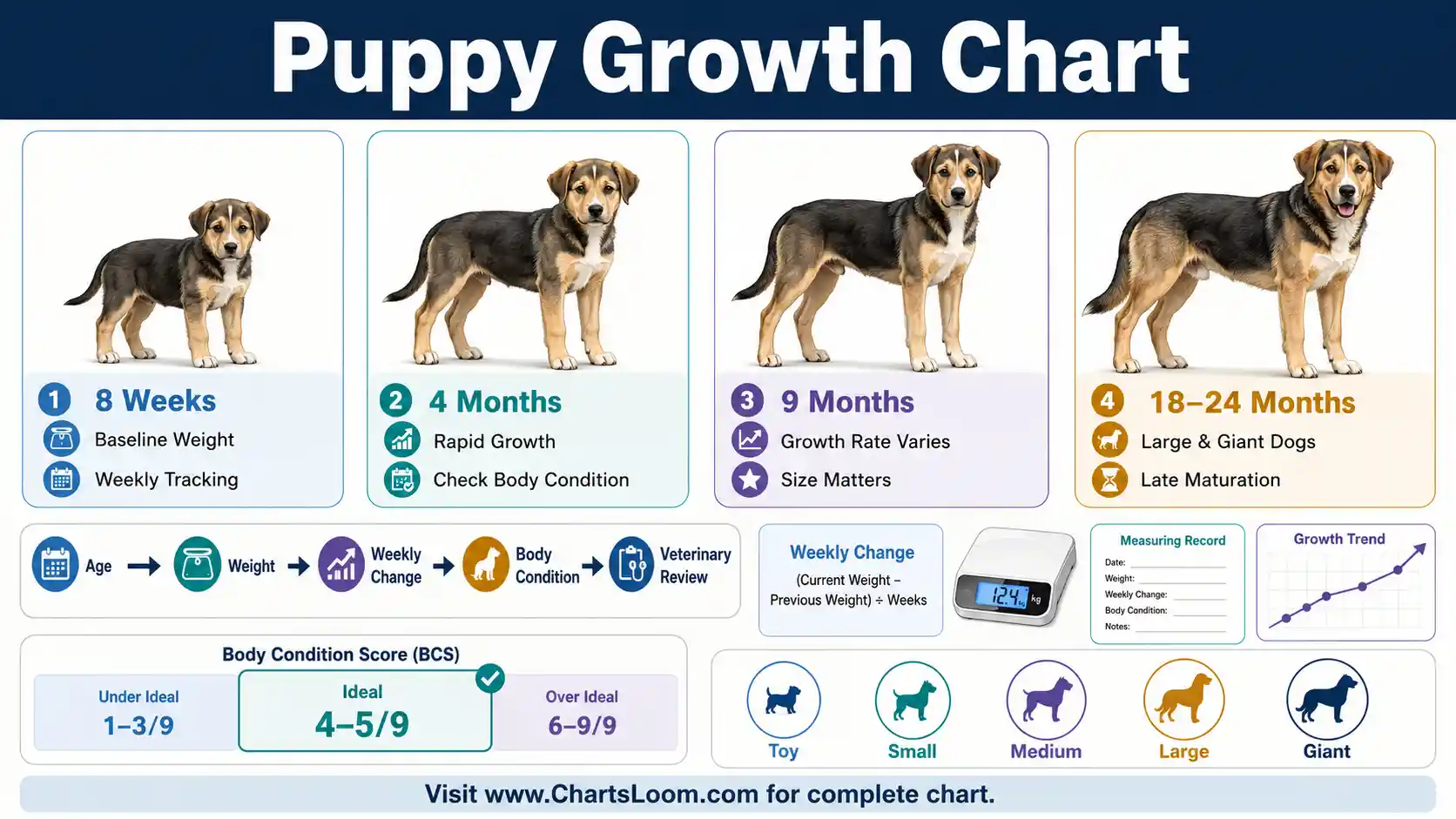
Puppy growth in practical terms
A useful puppy growth chart does not ask whether one weight is “right.” It asks whether accurately measured weights form a sensible trend for that puppy's age, expected adult size, body condition, diet, health and development. Record the original weight and unit, use comparable scale conditions, and keep symptoms beside the numbers.
AAHA describes puppyhood as birth through the end of rapid growth, roughly six to nine months with breed and size variation. That life-stage boundary is not the same as complete skeletal maturity. Many dogs approach adult size around one year, while large and giant dogs may continue developing toward two years.
Best measurement
Serial weight trend
Use the same scale, unit, timing and feeding state whenever possible.
Body condition
4–5/9 is ideal
Ribs should be easy to feel, with a visible waist and abdominal tuck.
Growth timing
Size changes maturity
Small dogs often mature earlier; large and giant dogs may grow toward two years.
Core limitation
No exact adult-weight promise
Simple multipliers can be wrong, especially for mixed and large-breed puppies.
Questions at a glance
What is a puppy growth chart?
It is a record of age, repeated weight, body condition and development used to show a trend rather than one target number.
How fast should a puppy grow?
There is no universal weekly rate. Breed, size, age, health and diet change the expected pattern.
How often should a puppy be weighed?
Young puppies need more frequent tracking; older healthy puppies can usually be checked less often unless a veterinarian advises otherwise.
When does puppyhood end?
AAHA defines it as birth to the end of rapid growth, roughly 6–9 months with breed and size variation.
When do puppies reach adult size?
Many dogs approach adult size around 9–12 months, while large and giant breeds may continue toward 18–24 months.
Can current weight predict adult weight?
Only roughly. Parent size, breed, body condition and serial growth records provide context, but no simple formula guarantees the final weight.
What BCS is ideal for a puppy?
The WSAVA nine-point scale places scores 4 and 5 in the ideal range for most dogs.
Is a heavier puppy healthier?
No. A higher number may reflect a larger frame, food and water, muscle or excess fat.
What if a puppy stops gaining weight?
Repeat the measurement and seek veterinary advice when no gain is confirmed, especially in a young puppy or when symptoms are present.
Should large puppies be fed for maximum growth?
No. The goal is controlled growth in ideal condition with an appropriate complete diet and measured portions.
When should puppy food stop?
Continue a growth-appropriate diet until skeletal maturity is reasonably established, not simply until a birthday.
Can growth charts diagnose illness?
No. Weight trends can reveal a concern, but diagnosis requires history, examination and sometimes testing.
Puppy Growth Stages by Week and Month
A chronological growth reference from birth through two years. Age bands are practical checkpoints, not a promise that every puppy reaches the same milestone on the same date.
Swipe horizontally inside the table to view every column.
| Age | Practical phase | Typical growth focus | What to track |
|---|---|---|---|
| Birth | Neonatal | Adaptation after birth | Birth weight, nursing, warmth, vigor and daily trend |
| Days 1–3 | Neonatal | Early weight trend | Use the same scale and watch for any continued loss after the first day |
| Days 4–7 | Neonatal | Steady gain expected | Record daily weight and note nursing strength and hydration |
| Week 2 | Neonatal to transitional | Rapid early growth | Weight trend, eyes and ears beginning to open, litter comparison |
| Week 3 | Transitional | Mobility increases | Weight, walking, elimination, nursing and environmental safety |
| Week 4 | Early social development | Weaning begins for many litters | Weight, stool quality, food intake and body condition |
| Week 5 | Early puppy | Coordination and play expand | Weekly weight, appetite, gait and social behavior |
| Week 6 | Early puppy | Fast structural growth | Weekly weight, body condition, meal intake and veterinary plan |
| Week 7 | Early puppy | Learning and exploration | Weight trend, handling response, stool and hydration |
| Week 8 | Early puppy | Common rehoming age | Baseline home weight, food transition, body condition and records |
| Week 9 | Early puppy | Rapid change continues | Weekly weight, appetite, sleep, play and house-training progress |
| Week 10 | Early puppy | Muscle and coordination develop | Weight, ribs and waist, gait and feeding amount |
| Week 11 | Early puppy | Growth remains fast | Weight trend, body condition and any vomiting or diarrhea |
| Week 12 | Three-month checkpoint | Visible size change | Weight, body condition, diet calories and developmental progress |
| Week 13 | Juvenile | Steady growth | Weekly or biweekly weight and consistency of measurements |
| Week 14 | Juvenile | Proportions change | Weight, limb alignment, gait, appetite and energy |
| Week 15 | Juvenile | Growth and learning continue | Weight, body condition, meal pattern and training tolerance |
| Week 16 | Four-month checkpoint | Rapid-growth monitoring | Weight, body condition, teething, gait and food review |
| 5 months | Juvenile | Height and frame expand | Biweekly weight, body condition and portion accuracy |
| 6 months | Late puppy for some small dogs | Rapid growth may begin slowing | Monthly trend, body condition, calorie needs and activity |
| 7 months | Adolescent growth | Size-class differences widen | Weight, waist, ribs, gait and food-label life stage |
| 8 months | Adolescent growth | Many small dogs near adult height | Monthly weight and body condition rather than adult-weight guessing |
| 9 months | Adolescent growth | AAHA rapid-growth window may be ending | Trend, condition, muscle and continued growth-diet need |
| 10 months | Adolescent growth | Later growth varies by size | Monthly weight, condition and veterinary review if trend stalls |
| 11 months | Adolescent growth | Frame still filling in | Weight, muscle, body condition and portion adjustment |
| 12 months | One-year checkpoint | Adult transition for many dogs | Confirm whether skeletal growth is complete before changing diet |
| 13 months | Continued growth in larger dogs | Gradual frame and muscle change | Monthly weight, condition and activity tolerance |
| 14 months | Continued growth in larger dogs | Growth rate usually slower | Weight trend, body condition and joint comfort |
| 15 months | Late growth | Large-dog maturation may continue | Weight, muscle, gait and diet-stage discussion |
| 16 months | Late growth | Individual variation dominates | Use serial records, not a single target number |
| 17 months | Late growth | Large and giant dogs may still mature | Monthly weight and condition; avoid forced weight gain |
| 18 months | Large-dog checkpoint | Some large dogs near skeletal maturity | Confirm diet transition timing with the veterinary team |
| 19 months | Late giant-breed growth | Slow structural maturation may continue | Weight, condition, gait and controlled exercise |
| 20 months | Late giant-breed growth | Frame may still fill out | Monthly trend and body-condition control |
| 21 months | Late giant-breed growth | Rate is usually modest | Watch for unexplained loss, gain or mobility change |
| 22 months | Late giant-breed growth | Approaching adult transition | Confirm skeletal maturity and diet stage |
| 23 months | Late giant-breed growth | Near two-year checkpoint | Weight, condition and adult-care baseline |
| 24 months | Two-year checkpoint | Most dogs have completed major growth | Establish adult baseline weight, BCS, muscle and activity record |
- • AAHA defines puppyhood by cessation of rapid growth rather than one universal birthday.
- • Large and giant breeds may continue structural maturation well beyond one year.
Download or export
Interactive tool
Puppy weight-trend calculator
Compare two accurately measured weights, calculate absolute and percentage change, review the puppy's current growth stage, and add body-condition context. The calculator does not predict an exact adult weight or define a medically normal rate.
Use weights from the same scale and similar feeding conditions. For a puppy weighed at 14 and 16 weeks, enter those exact whole-week ages.
Trend result
Trend
Weight increased
Growth stage
Juvenile rapid growth
Total change
0.60 kg
Per week
0.30 kg
Percent change
7.7%
Body condition: Ideal (4–5/9)
Maturity guide: Medium dogs often continue noticeable growth toward 12–15 months.
Next step: Continue comparable serial weights and record body condition, diet and symptoms.
This result describes change between two measurements. It does not predict adult weight or decide whether the growth rate is medically normal.
What it does
Calculates change, percentage change and change per week between two comparable puppy weights.
Why it helps
It keeps age, unit, size class and body condition beside the number instead of treating weight alone as health.
What it cannot do
It cannot predict exact adult weight, diagnose poor growth, assess skeletal maturity or replace a veterinarian.
Puppy Maturity Planning by Adult Size
Broad adult-size bands and maturation windows for planning. These are not registry definitions, breed standards or precise adult-weight predictions.
Swipe horizontally inside the table to view every column.
| Expected adult size | Practical adult-weight band | Rapid-growth pattern | Common maturity window | Best interpretation |
|---|---|---|---|---|
| Toy | Usually under 5 kg adult weight | Rapid growth often slows earlier | Often near adult size around 9–12 months | Use breed, parents, body condition and veterinary records |
| Small | About 5–10 kg adult weight | Rapid growth often slows by the first year | Often near adult size around 9–12 months | Do not force a target weight from a generic chart |
| Medium | About 10–25 kg adult weight | Growth may remain visible through the first year | Often matures around 12–15 months | Track trend and condition rather than one predicted number |
| Large | About 25–40 kg adult weight | Longer structural-growth period | May continue growing around 15–18 months | Use a growth diet appropriate for large-breed puppies when advised |
| Giant | Often over 40 kg adult weight | Longest growth and maturation window | May continue toward 18–24 months | Controlled, steady growth matters more than maximum speed |
- • Weight bands are practical educational groupings only.
- • Mixed breeds and individual dogs can fall outside the listed window.
Download or export
Puppy Weighing Methods and Consistency Checks
Methods for obtaining repeatable puppy weights at home or in a clinic, plus the context needed to make serial measurements useful.
Swipe horizontally inside the table to view every column.
| Method or check | Best use | How to do it | Important limitation |
|---|---|---|---|
| Digital kitchen scale | Very small neonates | Use a stable container and tare it first | Record to the scale’s reliable precision |
| Baby scale | Small puppies and litters | Place on a nonslip towel and keep one hand close | Use the same scale each session |
| Pet platform scale | Growing puppies | Center all four feet and wait for a stable reading | Repeat once if movement affects the number |
| Veterinary floor scale | Any size | Use the clinic’s recorded value as a reference point | Note whether collar, harness or carrier was included |
| Human scale by subtraction | Puppies safe to hold | Weigh yourself, then yourself holding the puppy | Less precise for very small changes |
| Crate subtraction method | Puppies that will not stand still | Weigh crate plus puppy, then empty crate | Use the same crate and bedding state |
| Kilograms | Preferred calculation unit | Record at least one decimal when the scale supports it | Do not add false decimal precision |
| Pounds | Common household unit | Convert consistently with 1 kg = 2.20462 lb | Keep the original reading in the record |
| Same time of day | Trend consistency | Morning before a meal is often easier to reproduce | Exact timing matters less than consistency |
| Same feeding state | Trend consistency | Avoid comparing one pre-meal weight with one after a large meal | Note unusual food or water intake |
| Same equipment | Trend consistency | Different scales can show different offsets | If changing scales, record an overlap comparison |
| Level floor | Scale accuracy | Avoid carpet or uneven surfaces unless the scale permits them | Check that the display returns to zero |
| Calm handling | Animal welfare | Use treats or gentle positioning without restraint force | Stop if the puppy is fearful or unsafe |
| Repeat reading | Quality check | Take two readings when the puppy moves | Use a stable result, not the highest or lowest by preference |
| Record age precisely | Growth interpretation | Use weeks for young puppies and months later | A weight without age has limited meaning |
| Record body condition | Weight interpretation | Add a 1–9 BCS rather than weight alone | A heavier puppy is not automatically healthier |
| Record context | Clinical usefulness | Note illness, food change, deworming, surgery or travel | Context helps explain abrupt changes |
| Photograph scale display | Optional documentation | Useful when several people share care | Do not rely on photos instead of a written trend |
- • Trend quality depends on using comparable equipment and conditions.
- • Never leave a puppy unattended on an elevated scale.
Download or export
Interpret the number
Weight and body condition answer different questions
Weight shows total mass. Body condition estimates fat stores through ribs, waist and abdominal tuck. A puppy can gain weight while becoming too heavy, or remain smaller than a littermate while maintaining a healthy individual trend.
Puppy Body Condition Score Chart
The WSAVA nine-point canine body-condition framework. A growing puppy should be assessed by ribs, waist and abdominal tuck, not by weight alone.
Swipe horizontally inside the table to view every column.
| Score | Category | Ribs and bones | Waist, tuck and fat |
|---|---|---|---|
| 1/9 | Severely under ideal | Ribs, spine and pelvis obvious from a distance | No discernible fat; muscle loss may be present |
| 2/9 | Markedly under ideal | Ribs, lumbar vertebrae and pelvis easily visible | No palpable fat; other bony points may show |
| 3/9 | Under ideal | Ribs easy to feel and may be visible | Obvious waist and abdominal tuck |
| 4/9 — ideal body condition | Ideal | Ribs easy to feel with minimal fat cover | Waist easy to see; abdominal tuck evident |
| 5/9 — ideal body condition | Ideal | Ribs palpable without excess fat | Waist visible behind ribs; abdomen tucked |
| 6/9 | Slightly over ideal | Ribs palpable with slight excess fat | Waist present but less prominent |
| 7/9 | Over ideal | Ribs difficult to feel through heavy cover | Waist absent or barely visible; fat near back and tail base |
| 8/9 | Markedly over ideal | Ribs not palpable or only with pressure | No waist; heavy fat deposits and possible abdominal distention |
| 9/9 | Severely over ideal | Massive fat deposits over chest, spine and tail base | No waist or tuck; fat may extend to neck and limbs |
- • Scores 4–5/9 are the WSAVA ideal range for most dogs.
- • Coat, body shape and breed can make visual assessment difficult; palpation matters.
Download or export
Puppy Weight Trend Formulas and Interpretation
Simple calculations for comparing two or more puppy weights. The math describes change; it does not diagnose whether the rate is healthy.
Swipe horizontally inside the table to view every column.
| Measure | Formula or method | Example | What it tells you |
|---|---|---|---|
| Absolute change | Current weight − previous weight | 8.4 kg − 7.8 kg = 0.6 kg | Shows net gain or loss |
| Elapsed time | Current age − previous age | 14 weeks − 12 weeks = 2 weeks | Use the same age unit |
| Gain per week | Absolute change ÷ elapsed weeks | 0.6 kg ÷ 2 = 0.3 kg/week | Useful for comparing intervals of different length |
| Percent change | (Change ÷ previous weight) × 100 | (0.6 ÷ 7.8) × 100 = 7.7% | Describes proportional change, not health by itself |
| Kilograms to pounds | kg × 2.20462 | 8.4 × 2.20462 = 18.52 lb | Keep original unit in the record |
| Pounds to kilograms | lb ÷ 2.20462 | 18.5 ÷ 2.20462 = 8.39 kg | Round only after calculation |
| No net change | Current weight = previous weight | 5.2 kg to 5.2 kg | Recheck measurement and consider age, appetite and health |
| Weight decrease | Current weight < previous weight | 6.1 kg to 5.8 kg | Confirm the scale and contact a veterinarian when unexplained |
| Single reading | One weight only | 9.0 kg at 16 weeks | Cannot show growth direction |
| Serial trend | Three or more comparable readings | 7.8 → 8.4 → 9.0 kg | More informative than one isolated value |
| Scale offset | New scale differs from old scale | Clinic 10.2 kg; home 10.0 kg | Record the equipment change before interpreting 0.2 kg |
| Meal effect | Recent intake changes scale weight | Pre-meal 12.0 kg; post-meal 12.4 kg | Use consistent timing for trend work |
| Growth plus condition | Weight trend + BCS | Weight rises while BCS stays 4/9 | Suggests the gain may reflect normal growth |
| Excess-energy clue | Weight trend + rising BCS | Weight rises while BCS moves 5/9 to 7/9 | Review portions and veterinary nutrition advice |
| Illness context | Trend + symptoms | Weight falls with diarrhea | Symptoms matter more than the formula |
| Litter comparison | Puppy versus littermates | One puppy is smaller but gains steadily | Relative size alone does not establish a problem |
| Adult-weight guess | Current weight × simple multiplier | Not recommended as a precise method | Breed and growth timing create large error |
| Growth percentile | Repeated position on a validated chart | Stable curve position over time | Requires the correct chart and accurate age and weight |
| Plateau near maturity | Little change over several readings | Stable weight at 14–16 months | May be normal when growth is complete |
| Plateau in a young puppy | Little change during rapid growth | Stable weight at 8–10 weeks | Recheck immediately and seek veterinary advice |
- • Use unrounded values for calculation, then round the displayed result.
- • Symptoms, body condition and age can outweigh a reassuring percentage.
Download or export
Puppy Growth Record Fields
A complete record structure for turning isolated weights into a useful growth history that a veterinary team can interpret.
Swipe horizontally inside the table to view every column.
| Field | When to record | What to enter | Why it matters |
|---|---|---|---|
| Date | Every entry | Calendar date of measurement | Prevents age and interval errors |
| Age | Every entry | Weeks for young puppies; months later | Growth interpretation depends on age |
| Weight | Every entry | Original scale reading and unit | Core trend variable |
| Scale used | When equipment may vary | Home, clinic, baby scale or floor scale | Explains offsets between readings |
| Time of day | When possible | Morning, afternoon or evening | Improves consistency |
| Feeding state | When possible | Before meal, after meal or unknown | Large meals can shift short-term weight |
| Body condition score | At least monthly | WSAVA 1–9 score | Separates fatness from body weight |
| Muscle condition | At veterinary visits | Normal or degree of muscle loss | A puppy can gain fat without ideal muscle development |
| Food name | After any diet change | Complete product name and life-stage claim | Links growth changes to diet |
| Food amount | Daily | Grams, cups, cans or pouches | Allows portion review |
| Food calories | When available | kcal per cup, can or kilogram | Makes different foods comparable |
| Meals per day | After schedule changes | Number and approximate times | Supports feeding-management review |
| Treats and extras | Daily or weekly summary | Type and amount | Hidden calories can change body condition |
| Appetite | Each weigh-in | Normal, reduced or increased | Adds clinical context |
| Stool | Each weigh-in | Normal, soft, diarrhea or constipation | Persistent digestive signs can affect growth |
| Vomiting | Whenever present | Count and timing | May require prompt veterinary advice |
| Water intake | When noticeably different | Normal, increased or decreased | Supports health assessment |
| Activity | Each weigh-in | Usual, reduced or unusually restless | Changes can alter intake and indicate illness |
| Gait and comfort | Each weigh-in | Normal, limping, stiffness or reluctance | Important during skeletal growth |
| Medication or deworming | Whenever given | Product, date and veterinary direction | Can explain timing and health changes |
| Vaccination | Whenever given | Date and product record location | Keeps preventive care connected to age |
| Illness or procedure | Whenever relevant | Diagnosis, surgery, hospitalization or recovery | Explains interrupted growth |
| Photo | Optional monthly | Same stance and camera angle | Shows body-shape change but does not replace BCS |
| Veterinary note | After examinations | Target range, concerns and next review | Keeps professional advice with the trend |
- • Keep original values and units rather than overwriting them after conversion.
- • Bring the record to veterinary visits when growth, diet or illness is discussed.
Download or export
Support steady development
Feed and exercise for growth, not maximum size
A complete growth diet, measured portions, ideal body condition, progressive activity, good traction and adequate rest are more useful than trying to make a puppy grow faster. Large and giant puppies need particular attention to controlled energy intake and skeletal comfort.
Puppy Meal Frequency by Age and Size
Common meal-frequency starting patterns across age and expected adult size. Product instructions and veterinary guidance take priority.
Swipe horizontally inside the table to view every column.
| Age band | Expected adult size | Common starting pattern | Growth note |
|---|---|---|---|
| 4–8 weeks | Toy/small | 4 small meals | Weaning and stomach capacity vary; use a complete growth diet |
| 4–8 weeks | Medium | 4 small meals | Monitor stool, hydration and steady intake |
| 4–8 weeks | Large | 4 small meals | Use portion control and an appropriate growth formula |
| 4–8 weeks | Giant | 4 small meals | Avoid free-choice overfeeding; monitor condition closely |
| 8–12 weeks | Toy/small | 3–4 meals | Keep meal timing consistent during food transitions |
| 8–12 weeks | Medium | 3–4 meals | Adjust by calories and condition, not bowl volume alone |
| 8–12 weeks | Large | 3–4 meals | Controlled energy intake supports steady growth |
| 8–12 weeks | Giant | 3–4 meals | Large-breed growth food may be appropriate |
| 3–6 months | Toy/small | 3 meals | Review portions as rapid growth begins to slow |
| 3–6 months | Medium | 3 meals | Track weight and BCS at regular intervals |
| 3–6 months | Large | 3 meals | Avoid supplements unless specifically directed |
| 3–6 months | Giant | 3 meals | Do not chase the highest possible weekly gain |
| 6–9 months | Toy/small | 2–3 meals | Many small dogs are approaching the end of rapid growth |
| 6–9 months | Medium | 2–3 meals | Continue growth diet until appropriate transition |
| 6–9 months | Large | 2–3 meals | Structural growth is still active |
| 6–9 months | Giant | 2–3 meals | Continue measured feeding and body-condition checks |
| 9–12 months | Toy/small | Usually 2 meals | Discuss adult-diet timing when growth is complete |
| 9–12 months | Medium | Usually 2 meals | Confirm skeletal maturity before switching |
| 9–12 months | Large | Usually 2 meals | Growth may continue beyond one year |
| 9–12 months | Giant | Usually 2 meals | Continue large-breed growth management |
| 12–24 months | Toy/small | Usually 2 meals | Use adult maintenance only after appropriate transition |
| 12–24 months | Medium | Usually 2 meals | Monitor for post-growth excess weight |
| 12–24 months | Large | Usually 2 meals | Some dogs still require growth nutrition |
| 12–24 months | Giant | Usually 2 meals | Maturation may continue toward two years |
- • Meal frequency is not a calorie prescription.
- • Toy puppies, medical conditions and individual tolerance may require a different schedule.
Download or export
Puppy Growth Diet Label Checklist
What to read on a commercial puppy-food label before converting a package recommendation into measured daily portions.
Swipe horizontally inside the table to view every column.
| Label item | What to find | How to use it |
|---|---|---|
| Nutritional adequacy statement | States growth, reproduction, all life stages or adult maintenance | Choose a diet appropriate for growth until skeletal maturity |
| Large-size growth claim | Specifies growth of large-size dogs when relevant | Important for puppies expected to become large or giant |
| Calorie statement | kcal per cup, can, pouch or kilogram | Allows accurate portion calculations |
| Feeding directions | Starting amount by current weight or age | Treat as a starting point, then adjust by condition |
| Life-stage wording | Growth versus adult maintenance | Adult-only food may not meet growth needs |
| Complete and balanced claim | Meets an established nutrient profile or feeding test | Avoid using treats or toppers as the main diet |
| Manufacturer contact | Phone, email or website support | Useful for calorie and nutrient questions |
| Lot code | Printed production identifier | Keep for recall or quality questions |
| Best-by date | Product quality date | Store and rotate food appropriately |
| Serving unit | Cup, gram, can or pouch | Use the same unit as the feeding calculation |
| Measuring method | Grams are more repeatable than an unlevel cup | Kitchen scales reduce portion variation |
| Treat allowance | Extras included in total calories | Treats should not displace balanced growth nutrition |
| Supplement warning | Added calcium, vitamins or minerals | Do not add without veterinary direction |
| Food transition plan | Gradual change over several days | Abrupt changes may cause digestive upset |
| Storage instructions | Seal, refrigerate or discard after opening | Protects freshness and safety |
| Ingredient list | Ingredients listed by weight | Does not by itself prove nutritional suitability |
| Guaranteed analysis | Minimums and maximums for selected nutrients | Cannot be compared across moisture levels without calculation |
| Moisture content | Dry, canned and fresh foods differ | Explains why cup or can weights are not directly comparable |
| All-life-stages wording | Usually formulated to growth-level requirements | May be suitable but still requires calorie control |
| Veterinary therapeutic diet | Used for a diagnosed condition | Use only under veterinary direction when indicated |
- • A complete and balanced growth diet should supply required nutrients without unsupervised supplementation.
- • Contact the manufacturer or veterinary team when calorie or adequacy information is unclear.
Download or export
Large and Giant Puppy Growth Priorities
Growth-management priorities for puppies expected to become large or giant. The aim is controlled development and ideal condition, not the fastest possible gain.
Swipe horizontally inside the table to view every column.
| Topic | Prefer | Avoid | Reason |
|---|---|---|---|
| Goal | Steady, controlled growth | Maximum growth speed | Faster is not automatically healthier |
| Diet type | Growth diet appropriate for expected adult size | Adult food chosen only to slow growth | Nutrient balance matters as well as calories |
| Portioning | Measured meals | Unlimited free feeding | Portion control supports body-condition management |
| Body condition | Lean ideal range, often 4–5/9 | Keeping a puppy visibly heavy | Excess fat adds load without improving frame size |
| Calcium | Amount supplied by a complete diet | Unsupervised calcium supplements | Excess or imbalance can be harmful during growth |
| Treats | Small, counted portions | Large untracked extras | Extras can distort the intended diet balance |
| Weight target | Individual trend with veterinary review | Generic breed target treated as mandatory | Parents and lines vary |
| Exercise | Controlled, age-appropriate activity | Forced repetitive high-impact work | Growing joints need progressive loading |
| Stairs | Managed and taught safely | Repeated racing on slippery stairs | Environment affects injury risk |
| Jumping | Low, occasional and controlled | Repeated high jumps for conditioning | Delay demanding impact work until mature |
| Running | Self-paced play on safe footing | Long forced road runs | Endurance plans should match maturity |
| Flooring | Good traction | Persistent slipping | Traction supports normal movement |
| Growth plate concern | Veterinary review for pain or deformity | Waiting through persistent lameness | Early assessment matters |
| Limping | Stop activity and seek advice | Training through pain | Pain is not a normal growth milestone |
| Weight checks | Regular comparable measurements | Occasional guesses by appearance | Trend detects drift earlier |
| BCS checks | Ribs, waist and tuck assessed | Weight alone | Frame growth and fat gain are different |
| Food changes | Planned transition | Frequent switching to chase faster gain | Consistency helps interpretation |
| Neutering discussion | Individual veterinary timing | One rule for every breed and dog | Size, health and context matter |
| Maturity timing | May extend toward 18–24 months | Assuming one year means fully mature | Large and giant breeds mature later |
| Adult transition | After skeletal maturity is reasonably established | Automatic birthday switch | Diet stage should match development |
| Monitoring | Weight, BCS, muscle, gait and diet together | One number used in isolation | Integrated assessment is safer |
| Professional input | Veterinarian or veterinary nutritionist when needed | Online growth prediction as diagnosis | Charts cannot assess the individual puppy |
- • Persistent lameness, pain or limb change needs veterinary assessment.
- • Do not add calcium or other growth supplements to a complete diet without professional direction.
Download or export
Puppy Physical Development Milestones
Typical physical-development checkpoints from birth through young adulthood. Timing varies with breed, size, health and environment.
Swipe horizontally inside the table to view every column.
| Age | Developmental focus | Typical change | Care implication |
|---|---|---|---|
| Birth | Dependent neonate | Cannot regulate temperature well | Warmth, nursing and close monitoring |
| First week | Limited mobility | Crawling and sleeping dominate | Safe bedding and daily trend |
| Around 2 weeks | Sensory transition | Eyes and ears begin opening | Gentle handling and low-stress environment |
| Around 3 weeks | Walking begins | Coordination improves rapidly | Nonslip footing and safe exploration |
| Around 4 weeks | Play and weaning expand | Teeth begin emerging | Appropriate food texture and litter hygiene |
| 5–6 weeks | Fast motor learning | Running, play and bite interaction increase | Safe social learning and rest |
| 7–8 weeks | Early puppy independence | More reliable eating and elimination | Baseline records and gradual transitions |
| 9–10 weeks | Rapid growth | Body proportions change quickly | Weekly weight and BCS |
| 11–12 weeks | Strength increases | Longer play periods | Avoid excessive forced activity |
| 13–14 weeks | Juvenile development | Coordination and confidence vary | Positive exposure and rest |
| 15–16 weeks | Four-month stage | Permanent-tooth transition approaches | Chew safety and growth review |
| 5 months | Leg and frame growth | Adolescent proportions may look uneven | Track gait and comfort |
| 6 months | Adolescent transition | Sexual maturation may begin in some dogs | Discuss individual preventive plan |
| 7 months | Muscle and coordination build | Growth rate varies by size | Progressive exercise |
| 8 months | Small dogs may near adult height | Frame may still fill out | Continue condition monitoring |
| 9 months | Rapid growth may slow | AAHA puppy-stage boundary varies | Do not assume every dog is finished |
| 10 months | Later juvenile growth | Large dogs remain immature | Maintain growth-appropriate nutrition |
| 11 months | Approaching one year | Body composition can change quickly | Review portions and activity |
| 12 months | One-year checkpoint | Many dogs near adult size | Confirm skeletal maturity before diet change |
| 13 months | Large-dog continued growth | Muscle and frame continue developing | Monthly trend |
| 14 months | Late growth | Rate usually slower | Watch condition, gait and recovery |
| 15 months | Large-dog maturation | Some dogs near adult height | Avoid forced bulking |
| 16 months | Individual variation | Breed and genetics dominate | Use serial records |
| 17 months | Late growth | Large and giant dogs may still develop | Controlled conditioning |
| 18 months | Large-dog checkpoint | Many large dogs approach maturity | Discuss adult transition |
| 19 months | Giant-breed growth | Slow maturation may continue | Monitor joints and body condition |
| 20 months | Giant-breed growth | Frame may continue filling | Maintain measured feeding |
| 21 months | Late maturation | Growth becomes subtle | Compare monthly, not daily |
| 22 months | Adult transition approaches | Skeletal maturity likely near for many giants | Review diet stage |
| 23 months | Near two years | Establish adult baseline | Weight, BCS and muscle record |
| 24 months | Two-year checkpoint | Most major growth complete | Shift focus to adult maintenance |
| Beyond 24 months | Young adult | Social and muscle maturation may continue | Adult wellness and conditioning |
- • Milestones overlap and should not be used to diagnose delayed development.
- • A puppy that loses a previously acquired ability needs veterinary assessment.
Download or export
Puppy Exercise and Growth-Plate Considerations
Practical activity guidance that favors self-paced movement, traction, rest and gradual progression during growth.
Swipe horizontally inside the table to view every column.
| Age or topic | Prefer | Avoid | Growth-aware note |
|---|---|---|---|
| Under 8 weeks | Free movement in a safe litter area | Forced walks or repetitive stairs | Very short self-directed activity |
| 8–10 weeks | Brief exploration and play | Long-distance walking | Several short sessions with naps |
| 10–12 weeks | Short leash practice and play | Jogging beside a person | Stop before fatigue |
| 12–16 weeks | Varied surfaces and controlled games | Repeated high jumps | Focus on coordination |
| 4–5 months | Short walks and training games | Endurance conditioning | Increase slowly |
| 5–6 months | Self-paced play and sniffing | Sustained forced running | Monitor gait and recovery |
| 6–9 months | Progressive walks and skill work | High-impact repetition | Adapt to size and breed |
| 9–12 months | Longer low-impact activity | Automatic adult workload | Some dogs are still growing |
| 12–15 months | Conditioning for many small/medium dogs | One plan for all sizes | Confirm maturity and soundness |
| 15–18 months | Gradual adult work for many large dogs | Sudden workload spikes | Build volume before intensity |
| 18–24 months | Adult transition for giant breeds | Assuming maturity from size alone | Veterinary guidance for demanding sport |
| Nonslip flooring | Traction during play | Polished slippery surfaces | Reduce repeated falls and splaying |
| Stairs | Calm, supervised learning | Repeated racing up and down | Use barriers when needed |
| Jumping | Low obstacles used sparingly | High repetitive jumping | Growth plates and coordination vary |
| Fetch | Short sessions on safe footing | Long repetitive sprinting | Use rest and avoid sharp turns |
| Swimming | Supervised and gradual | Assuming every puppy can swim | Use safe entry and exit |
| Dog parks | Careful age, vaccine and temperament assessment | Uncontrolled rough play | Choose compatible partners |
| Heat | Cool periods and water access | Hard exercise in high heat | Puppies can overheat quickly |
| Cold | Age- and coat-appropriate exposure | Prolonged chilling | Very young puppies regulate temperature poorly |
| Rest | Frequent sleep and quiet recovery | Keeping a tired puppy active | Growth and learning require rest |
| Pain | Stop and assess | Training through limping | Pain is not normal conditioning |
| Fatigue | Shorten the next session | Adding work to build toughness | Watch lagging, lying down or poor coordination |
| Growth spurts | Reduce difficulty temporarily | Expecting linear performance | Balance may change during rapid growth |
| Sport preparation | Individual veterinary and training plan | Generic age rule alone | Breed, structure and health matter |
- • There is no single exercise formula that fits every breed and puppy.
- • Pain, limping or reluctance to move is not a normal training response.
Download or export
Puppy Teething and Oral Development Chart
A broad puppy teething timeline with safe-chewing guidance and signs that need veterinary dental assessment.
Swipe horizontally inside the table to view every column.
| Age or issue | Expected oral stage | What owners may notice | Action |
|---|---|---|---|
| Birth | No erupted teeth or very few | Nursing | Check for obvious oral abnormalities during veterinary care |
| 2–3 weeks | Deciduous teeth begin erupting | Mouthing starts | Use safe soft items |
| 3–4 weeks | More baby teeth appear | Weaning texture changes | Monitor nursing comfort and mouth |
| 4–6 weeks | Deciduous dentition develops | Chewing increases | Avoid brittle or very hard objects |
| 6–8 weeks | Most baby teeth present | Puppy chewing is active | Begin gentle mouth handling |
| 8–12 weeks | Baby teeth in use | Chewing supports exploration | Redirect from unsafe household items |
| 12–16 weeks | Permanent replacement may begin | Loose baby teeth possible | Blood spotting can be mild; pain or swelling is not ignored |
| 4 months | Incisor replacement common | Chewing may intensify | Offer appropriately sized chew options |
| 5 months | Canines and premolars replacing | Mouth can be sensitive | Check retained baby teeth at visits |
| 6 months | Many permanent teeth present | Teething often nearing completion | Veterinary oral exam remains important |
| 7 months | Adult dentition usually established | Chewing behavior may continue | Behavioral chewing can outlast teething |
| 8–12 months | Adult teeth in function | Jaw and chewing habits mature | Start consistent home dental care |
| Retained baby tooth | Baby tooth remains beside adult tooth | Crowding and plaque risk | Veterinary assessment |
| Broken tooth | Missing piece or exposed center | Pain may be subtle | Prompt veterinary examination |
| Malocclusion | Teeth contact abnormally | May injure palate or lips | Veterinary dental assessment |
| Bad breath | Persistent strong odor | May indicate oral disease | Not a normal growth milestone |
| Facial swelling | Asymmetry or swelling | Possible dental or other disease | Urgent veterinary advice |
| Refusal to eat | Reduced intake with oral discomfort | Growth may be affected | Prompt veterinary assessment |
| Safe chew size | Too large to swallow whole | No sharp splinters | Supervise and replace damaged items |
| Very hard chews | Can fracture teeth | Hardness is not proof of dental benefit | Choose safer options with veterinary guidance |
- • Eruption timing varies and cannot confirm exact age.
- • Do not use extremely hard chews that can fracture teeth.
Download or export
Puppy Growth Warning Signs
Weight, appetite, digestive, breathing, mobility and body-condition changes that should override reassurance from a generic growth chart.
Swipe horizontally inside the table to view every column.
| Sign | Why it matters | Next step |
|---|---|---|
| Weight loss after the first day of life | Neonatal concern | Reweigh and contact a veterinarian promptly |
| No measurable gain in a young puppy | Possible intake or health problem | Confirm scale and seek veterinary advice |
| Sudden drop on one scale reading | Measurement error or true change | Repeat carefully; assess appetite and symptoms |
| Persistent downward trend | Not normal growth | Veterinary examination |
| Repeated vomiting | Dehydration and reduced intake risk | Prompt veterinary advice |
| Persistent diarrhea | Fluid and nutrient loss | Veterinary advice, especially in young puppies |
| Refusal to eat | Growth and glucose risk | Prompt assessment; urgency depends on age and symptoms |
| Marked lethargy | Systemic illness possible | Urgent veterinary evaluation |
| Weakness or collapse | Emergency sign | Immediate veterinary care |
| Bloated or painful abdomen | Potential emergency | Immediate veterinary care |
| Difficulty breathing | Emergency sign | Immediate veterinary care |
| Pale, blue or gray gums | Emergency sign | Immediate veterinary care |
| Persistent coughing | Respiratory disease possible | Veterinary assessment |
| Fever or unusually low temperature | Illness or neonatal instability | Veterinary assessment |
| Limping | Pain or injury | Stop activity and arrange assessment |
| Joint swelling | Orthopedic concern | Veterinary examination |
| Angular limb change | Growth or orthopedic concern | Prompt veterinary assessment |
| Reluctance to stand or walk | Pain, weakness or illness | Urgent assessment |
| BCS 1–3/9 | Under ideal condition | Review intake and health with the veterinary team |
| BCS 6–9/9 | Over ideal condition | Review portions, treats and growth plan |
| Rapid rise in BCS | Fat gain may exceed frame growth | Adjust only with veterinary or nutrition guidance |
| Pot belly with poor condition | Parasites or disease possible | Veterinary fecal and physical assessment |
| Poor coat plus poor growth | Nutrition or disease concern | Veterinary assessment and diet review |
| Excessive drinking or urination | Possible health problem | Veterinary assessment |
| Persistent mouth pain or swelling | Dental or oral disease | Veterinary dental examination |
| Owner concern despite normal chart | Individual change matters | Trust the observed change and seek professional advice |
- • Emergency signs require immediate veterinary care rather than online calculation.
- • Very young, toy-size and medically fragile puppies can deteriorate quickly.
Download or export
Puppy Growth Tracking Worked Examples
Worked examples showing weight change, rate, percentage, scale effects, body-condition context and maturity limitations.
Swipe horizontally inside the table to view every column.
| Example | Inputs | Change | Calculated result | Interpretation |
|---|---|---|---|---|
| 1 | 12 to 14 weeks; 7.8 to 8.4 kg | 0.6 kg over 2 weeks | 0.3 kg/week; 7.7% gain | Record BCS and continue serial tracking |
| 2 | 10 to 11 weeks; 2.4 to 2.4 kg | No net change | 0 kg/week | Repeat measurement and discuss promptly if confirmed |
| 3 | 16 to 18 weeks; 12.0 to 13.2 kg | 1.2 kg over 2 weeks | 0.6 kg/week; 10% gain | Interpret with size, BCS, diet and gait |
| 4 | 20 to 24 weeks; 18 to 21 lb | 3 lb over 4 weeks | 0.75 lb/week; 16.7% gain | Keep pounds or convert consistently |
| 5 | 30 to 34 weeks; 15.0 to 15.6 kg | 0.6 kg over 4 weeks | 0.15 kg/week; 4% gain | Slower late growth may be expected |
| 6 | 52 to 60 weeks; 28.0 to 28.4 kg | 0.4 kg over 8 weeks | 0.05 kg/week; 1.4% gain | May be near a plateau; confirm maturity |
| 7 | 8 to 9 weeks; 1.1 to 0.9 kg | 0.2 kg loss | Negative trend | Prompt veterinary advice after confirming scale |
| 8 | 14 to 16 weeks; 5.0 to 5.7 kg | 0.7 kg over 2 weeks | 0.35 kg/week; 14% gain | A percentage alone does not define normality |
| 9 | Same puppy on two scales | Home 9.8 kg; clinic 10.1 kg | 0.3 kg equipment difference | Do not interpret as biological gain without overlap |
| 10 | Pre-meal and post-meal | 10.0 kg and 10.3 kg | 0.3 kg short-term difference | Use consistent feeding state |
| 11 | Weight rises; BCS stays 4/9 | Lean growth trend | Frame and tissue likely increasing | Continue measured feeding and monitoring |
| 12 | Weight rises; BCS 5/9 to 7/9 | Condition rising above ideal | Fat gain likely contributes | Review calories and treats |
| 13 | Small puppy at 10 months | Weight stable over 6 weeks | Possible adult plateau | Confirm growth completion before diet transition |
| 14 | Giant puppy at 12 months | Weight still increasing slowly | Continued growth plausible | Do not force an adult-food switch by birthday alone |
| 15 | Littermate is heavier | Both puppies gain steadily | Different size does not prove disease | Use each puppy’s own trend and condition |
| 16 | One isolated weight | 6.8 kg at 15 weeks | No rate can be calculated | Collect another comparable reading |
| 17 | Decimal age entry | 14.5 weeks | Tool requires whole weeks | Record age as 14 or 15 only if actual timing is known; otherwise use dates |
| 18 | Uncertain adult size class | Mixed-breed puppy | Maturity window uncertain | Use parent history, veterinary assessment and repeated growth records |
- • Examples illustrate arithmetic only and are not target growth rates.
- • Use a puppy’s own serial record and veterinary assessment.
Download or export
Practical limitations
What this chart and calculator cannot establish
Exact adult weight
No simple multiplier accounts for every breed, mixed ancestry, body condition and growth pattern.
Normal medical growth rate
A calculated weekly gain is descriptive and needs clinical context.
Skeletal maturity
Calendar age and size class cannot confirm that growth plates and joints are mature.
Diet prescription
The correct food and calories depend on the individual puppy and product.
Orthopedic diagnosis
Limping, pain, swelling or limb deviation requires examination.
Behavior prediction
Weight and growth stage do not determine temperament or training outcome.
Frequently asked questions
How fast should a puppy gain weight?
There is no universal weekly rate. Breed, expected adult size, age, diet and health change the pattern, so repeated comparable weights and body condition are more useful than one target number.
How often should I weigh my puppy?
Young puppies benefit from frequent tracking, while older healthy puppies can usually be checked less often. Use a veterinary schedule when growth, illness or nutrition is a concern.
Can puppy weight predict adult weight exactly?
No. Simple multipliers can be widely wrong, especially for mixed breeds and large dogs. Parent size, breed, age, body condition and serial growth records improve context but still do not guarantee a final weight.
When do puppies stop growing?
Many dogs approach adult size around 9–12 months, while large and giant breeds may continue developing toward 18–24 months. Skeletal, muscle and social maturity do not always finish together.
What body condition score is ideal for a puppy?
The WSAVA nine-point chart places 4/9 and 5/9 in the ideal range for most dogs. Ribs should be easy to feel, with a visible waist and abdominal tuck.
Should I be able to see my puppy’s ribs?
Breed and coat matter. Ribs should generally be easy to feel without a thick fat layer; some may be faintly visible in a lean puppy, but prominent bones or muscle loss need assessment.
What should I do if my puppy loses weight?
Repeat the measurement under comparable conditions and contact a veterinarian when the loss is confirmed or accompanied by poor appetite, vomiting, diarrhea, weakness or other symptoms.
Is a heavier puppy healthier?
No. Weight includes frame, muscle, food, water and fat. A heavier number can reflect excess body fat, so use body condition and growth trend together.
Should large-breed puppies grow as fast as possible?
No. Large and giant puppies should grow steadily in ideal condition, using an appropriate complete growth diet and measured portions rather than trying to maximize weekly gain.
Can I add calcium to help bones grow?
Do not add calcium or mineral supplements to a complete puppy diet unless a veterinarian specifically directs it. Imbalance can be harmful during skeletal growth.
When should a puppy switch to adult food?
Switch after the puppy’s growth needs and skeletal maturity are reasonably established, not simply on the first birthday. The correct timing varies by expected adult size and individual development.
Why does my puppy look lanky during a growth spurt?
Body proportions can change unevenly during normal growth. Persistent weakness, pain, limb deviation, poor condition or loss of function is different and needs veterinary assessment.
Do littermates need to weigh the same?
No. Genetics, sex, birth weight, intake and health can create differences. Each puppy should show an appropriate individual trend and body condition.
Can exercise stunt puppy growth?
Normal self-paced movement supports development. The concern is excessive forced, repetitive or high-impact work, especially when the puppy is tired, painful or not skeletally mature.
What is the best puppy growth chart?
The best chart is one matched to the puppy’s age and expected adult size, used with accurate serial weights, body-condition scoring and veterinary interpretation rather than as a stand-alone diagnosis.
Sources
External URLs are displayed as plain text. Table source labels link only to these entries.
American Animal Hospital Association — 2019 AAHA Canine Life Stage Guidelines
Defines the puppy stage as birth to cessation of rapid growth, roughly 6–9 months with breed and size variation, and recommends tracking body weight, body condition, muscle condition, breed, size, diet and feeding management during growth.
https://www.aaha.org/wp-content/uploads/globalassets/02-guidelines/canine-life-stage-2019/2019-aaha-canine-life-stage-guidelines-final.pdf
World Small Animal Veterinary Association — Dog Body Condition Score
Provides the nine-point canine body-condition scale used to distinguish under-ideal, ideal and over-ideal condition through ribs, waist, abdominal tuck and fat deposits.
https://wsava.org/wp-content/uploads/2025/06/WSAVA_BCSCat_BCSDog_Nutrition_250612.pdf
Merck Veterinary Manual — Puppy Care
Explains puppy nutrition, growth-stage needs and the wide difference in maturation timing, with many dogs reaching adulthood around 9–12 months while large and giant breeds may continue maturing for nearly two years.
https://www.merckvetmanual.com/dog-owners/routine-care-of-dogs/puppy-care