Science & Chemistry
Solubility Rules Chart
Use common aqueous solubility rules to classify ionic compounds, spot the exception ions that form precipitates, work through double-replacement reactions, and know when a qualitative chart should give way to Ksp and equilibrium data.
Solubility rules are teaching heuristics for common ionic compounds in water. “Insoluble” does not mean zero solubility, borderline classifications differ among textbooks, and actual precipitation can depend on concentration, temperature, pH, complex formation, and equilibrium constants.
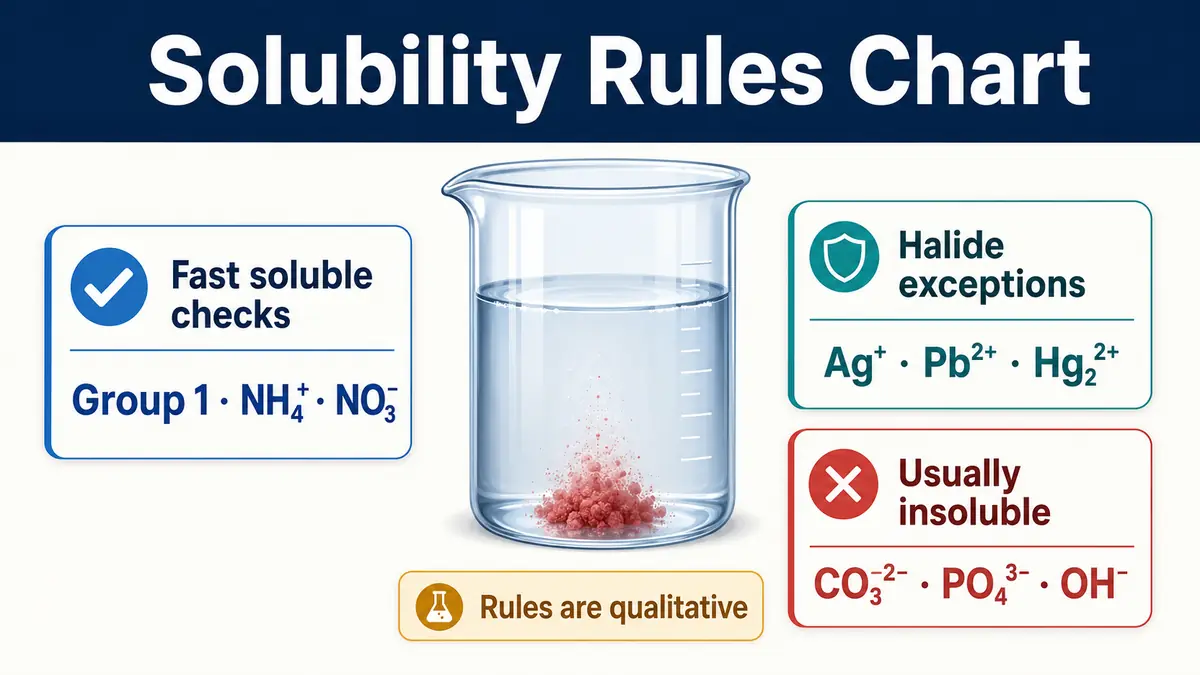
How solubility rules predict aqueous behavior
Solubility rules compress recurring patterns in ionic-compound behavior into a fast decision system. OpenStax uses them to predict which product of an aqueous ion-exchange reaction is likely to form a solid precipitate.
Nitrate salts, Group 1 salts, and ammonium salts are the fastest soluble checks. Chlorides, bromides, iodides, and sulfates are usually soluble but require exception checks. Carbonates, phosphates, chromates, many sulfides, and many hydroxides are usually classified as insoluble unless a soluble exception applies.
The word insoluble is qualitative. IUPAC defines solubility quantitatively through the composition of a saturated solution, so even a salt called insoluble has finite equilibrium solubility.
Borderline lists can differ. Chemistry LibreTexts, for example, calls Ca²⁺, Sr²⁺, and Ba²⁺ hydroxides sparingly soluble in one common table, while OpenStax uses a simpler hydroxide exception list. The safest approach is to follow the stated course rule set and flag borderline salts instead of inventing certainty.
Fastest checks
Group 1 · NH₄⁺ · NO₃⁻
These high-priority families are treated as soluble in common introductory aqueous rule tables.
Halide exceptions
Ag⁺ · Pb²⁺ · Hg₂²⁺
Chloride, bromide, and iodide salts are usually soluble except with these classic cations.
Common precipitate families
CO₃²⁻ · PO₄³⁻ · OH⁻
These families are usually insoluble unless a stated soluble exception applies.
What rules are
Qualitative heuristics
They predict common aqueous behavior; they do not replace numerical solubility or equilibrium calculations.
Core Aqueous Solubility Rules
Use the first matching rule as a screening guide for common ionic compounds in water, then check its listed exceptions.
Swipe horizontally inside the table to view every column.
| Ion or family | General classroom rule | Important exceptions | Typical prediction | Priority note |
|---|---|---|---|---|
| Group 1 cations: Li⁺, Na⁺, K⁺, Rb⁺, Cs⁺ | Soluble | None in the common introductory rule set | Aqueous | High-priority soluble rule |
| Ammonium, NH₄⁺ | Soluble | None in the common introductory rule set | Aqueous | High-priority soluble rule |
| Nitrate, NO₃⁻ | Soluble | None in the common introductory rule set | Aqueous | High-priority soluble rule |
| Acetate, C₂H₃O₂⁻ / CH₃COO⁻ | Usually soluble | Course tables may differ on rare exceptions | Usually aqueous | Use the rule set supplied in the course |
| Bicarbonate, HCO₃⁻ | Soluble in the OpenStax table | None listed there | Aqueous | Common soluble family |
| Chlorate, ClO₃⁻ | Soluble in common introductory tables | None listed in the cited tables | Aqueous | Common soluble family |
| Chloride, bromide, iodide | Usually soluble | Ag⁺, Pb²⁺, Hg₂²⁺ are key exceptions | Aqueous unless exception | Check cation |
| Sulfate, SO₄²⁻ | Usually soluble | Ba²⁺, Sr²⁺, Pb²⁺, Ca²⁺, Ag⁺ and Hg₂²⁺ appear in common exception lists | Aqueous unless exception | Exception lists vary slightly by text |
| Carbonate, chromate, phosphate | Usually insoluble | Group 1 and NH₄⁺ salts are soluble | Solid unless exception | Check cation first |
| Hydroxide, OH⁻ | Usually insoluble | Group 1 soluble; Ba(OH)₂ commonly treated soluble; Ca/Sr hydroxides are often treated as sparingly soluble or course-dependent | Solid or limited solubility | Use course convention for Ca/Sr |
| Sulfide, S²⁻ | Usually insoluble | Group 1 and NH₄⁺ soluble; some tables also list Ca²⁺, Sr²⁺, Ba²⁺ exceptions | Solid unless exception | Rule set matters |
These are qualitative aqueous prediction rules, not numerical solubilities or universal thermodynamic laws.
- • Different textbooks simplify a few borderline families differently. For graded work, follow the rule table supplied by the course while preserving the same logic.
Download or export
High-Priority Soluble Ion Families
These families are usually checked first because they commonly keep an ionic compound dissolved in introductory aqueous predictions.
Swipe horizontally inside the table to view every column.
| Family | Examples | Rule | Example compound | Prediction |
|---|---|---|---|---|
| Group 1 cations | Li⁺, Na⁺, K⁺, Rb⁺, Cs⁺ | Soluble | K₃PO₄ | Soluble despite phosphate rule |
| Ammonium | NH₄⁺ | Soluble | (NH₄)₂CO₃ | Soluble despite carbonate rule |
| Nitrate | NO₃⁻ | Soluble | Pb(NO₃)₂ | Soluble despite Pb²⁺ |
| Acetate | CH₃COO⁻ | Usually soluble in introductory rules | NaCH₃COO | Soluble |
| Bicarbonate | HCO₃⁻ | Soluble in the OpenStax table | Ca(HCO₃)₂ | Predicted soluble by that table |
| Chlorate | ClO₃⁻ | Soluble in common introductory rules | AgClO₃ | Predicted soluble by the cited rule set |
A high-priority soluble ion can override the default “usually insoluble” rule for its partner ion.
- • Rule tables are designed for common aqueous chemistry. They do not replace measured equilibrium solubility data.
Download or export
Halide Solubility Rules and Exceptions
Chlorides, bromides, and iodides are usually soluble, but several heavy-metal cations form important precipitates.
Swipe horizontally inside the table to view every column.
| Anion family | General rule | Key exception cations | Example soluble salt | Example precipitate |
|---|---|---|---|---|
| Chloride, Cl⁻ | Usually soluble | Ag⁺, Pb²⁺, Hg₂²⁺ | NaCl | AgCl |
| Bromide, Br⁻ | Usually soluble | Ag⁺, Pb²⁺, Hg₂²⁺ | KBr | PbBr₂ |
| Iodide, I⁻ | Usually soluble | Ag⁺, Pb²⁺, Hg₂²⁺ | NH₄I | PbI₂ |
| Fluoride, F⁻ | Handled separately in OpenStax | Group 2 cations, Pb²⁺, Fe³⁺ listed there | NaF | CaF₂ |
The classic Ag⁺/Pb²⁺/Hg₂²⁺ exception set applies most directly to Cl⁻, Br⁻, and I⁻.
- • Fluoride does not follow exactly the same exception pattern as chloride, bromide, and iodide.
Download or export
Sulfate Solubility Rules and Borderline Cases
Most sulfate salts are treated as soluble in introductory chemistry, but several cations are common exceptions or limited-solubility cases.
Swipe horizontally inside the table to view every column.
| Cation with SO₄²⁻ | Classroom prediction | Example | Why it matters | Caution |
|---|---|---|---|---|
| Na⁺ / K⁺ / NH₄⁺ | Soluble | Na₂SO₄ | High-priority soluble cation | No exception in common tables |
| Mg²⁺ | Soluble | MgSO₄ | Typical soluble sulfate | Condition-specific quantitative solubility still varies |
| Ba²⁺ | Insoluble | BaSO₄ | Classic sulfate precipitate | Very common precipitation example |
| Sr²⁺ | Insoluble / low solubility | SrSO₄ | Common sulfate exception | Reported labels depend on cutoff convention |
| Pb²⁺ | Insoluble | PbSO₄ | Common sulfate exception | Precipitate predicted |
| Ca²⁺ | Limited / exception in many tables | CaSO₄ | Borderline compared with many soluble sulfates | Avoid calling every sulfate highly soluble |
| Ag⁺ | Exception in cited tables | Ag₂SO₄ | Lower solubility than typical sulfate salts | Some course tables emphasize it; others simplify |
| Hg₂²⁺ | Exception in OpenStax table | Hg₂SO₄ | Heavy-metal sulfate exception | Course tables may differ in detail |
“Soluble” and “insoluble” are qualitative classroom categories; actual solubility is continuous and condition-dependent.
- • Sulfate exception lists vary more among introductory tables than nitrate or Group 1 rules.
Download or export
Usually Insoluble Anion Families
These anions commonly form precipitates unless paired with a high-priority soluble cation such as Group 1 or ammonium.
Swipe horizontally inside the table to view every column.
| Anion | Default rule | Main soluble exceptions | Example precipitate | Example soluble exception |
|---|---|---|---|---|
| Carbonate, CO₃²⁻ | Usually insoluble | Group 1, NH₄⁺ | CaCO₃ | Na₂CO₃ |
| Chromate, CrO₄²⁻ | Usually insoluble in OpenStax table | Group 1, NH₄⁺ | BaCrO₄ | K₂CrO₄ |
| Phosphate, PO₄³⁻ | Usually insoluble | Group 1, NH₄⁺ | Ca₃(PO₄)₂ | Na₃PO₄ |
| Oxalate, C₂O₄²⁻ | Usually insoluble in common rule tables | Group 1, NH₄⁺ | CaC₂O₄ | K₂C₂O₄ |
| Sulfide, S²⁻ | Usually insoluble | Group 1, NH₄⁺; some tables also list Ca/Sr/Ba | CuS | Na₂S |
High-priority cation rules are checked before applying the default insoluble-family rule.
- • This is why Na₂CO₃ is soluble even though carbonates are usually classified as insoluble.
Download or export
Hydroxide and Sulfide Rules
Hydroxides and sulfides need careful exception handling because textbook simplifications can differ for alkaline-earth cations.
Swipe horizontally inside the table to view every column.
| Family | Default | Clearly soluble exceptions | Borderline / course-dependent | Example |
|---|---|---|---|---|
| Hydroxide, OH⁻ | Usually insoluble | Group 1; Ba²⁺ in OpenStax | Ca²⁺ and Sr²⁺ often described as sparingly soluble in other teaching tables | Mg(OH)₂ precipitates |
| Sulfide, S²⁻ | Usually insoluble | Group 1 and NH₄⁺ | Ca²⁺, Sr²⁺, Ba²⁺ are listed as soluble exceptions in some tables | CuS precipitates |
| Group 1 hydroxides | Soluble | LiOH, NaOH, KOH family rule | Quantitative solubility still differs | NaOH remains aqueous |
| Barium hydroxide | Soluble by OpenStax rule table | Ba²⁺ exception | Do not generalize this to all Group 2 hydroxides | Ba(OH)₂ |
| Calcium hydroxide | Limited solubility | Not a simple “highly soluble” salt | Often called sparingly soluble; rule-table category can vary | Ca(OH)₂ |
If the course distinguishes soluble, slightly soluble, and insoluble, preserve that three-level classification instead of forcing a binary label.
- • Qualitative rule tables compress a continuous equilibrium property into categories for reaction prediction.
Download or export
Solubility Rule Checker
Choose a common cation and anion to apply the same qualitative aqueous rule logic used in the chart. Borderline families are labeled instead of being forced into a false binary answer.
Prediction
Insoluble / precipitate expected
Ag⁺ is a standard exception to the usual solubility of chloride, bromide, and iodide salts.
This tool is a classroom screening aid for common ionic compounds in water. Actual precipitation at specified concentrations can require equilibrium data such as Ksp, ion activities, pH, temperature, complexation, and the reaction quotient.
Worked Solubility Classifications
These examples show how to identify the controlling ion family, check exceptions, and assign the expected aqueous or solid state.
Swipe horizontally inside the table to view every column.
| Compound | Controlling rule | Exception check | Prediction | Reason |
|---|---|---|---|---|
| KBr | Group 1 and bromide both favor solubility | No relevant exception | Soluble | K⁺ is high-priority soluble |
| PbBr₂ | Bromides usually soluble | Pb²⁺ is an exception | Insoluble / precipitate | Heavy-metal halide exception |
| Zn(NO₃)₂ | Nitrates soluble | None in common rule set | Soluble | NO₃⁻ rule controls |
| Sr₃(PO₄)₂ | Phosphates usually insoluble | Sr²⁺ is not Group 1 or NH₄⁺ | Insoluble / precipitate | No soluble exception |
| Na₂CO₃ | Carbonates usually insoluble | Na⁺ is Group 1 | Soluble | Group 1 exception overrides carbonate default |
| AgCl | Chlorides usually soluble | Ag⁺ is an exception | Insoluble / precipitate | Classic chloride exception |
| BaSO₄ | Sulfates usually soluble | Ba²⁺ is an exception | Insoluble / precipitate | Classic sulfate exception |
| NH₄OH rule exercise | Ammonium compounds soluble in simple tables | NH₄⁺ high-priority rule | Classroom prediction: soluble | Actual aqueous ammonia chemistry is more nuanced than a salt formula suggests |
| CaCO₃ | Carbonates usually insoluble | Ca²⁺ is not Group 1/NH₄⁺ | Insoluble / low solubility | Common carbonate solid |
| Na₂S | Sulfides usually insoluble | Na⁺ is Group 1 | Soluble | Group 1 exception overrides sulfide default |
Predictions refer to common introductory aqueous-solubility rules, not measured numerical solubility at every condition.
- • When two rules seem to compete, high-priority soluble families such as Group 1, NH₄⁺, and NO₃⁻ usually resolve the classification.
Download or export
Precipitation Reaction Examples
A precipitation prediction requires identifying ions in solution, forming plausible product pairs, and finding a product classified as insoluble.
Swipe horizontally inside the table to view every column.
| Mixed solutions | Predicted solid | Net ionic equation | Spectator ions | Rule used |
|---|---|---|---|---|
| AgNO₃ + NaCl | AgCl(s) | Ag⁺ + Cl⁻ → AgCl(s) | Na⁺, NO₃⁻ | Ag⁺ is a chloride exception |
| Pb(NO₃)₂ + KI | PbI₂(s) | Pb²⁺ + 2I⁻ → PbI₂(s) | K⁺, NO₃⁻ | Pb²⁺ is an iodide exception |
| Ba(NO₃)₂ + K₂SO₄ | BaSO₄(s) | Ba²⁺ + SO₄²⁻ → BaSO₄(s) | K⁺, NO₃⁻ | Ba²⁺ is a sulfate exception |
| CaCl₂ + Na₂CO₃ | CaCO₃(s) | Ca²⁺ + CO₃²⁻ → CaCO₃(s) | Na⁺, Cl⁻ | Carbonates insoluble except Group 1/NH₄⁺ |
| MgCl₂ + NaOH | Mg(OH)₂(s) | Mg²⁺ + 2OH⁻ → Mg(OH)₂(s) | Na⁺, Cl⁻ | Most hydroxides insoluble |
| NaNO₃ + NH₄Cl | None predicted | No net ionic precipitation reaction | All ions remain aqueous | Nitrate, ammonium, sodium, chloride remain soluble |
A precipitate is represented as (s); spectator ions are omitted from the net ionic equation.
- • A qualitative rule predicts whether a low-solubility product is plausible. Actual precipitation also depends on concentrations and equilibrium conditions.
Download or export
Solubility Rules versus Ksp
Rules answer a fast qualitative question; Ksp-based equilibrium calculations address quantitative saturation and precipitation conditions.
Swipe horizontally inside the table to view every column.
| Question | Solubility rules | Ksp / equilibrium method | Best use | Limitation |
|---|---|---|---|---|
| Is this common salt usually treated as aqueous or solid? | Yes | Usually unnecessary for first pass | Fast reaction prediction | Qualitative categories |
| Will a precipitate form at given concentrations? | Screen possible solids | Compare reaction quotient Q with Ksp | Quantitative prediction | Requires reliable equilibrium data |
| How much dissolves at equilibrium? | No | Solve equilibrium relationships | Molar solubility | Activities and side equilibria may matter |
| How does a common ion change solubility? | Not quantitatively | Include ion concentration in equilibrium | Common-ion effect | Rule table alone cannot calculate magnitude |
| How does pH alter a salt containing a basic anion? | Usually not captured | Couple Ksp with acid-base equilibria | pH-dependent solubility | More than one equilibrium |
| Can two “insoluble” salts have different solubilities? | Yes, but rule gives no magnitude | Yes, equilibrium data distinguish them | Comparative analysis | Ksp values must respect stoichiometry |
IUPAC defines the solubility product from ion activities in a saturated solution.
- • Do not treat “insoluble” as zero solubility. It means low enough to fall in a qualitative category for the intended context.
Download or export
Solubility Rule Prediction Workflow
A consistent decision order reduces mistakes when several ions and exception lists are involved.
Swipe horizontally inside the table to view every column.
| Step | Action | Example prompt | Decision | Why it helps |
|---|---|---|---|---|
| 1 | Confirm the compound is being considered in water | “Will AgCl dissolve in aqueous solution?” | Use aqueous rule set | Rules are solvent-specific |
| 2 | Identify the cation and anion | AgCl → Ag⁺ + Cl⁻ | Find both ion families | Prevents formula-reading errors |
| 3 | Check high-priority soluble families | Is it Group 1, NH₄⁺, NO₃⁻? | If yes, usually soluble | Fastest path for many salts |
| 4 | Apply the anion-family default | Cl⁻ → usually soluble | Provisional soluble result | Sets the baseline rule |
| 5 | Check exceptions | Ag⁺ is a chloride exception | Change result to insoluble | Exceptions determine many precipitates |
| 6 | Use the course convention for borderline families | Ca(OH)₂ or CaSO₄ | Soluble / sparingly / insoluble as defined | Avoids false precision |
| 7 | For a mixed-solution problem, form possible products | AgNO₃ + NaCl | AgCl is candidate solid | Connects rules to precipitation |
| 8 | Use equilibrium data when concentrations matter | Does Q exceed Ksp? | Quantitative test | Rules alone cannot answer every case |
The workflow is designed for common ionic compounds in aqueous introductory chemistry.
- • If the solvent is not water, or if complexation, pH, redox chemistry, hydrolysis, or unusual concentrations dominate, a simple rule chart may be insufficient.
Download or export
Common Solubility-Rule Mistakes
Most errors come from skipping exceptions, treating qualitative labels as exact numbers, or applying an aqueous table outside its intended context.
Swipe horizontally inside the table to view every column.
| Mistake | Why it fails | Better approach | Example | Consequence |
|---|---|---|---|---|
| Saying all chlorides are soluble | Ag⁺, Pb²⁺, Hg₂²⁺ are key exceptions | Check the cation | AgCl | Missed precipitate |
| Saying all sulfates are soluble | Several cations form low-solubility sulfates | Check sulfate exception list | BaSO₄ | Missed precipitate |
| Forgetting Group 1 / NH₄⁺ exceptions | They override many default insoluble families | Check high-priority soluble cations first | Na₂CO₃ | False insoluble label |
| Treating insoluble as zero solubility | Every equilibrium classification has a quantitative context | Use measured solubility or Ksp when needed | CaCO₃ has finite solubility | False physical claim |
| Comparing Ksp numbers without stoichiometry | Ksp-to-solubility algebra differs by formula | Write the dissolution equation | AgCl versus CaF₂ | Wrong ranking |
| Using the water rules for another solvent | Ion solvation changes with solvent | Use solvent-specific data | Salt behavior in ethanol | Wrong prediction |
| Ignoring concentration in precipitation | A low-solubility salt may not precipitate below saturation | Use Q versus Ksp for quantitative cases | Very dilute ion mixtures | Overprediction |
| Assuming every textbook has identical borderline exceptions | Tables simplify Ca/Sr hydroxides, sulfides, sulfates differently | Follow the stated rule set and report borderline cases honestly | Ca(OH)₂ | Grading and interpretation mismatch |
Rules are qualitative heuristics for common aqueous ionic chemistry; they are not a substitute for equilibrium thermodynamics.
- • When a chart and measured data disagree, use data for the exact substance and conditions.
Download or export
Frequently asked questions
What are solubility rules?
Solubility rules are qualitative patterns used to predict whether common ionic compounds are likely to remain dissolved or form a low-solubility solid in water.
Are all nitrate salts soluble?
In the common introductory aqueous rule set, nitrate salts are classified as soluble with no listed exceptions.
Are all Group 1 salts soluble?
Common introductory solubility tables classify salts of Li⁺, Na⁺, K⁺, Rb⁺, and Cs⁺ as soluble in water.
Are ammonium salts soluble?
Yes. NH₄⁺ salts are treated as soluble in standard introductory aqueous solubility rules.
Which chlorides are commonly insoluble?
Chlorides are usually soluble, but Ag⁺, Pb²⁺, and Hg₂²⁺ are key exception cations in common rule tables.
Which bromides and iodides are commonly insoluble?
Bromides and iodides are usually soluble, with Ag⁺, Pb²⁺, and Hg₂²⁺ among the standard exceptions.
Are all sulfates soluble?
No. Most sulfates are soluble, but Ba²⁺, Sr²⁺, Pb²⁺, Ca²⁺ and some additional heavy-metal cations appear as exceptions in common teaching tables.
Are carbonates soluble?
Most carbonates are classified as insoluble unless paired with a Group 1 cation or NH₄⁺.
Are phosphates soluble?
Most phosphates are classified as insoluble, with Group 1 and ammonium salts as the standard soluble exceptions.
Are hydroxides soluble?
Most hydroxides are poorly soluble. Group 1 hydroxides are soluble, Ba(OH)₂ is commonly treated as soluble, and Ca/Sr hydroxides are often treated as borderline or sparingly soluble depending on the rule table.
What does insoluble mean in a solubility rule chart?
It means low solubility in the qualitative context of the rule set; it does not mean that exactly zero material dissolves.
How do solubility rules predict a precipitate?
Identify the ions in solution, form possible cation-anion products, and check whether any product falls in an insoluble rule or exception category.
What is a spectator ion?
A spectator ion remains dissolved and appears unchanged on both sides of the complete ionic equation, so it is omitted from the net ionic equation.
Are solubility rules the same as Ksp?
No. Solubility rules are qualitative shortcuts; Ksp is an equilibrium quantity based on ion activities in a saturated solution.
Can concentration change whether a precipitate forms?
Yes. For quantitative prediction, precipitation depends on whether the ion activity product exceeds the relevant equilibrium threshold, not only on a qualitative label.
Why do different solubility charts sometimes disagree?
Introductory charts use different cutoffs and simplifications for borderline salts such as some sulfates, hydroxides, and sulfides. Use the stated rule set and measured data when precision matters.
Sources
The rule tables use established introductory aqueous chemistry references and IUPAC terminology. URLs are shown as plain text for reference.
OpenStax — Chemistry 2e — Precipitation Reactions and Solubility Rules
Provides a commonly taught aqueous solubility-rule table for ionic compounds and examples of precipitation predictions.
https://openstax.org/books/chemistry-2e/pages/4-2-classifying-chemical-reactions
Chemistry LibreTexts — Solubility Rules for Ionic Compounds
Summarizes common soluble and insoluble ion families, including halide, sulfate, hydroxide, sulfide, carbonate, oxalate, and phosphate exceptions.
https://chem.libretexts.org/Courses/Anoka-Ramsey_Community_College/Introduction_to_Chemistry/07%3A_Chemical_Reactions/7.07%3A_Solubility_Rules_for_Ionic_Compounds
International Union of Pure and Applied Chemistry — Gold Book — solubility and solubility product
Defines solubility as the composition of a saturated solution and distinguishes quantitative equilibrium solubility from classroom prediction rules.
https://goldbook.iupac.org/terms/view/S05740