Science & Chemistry
Periodic Table Chart
Compare all 118 chemical elements by atomic number, symbol, period, group, block, family, and standard atomic-weight notation; then use periodic patterns to connect position with electron structure and chemical behavior.
Periodic-table layouts and educational category colors can differ. Atomic number, element name, symbol, and IUPAC group numbering are standardized; some classification boundaries and Group 3/f-block display conventions vary by table.
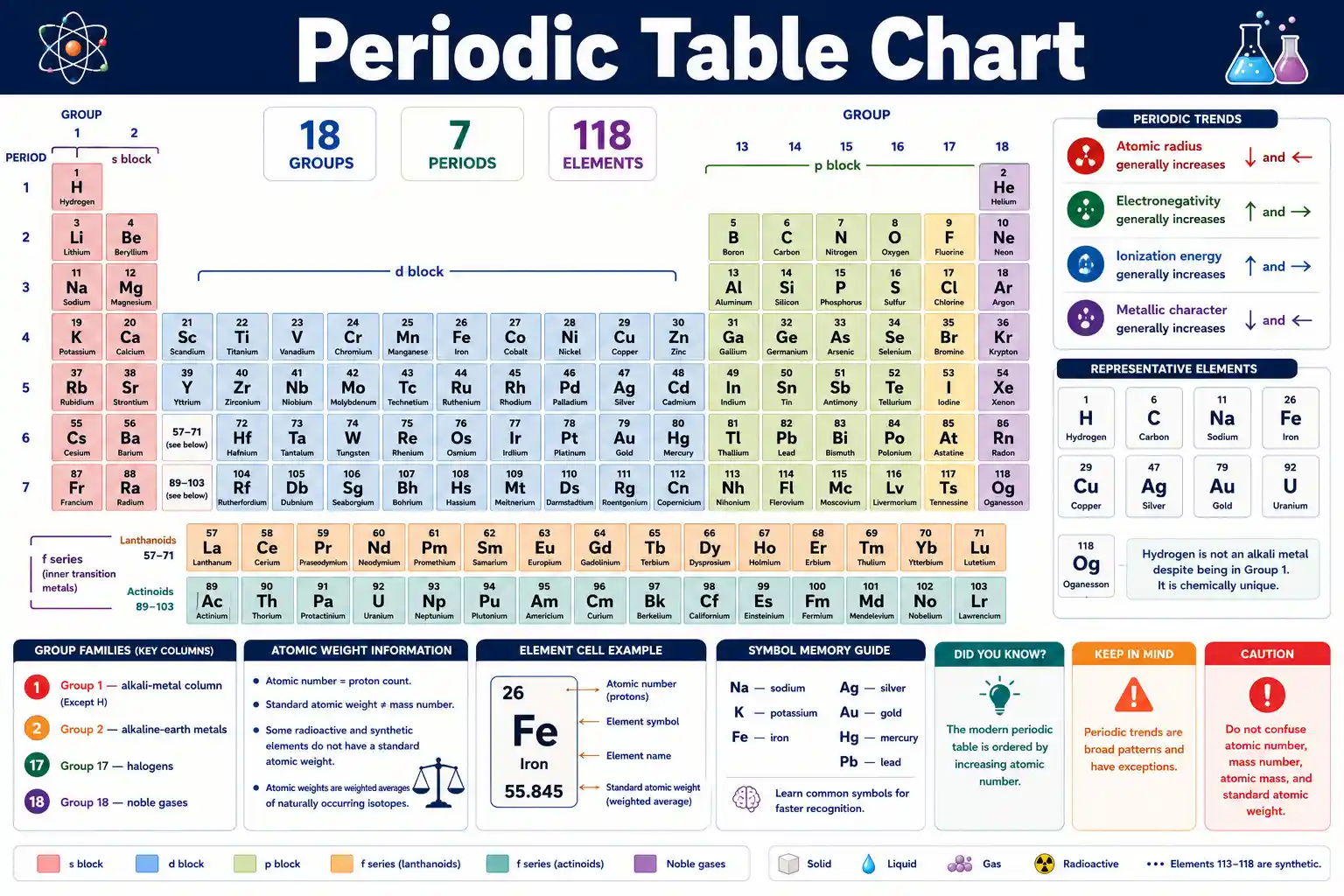
How the periodic table works
The IUPAC periodic table recognizes 118 elements and uses group numbers 1 through 18. The modern table is arranged by increasing atomic number, which equals the number of protons in an atom's nucleus.
Elements in the same group often share related valence-electron patterns. Elements in the same period occupy the same broad principal-shell level as the row develops. These repeating electron-structure patterns are why chemical properties recur periodically.
Atomic number defines the element. Atomic weight does not. Isotopes of one element share the same proton number but differ in neutron number, so natural isotopic composition can make standard atomic weight a measured average or interval rather than an integer.
Recognized elements
118
Hydrogen is atomic number 1 and oganesson is atomic number 118.
Long-form structure
18 groups · 7 periods
Groups are vertical columns; periods are horizontal rows.
Primary ordering
Atomic number
The modern periodic table is ordered by proton number, not atomic weight.
Atomic weights
Not always one fixed number
Natural isotope variation and radioactivity affect how atomic-weight information is reported.
Periodic Table of All 118 Elements
All recognized elements in atomic-number order. Atomic weights use the CIAAW abridged standard values where available; an em dash means no standard atomic weight is assigned.
Swipe horizontally inside the table to view every column.
| Atomic no. | Symbol | Element | Period | Group | Block / series | Family | Abridged standard atomic weight |
|---|---|---|---|---|---|---|---|
| 1 | H | Hydrogen | 1 | 1 | s | Nonmetal | 1.0080 ± 0.0002 |
| 2 | He | Helium | 1 | 18 | s | Noble gas | 4.0026 ± 0.0001 |
| 3 | Li | Lithium | 2 | 1 | s | Alkali metal | 6.94 ± 0.06 |
| 4 | Be | Beryllium | 2 | 2 | s | Alkaline-earth metal | 9.0122 ± 0.0001 |
| 5 | B | Boron | 2 | 13 | p | Group 13 | 10.81 ± 0.02 |
| 6 | C | Carbon | 2 | 14 | p | Group 14 | 12.011 ± 0.002 |
| 7 | N | Nitrogen | 2 | 15 | p | Group 15 | 14.007 ± 0.001 |
| 8 | O | Oxygen | 2 | 16 | p | Chalcogen | 15.999 ± 0.001 |
| 9 | F | Fluorine | 2 | 17 | p | Halogen | 18.998 ± 0.001 |
| 10 | Ne | Neon | 2 | 18 | p | Noble gas | 20.180 ± 0.001 |
| 11 | Na | Sodium | 3 | 1 | s | Alkali metal | 22.990 ± 0.001 |
| 12 | Mg | Magnesium | 3 | 2 | s | Alkaline-earth metal | 24.305 ± 0.002 |
| 13 | Al | Aluminium | 3 | 13 | p | Group 13 | 26.982 ± 0.001 |
| 14 | Si | Silicon | 3 | 14 | p | Group 14 | 28.085 ± 0.001 |
| 15 | P | Phosphorus | 3 | 15 | p | Group 15 | 30.974 ± 0.001 |
| 16 | S | Sulfur | 3 | 16 | p | Chalcogen | 32.06 ± 0.02 |
| 17 | Cl | Chlorine | 3 | 17 | p | Halogen | 35.45 ± 0.01 |
| 18 | Ar | Argon | 3 | 18 | p | Noble gas | 39.95 ± 0.16 |
| 19 | K | Potassium | 4 | 1 | s | Alkali metal | 39.098 ± 0.001 |
| 20 | Ca | Calcium | 4 | 2 | s | Alkaline-earth metal | 40.078 ± 0.004 |
| 21 | Sc | Scandium | 4 | 3 | d | Transition metal | 44.956 ± 0.001 |
| 22 | Ti | Titanium | 4 | 4 | d | Transition metal | 47.867 ± 0.001 |
| 23 | V | Vanadium | 4 | 5 | d | Transition metal | 50.942 ± 0.001 |
| 24 | Cr | Chromium | 4 | 6 | d | Transition metal | 51.996 ± 0.001 |
| 25 | Mn | Manganese | 4 | 7 | d | Transition metal | 54.938 ± 0.001 |
| 26 | Fe | Iron | 4 | 8 | d | Transition metal | 55.845 ± 0.002 |
| 27 | Co | Cobalt | 4 | 9 | d | Transition metal | 58.933 ± 0.001 |
| 28 | Ni | Nickel | 4 | 10 | d | Transition metal | 58.693 ± 0.001 |
| 29 | Cu | Copper | 4 | 11 | d | Transition metal | 63.546 ± 0.003 |
| 30 | Zn | Zinc | 4 | 12 | d | Group 12 | 65.38 ± 0.02 |
| 31 | Ga | Gallium | 4 | 13 | p | Group 13 | 69.723 ± 0.001 |
| 32 | Ge | Germanium | 4 | 14 | p | Group 14 | 72.630 ± 0.008 |
| 33 | As | Arsenic | 4 | 15 | p | Group 15 | 74.922 ± 0.001 |
| 34 | Se | Selenium | 4 | 16 | p | Chalcogen | 78.971 ± 0.008 |
| 35 | Br | Bromine | 4 | 17 | p | Halogen | 79.904 ± 0.003 |
| 36 | Kr | Krypton | 4 | 18 | p | Noble gas | 83.798 ± 0.002 |
| 37 | Rb | Rubidium | 5 | 1 | s | Alkali metal | 85.468 ± 0.001 |
| 38 | Sr | Strontium | 5 | 2 | s | Alkaline-earth metal | 87.62 ± 0.01 |
| 39 | Y | Yttrium | 5 | 3 | d | Transition metal | 88.906 ± 0.001 |
| 40 | Zr | Zirconium | 5 | 4 | d | Transition metal | 91.222 ± 0.003 |
| 41 | Nb | Niobium | 5 | 5 | d | Transition metal | 92.906 ± 0.001 |
| 42 | Mo | Molybdenum | 5 | 6 | d | Transition metal | 95.95 ± 0.01 |
| 43 | Tc | Technetium | 5 | 7 | d | Transition metal | — |
| 44 | Ru | Ruthenium | 5 | 8 | d | Transition metal | 101.07 ± 0.02 |
| 45 | Rh | Rhodium | 5 | 9 | d | Transition metal | 102.91 ± 0.01 |
| 46 | Pd | Palladium | 5 | 10 | d | Transition metal | 106.42 ± 0.01 |
| 47 | Ag | Silver | 5 | 11 | d | Transition metal | 107.87 ± 0.01 |
| 48 | Cd | Cadmium | 5 | 12 | d | Group 12 | 112.41 ± 0.01 |
| 49 | In | Indium | 5 | 13 | p | Group 13 | 114.82 ± 0.01 |
| 50 | Sn | Tin | 5 | 14 | p | Group 14 | 118.71 ± 0.01 |
| 51 | Sb | Antimony | 5 | 15 | p | Group 15 | 121.76 ± 0.01 |
| 52 | Te | Tellurium | 5 | 16 | p | Chalcogen | 127.60 ± 0.03 |
| 53 | I | Iodine | 5 | 17 | p | Halogen | 126.90 ± 0.01 |
| 54 | Xe | Xenon | 5 | 18 | p | Noble gas | 131.29 ± 0.01 |
| 55 | Cs | Caesium | 6 | 1 | s | Alkali metal | 132.91 ± 0.01 |
| 56 | Ba | Barium | 6 | 2 | s | Alkaline-earth metal | 137.33 ± 0.01 |
| 57 | La | Lanthanum | 6 | — | f series | Lanthanoid | 138.91 ± 0.01 |
| 58 | Ce | Cerium | 6 | — | f series | Lanthanoid | 140.12 ± 0.01 |
| 59 | Pr | Praseodymium | 6 | — | f series | Lanthanoid | 140.91 ± 0.01 |
| 60 | Nd | Neodymium | 6 | — | f series | Lanthanoid | 144.24 ± 0.01 |
| 61 | Pm | Promethium | 6 | — | f series | Lanthanoid | — |
| 62 | Sm | Samarium | 6 | — | f series | Lanthanoid | 150.36 ± 0.02 |
| 63 | Eu | Europium | 6 | — | f series | Lanthanoid | 151.96 ± 0.01 |
| 64 | Gd | Gadolinium | 6 | — | f series | Lanthanoid | 157.25 ± 0.01 |
| 65 | Tb | Terbium | 6 | — | f series | Lanthanoid | 158.93 ± 0.01 |
| 66 | Dy | Dysprosium | 6 | — | f series | Lanthanoid | 162.50 ± 0.01 |
| 67 | Ho | Holmium | 6 | — | f series | Lanthanoid | 164.93 ± 0.01 |
| 68 | Er | Erbium | 6 | — | f series | Lanthanoid | 167.26 ± 0.01 |
| 69 | Tm | Thulium | 6 | — | f series | Lanthanoid | 168.93 ± 0.01 |
| 70 | Yb | Ytterbium | 6 | — | f series | Lanthanoid | 173.05 ± 0.02 |
| 71 | Lu | Lutetium | 6 | — | f series | Lanthanoid | 174.97 ± 0.01 |
| 72 | Hf | Hafnium | 6 | 4 | d | Transition metal | 178.49 ± 0.01 |
| 73 | Ta | Tantalum | 6 | 5 | d | Transition metal | 180.95 ± 0.01 |
| 74 | W | Tungsten | 6 | 6 | d | Transition metal | 183.84 ± 0.01 |
| 75 | Re | Rhenium | 6 | 7 | d | Transition metal | 186.21 ± 0.01 |
| 76 | Os | Osmium | 6 | 8 | d | Transition metal | 190.23 ± 0.03 |
| 77 | Ir | Iridium | 6 | 9 | d | Transition metal | 192.22 ± 0.01 |
| 78 | Pt | Platinum | 6 | 10 | d | Transition metal | 195.08 ± 0.02 |
| 79 | Au | Gold | 6 | 11 | d | Transition metal | 196.97 ± 0.01 |
| 80 | Hg | Mercury | 6 | 12 | d | Group 12 | 200.59 ± 0.01 |
| 81 | Tl | Thallium | 6 | 13 | p | Group 13 | 204.38 ± 0.01 |
| 82 | Pb | Lead | 6 | 14 | p | Group 14 | 207.2 ± 1.1 |
| 83 | Bi | Bismuth | 6 | 15 | p | Group 15 | 208.98 ± 0.01 |
| 84 | Po | Polonium | 6 | 16 | p | Chalcogen | — |
| 85 | At | Astatine | 6 | 17 | p | Halogen | — |
| 86 | Rn | Radon | 6 | 18 | p | Noble gas | — |
| 87 | Fr | Francium | 7 | 1 | s | Alkali metal | — |
| 88 | Ra | Radium | 7 | 2 | s | Alkaline-earth metal | — |
| 89 | Ac | Actinium | 7 | — | f series | Actinoid | — |
| 90 | Th | Thorium | 7 | — | f series | Actinoid | 232.04 ± 0.01 |
| 91 | Pa | Protactinium | 7 | — | f series | Actinoid | 231.04 ± 0.01 |
| 92 | U | Uranium | 7 | — | f series | Actinoid | 238.03 ± 0.01 |
| 93 | Np | Neptunium | 7 | — | f series | Actinoid | — |
| 94 | Pu | Plutonium | 7 | — | f series | Actinoid | — |
| 95 | Am | Americium | 7 | — | f series | Actinoid | — |
| 96 | Cm | Curium | 7 | — | f series | Actinoid | — |
| 97 | Bk | Berkelium | 7 | — | f series | Actinoid | — |
| 98 | Cf | Californium | 7 | — | f series | Actinoid | — |
| 99 | Es | Einsteinium | 7 | — | f series | Actinoid | — |
| 100 | Fm | Fermium | 7 | — | f series | Actinoid | — |
| 101 | Md | Mendelevium | 7 | — | f series | Actinoid | — |
| 102 | No | Nobelium | 7 | — | f series | Actinoid | — |
| 103 | Lr | Lawrencium | 7 | — | f series | Actinoid | — |
| 104 | Rf | Rutherfordium | 7 | 4 | d | Transactinide | — |
| 105 | Db | Dubnium | 7 | 5 | d | Transactinide | — |
| 106 | Sg | Seaborgium | 7 | 6 | d | Transactinide | — |
| 107 | Bh | Bohrium | 7 | 7 | d | Transactinide | — |
| 108 | Hs | Hassium | 7 | 8 | d | Transactinide | — |
| 109 | Mt | Meitnerium | 7 | 9 | d | Transactinide | — |
| 110 | Ds | Darmstadtium | 7 | 10 | d | Transactinide | — |
| 111 | Rg | Roentgenium | 7 | 11 | d | Transactinide | — |
| 112 | Cn | Copernicium | 7 | 12 | d | Transactinide | — |
| 113 | Nh | Nihonium | 7 | 13 | p | Transactinide | — |
| 114 | Fl | Flerovium | 7 | 14 | p | Transactinide | — |
| 115 | Mc | Moscovium | 7 | 15 | p | Transactinide | — |
| 116 | Lv | Livermorium | 7 | 16 | p | Transactinide | — |
| 117 | Ts | Tennessine | 7 | 17 | p | Transactinide | — |
| 118 | Og | Oganesson | 7 | 18 | p | Transactinide | — |
Atomic number is dimensionless. Standard atomic weight is a relative quantity; displayed uncertainties follow the CIAAW abridged table.
- • Lanthanoids and actinoids are shown as detached f-series entries here rather than forcing one Group 3 layout convention.
- • Family labels are educational summaries; detailed classifications can vary at boundaries and for superheavy elements.
Download or export
Interactive reference
Periodic Table Element Finder
Enter an atomic number, element symbol, or full element name to retrieve its position and reference data.
Element
Iron (Fe)
Period
4
Group
8
Block / series
d
Family
Transition metal
Abridged standard atomic weight
55.845 ± 0.002
Atomic number is the table's backbone
Moving one place forward in atomic number adds one proton. Carbon is 6 because every carbon nucleus has six protons; oxygen is 8 because every oxygen nucleus has eight.
Periodic Table Periods Chart
The seven periods are horizontal rows. Period lengths reflect the subshells that become occupied as atomic number increases.
Swipe horizontally inside the table to view every column.
| Period | Element count | Span | Electron-structure idea |
|---|---|---|---|
| 1 | 2 | H → He | Only the 1s shell is being filled. |
| 2 | 8 | Li → Ne | 2s and 2p subshells fill. |
| 3 | 8 | Na → Ar | 3s and 3p subshells fill. |
| 4 | 18 | K → Kr | 4s, 3d, then 4p are occupied across the period. |
| 5 | 18 | Rb → Xe | 5s, 4d, then 5p are occupied. |
| 6 | 32 | Cs → Rn | Includes the lanthanoid series and 4f filling. |
| 7 | 32 | Fr → Og | Includes the actinoid series and superheavy elements through atomic number 118. |
Periods are numbered 1 through 7.
- • The detached lanthanoid and actinoid rows belong to periods 6 and 7, not to separate periods.
Download or export
Periodic Table Groups and Families
Groups are vertical columns numbered 1 through 18. Familiar family names emphasize shared chemistry within selected columns.
Swipe horizontally inside the table to view every column.
| Group | Family / region | Examples | Key note |
|---|---|---|---|
| 1 | Alkali-metal column | H, Li, Na, K, Rb, Cs, Fr | Hydrogen sits in Group 1 but is a nonmetal and chemically distinct from the alkali metals. |
| 2 | Alkaline-earth metals | Be, Mg, Ca, Sr, Ba, Ra | Typical main-group metals with two valence electrons. |
| 3 | Transition-region convention | Sc, Y; f-block placement varies by table | Group 3 presentation differs among long-form periodic-table conventions. |
| 4 | Transition metals | Ti, Zr, Hf, Rf | d-block family. |
| 5 | Transition metals | V, Nb, Ta, Db | d-block family. |
| 6 | Transition metals | Cr, Mo, W, Sg | d-block family. |
| 7 | Transition metals | Mn, Tc, Re, Bh | d-block family. |
| 8 | Transition metals | Fe, Ru, Os, Hs | d-block family. |
| 9 | Transition metals | Co, Rh, Ir, Mt | d-block family. |
| 10 | Transition metals | Ni, Pd, Pt, Ds | d-block family. |
| 11 | Coinage-metal column | Cu, Ag, Au, Rg | Group 11 d-block. |
| 12 | Group 12 | Zn, Cd, Hg, Cn | Often treated separately from the transition-metal definition in strict contexts. |
| 13 | Boron group | B, Al, Ga, In, Tl, Nh | p-block. |
| 14 | Carbon group | C, Si, Ge, Sn, Pb, Fl | p-block. |
| 15 | Pnictogen group | N, P, As, Sb, Bi, Mc | p-block. |
| 16 | Chalcogens | O, S, Se, Te, Po, Lv | p-block. |
| 17 | Halogens | F, Cl, Br, I, At, Ts | p-block. |
| 18 | Noble gases | He, Ne, Ar, Kr, Xe, Rn, Og | Helium is placed in Group 18 although its occupied shell is 1s². |
IUPAC group numbers run from 1 to 18.
- • Hydrogen is placed in Group 1 but is not an alkali metal.
- • Group 3 and detached f-series placement can be drawn differently in long-form tables.
Download or export
s, p, d and f Regions
Blocks organize the table by broad electron-configuration patterns. Detached f-series rows keep the conventional long form compact.
Swipe horizontally inside the table to view every column.
| Region | Typical location | Subshell idea | Interpretation |
|---|---|---|---|
| s block | Groups 1–2 plus He | s subshell | Usually 1–2 electrons in the differentiating s subshell. |
| p block | Groups 13–18 except He | p subshell | Main-group region containing nonmetals, metalloids, and metals. |
| d block | Groups 3–12 region | d subshell | Transition region; the exact formal definition of transition metal is narrower than simply being in the d block. |
| f series | Lanthanoids and actinoids | f subshell | Usually displayed as two detached rows to keep the conventional table compact. |
| Lanthanoid series | La–Lu | 4f region | Period 6 inner-transition series in the detached-row convention. |
| Actinoid series | Ac–Lr | 5f region | Period 7 inner-transition series; all actinoids are radioactive. |
Block labels are structural categories, not units.
- • Helium is chemically a noble gas in Group 18 even though its occupied shell is 1s².
Download or export
The detached rows still belong to periods 6 and 7
Lanthanoids are normally drawn below the main body to shorten period 6, and actinoids are drawn below it to shorten period 7. Detaching them is a layout choice, not a separate part of the periodic law.
Periodic Trends Chart
Broad directional trends help compare elements, but they are not exception-free laws and depend on the property definition.
Swipe horizontally inside the table to view every column.
| Property | Across a period → | Down a group ↓ | Main reason | Caution |
|---|---|---|---|---|
| Atomic radius | Generally decreases | Generally increases | Greater effective nuclear attraction across a period; added shells down a group. | Broad trend with exceptions. |
| First ionization energy | Generally increases | Generally decreases | Electrons are held more strongly across a period and are farther from the nucleus down a group. | Subshell and pairing effects create exceptions. |
| Electronegativity | Generally increases toward F | Generally decreases | Effective nuclear attraction and atomic size both matter. | Scale and element availability matter; noble gases often lack standard Pauling values. |
| Metallic character | Generally decreases | Generally increases | Electron loss becomes less favorable across a period and more favorable down many groups. | Not a single measured quantity. |
| Valence-shell principal level | Usually unchanged within a period | Increases | Moving down introduces a higher principal shell. | Useful for main-group reasoning. |
| Shielding | Changes modestly across | Generally increases | More occupied inner shells lie between valence electrons and the nucleus. | Detailed shielding is orbital-dependent. |
| Reactivity | No single universal direction | Family-specific | Chemical reactivity depends on electron configuration and reaction partner. | Use group-specific chemistry rather than one global trend. |
Qualitative trends only.
- • Use property-specific charts for numerical comparison because definitions and exceptions matter.
Download or export
Periodic trends are directions, not perfect staircases
Atomic radius generally decreases across a period, while ionization energy and electronegativity generally rise. Subshell structure, electron pairing, oxidation state, bonding environment, and the exact property definition create important exceptions.
Main-Group Valence Patterns
Representative outer-shell patterns help explain recurring main-group chemistry. Actual oxidation states and bonding depend on the element and compound.
Swipe horizontally inside the table to view every column.
| Group | Elements | Broad outer pattern | Common chemistry clue |
|---|---|---|---|
| 1 | H; Li, Na, K, Rb, Cs, Fr | ns¹ | Alkali metals commonly form +1 ions; hydrogen is a special case. |
| 2 | Be, Mg, Ca, Sr, Ba, Ra | ns² | Common +2 oxidation state for the alkaline-earth metals. |
| 13 | B, Al, Ga, In, Tl, Nh | ns²np¹ | +3 is important; heavier members also show lower oxidation states. |
| 14 | C, Si, Ge, Sn, Pb, Fl | ns²np² | Oxidation states from −4 to +4 occur across the group. |
| 15 | N, P, As, Sb, Bi, Mc | ns²np³ | −3, +3, and +5 are important patterns, with element-specific behavior. |
| 16 | O, S, Se, Te, Po, Lv | ns²np⁴ | −2 is common for lighter chalcogens; positive states also occur for heavier members. |
| 17 | F, Cl, Br, I, At, Ts | ns²np⁵ | Halogens commonly form −1; fluorine is especially electronegative. |
| 18 | He; Ne, Ar, Kr, Xe, Rn, Og | filled outer shell | Noble gases are comparatively unreactive, but heavier members can form compounds. |
ns and np represent valence-shell subshells.
- • These are broad patterns, not complete electron configurations or guaranteed oxidation states.
Download or export
Element Symbols That Are Easy to Misread
Several symbols reflect Latin or historical names rather than the modern English element name.
Swipe horizontally inside the table to view every column.
| Symbol | Element | Historical root | Memory clue |
|---|---|---|---|
| Na | Sodium | natrium | The symbol preserves a Latin-derived name. |
| K | Potassium | kalium | K comes from kalium. |
| Fe | Iron | ferrum | Fe comes from ferrum. |
| Cu | Copper | cuprum | Cu comes from cuprum. |
| Ag | Silver | argentum | Ag comes from argentum. |
| Sn | Tin | stannum | Sn comes from stannum. |
| Sb | Antimony | stibium | Sb comes from stibium. |
| W | Tungsten | wolfram | W reflects the name wolfram. |
| Au | Gold | aurum | Au comes from aurum. |
| Hg | Mercury | hydrargyrum | Hg derives from a historical Greek/Latin form meaning liquid silver. |
| Pb | Lead | plumbum | Pb comes from plumbum. |
| Cs | Caesium | caesius | The symbol follows the element name; US English often spells the name cesium. |
Chemical symbols are standardized identifiers.
- • Element symbols are case-sensitive: Co is cobalt, while CO is a chemical formula for carbon monoxide.
Download or export
Element symbols are case-sensitive
Co means cobalt. CO means carbon monoxide. The second character of a two-letter element symbol is lowercase, and several symbols such as Na, K, Fe, Ag, Au, Hg, and Pb reflect historical names rather than modern English spelling.
Atomic Number, Mass and Weight Notation
Atomic number, mass number, atomic mass, standard atomic weight, and molar mass are related but distinct quantities.
Swipe horizontally inside the table to view every column.
| Term | Meaning | Example | Key distinction |
|---|---|---|---|
| Standard atomic weight | Recommended relative atomic weight for normal terrestrial materials | H, C, O, Fe | Can be a single value with uncertainty or an interval. |
| Abridged standard atomic weight | Simplified CIAAW value for routine use | Fe 55.845 ± 0.002 | Useful when full uncertainty detail is unnecessary. |
| Interval atomic weight | Range caused by natural isotopic-composition variation | H, Li, B, C, N, O | A single exact value is not appropriate for all normal samples. |
| No standard atomic weight | No characteristic isotopic abundance in normal terrestrial material | Tc, Pm, many radioactive elements | Periodic tables may instead show a bracketed mass number for a selected nuclide. |
| Atomic number Z | Number of protons in the nucleus | O has Z = 8 | Atomic number defines the element. |
| Mass number A | Protons + neutrons in one nuclide | ¹²C has A = 12 | Mass number belongs to a specific isotope, not to an element as a whole. |
| Atomic mass | Mass of a particular atom or nuclide | Mass of ¹²C | Expressed in daltons for individual atoms/nuclides. |
| Molar mass | Mass per amount of substance | g/mol | Numerically close to familiar atomic-weight values for elemental atoms, but it is a different quantity and unit. |
Atomic number and relative atomic weight are dimensionless; atomic mass can be expressed in Da; molar mass is mass per amount of substance.
- • Do not treat the number shown in a periodic-table atomic-weight field as a universal isotope mass.
Download or export
Not every element has a standard atomic weight
The CIAAW abridged table assigns standard atomic weights only where characteristic terrestrial isotopic abundances support them. Technetium, promethium, and many radioactive or synthetic elements therefore have no standard atomic weight.
How to Read a Periodic-Table Cell
Most periodic-table cells combine identity information with one or more reference properties.
Swipe horizontally inside the table to view every column.
| Cell field | Typical format | What it tells you | Reading tip |
|---|---|---|---|
| Atomic number | Integer | Number of protons | Atomic number orders the modern periodic table. |
| Symbol | One- or two-letter identifier | C, Fe, Og | First letter uppercase; second letter lowercase. |
| Element name | Official element name | Carbon | Names and symbols are standardized by IUPAC. |
| Atomic weight / mass notation | Relative atomic-weight information | 12.011 ± 0.002 or — | Interpret the notation rather than assuming every element has one fixed natural atomic weight. |
| Group | Vertical column | 1–18 | Elements in a group often share valence-electron patterns. |
| Period | Horizontal row | 1–7 | Period tracks the principal shell structure of the ground-state atom. |
| Block | s, p, d, or f region | p block | Block reflects the type of subshell being filled in the broad electron-configuration pattern. |
| Family / series | Chemical grouping | Halogen, noble gas, lanthanoid | Family labels summarize useful similarities but are not substitutes for actual properties. |
Field formatting varies by periodic-table edition.
- • Always read the legend because color categories and extra properties differ between periodic tables.
Download or export
Periodic Table Terminology Chart
Useful terms for discussing positions, families, and series without confusing layout conventions with chemical definitions.
Swipe horizontally inside the table to view every column.
| Term | Meaning | Example | Important nuance |
|---|---|---|---|
| Group | Vertical column numbered 1–18 | Group 17 contains the halogens | IUPAC recommends Arabic group numbers 1 through 18. |
| Period | Horizontal row | Period 4 runs K through Kr | Periods reflect repeating electron-shell structure. |
| Family | Common chemical grouping | Alkali metals, halogens, noble gases | Family names emphasize shared chemistry. |
| Lanthanoids | La through Lu in common usage | Period 6 detached series | IUPAC prefers the collective name lanthanoids. |
| Actinoids | Ac through Lr | Period 7 detached series | All actinoids are radioactive. |
| Transition element | Element whose atom has an incomplete d subshell, or can form cations with an incomplete d subshell | Fe is a classic example | This definition is narrower than simply saying every Group 3–12 element is a transition metal. |
| Metalloid | Informal boundary classification | B, Si, Ge, As are commonly included | Metalloid lists vary among sources; the term has no single universally fixed membership. |
| Transactinide | Element with Z > 103 | Rf through Og | These are synthetic superheavy elements beyond the actinoid series. |
Terminology reference.
- • Some educational category labels, especially metalloid membership, are not defined by one universally fixed list.
Download or export
How to use the periodic table
Start with identity, then position, then property. Atomic number tells you which element you have. Group and period provide structural context. Block connects position with electron configuration. Only then should you apply property-specific trends or numerical charts.
1. Read atomic number
This is the proton count and uniquely identifies the element.
2. Check symbol and name
Use standardized symbols exactly; capitalization changes meaning.
3. Locate group and period
Groups compare vertical families; periods compare horizontal sequences.
4. Identify the block or series
s, p, d, and f regions connect position with electron configuration.
5. Interpret atomic-weight notation
A standard atomic weight is not the mass number of one isotope.
6. Apply a specific trend carefully
Use atomic-radius, electronegativity, ionization-energy, or oxidation-state data when you need a numerical comparison.
The Royal Society of Chemistry periodic table is useful when you want to switch from positional information to element-by-element property data and trend views.
Periodic table FAQs
How many elements are in the periodic table?
The periodic table contains 118 recognized elements, from hydrogen with atomic number 1 through oganesson with atomic number 118.
What determines an element's position in the periodic table?
Atomic number determines the order. Atomic number equals the number of protons in the nucleus.
How many groups are in the periodic table?
The conventional long-form periodic table has 18 numbered groups.
How many periods are in the periodic table?
The periodic table has seven periods.
What is a group in the periodic table?
A group is a vertical column. Elements in the same group often share related valence-electron patterns and chemical behavior.
What is a period in the periodic table?
A period is a horizontal row. Moving across a period increases atomic number one proton at a time.
What are the s, p, d, and f blocks?
They are broad regions associated with the type of subshell involved in the electron-configuration pattern across the table.
Why are lanthanoids and actinoids shown below the main table?
They are usually detached to keep the conventional 18-column table compact. They belong to periods 6 and 7 respectively.
Does every element have a standard atomic weight?
No. Elements without a characteristic natural terrestrial isotopic abundance, including many radioactive elements, do not have a standard atomic weight.
Is atomic number the same as atomic weight?
No. Atomic number counts protons. Atomic weight reflects isotope masses and abundances in an element's normal terrestrial material.
Why do some atomic weights have uncertainty or ranges?
Natural isotopic composition can vary, and measured quantities carry uncertainty. CIAAW therefore reports uncertainties and, for some elements, intervals.
Which element has the highest atomic number?
Oganesson has atomic number 118, the highest atomic number among the currently recognized elements.
Why is helium in Group 18 if it has an s-shell configuration?
Helium has a filled 1s shell and behaves chemically as a noble gas, so it is conventionally placed in Group 18 even though its occupied subshell is s.
Are metalloid classifications identical on every periodic table?
No. Metalloid is an informal classification and different educational tables can draw the boundary differently.
Does atomic radius always decrease perfectly from left to right?
No. Atomic radius generally decreases across a period, but detailed values depend on radius definition and electronic structure.
What is the best way to read a periodic-table cell?
Start with atomic number, symbol, and name. Then use group, period, block, and atomic-weight notation to interpret structure and periodic relationships.
Sources
Element names, symbols, group numbering, periodic-table conventions, atomic-weight data, and property organization are grounded in IUPAC, CIAAW, and the Royal Society of Chemistry.
International Union of Pure and Applied Chemistry — Periodic Table of Elements
Provides IUPAC element names, symbols, group numbering guidance, periodic-table conventions, and official background on the 118 recognized elements.
https://iupac.org/what-we-do/periodic-table-of-elements/
Commission on Isotopic Abundances and Atomic Weights — Abridged Standard Atomic Weights
Provides the current abridged standard atomic weights and identifies elements for which no standard atomic weight is assigned.
https://ciaaw.org/abridged-atomic-weights.htm
Royal Society of Chemistry — Periodic Table
Provides an interactive 118-element table with groups, periods, blocks, classifications, element data, and property-trend views.
https://periodic-table.rsc.org/