Biology · Zoology and Taxonomy
Animal Classification Chart for Taxonomic Ranks and Major Phyla
Follow animal taxonomy from domain and kingdom to species. Compare major phyla, body-plan traits, evolutionary clades, scientific names, representative animals, and the evidence scientists use to revise classification.
This chart is an educational classification snapshot. Taxonomic sources can differ in accepted names, intermediate ranks, phylum boundaries, and evolutionary placement. Check a current specialist source for research, conservation, regulatory, or specimen-identification work.
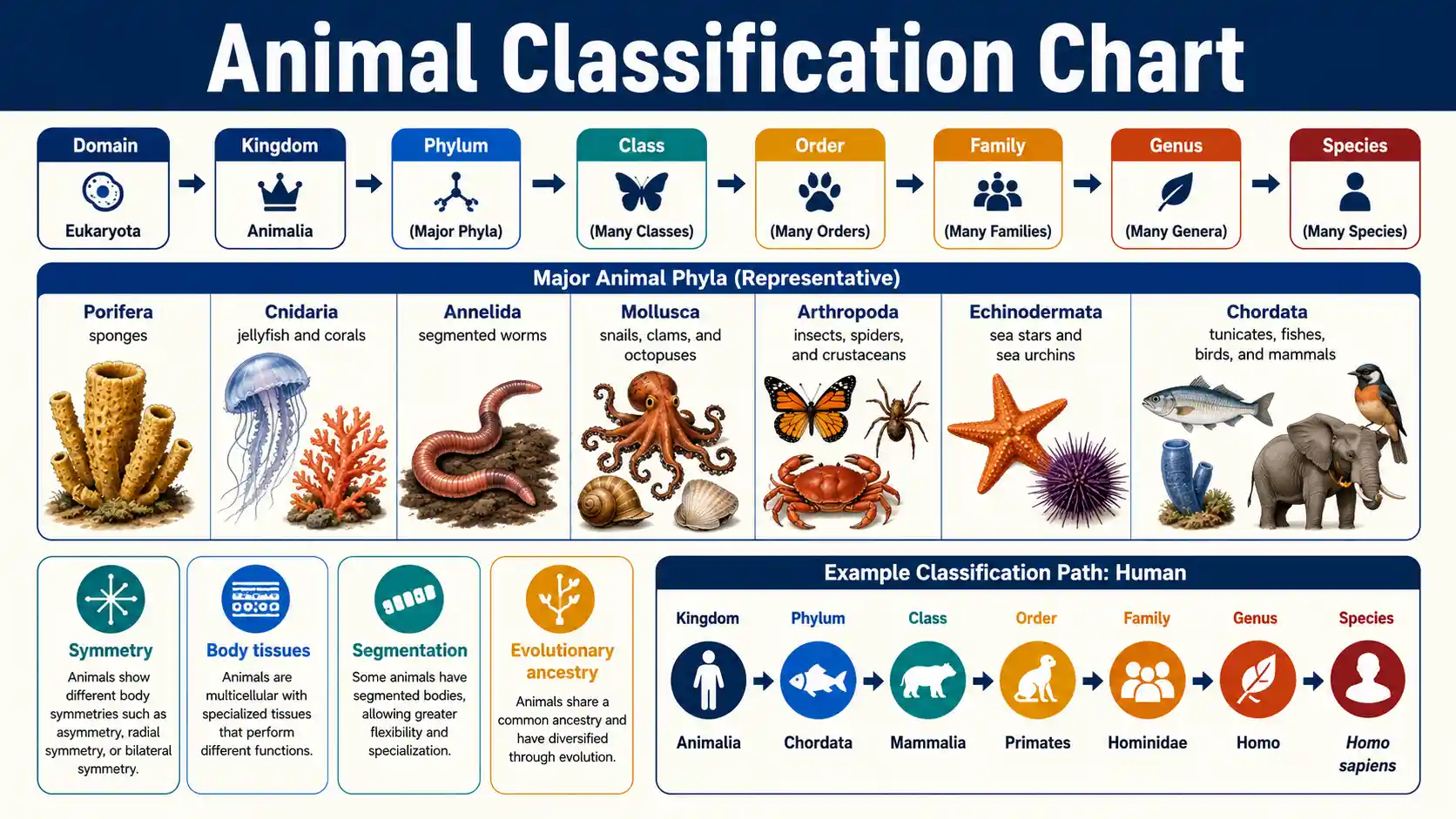
How are animals classified?
Scientists classify animals by shared ancestry using anatomy, embryonic development, molecular sequences, fossils, ecology, and geography. The familiar hierarchy runs from domain and kingdom through phylum, class, order, family, genus, and species.
The Catalogue of Life classification guide explains that species are placed within broader groups and may be split, merged, or moved when evidence changes. A classification therefore records the best-supported interpretation available from a stated source and version.
Kingdom
Animalia
Animals are multicellular eukaryotes placed in the kingdom Animalia, also called Metazoa.
Standard hierarchy
Domain to species
The common ranked sequence is domain, kingdom, phylum, class, order, family, genus, and species.
Major evidence
Anatomy plus molecules
Modern classification combines body plans, development, DNA, RNA, proteins, fossils, ecology, and geography.
Critical context
Taxonomy can change
Accepted names and placements may change when new evidence supports a revised evolutionary relationship.
Essential animal classification questions
These concise answers separate formal ranks, evolutionary clades, and familiar everyday labels before the detailed charts.
What kingdom are animals in?
Animals belong to the kingdom Animalia, also called Metazoa.
What rank follows kingdom?
Phylum follows kingdom in the standard taxonomic hierarchy.
Is invertebrate a phylum?
No. Invertebrate is an informal label that spans many animal phyla.
Are humans animals?
Yes. Humans are mammals, primates, chordates, and members of Animalia.
Are all chordates vertebrates?
No. Tunicates and lancelets are invertebrate chordates.
Are spiders insects?
No. Spiders are arachnids, while insects belong to class Insecta.
Are whales fish?
No. Whales are air-breathing mammals in the chordate lineage.
Are birds reptiles?
Cladistic systems place birds inside the reptile lineage because birds are living dinosaurs.
What is a clade?
A clade contains a common ancestor and all of its descendants.
What is a species name?
A zoological species name combines a capitalized genus with a lowercase specific epithet.
Why does taxonomy change?
Taxonomy changes when new evidence supports different species boundaries or relationships.
Can appearance identify every species?
No. Cryptic species can look alike, and one species can vary widely in appearance.
Animal Taxonomic Ranks from Domain to Species
The familiar ranked hierarchy moves from broad groups to increasingly specific groups. Intermediate ranks and clades may appear between these levels in modern databases.
Swipe horizontally inside the table to view every column.
| Rank | What the rank groups | Human example | Key interpretation |
|---|---|---|---|
| Domain | The broadest cellular lineage used in many teaching systems | Eukaryota | Animals are eukaryotes with cells that contain nuclei and membrane-bound organelles. |
| Kingdom | A major lineage within a domain | Animalia — Animal kingdom | Animalia includes multicellular heterotrophs that develop from embryos and lack rigid cell walls. |
| Phylum — Major animal rank | Animals sharing a deep body-plan and evolutionary lineage | Chordata | Phylum is below kingdom and above class in the standard ranked sequence. |
| Class | Related orders within a phylum | Mammalia | Mammals share derived traits including hair and milk production. |
| Order | Related families within a class | Primates | Orders group families that share a more recent common ancestry. |
| Family | Related genera within an order | Hominidae | Family names in zoology commonly end in “-idae.” |
| Genus | Closely related species | Homo | The genus starts the scientific species name and begins with a capital letter. |
| Species | A named lineage at the most specific standard rank | Homo sapiens — Binomial species name | A species name combines the genus and specific epithet; species boundaries may require multiple lines of evidence. |
Standard sequence: Domain → Kingdom → Phylum → Class → Order → Family → Genus → Species. Clades and intermediate ranks may be inserted where useful.
- • Taxonomic ranks are labels in a hierarchy; they do not represent equal amounts of evolutionary time or biological difference.
- • Modern classifications aim to reflect shared ancestry, but databases can use different intermediate ranks or accepted names.
- • The human example is educational and does not imply that every animal lineage uses the same number of intermediate ranks.
Download or export
How animal classification works
Classification organizes named groups, while phylogeny tests evolutionary relationships. A reliable placement uses several independent traits and remains open to revision.
1
Place the animal in a broad lineage
Confirm Animalia, then identify the phylum or major clade using defining traits.
2
Compare several kinds of evidence
Use anatomy, development, molecules, fossils, ecology, and geography together.
3
Follow the hierarchy downward
Move through class, order, family, genus, and species without skipping the source context.
4
Record the accepted name and source
Taxonomy changes, so note the database, release, synonym, and uncertainty when relevant.
A phylogenetic tree is a branching hypothesis about common ancestry. It is not a ladder that ranks living animals from lower to higher forms.
Animal phyla represent deep evolutionary lineages
A phylum groups animals with a broadly shared evolutionary history and body-plan organization. Arthropoda includes insects, arachnids, crustaceans, and myriapods. Mollusca includes snails, clams, and cephalopods. Chordata includes vertebrates plus tunicates and lancelets.
Major Animal Phyla and Defining Characteristics
This representative chart covers commonly taught phyla. It is not a complete list, and the number or boundaries of recognized phyla can differ among classifications.
Swipe horizontally inside the table to view every column.
| Phylum | Defining features | Typical body-plan clue | Familiar examples |
|---|---|---|---|
| Porifera | Porous body, choanocytes, internal water flow, and no true organs | Usually asymmetrical or irregular; sessile adult | Sponges |
| Placozoa | Very simple flattened body with a small number of cell types | No conventional organs; creeping marine animal | Trichoplax and relatives |
| Cnidaria | Cnidocytes with stinging organelles and a gastrovascular cavity | Radial or biradial symmetry; one main body opening | Jellyfish, corals, sea anemones, hydras |
| Ctenophora | Eight rows of ciliary comb plates; adhesive prey-capture cells in many species | Gelatinous marine body with comb rows | Comb jellies |
| Platyhelminthes | Dorsoventrally flattened bilateral body; many lack a complete gut | Flat, unsegmented worm-like form | Planarians, flukes, tapeworms |
| Nematoda | Unsegmented cylindrical body, tough cuticle, complete digestive tract | Round cross-section and tapered ends | Roundworms, pinworms, hookworms |
| Rotifera | Microscopic body with a ciliated corona and internal jaws | Wheel-like ciliary crown at the head | Rotifers |
| Annelida | Segmented coelomate body; bristles or chaetae occur in many groups | Repeated body segments | Earthworms, leeches, ragworms |
| Mollusca | Mantle, visceral mass, and muscular foot; a radula occurs in most groups | Soft body, often with a shell | Snails, clams, octopuses, squids |
| Arthropoda — Arthropod phylum | Jointed appendages, segmented body, chitinous exoskeleton, and molting | Paired jointed limbs and external skeleton | Insects, spiders, crabs, centipedes |
| Echinodermata | Water vascular system, internal calcareous skeleton, and marine habitat | Pentaradial adult; bilateral larva | Sea stars, sea urchins, sea cucumbers |
| Chordata | Notochord, dorsal hollow nerve cord, pharyngeal slits, post-anal tail, and endostyle or thyroid at some stage — Chordate defining traits | Chordate traits may appear only during development | Tunicates, lancelets, fishes, amphibians, reptiles, birds, mammals |
Phylum names are formal taxa. “Invertebrate” is an informal umbrella term for animals without a vertebral column and is not a single phylum.
- • Traits listed here are diagnostic summaries, not universal descriptions of every life stage or every species in a phylum.
- • Molecular phylogenetics can reveal relationships that body shape alone does not show.
- • Chordata includes vertebrates and invertebrate chordates; therefore, not every chordate has a vertebral column as an adult.
Download or export
Body plans help, but shared ancestry decides the framework
The OpenStax guide to animal classification features compares symmetry, tissues, body cavities, segmentation, and development. Modern phylogenetics combines those observations with molecular and fossil evidence because similar-looking traits can evolve independently.
Features Scientists Use to Classify Animals
Animal identification and phylogeny use multiple traits together. No single visible feature reliably determines every animal relationship.
Swipe horizontally inside the table to view every column.
| Feature | What scientists compare | Examples of states | Why one trait is not enough |
|---|---|---|---|
| Body symmetry | Arrangement of parts around an axis or plane | Asymmetrical, radial, biradial, bilateral | Symmetry can change during development, as in echinoderms. |
| Tissues and germ layers | Presence and embryonic origin of specialized tissues | No true germ-layer tissues, diploblastic, triploblastic | Similar tissue complexity can evolve in different lineages. |
| Body cavity | Space between the digestive tract and body wall | Acoelomate, pseudocoelomate, coelomate | Body-cavity categories can oversimplify complex developmental histories. |
| Segmentation | Repeated body units and their specialization | Absent, serially repeated, highly fused | Annelid and arthropod segmentation does not prove they are each other’s closest relatives. |
| Embryonic development | Early cleavage, blastopore fate, and larval traits | Protostome and deuterostome patterns | Real development includes exceptions and cannot be reduced to one classroom rule. |
| Molting and cuticle | Whether an external covering is shed during growth | Ecdysis present or absent | Molting supports Ecdysozoa but does not identify a species by itself. |
| Support structures | Exoskeletons, endoskeletons, hydrostatic skeletons, shells | Chitin, calcium carbonate, bone, fluid pressure | Similar support systems can evolve independently. |
| Feeding structures | Mouthparts, radulae, lophophores, tentacles, filter systems | Jointed mouthparts, radula, lophophore, choanocyte system | Diet can reshape anatomy through convergent evolution. |
| Molecular evidence — Molecular evidence | DNA, RNA, proteins, and genomic markers | Nuclear genes, mitochondrial genes, rRNA, protein sequences | Gene trees can conflict because of incomplete lineage sorting, hybridization, or limited sampling. |
| Fossils and biogeography | Historical anatomy, age, and geographic distribution | Transitional forms, stratigraphic ranges, endemic lineages | The fossil record is incomplete and preservation is uneven. — Incomplete fossil record |
Reliable classification combines morphology, development, molecules, fossils, ecology, and geography whenever those data are available.
- • A phylogenetic tree is a testable hypothesis about relationships, not a ladder from “simple” to “advanced.”
- • Convergent evolution can make unrelated animals look similar because they face similar environmental pressures.
- • Taxonomists revise classifications when new evidence supports a different evolutionary history.
Download or export
Browser-only educational tool
Compare two animal classification paths
Choose two example animals to compare their standard ranks and find the narrowest rank they share in this simplified dataset. No entered data leaves the browser.
Nearest shared rank
kingdom
Human and Monarch butterfly both share kingdom Animalia. Their paths separate at a narrower rank.
Human
Homo sapiens
A primate mammal and vertebrate chordate.
- domainEukaryotafollowed by the next narrower rank
- kingdomAnimaliafollowed by the next narrower rank
- phylumChordatafollowed by the next narrower rank
- classMammaliafollowed by the next narrower rank
- orderPrimatesfollowed by the next narrower rank
- familyHominidaefollowed by the next narrower rank
- genusHomofollowed by the next narrower rank
- speciesHomo sapiens
Monarch butterfly
Danaus plexippus
An insect and arthropod with jointed appendages and an exoskeleton.
- domainEukaryotafollowed by the next narrower rank
- kingdomAnimaliafollowed by the next narrower rank
- phylumArthropodafollowed by the next narrower rank
- classInsectafollowed by the next narrower rank
- orderLepidopterafollowed by the next narrower rank
- familyNymphalidaefollowed by the next narrower rank
- genusDanausfollowed by the next narrower rank
- speciesDanaus plexippus
Animal Classification Examples Across Major Phyla
These examples show how a familiar animal fits into phylum, class, order, family, genus, and species. Intermediate ranks are omitted for readability.
Swipe horizontally inside the table to view every column.
| Common name | Phylum | Class and order | Family | Scientific name |
|---|---|---|---|---|
| Human | Chordata | Mammalia · Primates | Hominidae | Homo sapiens — Human scientific name |
| Lion | Chordata | Mammalia · Carnivora | Felidae | Panthera leo |
| Bald eagle | Chordata | Aves · Accipitriformes | Accipitridae | Haliaeetus leucocephalus |
| Monarch butterfly | Arthropoda — Arthropod example | Insecta · Lepidoptera | Nymphalidae | Danaus plexippus |
| Western honey bee | Arthropoda | Insecta · Hymenoptera | Apidae | Apis mellifera |
| Common octopus | Mollusca | Cephalopoda · Octopoda | Octopodidae | Octopus vulgaris |
| Common earthworm | Annelida | Clitellata · Opisthopora | Lumbricidae | Lumbricus terrestris |
| Common sea star | Echinodermata | Asteroidea · Forcipulatida | Asteriidae | Asterias rubens |
| Moon jelly | Cnidaria | Scyphozoa · Semaeostomeae | Ulmaridae | Aurelia aurita |
| Bath sponge | Porifera | Demospongiae · Dictyoceratida | Spongiidae | Spongia officinalis |
Scientific names are shown as genus plus specific epithet. In finished typography, both words should be italicized, with only the genus capitalized.
- • Taxonomic databases may differ in intermediate ranks, spelling, synonym treatment, or the accepted placement of a species.
- • A common name can refer to more than one species; the scientific name identifies the intended taxon more precisely.
- • The explorer on this page uses the same simplified rank set for transparent comparison.
Download or export
Formal ranks, clades, and everyday groups are not interchangeable
Animalia and Arthropoda are formal taxa. Bilateria and Ecdysozoa are ancestry-based clades that may be used without a traditional rank. Invertebrate, fish, worm, and shellfish are practical labels, but they do not each represent one complete formal lineage.
Formal Taxa, Clades, and Informal Animal Groups
Biology uses ranked taxa, unranked clades, and convenient informal labels. These terms do not all function in the same way.
Swipe horizontally inside the table to view every column.
| Term | Type of grouping | What it means | Important limitation |
|---|---|---|---|
| Animalia | Formal kingdom | The animal kingdom | Its internal hierarchy can differ among databases. |
| Bilateria | Clade or named lineage | Animals descended from a bilaterian common ancestor | Adult symmetry can be modified, as in echinoderms. |
| Protostomes | Evolutionary clade | A major bilaterian lineage including ecdysozoans and lophotrochozoans | The name is not simply a universal rule about blastopore fate. |
| Deuterostomes | Evolutionary clade | A lineage including echinoderms and chordates | Developmental patterns include variation and exceptions. |
| Invertebrates | Informal umbrella group — Informal grouping | Animals without a vertebral column | It is not one natural phylum or a single close-knit clade. |
| Vertebrates | Subphylum or clade | Chordates with vertebrate characteristics | Some classifications discuss Craniata and Vertebrata boundaries differently. |
| Fish | Informal collection of aquatic vertebrates | Jawless, cartilaginous, and bony fish lineages | Used broadly, “fish” excludes tetrapods descended from fish ancestors and is not one complete clade. |
| Reptiles | Traditional class or cladistic lineage | Turtles, lizards, snakes, crocodilians, birds, and extinct relatives in cladistic usage | A traditional reptile group that excludes birds is not monophyletic. — Bird inclusion matters |
| Worm | Body-form term | Long, soft-bodied animals from many phyla | Flatworms, roundworms, and segmented worms are not one taxonomic group. |
| Shellfish | Culinary term | Aquatic molluscs and crustaceans | It combines animals from different phyla and has no formal taxonomic rank. |
A taxon is a named biological group. A clade contains an ancestor and all its descendants. Informal labels may be useful but can combine unrelated lineages.
- • A rank such as class or order describes a position in a hierarchy; a clade describes ancestry.
- • “Invertebrate” is useful in education and ecology, but it should not be treated as the opposite phylum to Chordata.
- • Cladistic usage often differs from traditional school groupings because it requires complete ancestry-based groups.
Download or export
Scientific names identify taxa more precisely than common names
Write a species as a two-word binomial: capitalize the genus, keep the specific epithet lowercase, and italicize both words. A common name can vary across languages and regions, while a scientific name links the organism to a nomenclatural record.
How to Write Scientific Animal Names Correctly
Zoological names follow formal nomenclatural rules. Formatting helps readers distinguish a genus, species, subspecies, and uncertain identification.
Swipe horizontally inside the table to view every column.
| Form | Correct pattern | Example | Meaning |
|---|---|---|---|
| Genus | Capitalized and italicized | Panthera | A group of closely related species. |
| Species | Genus capitalized; specific epithet lowercase; both italicized — Binomial format | Panthera leo | The binomial name of the lion. |
| Repeated genus | Abbreviate the genus after first full use when unambiguous | P. leo | Short form used after Panthera leo has already been written. |
| Subspecies | Three italicized words | Panthera tigris tigris | A trinomial naming a subspecies. |
| Unidentified species | Genus followed by non-italic “sp.” | Aurelia sp. | One unidentified species in the genus Aurelia. |
| Multiple species | Genus followed by non-italic “spp.” | Aurelia spp. | More than one species in the genus Aurelia. |
| Tentative comparison | Genus plus “cf.” plus species epithet | Aurelia cf. aurita | The specimen resembles the named species but identification is uncertain. — Uncertain identification |
| Author and year | Name followed by authorship outside italics | Panthera leo (Linnaeus, 1758) | Authorship records the name’s nomenclatural history. |
| Common name | Lowercase unless a proper noun or style guide requires otherwise | lion | A vernacular label that can vary by region and language. |
Plain-text tables cannot display italics reliably in exported data; apply italics to genus, species, and subspecies names in formatted prose.
- • The specific epithet alone is not the complete species name; write the genus with it at first mention.
- • The ICZN governs the names of animals, while taxonomic research determines how organisms are classified.
- • A validly formed name can later become a synonym if taxonomists adopt another accepted name or placement.
Download or export
A taxonomic chart should show uncertainty, not hide it
The ITIS Animalia report illustrates a curated hierarchy, but no single database is permanently final. Molecular studies can reveal hidden species or unexpected relationships, and nomenclatural rules can preserve name stability while classifications change.
Common Animal Classification Mistakes
Most classification errors come from using one visible trait, one common name, or one outdated diagram as if it were decisive.
Swipe horizontally inside the table to view every column.
| Mistake | Why it fails | Better approach | Example |
|---|---|---|---|
| Classifying by habitat alone | Unrelated animals can independently adapt to the same environment | Compare anatomy, development, and molecular evidence | Whales and sharks are both aquatic, but whales are mammals and sharks are cartilaginous fishes. |
| Treating every winged animal as closely related | Wings evolved independently in insects, pterosaurs, birds, and bats | Identify the underlying limb or appendage structure | A bat wing is a modified tetrapod forelimb; an insect wing is not. |
| Calling spiders insects | Both are arthropods but belong to different classes | Count body regions and appendages, then verify finer traits | Spiders are arachnids; insects have six legs and three main body regions. |
| Using “invertebrate” as a phylum — Invertebrate is not a phylum | The term spans many separate animal phyla | Name the actual phylum when known | An octopus is Mollusca; a crab is Arthropoda. |
| Assuming all chordates are vertebrates | Tunicates and lancelets are chordates without vertebral columns | Separate phylum Chordata from the vertebrate subgroup | A sea squirt is an invertebrate chordate. |
| Using a common name as a unique identifier | One common name can refer to several species | Use a verified scientific name and geographic context | “Daddy longlegs” can refer to harvestmen, cellar spiders, or crane flies. |
| Reading a phylogenetic tree as a ladder | Branch order shows relationships, not progress or superiority — Tree is not a ladder | Follow nodes and shared ancestors | Living species at the tips are not ancestors of one another. |
| Assuming similar appearance proves close ancestry | Convergent evolution creates analogous traits | Distinguish analogous from homologous structures | Dolphins and ichthyosaurs evolved similar streamlined bodies separately. |
| Treating one database as permanently final | Names and placements change with evidence and editorial decisions | Record the source and version used | A species can be moved to a different genus. |
| Capitalizing both words in a species name | The specific epithet begins with a lowercase letter | Capitalize only the genus and italicize both words | Write Homo sapiens, not Homo Sapiens. |
Good classification documents the evidence, source, version, and level of certainty rather than relying on one memorable feature.
- • Identification and classification are related but different: identification assigns a specimen to a taxon, while classification organizes taxa and relationships.
- • A classroom key can identify common examples, but specialists may need microscopy, dissection, DNA, life-history data, or voucher specimens.
- • Do not infer ecological behavior, danger, or legal status from taxonomy alone.
Download or export
Animal Taxonomy Limitations and Special Cases
Species and higher taxa are scientific hypotheses supported by evidence. Some lineages do not fit simple classroom boundaries.
Swipe horizontally inside the table to view every column.
| Special case | Why classification is difficult | Evidence that helps | Responsible interpretation |
|---|---|---|---|
| Cryptic species — Hidden diversity | Different species can look nearly identical | DNA, mating data, calls, ecology, geography | Do not merge specimens based on appearance alone. |
| Convergent evolution | Unrelated lineages can evolve similar forms | Homology, development, fossils, molecular phylogeny | Similar function does not guarantee close ancestry. |
| Hybridization | Gene flow can cross named species boundaries | Genomic data, fertility, parentage, population structure | A hybrid does not automatically erase either parent lineage. |
| Ring species and clines | Neighboring populations may interbreed while endpoints differ strongly | Geographic sampling and reproductive data | Species boundaries may be gradual rather than sharply discrete. |
| Asexual lineages | The biological species concept depends on interbreeding | Genetic clusters, ecology, morphology, lineage continuity | Use a species concept suited to the organism and question. |
| Fossil taxa | DNA and behavior are usually unavailable | Anatomy, stratigraphy, phylogenetic analysis | Fossil placement often carries wider uncertainty. |
| Incomplete life cycles | Larvae and adults can look unrelated | Rearing, DNA barcoding, developmental anatomy | Match life stages before naming separate species. |
| Domesticated animals | Selective breeding and hybrid ancestry complicate boundaries | Genomes, breeding history, nomenclatural practice | Domestic forms may be treated as species, subspecies, or populations depending on context. |
| Synonyms and reclassification | One organism can have multiple historical names | Type specimens, original descriptions, code rules, revisionary studies | Use the accepted name for the chosen source and record important synonyms. — Record source and synonym |
| Incomplete sampling | Unknown species and missing genes can distort trees | Broader taxon sampling and multiple independent datasets | Treat unresolved branches as uncertainty, not failure. |
Taxonomic uncertainty should be stated explicitly. A classification chart is a reference snapshot, not an unchangeable law of nature.
- • Different species concepts answer different biological questions and can produce different boundaries.
- • Taxonomy concerns named groups; nomenclature concerns the rules and availability of names.
- • When databases disagree, compare the underlying source, version, taxonomic scope, and evidence.
Download or export
Frequently asked questions
What are the eight main taxonomic ranks used for animals?
The standard sequence is domain, kingdom, phylum, class, order, family, genus, and species. Modern databases often insert clades, subphyla, subclasses, superfamilies, subfamilies, and other intermediate levels.
What kingdom do animals belong to?
Animals belong to the kingdom Animalia, also called Metazoa in many scientific contexts. Animalia contains multicellular eukaryotic organisms that obtain organic nutrients from other organisms.
What rank comes after kingdom in animal classification?
Phylum comes after kingdom in the standard ranked hierarchy. A phylum groups animals that share a deep evolutionary lineage and a broadly comparable body-plan organization.
How many animal phyla are there?
There is no permanently fixed count. Different references recognize different boundaries and ranks, and classifications change as molecular, developmental, and fossil evidence is reanalyzed.
Is invertebrate a taxonomic rank?
No. Invertebrate is an informal term for animals without a vertebral column. It includes many separate phyla and does not represent one formal rank or one exclusive close-knit lineage.
Are all chordates vertebrates?
No. Chordata includes vertebrates plus invertebrate chordates such as tunicates and lancelets. Chordates share defining features at some stage of development, even when adults do not retain every feature.
Are humans classified as animals?
Yes. Humans are animals in the phylum Chordata, class Mammalia, order Primates, family Hominidae, genus Homo, and species Homo sapiens.
Are spiders insects?
No. Spiders are arachnids, while insects belong to class Insecta. Both classes are in phylum Arthropoda, so they share jointed appendages and an exoskeleton but differ in body organization.
Are whales fish?
No. Whales are mammals in the cetacean lineage. They breathe air with lungs, nurse their young with milk, and descend from terrestrial mammal ancestors.
Are birds reptiles?
In modern cladistic classification, birds belong within the reptile lineage because they descend from theropod dinosaurs. Traditional school systems often list Aves and Reptilia as separate classes, so the answer depends on the classification framework.
What is the difference between taxonomy and phylogeny?
Taxonomy names and classifies organisms. Phylogeny reconstructs their evolutionary relationships. Modern taxonomy uses phylogenetic evidence but also follows nomenclatural rules and practical rank conventions.
What is a clade?
A clade contains a common ancestor and all of its descendants. Clades can be named without using a traditional Linnaean rank such as class or order.
Why does animal classification change?
Classification changes when new DNA, anatomical, developmental, fossil, or geographic evidence supports a different relationship or species boundary. Revisions can split, merge, rename, or move taxa.
How should an animal species name be written?
Write the genus first with a capital letter and the specific epithet second in lowercase, and italicize both words in formatted text. For example, write Panthera leo for the lion.
Can appearance alone identify an animal species?
Not always. Cryptic species can look alike, while members of one species can vary by sex, age, season, or geography. Reliable identification may require anatomy, behavior, location, DNA, or expert comparison.
Which source should I use when taxonomic databases disagree?
Use the source that best matches your organism, region, and purpose, then record its version and accepted name. Compare specialist revisions, type-based nomenclature, and current curated databases before treating one placement as final.
Sources
These taxonomic databases, zoological nomenclature rules, and biology references support the hierarchy, phylum traits, phylogenetic context, scientific-name format, examples, and limitations presented on this page.
Catalogue of Life — Species and Classification
https://www.catalogueoflife.org/building/classification
Explains taxonomic classification, binomial species names, type specimens, accepted names, synonyms, and why species may be split, merged, or moved as evidence changes.
Catalogue of Life — Browse the Catalogue of Life
https://www.catalogueoflife.org/data/browse
Provides a current global classification tree and release-based taxonomic data while noting that the catalogue remains incomplete and can contain errors.
Integrated Taxonomic Information System — Animalia Taxonomic Report
https://itis.gov/servlet/SingleRpt/SingleRpt?search_topic=TSN&search_value=202423
Lists Animalia as a valid kingdom and shows a curated hierarchy containing major animal lineages and phyla.
OpenStax — Features of the Animal Kingdom
https://openstax.org/books/biology-2e/pages/27-1-features-of-the-animal-kingdom
Summarizes shared animal features and introduces broad lineages such as Porifera, Placozoa, Cnidaria, Ctenophora, and Bilateria.
OpenStax — Features Used to Classify Animals
https://openstax.org/books/biology-2e/pages/27-2-features-used-to-classify-animals
Explains how symmetry, tissues, germ layers, body cavities, segmentation, and development help compare animal body plans.
OpenStax — Animal Phylogeny
https://openstax.org/books/biology-2e/pages/27-3-animal-phylogeny
Describes phylogenetic trees as hypotheses and explains how DNA, RNA, proteins, morphology, and fossils can revise animal relationships.
OpenStax — Chordates
https://openstax.org/books/biology-2e/pages/29-1-chordates
Defines the characteristic chordate features and distinguishes vertebrates from invertebrate chordates such as tunicates and lancelets.
International Commission on Zoological Nomenclature — The Code Online
https://www.iczn.org/the-code/the-code-online/
Provides the international rules that govern zoological names, including binominal species names and trinomial subspecies names.