Health & Medical · Veterinary aging reference
Dog Age Chart by Size, Breed Context and Life Stage
Convert dog years into broad human-age equivalents, compare small through giant dogs, understand puppy and senior transitions, and use health and function—not a seven-times formula—to guide care.
A human-year equivalent is educational shorthand, not a diagnosis or lifespan prediction. Veterinary decisions require breed, adult size, history, examination, body and muscle condition, symptoms, and quality of life. Read the ChartsLoom Disclaimer.
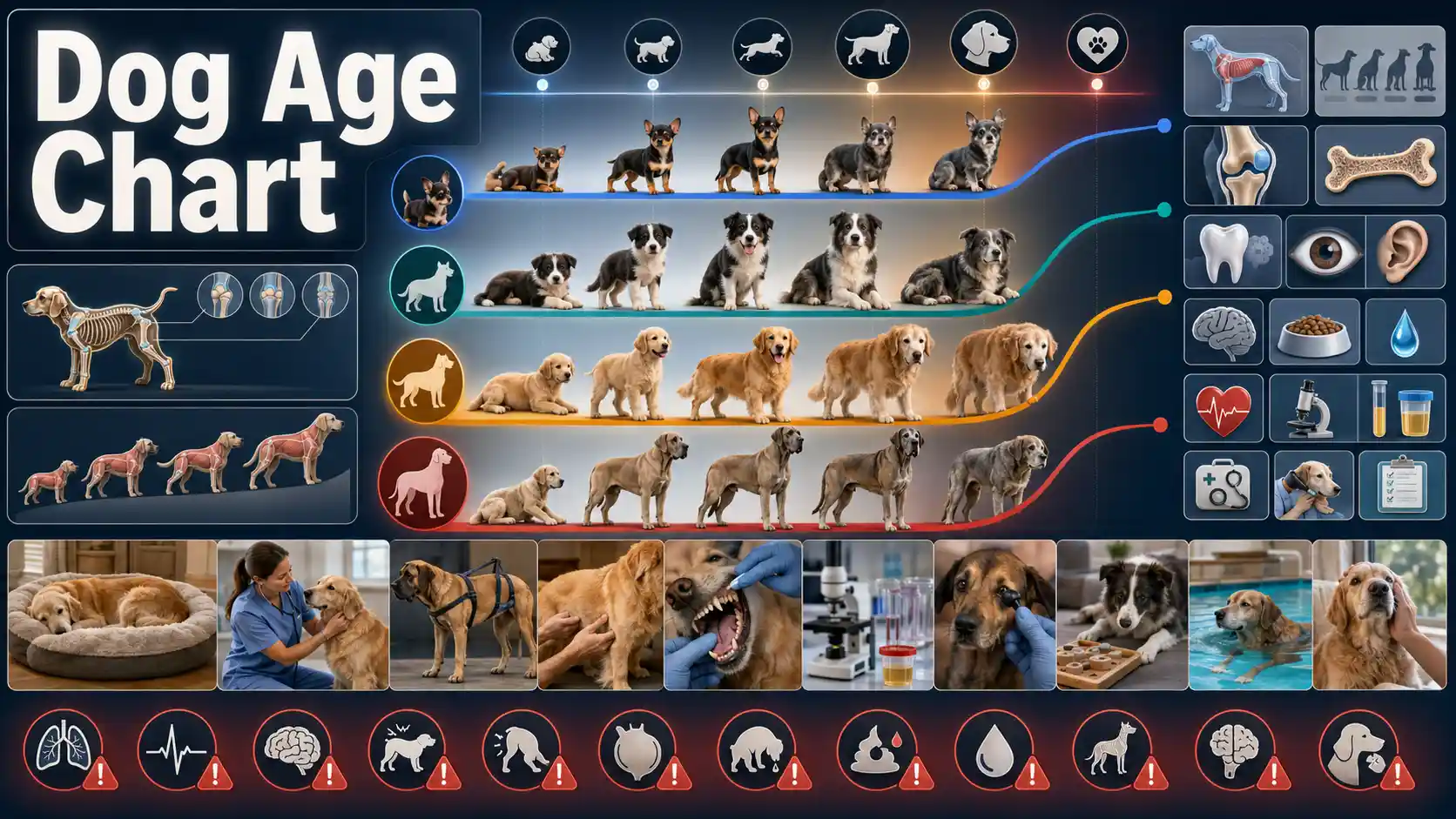
How old is a dog in human years?
A practical veterinary comparison uses about 15 human years for a dog’s first year and 24 by the second year. After that, adult size changes the estimate: larger dogs generally age faster than smaller dogs.
AAHA recommends using life stage and individual characteristics rather than trying to calculate a perfectly exact human equivalent. Read the AAHA canine life-stage definitions.
First year
About 15
The AAHA comparison uses roughly 15 human years.
Second year
About 24
The second year adds far more than seven.
After age 2
Size diverges
Large and giant dogs accumulate age faster in the chart.
Better guide
Life stage
Function, breed, health, and expected lifespan matter more.
Dog Age to Human Years by Adult Size
Approximate physiological-age equivalents from the AAHA poster. Adult weight matters increasingly after the second year.
Swipe horizontally inside the table to view every column.
| Dog age | Small ≤20 lb | Medium 21–50 lb | Large 51–90 lb | Giant >90 lb |
|---|---|---|---|---|
| 1 year | 15 — First-year reference | 15 | 15 | 15 |
| 2 years | 24 — Second-year reference | 24 | 24 | 24 |
| 3 years | 28 | 28 | 30 | 32 |
| 4 years | 32 | 33 | 35 | 37 |
| 5 years | 36 | 37 | 40 | 42 |
| 6 years | 40 | 42 | 45 | 49 |
| 7 years | 44 | 47 | 50 | 56 |
| 8 years | 48 | 51 | 55 | 64 |
| 9 years | 52 | 56 | 61 | 71 |
| 10 years | 56 | 60 | 66 | 78 — Advanced age for many giant dogs |
| 11 years | 60 | 65 | 72 | 86 |
| 12 years | 64 | 69 | 77 | 93 |
| 13 years | 68 | 74 | 82 | 101 |
| 14 years | 72 | 78 | 88 | 108 |
| 15 years | 76 | 83 | 93 | 115 |
| 16 years | 80 | 87 | 99 | 123 |
| 17 years | 84 | 92 | 104 | Not listed |
| 18 years | 88 | 96 | 109 | Not listed |
| 19 years | 92 | 101 | 115 | Not listed |
| 20 years | 96 | 105 | 120 | Not listed |
Human-year equivalents are approximations, not biological measurements.
- • The first year is shown as approximately 15 human years and the second as approximately 24 for every size group.
- • After age 2, larger dogs generally accumulate age-related risk faster than smaller dogs in this comparison.
- • The source does not list giant-dog equivalents beyond 16 years; the chart does not extrapolate missing values.
Download or export
Why the age gap widens after the second year
The first two rows are similar across all size groups. Later, the chart assigns progressively older human-year equivalents to larger dogs at the same chronological age.
Small dog
≤20 lb
Often 8–11 years
Medium dog
21–50 lb
Often 8–10 years
Large dog
51–90 lb
Often 8–9 years
Giant dog
>90 lb
Often 6–7 years
Puppy Growth Completion by Expected Adult Size
Approximate percentage of adult size reached at common puppy ages. Skeletal, social, and behavioral maturation do not finish on one identical date.
Swipe horizontally inside the table to view every column.
| Puppy age | Small 0–20 lb | Medium 21–50 lb | Large 51–100 lb | Extra-large 100+ lb |
|---|---|---|---|---|
| 6 months | About 75% | About 66% | About 60% | About 50% |
| 9 months | About 90% | About 85% | About 75% | About 65% |
| 12 months | About 100% | About 95% | About 85% | About 80% |
| 15 months | About 100% | About 100% | About 95% | About 90% |
| 18 months | About 100% | About 100% | About 100% | About 100% |
- • Some very large breeds may continue filling out or growing until about 24 months.
- • Growth percentage is not a feeding target and does not determine whether growth plates have closed.
- • Use expected adult size, breed history, body condition, and veterinary examination rather than paw size alone.
Download or export
Adult size and adult behavior arrive on different schedules
Small dogs may approach adult size within their first year, while large and giant dogs can continue skeletal development much longer. Social and behavioral maturity commonly continues until 3–4 years. Review the puppy growth-size overview.
Dog age and life-stage calculator
Enter chronological age and expected adult weight. The tool interpolates the AAHA size chart and uses broad life-stage ranges; it does not predict lifespan or diagnose age-related disease.
Medium (21–50 lb / 9.5–22.7 kg)
Broad life stage: Mature adult
- Approximate human equivalent
- 42 years
- Common senior range
- 8–10 dog years
This comparison is approximate. Breed lifespan, body condition, muscle, chronic disease, mobility, cognition, and quality of life matter more than the converted number.
Canine Life Stages and Practical Meaning
AAHA life stages are based on growth, maturation, and the proportion of expected lifespan rather than a fixed human-age conversion.
Swipe horizontally inside the table to view every column.
| Life stage | Approximate boundary | What changes | Care focus |
|---|---|---|---|
| Puppy | Birth to end of rapid growth; often about 6–9 months | Fast physical, neurologic, and behavioral development | Vaccination plan, parasite prevention, nutrition, socialization, safe exercise |
| Young adult | End of rapid growth to physical and social maturity; usually by 3–4 years | Adult body develops while behavior continues maturing | Training, dental care, weight control, preventive screening |
| Mature adult | From maturity until the final quarter of expected lifespan | Age-related risks begin accumulating at different rates | Trend weight, muscle, mobility, dental health, laboratory results |
| Senior | Final 25% of estimated lifespan | Reduced reserve and higher chronic-disease risk | More frequent assessment, pain and mobility review, diagnostic testing |
| End of life | Determined by disease trajectory and quality of life | Comfort and function may become the central goals | Palliative care, symptom control, caregiver support, quality-of-life planning |
- • Life-stage boundaries phase in and out gradually and vary by breed, size, lifestyle, and health status.
- • Chronological age alone should not decide whether a dog can receive anesthesia, surgery, rehabilitation, or other treatment.
Download or export
Approximate Senior-Dog Transition by Size
Body-size ranges can help start a senior-care conversation, but AAHA defines senior status more precisely as the final 25% of expected lifespan.
Swipe horizontally inside the table to view every column.
| Expected adult size | Weight range | Common senior range | Interpretation |
|---|---|---|---|
| Toy or small | Under 20 lb / 9.1 kg | About 8–11 years | Many remain active well beyond the lower boundary |
| Medium | 20–50 lb / 9.1–22.7 kg | About 8–10 years | Breed lifespan and chronic disease shift the transition |
| Large | 50–90 lb / 22.7–40.8 kg | About 8–9 years | Mobility and muscle trends may become important earlier |
| Giant | Over 90 lb / 40.8 kg | About 6–7 years | Shorter expected lifespan often moves senior care earlier |
- • These are broad AVMA ranges, not birthdays at which every dog suddenly becomes senior.
- • A small dog with significant chronic illness may need senior-style care earlier; a healthy older dog may remain highly functional.
Download or export
Senior is a life-stage estimate, not a single birthday
AVMA gives broad size-based ranges, while AAHA defines senior as the final 25% of expected lifespan. A giant dog may need senior monitoring years before a long-lived toy breed. Read AVMA senior-pet guidance.
Factors That Change How a Dog Ages
Human-year equivalents cannot include every variable that affects longevity, disease risk, resilience, and daily function.
Swipe horizontally inside the table to view every column.
| Factor | Possible effect | What to track | Why the chart cannot adjust perfectly |
|---|---|---|---|
| Breed and genetics | Different inherited lifespan and disease patterns | Family history, breed risks, screening plan | Dogs of similar weight can still age differently |
| Adult body size | Larger dogs often reach senior stages earlier | Mature weight and body frame | Weight categories are broad |
| Body and muscle condition | Obesity and muscle loss can reduce mobility and reserve | Body-condition and muscle-condition scores | Scale weight does not separate fat from muscle |
| Nutrition | Deficiency, excess, and inappropriate growth diets affect health | Diet adequacy, portions, treats, weight trend | Needs vary by life stage and disease |
| Activity and fitness | Appropriate movement supports muscle, joints, and cognition | Stamina, recovery, willingness to move | High activity does not erase disease |
| Dental health | Pain and infection can affect eating and wellbeing | Breath, chewing, gums, dental examinations | Age charts cannot see oral disease |
| Chronic disease | Kidney, heart, endocrine, cancer, and neurologic disease alter reserve | Symptoms, examinations, laboratory trends | Diagnosis and severity matter more than age alone |
| Environment and preventive care | Safety, vaccines, parasites, toxins, and access to care affect risk | Lifestyle exposures and preventive plan | Geography and household conditions differ |
- • A useful age chart starts a care discussion; it cannot predict an individual dog’s lifespan.
Download or export
Age-Related Changes Worth Monitoring
Many changes attributed to “old age” can reflect treatable pain, dental disease, sensory loss, organ disease, or cognitive dysfunction.
Swipe horizontally inside the table to view every column.
| Area | Possible change | Track at home | Discuss promptly when |
|---|---|---|---|
| Mobility | Stiffness, slower rising, reluctance on stairs | Gait, slips, jump height, recovery after walks | Pain, falls, sudden lameness, inability to stand |
| Muscle and weight | Muscle loss, weight gain, or weight loss | Monthly weight, body shape, thigh and spine muscle | Unplanned loss, rapid gain, weakness |
| Thirst and urination | More drinking, accidents, larger urine volume | Bowl refills, urine frequency, nighttime needs | Marked increase, straining, blood, inability to urinate |
| Appetite and digestion | Changing appetite, nausea, constipation, diarrhea | Meal completion, vomiting, stool pattern | Repeated vomiting, black stool, swollen abdomen |
| Cognition and behavior | Disorientation, altered sleep, anxiety, house soiling | Night waking, interactions, learned routines | Sudden confusion, seizures, collapse |
| Vision and hearing | Startle responses, bumping, reduced response to cues | Navigation, pupil changes, response to sound | Sudden blindness, painful eye, head tilt |
| Breathing and stamina | Less endurance or cough | Resting breathing, walk tolerance, recovery | Labored breathing, blue gums, fainting |
| Skin and masses | New lumps, coat change, slow wound healing | Monthly nose-to-tail check | Fast growth, ulceration, bleeding, pain |
- • Old age is not a diagnosis. New or progressive changes deserve veterinary assessment.
Download or export
Wellness Priorities by Dog Life Stage
The exact examination, vaccine, parasite, laboratory, dental, and nutrition plan depends on geography, lifestyle, breed, and medical history.
Swipe horizontally inside the table to view every column.
| Stage | Veterinary focus | Home monitoring | Planning questions |
|---|---|---|---|
| Puppy | Growth, congenital concerns, vaccines, parasites, behavior | Eating, stool, weight, socialization, gait | Expected adult size? Safe exercise? Growth diet? |
| Young adult | Baseline health, reproduction, dental and weight prevention | Behavior, body condition, activity, skin and ears | What baseline tests are useful? |
| Mature adult | Trend changes before symptoms become obvious | Weight, muscle, stamina, thirst, dental health | When should screening frequency increase? |
| Senior | Function, pain, cognition, organ screening, quality of life | Mobility, sleep, appetite, elimination, interaction | Should visits or tests occur more often? |
| Any age with disease | Condition-specific monitoring overrides age averages | Medication effects, symptoms, quality of life | Which changes are urgent? What is the follow-up plan? |
- • AAHA senior resources commonly recommend at least twice-yearly physical examinations for senior dogs, with testing individualized to risk.
- • Vaccination and parasite schedules must follow veterinary guidance and local legal requirements rather than a generic age table.
Download or export
Do not label treatable symptoms as normal aging
Pain, dental disease, endocrine disorders, kidney or heart disease, sensory loss, cancer, and cognitive dysfunction can all appear as “slowing down.” AAHA senior guidance emphasizes function, diagnostic assessment, pain control, and individualized quality-of-life planning. Review the AAHA senior-care framework.
How Veterinarians Estimate an Unknown Dog’s Age
Age estimation becomes less precise after adulthood. Several clues are combined rather than relying on tooth wear or gray hair alone.
Swipe horizontally inside the table to view every column.
| Clue | What it may suggest | Major limitation |
|---|---|---|
| Teeth and eruption | Useful for puppies while teeth are developing and changing | Adult wear varies with diet, chewing, and dental care |
| Lens appearance | Age-related lens changes may develop over time | Eye disease can mimic or alter appearance |
| Muscle tone and posture | Mature or senior dogs may lose muscle or change stance | Injury, nutrition, and exercise also affect muscle |
| Coat and muzzle color | Some dogs gray with age | Genetics and coat color make this unreliable |
| Behavior and activity | Play, sleep, learning, and stamina can provide context | Temperament, training, pain, and fear alter behavior |
| Medical history | Prior records, microchip data, and shelter history may narrow the range | Records may be incomplete or based on prior estimates |
| Imaging and examination | Skeletal development or chronic changes can support an estimate | No routine test produces an exact birthday |
- • A veterinarian may provide an age range rather than a single year, especially for an adult rescue dog.
Download or export
Dog Warning Signs That Override an Age Chart
Symptoms and function matter more than the calculated human-year equivalent. Contact a veterinarian or emergency service based on severity.
Swipe horizontally inside the table to view every column.
| Warning sign | Why it matters | Response |
|---|---|---|
| Difficulty breathing or blue, gray, or very pale gums | Possible oxygen, circulation, heart, or lung emergency | Seek emergency veterinary care now |
| Collapse, seizure, or unresponsiveness | Neurologic, metabolic, toxic, or cardiovascular emergency | Seek emergency veterinary care now |
| Swollen painful abdomen with unproductive retching | Possible gastric dilatation-volvulus | Seek emergency veterinary care now |
| Inability to urinate or repeated straining | Possible urinary obstruction | Seek urgent or emergency care |
| Sudden inability to walk or severe uncontrolled pain | Possible neurologic, orthopedic, or vascular emergency | Seek urgent assessment |
| Repeated vomiting, bloody diarrhea, or black stool | Risk of bleeding, dehydration, obstruction, or serious disease | Contact a veterinarian promptly |
| Rapid unplanned weight loss or persistent refusal to eat | Possible systemic, dental, gastrointestinal, or cancer-related disease | Arrange a veterinary examination |
| Progressive confusion, nighttime distress, or loss of house training | Pain, sensory loss, organ disease, or cognitive dysfunction may contribute | Schedule assessment rather than assuming normal aging |
- • Do not delay care because a dog is young, and do not dismiss serious symptoms because a dog is old.
Download or export
Dog age chart FAQs
Is one dog year equal to seven human years?
No. Dogs mature much faster during their first two years, and later aging differs substantially by adult size, breed, genetics, health, and lifestyle.
How old is a 1-year-old dog in human years?
The AAHA physiological-age poster uses about 15 human years for a 1-year-old dog across all size groups.
How old is a 2-year-old dog in human years?
The same reference uses about 24 human years for a 2-year-old dog across all size groups.
Why do large dogs age faster than small dogs?
Large and giant dogs generally have shorter expected lifespans and enter later life stages earlier, although breed genetics and individual health still create substantial variation.
When is a dog considered senior?
AAHA defines the senior stage as the final 25% of expected lifespan. Broad AVMA ranges begin around 8–11 years for small dogs and about 6–7 years for giant dogs.
Is a 7-year-old dog always a senior?
No. Seven may be senior for some giant or medically fragile dogs, while many small dogs are still mature adults. Size, breed lifespan, function, and health matter.
When does a puppy become an adult?
Rapid growth often slows by about 6–9 months, but physical and social maturation continues. Small dogs may finish growing by 6–8 months, while giant dogs can continue for 18–24 months.
Can I calculate my dog’s exact human age?
No. Human-year equivalents are communication aids, not exact biological conversions. Life stage and individual health are more useful for veterinary planning.
Does breed matter more than weight?
Both matter. Adult size strongly affects broad aging patterns, while breed genetics can change expected lifespan and disease risk even among dogs of similar weight.
How can I estimate the age of a rescue dog?
Veterinarians combine teeth, skeletal development, eyes, muscle, coat, behavior, medical findings, and any available records. Adult estimates are usually ranges rather than exact birthdays.
Should senior dogs see a veterinarian more often?
Often yes. AAHA senior guidance supports more frequent assessment, commonly at least twice yearly, with diagnostic testing tailored to the dog’s risk and medical history.
Is slowing down normal in an older dog?
Some change can occur, but reduced activity may reflect pain, arthritis, heart or lung disease, anemia, endocrine disease, sensory loss, or cognitive dysfunction. New changes should be assessed.
Can an old dog safely have surgery?
Age alone does not determine anesthesia or surgical eligibility. The decision depends on diagnosis, organ function, frailty, pain, expected benefit, and individualized risk assessment.
What matters more than human-year age?
Function, comfort, mobility, body and muscle condition, appetite, thirst, elimination, cognition, chronic disease, laboratory trends, and quality of life usually matter more.
Sources
URLs are shown as plain text for transparent reference. Table-specific source names link to this section.
American Animal Hospital Association — My Pet’s Physiological Age
Provides size-specific dog-age equivalents from 1 through 20 years and a 6-month reference point.
https://www.aaha.org/wp-content/uploads/globalassets/02-guidelines/canine-life-stage-2019/canine_and_feline_age_chart_poster.pdf
American Animal Hospital Association — Canine Life Stage Definitions
Defines puppy, young adult, mature adult, senior, and end-of-life stages using growth, maturation, and estimated lifespan.
https://www.aaha.org/resources/life-stage-canine-2019/canine-life-stage-definitions/
American Veterinary Medical Association — Caring for Senior Cats and Dogs
Explains that senior timing differs by body size and that the seven-human-years rule is inaccurate.
https://www.avma.org/resources-tools/pet-owners/petcare/senior-pets
American Animal Hospital Association — 2023 AAHA Senior Care Guidelines for Dogs and Cats
Supports individualized senior assessment, functional monitoring, preventive testing, pain evaluation, and quality-of-life planning.
https://www.aaha.org/wp-content/uploads/globalassets/02-guidelines/2023-aaha-senior-care-guidelines-for-dogs-and-cats/resources/2023-aaha-senior-care-guidelines-for-dogs-and-cats.pdf
American Kennel Club — Puppy Growth Chart: When Does My Puppy Finish Growing?
Provides approximate growth-completion percentages by expected adult size and explains that giant breeds mature more slowly.
https://www.akc.org/expert-advice/health/when-does-my-puppy-finish-growing/