Health & Medical · Infant nutrition and feeding safety
Infant Feeding Chart: Breast Milk, Formula, Solids and Safety
Follow feeding changes from birth through 23 months, compare breastfeeding and formula patterns, identify solid-food readiness, progress textures safely, and recognize when feeding problems need medical assessment.
Infant feeding guidance must be individualized when growth, prematurity, allergy, swallowing, illness, or special formula is involved. Never dilute or concentrate formula, add cereal to a bottle, start a supplement, or delay urgent care based on a general chart. Read the ChartsLoom Disclaimer.
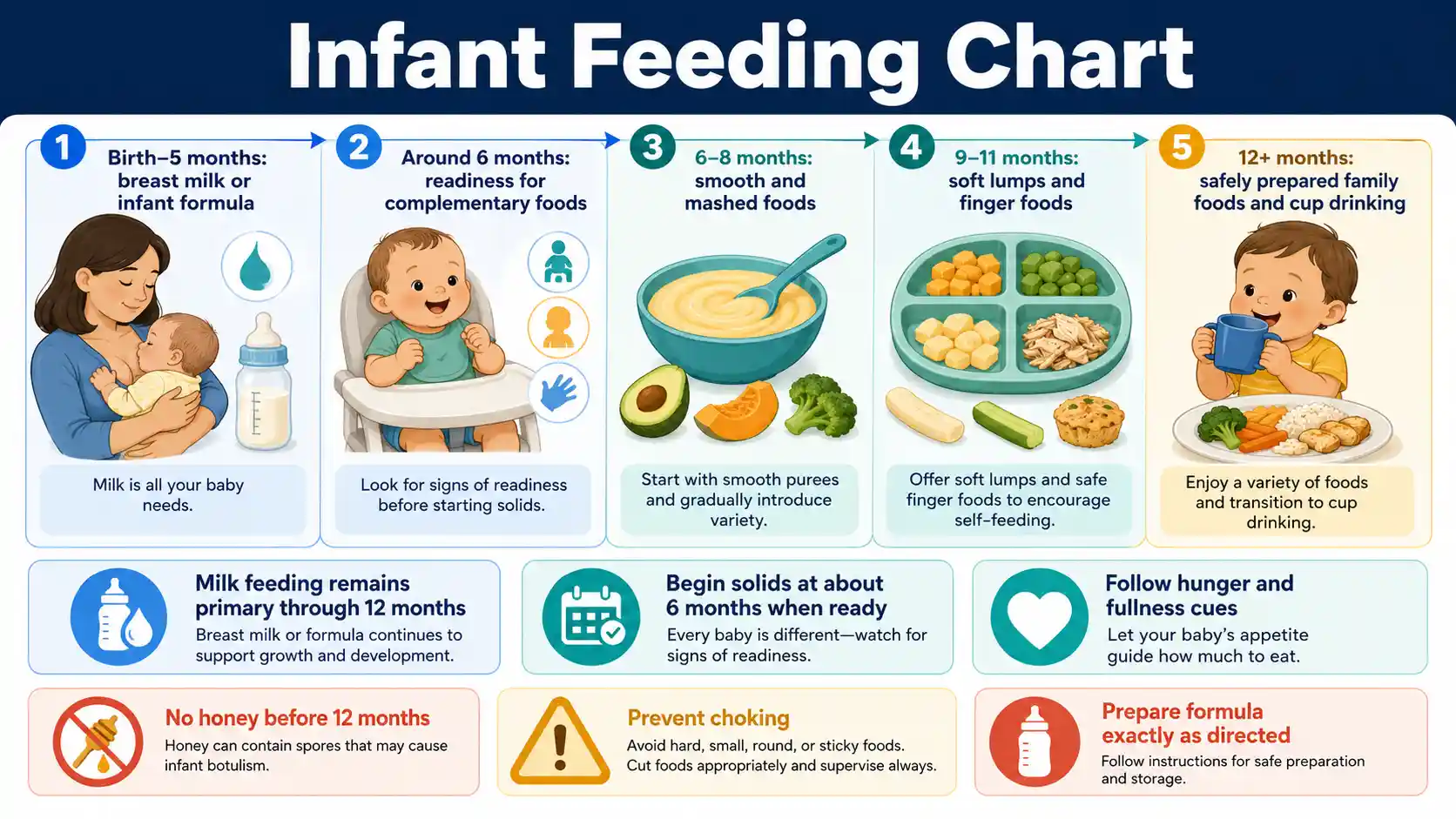
What is the basic infant feeding timeline?
For most infants, breast milk or infant formula provides the feeding base for about the first 6 months. Complementary foods usually begin at about 6 months when developmental readiness is present, while milk feeding remains nutritionally central through 12 months.
CDC describes cue-based milk feeding and the continuing importance of breast milk after complementary foods begin. Formula-fed and combination-fed infants follow the same core principles of safe preparation, responsive feeding, and growth-based assessment.
Birth to about 6 months
Milk feeding
Breast milk or iron-fortified infant formula is the feeding base for most infants.
Complementary foods
Around 6 months
Begin when age and developmental readiness signs align; never before 4 months.
Ages 6 to 12 months
Milk stays primary
Foods gradually add nutrients, texture practice, and family-meal skills.
Core safety rule
Follow cues
Use safe textures, upright positioning, supervision, and prompt care for feeding distress.
Infant Feeding Chart by Age and Developmental Stage
A practical overview from birth through the transition into toddler feeding. Individual readiness, growth, medical history, and feeding skills can change the plan.
Swipe horizontally inside the table to view every column.
| Age or stage | Primary nutrition | Usual feeding pattern | Complementary foods and textures | Main safety focus |
|---|---|---|---|---|
| Birth to first days | Breast milk or iron-fortified infant formula | Feed responsively; newborns commonly feed 8–12 times in 24 hours | No routine solids or other drinks | Effective feeding, hydration, safe formula preparation, and prompt help for poor feeding |
| First weeks to 3 months | Breast milk or infant formula | Breastfed infants often feed every 2–4 hours on average; formula-fed infants often every 3–4 hours | No solid foods | Follow hunger and fullness cues; never prop a bottle |
| 4 to under 6 months | Breast milk or infant formula remains primary | Cue-based milk feeding | Most infants are not ready until about 6 months; never begin before 4 months | Assess head control, supported sitting, swallowing, and developmental readiness |
| About 6 months | Breast milk or infant formula plus complementary foods | Milk remains the main source of nutrition | Begin small amounts of iron-rich, nutrient-dense, smooth or mashed foods | Upright seating, direct supervision, safe textures, and allergen planning |
| 6 to 8 months | Milk feeding plus complementary foods | WHO: usually 2–3 complementary meals daily, adjusted to cues | Progress from smooth to thicker mashed foods; offer varied food groups | Prevent choking; no honey, juice, or cow’s milk as a drink |
| 9 to 11 months | Milk feeding remains important as food variety expands | WHO: usually 3–4 complementary meals daily | Soft lumps, finely chopped family foods, soft finger foods, and cup practice | Supervise every meal and continue avoiding unsafe shapes and textures |
| 12 to 23 months | Family foods, meals and snacks; breastfeeding may continue | WHO: 3–4 meals with 1–2 snacks as needed | Varied family foods; plain whole cow’s milk may begin after 12 months | Avoid added sugars, excess sodium, unpasteurized foods, and choking hazards |
- • “About 6 months” means developmental readiness and age should be considered together.
- • Breast milk or infant formula remains the main source of nutrition from 6 to 12 months while complementary foods gradually increase.
- • Prematurity, oral-motor delay, growth concerns, allergy risk, and medical conditions require individualized guidance.
Download or export
How infant feeding changes across the first two years
The transition is gradual. Milk feeding remains essential through the first year while the child learns to manage increasingly varied complementary foods.
Birth–5 months
Milk feeding
Breast milk or infant formula remains the complete feeding base for most infants.
Around 6 months
Readiness first
Begin complementary foods when developmental signs are present; do not start before 4 months.
6–8 months
Learn tastes and textures
Offer small amounts, iron-rich choices, and smooth-to-mashed textures while milk remains primary.
9–11 months
Increase variety
Progress toward lumpier textures, soft finger foods, cup practice, and shared family foods prepared safely.
12–23 months
Toddler transition
Meals and snacks become central; breastfeeding may continue and plain whole milk can begin after 12 months.
Development matters more than the calendar alone. Prematurity, oral-motor skills, medical conditions, growth, allergy risk, and feeding history may change the plan.
Browser-only educational tool
Infant Feeding Stage Guide
Choose an age and feeding pattern to see the relevant feeding stage, milk role, complementary-food guidance, texture progression, and cautions. No information is stored.
Current stage
Early complementary-feeding stage
- Milk feeding
- breast milk and infant formula remains the main source of nutrition from 6–12 months.
- Complementary foods
- Offer small amounts of nutrient-dense foods. WHO guidance describes 2–3 complementary meals per day for ages 6–8 months.
- Texture and feeding skill
- Begin with smooth, mashed, or soft foods and progress as skills develop. Always seat the baby upright and supervise.
- Priority
- Include iron-rich foods, vary grains, introduce allergens in safe forms, and respond to hunger and fullness cues.
- • No honey, cow’s milk as a drink, or juice before 12 months.
- • Whole nuts, spoonfuls of nut butter, round foods, hard raw pieces, and other choking hazards require safer preparation.
Limitations: This tool does not calculate required ounces, calories, supplements, allergy dosing, or a treatment plan. Prematurity, growth concerns, swallowing difficulty, food allergy, metabolic disease, and other conditions require individualized guidance.
Breastfeeding and Infant Formula Pattern Chart
These are broad population patterns, not a schedule every baby must follow. Feed according to cues and the individualized pediatric plan.
Swipe horizontally inside the table to view every column.
| Feeding situation | Common pattern | Amount guidance | What to watch | Important caveat |
|---|---|---|---|---|
| Breastfed newborn | Often every 1–3 hours; commonly 8–12 feeds per 24 hours | Milk transfer cannot be judged by minutes alone | Swallowing, comfort, wet diapers, stool pattern, and weight trend | Cluster feeding can be normal; painful or ineffective feeding needs support |
| Breastfed first weeks and months | Often every 2–4 hours on average, with shorter or longer intervals | Follow cues rather than forcing a measured volume | Contentment after feeds, growth, hydration, and breast comfort | Some babies need waking plans because of age or medical risk |
| Formula-fed first days | Offer every 2–3 hours; commonly 8–12 feeds per 24 hours | CDC suggests starting with 1–2 fl oz per feed when formula is the only milk — CDC first-days formula guidance | Hunger and fullness cues; safe preparation and discard times | The care team should advise the right amount for the individual newborn |
| Formula-fed first weeks and months | Many feed about every 3–4 hours | Volume generally rises as the stomach and baby grow | Do not require the bottle to be finished | Growth, illness, prematurity, and reflux can change the plan |
| Combination feeding | Frequency depends on breast milk transfer, formula use, pumping, and goals | No single standard split applies | Milk supply, latch, bottle technique, growth, and caregiver preference | A lactation or pediatric professional can help protect supply or simplify the plan |
| Ages 6–12 months | Breast milk or formula plus complementary foods about 5–6 eating or drinking occasions in 24 hours for many infants | Milk needs gradually change as food intake grows | Continued cue-based feeding and balanced food progression | Do not replace milk feeds too quickly with low-nutrient foods or drinks |
Fluid-ounce figures are U.S. customary units; 1 fl oz is about 30 mL.
- • Feeding frequency varies from day to day and during growth spurts, illness, or developmental change.
- • A bottle is not a target to finish. Stop when the baby shows fullness cues.
- • Do not thicken feeds, add cereal to a bottle, or change formula concentration without a specific medical instruction.
Download or export
Solid-food readiness is developmental, not just a birthday
CDC recommends introducing foods other than breast milk or formula at about 6 months and not before 4 months. Stable head control, supported sitting, food interest, and the ability to move food back and swallow are more informative than age alone.
Solid-Food Readiness and Texture Progression Chart
Complementary foods generally begin at about 6 months when the infant can safely manage them. Skills progress gradually rather than on one exact date.
Swipe horizontally inside the table to view every column.
| Readiness or stage | What it can look like | Appropriate progression | Do not assume |
|---|---|---|---|
| Stable head and neck control | Holds the head steady while seated with support | Use upright, well-supported feeding position | Age alone proves safe swallowing |
| Sits alone or with support | Maintains an upright trunk rather than slumping | Offer food only while awake and securely seated | A reclined infant seat is a safe eating position |
| Opens mouth and leans toward food | Shows interest when food is offered | Offer a small spoonful and pause for response | Interest means the child must continue eating |
| Moves food back and swallows | Less tongue-thrusting; manages a smooth texture | Start smooth or mashed, then thicken as skill develops | Gagging and choking are the same event |
| Reaches and grasps | Brings safe objects or food toward the mouth | Introduce soft graspable foods when ready | Whole hard or round foods are safe finger foods |
| Around 7–8 months | Can often eat foods from several food groups | Increase variety and avoid relying only on rice cereal | Foods must be introduced in one fixed order |
| Around 9–11 months | Improved chewing movements and hand control | Lumpier mashed foods, finely chopped foods, and soft finger foods | Purees must continue until teeth appear |
| Around 12 months | Moves toward family meals and utensils | Safely modified family foods, open-cup practice, spoon participation | Adult-size pieces and hard textures are safe |
- • Coughing, gagging, or spitting up can happen during learning, but repeated distress or choking requires assessment.
- • Always supervise closely and match shape, softness, and size to developmental skill.
- • Prematurity or oral-motor concerns may require a feeding specialist’s plan.
Download or export
Complementary Feeding Frequency and Portion Guide
Meal frequency increases with age, but appetite varies. Start with small portions and let the child decide how much to eat.
Swipe horizontally inside the table to view every column.
| Age | Complementary-food pattern | Starting portion idea | Milk role | Responsive-feeding approach |
|---|---|---|---|---|
| About 6 months | Begin with one or more brief learning opportunities as tolerated | CDC suggests starting with 1–2 tablespoons of food — CDC starting portion suggestion | Breast milk or formula remains primary | Offer slowly, pause, and stop when the child closes the mouth or turns away |
| 6–8 months | WHO: 2–3 complementary meals per day | Increase gradually from small tastes | Continue frequent milk feeding | Encourage without pressure and allow time to explore |
| 9–11 months | WHO: 3–4 complementary meals per day | Offer varied portions based on appetite and skill | Milk remains nutritionally important | Use predictable opportunities but accept day-to-day variation |
| 12–23 months | WHO: 3–4 meals plus 1–2 nutritious snacks as needed | Child-sized servings with more offered if hungry | Breastfeeding may continue; other milk follows age guidance | Caregiver chooses what, when, and where; child chooses whether and how much |
| During illness | Offer fluids more often and continue feeding patiently | Soft preferred nutrient-dense foods may be easier | More breastfeeding can help maintain fluids and comfort | Do not force; seek medical help for dehydration or inability to feed |
- • Meal frequency is a broad framework, not a requirement to finish a specified volume.
- • Complementary foods should become more varied, nutrient-dense, and textured as the child grows.
- • Milk feeds should not be abruptly displaced during the 6–12 month transition.
Download or export
Responsive feeding supports skill, trust, and self-regulation
WHO recommends feeding slowly and patiently, encouraging without forcing, and increasing complementary-food frequency and texture with age. The caregiver offers appropriate food and structure; the infant communicates hunger, pace, and fullness.
Infant Hunger and Fullness Cue Chart
Responsive feeding means noticing cues, offering food or milk, and stopping when the infant communicates fullness.
Swipe horizontally inside the table to view every column.
| Stage | Possible hunger cues | Possible fullness cues | Caregiver response |
|---|---|---|---|
| Birth to about 5 months | Hands to mouth, turns toward breast or bottle, puckers or smacks lips, clenched hands | Closes mouth, turns head away, relaxes hands, loses interest | Offer early; pause and stop when fullness cues appear |
| About 6–8 months | Reaches for food, opens mouth, becomes excited when food appears | Pushes food away, closes mouth, turns head, slows eating | Offer small amounts and wait before offering more |
| About 9–23 months | Points, reaches, makes sounds or words, becomes excited at food | Shakes head, says no, pushes food away, slows or stops | Respect refusal and offer another planned opportunity later |
| During bottle feeding | Roots, brings hands to mouth, actively sucks | Stops sucking, spills milk, turns away, becomes relaxed or sleepy | Hold the bottle, allow pauses, and never prop or force completion |
| During breastfeeding | Rooting, hand-to-mouth movements, increased alertness | Releases breast, relaxed body, no longer actively swallowing | Allow the infant to finish and offer the other side if still interested |
| Crying | May be a late hunger cue but also signals discomfort, fatigue, pain, or need for closeness | Not applicable | Check the full context rather than assuming every cry requires feeding |
- • Cues differ among children and become easier to recognize with repeated observation.
- • Pressure to finish can override self-regulation and make mealtimes stressful.
- • Poor feeding, weak cues, or a sudden change in feeding behavior may be a sign of illness.
Download or export
Infant Nutrients, First Foods and Allergen Guide
Nutrient-dense complementary foods support rapid growth. Potential allergens should be introduced in developmentally safe forms rather than automatically delayed.
Swipe horizontally inside the table to view every column.
| Topic | When it matters | Practical food or supplement context | Important caution |
|---|---|---|---|
| Vitamin D | Beginning shortly after birth | Infants younger than 12 months need 400 IU daily; breastfed and combination-fed babies generally need a supplement — CDC vitamin D guidance | Formula-fed babies consuming about 32 fl oz daily may not need extra vitamin D; confirm with the care team |
| Iron | Especially from about 6 months | Meat, poultry, fish, eggs, beans, lentils, tofu, and iron-fortified infant cereal | Breastfed infants may need individualized iron guidance before and after 6 months |
| Zinc and protein | As complementary foods begin | Meat, eggs, dairy foods, beans, lentils, tofu, fish, and fortified grains | Match texture and allergen plan to developmental readiness |
| Varied grains | From complementary-food introduction | Oat, barley, multigrain, and other fortified infant cereals | Do not rely only on rice cereal because variety reduces repetitive exposure |
| Egg | When other complementary foods begin | Cook thoroughly and offer an age-appropriate texture | Stop and seek help for allergic symptoms |
| Peanut | During complementary-food introduction | Use thinned smooth peanut butter or another age-appropriate peanut form | Whole peanuts and spoonfuls of thick nut butter are choking hazards |
| Severe eczema or egg allergy | Before peanut introduction | Discuss timing and supervised introduction with the child’s clinician | NIAID guidance may recommend early introduction from 4–6 months after readiness and evaluation |
| Other allergens | When other foods are introduced | Dairy foods, wheat, soy, fish, shellfish, sesame, and tree-nut forms can be introduced safely | Use one new food at a time initially so reactions can be recognized |
- • Supplement decisions should use the product concentration and pediatric guidance; this table does not provide dosing instructions.
- • An allergic reaction can include hives, swelling, vomiting, cough, wheeze, breathing difficulty, or sudden lethargy.
- • Call emergency services for breathing difficulty, collapse, blue color, or rapidly progressive swelling.
Download or export
Nutrient density matters because infant portions are small
Prioritize iron-rich foods, varied grains, protein foods, vegetables, fruits, and safe allergen exposure instead of filling limited stomach capacity with juice, added sugar, salty snacks, or low-nutrient drinks. Supplement decisions must use pediatric guidance and the exact product concentration.
Foods and Drinks to Avoid or Limit for Infants
Age, preparation, pasteurization, mercury content, added sugar, and choking risk all affect whether a food or drink is appropriate.
Swipe horizontally inside the table to view every column.
| Food or drink | Age or situation | Why it is limited | Safer approach |
|---|---|---|---|
| Honey in any form | Younger than 12 months | Risk of infant botulism | Avoid honey in food, water, formula, and on pacifiers |
| Cow’s milk as the main drink | Younger than 12 months | Not nutritionally appropriate; may stress kidneys and increase intestinal-bleeding risk | Use breast milk or infant formula; yogurt and cheese can be introduced as foods |
| Fruit or vegetable juice | Younger than 12 months | No nutritional need and can displace nutrient-dense intake | Offer whole fruit after solids begin; breast milk or formula remains primary |
| Added sugars and sugary drinks | Younger than 24 months | Use limited stomach capacity without needed nutrients | Choose unsweetened foods and drinks |
| Caffeinated drinks | Younger than 24 months | No established safe caffeine limit for young children | Avoid tea, coffee, energy drinks, and caffeinated soda |
| Unpasteurized milk, juice, cheese, or yogurt | All infants and young children | Risk of harmful bacteria and severe illness | Use pasteurized products |
| High-mercury fish | Young children | Mercury can harm the developing brain and nervous system | Choose lower-mercury fish from current FDA/EPA advice |
| Whole nuts or thick spoonfuls of nut butter | Infants and young children | Major choking hazard | Use finely ground or smoothly thinned age-appropriate forms |
| Whole grapes, popcorn, hard raw vegetables, round sausage pieces, hard candy | Infants and young children | Shape and hardness can block the airway | Cook, mash, grate, quarter lengthwise, or avoid according to the food |
| Foods high in sodium | Infants and young children | Displace nutrient-dense choices and add unnecessary salt | Choose low-sodium or no-salt-added foods |
- • This table is not exhaustive. Food preparation and supervision are as important as the ingredient itself.
- • Gagging is noisy and can occur while learning; choking may be silent and requires immediate action.
- • Caregivers should learn age-appropriate choking first aid and emergency response.
Download or export
Honey, cow’s milk as a drink, and juice wait until after 12 months
CDC advises no honey, cow’s milk as the main drink, or fruit and vegetable juice before 12 months. Choking hazards, unpasteurized foods, high-mercury fish, caffeine, added sugars, and excess sodium also require age-specific caution.
Infant Formula Preparation, Storage and Bottle Safety Chart
Powdered formula is not sterile. Follow the exact package instructions, use safe water, keep equipment clean, and discard formula on time.
Swipe horizontally inside the table to view every column.
| Task or situation | Safe practice | Time or condition | Why it matters |
|---|---|---|---|
| Before preparation | Wash hands with soap and water and clean the preparation surface | Every time | Reduces contamination of formula and feeding equipment |
| Mixing formula | Measure water first, then add the exact number of level scoops stated on the label | Use the product directions | Too much or too little water can be dangerous |
| Water source | Use water from a safe source; ask local health authorities if safety is uncertain | Every preparation | Unsafe water can introduce germs or contaminants |
| Powder and scoop | Keep the container, lid, and scoop dry; never clean inside the container | During the container’s use period | Moisture can promote contamination |
| Fresh prepared formula | Use promptly | Within 2 hours of preparation — Two-hour preparation limit | Limits bacterial growth |
| Bottle after feeding begins | Discard remaining formula | Within 1 hour from the start of feeding — One-hour feeding limit | Saliva can introduce bacteria into the bottle |
| Prepared but unused bottle | Refrigerate immediately if not used within 2 hours | Use within 24 hours when refrigerated — Twenty-four-hour refrigerated limit | Cold storage slows bacterial growth but does not make formula sterile |
| Opened powder container | Close tightly and store in a cool, dry place according to label directions | Often use within 1 month, but follow the product label | Quality and safety decline after the recommended period |
| Warming | Warm in a container of warm water and test temperature | Never microwave | Microwaves can create hot spots that burn the mouth |
| Bottle position | Hold the baby and bottle; keep the bottle angled so the nipple contains milk | Every bottle feed | Supports responsive pacing and reduces choking risk |
| Bottle propping or bed bottle | Do not prop a bottle or leave the baby alone with it | Never | Increases choking and feeding-safety risk |
| Higher-risk infant | Ask the clinician whether ready-to-feed liquid formula or extra preparation precautions are needed | Prematurity, age under 2 months, or weakened immunity | Cronobacter infection is rare but can be severe or fatal |
- • Never dilute formula to make it last longer and never concentrate it unless a clinician provides exact instructions.
- • Use the manufacturer’s label when it is more restrictive than a general storage rule.
- • For emergencies, unsafe water, recalls, or special medical formula, follow current public-health and clinical instructions.
Download or export
Powdered infant formula is not sterile
FDA emphasizes handwashing, dry containers and scoops, clean feeding equipment, safe water, and prevention of cross-contamination. Higher-risk infants may need ready-to-feed formula or extra precautions chosen with their clinician.
Feeding warning signs that need prompt assessment
Emergency now
Blue or gray color, severe breathing difficulty, unresponsiveness, collapse, seizure, or complete airway obstruction.
Urgent newborn concern
Will not feed, is difficult to wake, has a weak suck, repeated vomiting, fever, or markedly fewer wet diapers.
Swallowing concern
Repeated coughing, choking, wet breathing, color change, arching, or exhaustion during feeds.
Allergic reaction
Hives, swelling, vomiting, cough, wheeze, breathing difficulty, or sudden lethargy after a food.
Growth concern
Confirmed poor weight gain, ongoing weight loss, persistent feeding refusal, or feeds that routinely take an unusually long time.
Dehydration concern
Dry mouth, no tears, sunken soft spot, unusual sleepiness, or clearly reduced urine output.
Current symptoms override a previous normal chart, feeding amount, or weight percentile. Call local emergency services for life-threatening symptoms.
Frequently asked questions
What should an infant eat from birth to 6 months?
For most infants, breast milk or iron-fortified infant formula provides the feeding base for about the first 6 months. Routine water, juice, cereal, and solid foods are not needed before developmental readiness, and solids should not begin before 4 months.
How often should a newborn feed?
Many newborns feed 8 to 12 times in 24 hours. Breastfed newborns may feed every 1 to 3 hours, while formula-fed newborns are often offered feeds every 2 to 3 hours in the first days. Individual medical plans can differ.
How much formula should a newborn take?
CDC suggests starting with 1 to 2 fluid ounces every 2 to 3 hours in the first days when formula is the only milk. The correct amount depends on the baby’s cues, growth, age, and medical context, so the pediatric team should guide concerns.
When can a baby start solid foods?
Most babies can begin complementary foods at about 6 months when they have head control, can sit with support, show interest, and can move food back and swallow. Starting before 4 months is not recommended.
What are good first foods?
There is no required order. Good choices include iron-rich meat, beans, lentils, eggs, tofu, iron-fortified cereals, vegetables, fruits, yogurt without added sugar, and varied grains prepared in a safe texture.
How many meals should a 6-month-old eat?
At about 6 months, begin with small amounts and increase gradually. WHO describes 2 to 3 complementary meals daily for ages 6 to 8 months, while breast milk or infant formula remains the main source of nutrition.
How do I know when my baby is full?
Fullness cues can include closing the mouth, turning away, relaxing the hands, slowing or stopping sucking, pushing food away, or losing interest. Respect these cues rather than requiring the bottle or serving to be finished.
Can a baby drink water?
From about 6 to 12 months, small amounts of water can be offered with meals while breast milk or formula remains primary. CDC notes a broad total of 4 to 8 ounces a day for this age, but needs vary and water should not displace milk feeds.
When can a baby drink cow’s milk?
Plain pasteurized whole cow’s milk can generally be introduced as a drink at 12 months, not before. Yogurt and cheese can be introduced earlier as complementary foods when prepared appropriately.
Why can babies not have honey?
Honey can contain spores that cause infant botulism. Do not give honey in any form before 12 months, including in food, water, formula, baked products intended for the infant, or on a pacifier.
When should allergenic foods be introduced?
Potential allergens can be introduced when other complementary foods begin, using age-appropriate forms. Babies with severe eczema or egg allergy need clinician guidance about peanut introduction because early supervised introduction may be recommended.
Does a breastfed baby need vitamin D?
CDC recommends 400 IU of vitamin D daily beginning shortly after birth for babies fed only breast milk or both breast milk and formula. Formula-fed babies consuming about 32 ounces daily may not need an additional supplement.
How long can prepared formula be kept?
Use prepared formula within 2 hours of preparation and within 1 hour after feeding begins. If an unused bottle is refrigerated immediately, use it within 24 hours. Follow the product label if it gives a shorter limit.
What is the difference between gagging and choking?
Gagging is often noisy and may occur while learning textures. Choking can be silent because the airway is blocked. Always supervise eating, prepare foods safely, learn infant choking first aid, and call emergency services for severe airway obstruction.
When does feeding difficulty need medical help?
Seek prompt help for a newborn who will not feed, is difficult to wake, has fewer wet diapers, repeated forceful or green vomiting, breathing trouble, blue color, coughing or choking during feeds, poor weight gain, allergic symptoms, or a sudden major feeding change.
Sources
These sources support the visible feeding-stage timeline, milk patterns, complementary-food guidance, nutrient information, allergen context, formula safety, foods to avoid, and warning signs. URLs are shown as plain text for transparent reference.
Centers for Disease Control and Prevention — How Much and How Often to Breastfeed
Describes cue-based breastfeeding, common newborn and early-infant feeding frequency, and the continuing role of breast milk after complementary foods begin.
https://www.cdc.gov/infant-toddler-nutrition/breastfeeding/how-much-and-how-often.html
Centers for Disease Control and Prevention — How Much and How Often to Feed Infant Formula
Provides current U.S. guidance for formula-feeding frequency, first-day offering amounts, cue-based feeding, and the transition after 12 months.
https://www.cdc.gov/infant-toddler-nutrition/formula-feeding/how-much-and-how-often.html
Centers for Disease Control and Prevention — When, What, and How to Introduce Solid Foods
Explains starting complementary foods at about 6 months, readiness signs, food variety, allergen introduction, texture progression, and choking-safe preparation.
https://www.cdc.gov/infant-toddler-nutrition/foods-and-drinks/when-what-and-how-to-introduce-solid-foods.html
Centers for Disease Control and Prevention — How Much and How Often to Feed
Explains that breast milk or infant formula remains the main source of nutrition from 6 to 12 months and recommends starting with small food portions while following cues.
https://www.cdc.gov/infant-toddler-nutrition/foods-and-drinks/how-much-and-how-often-to-feed.html
World Health Organization — Infant and Young Child Feeding
Supports responsive feeding, complementary foods from 6 months, progressive texture and variety, and meal-frequency guidance from 6 to 23 months.
https://www.who.int/news-room/fact-sheets/detail/infant-and-young-child-feeding
World Health Organization — WHO Guideline for Complementary Feeding of Infants and Young Children 6–23 Months of Age
Provides evidence-based recommendations for complementary feeding of breastfed and non-breastfed children from 6 through 23 months.
https://www.who.int/publications/i/item/9789240081864
Centers for Disease Control and Prevention — Signs Your Child Is Hungry or Full
Describes age-related hunger and fullness cues and advises caregivers not to force a child to finish a bottle, jar, or plate.
https://www.cdc.gov/infant-toddler-nutrition/mealtime/signs-your-child-is-hungry-or-full.html
Centers for Disease Control and Prevention — Choking Hazards
Explains how food shape, size, texture, preparation, seating, and supervision affect choking risk.
https://www.cdc.gov/infant-toddler-nutrition/foods-and-drinks/choking-hazards.html
Centers for Disease Control and Prevention — Foods and Drinks to Avoid or Limit
Covers honey, cow’s milk before 12 months, juice, added sugars, sodium, caffeine, high-mercury fish, and unpasteurized foods.
https://www.cdc.gov/infant-toddler-nutrition/foods-and-drinks/foods-and-drinks-to-avoid-or-limit.html
Centers for Disease Control and Prevention — Foods and Drinks to Encourage
Describes nutrient-dense foods, water from 6 to 12 months, and the transition to pasteurized whole cow’s milk or suitable fortified alternatives after 12 months.
https://www.cdc.gov/infant-toddler-nutrition/foods-and-drinks/foods-and-drinks-to-encourage.html
Centers for Disease Control and Prevention — Vitamin D
States the daily vitamin D requirement for infants and explains when breastfed, combination-fed, and formula-fed babies may need supplementation.
https://www.cdc.gov/infant-toddler-nutrition/vitamins-minerals/vitamin-d.html
Centers for Disease Control and Prevention — Iron
Identifies heme and non-heme iron sources and explains the importance of iron-rich complementary foods from about 6 months.
https://www.cdc.gov/infant-toddler-nutrition/vitamins-minerals/iron.html
Centers for Disease Control and Prevention — Infant Formula Preparation and Storage
Provides formula-mixing, storage, refrigeration, discard-time, water-safety, and cleaning guidance.
https://www.cdc.gov/infant-toddler-nutrition/formula-feeding/preparation-and-storage.html
U.S. Food and Drug Administration — Handling Infant Formula Safely: What You Need to Know
Explains Cronobacter risk, handwashing, feeding-equipment hygiene, safe water, cross-contamination prevention, and package instructions.
https://www.fda.gov/food/buy-store-serve-safe-food/handling-infant-formula-safely-what-you-need-know
National Institute of Allergy and Infectious Diseases — Addendum Guidelines for the Prevention of Peanut Allergy in the United States
Provides risk-stratified guidance for introducing age-appropriate peanut-containing foods, including clinician involvement for severe eczema or egg allergy.
https://www.niaid.nih.gov/sites/default/files/addendum-peanut-allergy-prevention-guidelines.pdf
Every table includes notes, source attribution, and controls for copying, CSV, PNG, PDF, and printing.