Shoe size labels are not universal. Measure both feet, verify the exact manufacturer’s chart, and assess the actual shoe while standing and walking. Remove footwear that causes skin damage, pain, swelling, colour change, or limping.
Foot length · size conversion · first-walker fit
Baby Shoe Size Chart
A baby shoe size chart converts measured foot length into a starting shoe label. Foot length is more useful than age, but length alone cannot confirm width, instep space, heel security, flexibility, or walking comfort in a specific shoe.
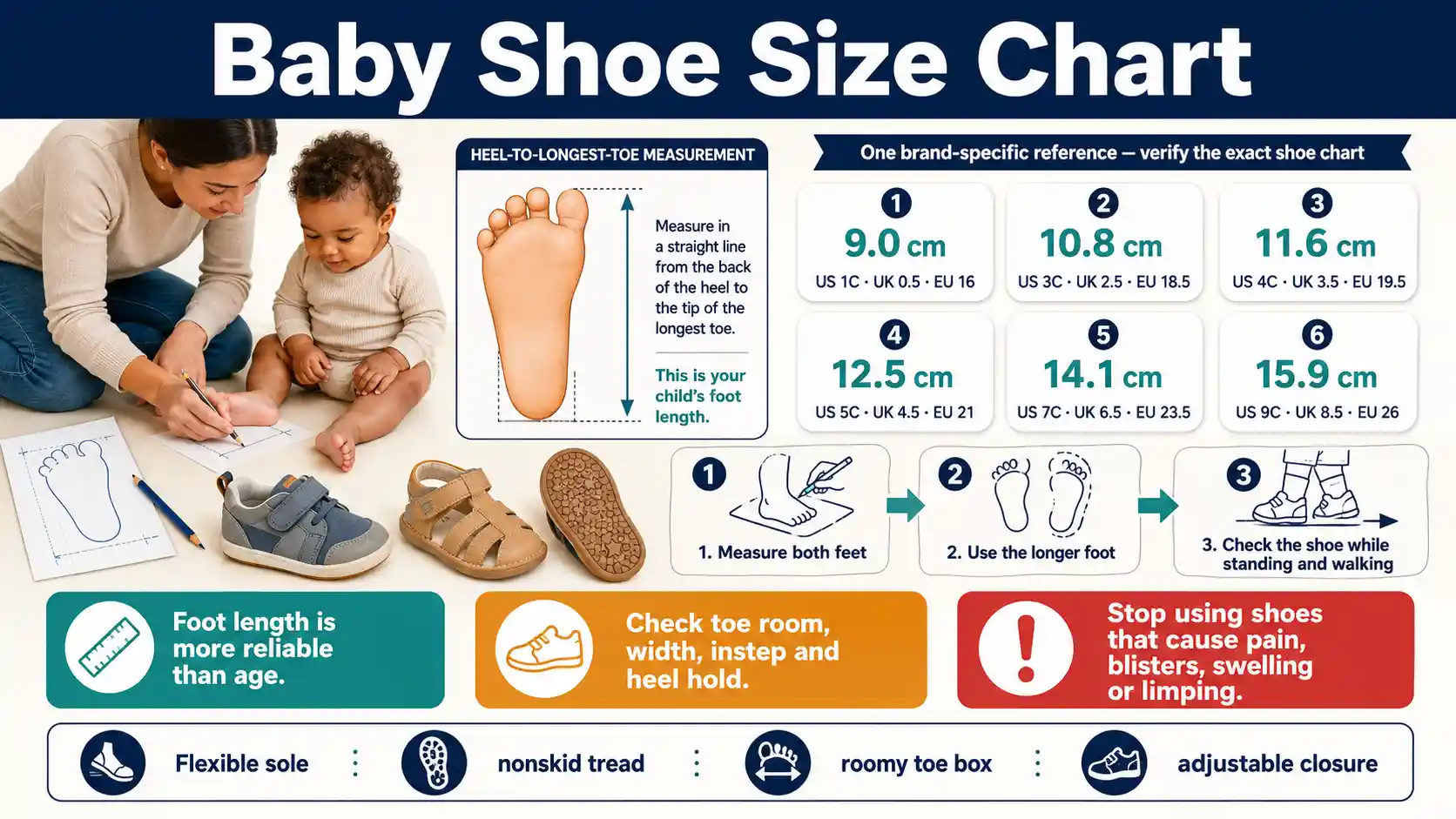
Baby shoe sizing quick answer
Measure heel to the longest toe on both feet, use the longer result with the shoe brand’s own chart, and confirm the fit inside the actual shoe. Age can suggest a store department, but it cannot identify the correct size.
Primary measurement
Heel to longest toe
Measure both feet in millimetres and use the longer value with the exact brand chart.
Fit beyond length
Width and volume matter
Toe-box shape, instep depth, heel hold, and closure can change fit at the same length.
First-shoe timing
Outdoor walking
Structured shoes are mainly for protection once a child walks outdoors on unsafe surfaces.
Fit-check rhythm
Check monthly
Rapid early growth means a shoe can become tight before it looks worn or the child reports pain.
Direct answers to common baby shoe-size questions
What determines a baby shoe size?
Measured heel-to-longest-toe length determines the starting size; age is only a rough retail label.
Which foot should I use for baby shoe sizing?
Use the longer or larger foot because the shoe must fit both feet.
Are baby shoe sizes the same across brands?
No. US, UK, EU, and centimetre labels can differ between manufacturers at the same foot length.
How should I measure baby feet?
Measure from the heel to the longest toe on a hard floor, repeat both feet, and use the intended socks.
How much room should be in front of the toes?
The AAP suggests about a finger width between the big toe and the inside front edge of the shoe.
Do non-walking babies need shoes?
Most non-walking babies need only socks or soft booties for warmth, not rigid shoes indoors.
When does a baby need first walking shoes?
A baby needs protective shoes when walking outdoors on hot, cold, rough, wet, or sharp surfaces.
What should a first-walker shoe feel like?
A first-walker shoe should feel lightweight, flexible, secure at the heel, roomy at the toes, and nonslip underfoot.
Should I buy a larger size for growth?
Choose modest growth room, not several extra sizes, because oversized shoes can slip and increase tripping.
How often do baby feet need measuring?
Measure about every two months and check the in-shoe fit monthly during rapid growth.
What shows that baby shoes are too small?
Toe contact, curled toes, red marks, blisters, strap pressure, shoe refusal, or limping can indicate a tight shoe.
What shoe symptom needs prompt medical review?
Unexplained limping, refusal to bear weight, swelling, severe pain, infection signs, or colour change needs prompt assessment.
Baby Shoe Size Chart by Foot Length
This reference reproduces Nike baby and toddler length mappings so every row belongs to one sizing system. Use the measured foot length, then verify the exact brand and model before buying.
Swipe horizontally inside the table to view every column.
| Measured foot length | US kids | UK | EU | Nike CM/JP label | Practical note |
|---|---|---|---|---|---|
| 9.0 cm · 3 9/16 in | 1C | 0.5 | 16 | 7 | Small infant reference; shoes are usually unnecessary before outdoor walking |
| 10.0 cm · 3 15/16 in | 2C | 1.5 | 17 | 8 | Measure again before purchase because baby feet change quickly |
| 10.8 cm · 4 1/4 in | 3C | 2.5 | 18.5 | 9 | Often sold as a crawler or early infant size |
| 11.6 cm · 4 9/16 in | 4C — Common first-walker reference only | 3.5 | 19.5 | 10 | Common first-walker range, but age does not determine fit |
| 12.5 cm · 4 15/16 in | 5C | 4.5 | 21 | 11 | Check toe room, width, heel hold, and closure |
| 13.3 cm · 5 1/4 in | 6C | 5.5 | 22 | 12 | Use the longer foot when the two feet differ |
| 14.1 cm · 5 9/16 in | 7C | 6.5 | 23.5 — EU conversions vary by brand | 13 | Verify the brand chart because EU half steps are not standardized |
| 15.1 cm · 5 15/16 in | 8C | 7.5 | 25 | 14 | Often transitions into younger-kid ranges |
| 15.9 cm · 6 1/4 in | 9C | 8.5 | 26 | 15 | A child may need a wide or extra-wide option at the same length |
| 16.7 cm · 6 9/16 in | 10C | 9.5 | 27 | 16 | Recheck fit monthly and after a growth spurt |
Foot length is heel to the longest toe. Nike’s CM/JP label is a product label and is not the same value as measured foot length.
- • This is a brand-specific conversion reference, not a universal shoe-size standard.
- • Measure both feet while the child is standing when possible and select from the longer measurement.
- • When the measurement lies between two rows, Nike advises moving to the larger listed size and then checking the actual fit.
Download or export
Four checks turn a size label into a real fit
A chart can identify a starting number, but only the child’s foot inside the actual shoe can confirm length, width, security, flexibility, and comfort.
Length
Measure heel to longest toe
Measure both feet on a hard floor and use the longer result with the exact brand chart.
Width
Let toes lie flat and spread
Extra length does not correct a narrow toe box or tight instep. Choose the right width and shape.
Movement
Watch standing and walking
The shoe should stay on without heel lift, toe gripping, altered steps, or repeated tripping.
Protection
Match the surface and stage
Bare feet suit safe indoor practice; outdoor walkers need lightweight protection and nonskid traction.
US, UK, EU, and centimetre labels do not form one universal system
Manufacturers choose their own lasts, internal lengths, width options, and conversion labels. The published Nike kids’ footwear chart even distinguishes its CM/JP product label from measured foot length. Compare the heel-to-toe value first, then verify the specific model.
Why Baby Shoe Size Conversions Differ by Brand
The same heel-to-toe length can map to different labels. These examples compare published Nike and adidas baby charts to show why a generic conversion is only a starting point.
Swipe horizontally inside the table to view every column.
| Heel-to-toe length | Nike reference | adidas reference | What the difference means |
|---|---|---|---|
| About 9.0 cm | US 1C · UK 0.5 · EU 16 | US 2k · UK 1k · EU 17 | A one-number difference can appear at the same measured length |
| About 9.8–10.0 cm | US 2C · UK 1.5 · EU 17 | US 3k · UK 2k · EU 18 | Do not convert by US number alone |
| About 10.6–10.8 cm | US 3C · UK 2.5 · EU 18.5 | US 4k · UK 3k · EU 19 | Use the product page’s heel-to-toe column |
| About 11.5–11.6 cm | US 4C · UK 3.5 · EU 19.5 | US 5k · UK 4k · EU 20 | EU labels may differ even when lengths are close |
| About 12.3–12.5 cm | US 5C · UK 4.5 · EU 21 | US 5.5k · UK 5k · EU 21 | Some labels align while others do not |
| About 13.2–13.3 cm | US 6C · UK 5.5 · EU 22 | US 6.5k · UK 6k · EU 23 | Width and shoe shape can still change the final fit |
| About 14.0–14.1 cm | US 7C · UK 6.5 · EU 23.5 | US 7.5k · UK 7k · EU 24 | Half-size and half-EU steps are brand decisions |
| About 15.7–15.9 cm | US 9C · UK 8.5 · EU 26 | US 9.5k · UK 9k · EU 26.5 | Always verify the exact model chart before checkout |
- • Values are rounded to comparable heel-to-toe lengths and remain brand-specific.
- • A size printed in centimetres may be a regional label rather than the child’s exact foot length.
Download or export
Walking stage determines footwear need better than age
A six-month-old and a twelve-month-old may both need no structured indoor shoe, while a confident outdoor walker needs protection from the surface and weather. Footwear should not be used to force standing, shape a healthy foot, or teach walking.
Baby Footwear by Walking Stage, Not Age Alone
Walking ability and environment determine whether footwear is needed. Age labels can organize store categories, but they cannot replace measurement and a physical fit check.
Swipe horizontally inside the table to view every column.
| Stage | Typical need | Suitable footwear | Avoid | Key fit check |
|---|---|---|---|---|
| Not pulling to stand | Warmth and protection from weather only | Socks or soft, roomy booties | Rigid fashion shoes and tight elastic openings | Toes move freely; no pressure marks |
| Pulling to stand or cruising indoors | Traction may help on slippery surfaces | Bare feet on safe floors or nonslip socks | Heavy soles that restrict ankle and toe movement | Foot can bend and spread naturally |
| Taking first steps indoors | Usually no structured shoe is needed on safe floors | Bare feet or very flexible indoor footwear | Shoes used to “teach” walking | No slipping, curling toes, or altered gait |
| Walking outdoors | Protection from heat, cold, rough ground, and sharp objects | Closed-toe, flexible, comfortable shoe with nonskid sole — AAP first-shoe guidance | Stiff heel shaping, wedges, and unnecessary arch devices | Toe room, width, heel hold, flex point |
| Confident toddler | Durable protection for play and weather | Lightweight sneakers, suitable sandals, or weather boots | Oversized shoes bought far ahead for growth | Walk, squat, and run without tripping |
| Orthosis or medical plan | Accommodation for braces, inserts, swelling, or asymmetry | Shoe selected with the treating clinician or orthotist — Individual professional fitting needed | Forcing a standard-width shoe over equipment | Device fits without pressure or heel lift |
- • The American Academy of Pediatrics states that early feet generally develop best without confinement and that outdoor walkers need protective shoes.
- • Special footwear is appropriate when a clinician recommends it for an individual condition.
Download or export
Measure both feet under weight-bearing conditions when possible
Standing spreads the foot and gives a better shopping measurement for a child who can stand safely. Measure with intended socks, mark the longest toe rather than assuming it is the big toe, and repeat any reading taken while the heel lifted or toes curled.
How to Measure a Baby or Toddler Foot
Use a hard, level floor and measure when the child can stand safely. For a non-standing baby, measure gently without forcing the foot or curled toes flat.
Swipe horizontally inside the table to view every column.
| Step | What to do | Why it matters | Common error |
|---|---|---|---|
| 1. Prepare | Use paper, a thin pen, and a rigid ruler marked in millimetres | Soft tape can curve and overstate length | Using a ruler with a worn or missing zero edge |
| 2. Add normal socks | Use the sock thickness that will be worn with the shoe | Thick socks change internal space | Measuring barefoot for winter boots |
| 3. Position the heel | Place the heel lightly against a wall with weight through the foot | Standing spreads and lengthens the foot | Measuring while the child sits with toes curled |
| 4. Mark the longest toe | Mark the tip of whichever toe extends farthest | The big toe is not always the longest | Stopping at the big toe automatically |
| 5. Measure heel to toe | Measure perpendicular from the wall to the mark | A diagonal line inflates the result | Measuring the outline around the foot |
| 6. Repeat the other foot | Record left and right lengths separately | One foot commonly measures longer | Assuming both feet are identical |
| 7. Use the longer value | Compare the longer foot with the exact brand chart | The smaller shoe must still fit the larger foot | Averaging the two measurements |
| 8. Confirm inside the shoe | Check toe room, width, instep, heel, closure, and walking | Length alone cannot confirm fit | Keeping the shoe because the label matches |
- • If using a printable guide, print at 100% and verify its calibration box with a bank or identification card.
- • Repeat the measurement if the child moves, lifts the heel, or curls the toes.
Download or export
Baby shoe starting-size finder
Enter both heel-to-longest-toe measurements. The result uses the longer foot and one published Nike baby chart to provide a transparent starting reference—not a universal conversion or guaranteed fit.
After selecting a starting size, check about a finger width at the toe, toe-box width, instep pressure, heel hold, closure, and walking. Entered measurements stay in the browser and are not stored or transmitted.
Confirm length, width, heel hold, and movement inside the shoe
The in-shoe check matters more than the printed label. Toes should lie flat, the heel should remain seated, the closure should secure without pressure, and the child should walk and squat without gripping, limping, or repeated tripping.
Baby Shoe Fit Check from Toe to Heel
A correct number can still fit poorly. Check the shoe while the child is standing and again while walking, squatting, and turning.
Swipe horizontally inside the table to view every column.
| Fit area | Good fit | Too small or narrow | Too large or loose |
|---|---|---|---|
| Toe length | About a finger width between the big toe and inside front edge — AAP finger-width toe-room check | Toe touches front; nail pressure; red marks | Foot slides forward; child trips or grips with toes |
| Toe-box width | Toes lie flat and can spread | Toes overlap, curl, or press against the sides | Forefoot moves side to side despite secure closure |
| Instep | Upper closes without deep pressure lines | Straps barely reach; top of foot bulges | Upper wrinkles heavily or cannot hold the foot |
| Heel | Heel stays seated with only slight natural movement | Back collar rubs or cuts into skin | Heel lifts repeatedly and causes instability |
| Flex point | Shoe bends near the ball of the foot | Sole is rigid or bends in the middle of the arch | Shoe folds excessively and offers little protection outdoors |
| Closure | Can be secured without compressing the foot | Fastener is at its limit and leaves marks | Fastener must be overtightened to stop slipping |
| Walking check | Natural steps, easy squat, no repeated falls | Child resists walking, limps, or removes shoes | Clumsy gait, toe dragging, or frequent tripping |
| After removal | Skin colour returns normally with no persistent marks | Blisters, redness, swelling, or nail pressure — Stop using the shoe and assess the foot | Sock bunching and friction from movement |
- • The AAP recommends checking fit about monthly during rapid early growth.
- • A removable insole can help show toe position, but it does not replace checking width, heel, and walking behavior.
Download or export
First-walker shoes should protect without unnecessarily restricting the foot
The American Academy of Pediatrics first-shoe guidance recommends comfortable, flexible, closed-toe shoes with nonskid soles and room to grow for outdoor walkers. Wedges, special arches, high backs, and reinforced heels do not provide a proven benefit for the average child.
First-Walker Shoe Features That Matter
Choose protection and comfort rather than features marketed as shaping or strengthening a healthy foot.
Swipe horizontally inside the table to view every column.
| Feature | Prefer | Why | Be cautious with |
|---|---|---|---|
| Toe protection | Closed or well-protected toe for outdoor walking | Protects from rough ground and collisions | Open toes on playgrounds or uneven surfaces |
| Sole | Flexible at the ball of the foot with nonskid tread | Allows natural motion while improving traction | Thick, rigid, or very heavy soles |
| Weight | Lightweight construction | Reduces the work of lifting the foot | Decorative shoes heavier than the child needs |
| Toe box | Rounded or foot-shaped with room to spread | Avoids crowding developing toes | Pointed or tapered fronts |
| Upper | Breathable and smooth inside | Reduces heat, moisture, and rubbing | Hard seams or stiff overlays at pressure points |
| Closure | Adjustable strap or laces that secure the heel | Accommodates instep and width differences | Slip-ons that fall off or require toe gripping |
| Heel and arch | Comfortable, ordinary construction | Healthy average feet do not require shaping devices | Wedges, high backs, reinforced heels, or special arches without advice |
| Sizing options | Length plus narrow, wide, or extra-wide choices when needed | Foot width varies independently of length | Sizing up repeatedly to compensate for narrowness |
- • A flexible shoe is not the same as a shoe with no protective structure; it should still suit the surface and activity.
- • Children using braces or prescribed inserts may need different depth, closure, and sole characteristics.
Download or export
Choose the shoe type for the surface, weather, and duration
Socks, soft soles, sneakers, sandals, rain boots, and winter boots solve different problems. A weather boot may protect well for a short trip but feel too heavy or loose for all-day walking. Recheck fit with the exact socks and activity.
Baby Footwear Types and Best Uses
Match footwear to the child’s walking stage, surface, weather, and activity rather than using one pair for every situation.
Swipe horizontally inside the table to view every column.
| Footwear type | Best use | Main benefit | Fit or safety limitation |
|---|---|---|---|
| Socks | Warmth indoors for non-walkers | Soft and unrestricted | Use nonslip soles for standing on smooth floors |
| Soft booties | Warmth in a carrier or stroller | Stay on better than loose socks | Elastic must not leave deep ankle marks |
| Leather or fabric soft soles | Protected indoor cruising or short dry outdoor use | Flexible and lightweight | May not protect from heat, sharp objects, or wet ground |
| First-walker sneaker | Routine outdoor walking | Closed toe, adjustable closure, nonskid traction | Confirm flexibility and toe width |
| Sandals | Warm-weather walking on suitable surfaces | Ventilation | Secure heel and toe protection are important |
| Rain boots | Short wet-weather use | Water protection | Often wide, heavy, and loose; not ideal for all-day wear |
| Winter boots | Cold, snow, and wet conditions | Insulation and weather protection | Measure with intended socks and check weight |
| Dress shoes | Brief special occasions | Appearance | Often stiffer and less adjustable; limit wear if fit is marginal |
| Used shoes | Possible only when structure and hygiene remain sound | Lower cost and reduced waste | Discard if misshapen, worn unevenly, cracked, or contaminated |
- • Barefoot time on safe indoor surfaces supports natural movement and sensory feedback.
- • Check temperature, slip risk, and surface hazards before choosing no shoes outdoors.
Download or export
Remeasure before the shoe looks worn out
Early feet can outgrow a nearly new pair. The Stride Rite fit guide recommends frequent remeasurement, while the AAP advises checking fit about monthly and notes that first shoes may last only two or three months.
When to Remeasure or Replace Baby Shoes
Calendar reminders help, but the child’s feet, behavior, and shoe condition should decide when a new measurement or replacement is needed.
Swipe horizontally inside the table to view every column.
| Trigger | Action | Reason | Do not wait for |
|---|---|---|---|
| Monthly fit check | Press and inspect toe, width, heel, and skin after wear | AAP advises monthly checking during rapid growth | The child to clearly report tightness |
| Every 2 months | Measure both feet again | Baby and toddler feet can change quickly | A birthday or seasonal shopping trip |
| After a growth spurt | Measure immediately | Length and width may change between routine checks | Visible toe bulging through the upper |
| Repeated shoe removal | Check heat, seams, pressure, and size | Young children communicate discomfort through behavior | A blister |
| New tripping or toe gripping | Check whether the shoe is too large, loose, or rigid | Oversizing can impair stability | A fall-related injury |
| Red marks or blisters | Stop using the shoe until the cause is corrected — Stop using pressure-causing footwear | Persistent pressure can damage skin and nails | The mark to become an open wound |
| Worn tread or collapsed heel | Replace the pair | Loss of traction and shape changes fit | The shoe to split completely |
| Uneven sole wear | Compare both shoes and discuss persistent asymmetry | May reflect fit, gait, or activity pattern | Pain or limping |
| First pair after 2–3 months | Expect to remeasure even if the shoe looks new | AAP notes first shoes often last only a few months | The outsole to look worn |
- • Growth rates vary. A time interval is a reminder, not a guarantee that the current size remains correct.
- • Measure sooner whenever fit, comfort, gait, or skin changes.
Download or export
Common baby shoe sizing mistakes
Buying by age
Age labels cannot account for individual length, width, growth, or brand construction.
Measuring only one foot
The longer foot controls the starting size, while the smaller foot still needs secure heel hold.
Adding excessive growth room
Oversized shoes can slide, rub, trip, and make a child grip with the toes.
Using length to solve width
A longer narrow shoe remains the wrong shape. Select an appropriate wide or extra-wide model.
Checking only while seated
Weight-bearing changes length and spread, so standing and walking checks are important when possible.
Waiting for verbal complaints
Young children may show discomfort through shoe refusal, fatigue, reduced play, rubbing, or limping.
Common Baby Shoe Sizing Mistakes
Most sizing mistakes come from substituting age, labels, or visual guesses for measurement and an in-shoe fit check.
Swipe horizontally inside the table to view every column.
| Mistake | Why it fails | Better approach |
|---|---|---|
| Buying by age only | Children of the same age can have different foot lengths and widths | Measure both feet and use the exact brand chart |
| Using one universal conversion chart | US, UK, EU, and centimetre labels vary by brand | Treat conversions as a starting point only |
| Measuring only one foot | One foot may be longer or wider | Fit the longer or larger foot |
| Measuring while toes are curled | The result understates heel-to-toe length | Repeat when the foot is flat and relaxed |
| Adding several sizes for growth | Oversized shoes can slip, trip, and require toe gripping | Choose modest room and confirm the walking fit |
| Sizing up to solve a width problem | Extra length does not create the correct toe-box shape | Choose a wide or extra-wide model |
| Testing fit only while seated | Weight-bearing changes foot length and spread | Check standing and walking when developmentally possible |
| Passing down a misshapen shoe | The upper, footbed, and sole may reflect another child’s wear | Reuse only structurally sound, clean footwear |
| Assuming expensive means healthy | Price does not guarantee flexibility, shape, or fit | Evaluate the actual shoe features and fit |
| Ignoring the child’s behavior | Toddlers may not name pressure or pain | Investigate shoe refusal, limping, fatigue, or reduced play |
- • A child who cannot yet describe discomfort still provides useful behavior and skin clues.
- • The correct size is the one that fits the specific foot in the specific shoe—not the number that usually works.
Download or export
Some feet need more than a standard length chart
Wide, extra-wide, or high-instep feet: choose a model built for the needed width and volume instead of adding unnecessary length.
Orthoses, braces, or prescribed inserts: follow the treating clinician or orthotist’s depth, closure, and sizing instructions.
Swelling or changing volume: fit may vary during the day or with a medical condition. Do not compress a swollen foot into the usual size.
Different foot sizes: fit the larger foot and use an appropriate professional adjustment only when the smaller foot slides.
Sensory or communication differences: inspect skin and observe behavior because the child may not clearly report pressure, seams, heat, or pain.
Baby Foot and Shoe Warning Signs
Remove the shoe and inspect the foot when discomfort, skin damage, swelling, or gait change appears. Urgency depends on severity and associated symptoms.
Swipe horizontally inside the table to view every column.
| Sign | Immediate step | Professional follow-up |
|---|---|---|
| Persistent red pressure mark | Stop using the shoe and check size, width, seam, and sock | Seek advice if the mark persists, recurs, or breaks the skin |
| Blister, cut, or broken skin | Clean and protect the area; avoid the rubbing shoe | Contact a clinician for infection signs, diabetes, poor circulation, or deep injury |
| Swelling of one foot | Remove footwear and compare colour, warmth, movement, and tenderness | Prompt assessment is appropriate when swelling is unexplained or painful |
| Limp or refusal to bear weight | Stop the activity and inspect for injury or foreign object | Arrange prompt medical assessment if no simple removable cause is found — Prompt medical assessment |
| Sudden severe pain after injury | Keep weight off the foot and use urgent care guidance | Seek urgent evaluation for deformity, severe swelling, or inability to walk |
| Cold, pale, blue, or numb toes | Remove tight footwear immediately | Seek urgent care if normal colour and sensation do not return quickly — Possible circulation problem |
| Warmth, spreading redness, pus, or fever | Do not keep using the shoe over the affected area | Contact a clinician promptly for possible infection |
| Persistent toe walking, inward turning, or asymmetry | Record when it occurs and whether pain or falls accompany it | Discuss persistent, worsening, painful, or one-sided patterns with the child’s clinician |
| Uneven wear plus pain or fatigue | Check fit and pause the aggravating footwear | Consider pediatric or podiatric assessment |
- • Emergency care is appropriate for major trauma, severe deformity, uncontrolled bleeding, or signs of impaired circulation.
- • A new limp should not be assumed to be “just the shoes” when pain or illness may be present.
Download or export
Frequently asked questions
What shoe size does a 12-month-old baby wear?
There is no reliable shoe size for every 12-month-old. Measure both feet and use the longer heel-to-toe length with the exact brand chart; many first walkers fall near US infant sizes 3C to 5C, but the range is not a rule.
How do I measure a baby’s shoe size at home?
Place the heel against a wall, mark the longest toe, measure in millimetres, and repeat on the other foot. Use the longer measurement and the socks intended for that shoe.
Should I measure both baby feet?
Yes. One foot commonly measures longer or wider, so choose a shoe that fits the larger foot without allowing the smaller foot to slide excessively.
How much toe room should baby shoes have?
The American Academy of Pediatrics suggests about a finger width between the big toe and the inside front edge. The shoe must also fit the width, instep, and heel.
Should I size up when a baby is between shoe sizes?
Use the larger listed size as the starting point when the brand chart says to size up, then confirm the shoe does not slip, trip, or require toe gripping.
Are US, UK, and EU baby shoe sizes equivalent?
No. Conversion labels differ among brands, and even centimetre labels may not equal measured foot length. Verify the exact manufacturer’s heel-to-toe chart.
Do babies need shoes before they walk?
Most babies do not need structured shoes indoors before walking. Socks or soft booties can provide warmth, while shoes become useful for protection when walking outdoors.
What are the best shoes for a baby learning to walk?
For outdoor walking, choose a comfortable, lightweight, closed-toe shoe with a flexible sole, nonskid tread, roomy toe box, and adjustable closure.
Are hard-soled shoes better for first walkers?
No. The AAP recommends flexible first shoes and states that wedges, special arches, reinforced heels, and other shaping features have no proven benefit for the average child.
How often should I check baby shoe fit?
Check the fit about once a month and measure roughly every two months during rapid growth. Recheck sooner after a growth spurt or any sign of discomfort.
How long do first baby shoes usually last?
The AAP notes that a first pair may last only two or three months because feet grow rapidly. Condition alone cannot show whether the size still fits.
How can I tell whether baby shoes are too small?
Look for toes touching the front, curled toes, strap pressure, red marks, blisters, nail pressure, shoe refusal, or a new limp. Stop using a shoe that damages the skin.
How can I tell whether baby shoes are too big?
Repeated heel lift, sliding, toe gripping, clumsy steps, and frequent tripping can indicate excess length, width, or volume.
Should I buy extra-large shoes for growth?
No. Excessive growth room can reduce stability and cause rubbing. Choose the correct current fit and remeasure often instead of buying several sizes ahead.
Can a baby wear used shoes?
A lightly used pair may be acceptable when it is clean, structurally sound, evenly worn, and still fits correctly. Do not reuse a misshapen, cracked, contaminated, or unevenly worn shoe.
When should foot pain or limping be checked by a clinician?
Arrange prompt assessment for unexplained limping, refusal to bear weight, swelling, persistent pain, broken skin with infection signs, or colour and circulation changes.
Sources
These references support the measurement method, brand-specific size examples, first-shoe features, fit-check frequency, and warning guidance used on this page.
American Academy of Pediatrics — Shoes for Active Toddlers
https://www.healthychildren.org/English/ages-stages/toddler/Pages/Shoes-for-Active-Toddlers.aspx
Explains that early feet generally do not need shoes indoors, recommends comfortable nonskid shoes for outdoor walking, and advises monthly fit checks with about a finger width in front of the big toe.
American Academy of Pediatrics — Movement Milestones in Babies 8 to 12 Months Old
https://www.healthychildren.org/English/ages-stages/baby/Pages/Movement-8-to-12-Months.aspx
Recommends closed-toe, comfortable, flexible first shoes with nonskid soles and room to grow once a child walks outdoors.
Nike — Kids' Footwear Size Chart
https://www.nike.com/size-fit/kids-footwear
Provides baby and toddler US, UK, EU, and foot-length references and instructs caregivers to measure both feet and use the longer measurement.
Nike — Quick Guide to Measuring Kids’ Feet
https://www.nike.com/size-fit/kids-footwear
Describes standing measurement against a wall, tracing both feet, checking print scale, and sizing up when a measurement falls between listed sizes.
adidas — Kids' Shoes Size Chart
https://www.adidas.com/us/help/size_charts/kids-shoes
Publishes brand-specific heel-to-toe measurements for baby and toddler shoes and demonstrates that conversions differ by manufacturer.
Stride Rite — Kids' Shoe Fit Guide
https://www.striderite.com/pages/kids-shoe-fit-guide
Recommends frequent measurement because baby and toddler feet may change by a half size or more within a few months and describes fit checks at the toe, width, heel, and instep.
Stride Rite — Kids' Shoe Sizing Help
https://www.striderite.com/pages/sizing-help
Explains baby, little-kid, and big-kid labels and emphasizes using the brand’s own length and width tools rather than age alone.
American Podiatric Medical Association — Today's Podiatrist Keeps Kids Active
https://www.apma.org/patients-and-the-public/foot-health-awareness-month/todays-podiatrist-keeps-kids-active/
Encourages parents to monitor footwear fit and notice behavioral changes because young children may not clearly describe foot pain.