Eruption ages are broad reference ranges, not pass-or-fail deadlines. Do not blame high fever, diarrhea, repeated vomiting, facial swelling, pus, severe pain, or a very unwell child on teething. Seek prompt dental or medical care for infection signs, trauma, breathing or swallowing difficulty, and uncontrolled bleeding.
Eruption order · tooth letters · teething · oral care
Baby Teeth Chart
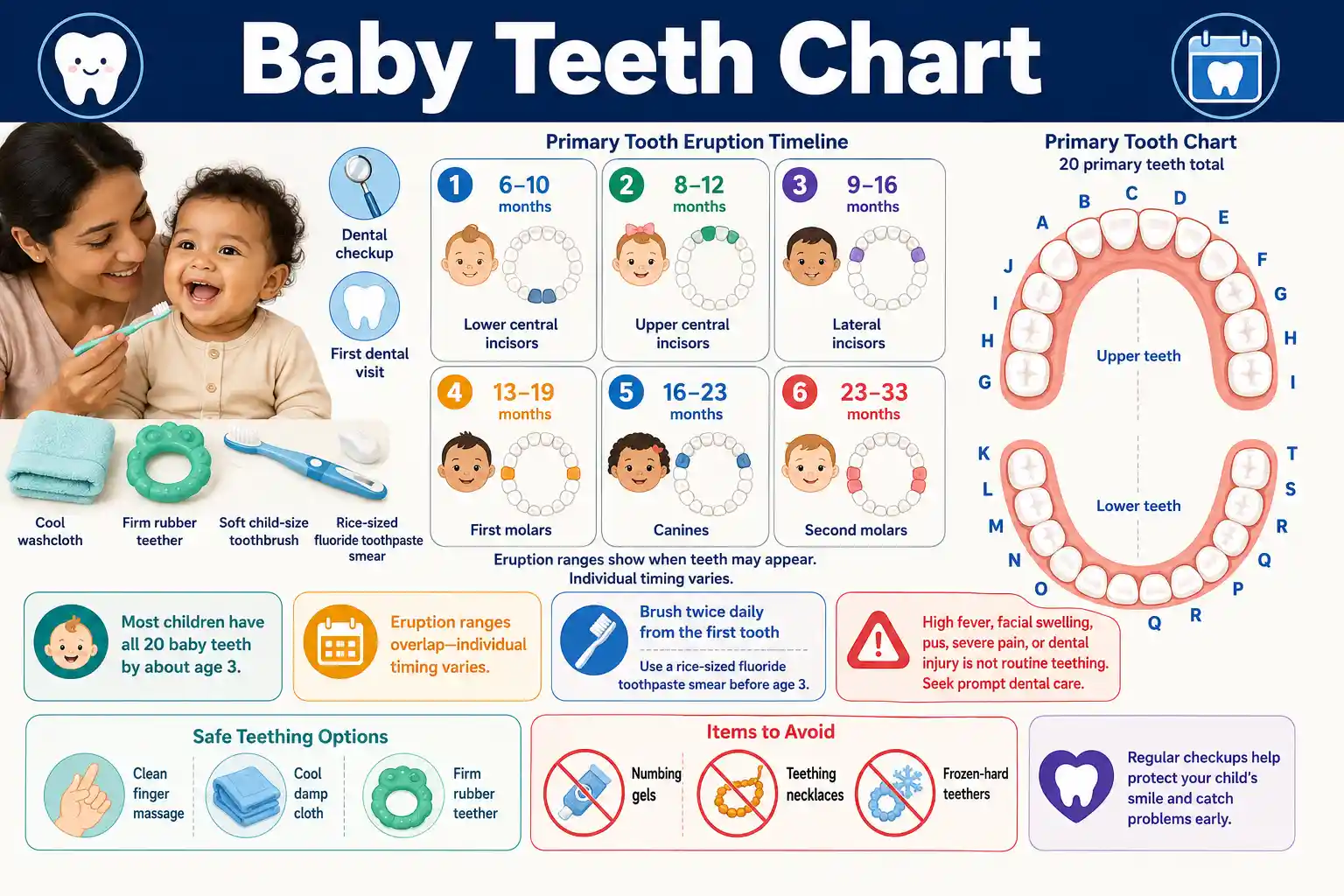
A baby teeth chart shows when each of the 20 primary teeth commonly erupts and later sheds. The ranges help caregivers understand development, but the actual mouth, symptoms, dental examination, and individual health history determine whether a pattern needs attention.
Baby teeth quick answer
Lower front teeth often begin erupting near 6 months. The front teeth usually arrive before first molars and canines, and second molars commonly complete the 20-tooth primary set by about age 3. Brush every erupted tooth twice daily and establish a dental home by age 1.
First tooth
Often near 6 months
The ADA range for lower central incisors is 6–10 months, but healthy timing varies.
Complete set
20 primary teeth
Most children have 10 upper and 10 lower baby teeth by about age 3.
Daily care
Brush twice daily
Start with the first tooth and use a rice-sized smear of fluoride toothpaste before age 3.
First dental visit
No later than age 1
Visit within 6 months after the first tooth erupts and no later than the first birthday.
Direct answers to common baby-teeth questions
When do baby teeth start coming in?
Baby teeth often start erupting around 6 months, but the first tooth may appear earlier or after 12 months.
Which baby teeth usually erupt first?
The lower central incisors commonly erupt first, usually within the ADA range of 6 to 10 months.
How many baby teeth are there?
A complete primary dentition contains 20 teeth: 10 upper teeth and 10 lower teeth.
When are all baby teeth usually present?
Most children have all 20 primary teeth by about age 3, although individual timing varies.
Does teething cause high fever?
No. High fever needs another explanation and should not be dismissed as teething.
Does teething cause diarrhea?
Diarrhea is not a reliable teething symptom; assess hydration and consider illness.
What safely soothes teething gums?
Use a clean finger massage, cool damp cloth, or firm rubber teether under close supervision.
Are numbing teething gels safe?
FDA guidance warns against benzocaine and lidocaine teething products because they can cause serious harm.
When should brushing begin?
Brush twice daily as soon as the first tooth erupts with a soft child-size toothbrush.
How much toothpaste should a baby use?
Use a smear or rice-sized amount of fluoride toothpaste for children younger than 3.
When should a baby see a dentist?
Schedule a dental visit within 6 months of the first tooth and no later than 12 months of age.
Should a knocked-out baby tooth be replanted?
No. Do not replant a knocked-out primary tooth; contact a dentist promptly.
Baby Teeth Eruption and Shedding Chart
The ranges below come from the American Dental Association. They describe common timing, not a deadline for an individual child.
Swipe horizontally inside the table to view every column.
| Primary tooth | ADA letter | Usual eruption age | Usual shedding age | Position and function |
|---|---|---|---|---|
| Upper right second molar | A | 25–33 months — Late primary-eruption range | 10–12 years | Back grinding tooth |
| Upper right first molar | B | 13–19 months | 9–11 years | Grinding and chewing |
| Upper right canine | C | 16–22 months | 10–12 years | Tearing and guiding the bite |
| Upper right lateral incisor | D | 9–13 months | 7–8 years | Cuts food beside the central incisor |
| Upper right central incisor | E | 8–12 months | 6–7 years | Front cutting tooth |
| Upper left central incisor | F | 8–12 months | 6–7 years | Front cutting tooth |
| Upper left lateral incisor | G | 9–13 months | 7–8 years | Cuts food beside the central incisor |
| Upper left canine | H | 16–22 months | 10–12 years | Tearing and guiding the bite |
| Upper left first molar | I | 13–19 months | 9–11 years | Grinding and chewing |
| Upper left second molar | J | 25–33 months — Late primary-eruption range | 10–12 years | Back grinding tooth |
| Lower left second molar | K | 23–31 months | 10–12 years | Back grinding tooth |
| Lower left first molar | L | 14–18 months | 9–11 years | Grinding and chewing |
| Lower left canine | M | 17–23 months | 9–12 years | Tearing and guiding the bite |
| Lower left lateral incisor | N | 10–16 months | 7–8 years | Cuts food beside the central incisor |
| Lower left central incisor | O | 6–10 months — Common first-tooth range | 6–7 years | Often among the first teeth to appear |
| Lower right central incisor | P | 6–10 months — Common first-tooth range | 6–7 years | Often among the first teeth to appear |
| Lower right lateral incisor | Q | 10–16 months | 7–8 years | Cuts food beside the central incisor |
| Lower right canine | R | 17–23 months | 9–12 years | Tearing and guiding the bite |
| Lower right first molar | S | 14–18 months | 9–11 years | Grinding and chewing |
| Lower right second molar | T | 23–31 months | 10–12 years | Back grinding tooth |
Eruption ages are shown in months; shedding ages are shown in years.
- • Primary-tooth letters follow the ADA Universal Tooth Designation System from A through T.
- • A tooth may erupt earlier or later than the range and still be healthy. Pattern, symmetry, symptoms, and the child’s overall development matter.
- • The chart is viewed from the child’s perspective: right and left refer to the child’s right and left sides.
Download or export
How dentists letter the 20 primary teeth
In the U.S. Universal system, primary teeth run from A at the child’s upper right back tooth across to J, then from K at the lower left back tooth across to T. The view below faces the child.
Upper arch
A
Second molar
B
First molar
C
Canine
D
Lateral incisor
E
Central incisor
F
Central incisor
G
Lateral incisor
H
Canine
I
First molar
J
Second molar
T
Second molar
S
First molar
R
Canine
Q
Lateral incisor
P
Central incisor
O
Central incisor
N
Lateral incisor
M
Canine
L
First molar
K
Second molar
Lower arch
8 incisors
Cut food and support speech
4 canines
Tear food and guide the bite
8 molars
Crush and grind food
20 total
Hold space for permanent teeth
Eruption order is a pattern, not a fixed sequence
The official ADA eruption charts show overlapping windows. One side can erupt before the other, and a later tooth can appear before an earlier-listed tooth. Look at the overall pattern rather than comparing one date with a rigid calendar.
Typical Baby Teeth Eruption Order by Stage
Eruption windows overlap. A child may get teeth in a different order without having a dental problem.
Swipe horizontally inside the table to view every column.
| Development stage | Common teeth appearing | Approximate ADA windows | What caregivers may notice |
|---|---|---|---|
| Before visible teeth | Teeth are developing inside the jaws | Birth to about 5 months | Drooling and mouthing can occur before actual eruption |
| First incisors | Lower central incisors | 6–10 months | One or two lower front teeth often appear first |
| Upper front teeth | Upper central and lateral incisors | 8–13 months | Four upper front teeth may appear close together |
| Lower side incisors | Lower lateral incisors | 10–16 months | The front cutting row becomes more complete |
| First molars | Upper and lower first molars | 13–19 months | Wider chewing surfaces erupt behind the front teeth |
| Canines | Upper and lower canines | 16–23 months | Pointed teeth fill the gaps between incisors and molars |
| Second molars | Lower and upper second molars | 23–33 months | The final primary molars complete the back of each arch |
| Full primary dentition | 20 primary teeth | Usually by about age 3 | Ten upper and ten lower teeth are commonly present |
- • Some children have a first tooth before 6 months; others remain toothless beyond 12 months.
- • Teeth often erupt in pairs, but perfect left-right symmetry is not required.
Download or export
Primary teeth support eating, speech, comfort, and permanent-tooth space
Baby teeth help a child bite and grind food, pronounce sounds, smile comfortably, and maintain space while the jaws grow. A painful or infected primary tooth can disturb sleep, nutrition, play, and learning long before the tooth is scheduled to shed.
Primary Tooth Letters, Groups, and Functions
Dentists in the United States commonly use letters A through T for primary teeth. Tooth type describes function more clearly for most caregivers.
Swipe horizontally inside the table to view every column.
| Tooth group | ADA letters | Number in the mouth | Main function | Why the tooth matters |
|---|---|---|---|---|
| Central incisors | E, F, O, P | 4 | Cut and bite food | Support speech sounds and guide permanent incisors |
| Lateral incisors | D, G, N, Q | 4 | Cut food beside the central incisors | Maintain front-arch spacing and appearance |
| Canines | C, H, M, R | 4 | Tear food and guide jaw movement | Support arch shape and spacing |
| First molars | B, I, L, S | 4 | Crush and grind food | Hold space for permanent premolars |
| Second molars | A, J, K, T | 4 | Grind food at the back of the mouth | Guide the bite and preserve posterior space |
| Complete primary dentition | A–T | 20 | Chewing, speech, appearance, and guidance | Primary teeth remain important until naturally replaced |
- • Baby teeth are not disposable placeholders. Untreated decay can cause pain, infection, sleep disruption, and eating difficulty.
- • Do not remove a loose or damaged primary tooth without dental guidance unless it falls out naturally.
Download or export
Teething usually causes local discomfort, not significant illness
Chewing, drooling, localized gum tenderness, mild fussiness, and temporary sleep disruption can occur. High fever, repeated vomiting, diarrhea, widespread rash, breathing trouble, or a child who appears very ill needs another explanation and appropriate medical assessment.
Teething Signs Versus Symptoms That Need Another Explanation
Teething can cause local gum discomfort and behavior changes. It should not become a catch-all explanation for significant illness.
Swipe horizontally inside the table to view every column.
| Observation | May fit teething | What to do | When to seek medical or dental advice |
|---|---|---|---|
| Chewing and mouthing | Common as a tooth approaches the gum | Offer a clean, firm rubber teether and supervise | Seek advice after choking, injury, or suspected swallowed object |
| Drooling | Common in infancy and may increase around eruption | Wipe gently and protect irritated chin skin | Seek care for trouble swallowing, breathing difficulty, or dehydration |
| Tender or swollen gum over one tooth | Can occur locally | Massage with a clean finger or cool damp cloth | Dental review for pus, spreading swelling, severe pain, or foul drainage |
| Mild fussiness or sleep disruption | Can accompany discomfort | Use comfort, routine, and safe soothing methods | Medical review when the child is difficult to wake, inconsolable, or appears very ill |
| Reduced interest in firm foods | Possible briefly when gums are sore | Offer normal milk feeds and soft age-appropriate foods | Seek advice for poor drinking, fewer wet diapers, or ongoing feeding refusal |
| High fever | Not explained by teething alone — Fever needs another explanation | Check temperature and assess the child for illness | Follow age-specific fever guidance promptly |
| Diarrhea or repeated vomiting | Not a reliable teething symptom — Gastrointestinal illness is not routine teething | Protect hydration and consider another cause | Seek medical advice for dehydration, blood, severe pain, or persistence |
| Widespread rash | Not explained by tooth eruption | Consider infection, allergy, or another cause | Urgent care for breathing problems, swelling, blistering, or a very unwell child |
| Ear pulling | May occur nonspecifically but does not prove teething | Look for fever, pain, drainage, and other illness signs | Medical review for persistent pain, fever, drainage, or reduced hearing response |
- • A baby can be teething and ill at the same time. Do not delay medical assessment because a tooth is erupting.
- • Age-specific fever thresholds are not included here because urgency depends on age, temperature, duration, and the child’s condition.
Download or export
Use pressure and cool comfort instead of numbing products or jewelry
A clean finger, cool damp cloth, or firm rubber teether can soothe sore gums. The FDA teething safety guidance warns that benzocaine, lidocaine, homeopathic products, and teething jewelry can cause serious harm and provide little or no benefit.
Safe and Unsafe Teething Relief Options
Use simple physical comfort measures first. Avoid products that numb the mouth or create choking, strangulation, poisoning, or tissue-injury risks.
Swipe horizontally inside the table to view every column.
| Method or product | Recommendation | Reason | Practical note |
|---|---|---|---|
| Clean finger gum massage | Generally suitable | Gentle pressure can soothe a tender eruption area | Wash hands and use light pressure |
| Cool damp washcloth | Generally suitable with supervision | Coolness and texture may reduce discomfort | Keep it clean and do not freeze it hard |
| Firm rubber teething ring | Generally suitable with supervision | Provides a chewable surface without medicine | Inspect for cracks and follow product age guidance |
| Chilled—not frozen—teether | Use cautiously | Extreme cold can injure oral tissue | Cool in a refrigerator rather than freezing solid |
| Benzocaine or lidocaine oral products | Do not use for teething — FDA warning | FDA warns of serious injury and little or no benefit | Keep adult oral numbing medicines out of reach |
| Homeopathic teething tablets or gels | Avoid | Ingredients and effects may be unpredictable and harmful | Do not treat “natural” as proof of safety |
| Amber or other teething necklaces | Do not use — Strangulation and choking risk | Strangulation, choking, and bead-ingestion risk | Do not place jewelry around an infant’s neck |
| Alcohol rubbed on gums | Do not use | Alcohol is unsafe for infants and does not treat eruption | Use physical comfort measures instead |
| Pain medicine | Ask the child’s clinician when needed | Dose depends on age, weight, product, and medical context | Do not guess doses or use adult products |
- • Never tie a teether around the neck or attach it with a cord long enough to entangle the child.
- • Discard any teething item that breaks, leaks, sheds pieces, or cannot be cleaned safely.
Download or export
Baby teeth stage guide
Enter age, erupted-tooth count, and the main concern. The guide compares the information with broad eruption stages and gives a transparent next step; it does not diagnose delayed eruption, infection, or injury.
Brush from the first tooth with a rice-sized smear of fluoride toothpaste
The AAPD parent guidance recommends cleaning gums from birth and brushing erupted teeth twice daily. For children younger than 3, use no more than a tiny smear or rice-sized amount of fluoride toothpaste. The caregiver should perform the brushing.
Baby Oral Care Timeline from Birth to Age 3
Daily care starts before the first tooth and changes as teeth erupt, eating patterns expand, and the child gains independence.
Swipe horizontally inside the table to view every column.
| Stage | Daily care | Toothpaste amount | Dental milestone | Key prevention step |
|---|---|---|---|---|
| Birth until first tooth | Wipe gums gently with a clean damp cloth or soft infant brush | No toothpaste is needed on toothless gums | Choose a dental home and ask about fluoride exposure | Avoid sharing saliva through utensils or cleaning a pacifier with an adult mouth |
| First tooth to under age 1 | Brush erupted teeth twice daily with a soft child-size brush | Tiny smear or rice-sized fluoride toothpaste | Visit within 6 months of first tooth and no later than age 1 — Dental visit by age one | Do not put the baby to bed with a bottle containing milk, formula, juice, or sweet drink |
| 12–23 months | Caregiver brushes every tooth twice daily and begins cleaning tight contacts as advised | Tiny smear or rice-sized fluoride toothpaste | Continue preventive visits based on individual risk | Use an open or training cup and limit frequent sugary exposure |
| 24–35 months | Caregiver still performs or closely assists brushing | Tiny smear or rice-sized fluoride toothpaste until age 3 | Dentist checks growth, decay risk, fluoride needs, and injury history | Build a consistent morning and bedtime routine |
| Age 3 to 6 years | Caregiver supervises and finishes brushing | No more than a pea-sized fluoride amount — Pea-sized amount begins at age three | Continue individualized recall visits | Teach spitting but do not rely on independent brushing skill |
- • Use fluoride toothpaste as directed by current pediatric dental guidance and the child’s dentist, especially when local water fluoride exposure is uncertain.
- • Young children do not brush effectively on their own. Caregiver help remains necessary well beyond the baby years.
Download or export
Cavities can begin soon after the first tooth appears
Protect new enamel by brushing twice daily, limiting repeated sweet-drink and snack exposure, avoiding bottles with caloric liquids during sleep, and keeping the recommended dental visit. Chalky white marks near the gumline can be an early sign of mineral loss before a visible hole forms.
Early Childhood Cavity Risks and Prevention
Cavities can begin soon after the first tooth erupts. Frequency and timing of sugar exposure often matter as much as the total amount.
Swipe horizontally inside the table to view every column.
| Risk pattern | Why it raises risk | Safer routine | When to ask a dentist |
|---|---|---|---|
| Sleeping with a bottle of milk, formula, juice, or sweet drink | Liquid pools around teeth for a long period | Use only water in a bedtime bottle if one is still used and work toward cup transition | Ask for help if bedtime feeding is difficult to change |
| Frequent sipping from a sweet drink | Repeated acid attacks reduce enamel recovery time | Offer water between meals and keep sweet drinks limited and mealtime-based | Discuss diet and fluoride when white spots appear |
| Frequent sticky snacks | Food remains on teeth and fuels acid production | Use regular meal and snack times with tooth-friendly options | Ask for individualized nutrition guidance when eating is medically complex |
| No brushing after the first tooth | Plaque remains undisturbed on new enamel | Brush twice daily with a rice-sized smear of fluoride toothpaste | Arrange a dental visit if brushing causes pain or bleeding |
| Caregiver stops brushing too early | Toddlers lack the skill to clean all surfaces | Let the child practice, then have the caregiver finish | Ask the dentist to demonstrate positioning and technique |
| Sharing utensils or cleaning a pacifier by mouth | Saliva can transfer cavity-associated bacteria | Use separate utensils and rinse or wash dropped items | Discuss household cavity risk at the first visit |
| Visible chalky white line near the gum — Possible early decay | May represent early enamel demineralization | Continue gentle fluoride brushing and arrange dental review | Contact a dentist promptly rather than waiting for a hole |
| Brown spot, hole, pain, or swelling | May indicate established decay or infection | Seek dental assessment; home brushing cannot repair a cavity | Urgent care for facial swelling, fever, or difficulty swallowing — Possible dental infection |
- • Breast milk and formula provide nutrition; the main preventable risk is prolonged or frequent tooth exposure without appropriate oral care.
- • Do not stop prescribed nutrition or feeding support without advice from the child’s clinician and dentist.
Download or export
Early, late, uneven, or out-of-order eruption can still be normal
Family patterns, premature birth, health history, and individual development affect timing. A dentist looks at the gum, tooth shape, spacing, symmetry, discomfort, and broader growth rather than diagnosing a problem from one missed chart window.
Baby Tooth Eruption Variations and Special Cases
Timing alone rarely gives a diagnosis. Dental review considers family pattern, birth history, nutrition, health conditions, medication, and the appearance of the gums and teeth.
Swipe horizontally inside the table to view every column.
| Situation | What may be normal | What deserves discussion | Best next step |
|---|---|---|---|
| First tooth before 6 months | Early eruption can occur in a healthy infant | Loose natal or neonatal tooth, feeding injury, or aspiration risk | Have a clinician or dentist examine any tooth present at or soon after birth |
| No tooth at 12 months | Some healthy children erupt later than average | No dental home, other growth concerns, unusual gums, or strong caregiver concern | Arrange the recommended age-one dental visit and discuss timing |
| Uneven left-right eruption | One side may lead temporarily | Persistent swelling, pain, missing space, or a long unexplained difference | Record the pattern and ask the dentist at the next visit |
| Teeth erupt in a different order | Sequence varies and windows overlap | Abnormal shape, blocked eruption, or associated symptoms | Use the chart as context rather than a pass-fail test |
| Premature birth | Chronological eruption may appear later in some children | Feeding, growth, enamel, or broader developmental concerns | Share gestational and medical history with the dentist |
| Enamel looks pitted, yellow, brown, or unusually thin | Colour can vary slightly | Defects, decay, injury, or developmental enamel change | Arrange dental assessment rather than scraping or bleaching |
| Two teeth appear joined or unusually shaped | Primary-tooth shape variations occur | Cleaning difficulty, crowding, or uncertainty about tooth count | A dentist can identify the tooth and monitor permanent successors |
| Primary tooth remains after the permanent tooth appears | A short overlap may occur | Pain, crowding, infection, or the primary tooth does not loosen | Ask a dentist before trying to pull it |
- • A chart cannot determine whether a tooth is congenitally missing, blocked, fused, or delayed by a medical condition.
- • Routine dental examination is the appropriate setting for interpreting unusual eruption patterns.
Download or export
Never replant a knocked-out primary tooth
Replanting a baby tooth can damage the permanent tooth developing underneath. Contact a dentist after a chip, looseness, displacement, colour change, or avulsion. Use emergency care for major facial injury, uncontrolled bleeding, loss of consciousness, breathing trouble, or swallowing difficulty.
Baby Tooth Injury: Immediate Actions and Warning Signs
Primary-tooth trauma can affect the lip, gum, tooth root, bone, and developing permanent tooth. Prompt advice is important even when the tooth remains in place.
Swipe horizontally inside the table to view every column.
| Injury or sign | Immediate action | Do not do | Urgency |
|---|---|---|---|
| Cut lip or gum with controlled bleeding | Apply gentle pressure with clean gauze and use a cold compress outside the mouth | Do not place aspirin or numbing gel on tissue | Contact a dentist if the wound is deep, contaminated, or will not stop bleeding |
| Chipped primary tooth | Save any fragment if easily found and contact a dentist | Do not file or glue the tooth at home | Same-day advice when sharp, painful, or exposing deeper colour |
| Primary tooth pushed inward, outward, or sideways | Keep the child from biting the area and seek urgent dental advice | Do not push the tooth back yourself | Urgent dental assessment |
| Primary tooth knocked out | Control bleeding and contact a dentist | Do not replant a knocked-out primary tooth — Do not replant a primary tooth | Urgent dental advice to check the socket and nearby structures |
| Loose tooth after a fall | Use soft foods and arrange dental assessment | Do not repeatedly wiggle or test it | Prompt review, especially with pain or bite change |
| Tooth turns grey or dark later | Record when the colour changed and contact the dentist | Do not assume the colour proves infection | Dental review; urgency rises with pain, swelling, or drainage |
| Facial swelling, fever, pus, or severe pain | Seek urgent dental or medical assessment | Do not wait for the tooth to fall out | Urgent; emergency care for breathing or swallowing difficulty |
| Uncontrolled bleeding, loss of consciousness, repeated vomiting, or major facial injury | Use emergency services or urgent medical care | Do not focus only on the tooth | Emergency assessment — Emergency assessment |
- • Permanent-tooth replantation rules do not apply to an avulsed primary tooth. Do not place a knocked-out baby tooth back into the socket.
- • After any head injury, follow medical concussion and emergency guidance in addition to dental advice.
Download or export
Establish a dental home by the first birthday
The first visit checks eruption, enamel, mouth development, injury history, feeding exposures, brushing technique, fluoride needs, and cavity risk. It also gives caregivers a place to call when a tooth is injured, painful, discoloured, or slow to appear.
First Baby Dental Visit Checklist
The first visit establishes a dental home, checks eruption and enamel, reviews risk factors, and gives caregivers a practical prevention plan.
Swipe horizontally inside the table to view every column.
| Bring or discuss | Why it helps | Questions to ask |
|---|---|---|
| Medical and birth history | Health conditions and premature birth can affect care planning | Does any condition change brushing, fluoride, or visit timing? |
| Medication and allergy list | Some medicines contain sugar or cause dry mouth | Should we rinse, brush, or adjust timing after medicine? |
| Feeding and drink routine | Night feeds, bottles, cups, and snack frequency affect exposure | How can we protect teeth without disrupting necessary nutrition? |
| Water source | Fluoride exposure differs by community and household supply | Does my child need any fluoride assessment or varnish? |
| Brushing products | The dentist can check brush size and toothpaste amount | Can you show the rice-sized smear and brushing position? |
| Teething methods | Unsafe numbing products and jewelry can be identified | Which comfort measures are appropriate for this child? |
| Injury history | Even healed trauma can affect a primary or developing permanent tooth | What colour or swelling changes should we watch for? |
| Family cavity history | Household risk can guide prevention intensity | How often should this child return based on risk? |
| Questions about eruption | The dentist can compare the mouth with broad ranges | Is this pattern within expected variation? |
- • The recommended first dental visit is within 6 months after the first tooth erupts and no later than the first birthday.
- • Visit frequency after that is individualized rather than fixed by this chart.
Download or export
Common baby-teeth mistakes
Treating eruption ranges as deadlines
Healthy children can erupt teeth earlier, later, or in a different order than the chart.
Calling every symptom teething
Fever, diarrhea, vomiting, widespread rash, or significant illness needs another explanation.
Using numbing gels or teething jewelry
These products can cause poisoning, tissue injury, choking, or strangulation.
Waiting to brush until several teeth appear
New enamel can develop plaque and cavities as soon as the first tooth erupts.
Using too much toothpaste
A baby needs only a rice-sized smear of fluoride toothpaste, applied by the caregiver.
Delaying the dentist until age 3
The recommended first visit is within 6 months of the first tooth and no later than age 1.
Putting a baby to sleep with a caloric drink
Prolonged liquid contact around teeth can increase early-childhood cavity risk.
Replanting a knocked-out baby tooth
A primary tooth should not be replanted because it can injure the developing permanent tooth.
Frequently asked questions
When do babies usually get their first tooth?
The first primary tooth often erupts around 6 months, and the ADA range for lower central incisors is 6 to 10 months. Some healthy babies erupt earlier or later.
Which baby teeth usually come in first?
The two lower central incisors commonly appear first, followed by upper front teeth. The order can vary because eruption windows overlap.
How many baby teeth does a child have?
A complete primary dentition has 20 teeth: 10 in the upper jaw and 10 in the lower jaw. Most children have all 20 by about age 3.
Can a baby be healthy with no teeth at 12 months?
Yes. Some healthy children get their first tooth after 12 months. The child should still have a dental visit no later than the first birthday so eruption and prevention can be reviewed.
Does teething cause a high fever?
No. A high fever should not be attributed to teething alone. Assess the child for illness and follow age-specific medical guidance.
Does teething cause diarrhea?
Diarrhea is not a reliable teething symptom. Protect hydration and seek medical advice when diarrhea is severe, persistent, bloody, or accompanied by dehydration or significant illness.
What is safe for teething pain?
A clean finger massage, cool damp washcloth, or firm rubber teether can provide comfort under supervision. Ask the child’s clinician before giving medicine.
Are benzocaine teething gels safe for babies?
No. The FDA warns against benzocaine and lidocaine products for teething because they offer little benefit and can cause serious harm.
Are amber teething necklaces safe?
No. Teething necklaces can strangle a child or create a choking hazard if beads break free. Do not place teething jewelry around an infant’s neck.
When should I start brushing baby teeth?
Start brushing twice daily as soon as the first tooth erupts. Use a soft child-size brush and a tiny smear or rice-sized amount of fluoride toothpaste before age 3.
How much fluoride toothpaste should a baby use?
Use no more than a smear or rice-sized amount for a child younger than 3. A caregiver should apply the toothpaste and perform the brushing.
When should a baby first see a dentist?
Schedule the first dental visit within 6 months after the first tooth erupts and no later than 12 months of age.
Why do baby teeth matter if they fall out?
Baby teeth support chewing, speech, appearance, jaw development, and space for permanent teeth. Decay or infection can cause pain and disrupt eating and sleep.
When do baby teeth start falling out?
Lower and upper central incisors commonly begin shedding around ages 6 to 7. Other primary teeth usually shed gradually through about ages 10 to 12.
Should a knocked-out baby tooth be put back in?
No. Do not replant an avulsed primary tooth because it can damage the developing permanent tooth. Contact a dentist promptly.
What baby tooth symptoms need urgent care?
Urgent assessment is needed for facial swelling, pus, severe pain, uncontrolled bleeding, a displaced tooth, breathing or swallowing difficulty, or significant head and facial trauma.
Sources
These references support the eruption and shedding ranges, primary-tooth lettering, teething safety, fluoride toothpaste amounts, cavity prevention, and first-visit guidance used on this page.
American Dental Association — Primary Tooth Development and Eruption Chart
https://www.mouthhealthy.org/-/media/project/ada-organization/ada/mouthhealthy/files/activity-sheets/adaprimarytoothdev_eng.pdf
Provides upper- and lower-primary-tooth eruption and shedding ranges used in the main chart.
American Dental Association — Baby Teeth
https://www.mouthhealthy.org/all-topics-a-z/baby-teeth
Explains that children have 20 primary teeth, the first tooth often appears near 6 months, and most primary teeth are present by age 3.
American Dental Association — Teething
https://www.mouthhealthy.org/all-topics-a-z/teething
Describes common teething discomfort and practical comfort measures while emphasizing safe care.
American Academy of Pediatric Dentistry — Dental Growth and Development
https://www.aapd.org/globalassets/media/policies_guidelines/r_dentalgrowth.pdf
Provides primary dentition development context and notes that many healthy children do not follow the stated eruption schedule exactly.
American Academy of Pediatric Dentistry — Parent FAQ
https://www.aapd.org/resources/parent/faq/
Recommends cleaning gums from birth and brushing erupted teeth twice daily with a tiny smear of fluoride toothpaste for children younger than 3.
American Academy of Pediatric Dentistry — Fluoride Therapy
https://www.aapd.org/media/Policies_Guidelines/BP_FluorideTherapy.pdf
Supports a smear or rice-sized amount of fluoride toothpaste before age 3 and no more than a pea-sized amount from ages 3 to 6.
Centers for Disease Control and Prevention — Oral Health Tips for Children
https://www.cdc.gov/oral-health/prevention/oral-health-tips-for-children.html
Recommends brushing twice daily with fluoride toothpaste, caregiver assistance, and preventive dental care.
U.S. Food and Drug Administration — Safely Soothing Teething Pain in Infants and Children
https://www.fda.gov/consumers/consumer-updates/safely-soothing-teething-pain-infants-and-children
Warns against benzocaine, lidocaine, homeopathic teething products, and teething jewelry because of serious safety risks.
American Academy of Pediatrics — When Does Teething Start?
https://www.healthychildren.org/English/ages-stages/baby/teething-tooth-care/Pages/Teething-4-to-7-Months.aspx
Recommends a dental visit within 6 months after the first tooth erupts and no later than 12 months of age.
American Dental Association — Universal Tooth Designation System
https://www.ada.org/-/media/project/ada-organization/ada/ada-org/files/publications/cdt/ada_utds_value_set_v1_2022_aug.pdf
Defines the A through T lettering system used for primary teeth in the United States.