Health & Medical · Dental development reference
Dental Eruption Chart: Baby Teeth, Shedding and Permanent Teeth
Compare when primary teeth usually appear and shed, when permanent teeth erupt, what happens during mixed dentition, and which symptoms or delayed patterns deserve dental or medical review.
Eruption ages are broad reference windows, not deadlines. A chart cannot show whether a tooth is missing, impacted, blocked, infected, or developing normally beneath the gum. Severe swelling, breathing or swallowing difficulty, dental trauma, or a serious product reaction needs urgent care. Read the ChartsLoom Disclaimer.
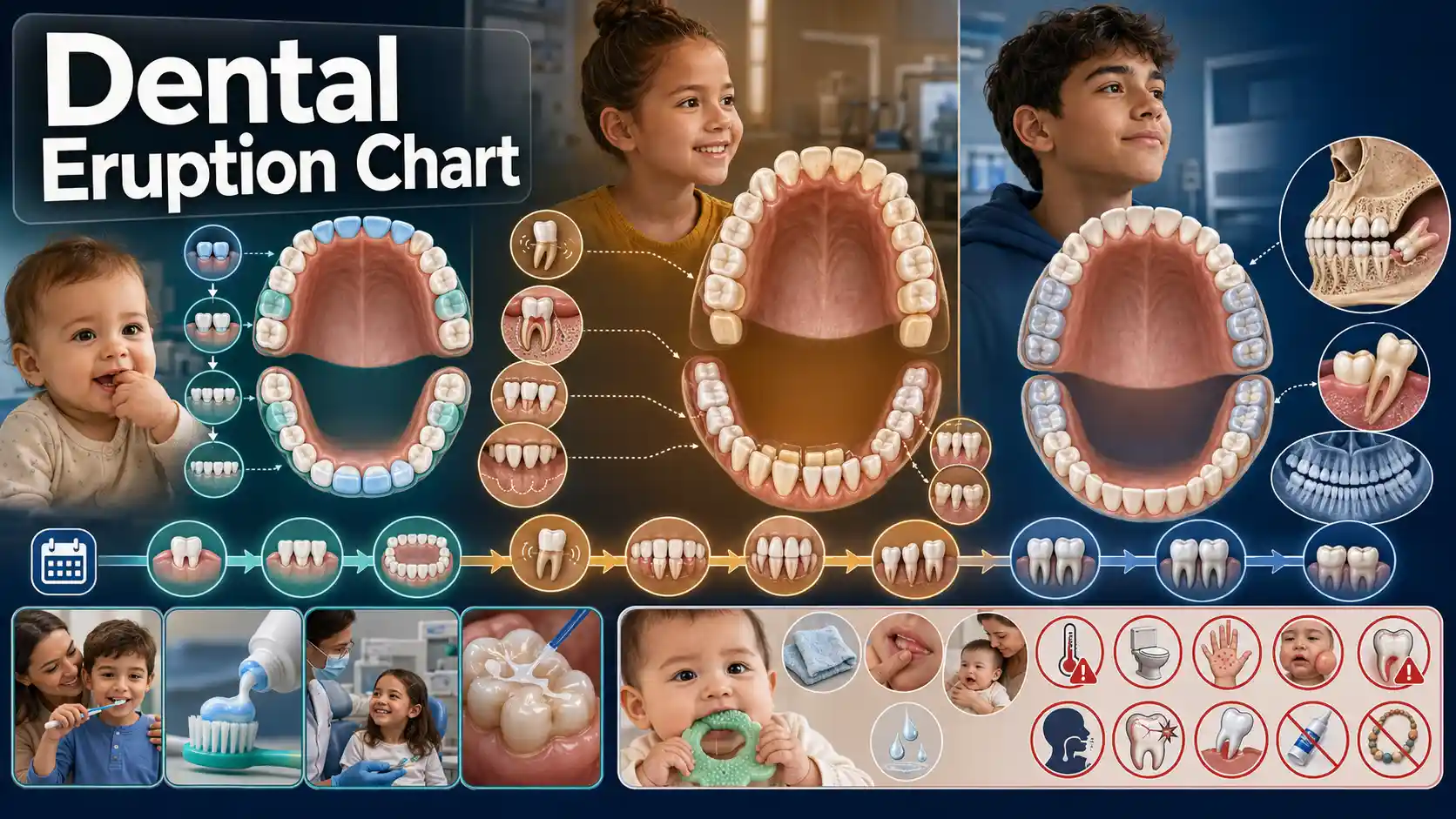
When do baby and permanent teeth erupt?
Primary teeth commonly begin with the lower central incisors around 6–10 months and are usually complete by about age 3. Permanent first molars and lower incisors often appear around ages 6–7, starting mixed dentition.
The American Dental Association notes that people usually have 20 primary teeth and up to 32 permanent teeth, with wisdom teeth commonly assigned a 17–21-year eruption window but showing wide variation. The chart is most useful for sequence and planning rather than judging one exact birthday. Review the ADA eruption charts.
Primary teeth
20 total
Most appear from about 6 months through age 3.
Mixed dentition
About 6–12 years
Baby teeth shed while permanent teeth erupt.
Permanent teeth
28–32 total
Third molars account for the variable final four.
First dental visit
By age 1
After the first tooth appears and no later than 12 months.
Primary Tooth Eruption Chart
Typical eruption windows for the 20 primary teeth. A child may be earlier or later than these ranges and still have normal development.
Swipe horizontally inside the table to view every column.
| Jaw | Tooth type | Typical eruption age | Usual sequence clue | What parents may notice |
|---|---|---|---|---|
| Upper | Central incisor | 8–12 months | Usually follows lower central incisors | Front teeth appear near the midline |
| Upper | Lateral incisor | 9–13 months | Often follows upper central incisors | The front dental arch begins to widen |
| Upper | First molar | 13–19 months | Commonly erupts before the canine | Broad chewing surface appears behind the incisors |
| Upper | Canine (cuspid) | 16–22 months | Usually fills the gap between lateral incisor and first molar | Pointed tooth appears at the corner of the arch |
| Upper | Second molar | 25–33 months — Later primary eruption window | Often among the final primary teeth | Backmost baby molar completes the upper arch |
| Lower | Central incisor | 6–10 months — Common first eruption window | Often the first primary teeth to erupt | Two lower front teeth commonly appear first |
| Lower | Lateral incisor | 10–16 months | Usually follows the central incisors | Lower front row expands outward |
| Lower | First molar | 14–18 months | Often erupts before the canine | A broad chewing tooth appears toward the back |
| Lower | Canine (cuspid) | 17–23 months | Usually erupts after the first molar | Pointed corner tooth fills the remaining gap |
| Lower | Second molar | 23–31 months | Often among the final primary teeth | Backmost lower baby molar completes the arch |
Ages are approximate windows from the ADA primary-tooth development chart.
- • Most children have all 20 primary teeth by about age 3, but individual timing varies.
- • Sequence and symmetry are often more useful than comparing one tooth with a single exact month.
- • Prematurity, family pattern, nutrition, endocrine conditions, local obstruction, and other factors can alter timing.
Download or export
Tooth eruption is a sequence, not a deadline
Primary teeth usually emerge from infancy through the third year. Around age 6, permanent first molars and incisors begin the mixed-dentition stage. Most permanent teeth except third molars are present by early adolescence.
Primary Tooth Shedding Chart
Typical ages when primary teeth loosen and are replaced. Shedding should be interpreted with the eruption and position of the permanent successor.
Swipe horizontally inside the table to view every column.
| Jaw | Primary tooth | Typical shedding age | Common replacement | Important context |
|---|---|---|---|---|
| Upper | Central incisor | 6–7 years | Permanent central incisor | Front teeth are often the first upper teeth lost |
| Upper | Lateral incisor | 7–8 years | Permanent lateral incisor | Spacing can temporarily look uneven during mixed dentition |
| Upper | First molar | 9–11 years | First premolar | A premolar replaces this baby molar |
| Upper | Canine | 10–12 years | Permanent canine | Crowding or delayed canine eruption may need monitoring |
| Upper | Second molar | 10–12 years | Second premolar | A premolar replaces this baby molar |
| Lower | Central incisor | 6–7 years | Permanent central incisor | May loosen as the permanent incisor moves upward |
| Lower | Lateral incisor | 7–8 years | Permanent lateral incisor | The new tooth may initially erupt slightly behind the baby tooth |
| Lower | First molar | 9–11 years | First premolar | Premature loss can affect available space |
| Lower | Canine | 9–12 years | Permanent canine | Lower canines often erupt earlier than upper canines |
| Lower | Second molar | 10–12 years | Second premolar | The mixed-dentition transition is nearing completion |
- • Primary molars are replaced by premolars; permanent first molars erupt behind the primary teeth and do not replace a baby tooth.
- • A baby tooth lost very early from decay or trauma may allow neighboring teeth to drift and reduce space for the permanent tooth.
- • A dentist may use examination and, when appropriate, imaging to assess a retained primary tooth or delayed successor.
Download or export
The six-year molars do not replace baby teeth
Permanent first molars erupt behind the primary molars, often around ages 6–7. Because no baby tooth falls out first, families can mistake them for temporary teeth. These new permanent molars need careful brushing and may benefit from sealants based on a dentist’s assessment.
Permanent Tooth Eruption Chart
Typical eruption windows for permanent teeth. Third molars are highly variable and may be absent, impacted, partially erupted, or removed.
Swipe horizontally inside the table to view every column.
| Jaw | Permanent tooth | Typical eruption age | Replaces a baby tooth? | Key note |
|---|---|---|---|---|
| Upper | First molar | 6–7 years — Early permanent eruption | No | Erupts behind the primary molars and is often called the six-year molar |
| Upper | Central incisor | 7–8 years | Yes | Replaces the upper primary central incisor |
| Upper | Lateral incisor | 8–9 years | Yes | Replaces the upper primary lateral incisor |
| Upper | First premolar | 10–11 years | Yes | Replaces the upper first primary molar |
| Upper | Second premolar | 10–12 years | Yes | Replaces the upper second primary molar |
| Upper | Canine | 11–12 years | Yes | Often one of the later front-region teeth to erupt |
| Upper | Second molar | 12–13 years | No | Erupts behind the first permanent molar |
| Upper | Third molar | 17–21 years — Highly variable wisdom tooth timing | No | Wisdom-tooth development and eruption vary greatly |
| Lower | Central incisor | 6–7 years — Early permanent eruption | Yes | Often among the first permanent teeth to appear |
| Lower | First molar | 6–7 years | No | Erupts behind the primary molars without a baby tooth falling out |
| Lower | Lateral incisor | 7–8 years | Yes | Replaces the lower primary lateral incisor |
| Lower | Canine | 9–10 years | Yes | Often erupts earlier than the upper canine |
| Lower | First premolar | 10–12 years | Yes | Replaces the lower first primary molar |
| Lower | Second premolar | 11–12 years | Yes | Replaces the lower second primary molar |
| Lower | Second molar | 11–13 years | No | Often called the twelve-year molar |
| Lower | Third molar | 17–21 years | No | May be absent or unable to erupt normally |
Ages are approximate windows from the ADA permanent-tooth development chart.
- • There are usually 28 permanent teeth excluding third molars and up to 32 when all wisdom teeth are present.
- • Permanent first molars require early brushing and preventive care because they may be mistaken for baby teeth.
- • An eruption window does not predict whether a tooth has enough space or is positioned normally.
Download or export
Tooth-eruption age-window checker
Enter an age to see which broad primary eruption, primary shedding, and permanent eruption windows overlap it. This tool summarizes the chart; it cannot confirm whether an individual tooth is present or positioned normally.
Primary-tooth eruption stage
Age equivalent: 12 months.
Windows overlapping this age
- Upper primary central incisors — Primary eruption
- Upper primary lateral incisors — Primary eruption
- Lower primary lateral incisors — Primary eruption
Next broad windows
- Primary first molars — begins around 13 months
- Primary canines — begins around 16 months
- Primary second molars — begins around 23 months
Dental Eruption Stages by Age
A life-stage overview linking primary eruption, mixed dentition, permanent eruption, and third-molar assessment.
Swipe horizontally inside the table to view every column.
| Age or stage | Typical dentition | Common changes | What to monitor | Care priority |
|---|---|---|---|---|
| Birth to 5 months | Teeth usually remain beneath the gums | Oral tissues and jaws continue developing | Natal or neonatal teeth, feeding difficulty, mouth lesions | Clean gums gently and arrange care for concerning findings |
| About 6–12 months | First primary incisors often erupt | Drooling, chewing, gum tenderness may occur | First tooth, symmetry, safe teething practices | Brush with a smear of fluoride toothpaste and establish a dental home |
| 12–24 months | Incisors, first molars, and canines emerge | Chewing pattern expands | Caries risk, bottle use, brushing quality | Twice-daily brushing and preventive dental care |
| 24–36 months | Second primary molars complete the set | Most children approach 20 primary teeth | Missing teeth, enamel defects, pain, swelling | Maintain fluoride, diet, brushing, and regular reviews |
| 3–5 years | Full primary dentition | Jaw growth creates spacing for future teeth | Early loss, decay, bite, speech, habits | Protect primary teeth and monitor development |
| 6–8 years | Early mixed dentition | Permanent first molars and incisors erupt | Sealants, crowding, double-row incisors, brushing | Identify permanent molars and strengthen independent brushing |
| 9–12 years | Late mixed dentition | Canines and premolars replace primary teeth | Space, retained primary teeth, asymmetric eruption | Monitor eruption sequence and orthodontic development |
| 12–13 years | Most permanent teeth except third molars | Second molars erupt | Hygiene around new molars and orthodontic appliances | Prevent cavities and gum inflammation |
| 17–21 years and later | Third molars may erupt or remain impacted | Wisdom-tooth position becomes clearer | Pain, infection, decay, crowding, cystic change | Individual clinical and imaging assessment when indicated |
- • The ranges overlap because tooth development is a continuous process rather than a single birthday milestone.
- • Dental age and chronological age are related but not identical.
Download or export
Tooth Types, Counts, and Functions
Primary and permanent teeth differ in number and shape, but every tooth type contributes to chewing, speech, spacing, and facial support.
Swipe horizontally inside the table to view every column.
| Tooth type | Primary count | Permanent count | Main function | Development note |
|---|---|---|---|---|
| Central incisors | 4 | 4 | Bite and cut food; support speech and appearance | Often the earliest teeth to erupt and shed |
| Lateral incisors | 4 | 4 | Cut food and shape the front dental arch | Usually follow central incisors |
| Canines | 4 | 4 | Tear food and guide jaw movement | Upper permanent canines may erupt later than neighboring teeth |
| First molars | 4 primary | 4 permanent | Crush and grind food | Permanent first molars do not replace primary teeth |
| Second molars | 4 primary | 4 permanent | Grind food at the back of the mouth | Permanent second molars usually appear around early adolescence |
| First premolars | 0 | 4 | Tear and grind food | Replace primary first molars |
| Second premolars | 0 | 4 | Grind food and support the bite | Replace primary second molars |
| Third molars | 0 | Up to 4 | Additional posterior chewing surface when functional | May be absent, impacted, partially erupted, or removed |
| Total teeth | 20 — Primary total | Up to 32 — Permanent total including wisdom teeth | Collective chewing, speech, spacing, and facial support | Most primary teeth are present by age 3; permanent completion varies |
- • A child’s permanent first molars can decay while parents assume they are replaceable baby teeth.
- • A missing tooth can reflect normal variation, delayed eruption, congenital absence, obstruction, or previous loss; examination determines the cause.
Download or export
Baby teeth protect speech, chewing, and permanent-tooth space
Primary teeth are not disposable placeholders. They support eating, speech, facial development, and space for permanent successors. The ADA recommends brushing as soon as the first tooth appears and arranging a first dental visit no later than the first birthday. Read the ADA baby-teeth guidance.
Teething Symptoms and Safer Relief
Teething can cause local gum discomfort and behavior changes, but it should not be used to explain significant illness.
Swipe horizontally inside the table to view every column.
| Finding or action | Usually compatible with teething? | What it may mean | Safer response |
|---|---|---|---|
| Drooling more than usual | Often | Normal salivary and chewing response | Wipe gently and protect irritated skin |
| Chewing on firm objects | Often | Pressure may temporarily soothe tender gums | Offer a clean solid-rubber teether under supervision |
| Mild gum tenderness | Often | Tooth is moving through the gum | Massage with a clean finger or use a cool damp cloth |
| Fussiness or sleep disruption | Can occur | Discomfort may affect behavior | Use comfort measures and discuss persistent pain with a clinician |
| Reduced interest in food | Can occur briefly | Tender gums may make chewing uncomfortable | Offer suitable textures and maintain normal fluids |
| Fever | Not considered a normal teething symptom — Not normal teething symptom | Possible infection or other illness | Use age-appropriate medical advice rather than assuming teething |
| Diarrhea or repeated vomiting | Not considered normal | Possible gastrointestinal illness or dehydration risk | Seek medical advice based on age and severity |
| Widespread rash | Not considered normal | Possible infection, allergy, or skin condition | Arrange medical assessment when persistent or concerning |
| Benzocaine oral gel | Avoid for teething — Avoid benzocaine | Can cause serious methemoglobinemia | Use non-drug comfort measures and professional advice |
| Teething necklaces or beads | Avoid | Strangulation and choking hazard | Use supervised solid teethers instead |
- • A cool—not frozen—teether or damp washcloth can reduce discomfort without numbing medicine.
- • Do not place aspirin on gums and do not use products containing benzocaine for teething pain in children.
- • Medication dosing must follow the child’s weight, product concentration, age restrictions, and clinician guidance.
Download or export
Do not use benzocaine products for teething pain
The FDA warns that benzocaine can cause methemoglobinemia, a serious reduction in the blood’s oxygen-carrying capacity. Safer comfort measures include gentle gum massage, a cool damp cloth, and a clean solid-rubber teether under supervision. Review the FDA safety guidance.
Dental Care Milestones During Tooth Eruption
Preventive care starts before the full set of teeth appears and changes as the child gains new teeth and brushing skills.
Swipe horizontally inside the table to view every column.
| Milestone | Recommended action | Why it matters | Common mistake |
|---|---|---|---|
| Before the first tooth | Wipe gums gently with a clean damp cloth | Builds a routine and removes residue | Waiting until several teeth are present |
| First tooth erupts | Brush twice daily with a rice-grain smear of fluoride toothpaste | Decay can begin as soon as a tooth appears | Using water alone or too much toothpaste |
| By the first birthday | Complete the first dental visit — Age-one dental visit | Establishes prevention, risk assessment, and a dental home | Waiting until pain or visible decay |
| Two teeth touch | Begin cleaning between them with floss or another advised method | Brush bristles may not clean the contact area | Assuming baby teeth never need interdental cleaning |
| Ages 3–6 | Use a pea-sized amount of fluoride toothpaste and supervise brushing | Young children need help reaching all surfaces and limiting swallowing | Allowing unsupervised brushing too early |
| Permanent first molars erupt | Identify and clean the deep grooves; ask about sealants — Protect permanent first molars | These teeth do not replace baby teeth and are cavity-prone | Mistaking them for temporary teeth |
| Mixed dentition | Monitor loose teeth, space, symmetry, bite, and hygiene | Crowding and eruption disturbances become easier to recognize | Pulling a tooth before it is naturally ready |
| Orthodontic appliances | Clean around brackets, bands, and erupting teeth carefully | Plaque accumulates around fixed hardware | Relying on brushing alone when interdental tools are needed |
- • A child’s preventive schedule should be personalized to caries risk, development, cooperation, and clinical findings.
- • The first dental visit should occur when the first tooth erupts and no later than 12 months of age.
Download or export
Establish a dental home by the first birthday
An early visit focuses on prevention, fluoride, feeding and diet, brushing technique, injury prevention, eruption, and individual cavity risk. The American Academy of Pediatric Dentistry recommends the first visit by age 1. See the AAPD parent FAQ.
Early, Delayed, and Asymmetric Tooth Eruption
Variation is common, but the pattern, symmetry, retained teeth, symptoms, medical history, and dental examination determine whether evaluation is needed.
Swipe horizontally inside the table to view every column.
| Pattern | Possible explanation | When it may be normal | Reason to arrange dental review |
|---|---|---|---|
| First tooth later than peers | Family pattern, prematurity, individual development | Child is otherwise growing well and teeth follow later | No tooth by a substantially delayed age or other developmental concerns |
| One side erupts before the other | Short-term normal asymmetry | Matching tooth follows within a reasonable interval | Persistent unilateral delay, swelling, pain, or abnormal position |
| Permanent tooth behind a retained baby tooth | Ectopic path or delayed resorption of the baby root | Commonly seen with lower incisors and may self-correct | Baby tooth stays firm, crowding is marked, or eruption path remains abnormal |
| Tooth erupts very early | Natal/neonatal tooth or early family pattern | Tooth is stable and does not interfere with feeding | Mobility, aspiration risk, tongue injury, feeding difficulty, or unusual appearance |
| Primary tooth lost early | Decay, injury, or extraction | Rarely harmless when space is not affected | Assess need for space management and protect the successor |
| Primary tooth remains after expected shedding | Delayed successor, missing permanent tooth, ankylosis, or obstruction | Small variation without symptoms | Neighboring teeth have erupted or the permanent tooth is displaced |
| Permanent tooth not visible in expected sequence | Normal variation, lack of space, impaction, extra tooth, or congenital absence | Other teeth are also developing later | Contralateral tooth erupted long ago or space is closing |
| Eruption with enamel defect | Developmental disturbance, trauma, illness, or mineralization problem | Minor isolated variation | Sensitivity, breakdown, discoloration, or multiple affected teeth |
- • A chart cannot show whether a tooth is present beneath the gum, blocked, angled, ankylosed, or congenitally absent.
- • Dental imaging is used selectively when examination and history suggest that it will change management.
Download or export
Dental Eruption Warning Signs and Urgency
Pain, swelling, trauma, infection, dehydration, breathing problems, and unsafe teething-product reactions can require faster care than the eruption schedule itself.
Swipe horizontally inside the table to view every column.
| Warning sign | Possible concern | Suggested urgency | Do not rely on |
|---|---|---|---|
| Facial swelling, spreading redness, or difficulty opening the mouth | Dental infection or deep-space inflammation | Urgent same-day dental or medical assessment | Waiting for the tooth to finish erupting |
| Trouble breathing or swallowing, drooling with distress | Airway or deep infection emergency | Emergency services now — Emergency | Home teething remedies |
| Severe tooth pain, fever, or pus | Decay, abscess, or infection | Prompt dental assessment; urgent if systemically unwell | Assuming fever is teething |
| Knocked-out permanent tooth | Dental trauma | Immediate dental emergency; handle by the crown and follow local first-aid advice | Scrubbing the root or delaying care |
| Loose or displaced baby tooth after trauma | Injury to primary tooth and developing successor | Prompt dental advice | Repositioning it without professional guidance |
| Blue, gray, or pale skin after oral numbing product | Methemoglobinemia from benzocaine | Emergency services now — Emergency medication reaction | Giving another dose |
| Poor feeding, dehydration, repeated vomiting, or diarrhea | Illness beyond normal teething | Medical advice based on age and severity | Attributing all symptoms to eruption |
| Painful partially erupted wisdom tooth with swelling or bad taste | Pericoronitis or infection around a third molar | Prompt dental assessment | Repeatedly covering symptoms without evaluation |
| Tooth eruption with persistent bleeding or mass | Trauma, infection, vascular lesion, cyst, or another condition | Prompt dental or medical examination | Assuming every gum lump is a normal eruption cyst |
- • Call emergency services for breathing difficulty, severe facial swelling, collapse, or signs of a serious medication reaction.
- • A knocked-out primary tooth is not replanted because this can damage the developing permanent tooth; permanent-tooth trauma requires immediate professional guidance.
Download or export
Frequently asked questions
When do babies usually get their first tooth?
The first primary tooth often appears around 6 months, commonly a lower central incisor. Some healthy babies erupt earlier or later, so the sequence, growth, symmetry, and dental examination matter more than one exact month.
How many baby teeth do children have?
Children usually develop 20 primary teeth: 10 in the upper jaw and 10 in the lower jaw. Most are visible by about age 3.
Which baby teeth usually come in first?
The lower central incisors are commonly first, followed by upper central incisors and lateral incisors. First molars often appear before the canines, and second molars are usually among the last primary teeth.
When do children start losing baby teeth?
Primary incisors commonly begin loosening around age 6. Most primary teeth are shed between ages 6 and 12 as permanent successors erupt.
Which permanent teeth appear first?
Lower central incisors and first permanent molars often erupt around ages 6–7. The first permanent molars come in behind the baby molars and do not replace a primary tooth.
At what age do all permanent teeth erupt?
Most permanent teeth other than wisdom teeth are present by the early teenage years. Third molars may erupt around ages 17–21, but they can appear later, remain impacted, or be absent.
Is it normal for teeth to erupt in a different order?
Small differences are common. Persistent one-sided delay, a retained baby tooth, crowding, pain, swelling, an abnormal path, or a long gap after the matching tooth erupts deserves dental review.
Can teething cause fever or diarrhea?
Fever and diarrhea are not considered normal teething symptoms. A child with these symptoms should be assessed according to age, severity, hydration, and other signs rather than having the illness automatically attributed to teething.
What is safe for teething pain?
Safer measures include gentle gum massage, a cool damp cloth, and a clean solid-rubber teether under supervision. Avoid benzocaine gels, liquid-filled teethers, choking hazards, and teething jewelry.
When should a child first see a dentist?
The first dental visit should occur when the first tooth erupts and no later than the first birthday. Earlier care helps prevent cavities and gives parents individualized brushing, fluoride, diet, and teething guidance.
Why do baby teeth matter if they fall out?
Primary teeth support chewing, speech, facial development, and space for permanent teeth. Early decay or loss can cause pain, infection, nutrition problems, and reduced space for the adult successor.
What is mixed dentition?
Mixed dentition is the stage when primary and permanent teeth are present together, usually from about ages 6–12. It includes shedding baby teeth, eruption of incisors and molars, and replacement by canines and premolars.
Why is a permanent tooth growing behind a baby tooth?
This can happen when the permanent tooth follows a slightly inward path before the primary root has fully resorbed. It is common with lower incisors, but a firm retained baby tooth, crowding, or persistent double row should be checked.
When is delayed tooth eruption concerning?
Concern rises when no teeth appear substantially later than expected, the matching tooth erupted long ago, the primary tooth remains far beyond its range, there is swelling or pain, growth is abnormal, or a medical or developmental condition may be involved.
Sources
These sources support the visible eruption windows, teething guidance, and preventive-care milestones. Always follow the child’s dentist, pediatrician, emergency service, and local product instructions.
American Dental Association — Eruption Charts
Provides the ADA primary- and permanent-tooth eruption charts and broad dentition timeline.
https://www.mouthhealthy.org/all-topics-a-z/eruption-charts
American Dental Association — Baby Teeth
Explains when primary teeth usually appear, why they matter, home care, and timing of the first dental visit.
https://www.mouthhealthy.org/all-topics-a-z/baby-teeth
American Dental Association — Teething
Separates common teething symptoms from fever, diarrhea, rash, and other symptoms that need medical review.
https://www.mouthhealthy.org/all-topics-a-z/teething
American Academy of Pediatric Dentistry — FAQ: First Dental Visit and Preventive Care
Recommends scheduling a child’s first dental visit by the first birthday and individualizing follow-up frequency.
https://www.aapd.org/resources/parent/faq/
U.S. Food and Drug Administration — Safely Soothing Teething Pain in Infants and Children
Warns against benzocaine and other unsafe teething products and recommends safer comfort measures.
https://www.fda.gov/consumers/consumer-updates/safely-soothing-teething-pain-infants-and-children