Health & Medical · Age-based cardiovascular reference
Blood Pressure by Age Chart for Children, Adults, and Seniors
Compare pediatric screening values, teen and adult blood pressure ranges, older-adult considerations, measurement methods, prevalence by age, and warning signs that need prompt care.
Age alone cannot diagnose or normalize a blood pressure reading. Children need pediatric percentile interpretation, and adults need repeated accurate readings plus symptoms and health context. Read the ChartsLoom Disclaimer.
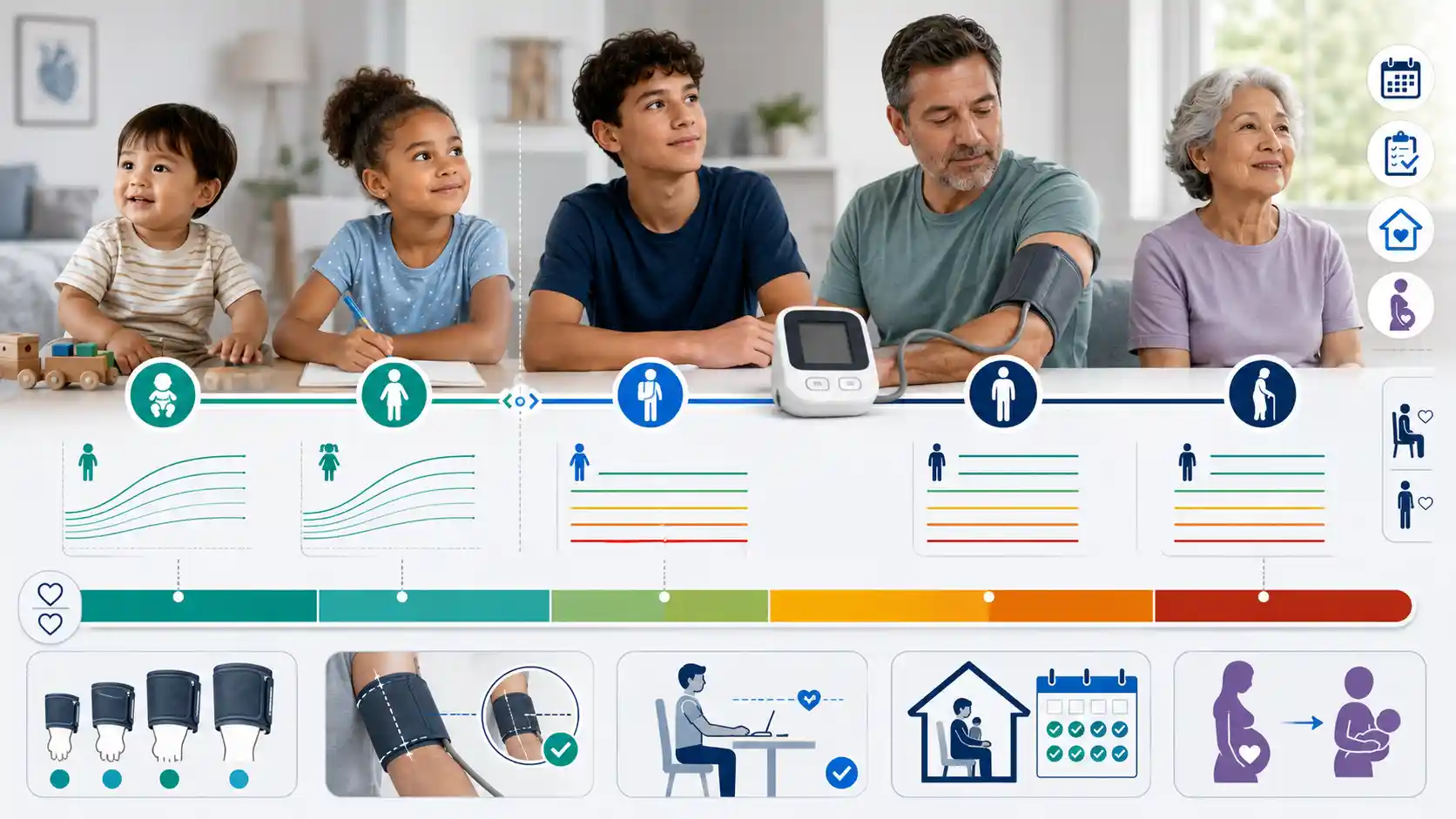
What is normal blood pressure by age?
For children ages 1–12, normal blood pressure depends on age, sex, and height percentile. From age 13 onward, normal blood pressure remains below 120 systolic and below 80 diastolic.
Adult thresholds do not rise with age. The current American Heart Association categories apply across adulthood, even though hypertension becomes much more common in later life. Treatment goals can still be individualized for frailty, dizziness, falls, kidney disease, pregnancy, and medication tolerance.
- Ages 1–12
- Use percentiles
- Age 13 and older
- <120/<80 is normal
- Older adults
- Same cutoffs
- Severe adult range
- >180 or >120
A child reading depends on age, sex, and height. Simplified values only screen for full evaluation.
Fixed teen and adult categories begin at age 13. Either number can determine the category.
High pressure is more common with age, but the definition of normal does not rise by decade.
Repeat after one minute. Emergency symptoms require emergency services immediately.
A higher adult reading does not become normal with age
Many online charts publish a different “normal” adult value for each decade. That approach can confuse population averages with clinical categories. Systolic pressure often rises as arteries stiffen, but 140/90 remains high for a 70-year-old just as it is for a 40-year-old.
Use the broader Blood Pressure Chart for full adult category, home measurement, pregnancy, and emergency-action guidance.
Blood pressure interpretation by age and life stage
Age changes the method used to interpret blood pressure in childhood. From age 13 onward, the same adult category cutoffs apply across age groups, although treatment decisions remain individualized.
Swipe horizontally inside the table to view every column.
| Age or life stage | How blood pressure is interpreted | What counts as normal or high | Important context |
|---|---|---|---|
| Birth to younger than 3 years | Routine screening is limited to children with specific medical risks or clinical indications. | Use neonatal or infant reference standards selected by a pediatric clinician. | Prematurity, congenital heart disease, kidney disease, intensive-care history, medicines, and measurement site can change interpretation. |
| Ages 3–5 | Compare the average systolic and diastolic pressure with age-, sex-, and height-specific percentiles. | Normal is below the 90th percentile. A full percentile table—not an adult chart—determines elevated or high pressure. | Use a pediatric cuff and confirm an elevated oscillometric reading by auscultation when clinically appropriate. |
| Ages 6–12 | Continue age-, sex-, and height-percentile interpretation. | The simplified screening table flags values that need repeat measurement and full percentile evaluation; it does not diagnose hypertension. | Growth, body size, obesity, kidney disease, sleep apnea, stimulant medicines, and family history add context. |
| Ages 13–17 | Use fixed adolescent categories that match adult numerical cutoffs. — Fixed adolescent categories begin | Normal is below 120/80; stage 1 begins at 130 systolic or 80 diastolic; stage 2 begins at 140 systolic or 90 diastolic. | Repeated accurate readings are required. A teen with severe pressure or symptoms needs prompt clinical assessment. |
| Ages 18–39 | Use standard adult categories and confirm the average with repeated office, home, or ambulatory measurements. | Normal is below 120/80; hypertension begins at a consistent 130 systolic or 80 diastolic. | Young adults can have hypertension even without symptoms. Secondary causes may deserve attention when onset is early or abrupt. |
| Ages 40–59 | Use the same adult cutoffs, then combine the average with cardiovascular and kidney risk. | Age does not raise the definition of normal blood pressure. | Diabetes, chronic kidney disease, sleep apnea, medicines, alcohol, weight, and menopause can influence risk and management. |
| Ages 60–74 | Use the same adult categories and assess seated and standing readings when dizziness or falls occur. | A pressure does not become normal simply because it is common at an older age. | Arterial stiffness often raises systolic pressure. Treatment should consider symptoms, kidney function, medicines, and tolerance. |
| Age 75 and older | Use adult categories, repeated measurements, and individualized goals. | The category thresholds remain the same; the safest treatment plan may differ with frailty, orthostatic symptoms, cognition, falls, and life expectancy. | Do not stop blood pressure medicine because of age alone. Report lightheadedness, fainting, falls, or large standing drops. |
| Pregnancy and postpartum | Use pregnancy-specific hypertension and severe-hypertension thresholds regardless of adult age. | Hypertension in pregnancy begins at 140 systolic or 90 diastolic; severe hypertension begins at 160 systolic or 110 diastolic. — Pregnancy-specific thresholds | Severe headache, vision changes, upper abdominal pain, chest pain, shortness of breath, or marked swelling requires urgent assessment. |
All values are measured in millimeters of mercury, abbreviated mm Hg.
- • There is no evidence-based adult “normal blood pressure by decade” table that makes higher pressure acceptable with aging.
- • The correct chart depends on age, pregnancy status, accurate technique, repeated readings, and clinical context.
Download or export
How blood pressure interpretation changes with age
The biggest transition occurs at age 13. Younger children need percentile-based interpretation; teens and adults use fixed numerical categories.
Birth–2 years
Risk-based measurement
Infants and toddlers need specialized references and routine checks only when clinical risks or indications exist.
3–12 years
Pediatric percentiles
Interpret the average by age, sex, and height percentile. A simplified table only screens for further evaluation.
13–17 years
Fixed teen categories
Normal is below 120/80. Stage 1 begins at 130 or 80, and stage 2 begins at 140 or 90.
18–59 years
Adult categories
The same cutoffs apply across young and middle adulthood. Confirm with repeated accurate measurements.
60+ years
Same cutoffs, more context
Higher pressure is more common, not more normal. Consider standing symptoms, frailty, medicines, and tolerance.
Adult hypertension becomes more common with age
U.S. prevalence, August 2021–August 2023
Prevalence does not redefine normal.
Data-table fallback: 18–39 years, 23.4%; 40–59 years, 52.5%; age 60 and older, 71.6%.
Blood pressure by age reading checker
Enter an age and measured reading. Ages 1–12 use the AAP simplified screening values; age 13 and older uses fixed categories. The result organizes the number but cannot diagnose hypertension.
Below 120/80
Both values fall below the fixed normal-category cutoffs used from age 13 onward.
Continue routine screening. Symptoms or a major change from usual still deserve clinical attention.
This checker stays in your browser and does not transmit the entered values. It uses a simplified pediatric screening step for ages 1–12 and cannot replace full height-percentile classification or professional assessment.
How pediatric blood pressure differs from adult blood pressure
Children ages 1–12 require sex-, age-, and height-specific percentiles because body size strongly affects normal pressure. The American Academy of Pediatrics guideline provides a simplified screening table to identify readings that need a complete percentile lookup.
The screening numbers below are intentionally conservative. A reading at or above either value means “repeat and evaluate,” not “hypertension confirmed.” The Baby Growth Percentile Chart explains growth percentiles, but blood pressure uses separate cardiovascular tables.
Simplified blood pressure screening chart for boys
These AAP values are screening thresholds for identifying a reading that needs repeat measurement and full age-, sex-, and height-percentile evaluation. They are not diagnostic cutoffs.
Swipe horizontally inside the table to view every column.
| Age | Systolic screening value | Diastolic screening value | What to do at or above either value |
|---|---|---|---|
| 1 year | 98 mm Hg | 52 mm Hg | Repeat the reading correctly and use the full pediatric percentile tables with height percentile. |
| 2 years | 100 mm Hg | 55 mm Hg | Repeat the reading correctly and use the full pediatric percentile tables with height percentile. |
| 3 years | 101 mm Hg | 58 mm Hg | Repeat the reading correctly and use the full pediatric percentile tables with height percentile. |
| 4 years | 102 mm Hg | 60 mm Hg | Repeat the reading correctly and use the full pediatric percentile tables with height percentile. |
| 5 years | 103 mm Hg | 63 mm Hg | Repeat the reading correctly and use the full pediatric percentile tables with height percentile. |
| 6 years | 105 mm Hg | 66 mm Hg | Repeat the reading correctly and use the full pediatric percentile tables with height percentile. |
| 7 years | 106 mm Hg | 68 mm Hg | Repeat the reading correctly and use the full pediatric percentile tables with height percentile. |
| 8 years | 107 mm Hg | 69 mm Hg | Repeat the reading correctly and use the full pediatric percentile tables with height percentile. |
| 9 years | 107 mm Hg | 70 mm Hg | Repeat the reading correctly and use the full pediatric percentile tables with height percentile. |
| 10 years | 108 mm Hg | 72 mm Hg | Repeat the reading correctly and use the full pediatric percentile tables with height percentile. |
| 11 years | 110 mm Hg | 74 mm Hg | Repeat the reading correctly and use the full pediatric percentile tables with height percentile. |
| 12 years | 113 mm Hg | 75 mm Hg | Repeat the reading correctly and use the full pediatric percentile tables with height percentile. |
| 13 years and older — Transition to fixed adolescent categories | 120 mm Hg | 80 mm Hg | Use the fixed adolescent categories and repeat the measurement correctly. |
Screening values are in mm Hg. Either the systolic or diastolic value can trigger further evaluation.
- • A value below this simplified threshold does not replace a complete clinical assessment when symptoms, kidney disease, heart disease, or other risks are present.
- • For ages 1–12, diagnosis requires full percentile classification and repeated measurements—not this screening table alone.
Download or export
Simplified blood pressure screening chart for girls
These AAP screening values identify readings that deserve repeat measurement and full pediatric percentile evaluation. They do not define a diagnosis by themselves.
Swipe horizontally inside the table to view every column.
| Age | Systolic screening value | Diastolic screening value | What to do at or above either value |
|---|---|---|---|
| 1 year | 98 mm Hg | 54 mm Hg | Repeat the reading correctly and use the full pediatric percentile tables with height percentile. |
| 2 years | 101 mm Hg | 58 mm Hg | Repeat the reading correctly and use the full pediatric percentile tables with height percentile. |
| 3 years | 102 mm Hg | 60 mm Hg | Repeat the reading correctly and use the full pediatric percentile tables with height percentile. |
| 4 years | 103 mm Hg | 62 mm Hg | Repeat the reading correctly and use the full pediatric percentile tables with height percentile. |
| 5 years | 104 mm Hg | 64 mm Hg | Repeat the reading correctly and use the full pediatric percentile tables with height percentile. |
| 6 years | 105 mm Hg | 67 mm Hg | Repeat the reading correctly and use the full pediatric percentile tables with height percentile. |
| 7 years | 106 mm Hg | 68 mm Hg | Repeat the reading correctly and use the full pediatric percentile tables with height percentile. |
| 8 years | 107 mm Hg | 69 mm Hg | Repeat the reading correctly and use the full pediatric percentile tables with height percentile. |
| 9 years | 108 mm Hg | 71 mm Hg | Repeat the reading correctly and use the full pediatric percentile tables with height percentile. |
| 10 years | 109 mm Hg | 72 mm Hg | Repeat the reading correctly and use the full pediatric percentile tables with height percentile. |
| 11 years | 111 mm Hg | 74 mm Hg | Repeat the reading correctly and use the full pediatric percentile tables with height percentile. |
| 12 years | 114 mm Hg | 75 mm Hg | Repeat the reading correctly and use the full pediatric percentile tables with height percentile. |
| 13 years and older — Transition to fixed adolescent categories | 120 mm Hg | 80 mm Hg | Use the fixed adolescent categories and repeat the measurement correctly. |
Screening values are in mm Hg. Either the systolic or diastolic value can trigger further evaluation.
- • The simplified table intentionally uses conservative values so clinicians do not miss a child who needs full percentile assessment.
- • Correct cuff size is essential because an undersized cuff can overstate a child’s blood pressure.
Download or export
Why a child can be above the screening value but below a diagnostic percentile
The simplified value is set low enough to catch nearly every child who might need the full table. A clinician then uses completed age, sex, measured height percentile, the average of repeated readings, and the correct pediatric definitions. This two-step process favors sensitivity during screening and precision during classification.
Blood pressure categories from age 13 onward
The same numerical categories apply to adolescents age 13 and older and to adults. Use the higher category reached by either the systolic or diastolic number.
Swipe horizontally inside the table to view every column.
| Category | Systolic pressure | Diastolic pressure | Interpretation |
|---|---|---|---|
| Normal — Normal category | Less than 120 mm Hg | and less than 80 mm Hg | Both numbers must remain below their cutoffs. |
| Elevated | 120–129 mm Hg | and less than 80 mm Hg | The systolic value is above normal while diastolic remains below 80. |
| Stage 1 hypertension | 130–139 mm Hg | or 80–89 mm Hg | Either number can place the reading in stage 1. Confirm with repeated accurate measurements. |
| Stage 2 hypertension | 140 mm Hg or higher | or 90 mm Hg or higher | Repeated readings need prompt professional assessment and a treatment plan. |
| Severe hypertension | Higher than 180 mm Hg | and/or higher than 120 mm Hg | Repeat after at least one minute. If it remains this high without emergency symptoms, contact a healthcare professional immediately. |
| Hypertensive emergency | Higher than 180 mm Hg | and/or higher than 120 mm Hg | Call emergency services when severe pressure occurs with chest pain, shortness of breath, weakness, numbness, vision change, back pain, or difficulty speaking. — Emergency action |
Blood pressure is recorded as systolic/diastolic mm Hg.
- • A reading such as 118/84 reaches stage 1 because the diastolic number is in the 80–89 range.
- • Pregnancy uses separate hypertension and severe-hypertension thresholds even when the person is age 13 or older.
Download or export
Why high blood pressure becomes more common with age
Arterial stiffness, kidney changes, accumulated cardiovascular risk, sleep apnea, diabetes, medicines, body composition, and lower activity can all contribute. Recent CDC National Center for Health Statistics data found hypertension in 23.4% of adults ages 18–39, 52.5% at ages 40–59, and 71.6% at age 60 and older.
These percentages describe populations. They do not create a personal target and do not mean that an age-group average is healthy.
Hypertension prevalence by adult age group
Recent U.S. survey data show that hypertension becomes more common with age. Prevalence describes how often hypertension occurs; it does not change the category thresholds.
Swipe horizontally inside the table to view every column.
| Adult age group | Total prevalence | Men | Women | Meaning |
|---|---|---|---|---|
| 18–39 years | 23.4% | 30.0% | 16.4% | Nearly one in four adults in this age group met the survey definition or used blood pressure medicine. |
| 40–59 years | 52.5% | 55.9% | 49.0% | More than half of adults in this age group had hypertension. |
| 60 years and older | 71.6% — Highest prevalence age group | 72.7% | 70.6% | More than seven in ten older adults had hypertension, but higher pressure is not automatically healthy or normal. |
Percent of U.S. adults during August 2021–August 2023.
- • The survey defined hypertension as systolic pressure of at least 130 mm Hg, diastolic pressure of at least 80 mm Hg, or current blood pressure medication use.
- • These population estimates cannot predict whether one person has hypertension.
Download or export
Blood pressure considerations for older adults
Older age increases hypertension prevalence and treatment complexity, but it does not create a separate definition of normal blood pressure.
Swipe horizontally inside the table to view every column.
| Clinical issue | What may change with age | What to check | Why it matters |
|---|---|---|---|
| Isolated systolic hypertension | Systolic pressure may rise while diastolic pressure stays below 80. | Review repeated systolic readings, pulse pressure, and overall cardiovascular risk. | Arterial stiffness becomes more common with age and can produce a wide gap between the two numbers. |
| Orthostatic blood pressure drop | Pressure may fall after standing, especially with dehydration, illness, autonomic disease, or medicines. | Measure seated or lying pressure, then standing pressure when a clinician recommends it. | Dizziness, fainting, and falls may indicate that treatment or hydration needs review. |
| Frailty and falls | The safest pace and intensity of treatment may differ. | Discuss walking stability, falls, cognition, daily function, and treatment tolerance. | A numerical goal should not ignore symptoms or the person’s overall health state. |
| Multiple medicines | Blood pressure drugs can interact with diuretics, pain medicines, decongestants, and other prescriptions. | Review every prescription, over-the-counter medicine, and supplement. | Medication effects can raise pressure, lower it excessively, or change kidney function and electrolytes. |
| Kidney disease or diabetes | Cardiovascular and kidney risks may be higher. | Track kidney function, potassium, albumin in urine, glucose, and medication effects as directed. | The 2025 guideline combines pressure with cardiovascular-kidney-metabolic risk. |
| White-coat or masked hypertension | Office and home readings may disagree at any age. | Use a validated home monitor or ambulatory monitoring when advised. | Out-of-office data can prevent overtreatment or reveal pressure missed in the clinic. |
| Low diastolic pressure | Diastolic pressure can decline while systolic pressure remains high. | Share symptoms, coronary disease history, and the full reading pattern. | Treatment should address systolic risk without ignoring poor tolerance or a very low bottom number. |
| Sudden change from baseline | An abrupt rise or fall is more important than age alone. | Repeat correctly and assess symptoms, illness, dehydration, medication changes, pain, and neurologic signs. | A sudden change can signal a technique error or a new medical problem requiring assessment. |
This table gives interpretation context, not personal treatment targets.
- • Do not stop, start, or change blood pressure medicine based only on an age chart.
- • A healthcare professional may individualize the target while still using the same adult category definitions.
Download or export
Older adults use the same categories but may need individualized treatment
The 2025 adult high blood pressure guideline emphasizes a general treatment goal below 130/80 mm Hg while integrating cardiovascular risk, kidney disease, pregnancy, medication effects, and treatment tolerance. Frailty, falls, orthostatic symptoms, and other health conditions may influence the safest plan.
High blood pressure can affect oxygen delivery, heart function, and kidney health. Use the Blood Oxygen Level Chart for SpO₂ interpretation, but do not use oxygen saturation as a substitute for blood pressure measurement.
Blood pressure measurement by age and body size
Accurate technique matters at every age. Device, cuff, body position, environment, and cooperation should match the person being measured.
Swipe horizontally inside the table to view every column.
| Person or setting | Device and cuff | Position and preparation | Key caution |
|---|---|---|---|
| Infant or toddler | Use pediatric equipment and a cuff matched to the measured limb. | Measurement may occur in a clinical setting with age-appropriate positioning and calming. | Adult home-monitor instructions do not automatically apply to infants. Interpretation needs pediatric or neonatal standards. |
| Child age 3–12 | Use a validated device and pediatric cuff with bladder dimensions appropriate for the upper arm. | Seat the child quietly when possible, support the back and arm, and keep feet supported rather than dangling. | A cuff that is too small can produce a falsely high reading. |
| Teen age 13–17 | Use a validated upper-arm device and correctly sized cuff. | Rest for five minutes, sit supported, keep feet flat, and support the arm at heart level. | Stimulants, nicotine, caffeine, exercise, stress, and talking can affect the result. |
| Adult age 18–59 | Use a validated automatic upper-arm monitor for home readings. | Avoid exercise, nicotine, and caffeine for 30 minutes; rest quietly; take two readings one minute apart. | Record every result rather than selecting only the lowest value. |
| Adult age 60 and older | Use the same validated upper-arm method and a cuff that fits the actual arm circumference. | Add standing measurements when a clinician advises this for dizziness, falls, or medication review. | Muscle tension, unsupported posture, arrhythmia, tremor, and arterial stiffness may affect readings or device performance. |
| Very large or small upper arm | Select a validated cuff range that includes the measured circumference. | Follow the same quiet seated technique. | Do not force an incorrect cuff size. A different validated cuff or device may be needed. |
| Irregular heart rhythm | Use a monitor validated for the rhythm when available and compare it with clinical measurement. | Take repeated readings under stable conditions. | Some automated devices may be less consistent during arrhythmia. |
| Pregnancy and postpartum | Use a device validated for pregnancy or preeclampsia when possible. | Measure promptly when symptoms occur and follow the obstetric care plan. | A normal reading does not dismiss severe symptoms; a severe reading needs urgent action. |
Home blood pressure is usually measured on the upper arm in mm Hg.
- • Bring a home monitor to a healthcare visit periodically so technique and device agreement can be checked.
- • Use the same arm and similar times for a trend unless a clinician gives different instructions.
Download or export
Home monitoring works best when the method stays consistent
The American Heart Association home log recommends a validated upper-arm monitor, an appropriate cuff, five minutes of quiet rest, two readings one minute apart, and recording results rather than selecting a preferred number.
The same foundation applies to teens and adults. Younger children need pediatric equipment, cooperation, and clinical percentile interpretation.
When age alone cannot explain a blood pressure reading
Blood pressure changes with more than age. Symptoms, pregnancy, medicines, health conditions, body position, and measurement quality can change the correct response.
Swipe horizontally inside the table to view every column.
| Context | Possible effect on the reading | Useful next step | Do not assume |
|---|---|---|---|
| Pain, anxiety, fever, or recent activity | Can temporarily raise systolic and diastolic pressure. | Rest, address the immediate trigger when appropriate, and repeat under standard conditions. | A transient rise proves chronic hypertension. |
| Dehydration, vomiting, diarrhea, or blood loss | Can lower pressure and cause a fast pulse, dizziness, or fainting. | Assess symptoms and seek prompt care when weakness, confusion, fainting, or ongoing fluid loss occurs. | Low pressure is harmless because the person is young. |
| Pregnancy or postpartum period | Hypertension and severe hypertension use obstetric thresholds and symptom patterns. | Contact the maternity care team promptly for high readings or warning symptoms. | A young age protects against preeclampsia. |
| Kidney disease, heart disease, diabetes, or sleep apnea | Can increase hypertension risk and influence the treatment plan. | Share repeated readings and follow disease-specific monitoring. | The same reading has identical implications for every person. |
| Prescription or over-the-counter medicines | Stimulants, decongestants, NSAIDs, hormones, steroids, and some other medicines can raise pressure; blood pressure drugs can lower it. | Review all medicines and supplements with a clinician or pharmacist. | An age trend explains a sudden medication-related change. |
| Standing, meals, heat, or prolonged bed rest | Can lower pressure in susceptible people, especially older adults. | Record posture, timing, symptoms, and repeated measurements. | A seated value describes standing tolerance. |
| Wrong cuff or poor technique | Can falsely raise or lower the reading. | Correct the cuff size, posture, rest period, arm height, and talking or movement. | A precise-looking digital number is automatically accurate. |
| Emergency symptoms | Severe pressure with chest pain, shortness of breath, weakness, numbness, vision change, or difficulty speaking may indicate an emergency. | Call emergency services rather than waiting for another age-based comparison. — Emergency action | The chart is more important than symptoms. |
Interpret the number together with symptoms and circumstances.
- • A sudden, symptomatic change from a person’s usual blood pressure may matter even when it does not cross a chart threshold.
- • Emergency symptoms require urgent action regardless of age.
Download or export
Pregnancy and postpartum blood pressure is a separate clinical context
Pregnancy hypertension begins at 140 systolic or 90 diastolic. Severe hypertension begins at 160 systolic or 110 diastolic. The thresholds apply regardless of adult age. Severe headache, vision changes, upper abdominal pain, chest pain, shortness of breath, or significant swelling requires urgent assessment.
Frequently asked questions
What is normal blood pressure by age?
For children ages 1–12, normal blood pressure depends on age, sex, and height percentile. From age 13 onward, normal remains below 120/80 mm Hg; adult category cutoffs do not rise by decade.
Does normal blood pressure increase with age?
No. High blood pressure becomes more common with age, especially higher systolic pressure, but common does not mean normal. Adults of all ages use the same category definitions.
Is 140/90 normal for a 70-year-old?
No. A repeated adult reading of 140 systolic or 90 diastolic reaches stage 2 hypertension. A clinician may individualize treatment according to health, frailty, symptoms, and tolerance, but age does not reclassify 140/90 as normal.
Is 130/80 high for a young adult?
Yes. A repeated reading of 130 systolic or 80 diastolic reaches stage 1 hypertension in adults. One reading does not confirm a diagnosis, so repeat it correctly and discuss the average pattern.
What blood pressure is normal for a teenager?
For adolescents age 13 and older, normal is below 120 systolic and below 80 diastolic. Teenagers younger than 13 require age-, sex-, and height-percentile interpretation.
Why do children need a different blood pressure chart?
Body size and normal cardiovascular development change rapidly in childhood. For ages 1–12, clinicians compare blood pressure with age-, sex-, and height-specific percentiles rather than adult cutoffs.
Can the simplified pediatric table diagnose hypertension?
No. It only identifies a reading that needs repeat measurement and full percentile evaluation. Diagnosis requires correct technique, repeated readings, and the complete pediatric tables.
At what age do adult blood pressure ranges begin?
Fixed adult-like categories begin at age 13 in the AAP pediatric guideline. Normal is below 120/80, stage 1 begins at 130 or 80, and stage 2 begins at 140 or 90.
Why is systolic blood pressure often higher in older adults?
Arteries often become stiffer with aging, which can raise systolic pressure while diastolic pressure stays normal or falls. This pattern is called isolated systolic hypertension and still needs clinical attention.
Should an older adult have standing blood pressure measured?
Standing readings can help when dizziness, fainting, falls, dehydration, autonomic disease, or medication effects are concerns. A clinician can specify the timing and interpret the change.
What blood pressure is high during pregnancy?
Pregnancy hypertension begins at 140 systolic or 90 diastolic. Severe hypertension begins at 160 systolic or 110 diastolic. Warning symptoms need urgent obstetric or emergency assessment.
How often should blood pressure be checked by age?
Children usually begin routine annual measurement at age 3, with earlier checks for specific risks. Adults should have regular screening, and people with high readings or treatment need a schedule set by their healthcare professional.
Can a wrist monitor be used for every age?
An appropriately sized, validated upper-arm device is generally preferred. Wrist devices may be used in selected situations, but positioning and validation matter and pediatric suitability must be confirmed.
When is a blood pressure reading an emergency?
For adults and adolescents, pressure above 180 systolic or 120 diastolic with chest pain, shortness of breath, weakness, numbness, vision change, back pain, or trouble speaking requires emergency services. Children and pregnancy require age- or condition-specific urgent assessment.
Sources
The page uses current adult cardiovascular guidance, pediatric screening and classification standards, national prevalence data, and home-measurement instructions.
American Heart Association
Top 10 Things to Know About the 2025 High Blood Pressure Guideline
https://www.heart.org/en/health-topics/high-blood-pressure/the-facts-about-high-blood-pressure/high-bp-top-10
Current adult blood pressure categories, severe hypertension actions, pregnancy thresholds, and the principle that all age groups need appropriate screening.
American Heart Association and American College of Cardiology
2025 High Blood Pressure Guideline
https://professional.heart.org/en/science-news/2025-high-blood-pressure-guideline
Current adult prevention, diagnosis, treatment-goal, home-monitoring, pregnancy, kidney-disease, and individualized-care guidance.
American Academy of Pediatrics
Clinical Practice Guideline for Screening and Management of High Blood Pressure in Children and Adolescents
https://publications.aap.org/pediatrics/article/140/3/e20171904/38358/Clinical-Practice-Guideline-for-Screening-and
Pediatric percentile-based definitions, simplified screening values for ages 1–12, and fixed categories for adolescents age 13 and older.
CDC National Center for Health Statistics
Hypertension Prevalence, Awareness, Treatment, and Control Among Adults Age 18 and Older
https://www.cdc.gov/nchs/products/databriefs/db511.htm
National Health and Nutrition Examination Survey estimates showing how adult hypertension prevalence differs across age groups and sex.
American Heart Association
My Blood Pressure Log and Home Measurement Instructions
https://www.heart.org/-/media/files/health-topics/high-blood-pressure/my-blood-pressure-log.pdf
Upper-arm device selection, cuff fit, seated preparation, repeated readings, and short home-monitoring schedules.
Match the chart to the person, then confirm the pattern
Use pediatric percentiles before age 13, fixed categories from age 13 onward, and pregnancy-specific thresholds when relevant. At every age, correct cuff fit, quiet rest, repeated readings, symptoms, medicines, and health history provide the context that one number cannot.