Health & Medical · Cardiovascular reference
Blood Pressure Chart: Adult Ranges, Readings, and Actions
Compare systolic and diastolic blood pressure levels, classify adult readings, measure accurately at home, understand pregnancy and pediatric exceptions, and recognize values that need urgent care.
A chart cannot diagnose hypertension. Diagnosis and treatment depend on repeated accurate readings, symptoms, health history, medicines, pregnancy status, age, and cardiovascular risk. Read the ChartsLoom Disclaimer.
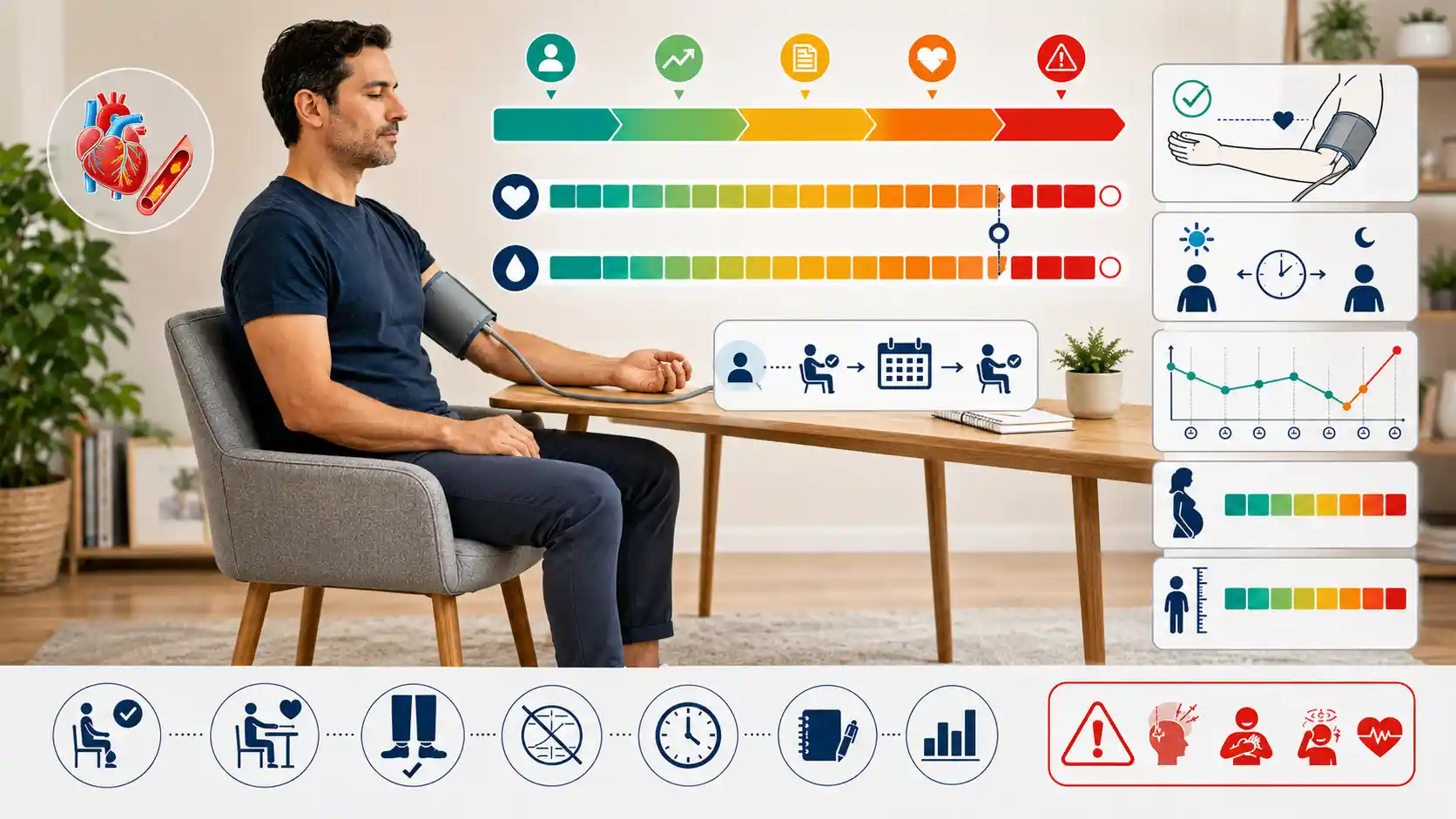
What is a normal blood pressure?
A normal adult blood pressure is below 120 systolic and below 80 diastolic. Stage 1 begins at 130 systolic or 80 diastolic, while stage 2 begins at 140 systolic or 90 diastolic.
The higher category reached by either number controls the result. The American Heart Association adult categories apply to averages from accurate measurements, not to one reading taken during stress, pain, activity, or poor cuff positioning.
- Normal adult range
- <120 and <80
- Stage 1 begins
- 130 or 80
- Stage 2 begins
- 140 or 90
- Severe range
- >180 or >120
Both the systolic and diastolic values must remain below their cutoffs to stay in the normal adult category.
A systolic value of 130–139 or a diastolic value of 80–89 places an adult reading in stage 1.
A systolic value of 140 or higher or a diastolic value of 90 or higher reaches stage 2.
Repeat after one minute. Persistent severe values need immediate professional contact; emergency symptoms require emergency services.
How to read a blood pressure result
- 1. Read both numbers. The top value is systolic pressure; the bottom value is diastolic pressure.
- 2. Use the higher category. A high value in either position determines the adult category.
- 3. Confirm technique. Correct the cuff, posture, rest period, recent activity, and talking before repeating an unexpected value.
- 4. Look at the pattern. Averages from repeated readings guide diagnosis better than one isolated result.
- 5. Add personal context. Pregnancy, childhood, medicines, kidney disease, diabetes, symptoms, and standing-related dizziness change interpretation.
- 6. Act on emergencies. Severe values plus chest, breathing, neurologic, or vision symptoms require immediate help.
Adult blood pressure chart by category
Use the higher category reached by either the systolic or diastolic number. Categories describe repeated, properly measured adult readings rather than one isolated result.
Swipe horizontally inside the table to view every column.
| Category | Systolic pressure | Diastolic pressure | How to interpret the result |
|---|---|---|---|
| Normal — Normal adult category | Less than 120 mm Hg | and less than 80 mm Hg | Both values must remain below the cutoffs. Continue routine screening and heart-healthy habits. |
| Elevated | 120–129 mm Hg | and less than 80 mm Hg | The top number is above normal while the bottom number remains below 80. Confirm the trend over time. |
| Stage 1 hypertension | 130–139 mm Hg | or 80–89 mm Hg | Either number can place a reading in stage 1. Diagnosis depends on an average from repeated measurements and clinical context. |
| Stage 2 hypertension | 140 mm Hg or higher | or 90 mm Hg or higher | Repeated readings need prompt clinical evaluation and a treatment plan. |
| Severe hypertension range | Higher than 180 mm Hg | and/or higher than 120 mm Hg | Wait at least one minute and measure again. If the second reading stays this high without emergency symptoms, contact a healthcare professional immediately. |
| Hypertensive emergency | Higher than 180 mm Hg | and/or higher than 120 mm Hg | When chest pain, shortness of breath, back pain, numbness, weakness, vision change, or difficulty speaking is present, call emergency services now. — Emergency action |
Blood pressure is measured in millimeters of mercury, written as mm Hg.
- • A value such as 118/84 is stage 1 because the diastolic value reaches the 80–89 range.
- • A clinician may confirm hypertension with home monitoring, ambulatory monitoring, repeated office readings, or a combination of methods.
Download or export
Visual adult blood pressure scale
Adult categories use the higher category reached by either number. A reading of 118/84 is stage 1 because the diastolic value is 84, even though the systolic value is below 120.
<120 / <80
Normal
Both systolic and diastolic values must remain below these cutoffs
120–129 / <80
Elevated
Systolic is elevated while diastolic remains below 80 mm Hg
130–139 or 80–89
Stage 1
Either number can place the reading in stage 1 hypertension
≥140 or ≥90
Stage 2
Either number at or above the cutoff qualifies as stage 2
>180 and/or >120
Severe range
Repeat after one minute and act immediately based on symptoms
A normal adult blood pressure is below 120 systolic and below 80 diastolic. High blood pressure begins at an average of 130 systolic or 80 diastolic under current U.S. adult categories.
A reading above 180 and/or 120 with chest pain, shortness of breath, back pain, numbness, weakness, vision change, or difficulty speaking requires emergency services now.
Blood pressure reading checker
Enter a measured systolic and diastolic value to organize it by adult, teen age 13–17, or pregnancy and postpartum guidance. The checker does not diagnose hypertension.
Use a validated upper-arm monitor, correct cuff size, five minutes of quiet rest, and two readings one minute apart. Children younger than 13 need age-, sex-, and height-specific percentiles, so this checker does not classify them.
Normal adult blood pressure range
Below 120 systolic and below 80 diastolic
Both numbers fall in the normal adult category. Continue routine checks because one reading does not describe the long-term pattern.
Calculated pulse pressure: 42 mm Hg. Pulse pressure is the difference between the two numbers, but it should not be used alone to diagnose or treat a condition.
Safety limit: Do not use this tool to start, stop, or change blood pressure medicine. Pregnancy, childhood, kidney disease, diabetes, heart disease, frailty, and orthostatic symptoms can require individualized targets and follow-up.
What systolic and diastolic blood pressure mean
The two numbers describe pressure at different phases of the heartbeat. Both values matter, and the higher category controls the adult classification.
Swipe horizontally inside the table to view every column.
| Term | What it measures | How it appears | Why it matters |
|---|---|---|---|
| Systolic pressure | Arterial pressure when the heart contracts and pumps blood forward | The top or first number in 120/80 | Higher systolic pressure becomes more common with aging and arterial stiffness, but it matters at every adult age. |
| Diastolic pressure | Arterial pressure while the heart relaxes between beats | The bottom or second number in 120/80 | A diastolic value of 80 or higher can classify a reading as hypertension even when systolic pressure is below 130. |
| Pulse pressure | The arithmetic difference between systolic and diastolic pressure | Systolic minus diastolic; 120 − 80 = 40 mm Hg | It can add clinical context but has no single home cutoff that should be used alone for diagnosis or treatment. |
| Reading category | The adult range reached by either number | The higher of the two category levels | A mixed reading uses the more serious category, such as 146/76 being stage 2. |
| Average blood pressure | The mean of repeated readings taken with a consistent method | A calculated trend over several measurements | Diagnosis and treatment decisions rely more on the average pattern than on one unusual result. |
| Blood pressure variability | Normal change across time, posture, activity, stress, sleep, and medicines | Differences between readings | Large or persistent changes may signal technique problems, medication effects, illness, or a need for clinical assessment. |
Example notation: 120/80 mm Hg means 120 systolic and 80 diastolic.
- • Blood pressure and heart rate are different measurements. A person can have a normal pulse with high blood pressure or the reverse.
- • Do not round away repeated borderline values before sharing a log with a clinician.
Download or export
Blood pressure is not blood oxygen or heart rate
Blood pressure measures force against artery walls. Heart rate counts beats per minute, while the blood oxygen level chart explains SpO₂, the percentage of hemoglobin estimated to carry oxygen. One value cannot substitute for another.
How to measure blood pressure correctly at home
Small technique errors can shift the result. Prepare the body, use the right cuff, position the arm correctly, and repeat the reading before interpreting it.
Swipe horizontally inside the table to view every column.
| Step | Correct method | Common error | Why the step matters |
|---|---|---|---|
| Choose the device | Use a validated automatic upper-arm monitor with an appropriate cuff. | Using an unvalidated wrist, finger, or smartwatch estimate as the main clinical reading. | Upper-arm devices generally provide the most reliable home measurements when the cuff fits. |
| Check cuff size | Measure the upper arm and use the manufacturer cuff range that fits. — Cuff fit is essential | A cuff that is too small or too large. | A poor fit can systematically raise or lower the displayed pressure. |
| Prepare for 30 minutes | Avoid smoking, nicotine, caffeine, and exercise before measuring. | Checking immediately after coffee, activity, or tobacco use. | These exposures can temporarily raise heart rate and blood pressure. |
| Empty the bladder | Use the bathroom before sitting down. | Measuring with a full bladder. | Discomfort and sympathetic activation can increase the reading. |
| Rest quietly | Sit for at least five minutes without talking, texting, or working. | Measuring immediately after walking into the room. | Rest helps the circulation reach a stable seated condition. |
| Position the body | Support the back, keep both feet flat, and leave the legs uncrossed. | Sitting on a stool, crossing the legs, or dangling the feet. | Unsupported posture and muscle tension can distort the result. |
| Place the cuff | Wrap the cuff on bare upper-arm skin with the lower edge above the elbow bend. | Putting the cuff over clothing or positioning it loosely. | Clothing and incorrect placement interfere with cuff pressure transmission. |
| Support the arm | Rest the arm on a table so the middle of the cuff is near heart level. | Holding the arm up or letting it hang below the heart. | Arm height changes the hydrostatic pressure measured by the cuff. |
| Stay still and silent | Relax the hand, do not talk, and avoid moving during inflation. | Talking, laughing, watching upsetting content, or tensing the arm. | Movement and conversation can produce a higher or unstable result. |
| Repeat and record | Take at least two readings one minute apart and record both. — Repeat readings | Keeping only the lowest value or repeating rapidly until a preferred number appears. | A short series reveals variability and supports a more representative average. |
Use the same arm and similar time of day unless a healthcare professional directs otherwise.
- • Bring the monitor to a clinical visit periodically so its readings and technique can be checked.
- • Measure both arms during an initial professional assessment when advised; later home logs usually use the arm selected by the care team.
Download or export
Why correct home technique matters
Talking, a full bladder, recent caffeine or exercise, crossed legs, unsupported feet, clothing under the cuff, and an arm below heart level can alter a reading. The American Heart Association home blood pressure log shows the recommended seated position: back supported, feet flat, cuff on bare skin, arm supported near heart height, and no talking.
A home monitor should fit the upper arm. A cuff that is too small can overestimate pressure, while a poor signal or irregular rhythm can create unstable results. Bring the device to a clinical visit when possible so the care team can compare it with office equipment and review technique.
Home blood pressure monitoring schedule and log
A structured log reduces noise from isolated readings. Follow the schedule requested by the treating clinician when it differs from this general example.
Swipe horizontally inside the table to view every column.
| Monitoring element | General approach | What to record | Important qualification |
|---|---|---|---|
| Morning session | Take two readings one minute apart before breakfast and before blood pressure medicine when instructed. | Time, systolic, diastolic, pulse, symptoms, and whether medicine was already taken. | Do not delay prescribed medicine unless the care plan specifically asks for pre-dose measurements. |
| Evening session | Take two readings one minute apart at a consistent evening time. | The same fields used in the morning plus unusual activity, alcohol, pain, or stress. | Use a time that can be repeated; avoid measuring immediately after exercise or a large meal. |
| Length of a pre-visit log | A minimum of three days and often seven days provides a more useful pattern. | All readings, not only selected values. | The clinician may request a longer period for medicine changes, pregnancy, kidney disease, or variable readings. |
| Calculate the average | Average the readings according to the care plan or let a validated monitor or clinician calculate it. | Daily and overall averages when available. | Some protocols exclude the first day, but do not discard data unless instructed. |
| Measure at the same times | Keep timing, posture, arm, cuff, and environment as consistent as practical. | Any deviation from the normal routine. | Consistency makes changes in the trend easier to interpret. |
| Add symptom notes | Record dizziness, faintness, headache, chest symptoms, shortness of breath, weakness, or vision change. | What happened, when it started, and the reading at that time. | Emergency symptoms require action and should not wait for the log period to finish. |
| Share the complete log | Bring or transmit the readings, device, medicine list, and questions. | Missed doses, over-the-counter products, supplements, and recent illness. | A complete record helps distinguish persistent hypertension, white-coat effect, masked hypertension, and technique problems. |
Record systolic/diastolic in mm Hg and pulse in beats per minute when the device displays it.
- • Do not measure obsessively throughout the day unless the healthcare team requests frequent checks.
- • Home monitoring complements professional care; it does not replace laboratory tests, examination, or medication review.
Download or export
The average matters more than the best or worst number
Do not keep only the lowest reading or repeat measurements until a preferred value appears. Record the full series with time, symptoms, medicine timing, pain, illness, exercise, caffeine, nicotine, and alcohol context. The BAC chart explains alcohol concentration and impairment, while this page focuses on pressure within the circulation.
Factors that can change a blood pressure reading
A reading can rise or fall because of true physiology or measurement error. Correct reversible factors before deciding that the blood pressure pattern has changed.
Swipe horizontally inside the table to view every column.
| Factor | Likely effect | How to reduce the effect | When it needs clinical attention |
|---|---|---|---|
| Cuff too small | Often reads falsely high. | Use a cuff matched to measured upper-arm circumference. | Repeated high readings continue with a correct cuff. |
| Cuff too large | Can read falsely low in some situations. | Use the device-specific size range rather than choosing by appearance. | Symptoms conflict with unexpectedly low values. |
| Arm below heart level | Can raise the reading. | Support the cuffed arm at heart level. | The difference persists after correcting position. |
| Arm above heart level | Can lower the reading. | Lower and support the arm at heart level. | The value remains unexpectedly low with symptoms. |
| Talking or active listening | Can raise or destabilize the reading. | Stay silent and avoid conversation during rest and measurement. | High readings persist in a quiet setting. |
| Crossed legs or unsupported feet | Can raise the reading through muscle tension and posture. | Keep feet flat, legs uncrossed, and back supported. | The trend remains high with correct posture. |
| Recent caffeine, nicotine, or exercise | Can temporarily raise blood pressure. | Wait at least 30 minutes before measuring. | Pressure remains high well after the temporary trigger. |
| Pain, anxiety, cold, or acute illness | Can raise pressure through stress responses. | Document the circumstance and repeat when stable if safe. | Severe symptoms, very high pressure, or ongoing illness requires assessment. |
| Dehydration, bleeding, infection, or medicine effects | Can lower pressure, sometimes dangerously. | Do not self-treat unexplained low readings; review fluid loss and medicines with a clinician. | Fainting, confusion, cold clammy skin, severe weakness, chest symptoms, or shortness of breath. |
| Irregular heart rhythm | Some automatic monitors may produce variable or less reliable readings. | Repeat calmly and ask whether manual or clinical confirmation is needed. | New palpitations, fainting, chest pain, or persistent device errors. |
The direction and size of error vary by person, device, and circumstance.
- • A sudden change can be real even when technique is imperfect; symptoms and severe values require appropriate action.
- • Never take an extra dose of blood pressure medicine solely to correct one home reading unless a written plan directs it.
Download or export
When a high blood pressure reading is an emergency
A reading above 180 systolic and/or above 120 diastolic is in the severe range. Wait at least one minute and repeat it. If severe pressure occurs with chest pain, shortness of breath, back pain, numbness, weakness, vision change, difficulty speaking, collapse, or another severe new symptom, call local emergency services immediately.
Do not drive yourself, do not wait for the pressure to fall, and do not take an extra medicine dose unless an emergency plan specifically directs it. A normal reading also does not rule out an emergency when severe symptoms are present.
Blood pressure chart during pregnancy and postpartum
Pregnancy uses obstetric definitions and urgent thresholds. A normal adult category does not replace prenatal assessment, and preeclampsia can occur after delivery.
Swipe horizontally inside the table to view every column.
| Situation | Blood pressure definition | Other context | Recommended response |
|---|---|---|---|
| Chronic hypertension | High blood pressure present before pregnancy or identified before 20 weeks | May continue through pregnancy and after birth. | Follow the obstetric treatment and monitoring plan; some medicines require pregnancy-specific changes. |
| Gestational hypertension | 140 systolic or higher and/or 90 diastolic or higher after 20 weeks | Occurs without the full findings required for preeclampsia at that time. | Prompt obstetric evaluation and follow-up are required. |
| Preeclampsia | New hypertension after 20 weeks plus proteinuria or other organ-related findings | Can involve headache, vision change, upper abdominal pain, swelling, breathing symptoms, liver, kidney, blood, or neurologic abnormalities. | Seek urgent maternity assessment for warning symptoms or an elevated reading. |
| Severe hypertension | 160 systolic or higher and/or 110 diastolic or higher — Severe pregnancy threshold | A severe reading can threaten the pregnant or postpartum patient and fetus. | Obtain urgent obstetric or emergency care. Do not wait for a routine appointment. |
| Postpartum preeclampsia | High blood pressure and preeclampsia findings after birth | Can begin after delivery even when pregnancy readings were normal. | Urgent assessment is needed for severe headache, vision changes, shortness of breath, upper abdominal pain, seizures, or severe blood pressure. — Urgent postpartum action |
| Meaningful rise with symptoms | May be below 140/90 yet clearly above the personal baseline | Symptoms and rapid change can matter before a fixed threshold is reached. | Contact the maternity team for individualized advice. |
Pregnancy blood pressure is recorded in mm Hg; obstetric thresholds use either systolic or diastolic criteria.
- • Never start, stop, or substitute a blood pressure medicine during pregnancy without obstetric guidance.
- • Severe headache, vision change, chest pain, shortness of breath, seizure, weakness, or feeling that something is seriously wrong requires immediate care.
Download or export
Pregnancy and postpartum readings need obstetric context
The NHLBI pregnancy guidance defines gestational hypertension at 140/90 mm Hg or higher after 20 weeks and describes 160/110 mm Hg or higher as a severe spike. Preeclampsia can involve organ-related findings and can begin after delivery.
Severe headache, vision change, upper abdominal pain, shortness of breath, seizure, marked swelling, or a strong sense that something is wrong needs urgent maternity assessment even when a home monitor gives an uncertain result.
Blood pressure categories for children and teenagers
Children younger than 13 require age-, sex-, and height-specific percentiles. Adolescents age 13 and older use fixed numeric categories aligned with adult thresholds.
Swipe horizontally inside the table to view every column.
| Age group and category | Systolic or diastolic definition | How clinicians interpret it | Important limitation |
|---|---|---|---|
| Younger than 13: normal | Below the 90th percentile | Both systolic and diastolic values are compared with the correct age, sex, and height table. | A generic adult chart cannot classify this age group. |
| Younger than 13: elevated | 90th to below 95th percentile, or 120/80 to below the 95th percentile, whichever threshold is lower | Repeated accurate measurements and the correct pediatric percentile table are required. | One automated reading may need confirmation by auscultation. |
| Younger than 13: stage 1 | 95th percentile to below the 95th percentile plus 12 mm Hg, or 130/80 to 139/89, whichever threshold is lower | The lower applicable threshold controls the category. | Evaluation considers obesity, kidney disease, sleep apnea, medicines, and other causes. |
| Younger than 13: stage 2 | 95th percentile plus 12 mm Hg or higher, or 140/90 or higher, whichever threshold is lower | This category needs timely pediatric evaluation. | Symptoms or very high readings can require urgent care. |
| Age 13–17: normal | Below 120 systolic and below 80 diastolic | Fixed adolescent categories are used. | Correct cuff size remains essential because arm size changes rapidly during growth. |
| Age 13–17: elevated | 120–129 systolic and below 80 diastolic | The systolic value is elevated while diastolic remains below 80. | Repeated measurements and lifestyle context matter. |
| Age 13–17: stage 1 | 130–139 systolic or 80–89 diastolic | Either number can place the teen in stage 1. | Diagnosis is not made from one reading. |
| Age 13–17: stage 2 | 140 systolic or higher, or 90 diastolic or higher | Either number can place the teen in stage 2. | Prompt pediatric assessment is appropriate. |
Pediatric values are recorded in mm Hg; percentile interpretation applies to children younger than 13.
- • Infants and young children may need specialized technique, equipment, and reference tables.
- • Use the baby growth percentile chart for weight, length, and head circumference; growth percentiles are not blood pressure percentiles.
Download or export
Why younger children need percentile tables
The American Academy of Pediatrics guideline classifies children younger than 13 with age-, sex-, and height-specific blood pressure percentiles. Adolescents age 13 and older use fixed thresholds aligned with adult categories.
Growth and blood pressure use different reference systems. The baby growth percentile chart covers weight, recumbent length, and head circumference; it cannot classify a child blood pressure reading.
Blood pressure treatment and follow-up context
Blood pressure category is only one part of treatment planning. Current adult guidance also considers cardiovascular disease, stroke, diabetes, kidney disease, predicted risk, pregnancy, age, frailty, symptoms, and treatment tolerance.
Swipe horizontally inside the table to view every column.
| Clinical situation | General guideline direction | Attributes that change the plan | What the reader should do |
|---|---|---|---|
| Elevated blood pressure | Use heart-healthy lifestyle measures and monitor the trend. | Overall cardiovascular risk, weight, sodium intake, activity, sleep, alcohol, and family history. | Discuss prevention and an appropriate recheck interval during routine care. |
| Stage 1 with lower predicted risk | Lifestyle treatment is generally started; medicine may be added if pressure remains above target after a monitored trial. | Predicted cardiovascular risk, age, preferences, and response over roughly three to six months. | Follow a clinician-defined plan rather than treating one home value. |
| Stage 1 with cardiovascular disease or higher-risk conditions | Lifestyle changes plus blood pressure medicine may be recommended. | Prior cardiovascular disease or stroke, diabetes, chronic kidney disease, and predicted 10-year risk. | Review the complete risk profile and medicine options with a clinician. |
| Stage 2 hypertension | Lifestyle treatment and medication are generally recommended; some adults begin two complementary medicines. | How far pressure is above target, other conditions, side effects, pregnancy potential, and kidney function. | Arrange prompt clinical evaluation and follow-up. |
| General treatment goal for many adults | A goal below 130/80 mm Hg is recommended for most adults receiving treatment. — General adult treatment goal | Frailty, orthostatic symptoms, limited life expectancy, pregnancy, and treatment tolerance can require individualization. | Use the personal target documented by the treating professional. |
| Possible white-coat or masked hypertension | Confirm pressure outside the clinic with validated home or ambulatory monitoring. | Difference between office and out-of-office averages, technique, work stress, sleep, and medicines. | Share a complete log; do not assume office or home readings are automatically more accurate. |
| Dizziness or pressure drop on standing | Assess for orthostatic hypotension and medication or volume-related causes. | Age, dehydration, bleeding, autonomic disease, illness, and medicine timing. | Rise slowly and seek medical advice; fainting, injury, chest symptoms, or severe weakness needs urgent assessment. |
Treatment thresholds and goals apply to average blood pressure and are individualized in clinical care.
- • Lifestyle measures include a heart-healthy eating pattern, reduced excess sodium, physical activity, healthy weight, adequate sleep, tobacco avoidance, and limiting excess alcohol.
- • Never stop prescribed medicine because one reading is normal; control may reflect that the treatment is working.
Download or export
Category does not equal a complete treatment plan
The 2025 ACC/AHA high blood pressure guidance combines average pressure with cardiovascular disease, prior stroke, diabetes, chronic kidney disease, predicted risk, pregnancy, age, frailty, symptoms, and treatment tolerance. A goal below 130/80 mm Hg applies to most treated adults, but personal targets can differ.
Blood pressure and glucose risk often overlap. Use the A1C chart to understand long-term glucose categories, but let a clinician integrate both measurements with kidney function, cholesterol, medicines, and overall cardiovascular risk.
Frequently asked questions
What is a normal blood pressure for adults?
A normal adult blood pressure is below 120 systolic and below 80 diastolic. Both numbers must meet the normal cutoff. The category describes repeated, correctly measured readings rather than one isolated result.
Is 130 over 80 considered high blood pressure?
Yes. Under current U.S. adult categories, 130 systolic or 80 diastolic enters stage 1 hypertension. A diagnosis still requires an average from repeated measurements and clinical confirmation.
Which blood pressure number is more important?
Both numbers matter. Systolic pressure measures pressure during heart contraction, while diastolic pressure measures pressure between beats. The higher category reached by either number controls the adult classification.
What should I do if my blood pressure is over 180 over 120?
Wait at least one minute and measure again. If the second reading remains above 180 systolic and/or above 120 diastolic, contact a healthcare professional immediately. Call emergency services now when chest pain, shortness of breath, back pain, numbness, weakness, vision change, difficulty speaking, or another severe symptom is present.
Can one high reading diagnose hypertension?
No. A single high reading can reflect stress, pain, recent activity, caffeine, nicotine, a full bladder, an incorrect cuff, or true hypertension. Clinicians usually confirm the pattern with repeated office, home, or ambulatory measurements.
How many blood pressure readings should I take at home?
A common method uses two readings one minute apart in the morning and two in the evening. A pre-visit log often covers at least three days and preferably seven, but the treating clinician may request a different schedule.
Why is my blood pressure different at home and at the clinic?
Stress can raise office readings, producing a white-coat pattern. Some people show the opposite pattern, called masked hypertension. Technique, cuff fit, time of day, medicines, sleep, pain, and activity also create differences.
Can a cuff that is too small raise blood pressure?
Yes. A cuff that is too small can produce a falsely high reading. Measure upper-arm circumference and use the cuff range specified by the monitor manufacturer.
What blood pressure is high during pregnancy?
During pregnancy, 140 systolic or higher and/or 90 diastolic or higher is hypertension. A reading of 160 systolic or higher and/or 110 diastolic or higher is severe and requires urgent obstetric assessment.
Do children use the same blood pressure chart as adults?
Not before age 13. Children younger than 13 use percentiles based on age, sex, and height. Adolescents age 13 and older use fixed categories that align with adult numeric thresholds.
What is pulse pressure?
Pulse pressure is systolic pressure minus diastolic pressure. For example, 120/80 has a pulse pressure of 40 mm Hg. It can provide clinical context but should not be used alone to diagnose or treat a condition.
Should I stop medicine when my blood pressure becomes normal?
No. A normal reading may show that the medicine is working. Stopping suddenly can allow pressure to rise and can be dangerous with some medicines. Change treatment only with the prescribing professional.
Can dehydration lower blood pressure?
Yes. Fluid loss can reduce circulating volume and lower pressure. Dizziness, fainting, confusion, cold clammy skin, severe weakness, bleeding, persistent vomiting, or severe illness requires prompt medical assessment.
What is the usual blood pressure treatment goal?
Current U.S. guidance recommends a goal below 130/80 mm Hg for most adults receiving treatment. The appropriate target can differ with pregnancy, frailty, standing-related symptoms, treatment tolerance, and other health conditions.
Sources
The tables and explanations use current adult cardiovascular guidance, home measurement instructions, obstetric thresholds, and pediatric blood pressure definitions.
American Heart Association
Understanding Blood Pressure Readings
https://www.heart.org/en/health-topics/high-blood-pressure/understanding-blood-pressure-readings
Adult blood pressure categories, severe hypertension thresholds, and symptom-based emergency actions.
American College of Cardiology
2025 High Blood Pressure Guidelines Resources
https://www.acc.org/Guidelines/Hubs/High-Blood-Pressure
Current U.S. adult prevention, risk assessment, treatment initiation, and blood pressure goal guidance.
American Heart Association
My Blood Pressure Log and Home Measurement Instructions
https://www.heart.org/-/media/files/health-topics/high-blood-pressure/my-blood-pressure-log.pdf
Validated-device guidance, cuff positioning, preparation, two readings one minute apart, and a three- to seven-day pre-visit log.
National Heart, Lung, and Blood Institute
Pregnancy and High Blood Pressure
https://www.nhlbi.nih.gov/health/high-blood-pressure/pregnancy
Pregnancy-related hypertension definitions, severe thresholds, preeclampsia context, and postpartum risk.
American Academy of Pediatrics
Clinical Practice Guideline for Screening and Management of High Blood Pressure in Children and Adolescents
https://publications.aap.org/pediatrics/article/140/3/e20171904/38358/Clinical-Practice-Guideline-for-Screening-and
Age-, sex-, and height-based pediatric categories and fixed thresholds for adolescents age 13 and older.
Use a repeatable method and respond to the whole clinical picture
A blood pressure chart organizes numbers, but the most useful information comes from correct cuff fit, quiet rest, repeated measurements, a complete log, symptoms, and personal medical context. Share the pattern with a healthcare professional and act immediately when severe symptoms occur.