Health & Medical · Clinical body-size reference
Body Surface Area Chart, BSA Calculator, and Formula Guide
Calculate body surface area from height and weight, compare common BSA equations, review square-metre dosing arithmetic, understand indexed clinical values, and separate BSA from burn total body surface area.
This page cannot authorize a medicine dose or burn treatment. Clinical protocols can specify a formula, rounding rule, dose cap, organ-function adjustment, or emergency response. Read the ChartsLoom Disclaimer.
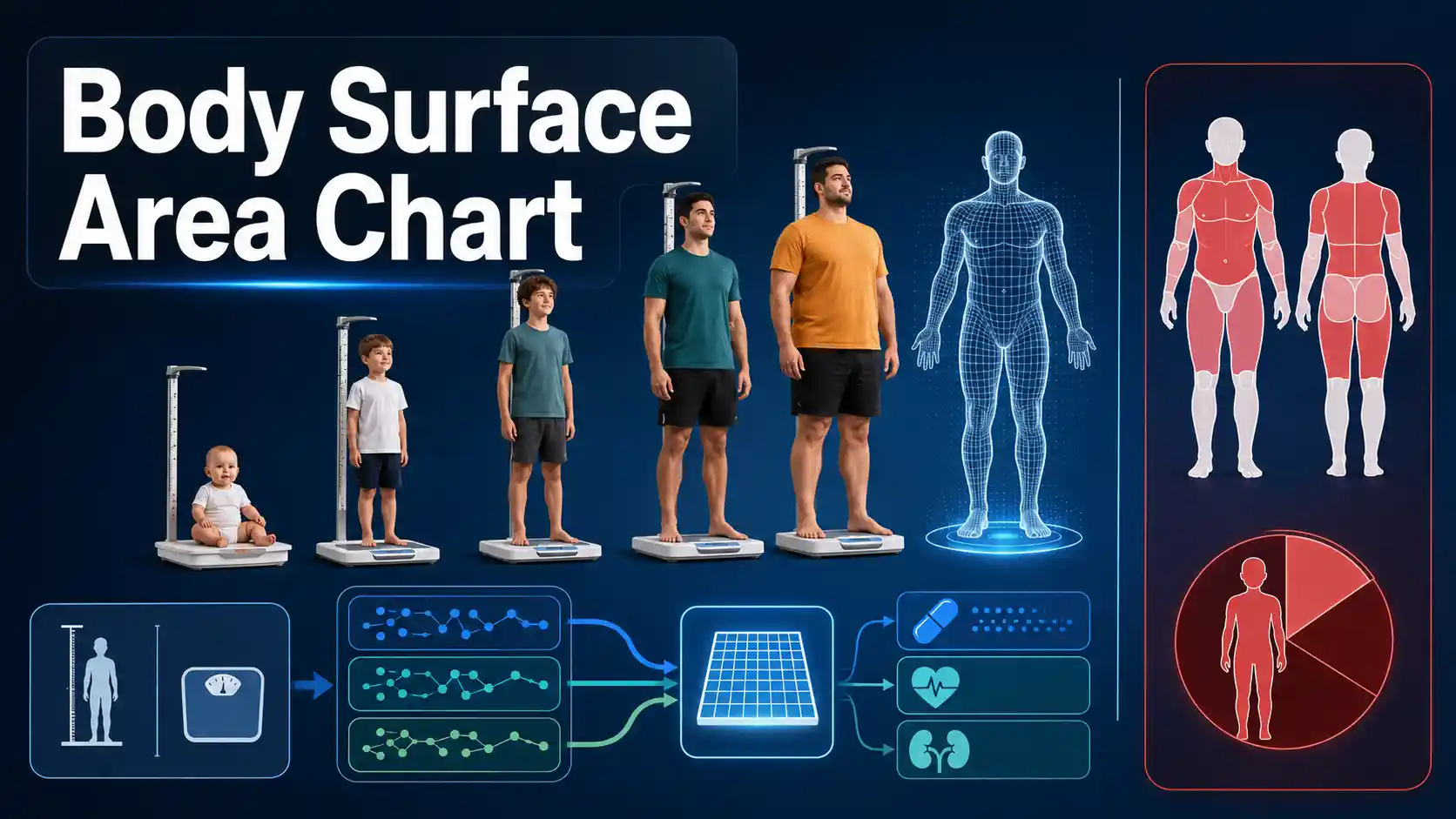
What is body surface area?
Body surface area is an estimated measurement of the body’s complete external surface, expressed in square metres. Most clinical formulas calculate BSA from current height and weight.
The eviQ clinical BSA calculator presents the Mosteller and Du Bois methods used in oncology settings. The original Mosteller publication describes the simplified square-root equation. A calculated result remains an estimate and must be used with the formula and safeguards required by the relevant protocol.
- What BSA measures
- Whole-body surface in m²
- Common formula
- Mosteller
- Clinical uses
- Dosing and indexed values
- Critical distinction
- BSA is not burn TBSA
BSA estimates the external area of the entire body from height and weight.
The square root of height × weight ÷ 3600 is widely used because it is simple to verify.
Selected medicines, cardiac measures, kidney reports, and research variables may use BSA.
Square metres estimate total body area; a burn percentage maps injured skin regions.
The fastest answer: use the formula required by the clinical protocol
Mosteller is common, but it is not automatically correct for every medicine, child, research system, or hospital workflow. The NCBI clinical review of BSA describes multiple validated formulas and explains why consistent formula selection matters.
Body surface area chart by height and weight
Approximate BSA values in square metres calculated with the Mosteller formula. Find the height row and weight column that most closely match the person being assessed.
Swipe horizontally inside the table to view every column.
| Height | 40 kg | 50 kg | 60 kg | 70 kg | 80 kg | 90 kg | 100 kg | 120 kg |
|---|---|---|---|---|---|---|---|---|
| 140 cm | 1.25 m² | 1.39 m² | 1.53 m² | 1.65 m² | 1.76 m² | 1.87 m² | 1.97 m² | 2.16 m² |
| 150 cm | 1.29 m² | 1.44 m² | 1.58 m² | 1.71 m² | 1.83 m² | 1.94 m² | 2.04 m² | 2.24 m² |
| 160 cm | 1.33 m² | 1.49 m² | 1.63 m² | 1.76 m² | 1.89 m² | 2.00 m² | 2.11 m² | 2.31 m² |
| 170 cm | 1.37 m² | 1.54 m² | 1.68 m² | 1.82 m² — Example adult BSA near 1.82 square metres | 1.94 m² | 2.06 m² | 2.17 m² | 2.38 m² |
| 180 cm | 1.41 m² | 1.58 m² | 1.73 m² | 1.87 m² | 2.00 m² — Example adult BSA of 2.00 square metres | 2.12 m² | 2.24 m² | 2.45 m² |
| 190 cm | 1.45 m² | 1.62 m² | 1.78 m² | 1.92 m² | 2.05 m² | 2.18 m² | 2.30 m² | 2.52 m² |
| 200 cm | 1.49 m² | 1.67 m² | 1.83 m² | 1.97 m² | 2.11 m² | 2.24 m² | 2.36 m² | 2.58 m² |
Height is in centimetres, weight is in kilograms, and BSA is in square metres (m²).
- • Use the calculator for an exact height and weight rather than interpolating when BSA affects treatment or clinical decisions.
- • The table estimates total external body surface area. It does not show the percentage of skin affected by a burn.
Download or export
How body surface area changes with body size
BSA rises as height and weight increase, but it does not rise in a simple one-to-one relationship with weight. These Mosteller examples are size illustrations, not age norms.
Small infant size
65 cm · 7 kg
0.36 m²
Toddler size
90 cm · 14 kg
0.59 m²
School-age size
130 cm · 30 kg
1.04 m²
Average adult size
175 cm · 75 kg
1.91 m²
Larger adult size
185 cm · 100 kg
2.27 m²
BSA uses measured size
Age, sex, and diagnosis do not calculate BSA by themselves. The equation requires current height and weight, converted to the units expected by the selected formula.
Similar answers do not make formulas interchangeable
Mosteller, Du Bois, Haycock, and Gehan often agree closely at ordinary sizes. A clinical protocol can still require one exact equation and a specific rounding method.
Body surface area formulas compared
Common BSA equations use height and weight but were developed from different populations and mathematical approaches.
Swipe horizontally inside the table to view every column.
| Formula | Equation using cm and kg | Common context | Important limitation |
|---|---|---|---|
| Mosteller — Common simple BSA formula | √[(height × weight) ÷ 3600] | Simple bedside and oncology calculation; widely used because it is easy to verify | Still an estimate and may differ from protocol-required formulas |
| Du Bois and Du Bois | 0.007184 × height^0.725 × weight^0.425 | Historic reference equation used in research and clinical systems | Derived from a very small original sample |
| Haycock | 0.024265 × height^0.3964 × weight^0.5378 | Often considered when infants and children are included — Pediatric formula context | Formula choice must match the clinical protocol or reference standard |
| Gehan and George | 0.0235 × height^0.42246 × weight^0.51456 | Alternative equation derived from a larger size range than Du Bois | Differences become more relevant at extreme body sizes |
Each equation returns BSA in square metres when height is entered in centimetres and weight in kilograms.
- • Do not switch formulas during a treatment course unless the responsible protocol or clinician specifically directs the change.
- • Round only at the stage and precision specified by the clinical protocol, pharmacy system, or prescribing information.
Download or export
Body surface area calculator
Enter measured height and weight, then compare four common BSA formulas. The optional dose field only multiplies an amount already prescribed per square metre.
Calculated BSA
1.818 m²
Mosteller formula using 170.0 cm and 70.00 kg.
Optional arithmetic preview
Enter an amount already prescribed in mg/m² to preview the multiplication. Do not enter a guessed or self-selected dose.
Formula comparison for the same measurements
Mosteller
1.818 m²
Du Bois and Du Bois
1.810 m²
Haycock
1.826 m²
Gehan and George
1.831 m²
Do not use this calculator to self-dose medicine. A valid prescription or protocol must specify the formula, dose intensity, rounding, maximum dose, organ-function adjustments, and verification process.
BSA examples across body sizes
Representative height and weight pairs show how common formulas compare. These are size examples, not normal values for a particular age.
Swipe horizontally inside the table to view every column.
| Representative size | Height and weight | Mosteller | Du Bois | Haycock | Gehan and George |
|---|---|---|---|---|---|
| Newborn-size example | 50 cm and 3.5 kg | 0.220 m² — Small-body formula differences | 0.209 m² | 0.224 m² | 0.234 m² |
| Small infant example | 65 cm and 7 kg | 0.356 m² | 0.339 m² | 0.362 m² | 0.373 m² |
| Older infant example | 75 cm and 10 kg | 0.456 m² | 0.437 m² | 0.464 m² | 0.476 m² |
| Toddler-size example | 90 cm and 14 kg | 0.592 m² | 0.576 m² | 0.597 m² | 0.612 m² |
| Young-child example | 110 cm and 20 kg | 0.782 m² | 0.775 m² | 0.783 m² | 0.800 m² |
| School-age example | 130 cm and 30 kg | 1.041 m² | 1.039 m² | 1.041 m² | 1.057 m² |
| Adolescent-size example | 150 cm and 45 kg | 1.369 m² | 1.370 m² | 1.370 m² | 1.384 m² |
| Smaller-adult example | 165 cm and 60 kg | 1.658 m² | 1.659 m² | 1.661 m² | 1.670 m² |
| Average-adult example | 175 cm and 75 kg | 1.909 m² — Representative adult BSA | 1.903 m² | 1.917 m² | 1.921 m² |
| Larger-adult example | 185 cm and 100 kg | 2.267 m² | 2.239 m² | 2.287 m² | 2.280 m² |
BSA values are square metres. Values are rounded to three decimal places for comparison.
- • Age cannot determine BSA by itself. Current measured height and weight are required.
- • Small formula differences may matter when a narrow therapeutic protocol uses BSA-based dosing.
Download or export
BSA-based dosing requires more than multiplication
A medicine label or treatment protocol can require dose caps, dose banding, kidney or liver adjustments, toxicity reductions, cycle-specific rules, and independent verification. The FDA prescribing-information resources explain how official labeling governs dosing instructions. Never derive a personal dose from a general chart.
BSA-based dose calculation examples
These neutral arithmetic examples show how a prescribed dose intensity in mg/m² converts to a total amount. They are not medicine recommendations.
Swipe horizontally inside the table to view every column.
| BSA | Prescribed intensity | Arithmetic | Unrounded total | Clinical safeguard |
|---|---|---|---|---|
| 0.35 m² | 50 mg/m² | 0.35 × 50 | 17.5 mg | Use the exact protocol for rounding, formulation, and maximum dose — Clinical verification required |
| 0.60 m² | 75 mg/m² | 0.60 × 75 | 45 mg | Verify current height, weight, formula, and treatment day |
| 0.90 m² | 100 mg/m² | 0.90 × 100 | 90 mg | Confirm whether dose capping or dose banding applies |
| 1.25 m² | 40 mg/m² | 1.25 × 40 | 50 mg | Check organ function, laboratory values, and protocol adjustments |
| 1.60 m² | 125 mg/m² | 1.60 × 125 | 200 mg | Independent verification may be required for high-risk medicines |
| 1.85 m² | 60 mg/m² | 1.85 × 60 | 111 mg | Do not round before the protocol-specified step |
| 2.10 m² | 30 mg/m² | 2.10 × 30 | 63 mg | A protocol may cap the BSA or final total |
| 2.40 m² | 80 mg/m² | 2.40 × 80 | 192 mg | Do not infer a dose from this educational chart — Educational example only |
Total amount = prescribed amount per square metre × BSA. Units must match.
- • Only calculate from an actual prescription, approved protocol, or medicine label. BSA alone never determines whether a medicine is appropriate.
- • Chemotherapy and other high-risk doses require protocol-specific verification, organ-function review, and professional oversight.
Download or export
Clinical values that may be indexed to body surface area
BSA can normalize selected physiological or imaging measurements for body size. Each metric uses its own units and interpretation rules.
Swipe horizontally inside the table to view every column.
| Clinical value | Typical relationship to BSA | Common unit | Important distinction |
|---|---|---|---|
| Cardiac index | Cardiac output ÷ BSA | L/min/m² | It is not the same as cardiac output in L/min |
| Stroke volume index | Stroke volume ÷ BSA | mL/beat/m² | Heart rate and clinical state still affect interpretation |
| Left ventricular mass index | LV mass ÷ BSA | g/m² | Some settings use height-based indexing instead |
| Valve area index | Measured valve area ÷ BSA | cm²/m² | Thresholds depend on the valve and guideline |
| Indexed eGFR | Kidney filtration normalized to 1.73 m² | mL/min/1.73 m² — Indexed kidney-function unit | Absolute drug-dosing decisions may require de-indexing in selected cases |
| Absolute GFR estimate | Indexed eGFR × BSA ÷ 1.73 — De-indexing equation | mL/min | Use only when the clinical method or medicine guidance calls for it |
| Medicine dose intensity | Amount specified per square metre | mg/m² or units/m² | The total dose still needs protocol-specific limits and adjustments |
| Creatinine clearance | Usually estimated directly rather than reported per m² | mL/min | Do not assume it equals indexed eGFR |
The conventional reference BSA of 1.73 m² is used for many indexed kidney-function reports.
- • Indexing improves comparability but can hide clinically meaningful absolute values at very small or large body sizes.
- • Never convert an indexed value unless the relevant guideline, protocol, or specialist requires the conversion.
Download or export
Indexed and absolute clinical values answer different questions
Dividing a value by BSA helps compare people of different sizes. Multiplying an indexed value back to an absolute value may be useful in selected settings, but it can be inappropriate when a guideline is built around the indexed unit. Always preserve the original unit and interpretation rule.
BSA versus total body surface area burned
BSA in m² and burn TBSA in percent sound similar but answer different clinical questions and must not be substituted for one another.
Swipe horizontally inside the table to view every column.
| Attribute | Body surface area (BSA) | Burn total body surface area (TBSA) | Why the distinction matters |
|---|---|---|---|
| What it estimates | Approximate external surface area of the entire body | Percentage of the body affected by partial- or full-thickness burns | One is an area estimate; the other is an injury percentage |
| Main units | Square metres (m²) | Percent of total body surface (%) | A value of 1.8 m² is not an 18% burn — Units are not interchangeable |
| Primary inputs | Height and weight | Body-region map and burn depth | Height and weight cannot map burn location |
| Common methods | Mosteller, Du Bois, Haycock, Gehan and George | Rule of nines, Lund-Browder chart, hand method | The calculation systems are unrelated |
| Clinical uses | Selected medicine doses, indexed cardiac or renal values, research normalization | Burn severity, transfer decisions, fluid planning, wound documentation | Each use has separate protocols |
| Children | Use current height and weight; formula choice may matter at small size | Use an age-adjusted Lund-Browder chart because body proportions differ | Adult rule-of-nines estimates can misclassify children |
| Emergency meaning | A high or low BSA is not itself an emergency | A larger deep-burn percentage can indicate critical injury — Burn emergency context | Burn symptoms and location can be urgent even with a small percentage |
BSA is expressed in m²; burn TBSA is expressed as a percentage.
- • Superficial redness alone is generally excluded from formal burn-resuscitation TBSA calculations.
- • Burns of the face, airway, hands, feet, genital area, major joints, or from chemicals or electricity can be serious regardless of percentage.
Download or export
Do not delay emergency burn care to calculate TBSA
The Merck Manual burn guidance distinguishes adult rule-of-nines estimates from age-adjusted Lund-Browder assessment in children. Major, deep, electrical, chemical, inhalation, facial, hand, foot, genital, or circumferential burns require professional evaluation regardless of a home estimate.
Adult rule of nines burn chart
The adult rule of nines divides the body into regions that approximate 9% or multiples of 9% of total body surface area.
Swipe horizontally inside the table to view every column.
| Adult body region | Approximate TBSA | Front and back detail | Use note |
|---|---|---|---|
| Head and neck | 9% | About 4.5% front and 4.5% back | Adult proportion only; children have a larger head proportion |
| One arm | 9% | About 4.5% front and 4.5% back | Each arm is counted separately |
| Anterior trunk | 18% | Chest and abdomen on the front | Do not include an unburned region |
| Posterior trunk | 18% | Upper and lower back and buttocks | Assess the visible partial- and full-thickness area |
| One leg | 18% | About 9% front and 9% back | Each leg is counted separately |
| Perineum | 1% — Small area with high clinical importance | Genital and perineal region | Location can require specialist care even when area is small |
| Entire adult body | 100% — Total body surface | All regions combined | The chart estimates distribution, not burn depth |
TBSA means total body surface area affected by the burn, expressed as a percentage.
- • Use a Lund-Browder chart for children because head and leg proportions change with age.
- • Small scattered burns can be estimated with the patient’s entire hand, including fingers, as roughly 1% of TBSA; professional assessment is more reliable.
Download or export
Burn surface area estimation methods
Clinicians choose a burn-size method according to age, burn pattern, available detail, and care setting.
Swipe horizontally inside the table to view every column.
| Method | Best suited for | How it works | Main limitation |
|---|---|---|---|
| Adult rule of nines | Rapid initial estimate in adults | Assigns 9% or multiples of 9% to major body regions | Less accurate in children and unusual body proportions |
| Lund-Browder chart | Children and detailed adult assessment — Preferred pediatric mapping method | Adjusts head and leg percentages by age and maps smaller regions | Requires a chart and careful documentation |
| Patient hand method | Small, scattered, or irregular burns | The patient’s whole hand including fingers approximates about 1% TBSA | Hand size and technique introduce error |
| Palmar surface method | Very small burns when a local protocol defines the reference area | Uses a defined part of the patient’s hand as a small-area reference | Different sources define palm-only versus whole-hand methods differently — Definition varies by source |
| Digital burn mapping | Specialist documentation and serial review | Maps affected regions electronically and totals the estimate | Accuracy still depends on correct depth and boundary assessment |
| Clinical reassessment | Evolving burns after initial care | Repeats depth and area assessment as tissue changes become clearer | The first estimate may change over time |
Only partial-thickness and full-thickness injury is generally counted for formal burn-resuscitation TBSA.
- • Call emergency services for major burns, breathing difficulty, altered consciousness, electrical or chemical injury, or burns involving critical areas.
- • Do not delay cooling with cool running water and appropriate emergency care to calculate a percentage.
Download or export
When body surface area needs extra caution
Formula estimates can be less reliable or less clinically useful when body size, fluid status, anatomy, or treatment protocols fall outside ordinary assumptions.
Swipe horizontally inside the table to view every column.
| Situation | Why BSA may mislead | What should be checked | Safer approach |
|---|---|---|---|
| Very small infant or premature newborn | Small absolute differences between formulas can become proportionally important | Current measured length, weight, gestational context, and protocol formula | Use the pediatric or neonatal protocol exactly |
| Very high body weight | BSA rises with weight, but drug exposure may not scale proportionally | Dose caps, adjusted dosing rules, organ function, and pharmacokinetics | Follow medicine- and disease-specific guidance — Protocol-specific dosing required |
| Very short or very tall stature | The person may fall outside the population used to develop an equation | Formula agreement and protocol requirements | Avoid substituting an unapproved formula |
| Edema, ascites, or rapid fluid change | Measured weight includes excess fluid that may not represent metabolic size | Dry-weight estimate, clinical fluid assessment, and treatment goal | Use specialist direction rather than automatic recalculation |
| Amputation or major limb difference | Standard equations assume ordinary body proportions | Adjusted weight, anatomy, and validated local method | Use an adapted clinical calculation |
| Pregnancy | Weight and physiology change through pregnancy | Medicine-specific pregnancy data, gestational age, and maternal-fetal considerations | Do not assume ordinary BSA dosing is appropriate |
| Changing weight during treatment | The calculated BSA can change, but protocols differ on when to recalculate | Protocol timing, treatment cycle, toxicity, and dose modifications | Recalculate only as directed |
| Home self-calculation | A correct arithmetic result can still lead to an unsafe clinical conclusion | Prescription, diagnosis, laboratory data, and professional verification | Use the calculator for education, not self-dosing — Do not self-dose |
Formula selection and recalculation rules are protocol dependent.
- • BSA is a body-size estimate, not a direct measurement of metabolism, organ function, medicine clearance, or treatment tolerance.
- • Unexpected or high-risk calculations should receive independent professional verification.
Download or export
A safe BSA workflow uses five verification steps
- 1
Confirm the measurements
Use current, accurately measured height and weight in the units required by the formula.
- 2
Confirm the equation
Use the exact BSA formula named by the protocol, label, study, or clinical system.
- 3
Keep full precision
Avoid premature rounding and document the calculated BSA before applying dose rules.
- 4
Apply clinical rules
Check caps, banding, organ function, toxicity changes, contraindications, and treatment-day requirements.
- 5
Verify independently
High-risk medicines and unexpected values require professional or independent double-checking.
Frequently asked questions
What is body surface area?
Body surface area is an estimate of the external surface of the whole body, usually reported in square metres. Clinical formulas calculate it from measured height and weight.
What is the Mosteller BSA formula?
The Mosteller formula is the square root of height in centimetres multiplied by weight in kilograms, divided by 3600. It returns body surface area in square metres.
What is a normal body surface area for an adult?
There is no single normal value. Many adults fall around 1.6 to 2.2 m², but height, weight, sex, age, and body build create substantial variation.
Why is 1.73 m² used in kidney reports?
Many estimated glomerular filtration rate reports normalize kidney function to a conventional reference body surface area of 1.73 m² so results can be compared across body sizes.
Is BSA more accurate than body weight for medicine dosing?
Not universally. Some medicines and protocols use mg/m², others use mg/kg or fixed dosing. The correct method comes from the medicine label, protocol, evidence, and clinical context.
Can I calculate a chemotherapy dose from BSA at home?
No. Chemotherapy dosing also depends on the exact protocol, diagnosis, cycle, laboratory results, organ function, previous toxicity, dose caps, and professional verification.
Which BSA formula should I use?
Use the formula required by the prescribing information, treatment protocol, clinical system, or specialist. Mosteller is common, but another validated equation may be specified.
Do Mosteller and Du Bois give the same result?
They often produce similar values in ordinary adult sizes, but they are not identical. Differences may become more important in infants, very small people, or very large body sizes.
How do I calculate BSA using pounds and inches?
Convert pounds to kilograms and inches to centimetres, then apply the selected formula. The page calculator performs these conversions automatically.
Is body surface area the same as BMI?
No. BSA estimates total external surface area in m². BMI compares weight with height squared and is used as a body-size screening index.
Is BSA the same as burn TBSA?
No. BSA estimates the entire body surface in square metres. Burn TBSA estimates what percentage of that surface has a clinically significant burn.
What is the rule of nines?
The adult rule of nines is a rapid burn-size method that assigns 9% or multiples of 9% to major body regions. Children require age-adjusted proportions.
Why do children use the Lund-Browder chart for burns?
Children have a larger head surface and smaller leg surface relative to adults. The Lund-Browder chart adjusts body-region percentages by age.
When should BSA be recalculated?
Recalculation depends on the protocol. Significant growth, weight change, fluid change, or a new treatment cycle may matter, but clinicians should follow the exact treatment rules.
Sources
The reference tables and explanations draw from the following clinical publications and organizations. URLs appear as plain text for transparent attribution.
1. The New England Journal of Medicine / PubMed
Simplified Calculation of Body-Surface Area
Original publication describing the simplified Mosteller body surface area formula.
https://pubmed.ncbi.nlm.nih.gov/3657876/
2. eviQ Cancer Treatments Online
Body Surface Area Calculator
Clinical calculator and oncology context for Mosteller and Du Bois body surface area estimates.
https://www.eviq.org.au/clinical-resources/eviq-calculators/3198-body-surface-area-calculator
3. National Center for Biotechnology Information
Body Surface Area
Clinical review of body surface area formulas, uses, pediatric considerations, and limitations.
https://www.ncbi.nlm.nih.gov/books/NBK559005/
4. U.S. Food and Drug Administration
Prescribing Information Resources
FDA resources covering prescription labeling, including medicines dosed by body weight or body surface area.
https://www.fda.gov/drugs/fdas-labeling-resources-human-prescription-drugs/prescribing-information-resources
5. Merck Manual Professional Edition
Burns
Clinical explanation of total body surface area burn estimation, rule of nines, pediatric Lund-Browder assessment, and burn-resuscitation context.
https://www.merckmanuals.com/professional/injuries-poisoning/burns/burns