Health & Medical · Digestive health reference
Bristol Stool Chart: Types 1–7, Meaning, and Bowel Guide
Compare all seven stool forms, understand hard and loose bowel patterns, record useful diary details, recognize common causes, and identify symptoms that need medical attention.
A stool type cannot diagnose a digestive condition. Seek timely care for blood or black stool, severe pain, vomiting, dehydration, inability to pass gas, fever, unintentional weight loss, or a persistent major change. Read the ChartsLoom Disclaimer.
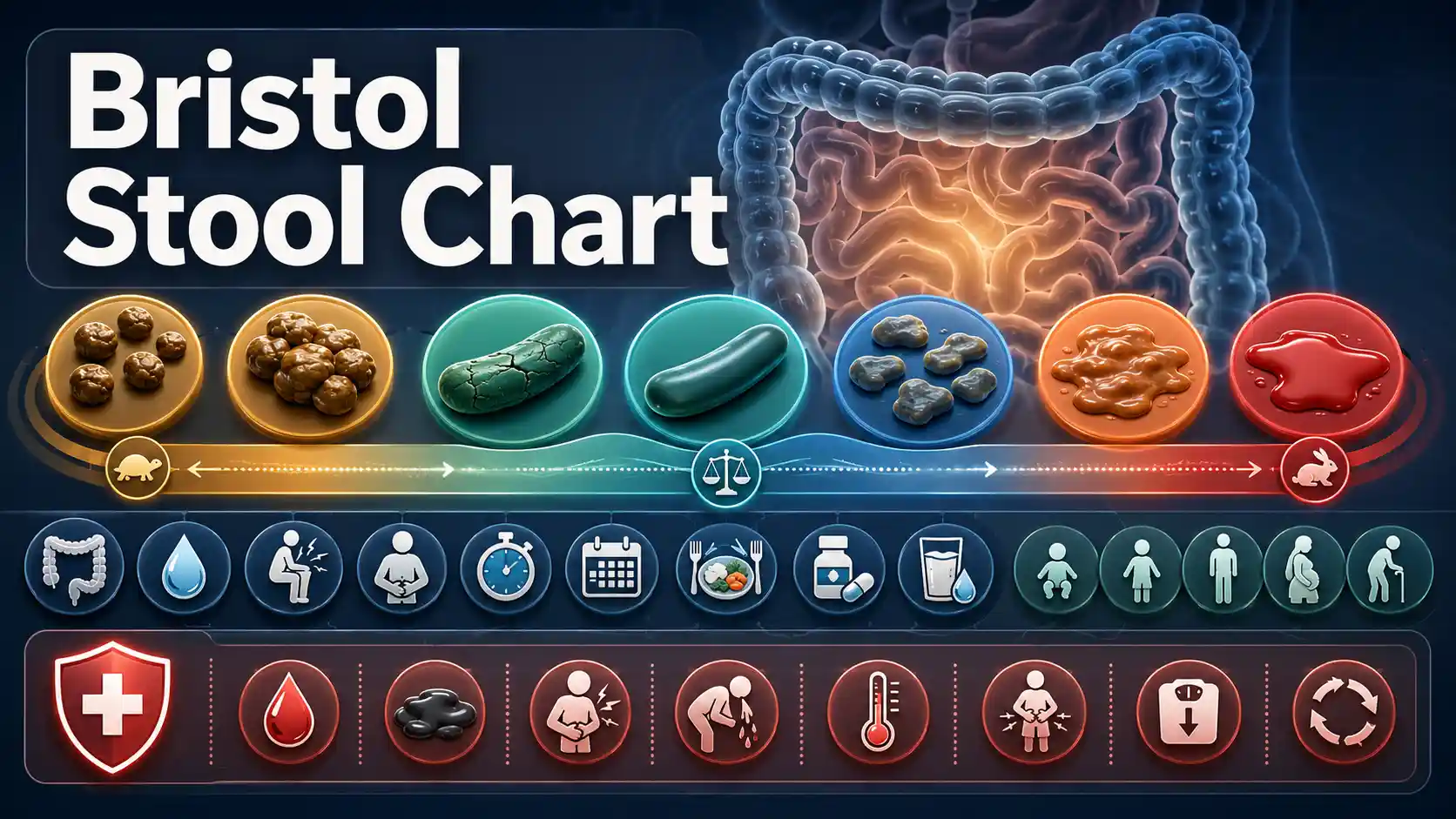
What does the Bristol Stool Chart show?
The Bristol Stool Chart classifies stool by shape and consistency from type 1, separate hard lumps, to type 7, entirely watery stool. Types 1–2 usually sit on the constipation side, types 3–4 are common formed references, and types 6–7 sit on the diarrhea side.
The NHS England Bristol Stool Chart provides the standard type descriptions. The original stool-form scale study found that stool form can act as a practical guide to intestinal transit, but form alone cannot identify the cause of a bowel change.
- Hardest end
- Types 1–2
- Formed reference
- Types 3–4
- Loose end
- Types 6–7
- Best use
- Track patterns
Hard or lumpy forms commonly appear with constipation, slow transit, straining, or incomplete emptying.
These are common formed stools when passage is comfortable and no warning symptoms are present.
Mushy or watery stools raise more concern when frequent, persistent, bloody, painful, or dehydrating.
Type, frequency, urgency, straining, pain, medicines, diet, and duration create the useful clinical picture.
The fastest answer: interpret the pattern, not one bowel movement
A single type 1 or type 7 stool may follow a temporary change in fluids, food, medicine, illness, travel, or stress. Repeated type, bowel frequency, urgency, straining, pain, bleeding, hydration, duration, and a change from the person’s baseline provide the more useful answer.
Bristol Stool Chart: types 1 through 7
The seven stool-form categories describe visible shape and consistency. Use the closest match and consider frequency, symptoms, duration, medicines, diet, and your usual bowel pattern.
Swipe horizontally inside the table to view every column.
| Type | Appearance and texture | Common interpretation | Useful next step |
|---|---|---|---|
| Type 1 — Hard-stool extreme | Separate hard lumps; dry and difficult to pass | Hard-stool or constipation pattern; often associated with slower transit | Review fluids, fibre, activity, medicines, and duration; seek advice if persistent or painful |
| Type 2 | Log-shaped or sausage-shaped but distinctly lumpy | Constipation-side pattern; formed but often hard and difficult to pass | Avoid repeated straining and review the full constipation pattern |
| Type 3 | Formed log with cracks on the surface | Commonly considered a formed, typical stool when passed comfortably — Common formed reference | Track only if other symptoms, blood, pain, or a major change is present |
| Type 4 | Smooth, soft, formed log or snake-like shape | Commonly considered a formed, easy-to-pass stool — Common formed reference | Usually no action is needed when this matches the person’s normal pattern |
| Type 5 | Soft separate pieces with clear edges | Soft or faster-transit pattern; may be brief and harmless or an early loose-stool change | Watch frequency, urgency, meals, medicines, and whether it progresses |
| Type 6 | Mushy pieces with ragged edges | Loose-stool pattern; can accompany infection, food intolerance, medicines, or bowel disorders | Replace fluids and monitor duration, frequency, fever, pain, and dehydration |
| Type 7 — Watery-stool extreme | Entirely watery with no solid pieces | Liquid-diarrhea pattern; higher fluid-loss and dehydration concern | Prioritize hydration and seek timely care when frequent, persistent, bloody, painful, or associated with dehydration |
Type number describes stool form and consistency; it does not identify the cause.
- • Types 3 and 4 are common formed references, but a healthy bowel pattern also depends on comfort, frequency, urgency, control, and absence of warning signs.
- • One unusual bowel movement rarely establishes a diagnosis. Repeated patterns and associated symptoms carry more meaning.
Download or export
Visual guide to the seven stool types
These simplified shapes are intentionally non-graphic. Match the closest consistency, then use symptoms, frequency, duration, urgency, medicines, and recent changes to interpret the result.
Type 1
Separate hard lumps
Hardest end of the scale
Type 2
Lumpy formed log
Constipation-side pattern
Type 3
Formed with cracks
Common formed reference
Type 4
Smooth and soft
Common formed reference
Type 5
Soft pieces with clear edges
Soft transitional pattern
Type 6
Mushy with ragged edges
Loose-stool pattern
Type 7
Entirely watery
Liquid-diarrhea pattern
Types 1–2: hard
Look for straining, pain, infrequent stools, incomplete emptying, medicine effects, and obstruction warning signs.
Types 3–4: formed
These are common formed references when passage is comfortable and no bleeding, pain, urgency, or major change is present.
Types 5–7: soft to watery
Increasing frequency, urgency, dehydration, blood, fever, or persistence makes loose stool more concerning.
Stool form, bowel transit, and symptom context
Stool form can act as a rough marker of how quickly material moved through the colon, but it cannot measure transit time or diagnose a digestive condition by itself.
Swipe horizontally inside the table to view every column.
| Type group | Approximate transit pattern | Common companion features | What changes the meaning |
|---|---|---|---|
| Types 1–2 | Slower or prolonged colonic transit is more likely — Slower-transit association | Straining, pain, incomplete emptying, bloating, fewer bowel movements | Opioids, iron, dehydration, low fibre intake, pelvic-floor problems, pregnancy, hypothyroidism, or obstruction |
| Types 3–4 | Intermediate transit is more likely — Intermediate-transit association | Formed stool that is easier to pass | Frequency, pain, bleeding, urgency, weight change, and a new persistent change still matter |
| Type 5 | Somewhat faster transit or reduced stool cohesion | Soft pieces, mild urgency, diet-related variation | A single episode differs from repeated stools with pain, fever, or weight loss |
| Types 6–7 | Faster transit and reduced water absorption are more likely — Faster-transit association | Urgency, cramping, repeated stools, possible incontinence | Infection, antibiotics, food intolerance, inflammatory disease, malabsorption, or medication effects |
| Alternating hard and loose stools | Variable transit or overflow can occur | Periods of straining followed by loose leakage or urgency | IBS patterns, fecal impaction, laxative use, diet changes, or another bowel disorder |
| Same type every day without symptoms | May represent an individual baseline | Stable timing, no pain, no bleeding, no urgency, no weight loss | A major new change from baseline deserves more attention than the number alone |
Transit descriptions are qualitative associations, not measured transit times.
- • The original Bristol scale study linked stool form with intestinal transit, but individual results overlap.
- • A clinician may use history, examination, laboratory tests, imaging, endoscopy, or formal transit testing when symptoms persist.
Download or export
Stool type and symptom context checker
Select the closest stool type and relevant context. The result explains general urgency; it does not diagnose a digestive condition.
Type 4 context
Formed-stool pattern
Types 3 and 4 are common formed references. Symptoms, bleeding, urgency, pain, and a persistent change from baseline still matter more than the type alone.
No selected warning sign changes the immediate context
Track the pattern and compare it with the person’s usual bowel habit. Seek advice if the change persists, worsens, recurs, causes pain, or affects hydration, eating, sleep, school, or daily activity.
This browser-only tool does not transmit the entered information and should not delay urgent care.
Constipation includes difficulty, not only infrequency
The NIDDK constipation guidance includes hard, dry, or lumpy stool, difficult or painful passage, fewer than three bowel movements per week, and a feeling that stool remains. A person can have constipation even when bowel movements occur more often.
Constipation pattern and hard-stool chart
Constipation is broader than stool type. Hard or lumpy stool, difficult passage, infrequent bowel movements, and incomplete emptying can occur together or separately.
Swipe horizontally inside the table to view every column.
| Feature | What it may look or feel like | Chart clue | When to discuss it |
|---|---|---|---|
| Hard or dry stool | Separate pellets, lumps, cracking, or a very firm log | Often type 1 or 2 | When recurrent, painful, or causing bleeding or avoidance |
| Infrequent bowel movements | Fewer than three per week for many adults | Any type can occur, but hard types are common | When this differs from baseline or comes with discomfort or incomplete emptying |
| Straining | Repeated pushing, long toilet time, or breath holding | Often types 1–2 but can occur with pelvic-floor dysfunction at other types | When frequent, severe, or associated with pain, prolapse, or hemorrhoids |
| Incomplete evacuation | Feeling that stool remains after the bowel movement | Type alone may not reveal it | When persistent or accompanied by blockage symptoms |
| Bloating or abdominal discomfort | Fullness, cramping, pressure, or distension | May accompany retained stool | Urgently if pain is constant, severe, or paired with vomiting or inability to pass gas — Possible urgent abdominal symptoms |
| Overflow leakage | Loose stool leaks around retained hard stool | May appear as types 6–7 despite constipation — Loose stool can coexist with impaction | Requires assessment when recurrent, especially in children or older adults |
| Painful stool withholding in a child | Posturing, tiptoe standing, clenching, or avoiding the toilet | Hard types may be present | Seek pediatric advice when persistent, painful, or affecting eating and growth |
Constipation is defined by symptoms and bowel function, not by one stool image.
- • Do not start, stop, or escalate long-term laxatives without appropriate guidance, particularly in children, pregnancy, kidney disease, or possible obstruction.
- • Rectal bleeding, blood in stool, constant abdominal pain, vomiting, fever, inability to pass gas, or unintentional weight loss require prompt medical attention.
Download or export
Diarrhea combines loose consistency with increased frequency
The NIDDK diarrhea guidance defines diarrhea as loose or watery stool three or more times a day, or more often than normal for the person. Dehydration, blood, black stool, severe pain, frequent vomiting, high fever, and persistence increase urgency.
Loose stool and diarrhea pattern chart
Diarrhea usually means loose or watery stool three or more times a day, or more often than is normal for the person. Duration and dehydration risk guide urgency.
Swipe horizontally inside the table to view every column.
| Pattern | Typical definition or clue | Main risk | Suggested response |
|---|---|---|---|
| Single soft stool | One type 5 or 6 stool without other symptoms | Usually low if the person feels well | Observe for recurrence and note recent food, medicine, stress, or travel changes |
| Acute diarrhea | Loose or watery stools lasting less than 7 days | Dehydration; infection may spread to others | Replace fluids and electrolytes; monitor frequency and warning signs |
| Frequent adult diarrhea | Six or more loose stools in one day — High stool frequency | Rapid fluid and electrolyte loss | Contact a healthcare professional promptly |
| Persistent diarrhea | Longer than 2 weeks but less than 4 weeks | Ongoing infection, intolerance, medicine effect, or malabsorption | Arrange medical assessment rather than relying only on self-care |
| Chronic diarrhea | At least 4 weeks, continuous or intermittent | Malabsorption, weight loss, inflammatory or functional bowel disease | Needs clinical evaluation and may require stool, blood, or other tests |
| Diarrhea with blood, pus, or black tarry stool | Visible red blood, pus, or black sticky stool | Bleeding or serious infection | Seek medical care right away — Urgent medical evaluation |
| Diarrhea with dehydration | Dry mouth, intense thirst, reduced urination, dark urine, dizziness, lethargy | Circulatory and kidney complications | Prompt medical care; emergency help for severe symptoms or altered consciousness — Dehydration concern |
| Infant or high-risk person | Infant, pregnancy, age over 65, antibiotics, or weakened immunity | Complications can develop faster | Use a lower threshold for professional advice |
Duration categories and action thresholds depend on age, health status, symptoms, and local guidance.
- • Do not use over-the-counter antidiarrheal medicines for infants or children without professional advice, or when stool is bloody or fever is present.
- • Severe abdominal or rectal pain, frequent vomiting, black or bloody stool, dehydration, altered mental state, or persistent symptoms require timely care.
Download or export
A bowel diary turns an isolated observation into a useful pattern
The NIDDK stool diary records type, urgency, straining, leakage, medicines, and comments. Add timing, frequency, pain, blood, food, fluids, travel, and illness to create a clear history for self-monitoring or a clinical visit.
What to record in a bowel diary
A structured diary shows patterns that one stool type cannot capture. Record enough detail to compare days, triggers, treatment effects, and warning symptoms.
Swipe horizontally inside the table to view every column.
| Diary field | What to record | Why it matters | Example format |
|---|---|---|---|
| Date and time | Time of every bowel movement | Shows timing, meal-related patterns, overnight symptoms, and daily frequency | 08:10 after breakfast |
| Bristol type | Closest type from 1 through 7 — Core stool-form field | Tracks consistency changes over time | Type 2 |
| Amount | Small, medium, large, or clinician-defined estimate | Helps distinguish small frequent stools from larger complete movements | Small |
| Straining | None, mild, moderate, or severe | Identifies difficult passage that form alone may miss | Moderate |
| Urgency | Whether the movement could be postponed | Helps characterize diarrhea, incontinence, and functional bowel symptoms | Could not wait 15 minutes |
| Pain or cramping | Location, severity, and whether it improved after stool | Connects bowel changes with abdominal symptoms | Lower cramps, 4/10, improved afterward |
| Blood, mucus, black stool, or oiliness | Visible unusual features — Potential warning feature | May indicate bleeding, inflammation, infection, or malabsorption | No blood; small mucus amount |
| Leakage or incontinence | Staining, seepage, or full loss of control | Shows severity and possible overflow or pelvic-floor problems | Minor seepage |
| Food and fluids | Major meals, alcohol, caffeine, new foods, fibre changes, and hydration | Helps identify dietary patterns without blaming one food prematurely | New sugar-free sweets; low fluid intake |
| Medicines and supplements | Antibiotics, laxatives, iron, magnesium, opioids, diabetes medicines, or new doses | Many products change stool consistency and transit | Started oral iron |
| Context | Travel, infection exposure, stress, menstruation, pregnancy, exercise, or sleep changes | Explains temporary shifts and supports clinical history | Travel day; poor sleep |
A seven-day record is often more useful than memory alone, but urgent symptoms should not wait for a completed diary.
- • Photographs may help a clinician when appropriate and securely handled, but the written type, frequency, symptoms, and duration usually provide the core information.
- • Do not record identifying health information in a shared or unsecured device.
Download or export
Common factors that change stool form
Stool form reflects water content, transit, diet, medicines, illness, and bowel function. Similar stool types can have different causes.
Swipe horizontally inside the table to view every column.
| Factor | Possible stool change | Clues to track | Important caution |
|---|---|---|---|
| Fluid intake and dehydration | Harder, drier types may become more likely | Thirst, dark urine, heat, illness, reduced drinking | Fluid advice must be individualized in heart, kidney, or liver disease |
| Fibre amount and type | Too little may harden stool; rapid increases can cause gas or looser stool | Whole grains, fruit, vegetables, supplements, timing | Increase gradually and pair with appropriate fluid intake |
| Physical activity and routine | Reduced movement or ignored urges may slow bowel transit | Travel, bed rest, schedule changes, toileting access | Sudden severe constipation still requires assessment |
| Infection or contaminated food | Types 6–7 with urgency, cramps, fever, or vomiting | Sick contacts, travel, shared meals, onset timing | Blood, dehydration, severe pain, or persistent symptoms require care — Infection warning signs |
| Antibiotics and magnesium products | Loose or watery stool | Start date, dose change, frequency, fever | Severe or persistent diarrhea after antibiotics needs prompt advice |
| Opioids, iron, anticholinergics, or some antacids | Harder stool, straining, reduced frequency | New medicine, dose increase, pain treatment | Do not stop prescribed medicine without discussing alternatives |
| Diabetes and autonomic nerve problems | Constipation, diarrhea, or alternating patterns | Glucose control, medicines, neuropathy symptoms — Diabetes context | Follow a diabetes sick-day plan during significant vomiting or diarrhea |
| Food intolerance or malabsorption | Loose, greasy, bulky, or foul-smelling stool | Specific foods, bloating, weight loss, nutrient deficiency | Persistent greasy stool or poor growth needs medical evaluation |
| Stress and gut-brain interaction | Hard, loose, urgent, or alternating stools | Pain relief after stool, stress timing, sleep | Blood, fever, weight loss, or nighttime symptoms should not be assumed to be stress |
| Pregnancy and hormonal change | Constipation is common; medicines and supplements may contribute | Iron use, activity, fluids, pain, bleeding | Pregnancy-specific treatment choices require professional guidance |
The table lists possibilities, not diagnoses.
- • A medicine review is often useful when a bowel change begins after a new prescription, supplement, or dose adjustment.
- • Persistent changes may require testing for infection, inflammation, malabsorption, endocrine disease, or structural bowel problems.
Download or export
Illness and bowel changes can affect diabetes management
Vomiting, diarrhea, reduced food intake, dehydration, and some medicines can alter glucose levels. People with diabetes should follow their personal sick-day plan and use the Blood Sugar Levels Chart for general measurement context, not as a replacement for individualized instructions.
Bristol Stool Chart cautions by age and health status
The seven types can describe appearance, but age, anatomy, medicines, feeding, and medical conditions change how a result should be interpreted.
Swipe horizontally inside the table to view every column.
| Group or situation | Why interpretation differs | What to monitor | When to seek advice |
|---|---|---|---|
| Newborn or young infant | Feeding method and age create stool patterns that do not fit adult expectations | Wet diapers, feeding, alertness, vomiting, fever, growth, stool frequency | Any dehydration, fever in an infant, blood, repeated watery stools, poor feeding, or unusual sleepiness — Infant dehydration risk |
| Older infant and toddler | Diet transitions and toilet learning can alter frequency and consistency | Pain, withholding, abdominal swelling, hydration, growth | Persistent constipation, diarrhea over a day, blood, vomiting, or poor intake |
| School-age child | Withholding and painful stools can create a constipation cycle | Toilet avoidance, accidents, appetite, pain, growth | Symptoms lasting more than 2 weeks, bleeding, vomiting, weight loss, or severe pain |
| Pregnancy or postpartum | Hormones, iron, reduced activity, pelvic-floor changes, and delivery can affect bowel function | Pain, bleeding, medicines, hydration, pelvic-floor symptoms | Severe pain, heavy bleeding, inability to pass stool or gas, fever, or persistent symptoms |
| Older adult or frail person | Dehydration, immobility, medicines, neurologic disease, and impaction risk may be higher | New confusion, appetite, abdominal swelling, leakage, medicine changes | Sudden change, vomiting, pain, inability to pass gas, black or bloody stool, or dehydration — Older-adult acute warning signs |
| Ostomy or altered bowel anatomy | Expected output depends on stoma type, surgery, and remaining bowel | Volume, consistency, stoma appearance, hydration, appliance output | Follow the person’s surgical team plan; seek help for blockage signs, high output, or dehydration |
| Immunocompromised person | Infections and dehydration can become serious more quickly | Temperature, stool frequency, blood, pain, hydration | Use a lower threshold for same-day professional advice — Lower threshold for care |
| Person taking antibiotics | Antibiotic-associated diarrhea can range from mild to serious | Frequency, fever, pain, blood, treatment timing | Prompt advice for severe, persistent, bloody, or high-frequency diarrhea |
Individual care plans override general chart guidance.
- • The Bristol chart is an observation tool, not a pediatric feeding chart, ostomy-output target, or diagnosis.
- • For recurrent diarrhea in a child, growth and hydration matter as much as stool type.
Download or export
Warning signs override the stool type
Black tarry stool, significant blood, severe or constant pain, vomiting with abdominal swelling, inability to pass gas, dehydration, confusion, collapse, or major unintentional weight loss needs medical assessment. Do not wait for the stool to become type 3 or 4.
Bowel warning signs and action chart
Stool type becomes secondary when bleeding, dehydration, obstruction symptoms, severe pain, systemic illness, or major persistent change is present.
Swipe horizontally inside the table to view every column.
| Warning sign | Why it matters | Suggested urgency | Do not rely on |
|---|---|---|---|
| Black, tarry stool | May represent bleeding higher in the digestive tract | Urgent medical assessment — Urgent bleeding assessment | A stool-form number or dietary assumption |
| Red blood mixed with stool or significant rectal bleeding | May reflect bleeding, inflammation, infection, or another bowel problem | Prompt or emergency assessment depending on amount and symptoms | Assuming hemorrhoids without evaluation |
| Severe or constant abdominal pain | Can accompany obstruction, inflammation, ischemia, infection, or another acute condition | Urgent assessment; emergency help when severe or worsening | Waiting for the stool type to normalize |
| Inability to pass gas with swelling or vomiting | Possible bowel obstruction | Emergency assessment — Possible obstruction emergency | Fibre, laxatives, or home remedies without advice |
| Dehydration or altered mental state | Fluid and electrolyte loss can impair circulation, kidneys, and brain function | Urgent or emergency care — Dehydration emergency | Water intake alone when symptoms are severe |
| High fever, frequent vomiting, or six or more loose stools in a day | Higher likelihood of significant infection or rapid fluid loss | Same-day medical advice | Over-the-counter antidiarrheal medicine alone |
| Unintentional weight loss or poor child growth | May indicate malabsorption, inflammation, endocrine disease, or another chronic condition | Arrange clinical evaluation | Diet restriction without assessment |
| Persistent new bowel change | A sustained change from baseline may require investigation | Discuss with a healthcare professional | Repeatedly classifying the stool without reviewing causes |
| Severe pain or bleeding during pregnancy or postpartum | Requires pregnancy-aware assessment | Prompt obstetric or emergency advice | Ordinary constipation self-care alone |
Urgency depends on severity, age, pregnancy, medical history, medicines, and local emergency guidance.
- • Call local emergency services for collapse, fainting, severe dehydration, altered consciousness, major bleeding, or severe escalating pain.
- • A stool chart can support communication, but it must not delay care for warning signs.
Download or export
Use five details when describing a bowel change
- 1
Name the closest type
Use type 1 through 7 and describe whether the match is exact or approximate.
- 2
Count frequency and duration
Record bowel movements per day or week and when the new pattern began.
- 3
Add passage symptoms
Note urgency, straining, incomplete emptying, pain, leakage, or nighttime symptoms.
- 4
List exposures and medicines
Include diet changes, fluids, travel, illness, antibiotics, laxatives, iron, magnesium, and opioids.
- 5
State warning signs first
Lead with blood, black stool, severe pain, vomiting, dehydration, fever, weight loss, or inability to pass gas.
Frequently asked questions
What is the Bristol Stool Chart?
The Bristol Stool Chart is a seven-type visual scale that describes stool shape and consistency from separate hard lumps at type 1 to entirely watery stool at type 7.
Which Bristol stool types are considered normal?
Types 3 and 4 are commonly used as formed reference stools. A healthy bowel pattern also requires comfortable passage, no bleeding or severe pain, and a frequency that is normal for the person.
What do types 1 and 2 mean?
Types 1 and 2 are hard or lumpy forms commonly associated with constipation or slower bowel transit. Duration, straining, pain, frequency, and incomplete emptying determine the wider pattern.
What does type 5 stool mean?
Type 5 consists of soft pieces with clear edges. It may be a brief diet-related variation, a faster-transit pattern, or an early shift toward loose stool depending on frequency and symptoms.
What do types 6 and 7 mean?
Types 6 and 7 are loose or watery forms commonly associated with diarrhea or fast transit. Repeated stools, dehydration, fever, pain, blood, medicines, and duration determine urgency.
Can the Bristol Stool Chart diagnose IBS?
No. Clinicians may use stool form as part of IBS assessment, but diagnosis also requires symptom patterns, duration, abdominal pain, exclusion of warning signs, and sometimes testing.
How many bowel movements are normal?
Normal frequency varies widely. The most useful comparison is the person’s stable baseline combined with stool comfort, urgency, control, and absence of warning signs.
Can constipation cause loose stool?
Yes. Watery stool may leak around retained hard stool in fecal impaction, creating overflow diarrhea. Recurrent leakage with constipation symptoms needs medical assessment.
When is watery stool dangerous?
Watery stool becomes more concerning when frequent, persistent, bloody, black, associated with severe pain or fever, or accompanied by dehydration, vomiting, confusion, pregnancy, infancy, older age, antibiotics, or weak immunity.
Should I use a Bristol chart for a newborn?
The chart can describe appearance, but newborn stool depends heavily on age and feeding. Poor feeding, fever, blood, repeated watery stools, vomiting, unusual sleepiness, or fewer wet diapers require pediatric advice.
What should I record in a bowel diary?
Record date, time, Bristol type, frequency, amount, urgency, straining, pain, blood or mucus, leakage, foods, fluids, medicines, travel, illness, and other changes.
Can food change stool type for one day?
Yes. Fibre, fat, alcohol, caffeine, sugar alcohols, unfamiliar foods, fluid intake, and meal timing can temporarily change consistency. Repeated changes need broader context.
When should constipation be checked?
Seek advice when constipation persists despite self-care, causes significant pain or bleeding, or comes with vomiting, fever, inability to pass gas, constant abdominal pain, or unintentional weight loss.
When should diarrhea be checked?
Seek timely care for dehydration, blood or black stool, severe pain, frequent vomiting, high fever, six or more loose stools in a day, adult diarrhea lasting more than two days, or earlier in infants and high-risk people.
Sources
The tables and explanations draw from the following research publication and public health resources. URLs appear as plain text for transparent attribution.
1. Scandinavian Journal of Gastroenterology / PubMed
Stool Form Scale as a Useful Guide to Intestinal Transit Time
Original 1997 study describing the seven-category stool form scale and its relationship with intestinal transit.
https://pubmed.ncbi.nlm.nih.gov/9299672/
2. NHS England
Bristol Stool Chart
Public-facing type 1–7 descriptions used to recognize hard, formed, soft, mushy, and watery stools.
https://www.england.nhs.uk/wp-content/uploads/2023/07/Bristol-stool-chart-for-carer-web-version.pdf
3. National Institute of Diabetes and Digestive and Kidney Diseases
Stool Diary
One-week diary template covering stool type, urgency, straining, leakage, medicines, and comments.
https://www.niddk.nih.gov/-/media/Files/Weight-Management/Stool_Diary_508.pdf
4. National Institute of Diabetes and Digestive and Kidney Diseases
Symptoms and Causes of Constipation
Government guidance on hard or lumpy stools, infrequent bowel movements, incomplete evacuation, causes, and warning signs.
https://www.niddk.nih.gov/health-information/digestive-diseases/constipation/symptoms-causes
5. National Institute of Diabetes and Digestive and Kidney Diseases
Symptoms and Causes of Diarrhea
Government guidance on loose or watery stools, dehydration, duration, higher-risk groups, and urgent symptoms.
https://www.niddk.nih.gov/health-information/digestive-diseases/diarrhea/symptoms-causes