Animals & Pets
Cat Body Language Chart
Read posture, tail, ears, eyes, whiskers, purring, play, stress and warning signals as connected patterns. Use the interpreter to organize observations without pretending one signal proves an emotion.
Quick answer
Read clusters, context and change
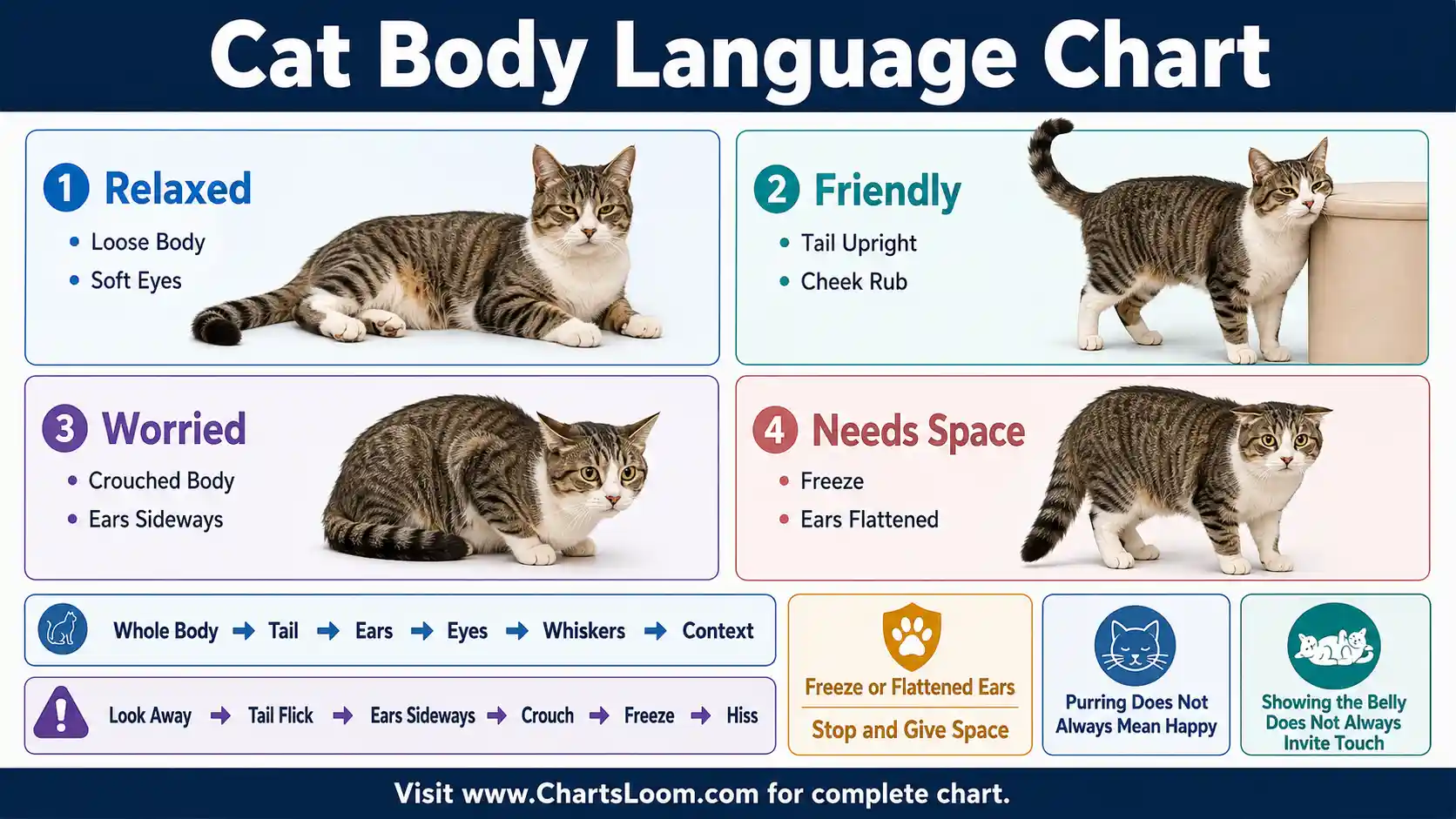
No single signal is enough. Cat body language is most useful when several signals point in the same direction. A loose body, soft eyes and free movement support a relaxed interpretation. An upright curved tail and voluntary approach often support a friendly greeting. A crouch, wrapped tail, sideways ears and retreat support a worried interpretation. Freezing, flattened ears, hissing, swatting or charging means contact should stop and distance should increase.
Always compare the cat with its normal behavior. Lighting changes pupils. Breed anatomy and coat can obscure ears, tail or whiskers. Purring can occur during comfort, fear or pain. A sudden change in tolerance, appetite, grooming, vocalization or movement deserves veterinary attention.
Best starting point
Read the whole cat
Posture, muscle tension, movement and access to an exit usually matter more than one isolated cue.
Friendly cluster
Tail up · Soft eyes
An upright curved tail, loose body and voluntary approach often support a friendly greeting.
High-concern cluster
Freeze · Flat ears
Stop contact when stillness, rigid focus, hissing, growling, swatting or charging appear.
Safest response
Give choice and refuge
Do not corner, chase, drag from hiding, punish warnings or block the cat’s route away.
Questions at a glance
Direct answers to common cat-language questions
What is cat body language?
Cat body language is communication through posture, movement, tail, ears, eyes, whiskers, facial tension, sound and distance.
How do I know if a cat is relaxed?
Look for a loose body, soft eyes, neutral ears and whiskers, free movement and normal resting or grooming.
What does an upright tail mean?
An upright tail, especially with a curved tip, often accompanies a friendly greeting.
Does purring mean a cat is happy?
Not always. Cats can purr during comfort, stress, pain or self-soothing.
What does a slow blink mean?
A slow blink commonly appears during relaxed social communication and can be returned from a distance.
What does a lashing tail mean?
Fast lashing or thumping often signals irritation or rising arousal, so touch or play should stop.
What do flattened ears mean?
Flattened ears often accompany fear, conflict, pain or a strong defensive distance request.
Why does a cat show its belly?
A loose cat may expose the belly because it feels safe or is stretching, but this is not automatic consent to belly touch.
What does a cat freeze mean?
A freeze is sudden stillness with muscle tension. Treat it as a high-concern stop signal.
How can I tell play from fighting?
Mutual play has pauses, role reversal and voluntary re-engagement; one-sided chasing, hiding or screaming suggests tension.
Should hissing be punished?
No. Hissing is a defensive warning. Punishment can increase fear without resolving the trigger.
When should behavior changes be checked by a vet?
Seek veterinary advice for sudden hiding, touch sensitivity, appetite change, squinting, panting, altered movement or unusual aggression.
Cat Emotional-State Body Language Overview
Read the whole cat, the situation and the change from normal. One tail, ear, pupil or sound cannot prove a single emotion.
Swipe horizontally inside the table to view every column.
| Broad state | Whole-body pattern | Face and head | Common movement | Safer response |
|---|---|---|---|---|
| Relaxed | Loose posture; weight distributed comfortably | Soft eyes; neutral ears; relaxed whiskers | Rests, grooms, explores or moves freely | Continue calmly while the cat can leave |
| Friendly greeting | Tail upright, often with a soft curve at the tip | Ears neutral or forward; eyes soft | Approaches, rubs, chirrups or tail-wraps | Offer a hand nearby and let the cat initiate |
| Interested or alert | Body oriented toward a sound or movement | Ears rotate; pupils and gaze track the event | Pauses, watches, sniffs or approaches | Observe whether the body stays loose |
| Playful | Body loose; rear may wiggle before a pounce | Ears generally forward; pupils may widen | Stalks toys, pounces, bats and pauses | Use toys, not hands, and allow breaks |
| Uncertain | Body lowers slightly or pauses | Ears turn sideways; whiskers may pull back | Hesitates, looks away or retreats | Reduce pressure and provide an exit |
| Worried | Crouched or compact posture; tail low or wrapped | Eyes wide; ears sideways or back | Hides, freezes briefly or moves away | Increase distance and lower noise |
| Fearful | Body flattened, tucked or trying to appear small | Pupils dilated; ears flattened; whiskers back | Freezes, flees, hides or may eliminate | Do not corner, grab or block escape |
| Defensive distance request | Body may arch or stay low and rigid | Ears flat; pupils wide; mouth may hiss or growl | Swats, spits, strikes or charges if escape fails | Stop contact and create a safe barrier |
| Over-aroused or frustrated | Body tense; tail lashes or thumps | Eyes fixed; ears rotate back and forth | Paces, redirects, grabs or bites during play | End stimulation and allow recovery |
| Pain or illness possibility | Guarded, hunched, asymmetric or unusually still posture | Squinting, flattened ears or changed expression | Avoids touch, hides, eats less or moves differently | A new change warrants veterinary assessment |
- • State labels are cautious interpretations, not diagnoses.
- • Purring can occur during comfort, stress or pain, so it should not be used alone.
Download or export
Interactive reference tool
Cat body-language signal interpreter
Select only signals you can observe. The tool groups them conservatively and recommends a safer response. It does not diagnose emotion, pain or aggression.
Cautious interpretation
Worried or uncertain cluster
Several selected signals indicate lowered posture, retreat, facial tension or conflict. The safest interpretation is that the cat needs less pressure and more control.
Observed cluster
crouched posture · wrapped or tucked tail · sideways ears · wide eyes or dilated pupils · whiskers pulled back · lip lick or repeated swallow · retreating or hiding
- 1. Pause and let the cat retreat or hide.
- 2. Turn slightly away and reduce direct eye contact.
- 3. Do not lure the cat close and then restrain it.
- 4. Seek veterinary advice if the change is sudden, persistent or linked to touch.
This result describes an observed signal cluster, not a diagnosis. Lighting, anatomy, pain, learning history, medication and individual baseline can change visible behavior.
What it does
Combines posture, tail, ears, eyes, whiskers, mouth, movement and context into a cautious cluster.
Why it helps
It discourages one-signal myths and prioritizes choice, distance, hiding and early intervention.
What it cannot do
It cannot diagnose fear, pain or aggression, analyze video, or guarantee that contact is safe.
Whole-Body Posture Signals
Posture shows muscle tension, weight distribution, height, direction and whether the cat is free to move.
Swipe horizontally inside the table to view every column.
| Signal | What to observe | Possible meaning | Safer response |
|---|---|---|---|
| Loose standing | Back and limbs are not rigid; weight is balanced | Usually comfortable or calmly alert | Continue only while movement remains free |
| Loose sitting | Tail rests naturally; shoulders and hips are soft | Comfortable waiting or observation | Approach slowly and stop if posture tightens |
| Loaf position | Paws tucked under; body compact but muscles soft | Resting, conserving warmth or calm watchfulness | Do not assume sleep; check eyes and ears |
| Side-lying | Body extended or curled with loose limbs | Rest or sleep | Avoid startling; let the cat wake first |
| Belly exposed with loose body | Back or side rolled open; limbs relaxed | Trust or comfortable stretching | Not automatically an invitation to rub the belly |
| Tail-up approach | Body walks toward you with tail vertical | Often friendly greeting | Let the cat close the final distance |
| Cheek or flank rub | Body presses or brushes past a person or object | Affiliative contact and scent marking | Pause and allow the cat to continue or leave |
| Slow curved approach | Body follows an arc rather than a direct rush | Low-pressure social approach | Stay still and avoid reaching over the head |
| Head lowered under a hand | Cat moves the forehead or cheek toward contact | May invite head-area touch | Use brief strokes and pause |
| Weight shifted back | Front paws brace or chest leans away | Uncertainty or preparation to retreat | Stop advancing |
| Lean away | Neck, shoulders or body move away from touch | Contact is not welcome at that moment | Remove the hand and give space |
| Crouch | Body low with legs folded under or beside the body | Fear, uncertainty, stalking or pain depending on context | Read eyes, ears, movement and trigger |
| Flattened posture | Body pressed close to the surface | Strong fear or attempt to be less visible | Do not pick up or corner |
| Hunched posture | Back rounded with head lowered; movement reduced | Pain, nausea, fear or illness possibility | Seek veterinary advice if new or persistent |
| Arched back with fur raised | Spine arched; tail and coat may puff | Defensive attempt to appear larger | Increase distance immediately |
| Sideways arched display | Body turns side-on while arched and puffed | Defensive display or kitten play depending on looseness | Check whether movement is bouncy or rigid |
| Freeze | Movement stops suddenly and muscles tighten | High concern; conflict or overload | Stop interaction and create an exit |
| Rigid forward stance | Weight moves forward; body remains still or deliberate | High arousal or distance request | Do not stare, reach or block escape |
| Rear wiggle before pounce | Hindquarters shift while eyes track a target | Normal predatory play when aimed at a toy | Redirect to an appropriate toy |
| Stalking low to ground | Slow, focused approach with controlled steps | Predatory play, hunting or intercat tension | Context and target determine response |
| Walking away | Cat increases distance voluntarily | Clear disengagement choice | Do not follow for more contact |
| Hiding | Cat uses furniture, carrier or height as cover | Rest, fear, pain or need for privacy | Do not drag the cat out |
| Blocking a route | Body occupies doorway, stair or resource path | May contribute to intercat tension | Add routes and duplicate resources |
| Repeated pacing | Back-and-forth movement without settling | Frustration, arousal, stress or medical concern | Reduce triggers and investigate persistent change |
- • Read posture together with the trigger and the cat’s baseline.
- • A hunched or guarded posture can reflect pain and should not be dismissed as mood.
Download or export
Cat Tail Language Chart
Tail position, muscle tension and speed matter. Tail meaning changes with posture, target and context.
Swipe horizontally inside the table to view every column.
| Tail signal | What to observe | Possible meaning | Safer response |
|---|---|---|---|
| Tail upright | Tail held vertically while approaching | Often a friendly greeting | Allow the cat to approach |
| Upright with curved tip | Question-mark shape near the tip | Friendly interest or greeting | Offer low-pressure interaction |
| Tail quiver while upright | Fine vibration, sometimes with stepping feet | Excitement or greeting; spraying context differs | Check whether urine marking is occurring |
| Tail wrapped around person or cat | Tail curls gently around another body | Affiliative contact | Let the cat control duration |
| Tail resting loosely | Tail lies without tension or rapid movement | Often relaxed | Read body and face for confirmation |
| Tail carried level | Tail extends behind at body height | Neutral travel, exploration or focus | Observe ears and pace |
| Tail slowly swaying | Broad, deliberate movement | Attention, uncertainty or building arousal | Pause handling and watch for escalation |
| Tail-tip twitch | Only the tip moves | Focus, mild irritation or hunting interest | Check target and rest of body |
| Tail lashing side to side | Fast, forceful movement | Irritation, frustration or over-arousal | Stop touch or play and give space |
| Tail thumping surface | Tail repeatedly strikes floor or furniture | Strong irritation or arousal | End interaction |
| Tail low | Tail held below normal carriage | Uncertainty or concern | Reduce pressure |
| Tail tucked close | Tail pressed under or around the body | Fear, discomfort or strong insecurity | Provide cover and exit |
| Tail wrapped around paws | Tail closely encircles sitting paws | May be cautious, cold or simply resting | Check muscle tension and ears |
| Puffed tail | Fur stands out and tail appears larger | High arousal, fear or defensive display | Do not approach |
| Puffed tail with sideways hops | Piloerection plus loose bouncing in a kitten | Can be playful excitement | Confirm body remains loose and pauses occur |
| Puffed tail with flattened ears | Rigid body, wide pupils and ears back | Defensive fear | Increase distance |
| Tail straight down while moving | Low, controlled carriage | Worry, focus or discomfort | Observe gait and context |
| Tail curved around another cat at rest | Gentle contact without blocking | Affiliative relationship possible | Do not interrupt if both are relaxed |
| Tail positioned across a route | Cat’s body and tail occupy access point | Possible passive blocking between cats | Add alternative paths |
| No visible tail | Tail hidden by body, coat or furniture | Cannot be interpreted | Use posture, ears, eyes and movement |
| Short or absent tail | Breed anatomy or prior injury limits signal visibility | Tail cues are reduced | Rely more on whole-body changes |
| Tail suddenly motionless | Movement stops during touch or conflict | Possible freeze or threshold change | Pause immediately |
| Tail flick after petting starts | Repeated twitching develops during contact | May signal declining tolerance | Use a consent pause |
| Tail movement during sleep | Small twitches while resting | May occur during sleep or dreaming | Do not wake solely because of tail movement |
- • A vertical tail often accompanies greeting, but no tail position guarantees that touch is welcome.
- • Fast lashing or thumping during petting is a practical cue to stop.
Download or export
Cat Ear Position Chart
Ears are mobile sound detectors and communication structures. Direction and muscle tension matter more than one snapshot.
Swipe horizontally inside the table to view every column.
| Ear signal | What to observe | Possible meaning | Safer response |
|---|---|---|---|
| Neutral forward | Ears upright and facing generally ahead | Comfortable interest | Continue calmly |
| Independent rotation | Each ear tracks a different sound | Normal environmental monitoring | Avoid startling from behind |
| Both ears rotate toward sound | Pinnae orient to one source | Focused attention | Watch whether body stays loose |
| Ears slightly sideways | Ears angle outward like airplane wings | Uncertainty, irritation or sensory monitoring | Reduce pressure |
| Ears turned back | Openings rotate behind the cat | Concern, irritation or tracking sound behind | Pause interaction |
| Ears flattened sideways | Pinnae press outward and lower | Fear, conflict or strong discomfort | Give distance |
| Ears pinned flat back | Ears close tightly to head | High defensive concern | Do not reach or restrain |
| Rapid ear flicking | Repeated small movements | Sound tracking, irritation, insects or ear discomfort | Investigate persistent scratching or discharge |
| One ear held differently | Asymmetry persists | Local discomfort, injury or hearing change possible | Veterinary review if new |
| Ears forward with loose body | Forward ears plus soft posture | Interest or friendly engagement | Let the cat choose contact |
| Ears forward with rigid body | Forward ears plus fixed stare and tension | Intense focus, hunting or conflict | Check target and create separation if needed |
| Ears back during play | Temporary backward rotation while wrestling | Can occur in vigorous play | Confirm pauses and reciprocal engagement |
| Ears back during petting | Ears gradually rotate away while tail twitches | Declining tolerance | Stop and allow the cat to leave |
| Flattened ears in carrier | Ears low with crouch and wide pupils | Fear or travel stress | Cover partly and minimize handling |
| Ears relaxed during slow blink | Neutral ears and soft eyelids | Lower-arousal social signal | Return a slow blink without approaching |
| Hairless-cat ear position | Large exposed ears make small rotations obvious | Anatomy changes appearance, not meaning | Compare with that cat’s baseline |
| Folded-ear breed anatomy | Permanent fold limits visible movement | Ear signaling can be harder to read | Use eyes, whiskers, posture and movement |
| Ear twitch with skin ripple | Brief twitch or skin movement | Normal response, irritation or overstimulation | Stop touch if repeated |
| Ears hot or red | Temperature or color change, not a body-language signal alone | Environment or medical issue possible | Assess health separately |
| Ear position not visible | Long coat, darkness or angle obscures ears | No reliable ear interpretation | Use other signal channels |
- • Ear shape differs among breeds and individuals.
- • Persistent asymmetry, discharge, odor or scratching is a health issue rather than a behavior label.
Download or export
Cat Eye and Gaze Language Chart
Eye shape, blink rate, gaze direction and pupils must be interpreted with lighting, health and posture.
Swipe horizontally inside the table to view every column.
| Eye signal | What to observe | Possible meaning | Safer response |
|---|---|---|---|
| Soft eyes | Eyelids relaxed; gaze moves naturally | Usually lower arousal | Continue calmly |
| Slow blink | Eyelids close and reopen slowly | Affiliative or relaxed social signal | Return a slow blink from a distance |
| Half-closed eyes while resting | Lids partly lowered with loose body | Rest or comfort | Avoid abrupt touch |
| Normal pupils in stable light | Pupil size matches ambient light | No strong conclusion alone | Read posture and context |
| Dilated pupils in dim light | Pupils large because light is low | Normal light response | Do not label fear from pupils alone |
| Dilated pupils in bright or stable light | Eyes wide with enlarged pupils | Arousal, fear, play, pain or medication effect | Use the whole signal cluster |
| Narrow pupils in bright light | Slit pupils under strong lighting | Normal light response | Do not label anger from shape alone |
| Narrow fixed gaze in normal light | Focused eyes with rigid body | Intense focus or conflict | Interrupt visual access safely |
| Direct stare between cats | Sustained gaze without softening | Can create social pressure | Add visual barriers and routes |
| Looking away | Head or gaze turns from social contact | De-escalation or disengagement | Respect the pause |
| Frequent scanning | Eyes move rapidly around environment | Vigilance or uncertainty | Reduce noise and movement |
| Wide eyes with crouch | Eyes open fully; body low | Fear or alarm | Provide hiding and distance |
| Squinting one eye | One eyelid closes more than the other | Eye pain or injury possibility | Prompt veterinary assessment |
| Both eyes squinting with tense face | Reduced eye opening plus facial tension | Pain, illness, bright light or stress possible | Investigate health and context |
| Third eyelid visible | Pale membrane covers part of eye | Sleepiness or medical concern | Veterinary advice if persistent |
| Rapid tracking of toy | Eyes follow moving object with loose play posture | Predatory play | Use safe wand-toy distance |
| Fixed gaze at window animal | Sustained visual focus; tail may twitch | Predatory or territorial arousal | Block view if frustration escalates |
| Eyes not visible | Cat faces away, hides or lighting is poor | No eye interpretation possible | Use posture and movement |
| Unequal pupil size | One pupil differs from the other | Neurological or eye emergency possibility | Seek urgent veterinary care |
| Sudden vision-related behavior change | Bumping, hesitation or startle increases | Vision or neurological concern possible | Arrange veterinary assessment |
- • Pupil size changes rapidly with light and cannot identify emotion by itself.
- • Unequal pupils, persistent squinting or sudden vision changes need veterinary attention.
Download or export
Cat Whisker Position Chart
Whiskers show facial muscle tension and sensory orientation. They are most useful beside eyes, ears and posture.
Swipe horizontally inside the table to view every column.
| Whisker signal | What to observe | Possible meaning | Safer response |
|---|---|---|---|
| Neutral fan | Whiskers extend gently to the sides | Often relaxed | Read with soft face and body |
| Forward whiskers | Whiskers project toward object or person | Interest, hunting or active investigation | Check eyes and body tension |
| Whiskers pulled back | Whiskers flatten toward cheeks | Fear, defensive concern or discomfort | Increase distance |
| Whiskers lowered | Whiskers angle down with tense muzzle | Stress or discomfort possible | Pause contact |
| Whiskers wide and stiff | Whiskers spread with tense face | High arousal | Avoid reaching |
| Whiskers forward during play | Forward fan with loose pounce posture | Predatory play | Use toys rather than fingers |
| Whiskers forward with rigid stare | Forward whiskers plus still tense body | Intense focus or conflict | Interrupt safely with distance |
| Whiskers back during handling | Whiskers retract as touch continues | Declining tolerance | Stop and use a consent pause |
| Whiskers relaxed during cheek rub | Neutral whiskers while cat initiates rubbing | Affiliative contact | Keep strokes brief |
| Whisker twitch | Small brief movement | Normal sensory sampling | No action unless paired with distress |
| One-sided whisker change | Asymmetry with facial tension | Local pain or injury possible | Veterinary review if persistent |
| Broken whiskers | Short or irregular whiskers | Wear, grooming, conflict or health issue possible | Do not trim; assess cause |
| Whiskers in a narrow bowl | Whiskers contact sides during eating | Some cats may avoid deep narrow dishes | Offer a wide shallow dish if needed |
| Whiskers hidden by long coat | Facial hair obscures orientation | Signal visibility is reduced | Use ears, eyes and posture |
| No whisker movement visible | Distance or angle prevents observation | Cannot interpret reliably | Use other channels |
| Whiskers with open-mouth panting | Facial tension plus panting | Heat, severe stress or medical concern | Cool environment and seek advice promptly |
| Whiskers with piloerection | Whiskers stiff while fur is raised | High defensive arousal | Back away |
| Whiskers with slow blink | Neutral fan and soft eyelids | Lower-arousal social state | Remain still and allow choice |
- • Never trim whiskers for cosmetic reasons.
- • Whisker direction alone does not identify one emotion.
Download or export
Cat Mouth, Purring and Vocalization Chart
Sounds and mouth movements are context-dependent. Purring is not proof of comfort, and panting at rest is abnormal.
Swipe horizontally inside the table to view every column.
| Signal | What to observe | Possible meaning | Safer response |
|---|---|---|---|
| Relaxed closed mouth | Lips and muzzle soft; jaw not tense | Often comfortable | Continue calmly |
| Soft meow | Short vocalization directed at a person | Greeting, request or learned communication | Check context rather than assuming one need |
| Chirrup or trill | Brief rolling sound | Often greeting or social invitation | Allow the cat to lead |
| Purr with loose body | Purring plus soft eyes and relaxed posture | Often comfort or social contact | Continue only while the body stays loose |
| Purr with hunched body | Purring plus hiding, tension or reduced appetite | Stress or pain possible | Assess health rather than assuming happiness |
| Silent open-mouth sniff | Mouth briefly open after smelling | Flehmen response | Normal scent analysis |
| Lip lick or nose lick | Tongue flicks over lips or nose | Food, grooming, stress, nausea or oral discomfort | Use context; investigate repetition |
| Repeated swallowing | Frequent gulping without eating | Nausea, stress or throat discomfort possible | Veterinary advice if persistent |
| Teeth chatter at prey view | Jaw chatters while watching bird or insect | Predatory arousal | Provide safe indoor enrichment |
| Long drawn-out meow | Prolonged vocalization | Attention request, frustration, mating behavior or illness | Check needs and sudden change |
| Yowl | Loud sustained vocalization | Distress, conflict, mating, pain or cognitive change | Investigate trigger and health |
| Growl | Low continuous warning sound | Strong discomfort or distance request | Stop and move away |
| Hiss | Forced exhalation with mouth open | Defensive warning | Do not punish or approach |
| Spit | Short explosive defensive sound | Immediate fear or threat response | Create distance |
| Snarl or teeth display | Lips retract and teeth show | High defensive concern | Use barrier and avoid handling |
| Open-mouth panting after vigorous play | Rapid breathing with mouth open | Overexertion, heat or stress possible | Stop activity and cool environment |
| Open-mouth panting at rest | Panting without recent exertion | Potential emergency in cats | Seek prompt veterinary care |
| Drooling during pleasant contact | Saliva appears while kneading or purring | Can be an individual comfort response | Confirm it is normal for that cat |
| New drooling | Unexpected saliva, pawing mouth or appetite change | Dental, oral, toxin or nausea concern | Veterinary assessment |
| Sudden silence in vocal cat | Marked reduction from normal communication | Stress or illness possible | Check other behavior and health |
| Sudden increased vocalization | More frequent or intense sounds | Environmental, endocrine, pain or cognitive cause possible | Veterinary review if persistent |
| Kneading with purr | Rhythmic paw motion plus relaxed sound | Comfort or self-soothing | Protect skin with a blanket if needed |
| Chattering teeth unrelated to prey | Jaw movement without visual target | Dental, neurological or pain concern possible | Record and seek veterinary advice |
| Biting after petting | Fast bite follows tail flick, skin twitch or tension | Petting intolerance or over-arousal | Stop earlier and shorten future sessions |
- • Punishing hissing or growling removes communication without resolving the cause.
- • Open-mouth breathing at rest requires prompt veterinary attention.
Download or export
Cat Stress and Coping Signal Chart
Stress often appears as changes in routine, resource use, grooming, appetite and social behavior rather than one dramatic display.
Swipe horizontally inside the table to view every column.
| Signal | What to observe | Possible meaning | Safer response |
|---|---|---|---|
| Hiding more than normal | Longer or more frequent use of hidden locations | Stress, pain or illness possible | Preserve hiding and assess cause |
| Seeking high places | Moves upward to avoid floor-level activity | Need for security or observation | Provide stable elevated refuges |
| Crouched posture | Body low and compact | Fear or uncertainty | Reduce social pressure |
| Flattened ears | Ears press sideways or back | Strong fear or conflict | Give distance |
| Wide pupils in stable light | Eyes dilated despite unchanged lighting | Arousal, fear, pain or play possible | Use whole-body context |
| Whiskers pulled back | Whiskers flatten toward cheeks | Fear or defensive tension | Stop approach |
| Tail wrapped tightly | Tail held close to body or paws | Insecurity or concern | Provide cover |
| Tail lashing | Fast side-to-side movement | Irritation or over-arousal | End handling or play |
| Freezing | Sudden stillness and muscle tension | High concern | Stop interaction |
| Lip licking | Repeated tongue flick without food | Stress, nausea or oral issue possible | Investigate context |
| Rapid grooming | Short burst after conflict or interruption | Displacement or self-regulation | Reduce trigger |
| Overgrooming | Repeated grooming causes thinning or skin damage | Medical or stress-related problem possible | Veterinary assessment |
| Reduced grooming | Coat becomes unkempt | Pain, obesity, dental disease or illness possible | Veterinary assessment |
| Reduced appetite | Food intake declines | Stress or illness | Cats should not go prolonged periods without eating |
| Elimination outside tray | Urine or stool appears outside normal location | Medical, litter-box or social stress cause possible | Veterinary check before behavior assumptions |
| Spraying | Small urine marks on vertical surfaces | Scent communication, stress or territorial issue | Do not punish; address resources and triggers |
| Scratching more or in new places | Marking increases near entrances or conflict zones | Arousal or territorial insecurity | Add appropriate scratch sites |
| Startle and vigilance | Cat scans and reacts to small sounds | Environmental insecurity | Create predictable quiet zones |
| Reduced play | Cat stops normal play or interaction | Stress, pain or illness possible | Compare with baseline |
| Increased irritability | Swats or bites with less provocation | Pain, stress or reduced tolerance possible | Stop contact and seek assessment if new |
| Restlessness | Repeated movement without settling | Frustration, heat, pain or medical issue possible | Investigate persistent change |
| Blocked resource use | Cat waits until another cat leaves before eating or toileting | Intercat tension | Duplicate and separate resources |
| Night vocalization | Calling increases after dark | Stress, sensory change, endocrine or cognitive issue possible | Veterinary review for new pattern |
| Weight change | Unexpected gain or loss accompanies behavior change | Medical or feeding concern | Track and seek veterinary advice |
- • A sudden behavior change should prompt a health assessment.
- • Never remove all hiding places; safe hiding supports coping.
Download or export
Cat Play and Social Interaction Chart
Healthy play stays voluntary, interruptible and balanced. Predatory play directed at toys is different from conflict between cats.
Swipe horizontally inside the table to view every column.
| Play pattern | What to observe | Interpretation | Safer response |
|---|---|---|---|
| Toy stalking | Low approach toward a toy with loose pauses | Normal predatory play | Use wand toys at safe distance |
| Pounce and release | Cat jumps, bats and disengages | Healthy toy play | Allow capture and breaks |
| Rear wiggle | Hindquarters shift before pounce | Normal targeting behavior | Keep hands away from target zone |
| Sideways kitten hop | Arched side-on bounce with loose movement | Playful excitement in many kittens | Confirm no rigid defensive signals |
| Chase with role reversal | Cats alternate chaser and chased roles | More balanced social play | Watch for voluntary re-engagement |
| Chase without role reversal | One cat repeatedly pursues another | Possible tension or bullying | Interrupt and add separation |
| Wrestling with pauses | Cats stop, reposition and resume | Can be mutual play | Check both choose to continue |
| Wrestling with screaming | Vocal distress, pinned cat or no release | Conflict or excessive intensity | Separate using a barrier, not hands |
| Ears mostly forward or mobile | Ears track action without staying flat | Supports play interpretation | Continue observing |
| Ears pinned throughout | Ears remain flat with rigid body | Fear or conflict more likely | Stop interaction |
| Claws mostly sheathed | Bats occur without repeated injury | Supports social play | Check for scratches afterward |
| Repeated biting with injury | Skin is punctured or fur pulled | Not safe play | Separate and seek behavior advice |
| Play bow-like crouch | Front lowers before springing at toy | Predatory play preparation | Redirect to toy |
| Hide-and-pounce game | Cat uses box or tunnel and reappears | Enrichment play | Ensure exits are not blocked |
| Zoomies | Short burst of running and turning | Normal energy release | Clear hazards |
| Play ends with grooming | Cat disengages and settles | Normal recovery | Allow rest |
| One cat hides after play | Hiding persists and cat will not re-engage | Possible fear or overload | Provide separate space |
| Toy-directed tail lashing | Tail moves while eyes track toy | Arousal during hunting play | End before frustration rises |
| Hand-directed grabbing | Cat grabs or kicks hands | Learned unsafe play pattern | Switch to long toys |
| Play stops abruptly with freeze | Body becomes still and tense | Threshold change or conflict | Pause and increase space |
- • Use toys rather than fingers or feet.
- • Mutual play includes pauses and the ability of both cats to leave.
Download or export
Cat Warning and Escalation Ladder
Cats may skip stages, especially when trapped, in pain or previously punished. Early retreat and freezing should be respected.
Swipe horizontally inside the table to view every column.
| Level | Observable change | Interpretation | Immediate response |
|---|---|---|---|
| 1. Orient | Cat turns eyes, ears or head toward trigger | Not yet a warning by itself | Observe and avoid crowding |
| 2. Pause | Movement slows or stops briefly | Arousal is changing | Reduce social pressure |
| 3. Look away or retreat | Cat disengages or increases distance | Early request to end interaction | Let the cat leave |
| 4. Tail twitch or skin ripple | Small movement develops during touch | Tolerance may be declining | Stop petting |
| 5. Crouch or hide | Body lowers or seeks cover | Fear or overload | Provide safe refuge |
| 6. Ears flatten and pupils widen | Facial tension increases | Defensive concern rising | Do not reach |
| 7. Tail lashes or body freezes | Movement becomes forceful or stops | High concern | Create distance |
| 8. Hiss or growl | Clear audible warning | Strong distance request | Stop and back away |
| 9. Swat or strike | Paw reaches toward threat | Contact warning or defense | Use a barrier; do not grab |
| 10. Bite or sustained attack | Teeth contact or cat pursues | Immediate safety event | Separate safely and obtain help |
| After event: hiding or shutdown | Cat remains withdrawn after trigger ends | Recovery still incomplete | Provide quiet and avoid forced reconciliation |
| After event: repeated conflict | Pattern recurs around routes or resources | Environmental or intercat problem | Veterinary and behavior assessment |
- • Do not provoke a cat to see how far the ladder goes.
- • A bite or scratch can become infected; clean wounds and seek medical advice as appropriate.
Download or export
How Context Changes Cat Body Language
The same pupil size, tail movement or sound can mean different things during play, handling, conflict, travel or illness.
Swipe horizontally inside the table to view every column.
| Context | Signal cluster | Likely interpretation | Safer response |
|---|---|---|---|
| Resting on bed | Loose body, soft eyes, tail still | Comfortable rest | Approach quietly and offer choice |
| Sleeping deeply | Body limp; reduced response | Sleep | Do not startle or pick up |
| Greeting at doorway | Tail up, rub, trill | Friendly greeting possible | Let the cat initiate |
| Unknown visitor enters | Crouch, hide, wide eyes | Uncertainty or fear | Provide escape and do not force greeting |
| Petting head and cheeks | Cat leans in, rubs and remains | Contact may be welcome | Pause every few strokes |
| Petting lower back or belly | Skin ripple, tail flick or grab | Area may be sensitive or overstimulating | Stop immediately |
| Being picked up | Body stiffens or paws brace | Lift may not be welcome | Support body and put down promptly |
| Carrier appears | Hiding, crouch or retreat | Learned travel concern | Use gradual carrier training |
| Veterinary waiting area | Wide pupils, flattened ears, freeze | Fear or sensory overload | Cover carrier and reduce exposure |
| Eating near another cat | Fast eating, guarding or leaving | Resource tension possible | Separate feeding stations |
| Litter tray access | Waiting, scanning or retreating | Route or resource may be blocked | Add trays in separate locations |
| Window view of outdoor cat | Fixed stare, tail twitch, redirected swat | Territorial or predatory arousal | Block view and avoid touching aroused cat |
| New cat introduction | Staring, blocking, chasing or hiding | Introduction is progressing too quickly | Return to gradual separation |
| Shared resting area | Loose proximity and voluntary contact | Affiliative tolerance possible | Keep multiple resting options |
| Toy play | Focused eyes, pounce, release | Normal predatory play | End with capture and food if suitable |
| Laser play | Chase without physical capture | Can create frustration in some cats | Finish on a catchable toy |
| Loud household noise | Flattened ears, hiding, vigilance | Noise stress | Provide quiet refuge |
| Child approaches | Cat turns away, crouches or tail lashes | Contact not welcome | Adult stops approach |
| Dog approaches | Cat freezes, arches or climbs | Fear or defensive concern | Use barriers and controlled introductions |
| Grooming session | Tail twitch, ears back, skin ripple | Tolerance is falling | Stop before swat or bite |
| Medication attempt | Hiding, struggling or defensive display | Learned handling stress | Ask veterinarian about lower-stress technique |
| After conflict | Cat hides or avoids a route | Recovery and tension persist | Separate resources and allow time |
| Sudden household change | Reduced appetite, hiding or spraying | Stress response possible | Restore routine and assess health |
| No obvious trigger | New behavior change appears | Pain or illness still possible | Veterinary assessment |
- • Context changes the safest interpretation.
- • When behavior changes suddenly without an obvious trigger, consider health first.
Download or export
Cat Handling and Consent Chart
Use short contact, pause often and treat withdrawal, tension or tail movement as meaningful information.
Swipe horizontally inside the table to view every column.
| Observation | What it may mean | Consent status | Safer response |
|---|---|---|---|
| Cat approaches voluntarily | Tail up; rubs or remains nearby | Contact may be welcome | Let cat initiate |
| Cat sniffs offered hand | Head moves forward without tension | Investigating | Keep hand still |
| Cheek rub | Cat presses cheek or forehead to hand | Head-area contact may be welcome | Use short strokes |
| Leans into touch | Body moves toward hand | Positive continuation signal | Continue briefly |
| Moves away during pause | Cat increases distance | Contact is finished | Do not follow |
| Remains but turns head away | Body stays while gaze and face disengage | May be tolerating rather than enjoying | Stop and wait |
| Tail begins twitching | Tip or whole tail moves faster | Arousal or irritation rising | End touch |
| Skin ripples | Back skin twitches under or after stroke | Overstimulation or sensitivity | Stop contact |
| Ears rotate sideways or back | Ear tension develops | Tolerance is declining | Pause |
| Pupils widen | Eyes enlarge without light change | Arousal rising | Reduce stimulation |
| Body stiffens | Muscles become rigid | High concern | Remove hands |
| Cat freezes | Movement stops completely | Immediate stop signal | Back away |
| Cat grabs hand | Forelegs hold and hind legs may kick | Overstimulation or play pattern | Do not pull violently; disengage safely |
| Hiss or growl | Audible warning during handling | Strong distance request | Release and stop |
| Swat | Paw strikes toward hand | Defensive response | Do not punish |
| Bite | Teeth contact skin | Handling exceeded tolerance or pain possible | Stop; assess injury and cause |
| Belly exposed | Cat rolls onto back | Trust or defensive readiness; not automatic consent | Pet head or cheeks only if invited |
| Lift with full body support | Chest and hindquarters supported | Lower-stress than dangling | Keep lift brief |
| Scruffing | Cat held by loose neck skin | Restrictive and stressful for many adult cats | Avoid routine scruffing |
| Towel support | Loose towel creates cover without force | Can reduce visual input when used skillfully | Use trained low-stress technique |
| Nail trim one paw at a time | Short session with breaks and rewards | Improves tolerance | Stop before struggle |
| Brushing preferred areas | Cheeks, neck or shoulders stroked gently | Often better tolerated | Avoid mats and painful areas |
| Medication with force | Repeated restraint predicts conflict | Can worsen future handling | Ask for alternative formulation or training plan |
| Sudden handling intolerance | Previously accepted touch becomes aversive | Pain or illness possible | Veterinary examination |
- • Cats often prefer head and cheek contact over prolonged body or belly touch.
- • A cat remaining still is not always consenting; freezing can reflect fear.
Download or export
Cat-to-Cat Body Language and Tension Chart
Intercat tension is often subtle. Staring, blocking, stalking and resource avoidance can matter even when there is no loud fight.
Swipe horizontally inside the table to view every column.
| Interaction | What to observe | Interpretation | Safer response |
|---|---|---|---|
| Tail-up approach | One cat approaches with vertical tail | Friendly intention possible | Observe recipient response |
| Nose touch | Brief mutual nose contact | Greeting or information exchange | Allow space afterward |
| Allogrooming | One cat grooms another | Affiliative behavior possible | Check it remains voluntary |
| Sleeping in contact | Bodies touch while loose | Affiliative relationship likely | Maintain multiple beds |
| Parallel resting | Cats rest nearby without touching | Comfortable tolerance possible | Do not force closer contact |
| Mutual play with role reversal | Both chase and pause | Balanced play | Allow escape routes |
| One-sided chasing | Same cat pursues; other hides | Intercat tension possible | Interrupt and separate |
| Staring | Sustained direct gaze | Social pressure | Use visual barriers |
| Blocking doorway | One cat occupies narrow route | Restricts access | Add alternate paths |
| Blocking litter tray | One cat waits near tray access | Resource control | Add trays in separated locations |
| Blocking food | One cat guards or watches feeding area | Resource tension | Feed separately |
| Stalking another cat | Low silent following directed at housemate | Predatory-like intimidation or tension | Separate and seek plan |
| Ambush from corner | Cat attacks as other passes | Route conflict | Remove ambush points |
| Chasing after hiss | Pursuer continues despite warning | Conflict escalation | Separate with barrier |
| Hissing at distance | Cat warns without advancing | Distance request | Do not force proximity |
| Growling over resource | Low vocalization near valued item | Resource conflict | Increase resource number and spacing |
| Mutual swatting with pauses | Brief pawing and both re-engage | Can be play | Check claws, ears and body looseness |
| Swatting with pinned ears | Rigid body, screaming or retreat | Conflict | Separate safely |
| Shared scent rubbing | Cats rub same objects or one another | Group scent may support affiliation | Keep environment stable |
| One cat stops normal routines | Less eating, toileting, play or movement | Subtle victim of tension possible | Veterinary and behavior assessment |
| Time-sharing resources | Cats use areas only when other cat leaves | Tension may be hidden | Duplicate resources |
| New cat introduction through barrier | Brief viewing with calm behavior | Controlled progress | Advance slowly |
| Forced face-to-face meeting | Cats held or placed together | High social pressure | Avoid; return to gradual introduction |
| Conflict after veterinary visit | Returning cat smells different | Temporary non-recognition tension | Separate and reintroduce gradually |
- • Cats can coexist without being socially bonded.
- • Resource distribution should prevent one cat from controlling every route or item.
Download or export
Cat Body Language Around Children
Children need adult supervision and simple stop rules. The cat must always have a route to leave and a child-free refuge.
Swipe horizontally inside the table to view every column.
| Situation | Cat signal or risk | Meaning | Adult response |
|---|---|---|---|
| Cat approaches child | Tail up and loose body | Contact may be possible | Adult supervises and child stays still |
| Cat stays at distance | Cat watches without approaching | Cat chooses no contact | Do not lure or chase |
| Cat hides | Uses furniture or height as refuge | Needs safety | Make hiding area child-free |
| Child reaches over head | Hand descends from above | Can feel threatening | Offer low hand beside cat instead |
| Child hugs cat | Arms restrict movement | High pressure for many cats | Do not allow hugging |
| Child picks up cat | Body may dangle or stiffen | Risk of fear and scratches | Adults handle only when necessary |
| Cat tail twitches | Movement develops during touch | Tolerance falling | Child stops immediately |
| Cat turns head away | Face disengages | Early no-contact signal | End interaction |
| Cat freezes | Body becomes still and tense | High concern | Adult separates calmly |
| Cat hisses | Audible warning | Strong distance request | Child moves away |
| Cat swats | Paw reaches toward child | Defensive response | Use barrier and end interaction |
| Cat sleeping | Cat is resting | Startle risk | Do not wake or touch |
| Cat eating | Focused on food | Resource and startle risk | Leave alone |
| Cat using litter tray | Vulnerable private activity | Interruption can create avoidance | Keep tray inaccessible to child |
| Wand-toy play | Distance separates hands from claws | Safer shared activity | Adult controls session |
| Hand play | Fingers become moving target | Teaches unsafe grabbing | Use toys only |
| Running and screaming nearby | Fast unpredictable movement and noise | May trigger fear or chase | Create calm cat zone |
| Cat on high perch | Cat has chosen distance | Safe observation | Do not pull cat down |
| Scratch or bite occurs | Skin is broken or injured | Medical and safety event | Wash wound and seek medical guidance |
| Repeated tension around child | Cat hides, lashes tail or swats often | Environment is not working | Veterinary and behavior support |
- • Never leave a young child and cat unsupervised.
- • Teach children that hiding, sleeping, eating and litter use are no-touch times.
Download or export
Worked Cat Body-Language Scenarios
These examples show how signal clusters and context change the safest response.
Swipe horizontally inside the table to view every column.
| Example | Observed situation | Cautious interpretation | Safer response |
|---|---|---|---|
| 1 | Cat walks in with tail upright and rubs cheek | Friendly greeting cluster | Offer brief head contact and pause |
| 2 | Cat slow-blinks from a chair | Lower-arousal social signal | Return a slow blink without approaching |
| 3 | Cat rolls onto back with loose body | Trust or comfortable stretch | Do not assume belly-rub consent |
| 4 | Cat purrs while kneading and leaning in | Comfort likely | Continue briefly while body stays loose |
| 5 | Cat purrs while hunched and refusing food | Pain or stress possible | Arrange veterinary assessment |
| 6 | Tail tip begins twitching during petting | Tolerance may be falling | Stop and allow cat to leave |
| 7 | Tail lashes and skin ripples during grooming | Overstimulation or discomfort | End grooming session |
| 8 | Ears turn sideways when visitor reaches | Uncertainty | Visitor withdraws hand |
| 9 | Cat crouches under table with wide pupils | Fear or alarm | Provide quiet refuge |
| 10 | Cat freezes when child hugs it | High-concern stop signal | Adult releases cat immediately |
| 11 | Cat hisses from carrier | Defensive distance request | Do not reach into carrier |
| 12 | Cat arches and puffs at unfamiliar dog | Defensive fear | Use barriers and increase distance |
| 13 | Kitten hops sideways with loose bouncing | Playful excitement likely | Redirect to toy |
| 14 | Adult cat arches rigidly with ears flat | Defensive warning | Back away |
| 15 | Cat stares at housemate across doorway | Social pressure | Add visual barrier and second route |
| 16 | One cat waits to eat until other leaves | Subtle resource tension | Feed in separated locations |
| 17 | Cats chase with pauses and role reversal | Mutual play likely | Allow breaks |
| 18 | One cat chases while other hides | Intercat tension likely | Separate and reassess introduction |
| 19 | Cat grabs hand during rough play | Unsafe learned play | Switch to long toy |
| 20 | Cat chatters while watching birds | Predatory arousal | Offer indoor hunting play |
| 21 | Cat pants after short mild activity | Abnormal concern in cat | Stop activity and seek veterinary advice |
| 22 | One pupil suddenly larger than the other | Eye or neurological emergency possibility | Seek urgent veterinary care |
| 23 | Cat squints one eye after play | Eye injury possible | Prompt veterinary assessment |
| 24 | Cat hides more and stops grooming | Pain, illness or stress possible | Veterinary examination |
| 25 | Cat sprays near window after outdoor-cat visits | Territorial stress possible | Block view and clean appropriately |
| 26 | Cat blocks litter-tray route | Resource control | Add trays and alternate paths |
| 27 | Cat keeps ears forward but body rigid | Intense focus, not necessarily comfort | Check target and avoid contact |
| 28 | Pupils dilate during toy chase | Normal play arousal possible | Read loose body and target |
| 29 | Pupils dilate while cat crouches and hides | Fear cluster | Reduce noise and distance |
| 30 | Cat walks away after two strokes | Contact is finished | Do not follow |
| 31 | Cat stays still but tail thumps | Not relaxed stillness | Stop petting |
| 32 | Cat rubs then suddenly bites after long petting | Petting intolerance or overstimulation | Shorten sessions and use pauses |
| 33 | Cat growls over food bowl | Strong resource warning | Do not reach; separate feeding |
| 34 | Cat sleeps touching another cat | Affiliative relationship likely | Keep multiple resting sites |
| 35 | Returning cat is hissed at after veterinary visit | Scent-related non-recognition tension | Separate and reintroduce gradually |
| 36 | Cat meows more at night and seems disoriented | Medical or cognitive change possible | Veterinary assessment |
| 37 | Cat suddenly resists being lifted | Pain or handling problem possible | Stop lifting and seek assessment |
| 38 | Cat chirrups and tail-wraps around leg | Friendly social contact likely | Allow cat-led interaction |
| 39 | Cat repeatedly licks lips away from food | Stress, nausea or oral issue possible | Investigate context and health |
| 40 | Cat retreats, ears back, then swats when followed | Escalation after exit was ignored | Stop pursuit and provide safe route |
- • Examples are educational and cannot diagnose emotion or medical conditions.
- • A sudden or persistent behavior change deserves veterinary assessment.
Download or export
Limits and safety boundaries
This page cannot diagnose aggression, fear, anxiety, pain or neurological disease. It cannot predict whether a cat will scratch or bite. It cannot replace an in-person veterinary examination or an individualized assessment by a qualified feline behavior professional.
Do not provoke hissing, freezing, swatting or guarding to test the chart. After a bite, deep scratch, repeated attack, sudden behavior change or open-mouth breathing, use safe separation and seek appropriate medical, veterinary or behavior help.
Frequently asked questions
Cat body language FAQ
What does an upright cat tail mean?
An upright tail, especially with a soft curve at the tip, often accompanies a friendly greeting. The cat still decides whether touch is welcome.
Why does my cat flick or lash its tail?
A small tip twitch can show focus, while faster lashing or thumping often signals rising irritation or arousal. Stop petting and reassess the whole body.
What does slow blinking mean?
A slow blink commonly appears during relaxed social communication. You can return a slow blink from a comfortable distance without moving closer.
Does purring always mean a cat is happy?
No. Cats can purr during comfort, stress, pain or self-soothing. Posture, appetite, movement and context are essential.
Why does my cat show its belly?
A loose cat may expose the belly because it feels safe or wants to stretch. It is not automatically asking for belly touch.
What do flattened ears mean in cats?
Flattened ears often accompany fear, conflict, pain or strong defensive concern. Give the cat space and do not reach toward it.
What does a cat freeze mean?
A freeze is sudden stillness with muscle tension. Treat it as a high-concern signal and stop the interaction.
Why does my cat bite after being petted?
Tail twitching, skin rippling, ears rotating back or body tension may show that tolerance is ending. Use shorter sessions and frequent pauses.
How can I tell whether two cats are playing?
Mutual play usually includes pauses, role reversal and voluntary re-engagement. One-sided chasing, blocking, hiding or screaming suggests tension.
What does a puffed cat tail mean?
A puffed tail reflects high arousal. It can occur in defensive fear or loose kitten play, so body tension and context decide the safer interpretation.
Why are my cat’s pupils large?
Pupils enlarge in dim light and can also enlarge during play, fear, pain or medication effects. Pupil size alone does not identify emotion.
Should I punish a cat for hissing?
No. Hissing is a defensive warning. Punishment can increase fear and remove an important signal without addressing the trigger.
How do I know whether my cat wants petting?
Look for voluntary approach, cheek rubbing, leaning in and staying after a pause. Moving away, tail twitching, skin rippling or tension means stop.
When does a behavior change need a veterinarian?
Seek veterinary advice for sudden hiding, aggression, touch sensitivity, appetite change, reduced grooming, squinting, panting or altered movement.
Can a chart predict whether a cat will scratch or bite?
No. Body language can support safer decisions, but it cannot predict an individual event or replace professional assessment.
Sources
External source addresses are shown as plain text. They are not clickable page links.
Cats Protection — Cat Body Language
Explains relaxed, happy, anxious, fearful and frustrated feline signals across posture, tail, ears, eyes and whiskers, while stressing that the whole cat and context matter.
https://www.cats.org.uk/help-and-advice/cat-behaviour/cat-body-language
International Cat Care — Handling and Interactions
Describes cat-led interaction, signs that a cat welcomes contact, touch preferences, short interaction sessions and the importance of allowing cats to disengage.
https://icatcare.org/articles/handling-and-interactions
Feline Veterinary Medical Association — 2024 AAFP Intercat Tension Guidelines
Provides evidence-based guidance for recognizing subtle tension between cats, including staring, blocking, stalking, chasing, hiding and changes in access to resources.
https://catvets.com/resource/2024-intercat-tension-guidelines/