Animals & Pets
Cat Teeth Chart
Identify kitten and adult teeth, decode Modified Triadan numbers, follow eruption timing, understand tooth resorption and recognize dental warning signs.
Quick answer
A kitten mouth changes from 26 to 30 teeth
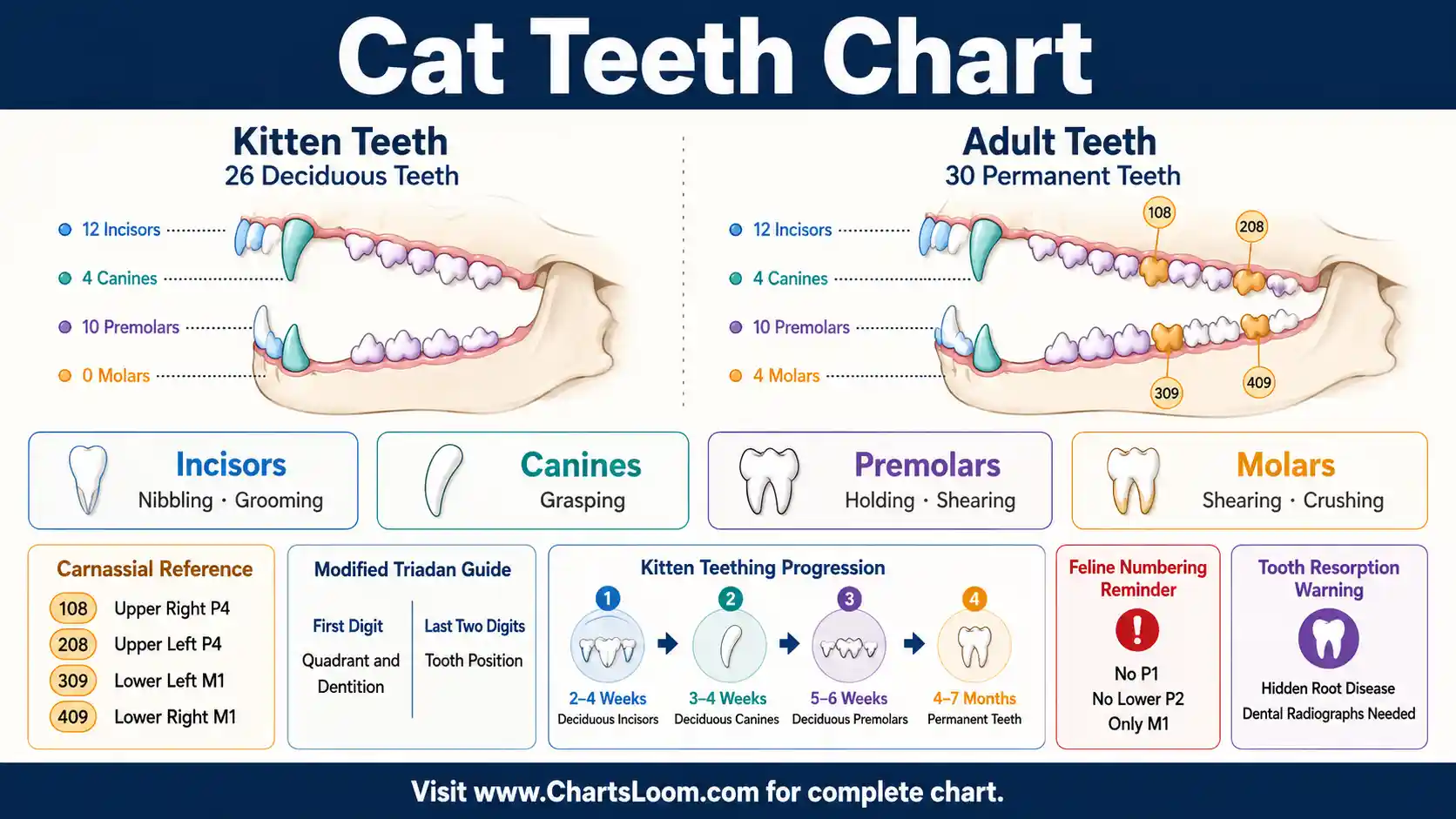
Most kittens have 26 temporary teeth, while most adult cats have 30 permanent teeth. Deciduous teeth emerge between about two and six weeks, and permanent teeth generally erupt from four to seven months. Use tooth numbers to identify location, but use a veterinary examination and dental radiographs to assess hidden disease—especially feline tooth resorption.
Kitten dentition
26 deciduous teeth
Kittens have incisors, canines and premolars, but no deciduous molars.
Adult dentition
30 permanent teeth
The adult set usually includes 12 incisors, 4 canines, 10 premolars and 4 molars.
Veterinary numbering
Modified Triadan
The first digit identifies quadrant and dentition; the last two identify position.
Most important limit
Roots are hidden
A normal-looking crown cannot rule out root resorption, pulp disease or periodontal bone loss.
Questions at a glance
How many teeth does an adult cat have?
Most adult cats have 30 permanent teeth.
How many kitten teeth are normal?
Most kittens have 26 deciduous teeth and no deciduous molars.
When do kitten teeth erupt?
Deciduous teeth generally emerge between about two and six weeks.
When are adult cat teeth complete?
Permanent feline teeth generally erupt between four and seven months.
What does tooth 108 mean?
108 is the permanent upper-right fourth premolar and an upper carnassial tooth.
What does tooth 309 mean?
309 is the permanent lower-left first molar and a lower carnassial tooth.
Why are some feline tooth numbers skipped?
Cats normally lack P1, lower P2 and molars beyond M1, so the Triadan sequence preserves intentional gaps.
What is feline tooth resorption?
It is painful loss of tooth structure that often requires radiographs to identify and classify.
Can a missing tooth still have roots?
Yes. A crown may be absent while roots remain, resorb or merge with bone.
Does visible tartar show periodontal stage?
No. Accurate staging requires probing and intraoral radiographs during a complete anesthetized assessment.
What is the best home dental care?
Daily brushing with cat-safe toothpaste is the most useful practical plaque-control method when the mouth is comfortable.
When does a broken tooth need care?
Every fracture deserves assessment; exposed pulp, facial swelling, severe pain or uncontrolled bleeding require prompt or urgent care.
Cat Teeth Overview
The normal feline mouth changes from 26 kitten teeth to 30 permanent teeth. Tooth count alone cannot confirm oral health.
Swipe horizontally inside the table to view every column.
| Feature | Typical count | Distribution | Timing or code | Why it matters |
|---|---|---|---|---|
| Deciduous teeth | 26 | 12 incisors · 4 canines · 10 premolars · 0 molars | Begin erupting at about 2–6 weeks | Temporary kitten dentition |
| Permanent teeth | 30 | 12 incisors · 4 canines · 10 premolars · 4 molars | Generally erupt at about 4–7 months | Adult feline dentition |
| Upper jaw | 16 permanent | 6 incisors · 2 canines · 6 premolars · 2 molars | Quadrants 1 and 2 | Left and right maxilla |
| Lower jaw | 14 permanent | 6 incisors · 2 canines · 4 premolars · 2 molars | Quadrants 3 and 4 | Left and right mandible |
| Incisors | 12 permanent | Three per quadrant | I1 · I2 · I3 | Nibbling, grooming and scraping |
| Canines | 4 permanent | One per quadrant | C | Grasping and puncturing |
| Premolars | 10 permanent | Three in each upper quadrant; two in each lower quadrant | P2–P4 upper · P3–P4 lower | Holding and shearing |
| Molars | 4 permanent | One per quadrant | M1 | Shearing and crushing |
| Carnassial pair | 4 key teeth | Upper P4 and lower M1 on both sides | 108/208 and 309/409 | Major shearing teeth |
| Modified Triadan | Three-digit system | First digit = quadrant; last two digits = position | 101–409 permanent | Standard veterinary charting |
| Tooth resorption | Common feline disease | Crown may look subtly abnormal or painful | Radiographs determine type and extent | Often requires extraction or crown treatment |
| Missing tooth | Not always truly absent | May be unerupted, resorbed, fractured or previously lost | Radiographs clarify | Do not assume a gap is harmless |
- • Counts describe a usual complete dentition; congenital absence, unerupted teeth, resorption and prior loss can change the visible count.
- • Eruption ages are approximate and vary among individual kittens.
Download or export
Interactive reference tool
Cat tooth number lookup
Enter a three-digit Modified Triadan number to identify its normal quadrant, tooth type, function and broad eruption timing.
Lookup result
108 — premolar 4
108 identifies the upper right premolar 4 in the Modified Triadan system.
Location
Permanent · Upper Right
Typical eruption
About 4–7 months
Function
Major shearing and cutting
Special role
Upper carnassial tooth
- 1. Use the number to match a veterinary dental chart or treatment record.
- 2. Remember that a normal-looking crown cannot rule out painful root or resorptive disease.
- 3. Seek veterinary assessment for pain, drooling, facial swelling, a fracture, a missing expected tooth or a retained kitten tooth.
This lookup identifies normal chart position only. It cannot confirm eruption, diagnose periodontal or resorptive disease, or replace an anesthetized oral examination and intraoral radiographs.
What it does
Decodes normal permanent and deciduous feline tooth numbers, including intentional numbering gaps.
Why it helps
It makes feline veterinary dental records easier to understand and distinguishes similar tooth names by exact side and jaw.
What it cannot do
It cannot diagnose pain, confirm tooth presence, stage periodontal disease or replace dental radiographs.
Adult Cat Dental Formula
The permanent feline formula is 2 × (I 3/3, C 1/1, P 3/2, M 1/1) = 30 teeth.
Swipe horizontally inside the table to view every column.
| Region | Location | Incisors | Canines | Premolars | Molars or role | Total |
|---|---|---|---|---|---|---|
| Quadrant 1 | Upper Right | 3 | 1 | 3 | 1 | 8 |
| Quadrant 2 | Upper Left | 3 | 1 | 3 | 1 | 8 |
| Quadrant 3 | Lower Left | 3 | 1 | 2 | 1 | 7 |
| Quadrant 4 | Lower Right | 3 | 1 | 2 | 1 | 7 |
| Incisors | Whole mouth | 12 | — | Three per quadrant | Nibble and groom | 12 |
| Canines | Whole mouth | 4 | — | One per quadrant | Grasp | 4 |
| Premolars | Whole mouth | 10 | — | P2–P4 upper; P3–P4 lower | Hold and shear | 10 |
| Molars | Whole mouth | 4 | — | One per quadrant | Shear and crush | 4 |
| Upper arch | Both sides | 6 | 2 | 6 | 2 | 16 |
| Lower arch | Both sides | 6 | 2 | 4 | 2 | 14 |
| Dental formula | One side, upper/lower | I 3/3 | C 1/1 | P 3/2 | M 1/1 | × 2 = 30 |
| Normal total | Whole mouth | 12 | 4 | 10 | 4 | 30 |
- • Cats have fewer premolars and molars than dogs, so skipped Triadan positions are expected.
- • The formula describes normal anatomy, not whether each tooth is present or healthy.
Download or export
Kitten Deciduous Dental Formula
The deciduous feline formula is 2 × (i 3/3, c 1/1, p 3/2) = 26 teeth, with no deciduous molars.
Swipe horizontally inside the table to view every column.
| Region | Location | Incisors | Canines | Premolars | Molars | Total |
|---|---|---|---|---|---|---|
| Quadrant 5 | Upper Right | 3 | 1 | 3 | 0 | 7 |
| Quadrant 6 | Upper Left | 3 | 1 | 3 | 0 | 7 |
| Quadrant 7 | Lower Left | 3 | 1 | 2 | 0 | 6 |
| Quadrant 8 | Lower Right | 3 | 1 | 2 | 0 | 6 |
| Incisors | Whole mouth | 12 | — | Three per quadrant | Begin about 2–4 weeks | 12 |
| Canines | Whole mouth | 4 | — | One per quadrant | About 3–4 weeks | 4 |
| Premolars | Whole mouth | 10 | — | P2–P4 upper; P3–P4 lower | About 5–6 weeks | 10 |
| Molars | Whole mouth | 0 | — | None | Kittens have no deciduous molars | 0 |
| Dental formula | One side, upper/lower | i 3/3 | c 1/1 | p 3/2 | No molars | × 2 = 26 |
| Normal total | Whole mouth | 12 | 4 | 10 | 0 | 26 |
- • Deciduous feline quadrants use the first digits 5 through 8.
- • A persistent kitten tooth beside its permanent successor requires prompt veterinary assessment.
Download or export
All Permanent Cat Teeth by Modified Triadan Number
Every normal permanent feline tooth, listed by exact three-digit Modified Triadan code.
Swipe horizontally inside the table to view every column.
| Code | Location | Tooth | Type | Typical eruption | Special role | Primary function |
|---|---|---|---|---|---|---|
| 101 | Upper Right | Incisor 1 | Incisor | About 4–7 months | — | Nibbling, grooming and scraping |
| 102 | Upper Right | Incisor 2 | Incisor | About 4–7 months | — | Nibbling, grooming and scraping |
| 103 | Upper Right | Incisor 3 | Incisor | About 4–7 months | — | Nibbling, grooming and scraping |
| 104 | Upper Right | Canine | Canine | About 4–7 months | — | Grasping and puncturing |
| 106 | Upper Right | Premolar 2 | Premolar | About 4–7 months | — | Holding and cutting |
| 107 | Upper Right | Premolar 3 | Premolar | About 4–7 months | — | Holding and cutting |
| 108 | Upper Right | Premolar 4 | Premolar | About 4–7 months | Upper carnassial | Major shearing tooth |
| 109 | Upper Right | Molar 1 | Molar | About 4–7 months | — | Shearing and crushing |
| 201 | Upper Left | Incisor 1 | Incisor | About 4–7 months | — | Nibbling, grooming and scraping |
| 202 | Upper Left | Incisor 2 | Incisor | About 4–7 months | — | Nibbling, grooming and scraping |
| 203 | Upper Left | Incisor 3 | Incisor | About 4–7 months | — | Nibbling, grooming and scraping |
| 204 | Upper Left | Canine | Canine | About 4–7 months | — | Grasping and puncturing |
| 206 | Upper Left | Premolar 2 | Premolar | About 4–7 months | — | Holding and cutting |
| 207 | Upper Left | Premolar 3 | Premolar | About 4–7 months | — | Holding and cutting |
| 208 | Upper Left | Premolar 4 | Premolar | About 4–7 months | Upper carnassial | Major shearing tooth |
| 209 | Upper Left | Molar 1 | Molar | About 4–7 months | — | Shearing and crushing |
| 301 | Lower Left | Incisor 1 | Incisor | About 4–7 months | — | Nibbling, grooming and scraping |
| 302 | Lower Left | Incisor 2 | Incisor | About 4–7 months | — | Nibbling, grooming and scraping |
| 303 | Lower Left | Incisor 3 | Incisor | About 4–7 months | — | Nibbling, grooming and scraping |
| 304 | Lower Left | Canine | Canine | About 4–7 months | — | Grasping and puncturing |
| 307 | Lower Left | Premolar 3 | Premolar | About 4–7 months | — | Holding and cutting |
| 308 | Lower Left | Premolar 4 | Premolar | About 4–7 months | — | Major shearing tooth |
| 309 | Lower Left | Molar 1 | Molar | About 4–7 months | Lower carnassial | Shearing and crushing |
| 401 | Lower Right | Incisor 1 | Incisor | About 4–7 months | — | Nibbling, grooming and scraping |
| 402 | Lower Right | Incisor 2 | Incisor | About 4–7 months | — | Nibbling, grooming and scraping |
| 403 | Lower Right | Incisor 3 | Incisor | About 4–7 months | — | Nibbling, grooming and scraping |
| 404 | Lower Right | Canine | Canine | About 4–7 months | — | Grasping and puncturing |
| 407 | Lower Right | Premolar 3 | Premolar | About 4–7 months | — | Holding and cutting |
| 408 | Lower Right | Premolar 4 | Premolar | About 4–7 months | — | Major shearing tooth |
| 409 | Lower Right | Molar 1 | Molar | About 4–7 months | Lower carnassial | Shearing and crushing |
- • Asterisks and gaps in the AVDC chart represent teeth not normally present in cats.
- • Visible crown appearance cannot show root, pulp or periodontal bone status.
Download or export
All Deciduous Kitten Teeth by Modified Triadan Number
Every normal deciduous feline tooth, including the intentional lower-premolar and molar gaps.
Swipe horizontally inside the table to view every column.
| Code | Location | Tooth | Type | Typical eruption | Dentition note | Primary function |
|---|---|---|---|---|---|---|
| 501 | Upper Right | Deciduous incisor 1 | Incisor | About 2–3 weeks | No deciduous molar | Nibbling and grooming |
| 502 | Upper Right | Deciduous incisor 2 | Incisor | About 3–4 weeks | No deciduous molar | Nibbling and grooming |
| 503 | Upper Right | Deciduous incisor 3 | Incisor | About 3–4 weeks | No deciduous molar | Nibbling and grooming |
| 504 | Upper Right | Deciduous canine | Canine | About 3–4 weeks | No deciduous molar | Grasping |
| 506 | Upper Right | Deciduous premolar 2 | Premolar | About 5–6 weeks | No deciduous molar | Holding and cutting |
| 507 | Upper Right | Deciduous premolar 3 | Premolar | About 5–6 weeks | No deciduous molar | Holding and cutting |
| 508 | Upper Right | Deciduous premolar 4 | Premolar | About 5–6 weeks | No deciduous molar | Holding and cutting |
| 601 | Upper Left | Deciduous incisor 1 | Incisor | About 2–3 weeks | No deciduous molar | Nibbling and grooming |
| 602 | Upper Left | Deciduous incisor 2 | Incisor | About 3–4 weeks | No deciduous molar | Nibbling and grooming |
| 603 | Upper Left | Deciduous incisor 3 | Incisor | About 3–4 weeks | No deciduous molar | Nibbling and grooming |
| 604 | Upper Left | Deciduous canine | Canine | About 3–4 weeks | No deciduous molar | Grasping |
| 606 | Upper Left | Deciduous premolar 2 | Premolar | About 5–6 weeks | No deciduous molar | Holding and cutting |
| 607 | Upper Left | Deciduous premolar 3 | Premolar | About 5–6 weeks | No deciduous molar | Holding and cutting |
| 608 | Upper Left | Deciduous premolar 4 | Premolar | About 5–6 weeks | No deciduous molar | Holding and cutting |
| 701 | Lower Left | Deciduous incisor 1 | Incisor | About 2–3 weeks | No deciduous molar | Nibbling and grooming |
| 702 | Lower Left | Deciduous incisor 2 | Incisor | About 3–4 weeks | No deciduous molar | Nibbling and grooming |
| 703 | Lower Left | Deciduous incisor 3 | Incisor | About 3–4 weeks | No deciduous molar | Nibbling and grooming |
| 704 | Lower Left | Deciduous canine | Canine | About 3–4 weeks | No deciduous molar | Grasping |
| 707 | Lower Left | Deciduous premolar 3 | Premolar | About 5–6 weeks | No deciduous molar | Holding and cutting |
| 708 | Lower Left | Deciduous premolar 4 | Premolar | About 5–6 weeks | No deciduous molar | Holding and cutting |
| 801 | Lower Right | Deciduous incisor 1 | Incisor | About 2–3 weeks | No deciduous molar | Nibbling and grooming |
| 802 | Lower Right | Deciduous incisor 2 | Incisor | About 3–4 weeks | No deciduous molar | Nibbling and grooming |
| 803 | Lower Right | Deciduous incisor 3 | Incisor | About 3–4 weeks | No deciduous molar | Nibbling and grooming |
| 804 | Lower Right | Deciduous canine | Canine | About 3–4 weeks | No deciduous molar | Grasping |
| 807 | Lower Right | Deciduous premolar 3 | Premolar | About 5–6 weeks | No deciduous molar | Holding and cutting |
| 808 | Lower Right | Deciduous premolar 4 | Premolar | About 5–6 weeks | No deciduous molar | Holding and cutting |
- • Kittens have no deciduous molars and no first premolars.
- • Lower deciduous quadrants contain p3 and p4 but no p2.
Download or export
Kitten Tooth Eruption and Replacement Timeline
Approximate emergence and replacement windows from the first deciduous incisors through the complete adult set.
Swipe horizontally inside the table to view every column.
| Tooth or stage | Typical timing | Replacement or next stage | Interpretation | Use |
|---|---|---|---|---|
| Deciduous I1 | 2–3 weeks | Permanent I1 at 4–7 months | First incisors | Use age as an approximate guide |
| Deciduous I2 | 3–4 weeks | Permanent I2 at 4–7 months | Middle incisors | Use age as an approximate guide |
| Deciduous I3 | 3–4 weeks | Permanent I3 at 4–7 months | Corner incisors | Use age as an approximate guide |
| Deciduous canine | 3–4 weeks | Permanent canine at 4–7 months | Long pointed tooth | Use age as an approximate guide |
| Deciduous upper P2 | 5–6 weeks | Permanent upper P2 at 4–7 months | No lower P2 | Use age as an approximate guide |
| Deciduous P3 | 5–6 weeks | Permanent P3 at 4–7 months | Upper and lower | Use age as an approximate guide |
| Deciduous P4 | 5–6 weeks | Permanent P4 at 4–7 months | Upper P4 becomes carnassial | Use age as an approximate guide |
| Permanent incisors | 4–7 months | Replace deciduous incisors | Timing varies | Use age as an approximate guide |
| Permanent canines | 4–7 months | Replace deciduous canines | Watch for retained kitten canines | Use age as an approximate guide |
| Permanent premolars | 4–7 months | Replace deciduous premolars | No feline P1 | Use age as an approximate guide |
| Permanent molars | 4–7 months | No deciduous predecessors | One per quadrant | Use age as an approximate guide |
| Two-tooth stage | During replacement | Deciduous tooth should shed | Persistent double tooth needs assessment | Use age as an approximate guide |
| Adult set | Usually by about 6–7 months | 30 permanent teeth | Count does not prove oral health | Use age as an approximate guide |
| Juvenile gingivitis window | Around 6–8 months | Inflamed gums may appear | Bad breath or swelling needs assessment | Use age as an approximate guide |
| Missing expected tooth | After eruption window | Could be unerupted or absent | Radiographs clarify | Use age as an approximate guide |
| Fractured kitten tooth | Any age | Pulp may be exposed | Prompt veterinary care | Use age as an approximate guide |
| Delayed eruption | Beyond expected window | Individual variation or abnormality | Discuss with veterinarian | Use age as an approximate guide |
| Age estimate limit | After adult eruption | Wear is highly variable | Teeth cannot prove exact adult age | Use age as an approximate guide |
- • Merck reports average timing subject to considerable variation.
- • After adult eruption, tooth wear cannot establish an exact chronological age.
Download or export
Feline Tooth Types, Roots and Functions
Compare feline incisors, canines, premolars and molars, including their roles and common root patterns.
Swipe horizontally inside the table to view every column.
| Code or structure | Name | Normal count | Key feature | Primary role |
|---|---|---|---|---|
| I1 | Central incisor | 4 total | Smallest incisor | Fine grooming |
| I2 | Intermediate incisor | 4 total | Between I1 and I3 | Nibbling |
| I3 | Corner incisor | 4 total | Nearest canine | Scraping |
| C | Canine | 4 total | Long rooted | Grasping prey |
| Upper P2 | Premolar | 2 total | First upper cheek tooth | Holding |
| Upper P3 | Premolar | 2 total | Middle upper cheek tooth | Cutting |
| Upper P4 | Premolar | 2 total | Upper carnassial | Major shearing |
| Upper M1 | Molar | 2 total | Small caudal upper tooth | Crushing/shearing |
| Lower P3 | Premolar | 2 total | First lower cheek tooth | Holding |
| Lower P4 | Premolar | 2 total | Caudal lower premolar | Cutting |
| Lower M1 | Molar | 2 total | Lower carnassial | Major shearing |
| Incisor roots | Single | 12 teeth | Usually one root | Hidden below gum |
| Canine roots | Single, very long | 4 teeth | Root longer than crown | Fracture can be serious |
| Upper P2 roots | Usually two | 2 teeth | Small cheek tooth | Radiographs map roots |
| Upper P3 roots | Usually two | 2 teeth | Cheek tooth | Radiographs guide treatment |
| Upper P4 roots | Three | 2 teeth | Carnassial | Complex extraction |
| Upper M1 roots | Usually two | 2 teeth | Caudal molar | Resorption can be hidden |
| Lower P3 roots | Usually two | 2 teeth | Cheek tooth | Root disease can be occult |
| Lower P4 roots | Usually two | 2 teeth | Cheek tooth | Often affected by resorption |
| Lower M1 roots | Usually two | 2 teeth | Carnassial | Major chewing tooth |
- • Root counts and anatomy can vary; intraoral radiographs are used before and after many dental procedures.
- • Function descriptions are simplified educational summaries.
Download or export
Feline Modified Triadan Quadrant and Position Guide
Decode the first digit for quadrant and dentition, then the final two digits for normal feline tooth position.
Swipe horizontally inside the table to view every column.
| Code part | Dentition | Jaw | Side | Meaning or prefix | Examples or normal use | Expected gaps |
|---|---|---|---|---|---|---|
| 1 | Permanent | Upper | Right | 100+ | 101 incisor · 104 canine · 108 P4 · 109 M1 | 105 absent |
| 2 | Permanent | Upper | Left | 200+ | 201 incisor · 204 canine · 208 P4 · 209 M1 | 205 absent |
| 3 | Permanent | Lower | Left | 300+ | 301 incisor · 304 canine · 308 P4 · 309 M1 | 305–306 absent |
| 4 | Permanent | Lower | Right | 400+ | 401 incisor · 404 canine · 408 P4 · 409 M1 | 405–406 absent |
| 5 | Deciduous | Upper | Right | 500+ | 501 incisor · 504 canine · 508 p4 | 505 absent; no molars |
| 6 | Deciduous | Upper | Left | 600+ | 601 incisor · 604 canine · 608 p4 | 605 absent; no molars |
| 7 | Deciduous | Lower | Left | 700+ | 701 incisor · 704 canine · 708 p4 | 705–706 absent; no molars |
| 8 | Deciduous | Lower | Right | 800+ | 801 incisor · 804 canine · 808 p4 | 805–806 absent; no molars |
| 01 | Position code | — | — | I1 | All quadrants | Keep skipped numbers |
| 02 | Position code | — | — | I2 | All quadrants | Keep skipped numbers |
| 03 | Position code | — | — | I3 | All quadrants | Keep skipped numbers |
| 04 | Position code | — | — | Canine | All quadrants | Keep skipped numbers |
| 05 | Position code | — | — | P1 | Not normally present in cats | Keep skipped numbers |
| 06 | Position code | — | — | P2 | Upper only | Keep skipped numbers |
| 07 | Position code | — | — | P3 | Upper and lower | Keep skipped numbers |
| 08 | Position code | — | — | P4 | Upper and lower | Keep skipped numbers |
| 09 | Position code | — | — | M1 | Permanent only; all quadrants | Keep skipped numbers |
| 10 | Position code | — | — | M2 | Not normally present | Keep skipped numbers |
| 11 | Position code | — | — | M3 | Not normally present | Keep skipped numbers |
| First digit | Position code | — | — | Quadrant and dentition | 1–4 permanent; 5–8 deciduous | Keep skipped numbers |
- • Cats preserve numbering gaps for teeth present in other species but not normally present in feline dentition.
- • Quadrants are viewed from the animal’s perspective.
Download or export
Cat Carnassial Teeth
The upper fourth premolars and lower first molars form the four major feline shearing teeth.
Swipe horizontally inside the table to view every column.
| Code or feature | Location or tooth | Structure | Opposes or action | Concern | Response |
|---|---|---|---|---|---|
| 108 | Upper Right | P4 | Three roots | Opposes 409 | Major shearing |
| 208 | Upper Left | P4 | Three roots | Opposes 309 | Major shearing |
| 309 | Lower Left | M1 | Two roots | Opposes 208 | Major shearing |
| 409 | Lower Right | M1 | Two roots | Opposes 108 | Major shearing |
| Upper carnassial | P4 | Large blade-like crown | Complex root anatomy | Fracture or resorption may be painful | Radiographs guide treatment |
| Lower carnassial | M1 | Long shearing crown | Two roots | Major chewing load | Radiographs guide treatment |
| Normal action | Scissor-like occlusion | Upper P4 passes outside lower M1 | Cuts meat | Not a grinding surface | Alignment matters |
| Crown fracture | Visible crack or missing piece | Pulp may be exposed | Pain may be subtle | Prompt assessment | Do not wait for appetite loss |
| Tooth resorption | Crown defect may be small | Root change can be extensive | Painful | Radiographs essential | Treatment is veterinary |
| Facial swelling | Often upper tooth-root concern | May appear below eye | Possible infection | Urgent assessment | Do not squeeze |
| Chewing change | Drops food or favors one side | Oral pain possible | Observe but do not diagnose | Arrange exam | Cats may keep eating |
| Hard-object risk | Bones, antlers and hard items | Can fracture carnassials | Use safer options | Ask veterinarian | No chew is risk-free |
- • Carnassial teeth may fracture or develop resorption while the cat continues eating.
- • Full diagnosis requires an anesthetized examination and intraoral radiographs.
Download or export
Cat Tooth Anatomy and Dental Terms
Key structures and charting terms used to describe feline teeth, roots, gums and supporting tissues.
Swipe horizontally inside the table to view every column.
| Structure or term | What it is | Key feature | Possible problem | Why it matters |
|---|---|---|---|---|
| Crown | Visible part above gum | Enamel covers crown | Can fracture or resorb | Appearance alone is incomplete |
| Root | Anchors tooth below gum | Longer than crown in many teeth | Hidden disease common | Radiographs required |
| Enamel | Hard outer crown layer | Thin in cats | Does not regrow | Damage exposes dentin |
| Dentin | Main tooth substance | Surrounds pulp | Sensitive when exposed | Can be destroyed by resorption |
| Pulp chamber | Nerves and blood vessels | Center of tooth | Exposure is painful | Requires treatment |
| Cementum | Covers root | Supports attachment | Affected in resorption | Seen radiographically |
| Periodontal ligament | Between root and bone | Suspends tooth | Lost in periodontitis | Cannot be assessed by crown alone |
| Alveolar bone | Socket-supporting bone | Supports roots | Bone loss defines periodontitis | Radiographs show loss |
| Gingiva | Gum tissue | Protective seal | Inflamed in gingivitis | Redness is not normal |
| Gingival sulcus | Space around tooth | Probed during exam | Deep pockets indicate disease | Requires anesthesia for full charting |
| Plaque | Bacterial biofilm | Forms rapidly | Causes gingivitis | Daily removal helps |
| Calculus | Mineralized plaque | Rough surface | Signals plaque retention | Removal alone is incomplete care |
| Furcation | Area between roots | Multi-rooted teeth | Exposure marks advanced disease | Radiographs and probing |
| Occlusion | How teeth meet | Species-specific alignment | Malocclusion can injure tissue | Assessment is individualized |
| Resorptive lesion | Tooth structure lost | Common in cats | Often painful | Radiographs classify |
| Root remnant | Root left below gum | May follow fracture or resorption | Can be painful | Imaging clarifies |
| Oral mucosa | Soft tissue lining mouth | Can inflame or ulcerate | Stomatitis affects wider tissues | Needs veterinary care |
| Dental chart | Written tooth-by-tooth record | Uses Triadan codes | Tracks findings and treatment | Useful for follow-up |
| Intraoral radiograph | Image of roots and bone | Required for full assessment | Finds hidden disease | Taken under anesthesia |
| Conscious exam | Initial visual screen | Can underestimate disease | No complete probing or radiographs | Not a full dental procedure |
- • Most clinically important tooth structure lies below the gumline.
- • A conscious visual examination can underestimate oral disease.
Download or export
Feline Tooth Resorption Chart
Visible clues, radiographic types, stages and treatment principles for a common and often painful feline dental disease.
Swipe horizontally inside the table to view every column.
| Feature | Description | What may be seen | Clinical meaning | Action |
|---|---|---|---|---|
| Definition | Loss of tooth structure by odontoclast activity | Often begins below or near gumline | Common in cats | Painful disease |
| Visible clue | Pink or red tissue at crown defect | May look like gum growing over tooth | Not always visible | Do not probe at home |
| Behavior clue | Head shaking or food dropping | May avoid hard food | Cats may hide pain | Book assessment |
| Jaw chattering | Rapid jaw movement during eating or oral exam | Can signal oral pain | Not specific | Veterinary evaluation |
| Drooling | Excess saliva or blood-tinged saliva | Oral pain possible | Multiple causes | Prompt exam |
| Missing crown | Tooth appears absent | Root may remain or resorb | Cannot classify visually | Radiographs required |
| Type 1 pattern | Root retains normal density | Periodontal ligament space remains | Extraction generally indicated | Radiographs define |
| Type 2 pattern | Root loses normal outline and merges with bone | Replacement resorption | Crown amputation may be considered in selected cases | Radiographs define |
| Type 3 pattern | Mixed type 1 and type 2 changes | Different roots may differ | Treatment tailored by root | Radiographs define |
| Stage 1 | Mild dental hard-tissue loss | Small lesion | Clinical significance varies | Veterinary staging |
| Stage 2 | Moderate hard-tissue loss | Reaches dentin but not pulp | Often painful | Veterinary treatment |
| Stage 3 | Deep hard-tissue loss | Extends into pulp | Much structure remains | Veterinary treatment |
| Stage 4 | Extensive hard-tissue loss | Major crown/root destruction | Substages describe remnants | Veterinary treatment |
| Stage 5 | Crown absent | Root remnants visible radiographically | Gum may cover site | Veterinary decision |
| Diagnosis | Anesthetized oral exam plus full-mouth radiographs | Visual exam alone misses lesions | Image every tooth | Professional procedure |
| Treatment goal | Remove source of pain | Extraction or selected crown amputation | Depends on radiographic type | No home cure |
| Antibiotics | Do not reverse resorption | May be used for separate infection indications | Not primary treatment | Veterinarian decides |
| Brushing | Helps plaque control | Does not stop existing resorption | Avoid painful areas | Start only if comfortable |
| Diet | Texture does not cure lesions | Soft food may be easier temporarily | Nutrition still matters | Follow veterinary advice |
| Recurrence | Other teeth may develop lesions later | Rechecks matter | Not caused by owner failure | Monitor over life |
| Age | Risk generally rises with age | Young cats can still be affected | Age alone is not diagnosis | Screen all adults |
| Breed | Any cat may be affected | Some studies report variation | Do not exclude by breed | Use examination |
| Home inspection | Lift lip only if cat is comfortable | Look for redness, defects or missing crowns | Do not force mouth open | Stop if stressed |
| Emergency threshold | Severe bleeding, trauma or inability to eat | Urgent care | Resorption itself may be chronic | Pain still matters |
| Key limitation | No chart can classify a lesion | Roots determine treatment | Radiographs are imperative | Seek veterinary dentistry |
- • Dental radiographs are imperative for determining the type and extent of feline tooth resorption.
- • Do not probe suspected lesions or attempt home treatment.
Download or export
Cat Periodontal Disease Stages
Periodontal staging depends on attachment loss, probing and radiographs—not visible tartar alone.
Swipe horizontally inside the table to view every column.
| Stage or finding | Definition | Visible or hidden clue | Meaning | Response |
|---|---|---|---|---|
| Healthy | No gingivitis or attachment loss | Pink firm gingiva | Routine prevention | Home care and exams |
| Gingivitis | Inflammation confined to gingiva | Redness or bleeding | Reversible with plaque control | Professional assessment |
| Stage 1 | Gingivitis only | No attachment loss | Early disease | Cleaning and home care plan |
| Stage 2 | Less than 25% attachment loss | Early periodontitis | Hidden pockets possible | Treatment under anesthesia |
| Stage 3 | 25–50% attachment loss | Moderate periodontitis | Mobility or furcation possible | Advanced treatment/extraction |
| Stage 4 | More than 50% attachment loss | Advanced periodontitis | Severe support loss | Extraction often required |
| Plaque | Soft bacterial film | Often invisible | Primary driver | Daily removal |
| Calculus | Mineralized plaque | Visible brown/tan deposits | Retains plaque | Professional removal |
| Pocket depth | Space measured with probe | Cannot be judged at home | Part of staging | Requires anesthesia |
| Bone loss | Loss around roots | Hidden below gum | Defines periodontitis | Radiographs required |
| Furcation exposure | Loss between roots | Advanced disease sign | Multi-rooted teeth | Professional treatment |
| Mobility | Tooth moves abnormally | Support loss or trauma | Painful risk | Prompt care |
| Bad breath | Common warning | Not normal aging | Multiple causes | Dental exam |
| Bleeding gum | Inflammation or trauma | Not normal brushing outcome | Stop if painful | Seek advice |
| Appetite normal | Does not rule out disease | Cats often continue eating | Watch subtle changes | Routine exams matter |
| Anesthesia-free scaling | Cleans visible crown only | No full probing/radiographs | Not equivalent to comprehensive dentistry | Avoid false reassurance |
| Professional cleaning | Above and below gumline | Includes charting and polishing | Under anesthesia | Treatment individualized |
| Pain control | Essential part of dentistry | Local blocks and analgesia | Veterinary plan | Do not give human medicines |
| Recheck | Confirms healing and home-care plan | Timing varies | Especially after treatment | Follow discharge plan |
| Prevention | Begins at first visits | Individualized throughout life | Plaque control and exams | Adjust for comfort |
- • Gingivitis can be reversible; periodontitis includes irreversible attachment loss.
- • Staging requires an anesthetized examination, periodontal probing and intraoral radiographs.
Download or export
Cat Dental Home-Care Chart
Practical plaque-control steps, product choices, safety limits and professional-care reminders.
Swipe horizontally inside the table to view every column.
| Method or issue | Purpose | How to use | Safety note | Limit |
|---|---|---|---|---|
| Daily brushing | Most effective practical plaque control | Use cat-safe toothpaste | Introduce gradually | Only if mouth is comfortable |
| Finger introduction | Touch cheek and lips briefly | Reward calm behavior | Short sessions | Stop before stress |
| Taste introduction | Offer tiny cat-safe toothpaste taste | Never use human toothpaste | Pair with reward | No force |
| Brush choice | Small soft brush or veterinary finger brush | Fit cat and handler | Replace when worn | Avoid hard bristles |
| Brushing angle | Aim toward gumline | Gentle circular motion | Outer surfaces first | Do not pry mouth open |
| Session length | A few seconds at first | Build slowly | Consistency matters | End positively |
| Frequency | Daily preferred | Several times weekly better than none | Plaque reforms quickly | Follow veterinary advice |
| Pain check | Stop for flinch, bleeding or refusal | Oral disease may be present | Do not push through pain | Book exam |
| VOHC products | Choose accepted products when available | Evidence varies by product | Use as adjunct | Not a substitute for exams |
| Dental diet | Some formulations reduce plaque/calculus | Must fit nutrition needs | Measure calories | Veterinarian can advise |
| Dental treats | May support plaque control | Count calories | Correct size and supervision | Not disease treatment |
| Water additives | Use feline-safe labeled product | Acceptance varies | Do not alter drinking | Monitor intake |
| Gels and wipes | May help selected cats | Less effective than brushing | Use gently | Avoid painful mouth |
| Hard chews | Can fracture teeth | Cats rarely need hard chews | Avoid bones/antlers | Safer product advice |
| Human toothpaste | Do not use | Ingredients and foaming agents unsuitable | No swallowing risk assumption | Use feline product |
| Baking soda | Do not improvise | Can upset electrolyte balance | Unnecessary | Use approved product |
| Professional exam | At least as veterinarian recommends | Frequency individualized | More often with disease | Includes oral history |
| Dental radiographs | Reveal roots and bone | Needed for hidden lesions | Especially resorption | Taken under anesthesia |
| Anesthesia | Enables safe complete procedure | Airway protection and monitoring | Risk assessed individually | Age alone is not contraindication |
| Home inspection | Briefly lift lip if tolerated | Look for redness, defects, odor | Do not force | Record changes |
| Weight and appetite | Track food intake and weight | Oral pain may reduce eating | Subtle change matters | Seek care |
| Food dropping | Possible dental pain | May be unilateral | Video can help history | Book exam |
| Pawing at mouth | Pain or foreign body possible | Do not reach blindly | Urgent if choking | Veterinary advice |
| String under tongue | Do not pull | Can be anchored internally | Emergency | Transport safely |
| Broken tooth | Do not wait for color change | Pulp exposure can hurt | Prompt exam | No home repair |
| Missing tooth | Ask whether expected | Could hide root disease | Radiograph if indicated | Document number |
| Post-procedure care | Follow feeding and medication instructions | Prevent pawing if advised | Monitor bleeding/swelling | Attend recheck |
| Stress reduction | Use carrier training and calm handling | Feline-friendly visits | Ask for previsit plan | Never withhold prescribed meds |
| Senior cats | Oral disease can affect quality of life | Eating may continue despite pain | Regular assessment | Imaging remains important |
| Home-care limit | Cannot cure resorption or periodontitis | Cannot remove subgingival disease | Supports prevention only | Professional treatment when needed |
- • Begin only when the mouth is comfortable and the cat can participate without force.
- • Home care supports prevention but does not treat tooth resorption, fractures or established periodontitis.
Download or export
Cat Dental Warning Signs
Oral changes that warrant routine, prompt, urgent or emergency veterinary attention.
Swipe horizontally inside the table to view every column.
| Sign | What it looks like | Possible concern | Action level | Important note |
|---|---|---|---|---|
| Bad breath | Persistent foul odor | Gingivitis, periodontitis or other oral disease | Book dental exam | Not normal aging |
| Drooling | New or excessive saliva | Pain, nausea, foreign body or disease | Prompt assessment | Urgent if breathing trouble |
| Blood in saliva | Pink or red saliva | Inflammation, trauma or lesion | Prompt assessment | Urgent if uncontrolled |
| Food dropping | Kibble falls from mouth | Oral pain or mechanical problem | Book exam | Cats may still eat |
| Chewing one side | Avoids one side | Localized pain possible | Prompt exam | Do not test painful tooth |
| Head tilt while eating | Changes head position | Oral discomfort possible | Record video | Veterinary assessment |
| Pawing at mouth | Repeated pawing | Pain or foreign body | Prompt care | Do not reach blindly |
| Jaw chattering | Rapid jaw movement | Often reported with dental pain | Prompt exam | Not a diagnosis |
| Reduced appetite | Eats less or slower | Pain or systemic illness | Same-day advice if persistent | Urgent if not eating |
| Weight loss | Unplanned loss | Pain or broader illness | Prompt assessment | Track trend |
| Red gums | Inflamed gingiva | Gingivitis | Dental exam | Do not scrub painful gums |
| Gum swelling | Localized or diffuse enlargement | Inflammation, mass or infection | Prompt assessment | Imaging may be needed |
| Visible crown defect | Hole or pink area | Resorption or fracture | Prompt dental exam | Do not probe |
| Broken tooth | Missing crown piece | Pulp exposure possible | Prompt care | Urgent with severe pain/bleeding |
| Discolored tooth | Gray, purple or pink tooth | Pulp injury possible | Dental evaluation | Radiographs needed |
| Loose adult tooth | Moves abnormally | Support loss or trauma | Prompt care | Do not pull |
| Missing adult tooth | Gap where expected | Absent, unerupted, resorbed or lost | Radiograph if indicated | Use Triadan record |
| Double canine | Kitten and adult tooth together | Retained deciduous tooth | Prompt assessment | Do not pull at home |
| Facial swelling | Swelling near cheek or jaw | Root infection or mass possible | Urgent care | May worsen quickly |
| Nasal discharge one side | Persistent unilateral discharge | Dental or nasal disease possible | Prompt evaluation | Imaging may be needed |
| Open-mouth breathing | Breathing with mouth open | Respiratory emergency in cats | Emergency care | Do not inspect mouth |
| String or thread | Visible under tongue or from mouth | Linear foreign body risk | Emergency care | Never pull |
| Trauma | Fall, bite or collision | Fracture or jaw injury | Urgent evaluation | Handle gently |
| Cannot close mouth | Jaw or foreign-body emergency | Severe pain and dehydration risk | Emergency | Do not manipulate |
| Sudden refusal of food | No intake plus pain signs | Dental or systemic emergency | Same-day/urgent care | Cats risk hepatic lipidosis |
- • Cats often conceal oral pain and may continue eating despite substantial disease.
- • Open-mouth breathing, inability to close the mouth and linear foreign bodies are emergencies.
Download or export
Cat Teeth Worked Examples
Fifty examples showing how to interpret tooth numbers, eruption stages, resorption clues and dental warning signs.
Swipe horizontally inside the table to view every column.
| No. | Scenario | Interpretation | Why it matters | Next step |
|---|---|---|---|---|
| 1 | Lookup 108 | Permanent upper-right P4 | Upper carnassial; three-rooted tooth | Match dental record |
| 2 | Lookup 208 | Permanent upper-left P4 | Upper carnassial | Match dental record |
| 3 | Lookup 309 | Permanent lower-left M1 | Lower carnassial | Match dental record |
| 4 | Lookup 409 | Permanent lower-right M1 | Lower carnassial | Match dental record |
| 5 | Lookup 104 | Permanent upper-right canine | Long-rooted grasping tooth | Match dental record |
| 6 | Lookup 204 | Permanent upper-left canine | Long-rooted grasping tooth | Match dental record |
| 7 | Lookup 304 | Permanent lower-left canine | Long-rooted grasping tooth | Match dental record |
| 8 | Lookup 404 | Permanent lower-right canine | Long-rooted grasping tooth | Match dental record |
| 9 | Lookup 106 | Permanent upper-right P2 | Cats have upper P2 | Match dental record |
| 10 | Lookup 306 | Invalid feline position | Cats have no lower P2 | Respect intentional gap |
| 11 | Lookup 105 | Invalid feline position | Cats have no P1 | Respect intentional gap |
| 12 | Lookup 110 | Invalid feline position | Cats have no M2 | Respect intentional gap |
| 13 | Lookup 506 | Deciduous upper-right p2 | Normal kitten tooth | Match dental record |
| 14 | Lookup 607 | Deciduous upper-left p3 | Normal kitten tooth | Match dental record |
| 15 | Lookup 708 | Deciduous lower-left p4 | Normal kitten tooth | Match dental record |
| 16 | Lookup 806 | Invalid kitten position | No lower deciduous p2 | Respect intentional gap |
| 17 | Lookup 509 | Invalid kitten position | Kittens have no deciduous molars | Respect intentional gap |
| 18 | A 3-week kitten has incisors | Expected early eruption | Age estimate remains approximate | Monitor growth |
| 19 | A 6-week kitten has premolars | Expected deciduous stage | 26 teeth may be present | Do not force count |
| 20 | A 5-month kitten loses a tooth | Normal replacement may occur | Permanent teeth erupt 4–7 months | Monitor comfort |
| 21 | A 7-month kitten has two canines together | Retained deciduous canine possible | Crowding risk | Prompt dental assessment |
| 22 | An adult cat has only 29 visible teeth | Missing tooth may be unerupted, lost or resorbed | Visual count is incomplete | Radiographs clarify |
| 23 | Pink defect at gumline | Tooth resorption possible | Often painful | Prompt dental exam |
| 24 | Cat chatters jaw over food | Oral pain possible | Not specific | Prompt dental assessment |
| 25 | Cat drops dry food but eats wet food | Oral pain possible | Texture preference can mask disease | Book exam |
| 26 | Cat keeps eating despite bad breath | Eating does not rule out pain | Periodontal disease possible | Dental assessment |
| 27 | Cat has red gums | Gingivitis possible | Potentially reversible early | Professional plan |
| 28 | Cat has missing crown but smooth gum | Root remnants or type 2 resorption possible | Cannot tell visually | Radiographs required |
| 29 | Cat resists brushing one side | Localized pain possible | Stop painful handling | Seek assessment |
| 30 | Daily brushing causes bleeding | Inflammation may be present | Do not continue forcefully | Ask veterinarian |
| 31 | Cat has string under tongue | Linear foreign body possible | Do not pull | Emergency care |
| 32 | Cat has open-mouth breathing | Respiratory emergency | Not a dental behavior sign | Emergency care |
| 33 | Anesthesia-free cleaning is offered | Visible crown cleaning only | No complete probing or radiographs | Not equivalent to comprehensive dentistry |
| 34 | Senior cat needs dental treatment | Age alone does not decide suitability | Individual risk assessment | Veterinary team plans anesthesia |
| 35 | Cat has gray canine after trauma | Pulp injury or death possible | May later infect | Dental radiographs |
| 36 | Cat has facial swelling below eye | Upper tooth-root disease possible | Urgent evaluation | Do not squeeze |
| 37 | Hard bone chew fractures 108 | Carnassial fracture | Pulp exposure risk | Prompt treatment |
| 38 | Cat has no visible 307 | Could be absent, resorbed or lost | Lower P3 is expected | Radiograph if clinically indicated |
| 39 | Cat has no 305 | Normal intentional gap | Cats lack P1 | No action for code gap |
| 40 | Cat has no 310 | Normal intentional gap | Cats have one molar per quadrant | No action for code gap |
| 41 | Kitten swallows a shed incisor | Usually harmless | Observe for choking only | No forced retrieval |
| 42 | Cat has tartar but no odor | Disease can still exist | Visible tartar does not stage disease | Routine dental exam |
| 43 | Cat has fresh breath but hidden resorption | Odor absence does not rule out pain | Radiographs reveal hidden lesions | Routine assessment |
| 44 | Cat eats only on one side | Localized oral pain possible | Watch video without provoking | Book exam |
| 45 | Cat scratches at face after eating | Pain or foreign body possible | Do not reach blindly | Prompt care |
| 46 | Cat has a loose adult incisor | Not normal | Periodontal loss or trauma possible | Prompt exam |
| 47 | Kitten tooth remains after adult eruption | Retained deciduous tooth | No two teeth should occupy one site | Prompt treatment plan |
| 48 | Cat has crown amputation discussed | May suit selected type 2 lesions | Only after radiographic classification | Veterinary dentist decides |
| 49 | Cat receives antibiotics for resorption | Antibiotics do not cure resorption | Pain source remains | Definitive dental treatment |
| 50 | Cat refuses all food for a day | Urgent due to illness and hepatic lipidosis risk | Oral pain one possibility | Same-day veterinary care |
- • Examples are educational and do not replace a hands-on oral examination or dental radiographs.
- • A cat that continues eating can still have substantial dental pain.
Download or export
Practical limitations
- • Tooth eruption ages are approximate and cannot prove a cat’s exact age after the adult set is present.
- • A visible crown does not reveal root resorption, pulp status, periodontal pockets or bone loss.
- • The lookup identifies normal chart position only; it cannot confirm whether the tooth is present or healthy.
- • Home brushing does not reverse attachment loss, repair a fracture or treat feline tooth resorption.
- • Missing, doubled, discolored, loose or painful teeth require veterinary evaluation.
Frequently asked questions
How many teeth do adult cats have?
Most adult cats have 30 permanent teeth: 12 incisors, 4 canines, 10 premolars and 4 molars.
How many baby teeth do kittens have?
Most kittens have 26 deciduous teeth: 12 incisors, 4 canines and 10 premolars. Kittens have no deciduous molars.
When do kitten teeth come in?
Deciduous incisors begin at about 2–4 weeks, canines around 3–4 weeks and premolars around 5–6 weeks.
When do cats get adult teeth?
Permanent feline teeth generally erupt between about 4 and 7 months of age.
What is the Modified Triadan system?
It is a three-digit veterinary numbering system in which the first digit identifies quadrant and dentition and the final two digits identify tooth position.
What tooth is 108 in a cat?
108 is the permanent upper-right fourth premolar, one of the upper carnassial teeth.
What tooth is 309 in a cat?
309 is the permanent lower-left first molar, one of the lower carnassial teeth.
Why are feline tooth numbers skipped?
The sequence preserves positions used across species even though cats normally lack P1, lower P2 and molars beyond M1.
What is feline tooth resorption?
It is painful destruction of tooth structure that often begins near or below the gumline and requires dental radiographs for classification.
Can a missing cat tooth still have roots?
Yes. The crown may be absent while roots remain, resorb or merge with bone, so radiographs are needed.
What is a retained kitten tooth?
It is a deciduous tooth that remains when the permanent successor erupts, creating a double-tooth position and plaque trap.
Can visible tartar show periodontal stage?
No. Accurate staging requires an anesthetized tooth-by-tooth examination, periodontal probing and intraoral radiographs.
Is anesthesia-free dental cleaning equivalent to veterinary dentistry?
No. It cannot provide complete subgingival cleaning, periodontal probing or diagnostic dental radiographs.
How often should I brush my cat’s teeth?
Daily brushing is the most effective practical home plaque-control routine when the mouth is comfortable and the cat accepts it.
When is a cat dental problem urgent?
Seek urgent or emergency care for open-mouth breathing, inability to close the mouth, facial swelling, uncontrolled bleeding, severe trauma or string under the tongue.
Sources
External source addresses are shown as plain text. They are not clickable page links.
Merck Veterinary Manual — Dental Development of Cats
Summarizes the normal 26-tooth deciduous and 30-tooth permanent feline dentitions and the broad eruption timeline from kitten teeth through the adult set.
https://www.merckvetmanual.com/cat-owners/digestive-disorders-of-cats/dental-development-of-cats
American Veterinary Dental College — Triadan Tooth Numbers — Canine and Feline Dentition
Provides the Modified Triadan numbering system and normal feline permanent and deciduous tooth positions, including intentional numbering gaps.
https://avdc.org/PDF/Triadan_Tooth_Numbering_System.pdf
American Animal Hospital Association — 2019 AAHA Dental Care Guidelines for Dogs and Cats
Covers complete oral assessment, intraoral radiography, periodontal staging, tooth resorption, professional treatment and preventive home care.
https://www.aaha.org/public_documents/guidelines/aaha_dental_guidelines.pdf