Biology · Cell Biology and Molecular Organization
Cell Organelles Chart for Structures, Functions, and Cell Types
Compare major cell organelles, membrane status, functions, trafficking pathways, animal and plant cell differences, prokaryotic structures, and common microscopy clues.
Cell diagrams are simplified models. Organelle size, shape, abundance, and location vary by species, cell type, developmental stage, preparation method, and current cellular activity.
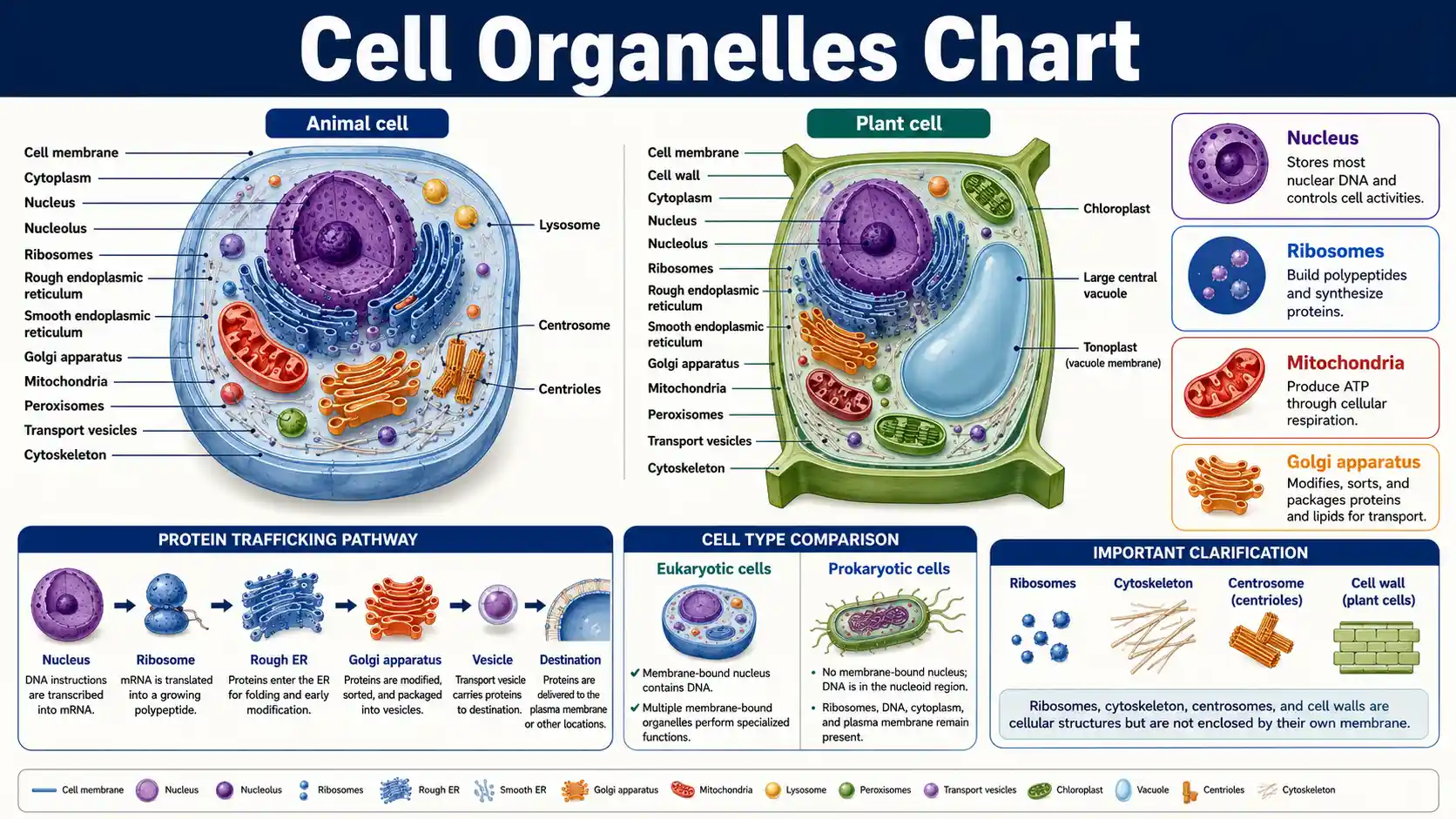
What are the main cell organelles?
Major eukaryotic organelles include the nucleus, endoplasmic reticulum, Golgi apparatus, mitochondria, lysosomes, peroxisomes, endosomes, vesicles, and—in photosynthetic cells—chloroplasts. Ribosomes and the cytoskeleton are essential non-membrane structures.
The NIGMS organelle tour introduces how these structures divide cellular work while remaining connected through transport, signaling, and metabolism.
Genetic compartment
Nucleus
The nucleus encloses most nuclear DNA, while the nucleolus assembles ribosomal subunits inside it.
Protein pathway
Ribosome → ER → Golgi
Many secreted and membrane proteins move through this coordinated synthesis, folding, modification, and sorting pathway.
Energy conversion
Mitochondria and chloroplasts
Both use internal membranes and proton gradients, but chloroplasts occur in photosynthetic eukaryotes.
Cellular organization
Dynamic compartments
Organelles move, reshape, divide, fuse, exchange cargo, and change abundance according to cellular needs.
Essential cell organelle questions
These direct answers establish the core functions before the detailed comparison charts.
What is a cell organelle?
A cell organelle is a specialized structure that performs a defined cellular function.
Which organelle stores DNA?
The nucleus stores most nuclear DNA in eukaryotic cells, while mitochondria and chloroplasts retain smaller genomes.
Which structure makes proteins?
Ribosomes translate messenger RNA into polypeptide chains.
What does rough ER do?
Rough ER synthesizes and begins processing many secreted, lysosomal, and membrane proteins.
What does smooth ER do?
Smooth ER supports lipid synthesis, calcium handling, and specialized detoxification reactions.
What does the Golgi apparatus do?
The Golgi modifies and sorts proteins and lipids received from the ER.
Which organelle produces most ATP?
Mitochondria produce most ATP from aerobic metabolism in many eukaryotic cells.
Which organelle performs photosynthesis?
Chloroplasts perform photosynthesis in plants and photosynthetic algae.
What do lysosomes do?
Lysosomes digest and recycle macromolecules in an acidic, enzyme-containing compartment.
Do plant cells have mitochondria?
Yes. Plant cells use mitochondria for respiration and may also contain chloroplasts.
Do bacteria have a nucleus?
No. Bacterial DNA occupies a nucleoid region rather than a membrane-bound nucleus.
Are organelles fixed in place?
No. Organelles move and change shape, number, position, and activity as cells respond to changing conditions.
Cell Organelles and Structures Overview
This chart compares major eukaryotic organelles and several essential non-membrane cellular structures. The word organelle is used differently across textbooks, so membrane status is shown explicitly.
Swipe horizontally inside the table to view every column.
| Structure | Membrane status | Core function | Typical location | Common in |
|---|---|---|---|---|
| Nucleus | Double membrane | Stores most nuclear DNA and coordinates gene expression | Usually within the cytoplasm | Animal, plant, fungal, and protist cells |
| Nucleolus | No surrounding membrane | Produces ribosomal RNA and assembles ribosomal subunits | Inside the nucleus | Eukaryotic cells |
| Ribosome | No membrane — Non-membrane structure | Translates messenger RNA into polypeptides | Free in cytosol or attached to rough ER; also inside mitochondria and chloroplasts | All cells |
| Rough endoplasmic reticulum | Single membrane network | Synthesizes and begins processing many secreted, lysosomal, and membrane proteins | Continuous with the nuclear envelope | Eukaryotic cells |
| Smooth endoplasmic reticulum | Single membrane network | Synthesizes lipids, stores calcium in specialized cells, and supports detoxification reactions | Continuous with rough ER | Eukaryotic cells |
| Golgi apparatus | Single membrane stacks | Modifies, sorts, and packages proteins and lipids | Cytoplasm near ER in many cells | Eukaryotic cells |
| Mitochondrion | Double membrane | Produces most ATP from aerobic metabolism and participates in cellular signaling | Cytoplasm | Most eukaryotic cells |
| Lysosome | Single membrane | Digests macromolecules and recycles cellular material in an acidic lumen | Endomembrane system | Especially prominent in animal cells |
| Peroxisome | Single membrane | Carries out oxidative reactions and helps break down certain fatty acids and hydrogen peroxide | Cytoplasm | Eukaryotic cells |
| Transport vesicle | Single membrane | Moves cargo among organelles or to and from the plasma membrane | Cytoplasm and endomembrane pathways | Eukaryotic cells |
| Cytoskeleton | No membrane | Supports shape, intracellular transport, division, and movement | Throughout cytoplasm | All cells, with different organization |
| Centrosome | No surrounding membrane | Organizes microtubules and helps form the mitotic spindle | Near nucleus in many animal cells | Many animal cells |
| Chloroplast | Double membrane plus internal thylakoids | Captures light energy and fixes carbon during photosynthesis | Cytoplasm | Plants and photosynthetic algae — Plant and algal structure |
| Central vacuole | Single membrane called tonoplast | Stores solutes, supports turgor, and contributes to degradation and pH control | Occupies much of a mature plant cell | Many plant cells |
| Cell wall | Not membrane-bound — External structure, not organelle | Provides external support and resists osmotic expansion | Outside plasma membrane | Plants, fungi, bacteria, and many archaea; composition differs |
Membrane status refers to the boundary around the structure, not to membranes contained inside it.
- • Ribosomes, the cytoskeleton, centrosomes, and cell walls are essential cellular structures but are not membrane-bound organelles.
- • Not every eukaryotic cell contains every listed structure; mature mammalian red blood cells, for example, lose the nucleus and most organelles.
- • Organelle abundance changes with cell type and workload.
Download or export
Core cellular systems
Organelles work as connected systems, not isolated parts
A cell coordinates information flow, membrane traffic, energy conversion, material recycling, force production, and environmental exchange. Organelle boundaries create local chemical conditions while transport pathways keep the whole cell integrated.
Information system
DNA → RNA → protein
The nucleus, nucleolus, ribosomes, cytosol, ER, and Golgi coordinate gene expression and protein routing.
Membrane traffic
ER → Golgi → destination
Vesicles carry selected proteins and lipids among endomembrane compartments and the plasma membrane.
Energy system
Gradients drive ATP
Mitochondria and chloroplasts use internal membranes and proton gradients for energy conversion.
Maintenance system
Sort, recycle, move
Lysosomes, peroxisomes, proteasomes, vacuoles, and the cytoskeleton preserve cellular organization.
Cell diagrams are generalized models. Real organelles change shape, number, position, and activity as the cell grows, divides, differentiates, or responds to stress.
Membrane status prevents common classification errors
Some textbooks use organelle broadly for specialized cellular structures. Others reserve it for membrane-bound compartments. The charts state membrane status directly so that ribosomes, cytoskeleton, centrosomes, and cell walls are not confused with compartments enclosed by their own membrane.
Endomembrane System Pathway
The endomembrane system links synthesis, modification, sorting, secretion, uptake, and recycling through membranes and vesicles.
Swipe horizontally inside the table to view every column.
| Stage or compartment | Main event | Typical cargo | Direction or connection | Important distinction |
|---|---|---|---|---|
| Nuclear envelope | Encloses nuclear material and connects structurally with the ER | RNAs and proteins moving through nuclear pores | Nucleus ↔ cytosol; outer membrane continues into rough ER | Nuclear pores regulate traffic; the envelope is not freely permeable |
| Rough ER | Co-translational entry, folding, and early modification of many proteins | Secreted proteins, membrane proteins, lysosomal proteins — Secretory pathway cargo | Ribosome → ER lumen or membrane | Free ribosomes usually make proteins that remain in cytosol or enter certain organelles after translation |
| Smooth ER | Lipid synthesis, calcium handling, and specialized detoxification | Lipids, sterols, calcium ions | ER network and transfer sites | Its functions vary strongly by cell type |
| ER transport vesicle | Packages selected cargo for delivery | Proteins and lipids | ER → cis-Golgi | Cargo selection prevents simple bulk mixing of compartments |
| Golgi cis face | Receives ER-derived cargo | New proteins and lipids | ER vesicles → Golgi | Cis and trans faces have different orientation and functions |
| Golgi cisternae | Modifies carbohydrate chains and other molecular features | Glycoproteins, glycolipids, membrane cargo | Across Golgi stack | Processing depends on cargo and cell type |
| Trans-Golgi network | Sorts cargo by destination — Sorting step | Secretory, plasma-membrane, endosomal, and lysosomal cargo | Golgi → multiple routes | A sorting station, not simply a storage stack |
| Secretory vesicle | Delivers cargo to cell surface | Hormones, enzymes, extracellular matrix proteins, membrane proteins | Golgi → plasma membrane | Fusion adds vesicle membrane to the plasma membrane |
| Endosome | Sorts material taken up from the cell surface | Receptors, ligands, nutrients, membrane components | Plasma membrane → endosome → recycling or degradation | Endosomes are dynamic sorting compartments |
| Lysosome | Degrades and recycles macromolecules | Endocytosed material and damaged cellular components | Endosome or autophagic pathway → lysosome | Acidic enzymes require compartmentalization — Compartment safety |
Arrows describe common trafficking routes; cells also use retrieval, recycling, and specialized pathways.
- • The endomembrane system includes the nuclear envelope, ER, Golgi, endosomes, lysosomes, vesicles, and plasma membrane in functional continuity.
- • Mitochondria and chloroplasts exchange molecules with the cell but are not part of the classic endomembrane system.
- • Protein targeting depends on molecular signals and transport machinery.
Download or export
Animal, Plant, and Prokaryotic Cell Comparison
Animal and plant cells are eukaryotic, whereas bacteria and archaea are prokaryotic. All cells share a plasma membrane, cytoplasm, genetic material, and ribosomes.
Swipe horizontally inside the table to view every column.
| Feature | Animal cell | Plant cell | Typical prokaryotic cell | Interpretation |
|---|---|---|---|---|
| Membrane-bound nucleus | Present | Present | Absent — No nucleus | Prokaryotic DNA occupies a nucleoid region rather than a nucleus |
| Mitochondria | Usually present | Usually present | Absent as classic organelles | Prokaryotes perform energy-conversion reactions at the plasma membrane or internal membrane systems |
| Chloroplasts | Absent | Present in photosynthetic tissues — Photosynthetic organelle | Absent | Some prokaryotes photosynthesize without chloroplasts |
| Endoplasmic reticulum | Present | Present | Absent | Classic ER is a eukaryotic membrane system |
| Golgi apparatus | Present | Present | Absent | Golgi-based processing is eukaryotic |
| Lysosome | Commonly described | Lytic vacuoles often perform related degradative roles | Absent as classic organelles | Degradation systems differ across lineages |
| Large central vacuole | Usually absent | Common in mature cells | Absent as a eukaryotic vacuole | Prokaryotes can have storage structures but not the same organelle |
| Cell wall | Absent | Usually cellulose-rich | Common, with composition varying by group | Fungal walls contain different materials, including chitin |
| Ribosomes | Present | Present | Present | All cells translate RNA into protein — Shared by all cells |
| Cytoskeleton | Extensive eukaryotic network | Extensive eukaryotic network | Protein filaments exist but differ in organization | The old idea that prokaryotes entirely lack a cytoskeleton is inaccurate |
| Cell division | Mitosis and cytokinesis | Mitosis and cytokinesis, with cell plate in many plants | Usually binary fission | Division mechanisms reflect cellular organization |
“Typical” describes broad patterns and does not cover every species, cell type, developmental stage, or specialized exception.
- • Plants have mitochondria as well as chloroplasts.
- • Not every plant cell contains chloroplasts; roots and other nonphotosynthetic tissues often do not.
- • Archaea and bacteria are both prokaryotic but differ in membrane chemistry, cell-wall composition, and molecular machinery.
Download or export
Eukaryotic and prokaryotic cells organize work differently
The OpenStax eukaryotic-cell reference describes membrane-bound compartments in plant and animal cells. Its prokaryotic-cell reference explains that all cells still share a plasma membrane, cytoplasm, DNA, and ribosomes.
Genetic Information and Protein Synthesis Structures
Gene expression spans the nucleus, nucleolus, ribosomes, cytosol, and endomembrane system. Different proteins follow different targeting routes.
Swipe horizontally inside the table to view every column.
| Structure or process | Main molecular role | Key products or cargo | Membrane relationship | Common misconception |
|---|---|---|---|---|
| Nucleus | DNA replication and transcription of most nuclear genes | DNA, precursor RNAs, messenger RNA | Double-membrane envelope with pores | The nucleus directs gene expression but does not make every cellular molecule |
| Nucleolus | Ribosomal RNA production and ribosomal subunit assembly | Pre-ribosomal subunits | Non-membrane nuclear region — No surrounding membrane | It is not a separate membrane-bound organelle |
| Nuclear pore complex | Selective transport across nuclear envelope | RNAs, ribosomal subunits, nuclear proteins | Embedded in nuclear envelope | Large molecules do not simply diffuse freely through the envelope |
| Free ribosome | Translation of many cytosolic and organelle-targeted proteins | Polypeptide chains | Non-membrane ribonucleoprotein complex | Free and ER-bound ribosomes are structurally similar |
| ER-bound ribosome | Translation of proteins entering secretory pathway | Secreted, membrane, and many lysosomal proteins — Secretory pathway | Temporarily attached to rough ER | Ribosomes bind the ER because of targeting signals during translation |
| Rough ER lumen | Folding, quality control, and early modification | New proteins and glycoproteins | Inside ER membrane network | Rough ER is more than a passive transport tube |
| Golgi apparatus | Further modification and destination sorting | Processed proteins and lipids | Membrane-bound cisternae | The Golgi does not synthesize proteins from amino acids |
| Mitochondrion | Expresses a small mitochondrial genome and imports most of its proteins | Mitochondrial RNAs and a limited set of proteins | Double membrane | Most mitochondrial proteins are encoded by nuclear genes — Nuclear control remains important |
| Chloroplast | Expresses a plastid genome and imports many nuclear-encoded proteins | Photosynthetic and plastid components | Double envelope plus thylakoids | Chloroplast DNA does not make the organelle independent of the cell |
The exact pathway depends on signal sequences, RNA processing, cell type, and protein destination.
- • Transcription converts DNA information into RNA; translation reads messenger RNA to build a polypeptide.
- • Mitochondria and chloroplasts retain genomes and ribosomes, supporting their evolutionary origin from bacteria-like ancestors.
- • Proteins can be modified after translation in the cytosol, ER, Golgi, and other compartments.
Download or export
Browser-only educational tool
Compare two organelles or cellular structures
Select two structures to compare membrane status, function, architecture, cell distribution, pathway connections, and identification clues. No information leaves the browser.
Genetic compartment
Nucleus
Double membrane
- Category
- Genetic compartment
- Membrane
- Double membrane
- Main function
- Stores most nuclear DNA and regulates gene expression.
- Key structure
- Nuclear envelope, pores, chromatin, and nucleolus
- Common in
- Most eukaryotic cells
- Pathway connection
- Exchanges RNAs and proteins with cytosol through nuclear pores.
- Identification clue
- Large compartment with chromatin and often a visible nucleolus
Energy organelle
Mitochondrion
Double membrane
- Category
- Energy organelle
- Membrane
- Double membrane
- Main function
- Produces most ATP from aerobic fuel oxidation in many eukaryotic cells.
- Key structure
- Outer membrane, inner membrane, cristae, matrix, and mitochondrial DNA
- Common in
- Most eukaryotic cells
- Pathway connection
- Imports most proteins from cytosol and exchanges metabolites with cell.
- Identification clue
- Double membrane with folded inner cristae
Mitochondria and Chloroplasts Comparison
Mitochondria and chloroplasts convert energy through membrane-based electron-transfer systems. They share several features but perform different processes.
Swipe horizontally inside the table to view every column.
| Feature | Mitochondrion | Chloroplast | Why it matters |
|---|---|---|---|
| Main energy role | Oxidizes fuels and generates ATP through cellular respiration | Captures light energy, generates ATP and reducing power, and fixes carbon | Both couple electron transfer to proton gradients — Shared chemiosmotic principle |
| Outer boundary | Outer and inner membranes | Outer and inner envelope membranes | Double membranes separate internal chemistry from cytosol |
| Internal membrane | Cristae formed by inner membrane | Thylakoid membranes arranged in connected systems and often stacks | Expanded membrane area supports energy-conversion complexes |
| Main internal spaces | Intermembrane space and matrix | Intermembrane space, stroma, and thylakoid lumen | Compartment boundaries maintain gradients and organize reactions |
| Genome | Small mitochondrial DNA genome | Plastid DNA genome | Both retain genetic information |
| Ribosomes | Mitochondrial ribosomes | Chloroplast ribosomes | Both synthesize a limited subset of their own proteins |
| Protein origin | Most proteins encoded in nucleus and imported | Most proteins encoded in nucleus and imported | Neither organelle is genetically independent — Nuclear genes dominate |
| Typical occurrence | Most eukaryotic cells | Plants and photosynthetic algae — Photosynthetic lineages | Cell lineage and specialization determine presence |
| Division | Growth and fission within cells | Growth and fission within cells | Replication is coordinated with cellular needs |
ATP generation occurs in both organelles, but the overall metabolic context differs.
- • Plant cells use mitochondria for respiration even when they also contain chloroplasts.
- • Mature mammalian red blood cells lack mitochondria, an important specialized exception.
- • Endosymbiotic theory explains the bacterial ancestry of mitochondria and chloroplasts.
Download or export
Cellular Recycling, Digestion, and Detoxification
Cells separate destructive chemistry into controlled systems. Lysosomes, peroxisomes, proteasomes, vacuoles, and autophagic pathways have overlapping but distinct roles.
Swipe horizontally inside the table to view every column.
| Structure or pathway | Primary role | Typical substrates | Key chemistry or feature | Important limit |
|---|---|---|---|---|
| Lysosome | Digestion and recycling in an acidic compartment | Proteins, lipids, nucleic acids, carbohydrates, and damaged structures | Acid hydrolase enzymes — Acidic digestion | Not every degradative event occurs in lysosomes |
| Endosome | Sorting material internalized from plasma membrane | Receptors, ligands, nutrients, membrane cargo | Maturation and recycling routes | An endosome is not simply an early lysosome |
| Autophagosome | Encloses cytoplasmic material for delivery to lysosomes | Damaged organelles and cytoplasmic components | Double-membrane intermediate | Autophagy is regulated recycling, not indiscriminate self-destruction |
| Peroxisome | Oxidation of selected molecules and peroxide metabolism | Certain fatty acids and reactive metabolites | Oxidases and catalase | Peroxisomes are distinct from lysosomes |
| Proteasome | Selective degradation of many tagged proteins | Ubiquitin-tagged proteins | Large non-membrane protease complex | It is not a membrane-bound organelle — Non-membrane complex |
| Plant lytic vacuole | Storage, degradation, pH control, and ion balance | Water, ions, pigments, metabolites, and macromolecules | Tonoplast boundary and acidic lumen | Plant vacuoles perform broader functions than simple storage |
| Smooth ER detoxification | Chemical modification of selected compounds | Drugs, toxins, and endogenous molecules | Cell-type-specific enzymes | Detoxification can create reactive intermediates as well as safer products — Context-dependent chemistry |
These pathways interact, and the dominant route depends on molecule, cell type, and physiological state.
- • Compartmentalization protects the rest of the cell from digestive enzymes and reactive chemistry.
- • Lysosomal dysfunction, peroxisomal dysfunction, and impaired protein quality control are biologically distinct problems.
- • Diagrams often simplify dynamic organelles into fixed round shapes.
Download or export
Cytoskeleton, Cell Shape, and Movement
The cytoskeleton is a dynamic network rather than a rigid internal skeleton. Its filaments organize the cell, move cargo, and generate force.
Swipe horizontally inside the table to view every column.
| Component | Approximate role | Major cellular tasks | Associated motors or structures | Common example |
|---|---|---|---|---|
| Microfilaments (actin filaments) | Thin, dynamic filaments near cortex and throughout cell | Cell shape, contraction, crawling, cytokinesis, microvilli support | Myosin motors — Actin motor | Contractile ring during cytokinesis |
| Intermediate filaments | Rope-like tensile network | Mechanical strength, tissue resilience, nuclear support | Nuclear lamins and tissue-specific filament proteins | Keratin networks in epithelial cells |
| Microtubules | Hollow polarized tubes | Long-range transport, organelle positioning, spindle formation, cilia and flagella | Kinesin and dynein motors — Microtubule motors | Mitotic spindle |
| Centrosome — Organizer, not filament | Major microtubule-organizing center in many animal cells | Nucleates and organizes microtubules | Centrioles and pericentriolar material | Spindle poles during division |
| Cilium | Membrane-covered projection with microtubule core | Fluid movement, cell movement, or sensing | Axoneme and dynein in motile cilia | Airway cilia move mucus |
| Flagellum | Longer motile projection in some eukaryotic cells | Cell propulsion | Axoneme and motor proteins | Human sperm flagellum |
| Cytoplasmic motor transport | Directed cargo movement along filaments | Moves vesicles, organelles, RNAs, and protein complexes | Kinesin, dynein, and myosin families | Vesicle transport along an axon |
Filament dimensions and organization vary; this chart emphasizes function rather than exact nanometer measurements.
- • Cytoskeletal structures constantly assemble, disassemble, and reorganize.
- • Motor proteins use chemical energy to produce directed movement along filaments.
- • Prokaryotes also contain cytoskeletal proteins, although their systems differ from the eukaryotic network shown here.
Download or export
Cell type, scale, and imaging method change what you see
A generalized animal or plant cell cannot represent every specialized cell. Muscle cells contain extensive contractile and calcium-handling systems, secretory cells contain abundant rough ER and Golgi, and mature mammalian red blood cells lack a nucleus and most organelles. A two-dimensional micrograph also shows only one section through a three-dimensional cell.
Cell specialization matters
Organelle abundance reflects workload, tissue function, developmental state, and environment.
Resolution matters
Small structures and membrane details may require fluorescence or electron microscopy.
Labels matter
Fluorescent colors usually identify selected molecules and are not natural organelle colors.
Organelle Identification Clues in Diagrams and Micrographs
Textbook drawings use idealized shapes and colors. Real micrographs require scale, preparation method, labeling, and cellular context.
Swipe horizontally inside the table to view every column.
| Structure | Common diagram clue | Micrograph clue | Frequent confusion | Best confirmation |
|---|---|---|---|---|
| Nucleus | Large compartment with envelope and chromatin | Double boundary, chromatin texture, nuclear pores in high resolution | Large vacuole or sectioning artifact | DNA stain plus nuclear-envelope marker |
| Nucleolus | Dark round body inside nucleus | Dense non-membrane region within nucleus | Chromatin clump | Ribosomal RNA or nucleolar protein marker |
| Mitochondrion | Oval with inner folds | Double membrane and cristae in electron microscopy — Cristae clue | Bacterium, vesicle, or chloroplast section | Mitochondrial marker plus ultrastructure |
| Chloroplast | Green oval with stacked discs | Envelope and thylakoid membranes; starch granules may appear | Mitochondrion in simplified black-and-white image | Chlorophyll signal and plastid markers |
| Golgi apparatus | Stack of curved flattened sacs with vesicles | Parallel cisternae and nearby vesicles | Smooth ER or sectioned membrane stack | Golgi-resident protein marker |
| Rough ER | Membrane sheets dotted with ribosomes | Cisternae with dense particles on cytosolic surface | Golgi cisternae | ER marker and ribosome association |
| Lysosome | Small digestive vesicle | Variable dense body; appearance changes with contents | Endosome, peroxisome, or transport vesicle — Variable appearance | Acidic-compartment probe and lysosomal marker |
| Peroxisome | Small oxidative organelle | Single membrane; dense core in some species or tissues | Lysosome | Peroxisomal enzyme or membrane marker |
| Ribosome | Tiny dots | Particles visible only at sufficient resolution — Resolution limit | Stain granules or noise | Ribosomal RNA or protein labeling |
| Central vacuole | Large clear plant-cell compartment | Large lumen bounded by tonoplast | Empty space caused by preparation | Tonoplast marker and intact-cell context |
Color in fluorescence images usually represents a chosen label, not the natural color of an organelle.
- • A single two-dimensional slice can make one continuous organelle appear as several separate profiles.
- • Light microscopy cannot resolve every membrane or ribosome without specialized methods.
- • Identification should combine morphology, scale, cellular location, and molecular markers.
Download or export
Common Cell Organelle Mistakes and Corrections
These corrections separate useful classroom shorthand from more accurate cell biology.
Swipe horizontally inside the table to view every column.
| Mistake | Correction | Why the distinction matters | Better wording |
|---|---|---|---|
| Every cell has a nucleus | Prokaryotes lack a nucleus, and some specialized eukaryotic cells lose it | Cell type and life stage determine structure | Most eukaryotic cells contain a nucleus |
| Only animal cells have mitochondria | Plant cells also use mitochondria for respiration | Photosynthesis does not replace cellular respiration | Most plant and animal cells contain mitochondria |
| Chloroplasts are present in every plant cell | Many nonphotosynthetic plant cells lack mature chloroplasts | Organelles reflect tissue function | Chloroplasts occur mainly in photosynthetic plant tissues |
| Ribosomes are membrane-bound organelles | Ribosomes are non-membrane ribonucleoprotein complexes — Non-membrane structure | Membrane status affects classification and trafficking | Ribosomes are essential cellular structures |
| The Golgi makes proteins | Ribosomes synthesize polypeptides; Golgi compartments modify and sort many cargoes | Synthesis and processing are different steps | The Golgi processes and sorts selected proteins and lipids |
| Smooth ER has no proteins | Smooth ER lacks dense ribosome coverage but contains many enzymes and transport proteins | “Smooth” describes appearance, not molecular emptiness | Smooth ER performs lipid, calcium, and detoxification functions |
| Lysosomes are the cell’s only waste system | Cells use lysosomes, proteasomes, autophagy, export, and other quality-control systems | Recycling pathways are specialized and interconnected | Lysosomes are one major degradative compartment |
| Organelles are fixed objects | Organelles move, fuse, divide, change shape, and exchange material — Dynamic organelles | Dynamics are central to function | Organelle architecture responds to cellular conditions |
| Diagram colors are natural | Most diagram and fluorescence colors are assigned for contrast or labels | Color alone cannot identify a structure | Use morphology, scale, location, and marker information |
| Prokaryotes have no internal organization | Prokaryotes organize DNA, ribosomes, proteins, membranes, and specialized structures without a typical nucleus — Organized differently | Absence of classic organelles does not mean absence of organization | Prokaryotic cells are organized differently from eukaryotic cells |
Terminology varies among educational levels; membrane status and function provide the clearest comparison.
- • Simple analogies such as “powerhouse” or “post office” can help memory but omit many functions.
- • Use “cellular structure” when a strict organelle definition is uncertain.
- • Specialized cells often depart from generalized animal-cell and plant-cell diagrams.
Download or export
Frequently asked questions
What is a cell organelle?
A cell organelle is a specialized structure that performs a defined cellular function. Some definitions reserve the term for membrane-bound compartments, while others also include structures such as ribosomes.
Which organelle controls the cell?
The nucleus stores most nuclear DNA and regulates much gene expression, but cell behavior emerges from coordinated activity across many structures and signaling systems.
Which organelle makes ATP?
Mitochondria produce most ATP from aerobic metabolism in many eukaryotic cells. Chloroplasts also generate ATP during photosynthesis, and prokaryotes use their plasma membrane for related energy-conversion processes.
Which organelle makes proteins?
Ribosomes synthesize polypeptides by translating messenger RNA. Rough ER and Golgi compartments then process and route many secreted and membrane proteins.
What is the difference between rough and smooth ER?
Rough ER has ribosomes attached during synthesis of selected proteins. Smooth ER lacks dense ribosome coverage and specializes in lipid metabolism, calcium handling, and cell-specific detoxification.
What does the Golgi apparatus do?
The Golgi apparatus modifies and sorts proteins and lipids arriving from the ER, then directs cargo toward secretion, the plasma membrane, endosomes, lysosomes, or other destinations.
Are ribosomes organelles?
Many introductory sources call ribosomes non-membrane organelles, while stricter definitions call them cellular structures rather than organelles. Their function as protein-synthesis machinery is not disputed.
Do plant cells have mitochondria?
Yes. Plant cells use mitochondria for cellular respiration and may also contain chloroplasts for photosynthesis.
Do animal cells have chloroplasts?
No typical animal cells contain chloroplasts. Chloroplasts occur in plants and photosynthetic algae.
Do bacteria have organelles?
Bacteria lack a membrane-bound nucleus and most classic eukaryotic organelles. They still contain organized structures such as ribosomes, membranes, DNA regions, cytoskeletal proteins, and specialized compartments in some species.
What is the endomembrane system?
The endomembrane system is the connected functional network of the nuclear envelope, ER, Golgi, endosomes, lysosomes, vesicles, vacuoles, and plasma membrane.
What is the function of lysosomes?
Lysosomes use acidic enzymes to digest macromolecules and recycle material delivered by endocytosis, autophagy, and related pathways.
What is the function of peroxisomes?
Peroxisomes carry out selected oxidative reactions, help break down particular fatty acids, and use enzymes such as catalase to manage hydrogen peroxide.
What is the largest organelle?
The answer depends on cell type. A central vacuole can occupy most of a mature plant cell, while the nucleus or ER may dominate other cells.
Can organelles be seen with a light microscope?
Some large organelles can be seen with suitable light microscopy and stains, but many membranes and small structures require fluorescence, electron microscopy, or molecular labels.
Why do organelle diagrams look different from real cells?
Diagrams enlarge, color, and separate structures for clarity. Real organelles are three-dimensional, dynamic, crowded, and often appear differently depending on sectioning and imaging method.
Sources
These cell-biology and molecular-biology references support the organelle definitions, membrane classifications, trafficking pathways, cell-type comparisons, and microscopy limitations used on this page.
National Institute of General Medical Sciences — Take a Tour of Your Cells' Organelles
https://nigms.nih.gov/biobeat/2021/03/take-a-tour-of-your-cells-organelles
Introduces the nucleus, endoplasmic reticulum, Golgi complex, mitochondria, lysosomes, cytoskeleton, and other major cellular structures.
National Institute of General Medical Sciences — Biomedical Glossary: Organelle and Eukaryotic Cell
https://www.nigms.nih.gov/education/glossary
Defines organelles as specialized cellular structures and distinguishes eukaryotic cells from prokaryotic cells.
OpenStax — Biology 2e: Eukaryotic Cells
https://openstax.org/books/biology-2e/pages/4-3-eukaryotic-cells
Describes eukaryotic cell organelles, the endomembrane system, cytoskeleton, plant-cell structures, and animal-cell structures.
OpenStax — Biology 2e: Prokaryotic Cells
https://openstax.org/books/biology-2e/pages/4-2-prokaryotic-cells
Explains the shared components of all cells and the absence of a membrane-bound nucleus and typical membrane-bound organelles in prokaryotes.
NCBI Bookshelf — The Compartmentalization of Cells
https://www.ncbi.nlm.nih.gov/books/NBK26907/
Reviews membrane-enclosed compartments in eukaryotic cells, including the nucleus, ER, Golgi, mitochondria, lysosomes, endosomes, peroxisomes, and plastids.
NCBI Bookshelf — The Golgi Apparatus
https://www.ncbi.nlm.nih.gov/books/NBK9838/
Explains how the Golgi modifies and sorts proteins and lipids received from the endoplasmic reticulum.
NCBI Bookshelf — Origins and Evolution of the Actin Cytoskeleton
https://www.ncbi.nlm.nih.gov/books/NBK5970/
Reviews bacterial and archaeal relatives of eukaryotic cytoskeletal proteins, including MreB and FtsZ filament systems.
NCBI Bookshelf — Lysosomes
https://www.ncbi.nlm.nih.gov/books/NBK9953/
Describes lysosomes as acidic, enzyme-containing compartments that digest imported material and obsolete cellular components.