Sleep Health · Duration & Daily Needs
Sleep Duration Chart for Recommended Hours by Age
Compare daily sleep recommendations from birth through older adulthood, calculate estimated sleep separately from time in bed, include naps, and interpret the result with sleep quality, symptoms, and safety.
A duration range cannot diagnose healthy sleep. Loud snoring, gasping, breathing pauses, sudden sleep attacks, or persistent daytime sleepiness need medical attention. Stop driving when sleepy; severe breathing difficulty or inability to wake normally is an emergency. Read the ChartsLoom Disclaimer.
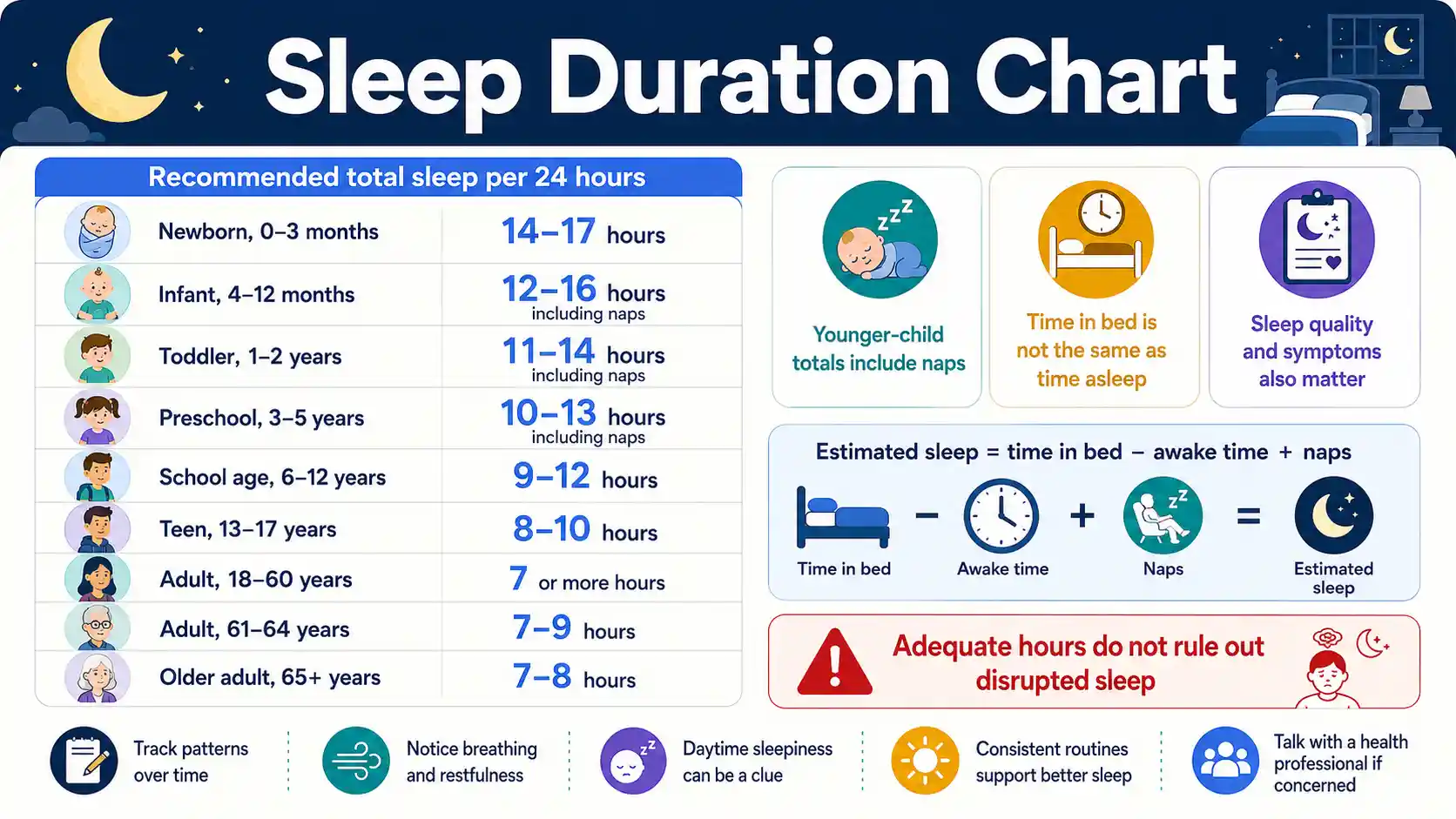
How much sleep do people need by age?
Recommended daily sleep declines from 14–17 hours for newborns to at least seven hours for adults ages 18–60. Younger-child totals include naps, and older-adult references become 7–9 hours at ages 61–64 and 7–8 hours at age 65 and older.
The CDC sleep-duration table expresses these values per 24-hour day. They are population references, not proof that a specific person’s sleep is continuous, well timed, refreshing, or free of a sleep disorder.
Newborns
14–17 hr
For ages 0–3 months, count sleep across the full 24-hour day.
Teens
8–10 hr
The age 13–17 reference applies per 24 hours, not only school nights.
Adults 18–60
7+ hr
Seven hours is a population minimum, not one ideal amount for every adult.
Interpretation
Hours + quality
Refreshment, timing, regularity, breathing, and daytime function also matter.
Sleep duration generally decreases from infancy to adulthood
The recommended total is highest in early life and becomes lower with age. The chart describes sleep obtained across 24 hours—not simply the clock interval spent in bed.
Birth–12 months
14–17 → 12–16 hr
Newborn and infant totals are counted across the full day.
Ages 1–5
11–14 → 10–13 hr
Toddler and preschool totals include naps.
Ages 6–17
9–12 → 8–10 hr
School schedules can compete with needed sleep opportunity.
Age 18+
7+ · 7–9 · 7–8 hr
Adult references vary across the 18–60, 61–64, and 65+ groups.
In bed
Awake portions
Estimated sleep
Time in bed is usually longer than time asleep. Naps count toward total daily sleep, but adequate hours do not prove that sleep was continuous, well timed, or refreshing.
Recommended Daily Sleep Duration by Age
These population recommendations describe total sleep in a 24-hour day. Infant, toddler, and preschool totals include naps; individual need and medical context can differ.
Swipe horizontally inside the table to view every column.
| Age group | Age | Recommended sleep | How to read the value |
|---|---|---|---|
| Newborn | 0–3 months | 14–17 hours per 24 hours | Sleep is distributed across day and night; use age-appropriate safe-sleep guidance |
| Infant | 4–12 months | 12–16 hours including naps | Add nighttime sleep and daytime naps rather than judging the night alone |
| Toddler | 1–2 years | 11–14 hours including naps | Nap transitions can change how the total is divided across the day |
| Preschool child | 3–5 years | 10–13 hours including naps | Some children still nap while others meet the total overnight |
| School-age child | 6–12 years | 9–12 hours per 24 hours | Schedule enough opportunity before the required morning wake time |
| Teen | 13–17 years | 8–10 hours per 24 hours — Teen recommendation | Later circadian timing can conflict with early school or work schedules |
| Adult | 18–60 years | 7 or more hours per night — Adult recommendation | Seven hours is a minimum population recommendation, not a universal ideal |
| Adult | 61–64 years | 7–9 hours per day | Assess refreshment, timing, awakenings, health, and daytime function |
| Older adult | 65 years and older | 7–8 hours per day | Frequent waking or sleepiness should not be dismissed as normal aging |
Hours of sleep per 24-hour day; younger-child totals include naps where stated.
- • Time in bed is not the same as time asleep because sleep onset and night awakenings use part of the interval.
- • A recommendation is a reference range, not a diagnosis or a guarantee that sleep will be refreshing.
- • Infant duration guidance never replaces safe-sleep recommendations.
Download or export
Browser-only educational planner
Estimate total daily sleep and compare an age reference
Enter the main in-bed interval, estimated awake time, and other sleep in the same 24-hour day. The planner separates time in bed from estimated sleep and does not prescribe an exact bedtime.
For newborns, infants, toddlers, and preschool children, enter all other sleep in the same 24-hour day because the listed reference includes naps.
Time in bed
8 hr 00 min
Clock interval, including estimated awake time.
Estimated daily sleep
7 hr 20 min
Night estimate plus other entered sleep.
Sleep efficiency
92%
Diary-style estimate, not a diagnosis.
Reference comparison
0 hr 00 min
Comparison only; symptoms still matter.
Within the listed duration reference
The arithmetic falls within the age-based reference. It does not measure sleep quality, breathing, circadian alignment, sleep stages, or whether the person feels restored.
Selected reference: 7 or more hours per night. Use total sleep per day.
All calculations run in this browser. No entered times, symptoms, or estimates are uploaded. This planner does not diagnose sleep deprivation, insomnia, sleep apnea, narcolepsy, a circadian disorder, or the cause of fatigue.
Calculate sleep time, not only the clock interval in bed
Subtract estimated sleep-onset latency and awake time after sleep begins from the in-bed interval, then add naps or other sleep in the same 24 hours. The result is still a diary estimate because the exact moment of falling asleep is difficult to perceive.
Sleep Window and Estimated Sleep Arithmetic
These examples show how time in bed can overstate sleep duration. They are arithmetic demonstrations, not recommended bedtimes or diagnostic sleep-efficiency cutoffs.
Swipe horizontally inside the table to view every column.
| Entered sleep window | Estimated awake time | Other sleep | Estimated 24-hour sleep |
|---|---|---|---|
| 10:00 p.m.–7:00 a.m. = 9 hr in bed | 20 min to fall asleep + 20 min awake overnight | None | 8 hr 20 min |
| 11:00 p.m.–7:00 a.m. = 8 hr in bed | 30 min to fall asleep + 30 min awake overnight | None | 7 hr — Seven-hour example |
| 12:00 a.m.–6:30 a.m. = 6 hr 30 min in bed | 15 min to fall asleep + 15 min awake overnight | None | 6 hr — Short-duration example |
| 9:30 p.m.–6:30 a.m. = 9 hr in bed | 45 min to fall asleep + 45 min awake overnight | None | 7 hr 30 min |
| 10:30 p.m.–6:30 a.m. = 8 hr in bed | 20 min to fall asleep + 40 min awake overnight | 30 min nap | 7 hr 30 min total |
| 8:00 p.m.–7:00 a.m. = 11 hr in bed | 30 min to fall asleep + 30 min awake overnight | 90 min nap | 11 hr 30 min total |
| 7:30 p.m.–6:30 a.m. = 11 hr in bed | 20 min to fall asleep + 40 min awake overnight | 2 hr naps | 12 hr total |
| Bedtime equals wake time | Cannot determine whether the intended interval is 0 or 24 hr | Any | Clarify the sleep window before calculating — Invalid interval |
Estimated sleep = time in bed − sleep-onset latency − awake time after sleep onset + other sleep in the same 24 hours.
- • Diary estimates are approximate because people do not always know the exact moment they fall asleep or briefly wake.
- • For young children, include every nap in the same 24-hour period.
- • Do not shorten a sleep window merely to make an efficiency percentage look higher without clinical guidance.
Download or export
Sleep Duration, Opportunity, Quality and Timing
Healthy sleep is multidimensional. A duration chart answers how long; it cannot by itself show whether sleep was continuous, well timed, physiologically normal, or restorative.
Swipe horizontally inside the table to view every column.
| Measure | Meaning | Simple example | Main limitation |
|---|---|---|---|
| Time in bed | Clock interval from getting into bed until getting out | 11:00 p.m. to 7:00 a.m. = 8 hours | Includes time awake |
| Sleep opportunity | Time and conditions available for attempting sleep | An 8.5-hour protected window | Opportunity does not prove sleep occurred |
| Total sleep time — Primary duration measure | Estimated or measured minutes actually asleep | 7 hr 20 min asleep | Diary, wearable, and sleep-study values can differ |
| Nighttime sleep | Sleep obtained during the main sleep episode | 7 hours overnight | Does not include daytime naps |
| Total 24-hour sleep | Nighttime sleep plus all naps | 7 hours overnight + 1-hour nap = 8 hours | Nap timing can affect later sleep |
| Sleep efficiency | Total sleep time ÷ time in bed × 100 | 7.5 hr ÷ 8 hr = about 94% | One value does not diagnose insomnia |
| Sleep quality | Continuity, refreshment, and absence of disruptive symptoms | Few prolonged awakenings and restored alertness | A high duration can coexist with poor quality — Quality distinction |
| Sleep timing | Placement of sleep relative to clock time and circadian phase | Consistent overnight schedule | Correct duration at a misaligned time may still impair function |
Use hours and minutes; track several days rather than treating one night as a baseline.
- • Duration, quality, regularity, timing, and absence of sleep disorders are related but not interchangeable.
- • A wearable can support trend tracking but cannot replace symptom assessment or diagnostic testing.
- • Sleep-cycle stage percentages belong to sleep architecture, not duration arithmetic.
Download or export
Age starts the interpretation; life context completes it
Newborn sleep is distributed across day and night, teens often develop a later biological preference, and adults may have schedule, caregiving, pregnancy, illness, pain, or shift-work constraints. Infant safe-sleep practices remain essential regardless of the duration target.
Sleep Duration Across Life Stages and Situations
Age is the starting point, not the whole interpretation. Development, pregnancy, illness, work schedules, caregiving, medicines, and sleep disorders can change sleep need or opportunity.
Swipe horizontally inside the table to view every column.
| Context | Common duration issue | Useful interpretation | Important caution |
|---|---|---|---|
| Newborns and young infants | Sleep occurs in multiple episodes across 24 hours | Add all sleep rather than expecting one long night | Always prioritize infant safe-sleep practices — Infant safety |
| Toddlers and preschool children | Nap needs and timing change rapidly | Judge the full 24-hour total and daytime behavior | Removing naps does not always improve total sleep |
| School-age children | Activities and early wake times can compress sleep | Work backward from the required wake time | Behavior or attention changes can reflect poor sleep |
| Teenagers | Biological timing often shifts later while school remains early | Protect an 8–10-hour opportunity and review schedule barriers | Late timing is not automatically defiance |
| Pregnancy | Fatigue, discomfort, urination, reflux, or breathing changes can fragment sleep | Track duration together with symptoms and trimester context | New breathing pauses or severe symptoms need clinical review |
| Older adults | Sleep may become lighter or more fragmented | Evaluate total sleep, daytime function, medicines, pain, and breathing | Persistent sleepiness is not inevitable aging |
| Shift workers | Sleep may be shortened or split at biologically difficult times | Add main sleep and planned naps across 24 hours | Safety-sensitive sleepiness needs immediate action — Shift-work safety |
| Caregivers and new parents | Sleep opportunity may be repeatedly interrupted | Use support, shared duties, and safe recovery opportunities when available | Do not drive or perform hazardous work while drowsy |
| Acute illness or recovery | Sleep may temporarily increase or become fragmented | Consider symptom severity, medicines, hydration, and recovery needs | Extreme sleepiness, confusion, or difficulty waking can be urgent — Urgent symptoms |
Interpret the age reference within the person’s health, schedule, and 24-hour sleep pattern.
- • Long or short sleep can be a symptom, a schedule result, an individual pattern, or a combination.
- • Never change a prescribed medicine solely to alter sleep duration without speaking with the prescriber.
- • People with bipolar disorder, epilepsy, respiratory disease, neurologic conditions, or high-risk pregnancy may need individualized advice.
Download or export
A sleep diary explains more than one device total
Record timing, naps, awakenings, symptoms, caffeine, alcohol, medicines, illness, and daytime function across workdays and days off. A wearable can support trend tracking, but quiet wakefulness may be counted as sleep and algorithms differ.
Sleep Diary and Duration Measurement Methods
A one- to two-week diary can show usual duration, schedule differences, naps, symptoms, and exposures. Devices add estimates but use different sensors and algorithms.
Swipe horizontally inside the table to view every column.
| Method or metric | How it is obtained | Useful for | Interpretation limit |
|---|---|---|---|
| Sleep diary — Core tracking method | Record bed, attempted-sleep, estimated sleep, wake, out-of-bed, nap, and symptom times | Daily patterns and clinical discussion | Relies on remembered estimates |
| Weekly average | Add daily sleep totals and divide by recorded days | Usual duration across workdays and days off | An average can hide very short nights |
| Workday versus day-off comparison | Compare separate averages | Possible schedule-driven restriction or catch-up sleep | Later timing and longer duration can both contribute |
| Sleep-onset latency | Estimate minutes from trying to sleep until sleep begins | Difficulty initiating sleep | The exact sleep-onset moment is hard to perceive |
| Wake after sleep onset | Total estimated minutes awake after initially falling asleep | Sleep-maintenance pattern | Brief awakenings may not be remembered |
| Actigraphy | A clinical movement sensor estimates sleep and wake over days or weeks | Sleep-wake patterns and circadian evaluation | Quiet wake can be scored as sleep |
| Consumer wearable | Movement and pulse-related signals feed a proprietary algorithm | Personal timing and duration trends | Not identical to EEG-measured sleep — Wearable limitation |
| Polysomnography | EEG, eye movement, muscle tone, breathing, oxygen, and heart signals are recorded | Diagnosing selected sleep disorders and measuring sleep physiologically | Usually samples one or a few nights in a testing setting |
| Daytime-function log | Record sleepiness, alertness, mood, concentration, and unplanned dozing | Connects sleep patterns with safety and function — Safety and function | Symptoms can also have non-sleep causes |
Record clock times, hours, minutes, naps, symptoms, and relevant exposures consistently.
- • Round diary estimates consistently rather than implying precision you do not have.
- • Include caffeine, alcohol, medicines, pain, illness, exercise, travel, and shift timing.
- • Bring the diary to a healthcare visit when sleep problems persist or affect daily activities.
Download or export
Longer weekend sleep can reveal weekday restriction
The NHLBI sleep-need guide notes that sleeping more on days off can signal insufficient regular sleep. Extra sleep may help, but repeated short nights and large schedule shifts still deserve attention.
Common Reasons Sleep Duration Becomes Shorter
Short sleep can result from too little opportunity, difficulty sleeping, interruptions, circadian mismatch, substances, medicines, symptoms, or environmental demands.
Swipe horizontally inside the table to view every column.
| Contributor | How duration is reduced | Clue in a diary | Next step |
|---|---|---|---|
| Late bedtime with fixed wake time | The available sleep window is too short — Opportunity restriction | Consistently short time in bed | Move the sleep opportunity earlier when feasible |
| Long sleep-onset latency | A large part of the in-bed window is spent awake | Repeatedly long time from trying to sleep to estimated sleep | Review timing, wind-down, stress, light, substances, and persistent insomnia |
| Night awakenings | Repeated or prolonged wake removes sleep time | High wake-after-sleep-onset estimate | Record triggers such as breathing, pain, urination, caregiving, heat, or noise |
| Early waking | Sleep ends before the planned wake time | Repeated early final wake with inability to return to sleep | Review mood, circadian timing, environment, illness, and medicines |
| Shift work or jet lag | Sleep is attempted at a circadianly difficult time | Shorter, split, or irregular sleep around schedule changes | Use occupational or clinical guidance when safety is affected — Safety context |
| Caffeine, nicotine, alcohol, or other substances | Sleep onset or continuity can be disrupted | Timing association in the diary | Reduce or review exposure safely; do not abruptly stop dependent use without advice |
| Medicine effects | A medicine may alert, sedate, fragment sleep, or change timing | Change follows starting, stopping, or altering a dose | Contact the prescriber or pharmacist rather than self-adjusting — Medicine safety |
| Pain, reflux, breathing symptoms, movement, or urination | Symptoms repeatedly interrupt sleep | Awakenings align with a physical symptom | Discuss recurrent or worsening symptoms with a clinician |
| Noise, light, heat, device use, or caregiving | Environmental or social demands delay or interrupt sleep | Pattern follows the exposure or duty | Modify what is feasible and seek practical support |
Look for repeated timing associations; one night rarely proves the cause.
- • Association in a diary can guide questions but cannot establish a medical diagnosis.
- • A person can have both a short sleep opportunity and a sleep disorder.
- • Trying to “catch up” only on days off may leave the underlying schedule problem unresolved.
Download or export
Adequate hours do not rule out disrupted sleep
The NHLBI sleep-apnea symptom guide lists breathing that starts and stops, loud snoring, gasping, fatigue, and daytime sleepiness. A reassuring hour total or device score cannot rule out apnea, insomnia, narcolepsy, or another cause of unrefreshing sleep.
Signs Sleep May Be Insufficient or Unrefreshing
Symptoms and function matter even when the entered hours meet a reference. Too little sleep, fragmented sleep, circadian misalignment, medicines, illness, and sleep disorders can overlap.
Swipe horizontally inside the table to view every column.
| Sign or pattern | What it may indicate | Useful context to record | Safety note |
|---|---|---|---|
| Difficulty waking at the required time | Insufficient duration, circadian mismatch, or poor-quality sleep | Bedtime, alarms, sleep inertia, and day-off schedule | Persistent severe difficulty waking deserves assessment |
| Sleeping much longer on days off | Possible accumulated sleep debt or schedule mismatch | Workday and day-off duration and timing | Recovery sleep does not erase every effect of repeated restriction |
| Daytime sleepiness or unplanned dozing | Insufficient sleep, apnea, narcolepsy, medicine effect, or another condition | Time, activity, prior sleep, and symptoms | Stop driving or hazardous activity immediately — Drowsy-driving safety |
| Trouble concentrating or slowed reactions | Sleep loss, circadian misalignment, illness, medicine effect, or other cause | Tasks affected and relationship to sleep | Treat safety-sensitive impairment seriously |
| Irritability, mood change, or behavior change | Insufficient or disrupted sleep among several possible causes | Age, timing, duration, stress, and daytime pattern | Urgent mental-health symptoms need prompt help |
| Loud snoring, gasping, or witnessed pauses | Possible sleep-related breathing disorder — Breathing concern | Frequency, position, morning symptoms, and observer report | Duration alone cannot rule out sleep apnea |
| Adequate hours but feeling unrefreshed — Quality concern | Fragmentation, breathing disorder, movement, pain, mood, medicine, or other illness | Awakenings, symptoms, exposures, and daytime function | Discuss a persistent pattern with a clinician |
| Persistently long sleep with ongoing fatigue | Individual need, recovery, illness, depression, medicine effect, or sleep disorder | Total sleep, quality, symptoms, and recent changes | Long duration is not automatically restorative |
Record frequency, duration, severity, context, and effect on school, work, caregiving, driving, and daily life.
- • The absence of obvious sleepiness does not prove that chronic sleep restriction is harmless.
- • Children may show hyperactivity, irritability, or attention problems rather than appearing sleepy.
- • A calculator cannot determine the cause of fatigue or unrefreshing sleep.
Download or export
Protect enough opportunity before optimizing details
A stable schedule, calm wind-down, daytime light, thoughtful caffeine timing, and a quiet, dark, comfortable room can support sleep. They cannot guarantee sleep or replace evaluation when breathing, pain, medicines, mood, or persistent insomnia remains a barrier.
Habits That Support Adequate Sleep Duration
Healthy habits protect sleep opportunity and alignment. They do not guarantee sleep, replace safe infant sleep, or treat an underlying sleep disorder.
Swipe horizontally inside the table to view every column.
| Habit | Practical action | How it supports duration | Important context |
|---|---|---|---|
| Protect enough opportunity | Reserve an in-bed window longer than the intended sleep amount to allow normal settling — Adequate opportunity | Prevents the schedule itself from forcing short sleep | Do not use an exact formula as a rigid prescription |
| Keep a stable wake time | Use a reasonably consistent wake time, including days off when possible | Supports circadian regularity and predictable sleep pressure | Shift work and caregiving may require adaptation |
| Work backward from obligations | Start with the required wake time and allow age-appropriate sleep plus settling time | Makes schedule conflicts visible | A calculated bedtime cannot guarantee sleep onset |
| Use a calm wind-down | Choose quiet activities during the hour before bed | Creates a transition and reduces competing alerting cues | A flexible routine is usually more sustainable than perfection |
| Manage light and screens | Get daytime light and reduce bright evening light | Supports day-night circadian signals | Content and stimulation can matter in addition to brightness |
| Use caffeine thoughtfully | Avoid caffeine late enough that it does not delay sleep | Prevents stimulant effects from shrinking the sleep window | Sensitivity and duration of effect vary |
| Avoid alcohol as a sleep strategy | Do not rely on alcohol to fall asleep | Reduces a common source of later-night disruption | Alcohol with sedating medicines can be dangerous — Alcohol safety |
| Build a sleep-supportive room | Use a quiet, dark, cool, comfortable environment when possible | Reduces avoidable delay and awakening | Housing, disability, caregiving, and work constraints may limit options |
| Review persistent barriers | Use a diary and discuss ongoing insomnia, breathing, pain, movement, mood, or medicine issues | Targets the reason sleep remains short or unrefreshing | Do not self-treat a suspected disorder with supplements or sedatives — Clinical evaluation |
Evaluate patterns over at least several days; consistency matters more than one perfect night.
- • For infants, use AAP safe-sleep guidance rather than adult sleep-environment advice.
- • A nap may help total 24-hour sleep but can also delay nighttime sleep depending on age, timing, and duration.
- • Effective clinical treatments exist for chronic insomnia and other sleep disorders.
Download or export
Safety and symptoms determine care timing
Stop driving or operating machinery when sleepy. Recurrent breathing pauses, unplanned dozing, sudden sleep attacks, persistent insomnia, or major new sleep changes need healthcare assessment. Severe breathing difficulty, collapse, seizure, or inability to wake normally is an emergency.
Sleep Duration Concerns and When to Seek Care
Care timing depends on symptoms, breathing, alertness, injury risk, frequency, and daytime effects—not only on whether estimated hours fall inside a chart range.
Swipe horizontally inside the table to view every column.
| Observation | Possible concern | Suggested timing | Do not wait for |
|---|---|---|---|
| Severe breathing difficulty, blue or gray color, chest pain, collapse, seizure, or inability to wake normally | Immediate respiratory, cardiovascular, neurologic, or toxic emergency | Call local emergency services now — Emergency care | A sleep-duration calculation or morning appointment |
| Sleepiness while driving or operating machinery | Impaired alertness from sleep loss, disorder, medicine, substance, or illness | Stop immediately and arrange safe transport — Drowsy-driving response | Finishing the trip or seeing whether caffeine works |
| Breathing repeatedly stops and restarts, gasping, choking, or frequent loud snoring | Possible sleep apnea or another breathing disorder | Arrange prompt healthcare assessment | A low hour total or a wearable alert |
| Unplanned dozing, sudden sleep attacks, or severe daytime sleepiness | Insufficient sleep, apnea, narcolepsy, medicine effect, or other condition | Seek medical assessment, especially when safety or function is affected | A calculator to identify the cause |
| Trouble falling or staying asleep that affects daily activities | Insomnia, schedule mismatch, stress, pain, illness, medicine, or substance effect | Discuss with a clinician if persistent, worsening, or impairing | A three-month threshold when safety is already affected |
| Sleep difficulty at least three nights weekly for three months or longer | Pattern consistent with chronic-insomnia timing when daytime effects and other causes are considered — Chronic insomnia context | Schedule a healthcare evaluation | The problem becoming severe every night |
| Child has persistent snoring, gasping, pauses, sleepiness, hyperactivity, or attention change | Possible pediatric sleep-related breathing or sleep disorder | Discuss with the child’s healthcare professional | Adult ranges or an adult device score |
| New major sleep change after a medicine or substance change | Side effect, withdrawal, interaction, or underlying illness | Contact the prescriber or pharmacist; seek urgent help for severe symptoms | Self-adjusting prescribed treatment |
| Regular sleep below the age reference despite enough intended opportunity | Unrecognized awake time, insomnia, environment, symptoms, circadian issue, or measurement error | Use a diary and discuss a persistent pattern | A single night to prove the cause |
| Regular long sleep, unrefreshing sleep, or fatigue that persists | Individual variation, recovery, illness, mood disorder, medicine effect, or sleep disorder | Arrange routine assessment; sooner if rapidly worsening or function is impaired | The value crossing a universal “too much” cutoff |
Emergency and urgent decisions are symptom-based; local emergency numbers and care pathways differ.
- • Chronic-insomnia criteria are not a reason to delay help when symptoms are severe or safety is affected.
- • A sleep study may be appropriate when history suggests apnea, narcolepsy, unusual behaviors, movement disorders, or another sleep condition.
- • Never give a sedating product to a child or combine sleep aids without age-appropriate professional advice.
Download or export
Frequently asked questions
How many hours of sleep do adults need?
Adults ages 18–60 are generally advised to sleep seven or more hours per night regularly. Adults ages 61–64 are listed at seven to nine hours, and adults 65 and older at seven to eight hours, while individual needs and health contexts vary.
How much sleep do teenagers need?
Teenagers ages 13–17 are listed at eight to ten hours of sleep per 24 hours. A biologically later sleep preference can conflict with early school or work schedules, so adequate opportunity must be protected before the required wake time.
Do naps count toward recommended sleep duration?
Yes. Sleep recommendations are expressed per 24 hours, and the infant, toddler, and preschool ranges explicitly include naps. For other ages, add naps when calculating total daily sleep but also consider whether their timing disrupts nighttime sleep.
Is time in bed the same as total sleep time?
No. Time in bed includes minutes spent falling asleep and awake during the night. Estimated total sleep subtracts that awake time, while a sleep study measures sleep physiologically and a diary or wearable only estimates it.
How is sleep efficiency calculated?
Sleep efficiency is estimated total sleep time divided by time in bed, multiplied by 100. It can describe a diary pattern, but one percentage is not a diagnosis and should not be used alone to shorten the sleep opportunity.
Is seven hours enough sleep for every adult?
No. Seven hours is the minimum population recommendation for adults ages 18–60, not a universal ideal. Some adults need more, and duration must be considered with refreshment, symptoms, regularity, timing, health, and daytime function.
Can someone get enough hours and still have poor sleep?
Yes. Sleep can be fragmented by breathing problems, pain, movement, medicines, substances, environmental interruptions, or circadian mismatch. Persistent sleepiness or unrefreshing sleep deserves attention even when the hour total looks adequate.
What is sleep debt?
Sleep debt is the accumulated difference between needed sleep and sleep obtained across repeated days. Longer sleep on days off may provide some recovery but can also reveal ongoing weekday restriction and shift sleep timing.
Can weekend catch-up sleep fix a week of short sleep?
Extra sleep may improve how a person feels, but it does not make repeated restriction harmless or resolve a schedule that stays too short. Large timing shifts on days off can also make the regular sleep-wake rhythm less stable.
How should sleep duration be tracked?
Record bedtime, when sleep was attempted, estimated sleep onset, awakenings, final wake time, out-of-bed time, naps, caffeine, alcohol, medicines, symptoms, and daytime sleepiness for one to two weeks when possible.
Can a smartwatch measure total sleep accurately?
A smartwatch can support personal trend tracking, but it infers sleep from movement, pulse-related signals, and a proprietary algorithm. Quiet wake can be labeled as sleep, so device duration should be interpreted with a diary and symptoms.
Does sleeping longer always mean better sleep?
No. Longer sleep may reflect individual need, recovery, illness, medication effects, mood conditions, fragmented sleep, or a sleep disorder. Persistent long sleep with fatigue or poor refreshment should be discussed with a healthcare professional.
How much sleep do newborns need?
The CDC lists 14–17 hours per 24 hours for newborns ages 0–3 months. Sleep is spread across day and night, and meeting a duration total never replaces safe infant sleep position, surface, and environment guidance.
What symptoms suggest sleep apnea despite enough sleep time?
Frequent loud snoring, gasping, choking, witnessed breathing pauses, morning headaches, unrefreshing sleep, and daytime sleepiness can suggest a sleep-related breathing problem. Adequate duration and one normal oxygen reading do not rule it out.
When should sleep duration problems be discussed with a doctor?
Seek help when short, long, or unrefreshing sleep persists, affects daily activities, or occurs with breathing symptoms, sudden sleep attacks, unusual behaviors, or medicine changes. Stop driving when sleepy; severe breathing difficulty or inability to wake normally is urgent.
Sources
Age-based duration, sleep opportunity, tracking, healthy habits, safe infant sleep, breathing symptoms, drowsy-driving safety, and care guidance were checked against these publications and health organizations.
Centers for Disease Control and Prevention — About Sleep
Lists recommended daily sleep duration from birth through older adulthood and distinguishes adequate duration from uninterrupted, refreshing sleep quality.
https://www.cdc.gov/sleep/about/index.html
American Academy of Sleep Medicine — Recommended Amount of Sleep for Pediatric Populations
Provides consensus recommendations for regular sleep per 24 hours for infants, children, and adolescents, including naps for younger age groups.
https://pubmed.ncbi.nlm.nih.gov/27250809/
American Academy of Sleep Medicine and Sleep Research Society — Recommended Amount of Sleep for a Healthy Adult
States that adults should sleep seven or more hours per night regularly to promote optimal health, while recognizing individual variation and clinical context.
https://pubmed.ncbi.nlm.nih.gov/26039963/
National Heart, Lung, and Blood Institute — How Much Sleep Is Enough?
Explains sleep need, sleep debt, recovery sleep, age-related variation, and why sleeping longer on days off can indicate insufficient weekday sleep.
https://www.nhlbi.nih.gov/health/sleep-deprivation/how-much-sleep
National Heart, Lung, and Blood Institute — Healthy Sleep Habits
Covers consistent schedules, wind-down time, daylight, physical activity, caffeine, alcohol, meals, naps, and bedroom conditions that support sleep.
https://www.nhlbi.nih.gov/health/sleep-deprivation/healthy-sleep-habits
National Heart, Lung, and Blood Institute — Sleep Deprivation and Deficiency: Diagnosis
Describes clinical history, sleep diaries, activity monitoring, sleep studies, and evaluation of sleep quantity, quality, timing, symptoms, medicines, and health conditions.
https://www.nhlbi.nih.gov/health/sleep-deprivation/diagnosis-treatment
National Heart, Lung, and Blood Institute — Sleep Diary
Provides a structured way to record sleep quantity and quality, caffeine, alcohol, medicines, and daytime sleepiness for discussion with a healthcare professional.
https://www.nhlbi.nih.gov/resources/sleep-diary
National Heart, Lung, and Blood Institute — Insomnia Diagnosis
Explains evaluation of difficulty falling or staying asleep, frequency, duration, daytime effects, medical history, medicines, and other possible causes.
https://www.nhlbi.nih.gov/health/insomnia/diagnosis
National Heart, Lung, and Blood Institute — Sleep Apnea Symptoms
Lists breathing that starts and stops, loud snoring, gasping, daytime sleepiness, fatigue, headaches, and pediatric attention or behavior changes.
https://www.nhlbi.nih.gov/health/sleep-apnea/symptoms
National Institute of Neurological Disorders and Stroke — Brain Basics: Understanding Sleep
Explains sleep regulation, brain and body functions, circadian timing, sleep stages, age-related change, and effects of disrupted or inadequate sleep.
https://www.ninds.nih.gov/health-information/public-education/brain-basics/brain-basics-understanding-sleep
American Academy of Pediatrics — How to Keep Your Sleeping Baby Safe
Summarizes infant safe-sleep practices and makes clear that duration targets never replace a safe sleep surface, position, and environment.
https://www.healthychildren.org/English/ages-stages/baby/sleep/Pages/a-parents-guide-to-safe-sleep.aspx
National Institute for Occupational Safety and Health — Driving, Drowsy Driving
Describes impaired driving risk associated with insufficient sleep and emphasizes stopping safety-sensitive activity when drowsiness threatens alertness.
https://www.cdc.gov/niosh/work-hour-training-for-nurses/longhours/mod11/02.html