Sleep Health · Stages & Timing
Sleep Cycle Chart for REM, NREM Stages and Night Patterns
Follow N1, N2, N3, and REM sleep across a typical night, compare age-based sleep needs, understand circadian timing, and track sleep without treating a wearable graph as a diagnosis.
Sleep stages cannot be identified from clock time alone. Loud snoring, gasping, breathing pauses, unusual sleep behaviors, or excessive daytime sleepiness need medical attention. Stop driving when sleepy; severe breathing difficulty or inability to wake normally is an emergency. Read the ChartsLoom Disclaimer.
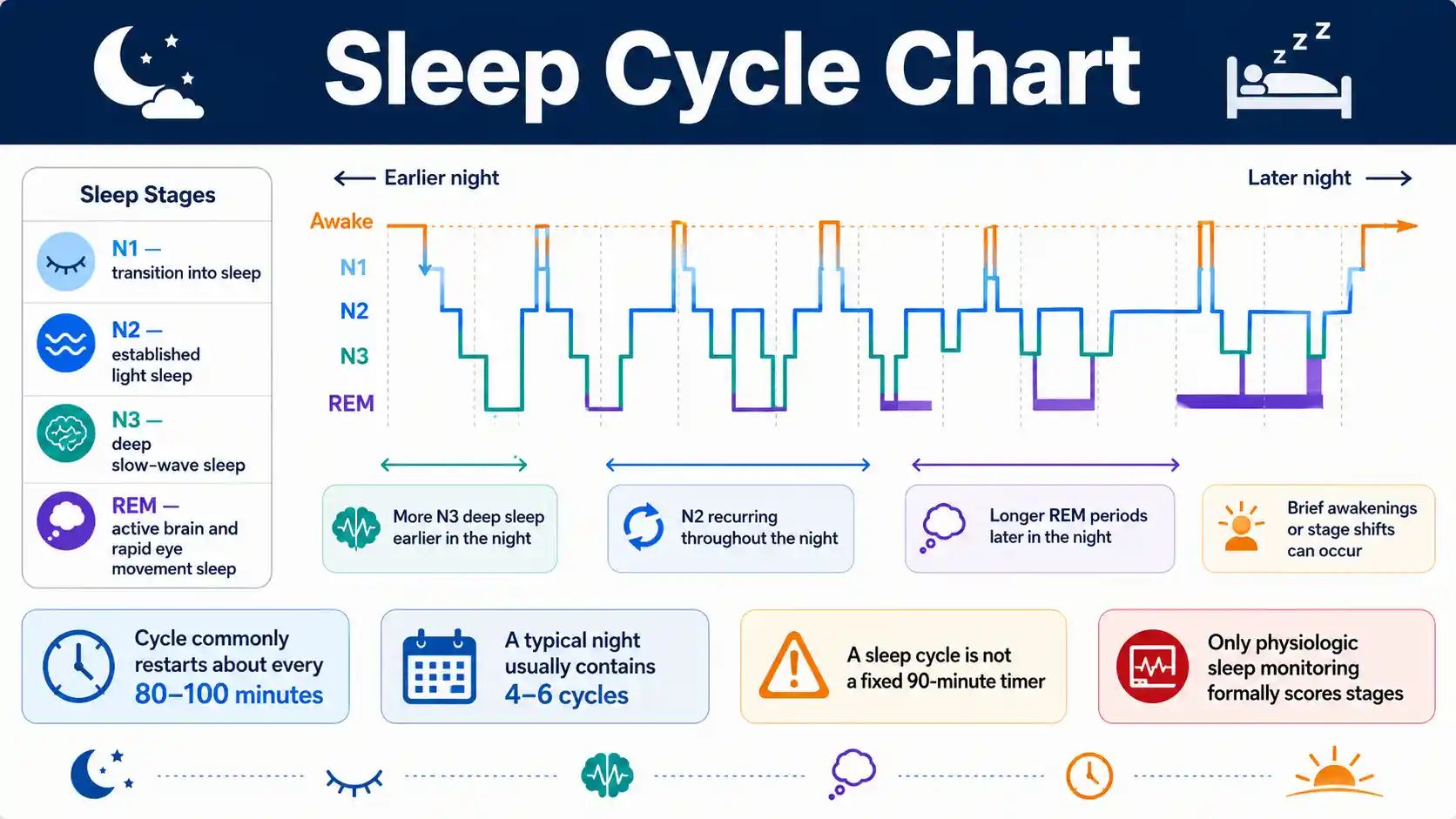
What is a sleep cycle?
A sleep cycle is a repeated progression through non-REM and REM sleep. NREM includes light stages N1 and N2 plus deep N3; REM combines active brain patterns with normally reduced skeletal-muscle tone.
The NHLBI sleep-stage overview describes cycles that restart about every 80–100 minutes, usually four to six times per night. Those numbers are population references, not an exact 90-minute timer or a way to identify the stage at a chosen alarm time.
Sleep phases
NREM + REM
NREM contains stages N1, N2, and N3. REM is a separate phase with active brain patterns.
Cycle range
80–100 min
This is a published broad range. A person’s cycles are not guaranteed to last 90 minutes.
Typical count
4–6 cycles
The number depends on total sleep time, awakenings, age, and changing cycle length.
Overnight shift
N3 → REM
Deep N3 is usually stronger earlier, while REM becomes more prominent later in the night.
NREM and REM Sleep Stages Chart
Adult sleep is classified with brain-wave, eye-movement, and muscle-activity signals. A normal night moves through NREM stages and REM repeatedly rather than following one perfectly fixed sequence.
Swipe horizontally inside the table to view every column.
| Stage | Plain-language description | Common physiology | Pattern across the night |
|---|---|---|---|
| N1 | Transition from wakefulness into light sleep | Muscle activity eases; slow eye movements may occur; awakening is easy | Usually brief and may recur after awakenings or stage shifts |
| N2 | Established light sleep | Heart rate and breathing slow; body temperature drops; sleep spindles and K-complexes appear on EEG | Common in every cycle and often forms the largest share of adult sleep |
| N3 — Deep sleep stage | Deep or slow-wave sleep | Slow delta activity dominates; awakening can be difficult; heart rate and breathing are generally at low resting levels | Usually concentrated in the first part of the night |
| REM — REM sleep stage | Rapid eye movement sleep | Brain activity is high; vivid dreaming is common; skeletal muscles normally become temporarily limp | REM periods generally lengthen and become more prominent later in the night |
Stages are categories scored from physiologic signals; they are not fixed minute blocks.
- • A brief awakening or return to a lighter stage does not automatically mean sleep is abnormal.
- • Dreams can occur outside REM, although vivid narrative dreaming is commonly associated with REM.
- • Only a sleep study directly measures the physiologic signals used for formal sleep-stage scoring.
Download or export
How sleep cycles change from evening to morning
A typical adult night repeatedly moves through NREM and REM sleep. Deep N3 sleep is usually concentrated earlier, while REM becomes more prominent later. Stage transitions and brief awakenings make the pattern irregular rather than clockwork.
N1
Transition
Wakefulness gives way to light sleep.
N2
Light sleep
Established sleep recurs throughout the night.
N3
Deep sleep
Slow-wave sleep is usually stronger early.
REM
Active brain
REM periods generally become longer later.
Earlier night
Later night
Illustrative direction only: cycles commonly restart about every 80–100 minutes, but no clock-only chart can show a person’s current stage.
Typical Sleep Cycle Pattern Across the Night
This sequence is a broad adult pattern, not a minute-by-minute template. NHLBI describes cycles that restart about every 80–100 minutes, usually four to six times per night.
Swipe horizontally inside the table to view every column.
| Part of night | Common direction of travel | Stage balance | What can vary |
|---|---|---|---|
| Sleep onset | Wake → N1 → N2 | Light sleep dominates while the person settles | Sleep latency changes with schedule, light, stress, substances, illness, and sleep pressure |
| First cycle | N1 → N2 → N3 → lighter sleep or REM | A substantial early block of N3 may occur — Early deep sleep | The first REM period may be relatively short |
| Second cycle | N2 and N3 recur, followed by REM | Deep sleep is still more prominent than it usually is late at night | Brief awakenings may be remembered or unnoticed |
| Middle cycles | Repeated NREM-to-REM cycling | N2 remains prominent while N3 begins to decrease | Cycle length and transitions vary within the same person |
| Later cycles | More N2 and REM, with less N3 | REM periods generally become longer — Later REM sleep | Temperature, medicines, alcohol, disorders, and prior sleep can alter the pattern |
| Final cycle | Light NREM and REM often precede waking | Late-night REM may be prominent | An alarm, light, noise, breathing events, or body-clock timing may end sleep at any stage |
| Between cycles | Brief arousal or wakefulness can occur | A person may change position and return to sleep | Frequent or prolonged awakenings with daytime effects deserve attention — Fragmentation context |
Reference cycle range: about 80–100 minutes; usual count: four to six cycles per night.
- • A “90-minute cycle” is a shorthand average, not a personal timer.
- • Cutting the later part of sleep can disproportionately reduce the opportunity for later-night REM.
- • The same clock time does not correspond to the same stage across people or nights.
Download or export
Browser-only educational planner
Estimate a sleep window and broad cycle range
Enter a typical in-bed window and estimated awake time. The tool compares estimated total sleep with the selected age reference and shows how many 80–100-minute intervals fit arithmetically. It cannot identify N1, N2, N3, or REM.
For newborns, infants, toddlers, and preschool children, enter all other sleep in the same 24-hour day because the duration reference includes naps.
Time in bed
8 hr 00 min
Clock interval, including estimated awake time.
Estimated daily sleep
7 hr 20 min
Night estimate plus other entered sleep.
Sleep efficiency
92%
Diary-style estimate, not a diagnosis.
Cycle equivalent
4.4–5.5
Arithmetic only; no stage or wake forecast.
Within the listed duration reference
The arithmetic falls within the age-based duration reference. This does not measure sleep quality, breathing, stage balance, or whether the person feels restored.
Selected reference: 7 or more hours per day. Use total sleep per day.
All calculations run in this browser. No entered times, symptoms, or estimates are uploaded. This planner does not diagnose insomnia, sleep apnea, narcolepsy, a circadian disorder, or abnormal sleep architecture.
Enough total sleep matters more than hitting a cycle count
The CDC age-based sleep guidance ranges from 14–17 hours for newborns to at least seven hours for adults ages 18–60. Children’s totals may include naps. Time in bed overestimates actual sleep when falling asleep or returning to sleep takes time.
Recommended Daily Sleep Duration by Age
Sleep need changes with age. These CDC-listed durations cover total sleep in a 24-hour day; infant and young-child values include naps where noted.
Swipe horizontally inside the table to view every column.
| Age group | Age | Recommended daily sleep | Interpretation |
|---|---|---|---|
| Newborn | 0–3 months | 14–17 hours | Sleep is distributed across day and night; newborn architecture differs from adult sleep |
| Infant | 4–12 months | 12–16 hours including naps | Nap and nighttime patterns are still developing |
| Toddler | 1–2 years | 11–14 hours including naps | Total daily sleep matters more than fitting adult cycle timing |
| Preschool | 3–5 years | 10–13 hours including naps | Some children still nap; individual routines differ |
| School age | 6–12 years | 9–12 hours | Regular schedules support adequate opportunity on school days |
| Teen | 13–17 years | 8–10 hours — Teen recommendation | A later biological sleep preference can conflict with early schedules |
| Adult | 18–60 years | 7 or more hours — Adult recommendation | Duration and quality both matter; some adults need more than seven hours |
| Older adult | 61–64 years: 7–9 hours; 65+: 7–8 hours | Age-specific adult ranges | Earlier timing or more fragmented sleep does not remove the need to assess daytime function |
Hours per 24-hour day.
- • Recommendations are population guidance, not a diagnosis or a guarantee that a specific duration will feel restorative.
- • Time in bed is not identical to time asleep because sleep onset and awakenings use part of the interval.
- • Persistent sleepiness despite enough opportunity can signal poor sleep quality, a disorder, medicine effects, or another health issue.
Download or export
How Sleep Architecture Changes
Sleep architecture means the amount, order, and continuity of sleep stages. Age and context change the pattern, so one adult hypnogram is not universal.
Swipe horizontally inside the table to view every column.
| Context | Common pattern | What not to assume | Useful focus |
|---|---|---|---|
| Across one normal night | More N3 tends to occur early and more REM later — Normal overnight shift | Every cycle is exactly 90 minutes | Adequate, uninterrupted opportunity across the whole night |
| Newborn period | More sleep is spent in REM-like active sleep and sleep is spread across day and night | Adult N1–N3 timing applies to newborns | Age-appropriate total sleep and safe-sleep guidance |
| Early childhood | Slow-wave sleep is prominent and peaks in childhood | Deep sleep percentage stays constant for life | Consistent routine and adequate daily duration |
| Adolescence | Slow-wave sleep decreases and circadian preference often shifts later | Late sleep timing is always a behavior choice | Schedule alignment and enough time before required wake time |
| Adulthood | N2 commonly occupies much of the night; N3 and REM continue to cycle | One night has a mandatory stage percentage | Trends, daytime function, symptoms, and enough opportunity |
| Older age | Slow-wave sleep generally decreases and sleep may become lighter or more fragmented | Poor daytime function is inevitable with aging — Aging limitation | Medical, medicine, breathing, pain, and circadian contributors |
| After sleep loss | Sleep pressure rises and later sleep architecture can change | A single long recovery sleep fully reverses repeated restriction | Restore regular adequate sleep and monitor safety-sensitive sleepiness |
| Illness, substances, or medicines | Stage timing and continuity may change | A tracker can identify the cause from a stage graph | Review symptoms, timing, exposures, and medicines with a clinician when needed — Clinical review |
Architecture is formally measured with sleep-study signals.
- • Stage percentages differ by age, individual, night, laboratory method, and health context.
- • A change on one consumer-device graph is not sufficient evidence of a sleep disorder.
- • Never stop or change a prescribed medicine solely because of a sleep-stage estimate.
Download or export
Sleep cycles and circadian rhythm are different
Sleep cycles describe changing stages after sleep begins. Circadian rhythm helps decide when the body promotes sleep or wakefulness across roughly 24 hours. Homeostatic sleep pressure builds with time awake. Light, schedule, naps, caffeine, age, and prior sleep influence how those systems interact.
Circadian Rhythm and Sleep-Pressure Drivers
Sleep timing reflects interaction between the body clock and homeostatic sleep pressure. Sleep stages are the structure within sleep; they are not the same as the circadian rhythm.
Swipe horizontally inside the table to view every column.
| Driver | Role | Common influence | Practical interpretation |
|---|---|---|---|
| Circadian clock — Circadian system | Organizes a roughly 24-hour sleep–wake rhythm | Light, darkness, timing, travel, and work schedule | A person can be tired yet biologically cued to stay awake |
| Homeostatic sleep pressure — Homeostatic system | Builds during time awake and eases during sleep | Prior wake time, naps, and sleep loss | A long or late nap can reduce pressure at bedtime |
| Adenosine | Accumulates during wakefulness and is linked to sleep pressure | Time awake and caffeine blockade | Caffeine can mask sleepiness without replacing sleep |
| Morning and daytime light | Helps align the central body clock with day | Outdoor light timing and intensity | Regular daytime light supports a stable rhythm |
| Evening light | Can delay melatonin signaling and alert the brain | Bright room light and light-emitting screens | Dim, calm conditions support the transition toward sleep |
| Melatonin rhythm | Rises in the evening under normal dark conditions | Light exposure and circadian timing | A hormone signal is not a direct readout of the current sleep stage |
| Schedule changes | Shift the relationship between clock time and body time | Jet lag, rotating shifts, weekends, and early obligations | Stage calculators cannot correct circadian misalignment — Schedule limitation |
| Age and chronotype | Influence preferred sleep timing and rhythm strength | Development, aging, and individual biology | Early and late preferences are not identical across people |
Circadian timing is measured over about 24 hours; sleep cycles repeat within a sleep period.
- • Clock time, circadian phase, time awake, and current sleep stage are related but distinct variables.
- • Shift workers may need individualized occupational or clinical guidance when sleepiness affects safety.
- • Melatonin products, timing, dose, interactions, and product quality require separate medical and regulatory consideration.
Download or export
A sleep study measures stages; a wearable estimates them
Formal stage scoring uses EEG brain activity together with eye movements and muscle tone. Diagnostic studies can also record airflow, breathing effort, oxygen, and heart signals. Consumer devices usually infer sleep from movement and optical pulse data, so their trends can be useful without making each stage label clinically exact.
How Sleep Stages and Sleep Quality Are Measured
Polysomnography combines several physiologic signals. A consumer tracker usually infers sleep from movement and pulse-related data and is not equivalent to a diagnostic sleep study.
Swipe horizontally inside the table to view every column.
| Method or signal | What it measures | What it can support | Main limitation |
|---|---|---|---|
| Electroencephalography (EEG) | Brain electrical activity | Formal N1, N2, N3, REM, wake, and arousal scoring — Formal stage scoring | Requires correctly placed sensors and trained scoring |
| Electro-oculography (EOG) | Eye movements | REM identification and stage transitions | Not used alone to classify a whole night |
| Chin electromyography (EMG) | Muscle tone | REM-related muscle atonia and movement assessment | A single muscle channel cannot explain all movements |
| Airflow | Air moving through the nose and mouth | Breathing-event assessment | Does not by itself establish sleep stage |
| Chest and abdominal effort | Breathing movement and effort | Distinguishing patterns of sleep-related breathing events | Needs interpretation with airflow and other signals |
| Pulse oximetry | Blood oxygen saturation trend | Oxygen changes associated with breathing events | A normal spot reading does not rule out sleep apnea |
| Electrocardiography or pulse | Heart rhythm or rate | Nighttime cardiovascular response and event context | Heart rate does not directly identify a sleep stage |
| Actigraphy | Movement over days or weeks | Sleep–wake schedule estimates and pattern tracking | Quiet wakefulness may be scored as sleep |
| Consumer wearable or nearable | Usually movement plus optical pulse or environmental signals | Personal trends and approximate sleep–wake timing | Stage labels can disagree with polysomnography and should not diagnose a disorder — Wearable limitation |
Polysomnography is the reference clinical test for physiologic sleep-stage scoring.
- • A home sleep apnea test answers a narrower breathing question and may not include full EEG-based stage scoring.
- • Device algorithms and labels differ, so values from different brands may not be interchangeable.
- • Symptoms and daytime function deserve attention even when a tracker reports a high sleep score.
Download or export
Sleep Diary and Tracking Metrics
Track repeatable observations for one to two weeks when possible. A diary records timing, symptoms, and exposures that a stage graph alone cannot explain.
Swipe horizontally inside the table to view every column.
| Metric | How to record it | What it helps show | Interpretation caution |
|---|---|---|---|
| Time in bed | Lights-out time to final out-of-bed time | Available sleep window | Includes time awake and is not total sleep time |
| Sleep-onset latency | Estimated minutes from trying to sleep until sleep begins | Difficulty initiating sleep and schedule fit | People do not always perceive the exact moment sleep starts |
| Night awakenings | Count and approximate duration of remembered awakenings | Fragmentation pattern | Brief arousals may not be remembered |
| Wake after sleep onset | Estimated total awake time after initial sleep begins | Sleep-maintenance difficulty | Consumer estimates can differ from perceived wake time |
| Estimated total sleep | Time in bed minus estimated awake time | Broad duration trend | A diary estimate is not EEG-measured sleep |
| Sleep efficiency | Estimated sleep ÷ time in bed × 100 — Sleep-efficiency formula | Relationship between sleep and the in-bed interval | One percentage does not diagnose insomnia |
| Context and exposures | Record naps, caffeine, alcohol, exercise, medicines, pain, illness, travel, and shift timing | Possible pattern associations | Association does not prove the cause |
| Daytime function | Record sleepiness, alertness, mood, concentration, and unplanned dozing | Whether sleep problems affect safety or daily life | Severe sleepiness needs action even without a low device score — Safety-relevant sleepiness |
Use minutes, clock times, and a consistent daily rating scale.
- • Keep the diary simple enough to complete every day; consistent estimates are more useful than false precision.
- • Include workdays and days off because schedule differences can reveal sleep restriction or circadian mismatch.
- • Bring the record to a healthcare visit when sleep problems persist or affect daily activities.
Download or export
Build conditions for sleep instead of chasing a stage score
Protect enough time, keep a reasonably consistent schedule, use a calm wind-down, reduce bright evening light, manage caffeine, avoid alcohol as a sleep tool, and make the bedroom quiet, cool, and dark. These steps support sleep but cannot guarantee a specific amount of N3 or REM.
Healthy Sleep Habits That Support a Full Night
Healthy habits support adequate opportunity and body-clock alignment. They do not guarantee a particular stage percentage or replace evaluation of a sleep disorder.
Swipe horizontally inside the table to view every column.
| Habit | Practical step | Why it helps | Important context |
|---|---|---|---|
| Protect enough time | Set a sleep window that can meet age-based needs plus normal settling time — Adequate opportunity | Prevents the schedule itself from truncating sleep | Time in bed is not identical to time asleep |
| Keep timing consistent | Use similar bed and wake times, including weekends when possible | Supports circadian stability | NHLBI suggests keeping weeknight–weekend differences to about one hour |
| Use a wind-down period | Choose quiet activities during the hour before bed | Reduces competing alerting cues | A rigid ritual is not required |
| Manage evening light | Reduce bright artificial light before bed | Supports normal evening circadian signaling | Screen content and stimulation can matter as well as light |
| Use caffeine thoughtfully | Avoid caffeine late enough that it no longer delays sleep | Caffeine can block adenosine-related sleep pressure | Effects can last for hours and vary by person |
| Avoid alcohol as a sleep tool | Do not rely on alcohol to initiate sleep | Alcohol can disrupt sleep later in the night | Mixing alcohol with sedating medicines can be dangerous — Alcohol safety |
| Build a sleep-friendly room | Keep the bedroom quiet, cool, dark, and comfortable | Reduces environmental awakenings | Caregiving, housing, and health constraints may require adaptations |
| Be active and get daylight | Use regular daytime activity and outdoor light when possible | Supports sleep pressure, health, and circadian timing | Avoid intense activity close to bed if it delays sleep for you |
| Use naps strategically | If nighttime sleep is difficult, keep adult naps short and earlier | Limits reduction of nighttime sleep pressure | Children and shift workers have different nap needs |
Habit effects are individualized and usually evaluated as patterns over time.
- • Do not use cycle timing to justify reducing the total amount of sleep.
- • People with shift work, caregiving duties, chronic illness, pregnancy, or pain may need an individualized plan.
- • Long-term insomnia has effective clinical treatments; repeated self-experimentation is not the only option.
Download or export
Symptoms matter even when a tracker looks reassuring
The NHLBI sleep-apnea symptom guide lists breathing that starts and stops, frequent loud snoring, gasping, and daytime sleepiness. An app cannot rule out apnea, insomnia, narcolepsy, parasomnia, or another condition from estimated stage percentages.
Sleep Problems and When to Seek Care
A stage estimate cannot rule out a sleep disorder or emergency. Use symptoms, breathing, injury risk, daytime function, frequency, and duration to decide what to do.
Swipe horizontally inside the table to view every column.
| Observation | Possible concern | Suggested timing | Do not wait for |
|---|---|---|---|
| Severe breathing difficulty, blue or gray color, chest pain, collapse, seizure, or inability to wake normally | Immediate breathing, cardiovascular, neurologic, or toxic emergency | Call local emergency services now — Emergency care | A wearable score, cycle estimate, or morning appointment |
| Dangerous sleepiness while driving or operating machinery | Sleep deprivation, medicine effect, sleep disorder, or other impairment | Stop the safety-sensitive activity immediately; arrange safe transport and prompt assessment — Drowsy-driving safety | Finishing the trip or seeing whether caffeine fixes it |
| Breathing repeatedly stops and restarts, gasping, choking, or frequent loud snoring | Possible sleep apnea or another sleep-related breathing disorder | Discuss promptly with a healthcare professional | A low stage score or a single normal oxygen reading |
| Excessive daytime sleepiness, unplanned dozing, or sudden sleep attacks | Insufficient sleep, apnea, narcolepsy, medicine effect, or another condition | Arrange medical assessment, especially when work, school, or safety is affected | A tracker to name the cause |
| Trouble falling or staying asleep at least three nights a week for three months or longer | Pattern consistent with chronic insomnia criteria when daytime effects and other causes are considered — Chronic insomnia context | Schedule a healthcare evaluation | The problem to become severe every night |
| Persistent sleep difficulty affecting daily activities for a shorter period | Short-term insomnia, schedule mismatch, stress, pain, illness, or substance effect | Discuss with a clinician if it persists, worsens, or impairs function | A three-month threshold when safety is already affected |
| Dream enactment, sleepwalking with injury risk, violent movements, or leaving a safe area | Parasomnia, REM-related disorder, seizure, medicine effect, or other condition | Make the environment safer and seek medical assessment | A consumer stage label to confirm REM |
| Uncomfortable urge to move the legs at rest or repetitive night movements | Restless legs syndrome, periodic limb movements, medicine effect, or another contributor | Discuss recurrent or disruptive symptoms with a healthcare professional | A home cycle calculation |
| New sleep change after starting, stopping, or changing a medicine or substance | Timing, dose, withdrawal, interaction, or underlying illness | Contact the prescriber or pharmacist; seek urgent help for severe symptoms | Self-adjusting a prescribed treatment |
| Child snores, gasps, has breathing pauses, unusual sleepiness, hyperactivity, bedwetting, or school-attention change | Possible pediatric sleep-related breathing or sleep disorder | Discuss with the child’s healthcare professional | Adult ranges or an adult sleep-cycle app |
Care timing depends on symptoms and safety, not on a single sleep-stage percentage.
- • Chronic insomnia criteria describe a diagnostic framework; they are not a reason to delay care when symptoms are severe or safety is affected.
- • A sleep study may be used when history and examination suggest apnea, abnormal behaviors, narcolepsy, movement disorders, or another sleep condition.
- • Emergency numbers and local care pathways differ by country.
Download or export
Frequently asked questions
What is a sleep cycle?
A sleep cycle is one repeated progression through non-REM and REM sleep. The order can include returns to lighter sleep and brief awakenings, so a real cycle is not a fixed block that repeats identically all night.
How long is one sleep cycle?
NHLBI describes a cycle that restarts about every 80 to 100 minutes. Ninety minutes is a convenient midpoint, not a precise personal value, and cycle length can differ between cycles, nights, ages, and health contexts.
What are the four sleep stages?
Current adult scoring groups sleep into three non-REM stages—N1, N2, and N3—plus REM sleep. N1 is the transition into sleep, N2 is established light sleep, N3 is deep slow-wave sleep, and REM has active brain patterns and normal muscle atonia.
Is N3 the same as deep sleep?
Yes. N3 is commonly called deep sleep or slow-wave sleep because of its characteristic EEG pattern. It is usually more prominent early in the night and generally decreases with age, but one night does not require an exact N3 percentage.
Is REM sleep the only time people dream?
No. Vivid narrative dreams are commonly associated with REM sleep, but dreaming can occur in non-REM sleep as well. A remembered dream cannot reliably identify the exact stage without physiologic sleep-study signals.
How many sleep cycles occur in a night?
NHLBI says a typical night usually contains four to six cycles. The count depends on total sleep time and variable cycle length; having a calculated count does not show whether sleep was restorative or whether breathing and arousals were normal.
Is it normal to wake briefly between sleep cycles?
Brief arousals or awakenings can occur between or within cycles, and many are not remembered. Frequent, prolonged, distressing, or symptom-associated awakenings deserve attention, especially when they impair daytime function.
Does deep sleep happen before REM sleep?
Deep N3 sleep is generally concentrated earlier in the night, while REM periods tend to lengthen later. Real nights include stage shifts and awakenings, so the sequence should be treated as a broad pattern rather than a rigid staircase.
Can a 90-minute sleep-cycle calculator choose the best wake time?
No calculator can know the current sleep stage from bedtime alone. Sleep onset, cycle length, awakenings, circadian phase, illness, substances, and environment vary, so adequate total sleep and a stable schedule matter more than hitting a calculated minute.
Can a smartwatch measure REM and deep sleep accurately?
Consumer devices can be useful for broad trends, but they infer stages from movement, pulse, and proprietary algorithms rather than the full EEG, eye-movement, and muscle signals used in polysomnography. Stage labels should not diagnose a disorder.
What is sleep architecture?
Sleep architecture is the organization, amount, order, and continuity of N1, N2, N3, REM, and wake across a sleep period. It changes with age and can be influenced by sleep loss, schedules, medicines, substances, illness, and sleep disorders.
How is sleep efficiency calculated?
Sleep efficiency is estimated total sleep time divided by time in bed, multiplied by 100. A diary or tracker can estimate it, but only a sleep study measures sleep with physiologic signals, and one percentage does not diagnose insomnia.
Why can someone feel tired after eight hours in bed?
Eight hours in bed may include long sleep latency or awakenings, and sleep can be fragmented by breathing problems, pain, movement, environment, medicines, substances, circadian mismatch, or illness. Persistent unrefreshing sleep warrants assessment.
Do naps contain a complete sleep cycle?
A nap may contain only lighter sleep or may progress into deeper sleep and REM depending on its length, timing, prior sleep, age, and individual biology. A nap should not be assumed to equal one exact 90-minute cycle.
When should sleep problems be discussed with a doctor?
Seek help when sleep problems persist, affect daily activities, cause dangerous sleepiness, or include loud snoring, gasping, breathing pauses, unusual behaviors, or sudden sleep attacks. Severe breathing difficulty or inability to wake normally is urgent.
Sources
Stage definitions, cycle timing, sleep needs, circadian regulation, measurement methods, healthy habits, tracking limitations, and symptom guidance were checked against these publications and health organizations.
National Heart, Lung, and Blood Institute — How Sleep Works: Sleep Phases and Stages
Defines NREM stages N1 through N3 and REM sleep, describes the 80–100-minute cycle range and four to six cycles per night, and explains how deep sleep and REM shift across the night.
https://www.nhlbi.nih.gov/health/sleep/stages-of-sleep
National Institute of Neurological Disorders and Stroke — Brain Basics: Understanding Sleep
Explains sleep biology, stage-related brain and body activity, dreaming, age-related changes, sleep regulation, and the health effects of disrupted sleep.
https://www.ninds.nih.gov/health-information/public-education/brain-basics/brain-basics-understanding-sleep
National Heart, Lung, and Blood Institute — How Sleep Works: Your Sleep/Wake Cycle
Describes circadian clocks, homeostatic sleep pressure, adenosine, light and darkness, melatonin, caffeine, aging, jet lag, and shift-work misalignment.
https://www.nhlbi.nih.gov/health/sleep/sleep-wake-cycle
Centers for Disease Control and Prevention — About Sleep
Provides daily sleep-duration recommendations from newborns through older adults and summarizes healthy sleep habits and health benefits.
https://www.cdc.gov/sleep/about/index.html
National Heart, Lung, and Blood Institute — Sleep Deprivation and Deficiency: Healthy Sleep Habits
Covers consistent schedules, quiet time before bed, light, caffeine, alcohol, meals, physical activity, bedroom conditions, naps, and shift-work strategies.
https://www.nhlbi.nih.gov/health/sleep-deprivation/healthy-sleep-habits
National Heart, Lung, and Blood Institute — Sleep Studies
Explains polysomnography and the brain-wave, eye-movement, heart-rate, breathing, oxygen, and other measurements used to assess sleep and diagnose sleep disorders.
https://www.nhlbi.nih.gov/health/sleep-studies
National Heart, Lung, and Blood Institute — Sleep Deprivation and Deficiency: Diagnosis
Describes clinical history, sleep diaries, sleep studies, multiple sleep latency testing, maintenance-of-wakefulness testing, and activity monitoring.
https://www.nhlbi.nih.gov/health/sleep-deprivation/diagnosis-treatment
National Heart, Lung, and Blood Institute — Sleep Apnea Symptoms
Lists breathing that starts and stops, frequent loud snoring, gasping, daytime sleepiness, fatigue, headaches, and pediatric attention or behavior changes.
https://www.nhlbi.nih.gov/health/sleep-apnea/symptoms
National Heart, Lung, and Blood Institute — Insomnia Diagnosis
Explains how sleep difficulty, frequency, duration, daytime effects, medical history, medicines, and a one- to two-week sleep diary inform evaluation.
https://www.nhlbi.nih.gov/health/insomnia/diagnosis
National Heart, Lung, and Blood Institute — Sleep Diary
Provides a structured record for sleep quantity and quality, medicines, alcohol, caffeine, and daytime sleepiness that can support a clinical discussion.
https://www.nhlbi.nih.gov/resources/sleep-diary
PubMed Central — Accuracy of Three Commercial Wearable Devices for Sleep Staging in Healthy Adults
Compares consumer wearable outputs with polysomnography and documents that sleep-versus-wake detection and individual sleep-stage classification have different performance.
https://pmc.ncbi.nlm.nih.gov/articles/PMC11511193/