Health & Medical · Dental notation reference
Dental Number Chart: Universal, FDI, Palmer and Tooth Surfaces
Map every permanent and primary tooth across the major numbering systems, identify quadrants and tooth names, decode surface abbreviations, and convert a number without confusing the patient’s right and left.
A tooth number is a location label, not a diagnosis or treatment authorization. Confirm the notation system, dentition, patient perspective, tooth name, clinical findings, imaging, and procedure before acting. Read the ChartsLoom Disclaimer.
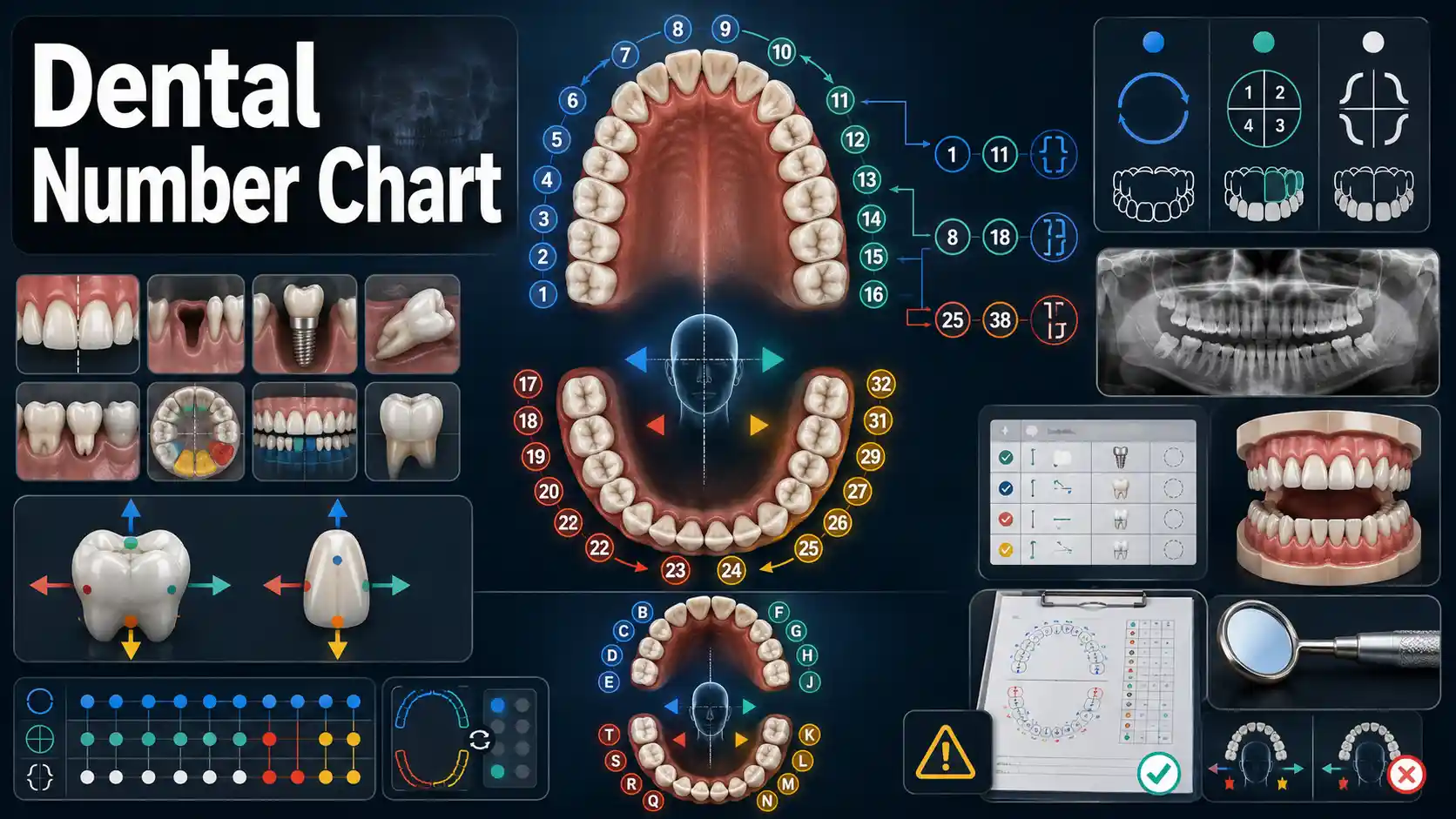
How are teeth numbered?
In the U.S. Universal system, permanent teeth run 1–32 and primary teeth use A–T. FDI/ISO uses two digits: the first identifies the dentition and quadrant, and the second counts away from the midline.
The ADA accepts the Universal/National system for its claim form and provides a value set that maps those identifiers to ISO designations. Review ADA tooth-designation guidance.
Permanent Universal
1–32
One continuous sequence around both arches.
Primary Universal
A–T
Twenty fixed primary-tooth positions.
FDI / ISO
Two digits
Quadrant first, position from midline second.
Orientation
Patient view
Right and left always belong to the patient.
Permanent Tooth Number Crosswalk
All 32 permanent teeth mapped across the Universal, FDI/ISO, and text-friendly Palmer systems. Directions are from the patient’s perspective.
Swipe horizontally inside the table to view every column.
| Universal | FDI / ISO | Palmer text form | Quadrant | Tooth name | Region |
|---|---|---|---|---|---|
| 1 | 18 | UR8 | Upper right | Third molar | Posterior |
| 2 | 17 | UR7 | Upper right | Second molar | Posterior |
| 3 | 16 | UR6 | Upper right | First molar | Posterior |
| 4 | 15 | UR5 | Upper right | Second premolar | Posterior |
| 5 | 14 | UR4 | Upper right | First premolar | Posterior |
| 6 | 13 | UR3 | Upper right | Canine | Anterior |
| 7 | 12 | UR2 | Upper right | Lateral incisor | Anterior |
| 8 — Upper-right central incisor | 11 | UR1 | Upper right | Central incisor | Anterior |
| 9 — Upper-left central incisor | 21 | UL1 | Upper left | Central incisor | Anterior |
| 10 | 22 | UL2 | Upper left | Lateral incisor | Anterior |
| 11 | 23 | UL3 | Upper left | Canine | Anterior |
| 12 | 24 | UL4 | Upper left | First premolar | Posterior |
| 13 | 25 | UL5 | Upper left | Second premolar | Posterior |
| 14 | 26 | UL6 | Upper left | First molar | Posterior |
| 15 | 27 | UL7 | Upper left | Second molar | Posterior |
| 16 | 28 | UL8 | Upper left | Third molar | Posterior |
| 17 | 38 | LL8 | Lower left | Third molar | Posterior |
| 18 | 37 | LL7 | Lower left | Second molar | Posterior |
| 19 | 36 | LL6 | Lower left | First molar | Posterior |
| 20 | 35 | LL5 | Lower left | Second premolar | Posterior |
| 21 | 34 | LL4 | Lower left | First premolar | Posterior |
| 22 | 33 | LL3 | Lower left | Canine | Anterior |
| 23 | 32 | LL2 | Lower left | Lateral incisor | Anterior |
| 24 — Lower-left central incisor | 31 | LL1 | Lower left | Central incisor | Anterior |
| 25 — Lower-right central incisor | 41 | LR1 | Lower right | Central incisor | Anterior |
| 26 | 42 | LR2 | Lower right | Lateral incisor | Anterior |
| 27 | 43 | LR3 | Lower right | Canine | Anterior |
| 28 | 44 | LR4 | Lower right | First premolar | Posterior |
| 29 | 45 | LR5 | Lower right | Second premolar | Posterior |
| 30 | 46 | LR6 | Lower right | First molar | Posterior |
| 31 | 47 | LR7 | Lower right | Second molar | Posterior |
| 32 | 48 | LR8 | Lower right | Third molar | Posterior |
- • Universal numbering begins at the patient’s upper-right third molar as tooth 1, moves across the upper arch to tooth 16, then continues at the lower-left third molar as tooth 17 and ends at the lower-right third molar as tooth 32.
- • The Palmer column uses text labels such as UR1 because the traditional bracket glyph can be lost in plain text, exports, or software.
- • Missing, unerupted, extracted, implant-supported, and supernumerary teeth require explicit clinical documentation rather than renumbering the remaining teeth.
Download or export
Read every dental chart from the patient’s perspective
Universal numbering follows one continuous path around the arches. FDI and Palmer restart at the midline in each quadrant. The same anatomy is being labeled with different rules.
Upper right
Universal
1–8
FDI
18 → 11
Upper left
Universal
9–16
FDI
21 → 28
Lower left
Universal
17–24
FDI
38 → 31
Lower right
Universal
25–32
FDI
41 → 48
Primary Tooth Letter and Number Crosswalk
The 20 primary teeth mapped across Universal letters A–T, FDI/ISO two-digit designations, and text-friendly Palmer notation.
Swipe horizontally inside the table to view every column.
| Universal letter | FDI / ISO | Palmer text form | Quadrant | Primary tooth name |
|---|---|---|---|---|
| A | 55 | UR E | Upper right | Second molar |
| B | 54 | UR D | Upper right | First molar |
| C | 53 | UR C | Upper right | Canine |
| D | 52 | UR B | Upper right | Lateral incisor |
| E — Upper-right central primary incisor | 51 | UR A | Upper right | Central incisor |
| F — Upper-left central primary incisor | 61 | UL A | Upper left | Central incisor |
| G | 62 | UL B | Upper left | Lateral incisor |
| H | 63 | UL C | Upper left | Canine |
| I | 64 | UL D | Upper left | First molar |
| J | 65 | UL E | Upper left | Second molar |
| K | 75 | LL E | Lower left | Second molar |
| L | 74 | LL D | Lower left | First molar |
| M | 73 | LL C | Lower left | Canine |
| N | 72 | LL B | Lower left | Lateral incisor |
| O | 71 | LL A | Lower left | Central incisor |
| P | 81 | LR A | Lower right | Central incisor |
| Q | 82 | LR B | Lower right | Lateral incisor |
| R | 83 | LR C | Lower right | Canine |
| S | 84 | LR D | Lower right | First molar |
| T | 85 | LR E | Lower right | Second molar |
- • Universal primary notation runs A–J across the upper arch and K–T across the lower arch.
- • Primary teeth do not have premolars; permanent premolars later replace the primary molars.
- • Use the exact notation system requested by the dental record, claim form, school, clinic, or examination.
Download or export
Missing teeth do not renumber the remaining teeth
A tooth designation identifies a fixed anatomical position. Extraction, congenital absence, impaction, or an implant at the site does not shift every later number. Document the site and status explicitly.
Tooth-number converter
Enter a Universal, FDI, or text-form Palmer identifier to find the matching tooth. The converter covers standard permanent and primary positions, not supernumerary designations.
Central incisor
Upper right · Permanent dentition
- Universal
- 8
- FDI / ISO
- 11
- Palmer text
- UR1
Universal Numbering Sequence by Quadrant
A compact guide to where each Universal sequence starts, which direction it travels, and which teeth mark the boundaries.
Swipe horizontally inside the table to view every column.
| Arch segment | Universal range | Starts at | Ends at | Travel direction |
|---|---|---|---|---|
| Upper right | 1–8 | Third molar (#1) | Central incisor (#8) | Back to midline |
| Upper left | 9–16 | Central incisor (#9) | Third molar (#16) | Midline to back |
| Lower left | 17–24 | Third molar (#17) | Central incisor (#24) | Back to midline |
| Lower right | 25–32 | Central incisor (#25) | Third molar (#32) | Midline to back |
| Primary upper right | A–E | Second molar (A) | Central incisor (E) | Back to midline |
| Primary upper left | F–J | Central incisor (F) | Second molar (J) | Midline to back |
| Primary lower left | K–O | Second molar (K) | Central incisor (O) | Back to midline |
| Primary lower right | P–T | Central incisor (P) | Second molar (T) | Midline to back |
- • Universal numbering follows one continuous path around each dentition rather than restarting at 1 in every quadrant.
- • Numbers and letters identify tooth positions, not the order in which teeth erupt or the number of teeth actually present.
Download or export
FDI / ISO Quadrant and Position Chart
The first FDI digit identifies dentition and quadrant; the second digit counts away from the midline.
Swipe horizontally inside the table to view every column.
| First digit | Dentition and quadrant | Second-digit range | Position 1 | Farthest position |
|---|---|---|---|---|
| 1 — Permanent upper-right quadrant | Permanent upper right | 1–8 | Central incisor | Third molar |
| 2 | Permanent upper left | 1–8 | Central incisor | Third molar |
| 3 | Permanent lower left | 1–8 | Central incisor | Third molar |
| 4 | Permanent lower right | 1–8 | Central incisor | Third molar |
| 5 — Primary upper-right quadrant | Primary upper right | 1–5 | Central incisor | Second molar |
| 6 | Primary upper left | 1–5 | Central incisor | Second molar |
| 7 | Primary lower left | 1–5 | Central incisor | Second molar |
| 8 | Primary lower right | 1–5 | Central incisor | Second molar |
- • FDI 11 means permanent upper-right central incisor; it is spoken as “one-one,” not eleven, to reduce ambiguity.
- • FDI 51 means primary upper-right central incisor. The first digit changes because the dentition is primary.
Download or export
FDI numbers are spoken digit by digit
ISO 3950 defines a two-digit designation system. FDI 11 is commonly spoken as “one-one,” not eleven, so the upper-right permanent quadrant and central-incisor position remain distinct. View the ISO 3950 standard record.
Palmer Notation Chart in Text-Friendly Form
Palmer notation combines a quadrant bracket with a position counted from the midline. Text labels are shown because bracket glyphs may not survive every export.
Swipe horizontally inside the table to view every column.
| Text label | Traditional meaning | Permanent position | Primary position | Example |
|---|---|---|---|---|
| UR | Upper right quadrant | 1–8 from midline | A–E from midline | UR1 = upper-right central incisor |
| UL | Upper left quadrant | 1–8 from midline | A–E from midline | UL6 = upper-left first molar |
| LL | Lower left quadrant | 1–8 from midline | A–E from midline | LL3 = lower-left canine |
| LR | Lower right quadrant | 1–8 from midline | A–E from midline | LR8 = lower-right third molar |
| Position 1 / A | Nearest the midline | Central incisor | Central incisor | UR1 or UR A |
| Position 2 / B | Second from midline | Lateral incisor | Lateral incisor | UL2 or UL B |
| Position 3 / C | Third from midline | Canine | Canine | LL3 or LL C |
| Position 4 / D | Fourth from midline | First premolar | First primary molar | LR4 or LR D |
| Position 5 / E | Fifth from midline | Second premolar | Second primary molar | UR5 or UR E |
| Positions 6–8 | Posterior permanent positions | First, second, third molars | Not used in primary Palmer letters | UL6, UL7, UL8 |
- • Traditional Palmer symbols use L-shaped quadrant brackets. Always confirm the viewing orientation because mirrored brackets can identify the opposite side.
- • Some clinics use numbers 1–5 instead of letters A–E for primary Palmer notation; record the local convention explicitly.
Download or export
Palmer brackets need extra care in digital records
Traditional bracket symbols can be mirrored, dropped, or replaced by unsupported fonts. A text form such as UR1 or UL6 preserves the quadrant when copying, exporting, or discussing the record.
Tooth Names, Number Groups, and Main Functions
A group-level reference linking common tooth names with Universal and FDI positions.
Swipe horizontally inside the table to view every column.
| Tooth group | Universal permanent numbers | FDI positions | Count | Main role |
|---|---|---|---|---|
| Central incisors | 8, 9, 24, 25 | 11, 21, 31, 41 | 4 | Biting and cutting at the midline |
| Lateral incisors | 7, 10, 23, 26 | 12, 22, 32, 42 | 4 | Cutting and shaping the front arch |
| Canines | 6, 11, 22, 27 | 13, 23, 33, 43 | 4 | Tearing and guiding jaw movement |
| First premolars | 5, 12, 21, 28 | 14, 24, 34, 44 | 4 | Tearing and grinding |
| Second premolars | 4, 13, 20, 29 | 15, 25, 35, 45 | 4 | Grinding and supporting the bite |
| First molars | 3, 14, 19, 30 | 16, 26, 36, 46 | 4 | Major chewing and grinding |
| Second molars | 2, 15, 18, 31 | 17, 27, 37, 47 | 4 | Posterior grinding |
| Third molars | 1, 16, 17, 32 | 18, 28, 38, 48 | 0–4 | Variable posterior teeth, often called wisdom teeth |
- • There are no primary premolars. Primary molars occupy those positions before permanent premolars replace them.
- • Third molars may be absent, unerupted, impacted, partially erupted, or removed; the numbering position remains defined.
Download or export
Tooth Surface Abbreviations Chart
Numbering identifies the tooth; surface notation identifies where on that tooth a condition or procedure is located.
Swipe horizontally inside the table to view every column.
| Abbreviation | Surface | Meaning | Commonly used for | Orientation clue |
|---|---|---|---|---|
| M | Mesial | Surface toward the dental midline | Anterior and posterior teeth | Faces the neighboring tooth closer to center |
| D | Distal | Surface away from the dental midline | Anterior and posterior teeth | Faces the neighboring tooth farther from center |
| F | Facial | Surface facing lips or cheeks | General external surface label | Visible from outside the arch |
| B | Buccal | Cheek-facing surface | Posterior teeth | Faces the cheek |
| L | Lingual | Tongue-facing surface | Upper and lower teeth | Faces the tongue |
| P | Palatal | Palate-facing surface | Upper teeth | Upper-arch alternative to lingual |
| O | Occlusal | Chewing surface | Premolars and molars | Top chewing table of posterior teeth |
| I | Incisal | Cutting edge | Incisors and canines | Edge rather than posterior chewing table |
| A | Apical | Toward the root tip | Endodontic and radiographic descriptions | Opposite the crown direction |
| C | Cervical | Near the gumline or tooth neck | Restorative and periodontal descriptions | Around the crown-root junction |
- • Combined abbreviations such as MOD describe multiple surfaces on one tooth. Order and accepted abbreviations may depend on the record or procedure code.
- • Do not infer a surface from the tooth number alone; the same numbered tooth has several distinct surfaces.
Download or export
A tooth number and a tooth surface are separate fields
“Tooth 30” identifies the lower-right first molar in Universal notation. “30-O” adds the occlusal chewing surface. Clinical and claim documentation may require the tooth, surface, diagnosis, and procedure to agree. Review ADA coding education.
Universal vs FDI vs Palmer Comparison
The three systems encode the same anatomy differently. The correct system depends on country, software, education, and documentation rules.
Swipe horizontally inside the table to view every column.
| Feature | Universal / National | FDI / ISO two-digit | Palmer |
|---|---|---|---|
| Permanent identifiers | 1–32 continuous sequence | Quadrants 1–4 plus positions 1–8 | Quadrant bracket plus positions 1–8 |
| Primary identifiers | A–T continuous sequence | Quadrants 5–8 plus positions 1–5 | Quadrant bracket plus A–E or local 1–5 |
| Common setting | United States claims and records | International records and standards | Orthodontics and teaching |
| Midline logic | Sequence changes direction at arch boundaries | Every quadrant counts outward from midline | Every quadrant counts outward from midline |
| Text-entry strength | Simple numbers or letters | Compact and unambiguous two digits | Bracket symbols can be lost or mirrored |
| Spoken example | Tooth number eight | One-one, not eleven | Upper-right one |
| Best safeguard | State permanent or primary dentition | Speak digits separately | State quadrant in words when brackets are unavailable |
| Primary limitation | Harder to infer quadrant from a number alone | Can be misread as ordinary whole numbers | Not uniformly supported by software |
- • Never translate a tooth identifier by intuition. Use a verified crosswalk and confirm the patient’s right and left.
- • The ISO two-digit system and ADA Universal system are both represented in the ADA value set for mapping purposes.
Download or export
Common Tooth-Numbering Errors and Safer Checks
A short safety checklist for interpreting referrals, radiographs, treatment plans, claims, and patient-facing explanations.
Swipe horizontally inside the table to view every column.
| Potential error | Why it happens | Safer check | Example |
|---|---|---|---|
| Using the viewer’s right instead of the patient’s right | Dental diagrams face the observer | Confirm that all quadrants use the patient’s perspective | Patient upper right is on the viewer’s left in a frontal diagram |
| Reading FDI 11 as eleven | Two digits look like a whole number | Speak each digit separately | 11 = one-one |
| Renumbering after an extraction | Sequence may seem to close the gap | Keep the original anatomical tooth designation | Missing #19 does not make #20 become #19 |
| Confusing primary and permanent teeth | Mixed dentition contains both | Record dentition and system explicitly | Universal E is primary; Universal 8 is permanent |
| Assuming a wisdom tooth is present | Position exists even when tooth does not | Confirm clinical or radiographic presence | FDI 18 may be absent or impacted |
| Mirroring a Palmer bracket | Symbols can flip in scans or fonts | Add UR, UL, LL, or LR text | Use UL3 when the bracket is uncertain |
| Confusing tooth number with surface | Procedure may require both fields | Document tooth and surface separately | #30-O means tooth 30, occlusal surface |
| Treating implant as a natural tooth | Implant occupies a site but is not a tooth | Record implant status and site | Implant at #8 site |
| Ignoring supernumerary teeth | Extra teeth do not fit the standard 32 positions | Use the organization’s approved supernumerary designation | Do not shift all later numbers |
| Copying a number without anatomy | Transcription errors can persist | Cross-check name, quadrant, image, and planned procedure | Verify “upper-left first molar” matches the identifier |
- • For clinical care, the written diagnosis, radiographs, anatomy, and planned procedure must agree with the tooth identifier.
- • Patients should ask the dental office which numbering system appears on a treatment plan before comparing it with another document.
Download or export
Frequently asked questions
What is tooth number 1 in the Universal system?
Tooth 1 is the patient’s upper-right permanent third molar, commonly called the upper-right wisdom tooth. The sequence then moves across the upper arch toward tooth 16.
What are teeth 8 and 9?
Universal teeth 8 and 9 are the two upper permanent central incisors. Tooth 8 is on the patient’s right and tooth 9 is on the patient’s left.
What are teeth 24 and 25?
Universal teeth 24 and 25 are the two lower permanent central incisors. Tooth 24 is on the patient’s left and tooth 25 is on the patient’s right.
What is tooth 30?
Universal tooth 30 is the patient’s lower-right permanent first molar. In FDI notation the same tooth is 46.
What does FDI tooth 11 mean?
FDI 11 is the permanent upper-right central incisor. The first digit identifies the upper-right permanent quadrant and the second digit identifies the central incisor position.
Is FDI 11 pronounced eleven?
Dental professionals commonly say “one-one” rather than “eleven” so the quadrant digit and tooth-position digit remain clear.
How are baby teeth numbered?
In the Universal system, primary teeth use letters A through T. In FDI notation, primary quadrants use first digits 5 through 8 and positions 1 through 5.
Do primary teeth have premolars?
No. Primary dentition has incisors, canines, and molars. Permanent premolars later replace the primary molars.
Does a missing tooth change the numbers of the other teeth?
No. Tooth designations represent fixed anatomical positions. Extracting or congenitally missing one tooth does not renumber the remaining teeth.
Which direction is right and left on a dental chart?
Dental right and left always refer to the patient’s perspective. On a frontal diagram, the patient’s right may appear on the viewer’s left.
What is Palmer notation?
Palmer notation uses a quadrant bracket plus a number 1–8 for permanent teeth or commonly a letter A–E for primary teeth. Text alternatives such as UR1 help when bracket symbols cannot be displayed.
What do M, D, O, B, L, and I mean?
They are tooth-surface abbreviations: mesial, distal, occlusal, buccal, lingual, and incisal. A procedure may require both a tooth designation and one or more surfaces.
Can a tooth number diagnose the problem?
No. The identifier only locates a tooth or site. Diagnosis depends on symptoms, examination, imaging, periodontal findings, pulp tests, and other clinical information.
Why can two dental documents show different numbers for the same tooth?
They may use different notation systems. Confirm whether each document uses Universal, FDI/ISO, or Palmer notation before comparing the identifiers.
Sources
These sources support the tooth-designation crosswalk, notation rules, tooth-group terminology, and surface abbreviations. Follow the notation used by the original dental record and confirm uncertain identifiers with the treating office.
American Dental Association — Universal Tooth Designation System Value Set
Maps permanent teeth 1–32 and primary teeth A–T to tooth names and ISO designations.
https://www.ada.org/-/media/project/ada-organization/ada/ada-org/files/publications/cdt/ada_utds_value_set_v1_2022_aug.pdf
American Dental Association — ADA Dental Claim Form and Tooth Designation Guidance
Explains that the Universal/National Tooth Designation System is used on the ADA claim form in the United States.
https://www.ada.org/publications/cdt/ada-dental-claim-form
International Organization for Standardization — ISO 3950:2016 Dentistry — Designation System for Teeth
Defines the two-digit designation system for teeth and oral-cavity areas.
https://www.iso.org/standard/68292.html
American Dental Association — Glossary of Dental Clinical and Administrative Terms
Supports tooth-group terminology and Universal-system references used in dental documentation.
https://www.ada.org/publications/cdt/glossary-dental-terms
American Dental Association — Tooth-Surface Coding and Abbreviation Guidance
Provides common dental abbreviations for facial, buccal, lingual, mesial, distal, occlusal, and related surfaces.
https://www.ada.org/-/media/project/ada-organization/ada/ada-org/files/education/test-construtor-resources/common_acronymsandabbreviations.pdf