Animals & Pets
Dog Body Language Chart
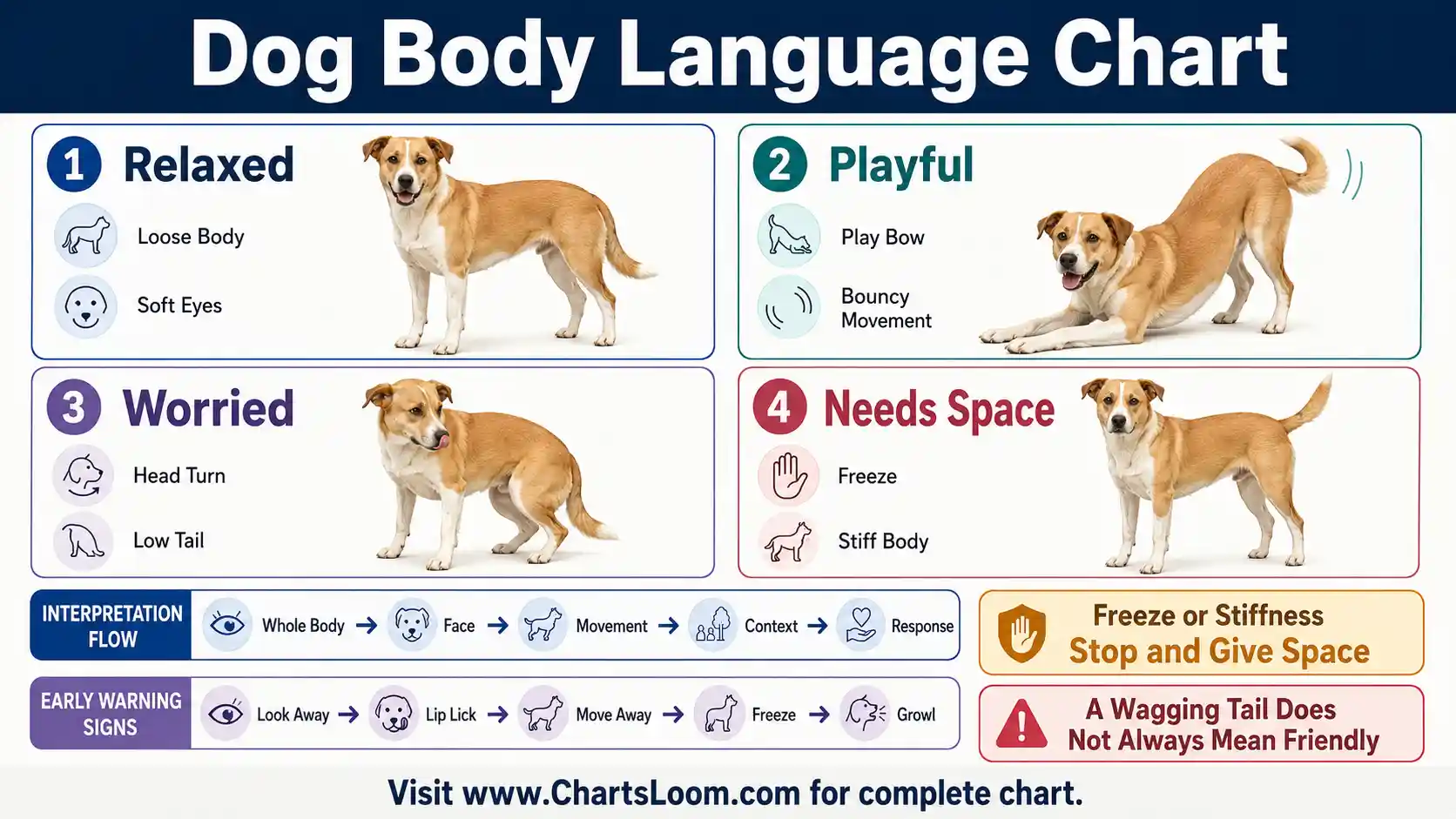
Read posture, movement, tail, ears, eyes, mouth, stress, play and warning signals as connected patterns. Use the interpreter to organize observations without pretending that one signal proves an emotion.
Quick answer
Read clusters, context and change
Dog body language is most useful when several signals point in the same direction. A loose body, soft eyes and free movement support a relaxed interpretation. A low body, tucked tail, head turn and retreat support a worried interpretation. A freeze, hard stare, stiff posture, growl or lunge means the interaction should stop and distance should increase.
Always compare the dog with its own normal posture. Breed anatomy, cropped or floppy ears, short tails, coat, age, pain, training history and the environment can change what is visible. A sudden change in tolerance or handling behavior deserves veterinary attention.
Best starting point
Read the whole body
Weight shift, muscle tension and movement usually matter more than one isolated feature.
Early stress clues
Look away · lick · slow
Head turns, lip licks, slowed movement and retreat often appear before stronger warnings.
High-concern cluster
Freeze · stare · stiffen
Stop the interaction and increase distance instead of waiting for a growl or snap.
Safest response
Give choice and space
Do not corner, restrain, punish warnings or follow a dog that is trying to leave.
Questions at a glance
Direct answers to common body-language questions
What is dog body language?
Dog body language is communication through posture, movement, facial expression, ears, eyes, mouth, tail and distance.
How do I know if a dog is relaxed?
Look for loose muscles, balanced weight, soft eyes, a relaxed mouth and free movement.
Does a wagging tail mean friendly?
No. A high, stiff or short rapid wag can accompany intense arousal or a warning.
What does a dog freeze mean?
A freeze is sudden stillness with muscle tension. Treat it as a high-concern signal and stop the interaction.
What is whale eye in dogs?
Whale eye is visible eye white while the head turns away. It often occurs with stress, fear or guarding.
Why does a dog lick its lips?
Lip licking can reflect food anticipation, stress, nausea or oral discomfort. Context determines the safer interpretation.
What does a tucked tail mean?
A tucked tail often accompanies fear, pain or strong uncertainty, especially with a crouched or retreating body.
Should a growl be punished?
No. A growl communicates discomfort or a need for distance. Punishment can suppress warning without resolving the cause.
How can I recognize healthy play?
Healthy play is loose, voluntary and interruptible, with pauses, role reversals and both dogs choosing to re-engage.
When should dog play stop?
Stop when one dog hides, freezes, tucks its tail, repeatedly retreats, is pinned or cannot disengage.
Can pain change body language?
Yes. Sudden stiffness, guarding, irritability or touch sensitivity can be caused by pain or illness.
Can one signal prove aggression?
No. Observable clusters and context matter, and repeated dangerous behavior needs professional assessment.
Dog Emotional-State Body Language Overview
Start with the whole body and the situation. A single tail, ear or mouth signal cannot prove one emotion.
Swipe horizontally inside the table to view every column.
| Broad state | Whole-body pattern | Face and head | Common movement | Safer response |
|---|---|---|---|---|
| Relaxed | Loose muscles; balanced weight; natural curves | Soft eyes; neutral ears; relaxed mouth | Moves freely; may rest or explore | Interaction may continue if the dog keeps choosing it |
| Interested or alert | Body becomes taller or oriented toward a stimulus | Eyes and ears track the event; mouth may close | Pauses, watches, sniffs or moves closer | Observe whether the body stays loose or becomes stiff |
| Playful | Loose, bouncy movement; play bow; curved body | Open mouth; bright soft eyes | Approaches and retreats; pauses; role reversals | Allow choice and breaks; stop if one dog cannot disengage |
| Uncertain | Weight shifts back or sideways; movement slows | Lip lick, head turn, ears back, brow tension | Hesitates, sniffs, scratches or looks away | Pause and reduce social pressure |
| Worried | Lowered body; leaning away; tail low | Whale eye, pinned ears, tight mouth | Avoids, hides, freezes briefly or seeks distance | Increase distance and remove the trigger when possible |
| Fearful | Crouched or tucked posture; tail tightly tucked | Wide eyes, dilated pupils, ears pinned | Trembles, retreats, freezes or attempts escape | Do not corner, restrain or force contact |
| Frustrated or over-aroused | Forward energy; rapid movement; difficulty settling | Harder focus; mouth may close or vocalization increases | Pulls, jumps, barks, spins or redirects activity | Create distance and lower stimulation before training |
| Distance-seeking warning | Body stiffens; weight may move forward or freeze | Hard stare, lip lift, teeth display or growl | Blocks, lunges, snaps or holds position | Stop advancing and provide a safe exit |
| Shutdown or inhibited | Very little movement; low or flattened posture | Minimal expression; may avoid eye contact | Does not explore, eat or respond normally | Do not mistake stillness for comfort; reduce pressure |
| Pain or illness possibility | Guarded, asymmetric or unusually tense posture | Squinting, pinned ears or changed expression | Sudden avoidance, irritability or handling sensitivity | A new behavior change warrants veterinary assessment |
- • Emotional labels are working interpretations, not diagnoses.
- • Compare the dog with its own normal posture and watch how the pattern changes over time.
Download or export
Interactive reference tool
Dog body-language signal interpreter
Select the whole-body pattern you can actually observe. The tool groups signals conservatively and recommends a safer response. It does not diagnose emotion or predict a bite.
Cautious interpretation
Worried or uncertain cluster
Several selected signals indicate avoidance, lowered posture, tension or conflict. The safest interpretation is that the dog needs less pressure and more distance.
Observed cluster
moving or leaning away · low or slow wag · ears back · averted gaze · lip lick or yawn · retreating movement
- 1. Pause the interaction and let the dog move away.
- 2. Turn slightly sideways and reduce direct eye contact.
- 3. Do not lure the dog closer and then restrain or touch it.
- 4. Seek veterinary advice if the behavior is new, sudden or linked to handling.
This result describes a signal cluster, not a diagnosis. Body language changes with context, anatomy, learning history, pain and individual baseline.
What it does
Combines posture, tail, ears, eyes, mouth, movement and context into a cautious signal cluster.
Why it helps
It discourages one-signal myths and prioritizes distance, choice and early intervention.
What it cannot do
It cannot diagnose fear, pain or aggression, identify a dog from video, or guarantee safety.
Whole-Body Posture Signals
Posture shows weight distribution, muscle tension and movement. Those features are often more informative than one isolated facial cue.
Swipe horizontally inside the table to view every column.
| Signal | What to observe | Possible meaning | Safer response |
|---|---|---|---|
| Loose standing | Curved lines; soft muscles; weight evenly distributed | Usually comfortable | Continue only while the dog remains free to move away |
| Loose sitting | Hips and shoulders not rigid; normal breathing | Often resting or waiting | Check the face and context before approaching |
| Lying on side | Muscles loose; limbs relaxed | Rest or sleep | Avoid startling; let the dog wake and orient |
| Play bow | Front lowered; rear raised; loose movement | Play invitation or playful punctuation | Look for bouncy movement and reciprocal pauses |
| Curved approach | Body follows an arc instead of a direct line | Polite greeting or reduced social pressure | Allow space and avoid looming |
| Direct frontal approach | Chest and head point straight at target | Confidence, excitement or social pressure | Slow down if the other dog retreats or stiffens |
| Weight shifted back | Rearward balance; front feet may brace | Uncertainty or desire for distance | Pause and let the dog choose |
| Lean away | Neck or shoulders move away from contact | Discomfort with proximity or touch | Stop reaching and increase space |
| Crouch | Body lowered close to ground | Fear, uncertainty or appeasement | Do not force contact |
| Tucked abdomen and rounded back | Compact posture with reduced footprint | Fear or discomfort | Remove pressure and assess context |
| Freeze | Movement stops suddenly; muscles often tense | High concern; conflict or warning | Stop the interaction and create distance |
| Stiff tall stance | Straight legs; elevated body; reduced movement | High arousal or distance request | Avoid direct approach and staring |
| Forward lean | Weight over front limbs; focus ahead | Interest, frustration or warning | Read eyes, mouth, tail and trigger |
| Blocking path | Body placed between person, dog or item | Space control, guarding or uncertainty | Do not push through; redirect at distance |
| Turning side-on | Presents flank rather than front | May lower pressure or pause interaction | Give time and observe whether muscles loosen |
| Turning back | Head and body orient away | Disengagement or stress reduction | Respect the attempt to end contact |
| Walking away | Increasing distance voluntarily | Clear choice to disengage | Do not follow or call the dog back for more contact |
| Hiding behind person or object | Uses barrier or person for cover | Fear or uncertainty | Provide a protected exit and prevent pursuit |
| Rolling onto back with loose body | Wiggly body; open posture | May be social or soliciting attention | Pause and see whether the dog re-initiates |
| Rolling onto back while tense | Tail tucked; limbs tight; head turned | Appeasement or fear, not a belly-rub request | Back away and reduce pressure |
| Paw lift | One forepaw raised while body pauses | Uncertainty, anticipation or learned behavior | Use context and accompanying tension |
| Rapid pacing | Repeated route; difficulty settling | Stress, frustration, arousal or physical need | Lower stimulation and check welfare needs |
| Shaking or trembling | Fine or whole-body tremor | Cold, fear, pain or excitement | Check environment and seek veterinary advice if unexplained |
| Full-body shake-off | Head-to-tail shake without being wet | Transition or release after tension | Note what happened immediately before |
| Sudden scratching | Brief scratch during social pressure | Possible displacement behavior or itch | Read context; recurring itch needs health review |
| Mounting | Front legs over another dog, person or object | Arousal, play, stress or sexual behavior | Interrupt calmly if unwanted; do not assume dominance |
| Air snapping | Snap without contact | Strong distance-increasing warning | Stop the interaction immediately |
| Lunge | Rapid forward movement, often on lead or behind barrier | High arousal, fear, frustration or warning | Increase distance and seek qualified help if repeated |
- • The same posture can have more than one cause.
- • Sudden posture changes, guarding or handling sensitivity can reflect pain.
Download or export
Dog Tail Position and Wagging Chart
A wag is a movement, not a guarantee of friendliness. Height, stiffness, speed, range and the rest of the body all matter.
Swipe horizontally inside the table to view every column.
| Tail signal | What it looks like | Possible interpretation | How to respond |
|---|---|---|---|
| Neutral carriage | Breed-typical resting position; muscles loose | Baseline or relaxed state | Compare with the dog's normal tail set |
| Broad loose wag | Tail sweeps widely; hips may move | Friendly arousal or social engagement | Confirm soft eyes and loose body |
| Whole-body or helicopter wag | Tail moves in circles; body curves | Often enthusiastic greeting | Keep greetings calm if arousal rises |
| Low loose wag | Tail below neutral but moving softly | Uncertainty or friendly deference | Approach less directly and allow choice |
| Low rapid wag | Small fast movements below neutral | Stress, conflict or appeasement | Pause rather than assuming friendliness |
| Tucked tail | Tail held tightly under body | Fear, pain or strong uncertainty | Increase distance and avoid restraint |
| Tail lowered and still | Below neutral with reduced movement | Concern, fatigue or discomfort | Read whole body and context |
| High loose tail | Above neutral but still mobile | Alert confidence or excitement | Watch for increasing stiffness |
| High stiff tail | Elevated and rigid; movement minimal | High arousal or warning | Avoid approach and create distance |
| High short rapid wag | Small fast wag near upright position | Intense arousal; not necessarily friendly | Stop greeting pressure and assess other cues |
| Horizontal stiff tail | Straight out from body | Focused alertness or tension | Look for freeze, hard stare and forward weight |
| Tail suddenly stops wagging | Movement ceases during interaction | Arousal shift or conflict | Pause immediately and reassess |
| Tail wag mainly to one side | Asymmetric movement | Can reflect emotional processing but is not a home diagnostic | Do not use side alone to label emotion |
| Tail carried over back | Normal in some breeds; tension matters more than height | Baseline, arousal or breed structure | Compare with individual normal |
| Naturally short or docked tail | Limited visible movement | Tail information is reduced | Rely more on body, ears, eyes and movement |
| Long feathered tail obscures motion | Coat changes visibility | Signal may be easy to miss | Watch tail base and whole-body movement |
| Tail between legs while approaching | Low posture plus forward movement | Conflict: wants information but feels unsafe | Do not reach; let the dog control distance |
| Tail up during play | Raised but mobile with bouncy body | Playful arousal | Confirm pauses and role reversal |
| Tail tucked during play | Low/tucked despite movement | One dog may be overwhelmed | Interrupt for a calm break |
| Tail chasing | Repeated spinning toward tail | Play, arousal, itch, pain or compulsive behavior | Frequent episodes need veterinary or behavior review |
| Tail held unusually to one side | New asymmetry or reduced movement | Possible pain or injury | Seek veterinary assessment |
| No visible tail | Tail outside view or concealed | Unknown | Do not guess; use other body regions |
- • Breed anatomy, coat and tail docking can limit what you can see.
- • A sudden change in tail carriage can indicate injury or pain.
Download or export
Dog Ear Position Chart
Ear direction can show attention and tension, but natural shape, cropping, coat and viewing angle can make ear signals difficult to read.
Swipe horizontally inside the table to view every column.
| Ear signal | Appearance | Possible meaning | Interpretation step |
|---|---|---|---|
| Neutral ears | Resting position for that individual | Relaxed baseline | Compare with the dog's normal ear shape |
| Softly forward | Mobile and not rigid | Interest or relaxed attention | Check body looseness |
| Strongly forward and fixed | Ears locked on target | Intense focus or arousal | Watch for stiffness and hard staring |
| Ears slightly back | Pulled back but mobile | Social engagement, uncertainty or appeasement | Use eyes, mouth and posture for context |
| Ears pinned flat | Held tightly against head | Fear, high stress or defensive warning | Increase distance |
| One ear forward, one back | Asymmetric listening | Monitoring several sounds or uncertainty | Do not label emotion from this alone |
| Rapid ear movement | Repeated orientation to sounds | Scanning or heightened vigilance | Reduce noise or social pressure if body is tense |
| Ears lowered during greeting | Back with loose curved body | Friendly deference or excitement | Keep greeting low pressure |
| Ears lowered with crouch | Back with low body and tucked tail | Fear or strong uncertainty | Do not approach |
| Ears upright during play | Forward or changing with loose movement | Playful attention | Confirm reciprocal play |
| Ears fixed during freeze | Little movement despite sound | High concern and intense focus | Stop interaction |
| Cropped ears | Surgical shape reduces normal movement cues | Signal visibility is limited | Rely on ear base and whole body |
| Floppy ears | Natural pinna may hide subtle positions | Movement seen mainly at ear base | Watch the base and forehead |
| Hair-covered ears | Coat obscures edges | Position may be hard to see | Use head angle and body movement |
| Ears back during petting | May reflect pleasure or discomfort | Ambiguous | Pause and see whether the dog asks for more |
| Ear flick away from touch | Quick movement from hand or sound | Sensitivity, irritation or attention shift | Stop and assess the trigger |
| Persistent head tilt with ear posture change | One-sided head or ear carriage | Possible ear or neurologic problem | Seek veterinary assessment |
| Repeated ear scratching | Pawing or rubbing ear | Itch, irritation or pain | Veterinary review if recurring |
| Sudden ear posture change | New asymmetry or guarding | Possible pain or fear | Check context and health |
| Ears not visible | Hidden by angle, coat or equipment | Unknown | Do not infer; gather more information |
- • Read the ear base when floppy or cropped ears hide the pinna.
- • Persistent one-sided changes or scratching can indicate an ear problem.
Download or export
Dog Eye and Gaze Signals
Softness, fixation, visible eye white and gaze direction can be useful. Lighting, anatomy and eye disease can also change appearance.
Swipe horizontally inside the table to view every column.
| Eye signal | What to notice | Possible meaning | Safer response |
|---|---|---|---|
| Soft eyes | Lids relaxed; gaze mobile | Comfort or low arousal | Continue gently while the body stays loose |
| Normal blinking | Regular blink rate | Relaxed visual engagement | Use as one part of baseline |
| Slow blink or softened gaze | Eyes partially close without tension | Relaxation or reduced social pressure | Avoid staring back |
| Looking away | Head or eyes turn from person or dog | Disengagement, uncertainty or conflict reduction | Respect the break |
| Scanning | Eyes repeatedly check environment | Vigilance or uncertainty | Reduce demands and allow observation |
| Hard stare | Fixed gaze with limited blinking | High arousal or distance request | Do not approach or stare back |
| Whale eye | White of eye visible as head turns away | Stress, guarding or fear | Stop pressure and increase distance |
| Wide eyes | More eye surface visible | Fear, surprise or excitement | Check body tension and trigger |
| Dilated pupils | Pupils enlarged for light or arousal | Low light, fear, excitement, pain or medication | Do not diagnose emotion from pupils alone |
| Constricted pupils | Small pupils | Bright light, arousal, pain or medication | Use lighting and health context |
| Squinting | Eye partly closed | Relaxation, bright light or eye pain | One-sided or persistent squint needs urgent veterinary care |
| Rapid blinking | Frequent blinks during interaction | Stress, irritation or appeasement | Pause and assess environment |
| Avoiding eye contact while crouched | Gaze away plus low posture | Fear or strong uncertainty | Increase distance |
| Side-eye at resource | Head stays near item; eye tracks approach | Possible guarding or conflict | Do not reach for item; manage safely |
| Eyes tracking hand | Visual focus on hand or food | Anticipation or concern about touch | Move slowly and watch body |
| Eyes closed while resting | Normal sleep or relaxation | Rest | Do not startle |
| Eyes closed during handling | May be stillness or stress | Ambiguous | Pause and check muscle tension and choice |
| Tear staining | Moisture or discoloration under eye | Not a body-language cue | Assess grooming and health separately |
| Unequal pupils | Different pupil sizes | Possible emergency | Seek urgent veterinary care |
| Cloudiness or redness | Visible eye change | Health concern, not emotion | Veterinary assessment |
| Gaze shifts between trigger and exit | Alternating attention | Conflict or planning escape | Provide a clear path away |
| Eyes not visible | Angle, hair or lighting blocks view | Unknown | Use other cues and reposition without crowding |
- • Do not use pupil size alone to infer emotion.
- • Sudden squinting, redness, cloudiness or unequal pupils require veterinary attention.
Download or export
Dog Mouth, Muzzle and Vocal Warning Chart
Mouth tension, lip movement and warning sounds can show changing comfort. Growls and snaps are communication that should not be punished.
Swipe horizontally inside the table to view every column.
| Mouth or vocal signal | Appearance | Possible meaning | Response |
|---|---|---|---|
| Relaxed open mouth | Jaw loose; lips soft; breathing easy | Comfort or mild activity | Check temperature and exercise context |
| Relaxed closed mouth | Lips neutral; jaw not clenched | Resting or attentive | Compare with baseline |
| Mouth closes suddenly | Open mouth becomes tight and closed | Arousal or concern increased | Pause and reassess |
| Tight lip corners | Mouth drawn back or compressed | Stress or tension | Reduce pressure |
| Lip lick | Quick tongue flick over nose or lips | Food anticipation, nausea or stress | Use timing and surrounding cues |
| Repeated lip licking | Several licks without food | Stress, nausea or oral discomfort | Stop pressure; seek health review if persistent |
| Yawn after waking | Full yawn in rest context | Normal transition from sleep | No concern by itself |
| Yawn during close interaction | Yawn while being approached or handled | Possible stress or conflict reduction | Pause and allow space |
| Panting after exercise | Open-mouth breathing after activity | Thermoregulation | Provide water and cooling |
| Panting at rest | Panting without heat or exercise | Stress, pain or illness possible | Assess environment and seek care if unexplained |
| Drooling around food | Saliva with food anticipation | Normal in some dogs | Use context |
| Sudden heavy drooling | New excessive saliva | Nausea, oral problem, toxin or stress possible | Contact a veterinarian promptly |
| Teeth display with loose play face | Open mouth during bouncy reciprocal play | Play signal | Confirm pauses and relaxed movement |
| Lip lift or teeth display while stiff | Tense muzzle; teeth exposed | Strong distance request | Stop approach |
| Growl | Low vocal warning, often with tension | Request for space or conflict signal | Do not punish; increase distance |
| Snarl | Lip lift plus growl and facial tension | High-intensity warning | End interaction safely |
| Air snap | Jaw closes without contact | Escalated warning | Create distance immediately |
| Bite | Teeth contact skin or clothing | Safety incident | Separate safely and seek qualified help |
| Chattering teeth | Rapid jaw movement | Excitement, scent response, cold or health issue | Read context; recurring unexplained episodes need veterinary review |
| Smacking lips | Repeated mouth movement | Nausea, dental discomfort or stress | Assess health and context |
| Muzzle wrinkles | Skin over nose or lips tightens | Tension or warning | Stop pressure if combined with stiffness |
| Grinning with lips pulled back | May be appeasement grin in some dogs | Ambiguous and individual | Read body looseness and context |
| Holding object with soft mouth | Jaw pressure controlled; body loose | Play or carrying | Avoid forced removal |
| Mouth not visible | Toy, muzzle, angle or coat obscures it | Unknown | Use whole-body signals |
- • A growl is useful warning information; punishment can suppress warning without changing fear.
- • Unexpected panting, drooling or mouth behavior can have medical causes.
Download or export
Dog Stress and Displacement Signals
Stress signals often appear in clusters or sequences. Early recognition can prevent the dog from needing stronger warnings.
Swipe horizontally inside the table to view every column.
| Signal | How it appears | Possible function | Helpful response |
|---|---|---|---|
| Head turn | Turns face away from person or dog | Reduce social pressure | Pause and allow distance |
| Body turn | Shoulders or whole body rotate away | Disengage | Do not follow |
| Lip lick | Quick tongue flick without food | Uncertainty or stress | Reduce demand |
| Yawning | Occurs during interaction rather than sleep transition | Stress or conflict reduction | Pause |
| Paw lift | Forepaw raised while still | Uncertainty | Slow interaction |
| Crouching | Body lowered | Fear or appeasement | Increase distance |
| Tail lowering | Tail drops below baseline | Concern | Stop advancing |
| Tail tuck | Tail pressed under body | Strong fear or pain | Create space |
| Ears back | Ear base pulled rearward | Concern or social uncertainty | Read body and stop pressure |
| Whale eye | White of eye visible | Stress or guarding | End pressure |
| Freezing | Sudden stillness | High concern | Stop immediately |
| Sniffing ground | Abrupt sniffing during social pressure | Displacement or information gathering | Allow decompression |
| Sudden scratching | Scratch appears during interaction | Displacement or itch | Pause and check recurrence |
| Shake-off | Full-body shake after event | Transition after arousal | Give a break |
| Pacing | Repeated movement pattern | Stress or unmet need | Lower stimulation |
| Hiding | Moves behind furniture or person | Fear or avoidance | Protect hiding space |
| Escape attempt | Pulls away, climbs, bolts or backs out | Strong need for distance | Secure area without cornering |
| Refusing food | Normally valued food is ignored | High arousal, nausea or satiety | Lower difficulty and assess health |
| Taking food hard | Grabs rapidly or cannot disengage | High arousal | Increase distance and slow session |
| Hypervigilance | Repeated scanning and startle | Environmental concern | Move to quieter space |
| Startle and slow recovery | Reaction persists after trigger | Stress load may be high | End session |
| Clinginess | Presses close or repeatedly seeks guardian | Seeking security or social contact | Offer safe support without forcing exposure |
| Jumping or mouthing | Activity rises as dog loses regulation | Over-arousal or frustration | Use calm distance and barriers |
| Barking or whining | Vocal output increases | Excitement, frustration, fear or need | Identify context rather than punish sound |
| Growling | Low warning vocalization | Distance request | Stop and increase space |
| Lunging | Rapid movement toward trigger | Fear, frustration or warning | Increase distance and seek help |
| Shutdown | Minimal movement or response | Severe inhibition or overwhelm | Remove pressure and obtain professional guidance |
| Sudden behavior change | New stress-like signals without clear trigger | Pain or illness possible | Veterinary assessment |
- • One isolated signal may be normal in context; repeated clusters are more informative.
- • Do not force a dog to stay near a trigger in order to make it get used to the situation.
Download or export
Dog Play and Greeting Signals
Healthy play is loose, voluntary and interruptible. Pauses, role reversals and the ability to move away matter more than noise alone.
Swipe horizontally inside the table to view every column.
| Play signal | What it looks like | Interpretation | Management |
|---|---|---|---|
| Play bow | Front down, rear up, loose body | Invitation or play punctuation | Positive when movement stays bouncy |
| Bouncy gait | Exaggerated springy movement | Playful arousal | Watch for reciprocal response |
| Curved approach | Approaches in an arc | Reduced social pressure | Usually safer than direct rushing |
| Open play face | Mouth open with soft jaw | Play expression | Confirm no facial tension |
| Role reversal | Dogs switch who chases or is on top | Balanced play | Good sign when both re-engage |
| Self-handicapping | Larger or stronger dog reduces force | Social adjustment | Positive when voluntary |
| Frequent pauses | Play stops briefly | Checks consent and arousal | Allow pauses to continue |
| Shake-off after pause | Full-body shake | Arousal reset | Give additional space if needed |
| Approach and retreat | Dog moves in and out | Choice and invitation | Do not block retreat |
| Loose wrestling | Curved bodies; soft mouths | Normal play | Monitor intensity |
| Chase with turns | Roles switch and paths curve | Reciprocal play | Interrupt if one only flees |
| One-sided chase | Same dog continually pursues | May become overwhelming | Call off for a break |
| Pinning without release | One dog stays on top while other struggles | Poor reciprocity | Interrupt calmly |
| Repeated mounting | Mounting persists despite avoidance | Over-arousal or social pressure | Separate for a reset |
| Tucked tail during play | Tail remains tucked | Fear or overwhelm possible | Pause immediately |
| Hiding under objects | Dog seeks cover | Wants distance | Protect the refuge |
| Freeze during play | Sudden stillness and tension | Conflict or escalation risk | End the interaction |
| Hard stare after pause | Fixed gaze replaces loose movement | Tension rising | Increase distance |
| Growl with loose movement | Vocal play can be normal | Depends on body and reciprocity | Do not judge sound alone |
| Growl with stiffness | Warning rather than play noise | Distance request | Stop play |
- • Separate dogs before arousal becomes difficult to interrupt.
- • A dog hiding or repeatedly trying to leave is not consenting to continued play.
Download or export
Dog Warning and Escalation Ladder
Dogs often communicate with subtle avoidance before stronger warnings. The sequence is not fixed, and a dog can skip directly to a bite.
Swipe horizontally inside the table to view every column.
| Step | Observable pattern | What it may communicate | Safer action |
|---|---|---|---|
| 1. Notice trigger | Dog orients to sound, person, dog or object | Information gathering | Increase space before tension rises |
| 2. Subtle avoidance | Look away, head turn, sniffing, slower movement | Attempts to reduce pressure | Pause interaction |
| 3. Body withdrawal | Lean away, step back, curved retreat | Clear desire for distance | Allow retreat |
| 4. Low posture | Crouch, tail low, ears back | Fear or uncertainty | Do not approach |
| 5. Freeze | Movement stops; body tightens | High-risk conflict point | Stop immediately |
| 6. Hard stare | Fixed gaze, closed mouth | Distance-increasing warning | Avoid eye contact and back away |
| 7. Growl | Audible warning | Requests space | Never punish the warning |
| 8. Lip lift or snarl | Teeth visible with tension | Stronger warning | Create a barrier and distance |
| 9. Air snap | Snap without contact | Escalated warning | End interaction |
| 10. Lunge | Rapid forward movement | High arousal or attempted distance control | Move away safely |
| 11. Bite | Teeth make contact | Safety incident | Separate and obtain qualified help |
| Sequence may skip steps | Some dogs escalate rapidly | Warnings vary by learning history and context | Do not wait for every sign |
| Warnings may be suppressed | Punished growls can disappear | Risk may remain without audible warning | Use reward-based behavior support |
| Distance can de-escalate | Trigger moves farther away | Dog may regain movement and softer posture | Use distance as an immediate safety tool |
| Barriers can help | Gate, door, pen or visual screen separates safely | Prevents rehearsal and contact | Avoid trapping dog against barrier |
| Leash tension can add pressure | Short tight leash limits retreat | May increase frustration or fear | Create space without jerking |
| Pain can shorten the ladder | Handling or movement hurts | Dog warns sooner than usual | Arrange veterinary assessment |
| Professional assessment | Repeated growling, lunging or bites | Needs individualized plan | Use a veterinarian and qualified behavior professional |
- • Never test how far a dog will escalate.
- • Do not punish growling, snapping or retreat; change the situation and seek qualified support.
Download or export
Same Signal, Different Context
The same visible action can mean different things. Compare what happened before, the whole body, the environment and what the dog does next.
Swipe horizontally inside the table to view every column.
| Signal | Context | More likely interpretation | Key distinction |
|---|---|---|---|
| Tail wag | Greeting with loose hips | Likely social excitement | Body loose; broad movement |
| Tail wag | High stiff tail at fence | High arousal or warning | Height and stiffness change meaning |
| Panting | After running in warm weather | Cooling | Exercise and temperature explain it |
| Panting | At rest in quiet room | Stress, pain or illness possible | Context is not normal exertion |
| Yawn | Immediately after waking | Normal | Rest context |
| Yawn | During close handling | Stress or conflict reduction possible | Social pressure context |
| Lip lick | Food preparation | Anticipation | Food is present |
| Lip lick | Stranger leaning over dog | Stress possible | Pressure is present |
| Rolling over | Loose wiggly dog approaches again | Social solicitation possible | Dog chooses re-engagement |
| Rolling over | Tense dog with tucked tail | Fear or appeasement | Do not touch belly |
| Growl | Loose reciprocal play | Play vocalization possible | Movement and pauses stay soft |
| Growl | Frozen body over food bowl | Resource-related warning | Stiffness and resource context |
| Paw lift | Waiting for a trained cue | Learned behavior or anticipation | Training history |
| Paw lift | Crouched near unfamiliar person | Uncertainty | Fear cues cluster |
| Sniffing | Exploring new field | Normal investigation | Environment invites scenting |
| Sniffing | Sudden during tense greeting | Displacement or disengagement | Timing changes interpretation |
| Shake-off | After bath | Water removal | Physical context |
| Shake-off | After difficult greeting | Arousal transition | Event just ended |
| Ears back | Loose affectionate greeting | Social engagement possible | Body remains curved and mobile |
| Ears back | Crouched and retreating | Fear | Whole body shows avoidance |
| Closed mouth | Resting quietly | Normal | No tension |
| Closed mouth | Mouth shuts as person reaches | Concern rising | Rapid change is informative |
| Stillness | Comfortable sleep | Rest | Breathing and body are loose |
| Stillness | Awake rigid freeze | High concern | Muscles and gaze are fixed |
- • Meaning comes from patterns, not a dictionary of one-to-one signals.
- • A sudden change from the dog's usual behavior can be medically important.
Download or export
Dog Handling and Consent Check Chart
A dog should be able to move away, pause the interaction and re-initiate. Stillness during restraint is not reliable consent.
Swipe horizontally inside the table to view every column.
| Observation | What it means | Interpretation | Action |
|---|---|---|---|
| Approach from side | Body angled; no looming | Reduces social pressure | Let dog see and sniff without trapping |
| Pause before touch | Hand stops near shoulder or chest | Creates choice point | Continue only if dog approaches or stays loose |
| Dog leans in | Moves toward hand with loose body | May want contact | Touch briefly, then pause again |
| Dog moves away | Steps or leans from hand | Declines contact | Stop immediately |
| Head turn during petting | Turns face away | Possible discomfort | Pause |
| Lip lick during handling | Tongue flick as touch continues | Possible stress | Reduce or stop touch |
| Body stiffens | Muscles become rigid | High concern | Remove hands |
| Freeze | Movement stops | Strong warning | Stop handling and create space |
| Pawing for more | Loose dog brings paw or nudges | May request contact | Use short consent checks |
| Returns after pause | Dog re-approaches voluntarily | Supports continued interaction | Keep session brief |
| Does not return | Stays away after pause | Interaction has ended | Respect choice |
| Chin rest taught voluntarily | Dog places chin on target | Cooperative-care behavior | Release cue before dog withdraws |
| Leaves chin rest | Lifts head from target | Withdraws participation | Stop procedure |
| Food accepted softly | Can eat while body remains loose | May indicate manageable arousal | Food does not erase other warning signs |
| Food refused | Turns away from valued treat | Stress, nausea or lack of appetite | Lower pressure |
| Restrained or cornered | Cannot move away | Consent cannot be inferred from stillness | Use trained low-stress handling |
| Muzzle worn comfortably | Conditioned basket muzzle permits panting and treats | Safety tool, not permission to force handling | Pair with choice and breaks |
| Growl during handling | Warning when touched or restrained | Fear, pain or conflict | Stop and seek health and behavior assessment |
| Sudden touch sensitivity | New avoidance or warning | Pain possible | Veterinary assessment |
| Repeated handling difficulty | Pattern across grooming or care | Needs cooperative-care plan | Use qualified reward-based professional |
- • Use short touch-pause cycles instead of prolonged restraint.
- • Medical procedures still require safe handling, but planning, conditioning and veterinary support can reduce fear.
Download or export
Dog-to-Dog Interaction Signals
Successful interactions include choice, loose movement, pauses and the ability to disengage. Persistent pursuit or blocking requires intervention.
Swipe horizontally inside the table to view every column.
| Interaction signal | Observation | Interpretation | Management |
|---|---|---|---|
| Parallel walking | Dogs move same direction with space | Low-pressure introduction | Keep leads loose and distance comfortable |
| Curved approach | Dog arcs rather than walking head-on | Polite investigation | Allow gradual approach |
| Brief sniff then disengage | Dogs gather information and move away | Healthy short greeting | Do not force longer contact |
| Loose reciprocal play | Bouncy movement and role reversal | Mutual play | Keep breaks available |
| Play pauses | Both dogs stop and re-engage | Consent check | Positive when both choose to resume |
| One dog walks away | Attempts to end interaction | Clear disengagement | Prevent following |
| One dog hides | Uses person, furniture or gate | Needs protection | Separate |
| Repeated pinning | One dog cannot rise or leave | Imbalanced interaction | Interrupt |
| One-sided chasing | Same dog pursues continuously | Possible overwhelm | End chase and reset |
| Body block | Dog blocks route or access | Social pressure or guarding | Create alternative paths |
| Standing over | Dog remains above another | Pressure or arousal | Call away before tension rises |
| Chin over shoulders | Head rests over another dog | Can be social pressure | Watch stiffness and avoidance |
| Mounting | Repeated climbing onto dog | Arousal or stress | Interrupt calmly |
| Hard stare | Fixed gaze toward dog | Distance warning | Increase separation |
| Freeze at greeting | Movement stops | High concern | Separate without pulling dogs face-to-face |
| Growl | Warning during proximity | Requests distance | Move dogs apart |
| Air snap | Snap without contact | Escalation | End interaction |
| Barrier barking | Barking/lunging behind gate or fence | Frustration, fear or territorial arousal | Increase distance and block view |
| Resource hovering | Dog remains tense over food or toy | Guarding risk | Remove access only through safe management |
| Shared resting with loose bodies | Dogs choose proximity while relaxed | Comfortable coexistence | Do not force sharing |
| Different play styles | One dog body-slams; other prefers chase | Compatibility issue possible | Match partners and interrupt early |
| Size mismatch | Large difference in body mass | Accidental injury risk | Supervise closely |
| Pain or aging changes | Dog becomes less tolerant | Health or mobility issue | Veterinary review |
| Repeated conflict | Warnings continue despite management | Needs individualized assessment | Consult qualified behavior professional |
- • Do not allow dogs to work it out when one dog is trying to escape.
- • Use barriers, distance and parallel movement rather than forced face-to-face greetings.
Download or export
Dog Body Language and Child Safety
Children can miss subtle warnings and cannot supervise themselves. Active adult supervision or physical separation is required.
Swipe horizontally inside the table to view every column.
| Situation | What happens | Risk meaning | Adult action |
|---|---|---|---|
| Dog resting or sleeping | Child wants to touch | Startle and bite risk | Leave dog completely alone |
| Dog eating | Child approaches bowl | Resource conflict risk | Use a child-free feeding area |
| Dog has chew or toy | Child reaches for item | Guarding risk | Adult manages trade from distance |
| Dog in crate or bed | Child enters safe space | Removes escape option | Make refuge off-limits |
| Dog walks away | Child follows | Dog's warning is ignored | Adult stops pursuit |
| Dog hides | Child reaches into hiding place | Cornering risk | Protect hiding area |
| Dog lip licks or turns head | Child hugs or leans over | Early discomfort | End contact |
| Dog freezes | Child remains close | Immediate high concern | Adult calmly separates |
| Dog growls | Child continues interaction | Escalation risk | Separate; never punish growl |
| Dog wags tail | Child assumes safe to hug | Wag alone is insufficient | Read whole body and supervise |
| Child runs or squeals | Dog chases or mouths | Arousal can rise quickly | Use barriers and structured activity |
| Child climbs on dog | Dog cannot escape pressure | Unsafe interaction | Never permit climbing or riding |
| Face near dog face | Direct proximity | Higher injury risk | Keep faces apart |
| Adult distracted | Child and dog share space | Supervision is not active | Separate with a barrier |
| Dog initiates brief contact | Child pets gently | Can be appropriate with active adult supervision | Use three-second touch then pause |
| Dog re-approaches after pause | Chooses more contact | Consent is more likely | Keep interaction calm |
| Dog does not re-approach | Interaction is over | Respect choice | Redirect child |
| New fear or irritability | Dog changes around child | Pain or stress possible | Veterinary and behavior review |
| Repeated warnings | Growls, snaps or retreats recur | Environment is unsafe | Use strict separation and professional help |
| No adult available | Child and dog would be alone together | Unacceptable risk | Physically separate them |
- • A familiar family dog can still bite when frightened, cornered, in pain or guarding a resource.
- • Supervision means an adult is close, attentive and ready to intervene—not merely in the same building.
Download or export
Dog Body Language Myths and Common Mistakes
Common shortcuts can cause people to miss fear, pain or a request for distance. Replace labels with observable descriptions.
Swipe horizontally inside the table to view every column.
| Myth or mistake | Why it fails | Better approach |
|---|---|---|
| A wagging tail means friendly | Wags vary in height, stiffness, speed and range | Read whole body and context |
| A dog showing its belly wants a rub | A tense roll-over can be fear or appeasement | Pause and look for re-initiation |
| Growling is bad behavior | Growling communicates discomfort or a need for distance | Do not punish; change the situation |
| A still dog is calm | Freezing and shutdown can look quiet | Check muscle tension and choice |
| Dogs should tolerate hugs | Many dogs find restraint or looming uncomfortable | Use brief low-pressure contact |
| Children can take food to prove leadership | Approaching food can provoke guarding | Use barriers and adult management |
| Dogs must meet nose-to-nose | Direct greetings can add pressure | Use curved approaches or parallel walking |
| Let dogs work it out | One dog may be unable to escape | Interrupt before escalation |
| Showing teeth always means aggression | Teeth can appear in play or an appeasement grin | Use stiffness and context |
| Play growling is always dangerous | Some dogs vocalize during loose reciprocal play | Read body and pauses |
| A quiet dog at the vet is comfortable | Inhibition or shutdown can suppress movement | Use stress-reducing handling |
| Food refusal means stubbornness | High arousal, nausea or fear can reduce eating | Lower pressure and assess health |
| Panting always means heat | Stress, pain and illness can cause panting | Use exercise and temperature context |
| Yawning always means tiredness | Yawns can occur during stress | Check timing |
| Lip licking always means hunger | It can signal stress or nausea | Read the situation |
| Mounting proves dominance | Mounting has several causes, including arousal and stress | Manage behavior without dominance assumptions |
| Punishment stops fear | Aversive methods can increase fear and suppress warnings | Use reward-based support |
| A dog that bites gave no warning | Warnings may be subtle, missed, suppressed or skipped | Learn early signals and manage risk |
| Breed alone predicts behavior | Individual learning, health and context matter | Assess the dog in front of you |
| One chart can diagnose emotion | Charts organize observations, not certainty | Observe sequences and seek expertise |
| Tail position is universal | Breed anatomy and individual baseline differ | Compare with normal posture |
| Rolling a dog over establishes control | Forced restraint can increase fear and bite risk | Avoid dominance-based handling |
| A muzzle means the dog is dangerous | A conditioned basket muzzle is a safety tool | Use it with positive training and space |
| Sudden irritability is a training problem | Pain or illness can change tolerance | Start with veterinary assessment |
- • Describe what the dog did before deciding why it happened.
- • Reward-based training and safe management are preferable to intimidation or dominance-based techniques.
Download or export
Worked Dog Body Language Examples
These examples show how clusters, context and change over time lead to safer interpretations than a single-signal label.
Swipe horizontally inside the table to view every column.
| Example | Situation | Observed cluster | Cautious interpretation | Immediate response |
|---|---|---|---|---|
| Example 1 | Visitor at door | Dog barks, leans forward, tail high and stiff | High arousal and distance request | Use a barrier and increase distance before greeting |
| Example 2 | Quiet greeting | Dog curves in, wags broadly and walks away after sniffing | Loose social interest | Let the dog choose whether to return |
| Example 3 | Child hug | Dog turns head, lip licks and closes mouth | Early discomfort | Adult ends hug and gives space |
| Example 4 | Food bowl approach | Dog freezes and shows whale eye | Resource conflict warning | Do not reach; use management and professional support |
| Example 5 | Vet exam | Dog crouches, refuses food and tries to hide | Fear or overwhelm | Pause and use low-stress veterinary plan |
| Example 6 | Dog park chase | One dog chases continuously while the other tucks tail | Play is not reciprocal | Interrupt and separate |
| Example 7 | Balanced play | Dogs bow, chase, pause and reverse roles | Mutual play | Continue with breaks |
| Example 8 | Petting on sofa | Dog leans away and stops wagging | Contact may be unwanted | Stop and wait for re-initiation |
| Example 9 | Thunderstorm | Dog pants, paces and hides | Fear or stress | Provide safe retreat and veterinary plan if severe |
| Example 10 | After exercise | Dog pants with loose body and recovers steadily | Cooling after activity | Provide water and monitor recovery |
| Example 11 | Resting at home | Dog lies on side with soft eyes and loose jaw | Relaxed | Avoid unnecessary disturbance |
| Example 12 | Unknown dog on lead | Dog freezes, closes mouth and stares | High concern | Turn away and create distance |
| Example 13 | Grooming paw | Dog pulls paw away, lip licks and growls | Handling discomfort or pain | Stop and arrange health/handling assessment |
| Example 14 | Toy tug | Dog growls with loose body and pauses | Play vocalization possible | Continue only while movement remains loose |
| Example 15 | Toy guarding | Dog hovers rigidly and hard-stares | Guarding warning | Do not grab; manage and seek help |
| Example 16 | New limp | Dog avoids touch and snaps when hip is approached | Pain likely needs consideration | Veterinary assessment |
| Example 17 | Crate rest | Dog enters crate and sleeps loosely | Using safe space | Keep children and visitors out |
| Example 18 | Crate cornering | Person reaches in while dog presses back | Dog cannot escape | Stop reaching and open a safe exit |
| Example 19 | Meeting puppy | Adult dog turns away and growls when puppy persists | Requests space | Redirect puppy and protect adult dog's rest |
| Example 20 | Fence reaction | Dog barks and lunges behind fence | Barrier frustration, fear or territorial arousal | Block view and increase distance |
| Example 21 | Elevator | Dog yawns, paws lift and body lowers | Stress in confined space | Exit or create distance |
| Example 22 | Training class | Dog takes treats gently and checks in with loose body | Manageable arousal | Continue short reward-based work |
| Example 23 | Training overload | Dog stops eating, scans and pulls away | Environment too difficult | Move farther away and end session |
| Example 24 | Sleeping dog | Dog startles and air-snaps when touched | Startle response and safety warning | Do not wake by touch; seek help if recurrent |
| Example 25 | Approach by stranger | Dog hides behind guardian | Needs distance | Ask stranger not to approach |
| Example 26 | Loose leash walk | Dog sniffs, moves freely and recovers after sounds | Comfortable exploration | Allow appropriate sniffing |
| Example 27 | Tight leash greeting | Dog leans forward, whines and cannot retreat | Frustration or social pressure | Avoid forced greeting |
| Example 28 | Car ride | Dog drools, pants and lip licks | Stress, nausea or both | Discuss gradual conditioning and veterinary care |
| Example 29 | Post-conflict | Dog shakes off and moves away | Arousal transition | Provide a quiet break |
| Example 30 | Repeated growl at handling | Warnings occur across care tasks | Ongoing fear, pain or learned conflict | Veterinary exam and qualified behavior plan |
- • Examples are educational patterns, not individual behavior diagnoses.
- • Repeated warnings, bites or sudden behavior changes require individualized veterinary and behavior support.
Download or export
Limits and safety boundaries
This page cannot diagnose aggression, fear, anxiety, pain or neurological disease. It cannot predict whether a dog will bite. It cannot replace an in-person veterinary examination or an individualized assessment by a qualified behavior professional.
Do not intentionally provoke warnings to test the chart. After a bite, repeated lunge, snap, resource-guarding event or sudden behavior change, use physical separation and seek professional help. Emergency medical care may be required for injuries.
Frequently asked questions
Dog body language FAQ
What does a relaxed dog look like?
A relaxed dog usually has loose muscles, balanced weight, soft eyes, a neutral tail and free, unhurried movement.
Does a wagging tail always mean a dog is friendly?
No. A high, stiff or short rapid wag can accompany intense arousal or a warning. Read the whole body.
What does whale eye mean?
Whale eye is visible white around the eye while the head turns away. It often appears with stress, fear or guarding.
Why does my dog lick its lips when no food is present?
Lip licking can occur with stress, nausea or oral discomfort. Context and repeated patterns matter.
What does a dog freeze mean?
A freeze is sudden stillness with tension. Treat it as a high-concern warning and stop the interaction.
Should I punish my dog for growling?
No. Growling provides warning information. Punishment can suppress the warning without resolving fear or pain.
Does rolling over mean a dog wants a belly rub?
Not always. A loose dog may solicit contact, while a tense dog with a tucked tail may be fearful or appeasing.
How can I tell if dogs are playing?
Look for loose movement, play bows, pauses, role reversals and both dogs choosing to re-engage.
What signs show that play should stop?
Stop when one dog hides, repeatedly retreats, tucks its tail, freezes, is pinned or cannot disengage.
How should children respond to dog warning signs?
An adult should end the interaction and create separation. Children should never approach a resting, eating or hiding dog.
Can body language diagnose aggression?
No. Body language describes observable communication. A qualified professional must assess repeated dangerous behavior in context.
Can pain change dog body language?
Yes. Sudden stiffness, avoidance, irritability, guarding or handling sensitivity can result from pain or illness.
What should I do when a dog moves away?
Let the dog leave. Following or restraining removes its safer option and can cause stronger warnings.
What is the safest response to a hard stare and stiff body?
Stop approaching, avoid staring back and increase distance without sudden confrontation.
Can this chart identify exactly how a dog feels?
No. It helps organize observations. Individual history, health, environment and signal sequences determine interpretation.
Sources
External source addresses are shown as plain text. They are not clickable page links.
Dogs Trust — How to Understand Your Dog's Body Language
Explains whole-body reading, subtle stress and fear signals, relaxed and playful communication, and the importance of responding before a dog escalates.
https://www.dogstrust.org.uk/dog-advice/understanding-your-dog/body-language
Royal Society for the Prevention of Cruelty to Animals — Understanding Your Dog's Body Language
Illustrates relaxed, worried and distance-seeking postures and emphasizes reading the body, face, tail, ears and movement together.
https://www.rspca.org.uk/adviceandwelfare/pets/dogs/behaviour/understanding
American Veterinary Society of Animal Behavior — Humane Dog Training Position Statement
Supports reward-based training and warns that aversive methods can increase fear, anxiety and stress-related behavior.
https://avsab.org/wp-content/uploads/2021/08/AVSAB-Humane-Dog-Training-Position-Statement-2021.pdf