Animals & Pets
Dog Heat Cycle Chart
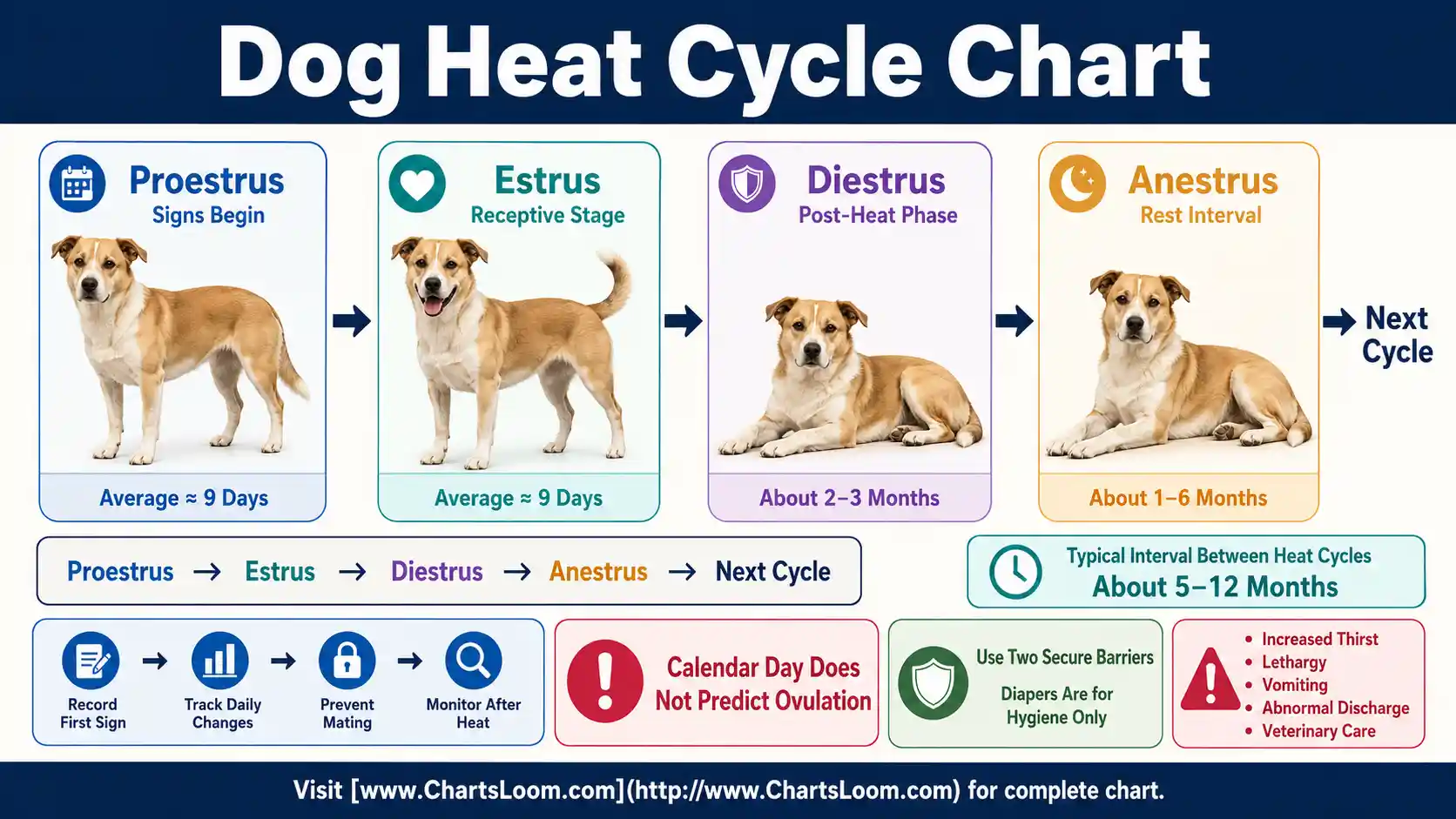
Follow the four stages, common timing, visible signs, first-heat variation, pregnancy prevention, pseudopregnancy and post-heat warning signs. Use the browser planner to organize records without treating a calendar as an ovulation test.
Quick answer
A dog’s heat cycle has four stages: proestrus, estrus, diestrus and anestrus. Visible active signs often last two to three weeks, but the stage lengths vary enough that discharge color, behavior and cycle day cannot identify ovulation. Prevent unintended mating throughout active signs and seek urgent veterinary care for post-heat lethargy, vomiting, increased thirst, abdominal enlargement or foul discharge.
Active signs
Often 2–3 weeks
Proestrus and estrus each vary from a few days to about three weeks.
Common cycle interval
About 6–7 months
Published inter-estrus intervals are broadly about 5–12 months.
Pregnancy prevention
Use two barriers
Diapers, discharge color and behavior do not prevent mating.
Post-heat safety
Watch systemic signs
Thirst, lethargy, vomiting or abnormal discharge can signal pyometra.
Questions at a glance
What is a dog heat cycle?
It is the recurring reproductive sequence of proestrus, estrus, diestrus and anestrus in an intact female dog.
How long does heat last?
Visible proestrus and estrus often total about two to three weeks, but individual stage lengths vary widely.
When can pregnancy occur?
Pregnancy risk occurs around estrus, but visible signs and cycle day cannot identify the fertile window precisely.
How often do dogs cycle?
Many cycle about every six to seven months, while a broad population interval is roughly five to twelve months.
When is the first heat?
Small dogs often cycle during the first year; large and giant dogs may not cycle until 12–24 months.
What is proestrus?
Proestrus is the early stage with swelling, discharge and male attraction, while the female commonly refuses mating.
What is estrus?
Estrus is the receptive stage, but its start and fertile portion cannot be proven from discharge or calendar day alone.
What is diestrus?
Diestrus follows estrus and lasts about two months hormonally whether pregnancy occurs or not.
What is anestrus?
Anestrus is the longer reproductive rest and uterine-recovery interval before the next cycle.
Do diapers prevent pregnancy?
No. A diaper only manages discharge; secure separation is still required.
Can a dog have a silent heat?
Yes. Swelling or discharge can be subtle, hidden by self-cleaning or absent from observation.
Can this tracker predict ovulation?
No. It organizes dates and warning signs but never selects a fertile or breeding day.
Four Stages of the Dog Heat Cycle
The canine cycle has four biologic stages. Durations overlap widely, so visible signs and calendar days cannot determine fertility with precision.
Swipe horizontally inside the table to view every column.
| Stage | Typical duration context | Common physical signs | Typical behavior | Interpretation |
|---|---|---|---|---|
| Proestrus | Often about 9 days; reported range roughly 2–22 days | Vulvar swelling, red or blood-tinged discharge, increased male interest | Usually attracts males but commonly refuses mating | Visible signs mark cycle onset, not a reliable ovulation date |
| Estrus | Often about 9 days; reported range roughly 4–21 days | Discharge may lighten or decrease; vulva may soften | May stand or flag for a male | Fertile timing varies; laboratory testing is needed when breeding timing matters |
| Diestrus | About two months hormonally, whether pregnant or not | External heat signs fade; progesterone remains influential | Usually no longer receptive | Pregnancy, pseudopregnancy and pyometra can occur in this broad post-heat period |
| Anestrus | Commonly 1–6 months | No active external heat signs | Sexual rest period | Uterine recovery and interval before the next cycle |
- • Ranges are population references, not deadlines for an individual dog.
- • A veterinarian may use history, examination, vaginal cytology and progesterone testing when precise staging matters.
Download or export
Heat-cycle record planner
Enter the first clearly visible sign and a check date. The tool calculates the record day, a cautious calendar band and broad next-cycle planning dates. It never predicts ovulation.
Record result
Cycle record day
Day 10
Calendar band
Active heat-sign window
Interpretation: Proestrus or estrus may be present. Calendar days and discharge cannot identify ovulation or a safe pregnancy-risk cutoff.
2026-12-01 to 2027-01-01
2026-11-01 to 2027-06-01
No urgent concern was selected. Continue secure pregnancy prevention and comparable records.
Next step: Record when active signs end and compare this cycle with prior and future cycles.
This is a record-planning result. It does not identify proestrus versus estrus, predict ovulation, declare a fertile day or rule out pregnancy or disease.
What it does
Calculates the record day, shows a cautious calendar band and produces broad next-cycle planning dates.
Why it helps
It keeps start dates, interval history, sterilization status and post-heat warning signs in one record.
What it cannot do
It cannot identify ovulation, prescribe breeding dates, prove pregnancy, diagnose pyometra or replace a veterinarian.
Illustrative Day-by-Day Heat Record
A 28-day record scaffold for observations. It is intentionally labeled as a calendar aid rather than a fertility chart.
Swipe horizontally inside the table to view every column.
| Cycle day | Calendar interpretation | What may be happening | Record or action |
|---|---|---|---|
| Day 1 | Very early observed-sign window | Proestrus is common, but onset can be missed | Record discharge, swelling, behavior and supervision |
| Day 2 | Very early observed-sign window | Proestrus is common, but onset can be missed | Record discharge, swelling, behavior and supervision |
| Day 3 | Very early observed-sign window | Proestrus is common, but onset can be missed | Record discharge, swelling, behavior and supervision |
| Day 4 | Common proestrus calendar band | Many dogs remain unreceptive; variation is wide | Prevent access to intact males and continue daily records |
| Day 5 | Common proestrus calendar band | Many dogs remain unreceptive; variation is wide | Prevent access to intact males and continue daily records |
| Day 6 | Common proestrus calendar band | Many dogs remain unreceptive; variation is wide | Prevent access to intact males and continue daily records |
| Day 7 | Common proestrus calendar band | Many dogs remain unreceptive; variation is wide | Prevent access to intact males and continue daily records |
| Day 8 | Common proestrus calendar band | Many dogs remain unreceptive; variation is wide | Prevent access to intact males and continue daily records |
| Day 9 | Common estrus calendar band | Receptivity may occur, but fertile timing is not proven by day count | Use strict separation; seek veterinary testing for breeding decisions |
| Day 10 | Common estrus calendar band | Receptivity may occur, but fertile timing is not proven by day count | Use strict separation; seek veterinary testing for breeding decisions |
| Day 11 | Common estrus calendar band | Receptivity may occur, but fertile timing is not proven by day count | Use strict separation; seek veterinary testing for breeding decisions |
| Day 12 | Common estrus calendar band | Receptivity may occur, but fertile timing is not proven by day count | Use strict separation; seek veterinary testing for breeding decisions |
| Day 13 | Common estrus calendar band | Receptivity may occur, but fertile timing is not proven by day count | Use strict separation; seek veterinary testing for breeding decisions |
| Day 14 | Common estrus calendar band | Receptivity may occur, but fertile timing is not proven by day count | Use strict separation; seek veterinary testing for breeding decisions |
| Day 15 | Common estrus calendar band | Receptivity may occur, but fertile timing is not proven by day count | Use strict separation; seek veterinary testing for breeding decisions |
| Day 16 | Common estrus calendar band | Receptivity may occur, but fertile timing is not proven by day count | Use strict separation; seek veterinary testing for breeding decisions |
| Day 17 | Common estrus calendar band | Receptivity may occur, but fertile timing is not proven by day count | Use strict separation; seek veterinary testing for breeding decisions |
| Day 18 | Late active-sign window | Estrus may continue in some dogs; others have entered diestrus | Do not assume pregnancy risk has ended from lighter discharge alone |
| Day 19 | Late active-sign window | Estrus may continue in some dogs; others have entered diestrus | Do not assume pregnancy risk has ended from lighter discharge alone |
| Day 20 | Late active-sign window | Estrus may continue in some dogs; others have entered diestrus | Do not assume pregnancy risk has ended from lighter discharge alone |
| Day 21 | Late active-sign window | Estrus may continue in some dogs; others have entered diestrus | Do not assume pregnancy risk has ended from lighter discharge alone |
| Day 22 | Early post-heat window | Diestrus becomes more likely if active signs have ended | Continue monitoring and record the day signs fully resolve |
| Day 23 | Early post-heat window | Diestrus becomes more likely if active signs have ended | Continue monitoring and record the day signs fully resolve |
| Day 24 | Early post-heat window | Diestrus becomes more likely if active signs have ended | Continue monitoring and record the day signs fully resolve |
| Day 25 | Early post-heat window | Diestrus becomes more likely if active signs have ended | Continue monitoring and record the day signs fully resolve |
| Day 26 | Early post-heat window | Diestrus becomes more likely if active signs have ended | Continue monitoring and record the day signs fully resolve |
| Day 27 | Early post-heat window | Diestrus becomes more likely if active signs have ended | Continue monitoring and record the day signs fully resolve |
| Day 28 | Early post-heat window | Diestrus becomes more likely if active signs have ended | Continue monitoring and record the day signs fully resolve |
- • Cycle day 1 means the first clearly observed sign, not necessarily the biologic start.
- • Proestrus and estrus can each be much shorter or longer than the common calendar bands shown.
Download or export
First Heat Timing by Adult Size
Broad first-cycle planning ranges by expected adult size. These are not pass-fail deadlines.
Swipe horizontally inside the table to view every column.
| Expected adult size | Broad first-heat planning range | Typical pattern | Factor that can shift timing |
|---|---|---|---|
| Toy | Often around 4–8 months | Earlier first heats are more common | Body weight and frame |
| Toy | Often around 4–8 months | Earlier first heats are more common | Breed family and genetics |
| Toy | Often around 4–8 months | Earlier first heats are more common | Growth rate and health |
| Toy | Often around 4–8 months | Earlier first heats are more common | Season and individual pattern |
| Toy | Often around 4–8 months | Earlier first heats are more common | Record quality and silent signs |
| Small | Often around 6–10 months | Many cycle in the first year | Body weight and frame |
| Small | Often around 6–10 months | Many cycle in the first year | Breed family and genetics |
| Small | Often around 6–10 months | Many cycle in the first year | Growth rate and health |
| Small | Often around 6–10 months | Many cycle in the first year | Season and individual pattern |
| Small | Often around 6–10 months | Many cycle in the first year | Record quality and silent signs |
| Medium | Often around 7–12 months | Individual and breed variation remains large | Body weight and frame |
| Medium | Often around 7–12 months | Individual and breed variation remains large | Breed family and genetics |
| Medium | Often around 7–12 months | Individual and breed variation remains large | Growth rate and health |
| Medium | Often around 7–12 months | Individual and breed variation remains large | Season and individual pattern |
| Medium | Often around 7–12 months | Individual and breed variation remains large | Record quality and silent signs |
| Large | Often around 12–16 months | Later puberty is common | Body weight and frame |
| Large | Often around 12–16 months | Later puberty is common | Breed family and genetics |
| Large | Often around 12–16 months | Later puberty is common | Growth rate and health |
| Large | Often around 12–16 months | Later puberty is common | Season and individual pattern |
| Large | Often around 12–16 months | Later puberty is common | Record quality and silent signs |
| Giant | May be 16–24 months or later | Some do not cycle until close to two years | Body weight and frame |
| Giant | May be 16–24 months or later | Some do not cycle until close to two years | Breed family and genetics |
| Giant | May be 16–24 months or later | Some do not cycle until close to two years | Growth rate and health |
| Giant | May be 16–24 months or later | Some do not cycle until close to two years | Season and individual pattern |
| Giant | May be 16–24 months or later | Some do not cycle until close to two years | Record quality and silent signs |
- • Small dogs often cycle earlier than large and giant dogs.
- • A veterinarian should assess absent, unusually early, prolonged or otherwise concerning signs.
Download or export
Heat Frequency and Inter-Cycle Intervals
How often dogs cycle and why one dog’s established record is more useful than a universal six-month rule.
Swipe horizontally inside the table to view every column.
| Pattern or interval | Meaning | Best use | Limitation |
|---|---|---|---|
| 5 months | Within the published broad inter-estrus range | Compare with the same dog’s prior cycles | Do not use one interval to predict fertility |
| 6 months | Common interval in many dogs | Compare with the same dog’s prior cycles | Do not use one interval to predict fertility |
| 7 months | Common interval in many dogs | Compare with the same dog’s prior cycles | Do not use one interval to predict fertility |
| 8 months | Within the published broad inter-estrus range | Compare with the same dog’s prior cycles | Do not use one interval to predict fertility |
| 9 months | Within the published broad inter-estrus range | Compare with the same dog’s prior cycles | Do not use one interval to predict fertility |
| 10 months | Within the published broad inter-estrus range | Compare with the same dog’s prior cycles | Do not use one interval to predict fertility |
| 11 months | Within the published broad inter-estrus range | Compare with the same dog’s prior cycles | Do not use one interval to predict fertility |
| 12 months | Within the published broad inter-estrus range | Compare with the same dog’s prior cycles | Do not use one interval to predict fertility |
| About twice yearly | Common household description | Many dogs cluster near six- to seven-month intervals | Use the individual record and discuss persistent changes with a veterinarian |
| Once yearly | Can occur in some large or primitive breeds | Review the individual pattern | Use the individual record and discuss persistent changes with a veterinarian |
| Three cycles yearly | Possible in some smaller dogs | Confirm that signs represent true cycles | Use the individual record and discuss persistent changes with a veterinarian |
| First cycle | May be split or irregular | Young dogs can show interrupted or subtle heats | Use the individual record and discuss persistent changes with a veterinarian |
| Silent heat | Hormonal cycle with few visible signs | Calendar records may miss onset | Use the individual record and discuss persistent changes with a veterinarian |
| Split heat | Signs begin, stop and return within weeks | More common in immature dogs | Use the individual record and discuss persistent changes with a veterinarian |
| Pregnant cycle | Next heat is delayed through pregnancy and recovery | Pregnancy history changes the calendar | Use the individual record and discuss persistent changes with a veterinarian |
| Postpartum interval | Depends on recovery and individual cycle | Do not use a generic prediction | Use the individual record and discuss persistent changes with a veterinarian |
| Medication effect | Hormonal drugs can alter signs or timing | Veterinary management is required | Use the individual record and discuss persistent changes with a veterinarian |
| Illness or low condition | Systemic health can affect cycling | Investigate the dog, not only the calendar | Use the individual record and discuss persistent changes with a veterinarian |
| Older intact dog | Cycles usually continue, though intervals may change | New irregularity deserves review | Use the individual record and discuss persistent changes with a veterinarian |
| Spayed dog | A normal heat cycle should not occur | Heat-like signs warrant veterinary evaluation | Use the individual record and discuss persistent changes with a veterinarian |
| Record uncertainty | The first visible sign may be missed | Use ranges and notes rather than exact dates | Use the individual record and discuss persistent changes with a veterinarian |
| Household male interest | May precede obvious discharge | Record behavior but do not call it ovulation | Use the individual record and discuss persistent changes with a veterinarian |
| Travel or boarding | Observation quality changes | Document who observed each sign | Use the individual record and discuss persistent changes with a veterinarian |
| Breed tendency | Some breed families cycle less often | Use breed history as context, not proof | Use the individual record and discuss persistent changes with a veterinarian |
- • Published inter-estrus intervals are broad; five to twelve months is a useful population context.
- • Sequential cycles in the same dog may still vary.
Download or export
Dog Heat Signs by Stage
Physical and behavioral observations grouped by likely context, with urgent signs separated from normal variation.
Swipe horizontally inside the table to view every column.
| Observed sign | Likely context | What it can mean | Action |
|---|---|---|---|
| Vulvar swelling | Proestrus | Common early sign | Compare with normal anatomy and record onset |
| Red discharge | Proestrus | Common but amount varies | Use washable bedding; note color and volume |
| Male attraction | Proestrus or estrus | Can begin before receptivity | Maintain separation throughout active signs |
| Refuses mounting | Often proestrus | Common early behavior | Behavior alone does not stage ovulation |
| Tail flagging | Often estrus | May accompany receptivity | Not a laboratory fertility test |
| Stands for male | Often estrus | Receptive behavior | Pregnancy can occur; prevent access if breeding is not planned |
| Lighter discharge | Often estrus | May become straw colored or less obvious | Do not assume risk has passed |
| Frequent urination | Proestrus or estrus | Scent marking may increase | Differentiate from urinary pain or infection |
| Restlessness | Active heat | Variable behavioral change | Provide calm routine and secure exercise |
| Clinginess | Active heat | Some dogs seek more contact | Respect individual comfort |
| Reduced appetite | Active heat | Can be mild and temporary | Persistent refusal or illness needs review |
| Increased appetite | Any stage | Nonspecific | Track food without assuming a cycle cause |
| Mounting behavior | Active heat or arousal | Nonspecific | Do not use alone to stage the cycle |
| Escaping or roaming | Active heat | Mate-seeking can increase | Use two barriers and supervised leash walks |
| Males gathering nearby | Active heat | Scent can travel | Inspect fences and doors |
| Signs fade | Transition to diestrus | External signs resolve | Record the last day clearly |
| Mammary enlargement | Diestrus / pseudopregnancy | May occur weeks later | Discuss marked changes or discomfort |
| Nesting | Pseudopregnancy window | May occur around two months after heat | Monitor severity and avoid self-treatment |
| Toy mothering | Pseudopregnancy window | Behavioral sign | Seek advice if distressing or persistent |
| Milk production | Pseudopregnancy or pregnancy | Needs assessment | Do not stimulate mammary glands |
| Increased thirst | Post-heat warning | Can indicate pyometra or other disease | Prompt veterinary assessment |
| Lethargy | Post-heat warning | Not a normal heat-stage marker | Prompt veterinary assessment |
| Vomiting | Post-heat warning | Systemic illness sign | Urgent veterinary assessment |
| Foul or pus-like discharge | Post-heat warning | Possible uterine infection | Urgent veterinary assessment |
| Abdominal enlargement | Pregnancy, pyometra or other cause | Cannot be interpreted from chart | Veterinary examination |
| Heavy bleeding | Any active-sign period | Not a routine staging clue | Prompt veterinary assessment |
| Signs longer than three weeks | Prolonged active signs | Outside common duration | Veterinary assessment |
| No visible discharge | Silent or subtle cycle possible | Some dogs clean themselves frequently | Use behavior and records cautiously |
| Heat signs after spay | Abnormal | Possible ovarian tissue or another condition | Veterinary assessment |
| Fever or collapse | Emergency sign | Not a normal cycle feature | Emergency veterinary care |
- • Many signs are nonspecific and should be interpreted together.
- • Systemic illness, foul discharge, marked bleeding or heat signs after spay require veterinary assessment.
Download or export
Fertility Timing and Veterinary Tests
Why visible signs are useful records but insufficient for selecting a breeding day or declaring pregnancy risk over.
Swipe horizontally inside the table to view every column.
| Method or clue | Relative precision | Useful role | Key limitation |
|---|---|---|---|
| Cycle day count | Low | Useful for organizing records | Cannot identify ovulation because stage length varies |
| Discharge color | Low | Tracks visible progression | Lighter discharge does not prove fertility |
| Standing behavior | Low to moderate | Shows receptivity | Some dogs accept outside the optimal conception window |
| Male interest | Low | Shows scent response | Can begin during proestrus |
| Vulvar softness | Moderate clinical clue | Part of examination | Subjective and not exact alone |
| Vaginal cytology | Moderate to high when serial | Helps classify epithelial changes | Does not give the exact ovulation time by itself |
| Serum progesterone series | High for clinical timing | Tracks the rise around ovulation | Requires properly timed repeat samples and laboratory interpretation |
| LH testing | High but narrow window | Can identify LH surge | Short surge makes sampling demanding |
| Vaginoscopy | Adjunct | Assesses vaginal fold changes | Requires experience and is not sufficient alone |
| Ultrasound of ovaries | Specialist adjunct | May support follicle or ovulation assessment | Availability and interpretation vary |
| One progesterone value | Limited | Can provide a snapshot | A series is often more informative |
| Home ovulation strip | Unsupported for routine canine timing | Convenient concept | Human urine tests do not replace canine veterinary testing |
| Calendar app fertile day | Low | Reminder only | Cannot account for biologic variation |
| First day of bleeding | Record anchor | Useful start point | Bleeding onset may be missed |
| End of bleeding | Record anchor | Useful household observation | Fertility may not match visible bleeding |
| Breeding date | Historical record | Supports pregnancy dating context | Does not reveal ovulation |
| Semen type | Clinical planning factor | Fresh, chilled and frozen semen have different timing needs | Requires reproductive veterinarian |
| Male fertility | Separate factor | Affects conception | Female timing cannot compensate for poor semen quality |
| Age and parity | Context | Influence reproductive planning | Do not override testing |
| Split heat | Complicating pattern | May interrupt signs | Restarting signs require reassessment |
| Silent heat | Complicating pattern | Few external signs | Testing may be needed to confirm cycling |
| Irregular cycles | Clinical question | May justify investigation | Do not self-treat with hormones |
| Pregnancy prevention | Management goal | Requires separation throughout risk window | No day-count shortcut is reliable |
| Breeding planning | Veterinary goal | Use health screening and serial testing | This chart cannot prescribe mating dates |
- • Precise breeding management belongs with a veterinarian experienced in canine reproduction.
- • This page does not provide mating dates or infer ovulation from a calendar alone.
Download or export
Pregnancy Prevention During Heat
Practical household controls for preventing escape and mating without relying on diapers, behavior or guessed fertile days.
Swipe horizontally inside the table to view every column.
| Situation | Recommended control | Why it matters |
|---|---|---|
| Before expected heat | Inspect fences, gates and doors | Repair gaps and plan two physical barriers |
| At first sign | Switch to supervised leash outings | Record cycle day 1 |
| Indoor separation | Use closed doors plus a secure secondary barrier | Baby gates alone may be inadequate |
| Yard access | Supervise every trip | Do not leave an intact female unattended |
| Walks | Use a secure leash and fitted equipment | Avoid off-leash areas |
| Household intact male | House separately with two barriers | Rotate access rather than relying on commands |
| Visiting dogs | Postpone visits | Scent can attract males from a distance |
| Boarding | Disclose heat status before arrival | Many facilities cannot accept dogs in heat |
| Daycare | Pause attendance | Group environments create escape and mating risk |
| Dog parks | Avoid during active signs | Receptive behavior can change quickly |
| Training class | Ask instructor and relocate if needed | Protect all dogs from distraction and contact |
| Transport | Crate securely inside a closed vehicle | Do not tether outside |
| Diapers | Use only for hygiene | They do not prevent mating |
| Washable bedding | Protect surfaces and track discharge | Change frequently and keep skin dry |
| Identification | Confirm collar tag and microchip data | Supports recovery after escape |
| Emergency contact | Keep veterinarian and local emergency clinic details ready | Act promptly after accidental mating or illness |
| Accidental mating | Contact a veterinarian promptly | Do not use unprescribed drugs or physical separation attempts |
| Pregnancy prevention medication | Veterinary only | Risks and availability vary by region |
| Permanent prevention | Discuss ovariectomy or ovariohysterectomy | Timing should be individualized |
| Hormone-sparing sterilization | Heat behavior may continue if ovaries remain | Pregnancy prevention does not equal cycle suppression |
| Male vasectomy household | Pregnancy risk may be reduced but mating behavior remains | Confirm procedure and fertility status with veterinarian |
| End of visible signs | Continue caution until veterinary or management plan says otherwise | Calendar-only fertility cutoff is unsafe |
| Cycle record | Save start and end dates plus observations | Improves future planning |
| Children and visitors | Explain doors and gate rules | Prevent accidental escape |
- • A diaper manages discharge; it is not contraception.
- • After accidental mating, contact a veterinarian promptly rather than attempting home treatment.
Download or export
Dog Heat Cycle Record Fields
A structured record improves future planning and helps a veterinarian interpret unusual timing or post-heat illness.
Swipe horizontally inside the table to view every column.
| Record field | What to enter | Why record it |
|---|---|---|
| Dog identity | Name, microchip and breed | Prevents mixed records |
| Date of birth | Known or estimated | Provides puberty context |
| Spay status | Intact, ovary-sparing or fully spayed | Changes interpretation |
| Cycle number | First, second or later | Highlights immature-cycle variation |
| First visible sign date | Calendar date and observer | Defines household cycle day 1 |
| First swelling noticed | Date and degree | May precede discharge |
| First discharge noticed | Date, color and amount | Tracks onset |
| Male interest | Date and intensity | Behavioral context only |
| Female receptivity | Yes, no or uncertain | Does not prove ovulation |
| Tail flagging | Date and context | Behavioral clue |
| Urination change | Frequency and marking | Separate from urinary disease |
| Appetite | Normal, reduced or increased | Nonspecific context |
| Energy | Normal, restless or lethargic | Lethargy is a warning sign |
| Discharge progression | Daily color and volume | Helps detect abnormal change |
| Last active sign date | Date signs fully resolved | Defines observed duration |
| Household separation | Barriers and schedule | Documents prevention plan |
| Accidental access | Date, duration and dog involved | Important for veterinary advice |
| Veterinary tests | Test, date, value and laboratory | Keeps serial interpretation intact |
| Medications | Name, dose, prescriber and dates | Hormones can alter cycles |
| Body weight | Date and measurement | Health context |
| Previous cycle start | Calendar date | Builds interval history |
| Previous cycle length | Observed sign duration | Shows individual pattern |
| Post-heat signs | Mammary, nesting, thirst, discharge | Screens pseudopregnancy and illness |
| Veterinary advice | Clinic, date and plan | Prevents memory errors |
| Next review date | Planned check or spay discussion | Turns records into action |
- • Use one record per dog and one row per cycle.
- • Photographs can document discharge color or swelling only when taken without distress and stored privately.
Download or export
Normal Variation and When to Ask a Veterinarian
Common variation is broad, but repeated pattern changes, systemic illness and prolonged signs should not be dismissed as “just heat.”
Swipe horizontally inside the table to view every column.
| Observation | Possible interpretation | Recommended response |
|---|---|---|
| First heat at 5 months | Can occur, especially in small dogs | Confirm health and prevention plan |
| First heat at 18 months | Can occur in large or giant dogs | Review size, breed and health |
| No first heat by about 24 months | Needs veterinary discussion | Rule out silent cycles or reproductive disorder |
| Cycle every 5 months | Within broad population range | Compare sequential cycles |
| Cycle every 12 months | Within broad population range | More common in some breed families |
| One unusually short interval | May be record error or true variation | Verify dates and monitor next cycle |
| Repeated very short intervals | Not typical for the dog | Veterinary assessment |
| Repeated very long intervals | May reflect breed tendency or disorder | Veterinary assessment |
| Light discharge | Can be normal | Do not use amount to infer fertility |
| No obvious discharge | Silent or self-cleaned signs possible | Record behavior and swelling |
| Heavy bleeding | Not a routine variation to ignore | Prompt assessment |
| Signs for 4 days | Possible short stage | Calendar alone cannot classify |
| Signs for 21 days | Upper end of common active window | Discuss if continuing |
| Signs beyond 21 days | Prolonged | Veterinary assessment |
| Split first heat | Can occur in young dogs | Record both episodes |
| Male interest before discharge | Possible | Maintain separation |
| Receptivity changes day to day | Possible | Do not use one behavior as a fertility test |
| Appetite change only | Nonspecific | Look for other signs and illness |
| Older intact dog still cycles | Expected | Age does not create menopause like humans |
| Cycle stops in older dog | Not assumed to be menopause | Veterinary assessment |
| Post-heat nesting | Possible pseudopregnancy | Assess severity and timing |
| Post-heat thirst and lethargy | Concerning | Prompt assessment for pyometra or other disease |
| Heat signs after complete spay | Abnormal | Evaluate for ovarian remnant or other causes |
| Different pattern after hormonal medication | Possible drug effect | Contact prescribing veterinarian |
- • A dog does not undergo human-style menopause; intact older dogs can continue cycling.
- • Compare new observations with the same dog’s prior pattern.
Download or export
The post-heat period still needs attention
Pseudopregnancy can cause nesting and mammary changes. Pyometra can cause severe illness and may occur without visible discharge. A calendar cannot distinguish them.
Pseudopregnancy After a Heat Cycle
Signs, timing and management boundaries for false pregnancy, which can occur after a normal non-pregnant cycle.
Swipe horizontally inside the table to view every column.
| Feature | Typical context | Practical guidance |
|---|---|---|
| Timing | Often appears around two months after estrus | Follows normal progesterone decline |
| Nesting | Collecting bedding or making a den | May be mild or disruptive |
| Toy mothering | Guarding or carrying toys | Behavioral sign |
| Mammary enlargement | Glands become more prominent | Avoid unnecessary stimulation |
| Milk production | Can occur without pregnancy | Needs assessment if painful or persistent |
| Restlessness | Difficulty settling | Nonspecific |
| Reduced activity | Quieter behavior | Differentiate from illness |
| Appetite change | Reduced or increased | Nonspecific |
| Weight change | May reflect appetite or fluid changes | Measure rather than guess |
| Abdominal appearance | May seem enlarged | Cannot distinguish pregnancy, pseudopregnancy or disease |
| Mild case | Comfortable dog with short-lived signs | Monitor under veterinary guidance |
| Distressing behavior | Anxiety, guarding or inability to rest | Veterinary advice |
| Painful mammary glands | Heat, redness or discomfort | Prompt assessment |
| Fever or systemic illness | Not routine pseudopregnancy | Urgent assessment |
| Milk expression | Generally avoid | Stimulation can prolong milk production |
| Warm compresses | Do not start without advice | May stimulate glands |
| Food restriction | Do not improvise | Nutrition changes need professional guidance |
| Medication | Veterinary prescription only | Drug choice depends on severity and health |
| Pregnancy test | May be needed if mating occurred | History alone may be uncertain |
| Recurrence | Can happen after later cycles | Discuss long-term plan |
| Spay timing | Discuss after signs resolve | Timing during active pseudopregnancy can matter |
| Emergency distinction | Pyometra can occur in a similar post-heat period | Systemic signs require prompt examination |
- • Pseudopregnancy is a physiologic response, but severe or painful signs need veterinary care.
- • Do not assume abdominal enlargement or milk production rules out true pregnancy or uterine disease.
Download or export
Pyometra Warning Signs After Heat
A high-priority safety chart for intact dogs in the weeks after a cycle. Closed-cervix disease may occur without discharge.
Swipe horizontally inside the table to view every column.
| Sign or factor | Why it matters | Action |
|---|---|---|
| Timing risk | Commonly during diestrus, often weeks after heat | Keep post-heat dates in the medical history |
| Increased thirst | May be an early systemic sign | Prompt veterinary assessment |
| Increased urination | Often accompanies thirst | Prompt veterinary assessment |
| Lethargy | Dog is unusually quiet or weak | Urgent assessment |
| Poor appetite | Food refusal or marked reduction | Urgent assessment |
| Vomiting | Systemic illness sign | Urgent assessment |
| Fever | May occur, but absence does not rule out disease | Urgent assessment |
| Abdominal enlargement | Possible enlarged infected uterus | Emergency assessment |
| Abdominal pain | Guarding or discomfort | Emergency assessment |
| Pus-like discharge | Open-cervix pyometra possible | Urgent assessment |
| Blood-tinged abnormal discharge | Can be mistaken for another heat | Urgent assessment |
| Foul odor | Abnormal discharge feature | Urgent assessment |
| No discharge | Closed-cervix pyometra is possible | Do not wait for discharge |
| Collapse | Shock or severe illness | Emergency care now |
| Pale gums | Circulatory concern | Emergency care now |
| Rapid breathing | Pain, fever or shock | Emergency care now |
| Dehydration | Tacky gums or weakness | Urgent assessment |
| Recent heat record | Bring start and end dates | Helps clinical interpretation |
| Pregnancy possibility | Tell the veterinarian about any mating | Changes diagnostic plan |
| Medication history | List hormones and other drugs | May affect risk and signs |
| Home remedy | None is appropriate | Pyometra is life-threatening |
| Wait-and-see approach | Unsafe with systemic signs | Seek care promptly |
| Spayed dog | Typical pyometra is unlikely after complete ovary and uterus removal | Stump infection or ovarian remnant still requires evaluation |
| Prevention discussion | Spaying prevents future uterine pyometra when uterus and ovaries are removed | Individualize timing with veterinarian |
- • Pyometra can progress rapidly and is not treatable with a home chart.
- • Contact a veterinarian urgently for systemic illness, abnormal discharge, abdominal enlargement or collapse after heat.
Download or export
Spay Procedures and Heat-Like Signs
Why “spayed” can mean different procedures and why recurrent swelling or discharge after complete spay needs evaluation.
Swipe horizontally inside the table to view every column.
| Procedure or finding | What it means | Heat-cycle implication |
|---|---|---|
| Complete ovariectomy | Ovaries removed | Heat cycles should stop |
| Ovariohysterectomy | Ovaries and uterus removed | Heat cycles and uterine pyometra should stop |
| Ovary-sparing hysterectomy | Uterus removed, ovaries retained | Heat behavior and attraction can continue; pregnancy cannot occur without a uterus |
| Tubal ligation | Ovaries and uterus remain | Heat and pregnancy risk may remain depending procedure |
| Ovarian remnant | Functional ovarian tissue remains after spay | Heat-like signs can recur |
| Adrenal hormone disorder | Rare alternative explanation | Requires veterinary investigation |
| Vaginal or urinary disease | Can mimic discharge or licking | Needs examination |
| Skin irritation | May cause licking or swelling | Not automatically heat |
| Behavioral mounting | Nonspecific | Does not prove ovarian activity |
| Male interest | Nonspecific but important | Record and report with other signs |
| Vulvar swelling after spay | Abnormal | Veterinary assessment |
| Bloody discharge after spay | Abnormal | Prompt veterinary assessment |
| Cyclic recurrence | Suggests hormonal pattern | Record dates and signs |
| Hormone testing | May support diagnosis | Timing and interpretation are veterinary tasks |
| Vaginal cytology | May show estrogen influence | Requires clinical sampling |
| Ultrasound | May help find tissue or other disease | Not always definitive |
| Exploratory surgery | Sometimes required for confirmed remnant | Specialist decision |
| Heat prevention goal | Clarify whether ovaries will remain | Procedure choice changes future signs |
| Breeding prevention goal | Clarify procedure and residual risks | Do not assume every sterilization suppresses hormones |
| Medical record | Keep operative report | Identifies exactly what was removed |
- • Ask for the operative record when the exact sterilization procedure is uncertain.
- • Heat-like signs after complete ovary removal are not normal.
Download or export
Home Care and Management During Heat
Comfort, hygiene and escape-prevention measures that preserve normal activity without treating diapers or odor products as contraception.
Swipe horizontally inside the table to view every column.
| Task | Practical method | Purpose |
|---|---|---|
| Secure collar or harness | Check fit before every outing | Escape prevention |
| Leash walks | Use direct supervision | Avoid off-leash contact |
| Two-door rule | Close one barrier before opening another | Reduces accidental escapes |
| Fence inspection | Check gaps, digging and gate latches | Males may approach the property |
| Yard supervision | Stay outside with the dog | A fence alone is not enough |
| Crate use | Use only if crate-trained and comfortable | Management, not punishment |
| Indoor rotation | Schedule separate rooms for intact dogs | Prevents contact |
| Washable bedding | Use light-colored washable layers | Tracks discharge and protects surfaces |
| Dog diaper | Change often and check skin | Hygiene only, not contraception |
| Skin cleaning | Use gentle water and dry thoroughly | Avoid irritating products |
| Bathing | Routine gentle bathing is usually possible | Avoid stress and harsh cleansers |
| Exercise | Continue appropriate controlled activity | Supports routine without exposure |
| Mental enrichment | Use food puzzles and scent games | Reduces restlessness |
| Training | Practice calm stationing and door manners | Supports management |
| Visitors | Explain barrier rules | Prevents accidental door opening |
| Children | Adult supervises all access | Management cannot depend on a child |
| Household males | Separate with two barriers | Do not rely on obedience |
| Public areas | Avoid dog parks and crowded off-leash spaces | Prevents mating and conflict |
| Boarding | Call facility before booking | Policies vary |
| Grooming appointment | Disclose heat status | Reschedule if facility cannot isolate |
| Travel | Use a secure crate inside vehicle | Prevents escape during stops |
| Odor products | Do not rely on sprays to hide scent | They do not prevent male interest |
| Pain medication | Do not give human medicine | Heat is not treated with home analgesics |
| Daily record | Note discharge, behavior and appetite | Detects change |
| Emergency plan | Know nearest veterinary clinic | Speeds response to illness or mating |
- • Keep routines calm and predictable while maintaining strict separation from intact males.
- • Human pain relievers and unprescribed hormones can be dangerous.
Download or export
Questions for a Veterinary Visit
A consultation checklist for first cycles, irregular timing, breeding management, pregnancy risk, pseudopregnancy and post-heat illness.
Swipe horizontally inside the table to view every column.
| Question | Information to bring | Why it helps |
|---|---|---|
| Is this the first true cycle? | Age, size, signs and prior records | Distinguishes puberty from another condition |
| Is the duration within her pattern? | Start and end dates | Identifies prolonged signs |
| Could this be a split heat? | Stopped and restarted signs | Common in immature dogs |
| Could this be a silent heat? | Male interest and subtle changes | Explains missing visible signs |
| Does she need examination now? | Discharge, bleeding, pain and systemic signs | Triage |
| Could urinary disease mimic heat? | Straining, frequency, urine testing | Separates reproductive and urinary signs |
| Could vaginal disease mimic heat? | Discharge and examination | Finds local disease |
| Is pregnancy possible? | Any male access or mating | Changes testing and advice |
| When can pregnancy be tested? | Mating and ovulation context | Selects appropriate test timing |
| Is pseudopregnancy likely? | Post-heat timing and mammary behavior | Plans monitoring or treatment |
| Could this be pyometra? | Post-heat illness signs | Emergency assessment |
| What sterilization procedure was performed? | Operative record | Explains residual cycling |
| Could ovarian remnant be present? | Cyclic post-spay signs | Guides testing |
| Should progesterone be measured? | Breeding goal and cycle stage | Clinical ovulation timing |
| Is vaginal cytology useful? | Serial stage assessment | Supports interpretation |
| Does this dog need breeding health screening? | Breed, age and planned mating | Responsible breeding plan |
| Is current body condition appropriate? | Weight and body condition score | Reproductive health context |
| Can medications alter the cycle? | Drug list and dates | Identifies hormonal effects |
| When should spay be scheduled? | Cycle stage, age and health | Individualized timing |
| What happens after accidental mating? | Date and details | Prompt veterinary options |
| How should household separation work? | Home layout and other dogs | Prevention plan |
| What signs require emergency care? | Clinic-specific triage guidance | Clear action threshold |
| What records should I bring? | Cycle chart, photos, tests and medication list | Efficient consultation |
| When should the next review occur? | Current findings and goals | Creates follow-up plan |
- • Reproductive timing and disease assessment require an individual history and examination.
- • Bring exact dates and the operative report when a dog has been sterilized.
Download or export
Worked Dog Heat Cycle Examples
Thirty common scenarios showing how to use timing, signs and history without treating a calendar as a diagnosis.
Swipe horizontally inside the table to view every column.
| Example | Scenario | Observation | Interpretation | Best next step |
|---|---|---|---|---|
| 1 | Small dog, 7 months | First swelling and red discharge today | Likely first proestrus observation | Start record and strict separation |
| 2 | Large dog, 14 months | No prior heat recorded | First heat may still be within size-related variation | Discuss at next veterinary visit and monitor |
| 3 | Giant dog, 23 months | No observed cycle | Near upper planning range | Veterinary discussion to assess silent cycling or disorder |
| 4 | Cycle day 5 | Bloody discharge, refuses male | Proestrus is plausible | Continue prevention; day count cannot predict ovulation |
| 5 | Cycle day 11 | Lighter discharge, tail flagging | Estrus is plausible | Pregnancy risk; do not use calendar alone |
| 6 | Cycle day 20 | Signs fading | Late estrus or transition possible | Continue caution and record resolution |
| 7 | About six weeks after heat | Nesting and carrying toys | Pseudopregnancy timing possible | Seek advice if distressing or mammary signs develop |
| 8 | Six weeks after heat | Thirst, lethargy, vomiting | Pyometra concern | Urgent veterinary assessment |
| 9 | Spayed dog | New swelling and male interest | Heat-like signs are abnormal | Veterinary assessment for ovarian remnant or mimic |
| 10 | Heat every 6 months | Similar signs and duration | Consistent individual pattern | Keep serial records |
| 11 | Heat every 11 months | Healthy dog, established pattern | Within broad population range | Use her own history |
| 12 | First heat starts then stops | Signs return two weeks later | Split heat possible | Record both episodes and discuss if uncertain |
| 13 | No discharge seen | Males interested and vulva enlarged | Silent or self-cleaned heat possible | Maintain separation and seek confirmation if needed |
| 14 | Diaper in place | Intact male in same room | Pregnancy prevention inadequate | Use two physical barriers |
| 15 | Accidental mating | Dogs tied | Pregnancy possible | Contact veterinarian promptly; do not force separation |
| 16 | Older intact dog | Cycle interval suddenly shortens | Pattern change | Veterinary assessment |
| 17 | Older intact dog | No cycle for 18 months | Not assumed menopause | Veterinary assessment |
| 18 | Three weeks of bleeding | Signs continue | Prolonged active signs | Prompt assessment |
| 19 | Day 60 after heat | Mammary enlargement but bright and eating | Pseudopregnancy possible | Discuss management |
| 20 | Day 60 after heat | Foul discharge and weakness | Pyometra concern | Emergency care |
| 21 | First visible sign missed | Male interest started earlier | Cycle day uncertain | Use ranges, not exact fertile dates |
| 22 | Progesterone test once | Single low result | Snapshot only | Follow veterinarian’s serial plan |
| 23 | Breeding planned | Healthy appearing dog | Health screening still needed | Pre-breeding veterinary examination |
| 24 | Boarding reservation | Heat begins before trip | Facility may not accept | Call and rearrange |
| 25 | Yard with tall fence | Male dog digs under | Fence alone failed | Supervise and add secondary barrier |
| 26 | Dog refuses meals for one day | Otherwise bright | Can be mild but nonspecific | Monitor closely |
| 27 | Dog refuses meals and vomits | Post-heat | Systemic illness | Urgent assessment |
| 28 | Ovary-sparing sterilization | Heat behavior returns | Expected hormonal cycling may remain | Confirm procedure and prevention plan |
| 29 | Complete spay | Bloody discharge | Abnormal | Prompt examination |
| 30 | Two prior intervals differ | 6 and 8 months | Normal variability possible | Continue multi-cycle record |
- • Examples are educational and do not diagnose an individual dog.
- • Systemic illness, abnormal discharge or signs after complete spay require veterinary assessment.
Download or export
Important limitations
- • This chart cannot diagnose pregnancy, pyometra, ovarian remnant syndrome, urinary disease or reproductive disorders.
- • The first visible sign may occur after biologic onset, so cycle day is an observation record rather than a precise stage marker.
- • A lighter discharge or receptive behavior does not prove ovulation or define a safe pregnancy-prevention cutoff.
- • Breeding decisions require health screening and veterinary timing methods; the planner never recommends a mating day.
- • Spay timing, accidental-mating management and hormone treatment are individual veterinary decisions.
Frequently asked questions
How long is a dog in heat?
Visible proestrus and estrus commonly total about two to three weeks, but each stage varies widely. Merck reports proestrus and estrus ranges that can each extend from only a few days to about three weeks.
What are the four dog heat-cycle stages?
The four stages are proestrus, estrus, diestrus and anestrus. Proestrus and estrus create the visible active heat period; diestrus and anestrus make up the longer post-heat and resting intervals.
When can a dog become pregnant during heat?
Pregnancy risk is associated with estrus, but visible signs and cycle day cannot identify the fertile window precisely. Strict separation is safer than guessing, and breeding timing requires veterinary testing.
How often do dogs go into heat?
Many dogs cycle about every six to seven months, but published intervals range broadly from about five to twelve months. Some large or primitive breeds may cycle less often.
When is a dog’s first heat?
Small dogs often begin earlier, while large and giant dogs may not cycle until 12–24 months. Individual and breed variation is substantial.
Can a dog have a silent heat?
Yes. Some dogs show minimal discharge or swelling, and frequent self-cleaning can hide signs. Male interest or behavior may provide clues, but veterinary testing is needed for confirmation.
What is a split heat?
A split heat is an interrupted cycle in which early signs appear, stop and return within weeks. It is more common in young dogs experiencing early cycles.
Does bleeding stop before a dog can become pregnant?
Discharge often lightens during estrus, when pregnancy can occur. The amount or color of discharge is not a reliable contraception guide.
Do dog diapers prevent mating?
No. A diaper manages discharge but does not prevent mating. Use secure physical separation and supervised leash outings.
What is pseudopregnancy in dogs?
Pseudopregnancy is a normal hormonal response that may cause nesting, toy mothering, mammary enlargement or milk production around around two months after heat.
When does pyometra occur after heat?
Pyometra commonly occurs during diestrus, often several weeks after heat. Increased thirst, lethargy, vomiting, abdominal enlargement or abnormal discharge need urgent veterinary assessment.
Can an older dog still go into heat?
Yes. Dogs do not have a human-style menopause. An intact older dog may continue cycling, and new irregularity or illness deserves veterinary review.
Why is my spayed dog showing heat signs?
Heat-like signs after complete ovary removal are abnormal and can reflect ovarian remnant tissue or another disorder. The exact sterilization procedure and a veterinary examination matter.
Can a calendar predict dog ovulation?
No. Calendar records organize observations, but stage duration varies too much for a day number to identify ovulation. Serial progesterone testing and other veterinary methods are used when timing matters.
What should I record during a heat cycle?
Record the first and last visible signs, discharge, swelling, behavior, male interest, access incidents, medications, post-heat symptoms and prior-cycle dates.
Sources
External source URLs are shown as plain text so the reference list remains transparent without adding outbound source links.
UC Davis School of Veterinary Medicine — Breeding Management of the Bitch
Defines proestrus, estrus, diestrus and anestrus; describes average and broad stage durations, receptivity, serial progesterone and cytology testing, false pregnancy and inter-estrus timing.
https://healthtopics.vetmed.ucdavis.edu/health-topics/canine/breeding-management-bitch
Merck Veterinary Manual — Reproductive Disorders of Female Dogs
Explains reproductive disorders that can resemble or follow heat, including pyometra signs such as lethargy, appetite loss, vomiting, increased thirst and urination, and abnormal discharge.
https://www.merckvetmanual.com/dog-owners/reproductive-disorders-of-dogs/reproductive-disorders-of-female-dogs
American Kennel Club — Everything You Need to Know About Dogs in Heat
Summarizes practical first-heat variation by body size, common household signs, split or silent heats and the need to treat visible timing as variable rather than exact.
https://www.akc.org/expert-advice/dog-breeding/dogs-in-heat/
This chart is educational and does not replace veterinary care. Review the ChartsLoom disclaimer before using any health-related reference.