Animals & Pets
Dog Teeth Chart
Identify puppy and adult teeth, decode Modified Triadan numbers, follow eruption timing, understand carnassial teeth and recognize dental warning signs.
Quick answer
A puppy mouth changes from 28 to 42 teeth
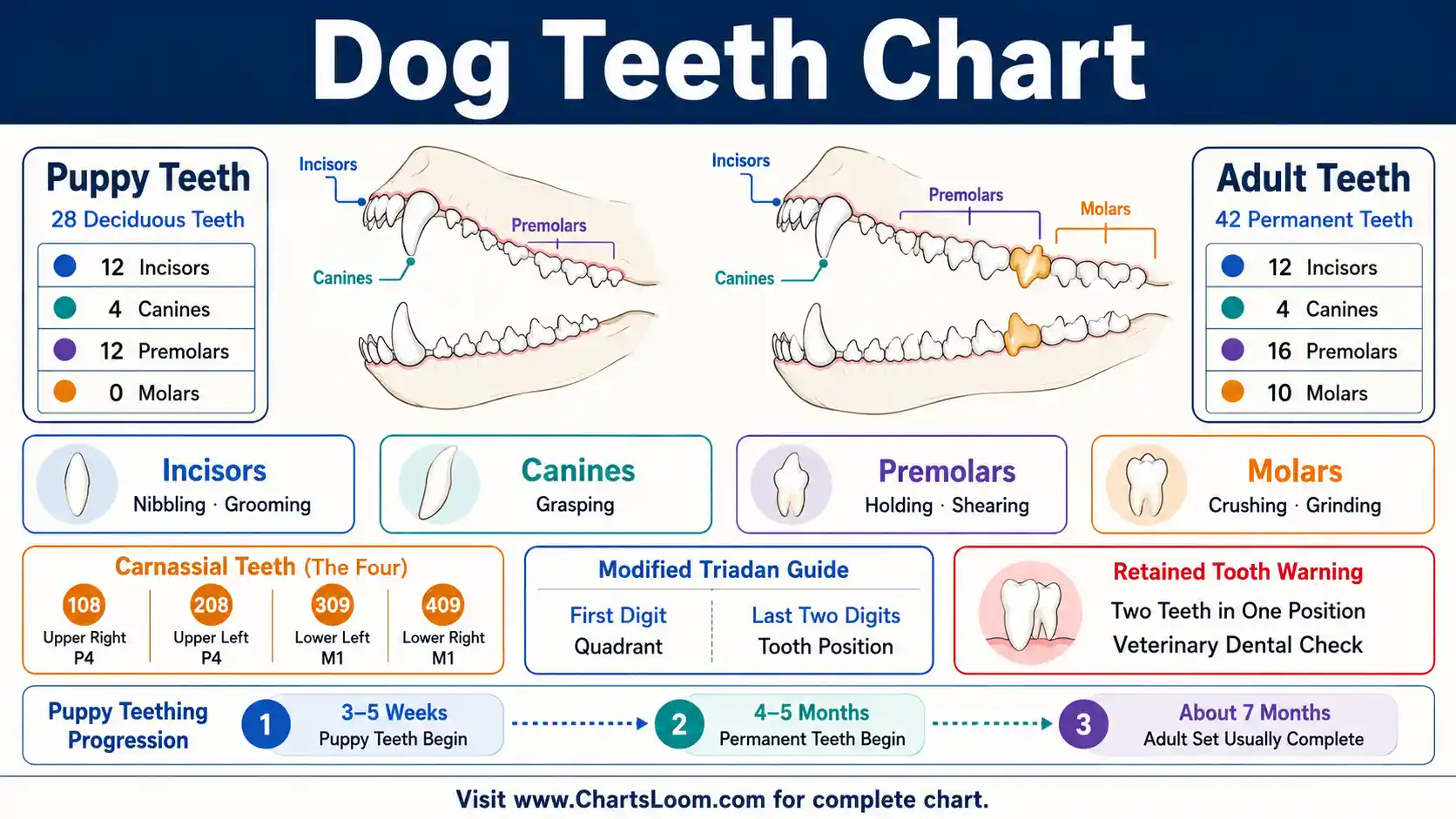
Most puppies have 28 temporary teeth, while most adult dogs have 42 permanent teeth. Puppy teeth begin erupting at about three to five weeks. Permanent teeth usually start replacing them around four to five months, and the adult set is commonly complete by about seven months. Use tooth numbers to identify location, but use a veterinary examination and dental radiographs to assess disease.
Puppy dentition
28 deciduous teeth
Puppies have incisors, canines and premolars, but no deciduous molars.
Adult dentition
42 permanent teeth
The adult set usually includes 12 incisors, 4 canines, 16 premolars and 10 molars.
Veterinary numbering
Modified Triadan
The first digit identifies quadrant and dentition; the last two identify position.
Most important limit
Roots are hidden
A normal-looking crown cannot rule out root, pulp or periodontal bone disease.
Questions at a glance
How many teeth does an adult dog have?
Most adult dogs have 42 permanent teeth.
How many puppy teeth are normal?
Most puppies have 28 deciduous teeth and no deciduous molars.
When do puppy teeth erupt?
Deciduous teeth generally begin appearing at about three to five weeks.
When are adult dog teeth complete?
Permanent teeth usually begin erupting around four to five months and are commonly complete by about seven months.
What does tooth 108 mean?
108 is the permanent upper-right fourth premolar and an upper carnassial tooth.
What does tooth 309 mean?
309 is the permanent lower-left first molar and a lower carnassial tooth.
Why are some puppy tooth numbers skipped?
Deciduous dogs have no first premolars or molars, so the Triadan sequence preserves intentional gaps.
What is a retained deciduous tooth?
It is a puppy tooth that remains while the permanent successor erupts, creating crowding and plaque retention.
Can a missing tooth be under the gum?
Yes. Dental radiographs may reveal an unerupted tooth, root remnant or other hidden problem.
Does visible tartar show periodontal stage?
No. Accurate staging requires probing and intraoral radiographs during a complete anesthetized assessment.
What is the best home dental care?
Daily brushing with dog-safe toothpaste is the most useful practical plaque-control method when the mouth is comfortable.
When does a broken tooth need care?
Every fracture deserves assessment; exposed pulp, facial swelling, severe pain or uncontrolled bleeding require prompt or urgent care.
Dog Teeth Overview
The normal canine mouth changes from 28 puppy teeth to 42 permanent teeth. Tooth count alone cannot confirm oral health.
Swipe horizontally inside the table to view every column.
| Feature | Typical count | Distribution | Timing or code | Why it matters |
|---|---|---|---|---|
| Deciduous teeth | 28 | 12 incisors · 4 canines · 12 premolars · 0 molars | Begin erupting at about 3–5 weeks | Temporary puppy dentition |
| Permanent teeth | 42 | 12 incisors · 4 canines · 16 premolars · 10 molars | Begin erupting at about 4–5 months | Usually complete by about 7 months |
| Upper jaw | 20 permanent | 6 incisors · 2 canines · 8 premolars · 4 molars | Quadrants 1 and 2 | Left and right maxilla |
| Lower jaw | 22 permanent | 6 incisors · 2 canines · 8 premolars · 6 molars | Quadrants 3 and 4 | Left and right mandible |
| Incisors | 12 permanent | Three per quadrant | I1 · I2 · I3 | Nibbling, grooming and scraping |
| Canines | 4 permanent | One per quadrant | C | Grasping and puncturing |
| Premolars | 16 permanent | Four per quadrant | P1–P4 | Holding and shearing |
| Molars | 10 permanent | Two in each upper quadrant; three in each lower quadrant | M1–M3 | Crushing and grinding |
| Carnassial pair | 4 key teeth | Upper P4 and lower M1 on both sides | 108/208 and 309/409 | Major shearing teeth |
| Modified Triadan | Three-digit system | First digit = quadrant; last two digits = tooth position | 101–411 permanent | Standard veterinary charting |
| Retained puppy tooth | Not a normal second row | A deciduous tooth remains beside an erupting permanent tooth | Often canine teeth | Needs prompt veterinary assessment |
| Missing adult tooth | Not always truly absent | May be unerupted, fractured or previously lost | Dental radiographs clarify | Do not assume a gap is harmless |
- • Counts describe the usual complete dentition; congenital absence, unerupted teeth and prior loss can change the visible count.
- • Eruption ages are approximate and vary among individuals.
Download or export
Interactive reference tool
Dog tooth number lookup
Enter a three-digit Modified Triadan number to identify its normal quadrant, tooth type, function and broad eruption timing.
Lookup result
108 — premolar 4
108 identifies the upper right premolar 4 in the modified Triadan system.
Location
Permanent · Upper Right
Typical eruption
About 5–6 months
Function
Holding and shearing
Special role
Upper carnassial tooth
- 1. Use the number to match a veterinary dental chart or treatment record.
- 2. Remember that visible crown appearance does not show the roots or surrounding bone.
- 3. Seek veterinary assessment for pain, fracture, swelling, a missing expected tooth or a retained puppy tooth.
This lookup identifies normal chart position only. It cannot confirm eruption, diagnose periodontal or pulp disease, or replace an anesthetized examination and intraoral radiographs.
What it does
Decodes normal permanent and deciduous canine tooth numbers, including intentional numbering gaps.
Why it helps
It makes veterinary dental records easier to understand and distinguishes similar tooth names by exact side and jaw.
What it cannot do
It cannot diagnose pain, confirm tooth presence, stage periodontal disease or replace dental radiographs.
Adult Dog Dental Formula
The permanent canine formula is 2 × (I 3/3, C 1/1, P 4/4, M 2/3) = 42 teeth.
Swipe horizontally inside the table to view every column.
| Region | Location | Incisors | Canines | Premolars | Molars or role | Total |
|---|---|---|---|---|---|---|
| Quadrant 1 | Upper Right | 3 | 1 | 4 | 2 | 10 |
| Quadrant 2 | Upper Left | 3 | 1 | 4 | 2 | 10 |
| Quadrant 3 | Lower Left | 3 | 1 | 4 | 3 | 11 |
| Quadrant 4 | Lower Right | 3 | 1 | 4 | 3 | 11 |
| Incisors | Whole mouth | 12 | — | 3/3 per side pair | Nibble and scrape | 12 |
| Canines | Whole mouth | 4 | — | 1/1 per side pair | Grasp | 4 |
| Premolars | Whole mouth | 16 | — | 4/4 per side pair | Hold and shear | 16 |
| Molars | Whole mouth | 6 | — | 2/3 per side pair | Crush and grind | 10 |
| Upper arch | Both sides | 6 | 2 | 8 | 4 | 20 |
| Lower arch | Both sides | 6 | 2 | 8 | 6 | 22 |
| Complete adult set | Whole mouth | 12 | 4 | 16 | 10 | 42 |
| Dental formula | Per half of mouth | I 3/3 | C 1/1 | P 4/4 | M 2/3 | ×2 = 42 |
- • The numerator represents upper-jaw teeth and the denominator lower-jaw teeth on one side.
- • The final multiplication by two accounts for left and right sides.
Download or export
Puppy Deciduous Dental Formula
Puppies normally have 28 deciduous teeth and no deciduous molars or first premolars.
Swipe horizontally inside the table to view every column.
| Region | Location | Incisors | Canines | Premolars | Molars | Total |
|---|---|---|---|---|---|---|
| Quadrant 5 | Upper Right | 3 | 1 | 3 | 0 | 7 |
| Quadrant 6 | Upper Left | 3 | 1 | 3 | 0 | 7 |
| Quadrant 7 | Lower Left | 3 | 1 | 3 | 0 | 7 |
| Quadrant 8 | Lower Right | 3 | 1 | 3 | 0 | 7 |
| Incisors | Whole mouth | 12 | — | — | — | 12 |
| Canines | Whole mouth | — | 4 | — | — | 4 |
| Premolars | Whole mouth | — | — | 12 | — | 12 |
| Molars | Whole mouth | — | — | — | 0 | 0 |
| Complete puppy set | Whole mouth | 12 | 4 | 12 | 0 | 28 |
| Dental formula | Per half of mouth | i 3/3 | c 1/1 | p 3/3 | m 0/0 | ×2 = 28 |
- • Deciduous premolars correspond to positions 06–08 in the modified Triadan system; position 05 is intentionally absent.
- • A permanent tooth should not share the same position with a retained deciduous predecessor.
Download or export
Permanent Dog Modified Triadan Chart
Every normal permanent tooth is listed by its three-digit veterinary charting number.
Swipe horizontally inside the table to view every column.
| Number | Quadrant | Tooth | Name and function | Typical eruption | Special role |
|---|---|---|---|---|---|
| 101 | Upper Right | I1 | Central incisor; fine nibbling | 4–5 months | — |
| 102 | Upper Right | I2 | Intermediate incisor; fine nibbling | 4–5 months | — |
| 103 | Upper Right | I3 | Corner incisor; fine nibbling | 5 months | — |
| 104 | Upper Right | C | Canine; grasping and puncturing | 5–6 months | — |
| 105 | Upper Right | P1 | First premolar; small holding tooth | 4–5 months | — |
| 106 | Upper Right | P2 | Second premolar; holding and cutting | 5–6 months | — |
| 107 | Upper Right | P3 | Third premolar; holding and shearing | 5–6 months | — |
| 108 | Upper Right | P4 | Fourth premolar; upper carnassial or lower premolar | 5–6 months | Carnassial |
| 109 | Upper Right | M1 | First molar; lower carnassial or upper crushing tooth | 4–5 months | — |
| 110 | Upper Right | M2 | Second molar; crushing and grinding | 5–6 months | — |
| 201 | Upper Left | I1 | Central incisor; fine nibbling | 4–5 months | — |
| 202 | Upper Left | I2 | Intermediate incisor; fine nibbling | 4–5 months | — |
| 203 | Upper Left | I3 | Corner incisor; fine nibbling | 5 months | — |
| 204 | Upper Left | C | Canine; grasping and puncturing | 5–6 months | — |
| 205 | Upper Left | P1 | First premolar; small holding tooth | 4–5 months | — |
| 206 | Upper Left | P2 | Second premolar; holding and cutting | 5–6 months | — |
| 207 | Upper Left | P3 | Third premolar; holding and shearing | 5–6 months | — |
| 208 | Upper Left | P4 | Fourth premolar; upper carnassial or lower premolar | 5–6 months | Carnassial |
| 209 | Upper Left | M1 | First molar; lower carnassial or upper crushing tooth | 4–5 months | — |
| 210 | Upper Left | M2 | Second molar; crushing and grinding | 5–6 months | — |
| 301 | Lower Left | I1 | Central incisor; fine nibbling | 4–5 months | — |
| 302 | Lower Left | I2 | Intermediate incisor; fine nibbling | 4–5 months | — |
| 303 | Lower Left | I3 | Corner incisor; fine nibbling | 5 months | — |
| 304 | Lower Left | C | Canine; grasping and puncturing | 5–6 months | — |
| 305 | Lower Left | P1 | First premolar; small holding tooth | 4–5 months | — |
| 306 | Lower Left | P2 | Second premolar; holding and cutting | 5–6 months | — |
| 307 | Lower Left | P3 | Third premolar; holding and shearing | 5–6 months | — |
| 308 | Lower Left | P4 | Fourth premolar; upper carnassial or lower premolar | 5–6 months | — |
| 309 | Lower Left | M1 | First molar; lower carnassial or upper crushing tooth | 4–5 months | Carnassial |
| 310 | Lower Left | M2 | Second molar; crushing and grinding | 5–6 months | — |
| 311 | Lower Left | M3 | Third molar; lower grinding tooth | 6–7 months | — |
| 401 | Lower Right | I1 | Central incisor; fine nibbling | 4–5 months | — |
| 402 | Lower Right | I2 | Intermediate incisor; fine nibbling | 4–5 months | — |
| 403 | Lower Right | I3 | Corner incisor; fine nibbling | 5 months | — |
| 404 | Lower Right | C | Canine; grasping and puncturing | 5–6 months | — |
| 405 | Lower Right | P1 | First premolar; small holding tooth | 4–5 months | — |
| 406 | Lower Right | P2 | Second premolar; holding and cutting | 5–6 months | — |
| 407 | Lower Right | P3 | Third premolar; holding and shearing | 5–6 months | — |
| 408 | Lower Right | P4 | Fourth premolar; upper carnassial or lower premolar | 5–6 months | — |
| 409 | Lower Right | M1 | First molar; lower carnassial or upper crushing tooth | 4–5 months | Carnassial |
| 410 | Lower Right | M2 | Second molar; crushing and grinding | 5–6 months | — |
| 411 | Lower Right | M3 | Third molar; lower grinding tooth | 6–7 months | — |
- • First digit: 1 upper right, 2 upper left, 3 lower left, 4 lower right.
- • Last two digits identify position from the midline toward the back of the mouth.
Download or export
Deciduous Dog Modified Triadan Chart
Puppy teeth use quadrants 5–8. The numbering preserves gaps for teeth that do not exist in the deciduous set.
Swipe horizontally inside the table to view every column.
| Number | Quadrant | Tooth | Type | Typical eruption | Expected transition |
|---|---|---|---|---|---|
| 501 | Upper Right | i1 | Deciduous incisor | About 3–4 weeks | Should shed as permanent successor erupts |
| 502 | Upper Right | i2 | Deciduous incisor | About 3–4 weeks | Should shed as permanent successor erupts |
| 503 | Upper Right | i3 | Deciduous incisor | About 3–4 weeks | Should shed as permanent successor erupts |
| 504 | Upper Right | c | Deciduous canine | About 3–5 weeks | Should shed as permanent successor erupts |
| 506 | Upper Right | p2 | Deciduous premolar | About 4–6 weeks | Should shed as permanent successor erupts |
| 507 | Upper Right | p3 | Deciduous premolar | About 4–6 weeks | Should shed as permanent successor erupts |
| 508 | Upper Right | p4 | Deciduous premolar | About 4–6 weeks | Should shed as permanent successor erupts |
| 601 | Upper Left | i1 | Deciduous incisor | About 3–4 weeks | Should shed as permanent successor erupts |
| 602 | Upper Left | i2 | Deciduous incisor | About 3–4 weeks | Should shed as permanent successor erupts |
| 603 | Upper Left | i3 | Deciduous incisor | About 3–4 weeks | Should shed as permanent successor erupts |
| 604 | Upper Left | c | Deciduous canine | About 3–5 weeks | Should shed as permanent successor erupts |
| 606 | Upper Left | p2 | Deciduous premolar | About 4–6 weeks | Should shed as permanent successor erupts |
| 607 | Upper Left | p3 | Deciduous premolar | About 4–6 weeks | Should shed as permanent successor erupts |
| 608 | Upper Left | p4 | Deciduous premolar | About 4–6 weeks | Should shed as permanent successor erupts |
| 701 | Lower Left | i1 | Deciduous incisor | About 3–4 weeks | Should shed as permanent successor erupts |
| 702 | Lower Left | i2 | Deciduous incisor | About 3–4 weeks | Should shed as permanent successor erupts |
| 703 | Lower Left | i3 | Deciduous incisor | About 3–4 weeks | Should shed as permanent successor erupts |
| 704 | Lower Left | c | Deciduous canine | About 3–5 weeks | Should shed as permanent successor erupts |
| 706 | Lower Left | p2 | Deciduous premolar | About 4–6 weeks | Should shed as permanent successor erupts |
| 707 | Lower Left | p3 | Deciduous premolar | About 4–6 weeks | Should shed as permanent successor erupts |
| 708 | Lower Left | p4 | Deciduous premolar | About 4–6 weeks | Should shed as permanent successor erupts |
| 801 | Lower Right | i1 | Deciduous incisor | About 3–4 weeks | Should shed as permanent successor erupts |
| 802 | Lower Right | i2 | Deciduous incisor | About 3–4 weeks | Should shed as permanent successor erupts |
| 803 | Lower Right | i3 | Deciduous incisor | About 3–4 weeks | Should shed as permanent successor erupts |
| 804 | Lower Right | c | Deciduous canine | About 3–5 weeks | Should shed as permanent successor erupts |
| 806 | Lower Right | p2 | Deciduous premolar | About 4–6 weeks | Should shed as permanent successor erupts |
| 807 | Lower Right | p3 | Deciduous premolar | About 4–6 weeks | Should shed as permanent successor erupts |
| 808 | Lower Right | p4 | Deciduous premolar | About 4–6 weeks | Should shed as permanent successor erupts |
- • Deciduous dogs have no first premolars and no molars.
- • A retained deciduous tooth can crowd the permanent tooth and promote periodontal disease.
Download or export
Dog Tooth Eruption and Teething Timeline
Use age as a broad guide only. Eruption sequence and exact timing vary among puppies.
Swipe horizontally inside the table to view every column.
| Age | Stage | Teeth expected | What to observe | Action |
|---|---|---|---|---|
| Birth | No erupted teeth expected | Gums only | Nursing and jaw symmetry | Veterinary exam for congenital oral problems |
| 3 weeks | Deciduous eruption begins | Incisors and canines may appear | Small sharp teeth | Avoid forcing the mouth open |
| 4 weeks | Puppy teeth increasing | Incisors, canines, premolars | Normal chewing starts | Offer safe puppy-appropriate chew items |
| 5 weeks | Most deciduous groups present | Incisors, canines, premolars | Mouth may be sensitive | Monitor feeding and weight |
| 6–8 weeks | Deciduous set usually established | Up to 28 puppy teeth | Check alignment and missing teeth | Record baseline at puppy visit |
| 12 weeks | Pre-transition period | Deciduous teeth remain | Chewing may increase | Prepare for teething management |
| 16 weeks | Permanent eruption begins | Incisors and first molars often start | Loose puppy teeth; mild gum sensitivity | Check weekly without pulling teeth |
| 18 weeks | Active replacement | Incisors and premolars | Mixed dentition | Look for double teeth |
| 20 weeks | Canines and premolars erupting | Permanent canines may appear | Puppy canines should loosen | Prompt exam if two canines occupy one site |
| 22 weeks | Mixed dentition continues | Premolars and molars | Chewing remains active | Use flexible safe toys |
| 24 weeks | Most permanent teeth present | Canines, premolars and molars | Check both sides for symmetry | Ask about missing or retained teeth |
| 26 weeks | Late teething | Lower M3 may still erupt | Fewer loose teeth | Avoid very hard chews |
| 28 weeks | Adult set usually complete | Up to 42 permanent teeth | No retained puppy teeth expected | Dental exam if gaps or doubles remain |
| 7 months | Adult dentition expected | 42 permanent teeth | Stable bite and tooth count | Radiographs may be needed for missing teeth |
| 8–12 months | Young adult mouth | Permanent teeth | Plaque can accumulate quickly | Establish daily home care |
| 1 year | Preventive-care milestone | Permanent teeth | Small breeds may show early disease | Discuss professional oral assessment |
| 2 years | Adult maintenance | Permanent teeth | Watch gingiva and breath | Continue daily plaque control |
| 3–5 years | Periodontal risk rises | Permanent teeth | Tartar, gingivitis or recession may appear | Veterinary dental evaluation as advised |
| 6–9 years | Mature adult | Permanent teeth | Fracture, wear and attachment loss possible | Do not dismiss chewing changes as age |
| 10+ years | Senior | Permanent teeth, sometimes lost | Pain can be subtle | Age alone is not a reason to avoid needed dental care |
| Any age | Broken tooth | Crown chip or fracture | Pink/red pulp, dark tooth or pain | Prompt veterinary assessment |
| Any age | Facial swelling | Tooth-root or soft-tissue problem possible | Swelling below eye or jaw | Urgent veterinary assessment |
| Any age | Bleeding mouth | Trauma or disease possible | Blood not explained by brief teething | Prompt assessment |
| Any age | Refusal to eat | Oral pain or systemic illness possible | Drops food or avoids hard food | Same-day veterinary advice |
- • Most dogs have all 42 permanent teeth by about seven months.
- • Do not pull a loose puppy tooth or assume a missing adult tooth never formed.
Download or export
Dog Tooth Types and Functions
Tooth shape reflects its primary mechanical role, but every tooth can develop plaque, fracture or periodontal disease.
Swipe horizontally inside the table to view every column.
| Tooth or group | Shape or location | Primary function | Count or numbers | Common concern |
|---|---|---|---|---|
| Incisor I1 | Small central front tooth | Fine nibbling, grooming and scraping | 12 total across I1–I3 | Wear, fracture, crowding |
| Incisor I2 | Middle front incisor | Fine nibbling and grooming | 12 total across I1–I3 | Wear, fracture, crowding |
| Incisor I3 | Corner incisor beside canine | Fine nibbling and grasp transition | 12 total across I1–I3 | Fracture and crowding |
| Canine | Long conical tooth | Grasping and puncturing | 4 total | Fracture, retained deciduous canine, malocclusion |
| Premolar P1 | Smallest premolar | Holding and minor cutting | 4 total | May be missing or unerupted |
| Premolar P2 | Triangular cheek tooth | Holding and cutting | 4 total | Crowding in small or short-faced dogs |
| Premolar P3 | Larger cheek tooth | Holding and shearing | 4 total | Periodontal pockets and fracture |
| Upper P4 | Large upper fourth premolar | Carnassial shearing tooth | 108 and 208 | Slab fracture and root disease |
| Lower P4 | Lower fourth premolar | Holding and shearing | 308 and 408 | Fracture and periodontal disease |
| Upper M1 | Upper first molar | Crushing and grinding | 109 and 209 | Periodontal disease |
| Lower M1 | Large lower first molar | Lower carnassial shearing tooth | 309 and 409 | Fracture and root disease |
| Upper M2 | Rear upper molar | Crushing and grinding | 110 and 210 | Crowding and periodontal disease |
| Lower M2 | Rear lower molar | Crushing and grinding | 310 and 410 | Periodontal disease |
| Lower M3 | Small rearmost lower molar | Grinding | 311 and 411 | May be difficult to see |
| Upper right carnassial | 108 | Large three-rooted upper shearing tooth | See Triadan chart | Use veterinary charting number |
| Upper left carnassial | 208 | Large three-rooted upper shearing tooth | See Triadan chart | Use veterinary charting number |
| Lower left carnassial | 309 | Large lower first molar | See Triadan chart | Use veterinary charting number |
| Lower right carnassial | 409 | Large lower first molar | See Triadan chart | Use veterinary charting number |
| Upper incisors | 101–103 and 201–203 | Front teeth in maxilla | See Triadan chart | Use veterinary charting number |
| Lower incisors | 301–303 and 401–403 | Front teeth in mandible | See Triadan chart | Use veterinary charting number |
| Upper canines | 104 and 204 | Long roots occupy substantial jaw space | See Triadan chart | Use veterinary charting number |
| Lower canines | 304 and 404 | Long roots occupy substantial jaw space | See Triadan chart | Use veterinary charting number |
| Upper premolars | 105–108 and 205–208 | Progressively larger cheek teeth | See Triadan chart | Use veterinary charting number |
| Lower premolars | 305–308 and 405–408 | Cheek teeth before molars | See Triadan chart | Use veterinary charting number |
| Upper molars | 109–110 and 209–210 | Two per upper quadrant | See Triadan chart | Use veterinary charting number |
| Lower molars | 309–311 and 409–411 | Three per lower quadrant | See Triadan chart | Use veterinary charting number |
| Deciduous incisors | 501–503, 601–603, 701–703, 801–803 | Temporary front teeth | See Triadan chart | Use veterinary charting number |
| Deciduous canines | 504, 604, 704, 804 | Common retained-tooth sites | See Triadan chart | Use veterinary charting number |
- • The carnassial pair works like opposing shears rather than flat human molars.
- • Visible crown size does not show the full root length or disease below the gumline.
Download or export
Modified Triadan Quadrant Guide
The first digit identifies quadrant and dentition; the final two digits identify the tooth position.
Swipe horizontally inside the table to view every column.
| Code or quadrant | Dentition or meaning | Jaw and side | Position meaning | Status |
|---|---|---|---|---|
| 1 | Permanent | Upper right | Starts at 101 | Ends at 110 |
| 2 | Permanent | Upper left | Starts at 201 | Ends at 210 |
| 3 | Permanent | Lower left | Starts at 301 | Ends at 311 |
| 4 | Permanent | Lower right | Starts at 401 | Ends at 411 |
| 5 | Deciduous | Upper right | Starts at 501 | Ends at 508 with no 505 |
| 6 | Deciduous | Upper left | Starts at 601 | Ends at 608 with no 605 |
| 7 | Deciduous | Lower left | Starts at 701 | Ends at 708 with no 705 |
| 8 | Deciduous | Lower right | Starts at 801 | Ends at 808 with no 805 |
| 104 | Permanent upper right canine | 1 = upper right | 04 = canine | Valid |
| 208 | Permanent upper left P4 | 2 = upper left | 08 = fourth premolar | Upper carnassial |
| 309 | Permanent lower left M1 | 3 = lower left | 09 = first molar | Lower carnassial |
| 411 | Permanent lower right M3 | 4 = lower right | 11 = third molar | Valid only in lower adult quadrant |
| 504 | Deciduous upper right canine | 5 = upper right puppy quadrant | 04 = canine | Valid |
| 608 | Deciduous upper left p4 | 6 = upper left puppy quadrant | 08 = fourth deciduous premolar | Valid |
| 705 | No normal tooth | 7 = lower left puppy quadrant | 05 would be p1 | Intentional gap |
| 809 | No normal tooth | 8 = lower right puppy quadrant | 09 would be molar | Puppies have no molars |
| 111 | No normal tooth | 1 = upper right permanent quadrant | 11 would be M3 | Upper dog has no M3 |
| 399 | No normal tooth | 3 = lower left permanent quadrant | 99 unsupported | Invalid position |
| 010 | No normal tooth | 0 is not a quadrant | 10 cannot stand alone | Invalid code |
| 108/208 | Paired upper carnassials | Upper right and upper left | P4 on each side | Important fracture site |
- • Numbering follows the animal’s right and left, not the viewer’s.
- • Gaps are preserved; numbers are not renumbered when a tooth is absent.
Download or export
Dog Carnassial Teeth Chart
The upper fourth premolar and lower first molar form the main shearing pair on each side of the mouth.
Swipe horizontally inside the table to view every column.
| Side | Tooth or issue | Triadan number | Structure or sign | Interpretation |
|---|---|---|---|---|
| Right | Upper fourth premolar | 108 | Three roots | Shears against lower M1 |
| Right | Lower first molar | 409 | Two roots | Shears against upper P4 |
| Right | Functional pair | 108 + 409 | Opposing blades | Cuts food with scissor-like action |
| Right | Common fracture pattern | 108 | Slab fracture possible | Hard objects can split the crown |
| Right | Hidden disease risk | 108 | Roots extend below gumline | Radiographs assess root and bone |
| Right | Hidden disease risk | 409 | Large root structure | Radiographs assess root and bone |
| Right | Pain clue | Either | Chewing one-sided or dropping food | Prompt oral exam |
| Right | Swelling clue | 108 | Below the eye possible | Urgent dental assessment |
| Right | Home check | Either | Look for fracture or discoloration | Do not probe the tooth |
| Right | Treatment planning | Either | Depends on pulp and periodontal status | Veterinary dental radiographs required |
| Left | Upper fourth premolar | 208 | Three roots | Shears against lower M1 |
| Left | Lower first molar | 309 | Two roots | Shears against upper P4 |
| Left | Functional pair | 208 + 309 | Opposing blades | Cuts food with scissor-like action |
| Left | Common fracture pattern | 208 | Slab fracture possible | Hard objects can split the crown |
| Left | Hidden disease risk | 208 | Roots extend below gumline | Radiographs assess root and bone |
| Left | Hidden disease risk | 309 | Large root structure | Radiographs assess root and bone |
| Left | Pain clue | Either | Chewing one-sided or dropping food | Prompt oral exam |
| Left | Swelling clue | 208 | Below the eye possible | Urgent dental assessment |
| Left | Home check | Either | Look for fracture or discoloration | Do not probe the tooth |
| Left | Treatment planning | Either | Depends on pulp and periodontal status | Veterinary dental radiographs required |
- • A fractured carnassial tooth can remain painful even if the dog continues eating.
- • Do not give antler, bone or other very hard objects as a test of tooth strength.
Download or export
Dog Tooth Anatomy and Dental Terms
Most of a tooth lies below the gumline, so a normal-looking crown does not rule out root or bone disease.
Swipe horizontally inside the table to view every column.
| Structure or term | Location | Role | Clinical meaning |
|---|---|---|---|
| Crown | Visible portion above gingiva | Enamel covers crown | Inspect for fracture, wear and discoloration |
| Root | Portion below gingiva in alveolar bone | Covered by cementum | Cannot be fully assessed by surface inspection |
| Enamel | Hard outer crown layer | No regenerative blood supply | Fracture may expose dentin or pulp |
| Dentin | Mineralized layer beneath enamel | Contains microscopic tubules | Exposure can be painful and allow bacterial movement |
| Pulp | Living central tissue | Contains nerves and blood vessels | Exposure or death needs veterinary treatment |
| Pulp chamber | Crown-space containing pulp | Wider in young teeth | Radiographs help assess vitality and development |
| Root canal | Pulp space within root | Extends toward root tip | Disease can reach surrounding bone |
| Cementum | Outer root covering | Anchors periodontal ligament fibers | Not normally visible |
| Periodontal ligament | Fibrous attachment between root and bone | Supports tooth and senses force | Attachment loss is periodontal disease |
| Alveolar bone | Jawbone surrounding roots | Provides tooth socket | Bone loss is assessed radiographically |
| Gingiva | Gum tissue around teeth | Forms protective seal | Redness and bleeding indicate inflammation |
| Gingival margin | Edge of gum around crown | Plaque accumulates here | Daily brushing targets this area |
| Gingival sulcus | Shallow space around tooth | Probed during anesthetized exam | Abnormal depth can indicate disease |
| Furcation | Area where multi-rooted tooth divides | Hidden beneath gum | Exposure indicates attachment loss |
| Apex | Root tip | Nerves and vessels enter here | Root-end disease can cause bone lesions |
| Occlusion | How upper and lower teeth meet | Depends on jaw and tooth alignment | Abnormal contact can injure tissue |
| Plaque | Soft bacterial biofilm | Forms continuously | Mechanical removal is most effective early |
| Calculus | Mineralized plaque | Rough surface retains more plaque | Requires professional scaling |
| Gingivitis | Inflamed gingiva without attachment loss | Potentially reversible | Needs plaque control and assessment |
| Periodontitis | Attachment and bone loss | Not reversible by home brushing alone | Requires professional diagnosis and treatment |
| Attrition | Tooth-to-tooth wear | May flatten surfaces | Needs assessment if dentin or pulp involved |
| Abrasion | Wear from external object | Can result from chewing habits | Change the object and assess tooth |
| Enamel defect | Developmental surface abnormality | May retain plaque | Veterinary evaluation determines significance |
| Tooth resorption | Loss of dental hard tissue | Less common in dogs than cats | Requires radiographic diagnosis |
- • Intraoral radiographs are needed to evaluate roots, periodontal bone and many hidden lesions.
- • Do not probe, scrape or attempt to treat a painful tooth at home.
Download or export
Retained Puppy Teeth and Teething Problems
A retained deciduous tooth is more than a cosmetic extra tooth because it can redirect the adult tooth and trap plaque.
Swipe horizontally inside the table to view every column.
| Finding | What it looks like | Why it matters | Action |
|---|---|---|---|
| Two teeth in one site | Puppy tooth remains beside permanent tooth | Crowding and plaque trapping | Prompt veterinary exam |
| Retained canine | Thin puppy canine beside larger adult canine | Common retained-tooth pattern | Prompt exam; treatment is usually extraction |
| Retained incisor | Small front tooth remains | Crowding or abnormal contact | Veterinary assessment |
| Retained premolar | Puppy premolar remains | Food and plaque trap | Veterinary assessment |
| Permanent tooth displaced | Adult tooth erupts into abnormal position | Soft-tissue trauma or malocclusion | Early dental evaluation |
| Food between double teeth | Debris collects in narrow gap | Gingivitis and periodontal risk | Do not pick aggressively; arrange exam |
| Bad breath during teething | Persistent foul odor | Inflammation or retained material possible | Dental check |
| Bleeding beyond brief teething | Ongoing or heavy bleeding | Trauma or disease possible | Prompt assessment |
| Puppy tooth not loose | Adult successor is visible | Normal shedding has not occurred | Do not pull; seek veterinary advice |
| Missing adult tooth | No permanent crown after teething | Absent or unerupted tooth possible | Dental radiograph |
| Small-breed puppy | Crowding risk is higher | Retained teeth are more common | Schedule careful mouth checks |
| Short-faced puppy | Reduced jaw space | Crowding and abnormal eruption possible | Early occlusion assessment |
| Adult dog with puppy tooth | Persistent deciduous tooth | Long-term periodontal risk | Veterinary dental treatment |
| Fractured puppy tooth | Broken deciduous crown | Pulp infection can affect surrounding tissues | Prompt treatment |
| Puppy chewing less | Oral discomfort | Could be normal teething or disease | Check for asymmetry, swelling and double teeth |
| Face swelling | Root or soft-tissue problem | Not normal teething | Urgent assessment |
| Nasal discharge one side | Upper tooth or nasal disease possible | Not a normal teething sign | Veterinary evaluation |
| Jaw pain | Cries or resists mouth opening | Trauma, fracture or infection possible | Prompt evaluation |
| Object stuck between teeth | Visible foreign material | Gum injury or aspiration risk | Do not pull if embedded |
| Thread or string in mouth | May extend under tongue or into gut | Potential emergency | Do not pull; urgent veterinary care |
| Loose adult tooth | Permanent tooth moves | Trauma or periodontal disease | Prompt dental exam |
| Permanent tooth darkens | Gray, purple or brown crown | Pulp injury possible | Dental assessment |
| Normal shedding | Puppy tooth falls as successor erupts | Brief mild bleeding may occur | Monitor |
| Swallowed puppy tooth | Tooth not found after shedding | Usually harmless | Monitor unless choking or illness occurs |
- • Do not pull a retained or loose tooth at home.
- • Early assessment is especially important when an adult canine erupts beside a deciduous canine.
Download or export
Dog Periodontal Disease Stages
Periodontal stage depends on attachment loss measured with probing and intraoral radiographs, not on visible tartar alone.
Swipe horizontally inside the table to view every column.
| Stage or finding | Meaning | Limit or attachment loss | How assessed | Typical response |
|---|---|---|---|---|
| PD0 | Clinically normal | No gingivitis or attachment loss | Probing plus intraoral radiographs | Routine preventive care |
| PD1 | Gingivitis | Inflammation without attachment loss | Probing plus intraoral radiographs | Professional cleaning and home plaque control |
| PD2 | Early periodontitis | Less than 25% attachment loss | Probing plus intraoral radiographs | Professional periodontal treatment |
| PD3 | Moderate periodontitis | 25–50% attachment loss | Probing plus intraoral radiographs | Advanced treatment or extraction depending on tooth |
| PD4 | Advanced periodontitis | More than 50% attachment loss | Probing plus intraoral radiographs | Extraction often indicated |
| Plaque | Soft film at gumline | Does not stage disease alone | Visual exam | Daily removal helps |
| Calculus | Hard mineral deposit | Does not reveal attachment level | Visual and tactile exam | Professional scaling required |
| Red gingiva | Gingivitis possible | Could be PD1 or worse | Probing and radiographs | Arrange dental assessment |
| Bleeding on probing | Inflammation | Cannot be assessed safely at home | Anesthetized exam | Professional treatment plan |
| Gingival recession | Root surface exposed | Attachment loss possible | Measure and radiograph | Professional treatment |
| Mobile tooth | Loss of support or trauma | Often advanced disease | Anesthetized exam and radiographs | Prompt treatment |
| Furcation exposure | Bone loss between roots | Periodontal attachment loss | Probe and radiograph | Treatment depends on grade |
| Deep pocket | Abnormal sulcus depth | Localized attachment loss | Periodontal probing | Professional therapy |
| Halitosis | Odor | Can reflect oral or systemic disease | Complete examination | Do not mask with products |
| Oral pain | Changed chewing or touch response | Severity not visible from tartar amount | Clinical exam and imaging | Prompt veterinary assessment |
| Anesthesia-free scaling | Visible crown scraping only | Cannot stage or treat subgingival disease | No complete probing or radiographs | Not equivalent to comprehensive dentistry |
| Full-mouth radiographs | Images of roots and bone | Reveals hidden disease | Performed under anesthesia | Supports diagnosis and treatment |
| Dental charting | Tooth-by-tooth record | Tracks findings and treatment | Performed during complete oral assessment | Keep copy in medical record |
| Home brushing | Plaque control | Does not reverse attachment loss | Daily mechanical cleaning | Continue after professional care as advised |
| Extraction | Removal of diseased tooth | Eliminates painful non-salvageable tooth | Surgical procedure with imaging | Requires postoperative care |
| Endodontic treatment | Treats pulp disease | Preserves selected tooth | Specialized procedure | Follow-up radiographs needed |
| Periodontal therapy | Treats supporting tissues | Depends on stage and tooth | Professional procedure | Home care remains important |
| Recheck | Post-treatment review | Confirms healing and home-care plan | Scheduled by veterinary team | Report pain or swelling sooner |
| Senior dog | Age is not a stage | Can have PD0–PD4 | Individual assessment | Balance disease and anesthesia risk |
| Small dog | Higher early disease risk | Jaw crowding increases plaque retention | Earlier and frequent assessment | Daily home care |
- • Only a veterinary dental examination can assign a periodontal stage accurately.
- • Home care helps prevent plaque accumulation but does not restore lost periodontal attachment.
Download or export
Dog Dental Home-Care Chart
Daily mechanical plaque removal is valuable, but home care cannot replace a complete veterinary oral assessment and treatment.
Swipe horizontally inside the table to view every column.
| Method or situation | How to use it | Potential benefit | Important limit |
|---|---|---|---|
| Daily brushing | Use pet toothpaste and soft brush | Best-supported home plaque control | Start gradually; never use human toothpaste |
| Finger introduction | Touch cheek and lift lip briefly | Builds consent and tolerance | Stop before struggling |
| Taste introduction | Offer tiny pet-toothpaste taste | Creates positive association | No force |
| Outer surfaces first | Brush cheek-facing surfaces | Most practical target | Do not pry mouth wide |
| Gumline angle | Aim bristles toward gingival margin | Targets plaque accumulation | Use gentle pressure |
| Short sessions | Several seconds at first | Improves adherence | Increase slowly |
| Reward after care | Food, play or affection | Builds positive routine | Choose suitable reward |
| Same time daily | Attach to routine | Improves consistency | Daily is preferable |
| Dental diet | Use only when appropriate | May reduce plaque or calculus | Calories still count |
| Dental chew | Choose size and texture carefully | Can provide mechanical action | Avoid items harder than teeth |
| Water additive | Follow veterinary/product directions | Adjunct only | Does not replace brushing or exams |
| Dental wipe | Wipe accessible outer surfaces | Alternative for some dogs | Less complete than brushing |
| Oral gel | Use veterinary-recommended product | Adjunct | Avoid unverified ingredients |
| Chew inspection | Discard broken or undersized item | Reduces choking and fracture risk | Supervise use |
| Toy flexibility | Item should not be extremely rigid | Reduces tooth-fracture risk | Replace damaged toys |
| Avoid bones | Natural or cooked bones can fracture teeth | High-risk hardness and splintering | Use safer alternatives |
| Avoid antlers | Very hard material | Common fracture risk | Do not use for dental cleaning |
| Avoid hard nylon | Can exceed tooth tolerance | Fracture risk | Choose flexible material |
| Professional exam | Veterinary oral assessment | Finds disease home care misses | Frequency is individualized |
| Dental radiographs | Images roots and bone | Detect hidden disease | Require anesthesia |
| Professional scaling | Cleans above and below gumline | Treats plaque and calculus | Requires complete anesthetized procedure |
| Polishing | Smooths scaled enamel surface | Reduces plaque retention | Part of professional cleaning |
| Pain control | Veterinary plan | Supports comfort and recovery | Never give human pain medicine |
| Post-extraction care | Follow feeding and activity instructions | Protects healing sites | Report bleeding or swelling |
| Brushing after procedure | Restart only when cleared | Avoids painful surgical sites | Follow discharge instructions |
| Inflamed gums | Do not force brushing | Brushing can hurt | Seek veterinary advice |
| Fractured tooth | Do not brush directly | Pulp may be exposed | Prompt dental assessment |
| Loose tooth | Do not wiggle or pull | May worsen trauma | Veterinary evaluation |
| Puppy training | Begin gentle lip handling early | Builds lifelong tolerance | Keep sessions positive |
| Senior training | Use short comfortable sessions | Older dogs can learn | Adapt for pain or mobility |
| Recordkeeping | Note products and response | Helps refine plan | Bring notes to appointments |
| Consistency review | Check whether routine is sustainable | Best plan is one performed safely | Adjust with veterinary team |
- • Use only products intended for dogs and follow veterinary advice.
- • Stop home care and seek assessment when the mouth is painful, bleeding, swollen or has a fractured tooth.
Download or export
Dog Dental Warning Signs
Dogs often continue eating despite oral pain. A change in chewing, behavior or facial symmetry can be more informative than appetite alone.
Swipe horizontally inside the table to view every column.
| Sign | What you may notice | Possible concern | Response |
|---|---|---|---|
| Foul breath | Persistent strong odor | Periodontal or other oral disease | Book dental assessment |
| Red gums | Inflamed gingiva | Gingivitis or deeper disease | Veterinary oral exam |
| Bleeding gums | Blood with eating or touch | Inflammation, trauma or mass | Prompt exam |
| Visible tartar | Hard yellow-brown deposit | Plaque-retentive surface | Professional evaluation |
| Dropping food | Food falls while chewing | Pain, fracture or neurologic issue | Prompt exam |
| Chewing one side | Avoids one side of mouth | Localized pain possible | Prompt exam |
| Refusing hard food | Prefers soft food suddenly | Oral pain possible | Prompt exam |
| Pawing at mouth | Repeated rubbing or scratching | Pain or foreign body | Prompt exam |
| Facial swelling | Swelling below eye or jaw | Tooth-root infection or mass | Urgent assessment |
| Eye-area swelling | Swelling beneath eye | Upper carnassial root disease possible | Urgent assessment |
| Nasal discharge one side | Persistent unilateral discharge | Upper dental or nasal disease | Veterinary evaluation |
| Loose adult tooth | Permanent tooth moves | Periodontal disease or trauma | Prompt exam |
| Broken tooth | Missing crown piece | Dentin or pulp exposure possible | Prompt dental assessment |
| Pink or red center | Pulp visible in fracture | Open painful pulp | Urgent dental treatment |
| Gray or purple tooth | Crown discoloration | Pulp injury or death possible | Dental assessment |
| Worn flat tooth | Crown surface shortened | Dentin or pulp may be exposed | Veterinary evaluation |
| Oral mass | Lump or tissue growth | Benign or malignant lesion possible | Prompt biopsy assessment |
| Nonhealing mouth sore | Ulcer persists | Trauma, immune disease or cancer possible | Prompt exam |
| Excessive drooling | More saliva than normal | Pain, nausea or toxin exposure | Assess urgency with veterinarian |
| Blood in saliva | Red-tinged drool | Trauma or oral disease | Prompt assessment |
| Chattering jaw | Repeated jaw movement | Pain, neurologic or behavioral cause | Veterinary assessment |
| Reluctance to be touched | New head or face sensitivity | Pain possible | Stop handling and seek advice |
| Weight loss | Reduced intake or chronic disease | Oral or systemic problem | Veterinary assessment |
| Poor grooming | Coat care declines | Pain or illness possible | Veterinary evaluation |
| Retained puppy tooth | Double tooth at one site | Crowding and periodontal risk | Prompt dental evaluation |
| Missing expected tooth | Gap after adult eruption | Unerupted tooth possible | Dental radiograph |
| Object stuck in mouth | Bone, stick or toy fragment | Trauma or airway risk | Do not reach blindly |
| String under tongue | Thread or line visible | May extend into gastrointestinal tract | Do not pull; emergency care |
| Jaw cannot close | Open-mouth lock or dislocation | Trauma or neurologic emergency | Emergency care |
| Breathing difficulty | Noisy or labored breathing | Airway emergency | Emergency care |
| Heavy uncontrolled bleeding | Bleeding does not stop | Trauma or clotting problem | Emergency care |
| Sudden severe pain | Crying, collapse or panic with mouth | Fracture, foreign body or trauma | Emergency care |
- • This table cannot identify the cause of a sign.
- • Breathing difficulty, uncontrolled bleeding, jaw locking and string under the tongue require urgent or emergency care.
Download or export
Dog Teeth Worked Examples
These scenarios show how to combine age, tooth number, visible signs and safety limits without diagnosing from a chart alone.
Swipe horizontally inside the table to view every column.
| Example | Situation | Likely interpretation | Next step |
|---|---|---|---|
| 1 | Lookup 101 | Permanent upper right I1 | Use the number to confirm the exact tooth in the dental record |
| 2 | Lookup 103 | Permanent upper right I3 | Use the number to confirm the exact tooth in the dental record |
| 3 | Lookup 104 | Permanent upper right C | Use the number to confirm the exact tooth in the dental record |
| 4 | Lookup 105 | Permanent upper right P1 | Use the number to confirm the exact tooth in the dental record |
| 5 | Lookup 108 | Permanent upper right P4 | Use the number to confirm the exact tooth in the dental record |
| 6 | Lookup 109 | Permanent upper right M1 | Use the number to confirm the exact tooth in the dental record |
| 7 | Lookup 110 | Permanent upper right M2 | Use the number to confirm the exact tooth in the dental record |
| 8 | Lookup 201 | Permanent upper left I1 | Use the number to confirm the exact tooth in the dental record |
| 9 | Lookup 204 | Permanent upper left C | Use the number to confirm the exact tooth in the dental record |
| 10 | Lookup 208 | Permanent upper left P4 | Use the number to confirm the exact tooth in the dental record |
| 11 | Lookup 209 | Permanent upper left M1 | Use the number to confirm the exact tooth in the dental record |
| 12 | Lookup 210 | Permanent upper left M2 | Use the number to confirm the exact tooth in the dental record |
| 13 | Lookup 301 | Permanent lower left I1 | Use the number to confirm the exact tooth in the dental record |
| 14 | Lookup 304 | Permanent lower left C | Use the number to confirm the exact tooth in the dental record |
| 15 | Lookup 305 | Permanent lower left P1 | Use the number to confirm the exact tooth in the dental record |
| 16 | Lookup 308 | Permanent lower left P4 | Use the number to confirm the exact tooth in the dental record |
| 17 | Lookup 309 | Permanent lower left M1 | Use the number to confirm the exact tooth in the dental record |
| 18 | Lookup 311 | Permanent lower left M3 | Use the number to confirm the exact tooth in the dental record |
| 19 | Lookup 401 | Permanent lower right I1 | Use the number to confirm the exact tooth in the dental record |
| 20 | Lookup 404 | Permanent lower right C | Use the number to confirm the exact tooth in the dental record |
| 21 | Lookup 405 | Permanent lower right P1 | Use the number to confirm the exact tooth in the dental record |
| 22 | Lookup 408 | Permanent lower right P4 | Use the number to confirm the exact tooth in the dental record |
| 23 | Lookup 409 | Permanent lower right M1 | Use the number to confirm the exact tooth in the dental record |
| 24 | Lookup 411 | Permanent lower right M3 | Use the number to confirm the exact tooth in the dental record |
| 25 | Lookup 501 | Deciduous upper right i1 | Use the number to confirm the exact tooth in the dental record |
| 26 | Lookup 504 | Deciduous upper right c | Use the number to confirm the exact tooth in the dental record |
| 27 | Lookup 508 | Deciduous upper right p4 | Use the number to confirm the exact tooth in the dental record |
| 28 | Lookup 604 | Deciduous upper left c | Use the number to confirm the exact tooth in the dental record |
| 29 | Lookup 608 | Deciduous upper left p4 | Use the number to confirm the exact tooth in the dental record |
| 30 | Lookup 704 | Deciduous lower left c | Use the number to confirm the exact tooth in the dental record |
| 31 | Lookup 708 | Deciduous lower left p4 | Use the number to confirm the exact tooth in the dental record |
| 32 | Lookup 804 | Deciduous lower right c | Use the number to confirm the exact tooth in the dental record |
| 33 | Lookup 808 | Deciduous lower right p4 | Use the number to confirm the exact tooth in the dental record |
| 34 | A 5-month puppy has two upper canine teeth in one spot | Retained deciduous canine beside erupting permanent canine | Prompt veterinary dental exam; do not pull the puppy tooth |
| 35 | A 7-month puppy has no visible 305 | Missing or unerupted lower-left first premolar | Confirm correct quadrant and obtain dental radiographs if truly missing |
| 36 | An adult dog fractures 108 on a hard antler | Upper right carnassial fracture | Prompt dental assessment with radiographs |
| 37 | A dog has swelling below the left eye | Upper left tooth-root disease, often 208, is possible | Urgent veterinary assessment |
| 38 | A dog has a wagging tail but drops kibble | Body language does not exclude oral pain | Arrange oral examination |
| 39 | A dog has heavy tartar but still eats | Eating does not rule out periodontal pain | Book complete dental assessment |
| 40 | A dog has fresh breath but a missing 204 | Absence may be congenital, unerupted or previously lost | Dental radiograph clarifies |
| 41 | A puppy swallows a shed incisor | Usually harmless | Monitor unless choking or illness occurs |
| 42 | A dog has a gray canine tooth after trauma | Pulp injury or death possible | Dental evaluation |
| 43 | A dog resists brushing only on one side | Localized pain possible | Stop brushing that area and seek assessment |
| 44 | Daily brushing causes gum bleeding | Inflamed gingiva may be painful | Pause and seek veterinary advice before continuing |
| 45 | A dog chews rocks and has flat incisors | Abrasion or fracture risk | Stop access and arrange dental evaluation |
| 46 | An anesthesia-free cleaning is offered | Visible calculus may be removed without complete diagnosis | It is not equivalent to anesthetized charting, probing and radiographs |
| 47 | A small dog is one year old with crowded teeth | Early periodontal risk may be higher | Discuss a complete dental assessment and home care |
| 48 | A senior dog needs dental treatment | Age alone does not define treatment suitability | Veterinary team should assess disease and individualized anesthesia risk |
| 49 | A chew cannot be indented and feels extremely hard | Tooth-fracture risk | Choose a safer flexible alternative |
| 50 | A dog has string caught under the tongue | Linear foreign body possible | Do not pull; seek emergency care |
- • Examples are educational and do not replace a hands-on oral examination or dental radiographs.
- • A dog that continues eating can still have substantial dental pain.
Download or export
Practical limitations
- • Tooth eruption ages are approximate and cannot prove a dog’s exact age after the adult set is present.
- • A visible crown does not reveal root fractures, pulp status, periodontal pockets or bone loss.
- • The lookup identifies normal chart position only; it cannot confirm whether the tooth is present or healthy.
- • Home brushing does not reverse attachment loss, repair a fracture or replace professional diagnosis and treatment.
- • Missing, doubled, discolored, loose or painful teeth require veterinary evaluation.
Frequently asked questions
How many teeth do adult dogs have?
Most adult dogs have 42 permanent teeth: 12 incisors, 4 canines, 16 premolars and 10 molars.
How many baby teeth do puppies have?
Most puppies have 28 deciduous teeth: 12 incisors, 4 canines and 12 premolars. Puppies have no deciduous molars.
When do puppy teeth come in?
Deciduous teeth generally begin erupting at about three to five weeks of age.
When do dogs lose puppy teeth?
Replacement usually begins around four to five months, and the adult set is commonly complete by about seven months.
What is the Modified Triadan system?
It is a three-digit veterinary tooth-numbering system in which the first digit identifies quadrant and dentition and the final two identify tooth position.
What tooth is 108 in a dog?
108 is the permanent upper-right fourth premolar, one of the upper carnassial teeth.
What tooth is 309 in a dog?
309 is the permanent lower-left first molar, one of the lower carnassial teeth.
What are carnassial teeth?
They are the upper fourth premolars and lower first molars that oppose each other as major shearing teeth.
What is a retained puppy tooth?
It is a deciduous tooth that remains when its permanent successor erupts, often creating crowding and plaque retention.
Should I pull a loose puppy tooth?
No. Let it shed naturally and ask a veterinarian about double teeth, pain, swelling or delayed shedding.
Can a missing dog tooth be under the gum?
Yes. A tooth may be congenitally absent, unerupted, fractured or previously lost, so dental radiographs may be needed.
Can visible tartar show periodontal stage?
No. Accurate staging requires an anesthetized tooth-by-tooth examination, periodontal probing and intraoral radiographs.
Is anesthesia-free dental cleaning equivalent to veterinary dentistry?
No. It cannot provide complete subgingival cleaning, periodontal probing or diagnostic dental radiographs.
How often should I brush my dog’s teeth?
Daily brushing is the most effective practical home plaque-control routine when the mouth is comfortable and your veterinarian has not advised otherwise.
When is a broken dog tooth urgent?
Seek prompt care for any fracture and urgent care for exposed pink or red pulp, facial swelling, uncontrolled bleeding or severe pain.
Sources
External source addresses are shown as plain text. They are not clickable page links.
Merck Veterinary Manual — Dental Development of Dogs
Summarizes the normal 28-tooth deciduous and 42-tooth permanent dentitions and the broad eruption timeline from puppy teeth through the complete adult set.
https://www.merckvetmanual.com/dog-owners/digestive-disorders-of-dogs/dental-development-of-dogs
American Veterinary Dental College — Triadan Tooth Numbers — Canine and Feline Dentition
Provides the modified Triadan numbering system used to identify canine permanent and deciduous teeth by quadrant and position.
https://avdc.org/PDF/Triadan_Tooth_Numbering_System.pdf
American Animal Hospital Association — 2019 AAHA Dental Care Guidelines for Dogs and Cats
Covers complete oral assessment, dental charting, intraoral radiography, periodontal staging, professional treatment and home oral care.
https://www.aaha.org/public_documents/guidelines/aaha_dental_guidelines.pdf