Health & Medical · Menstrual cycle and ovulation reference
Fertility Window Chart: Ovulation Timing and Signs
Estimate fertile days by cycle length, understand why the highest chance occurs before ovulation, compare cervical mucus, LH and temperature tracking, and recognize when calendar predictions are not reliable.
A fertility window is an estimate, not proof of ovulation. Do not use a calendar date alone as contraception, and follow a fertility clinic’s instructions instead of a general calculator during treatment. Read the ChartsLoom Disclaimer.
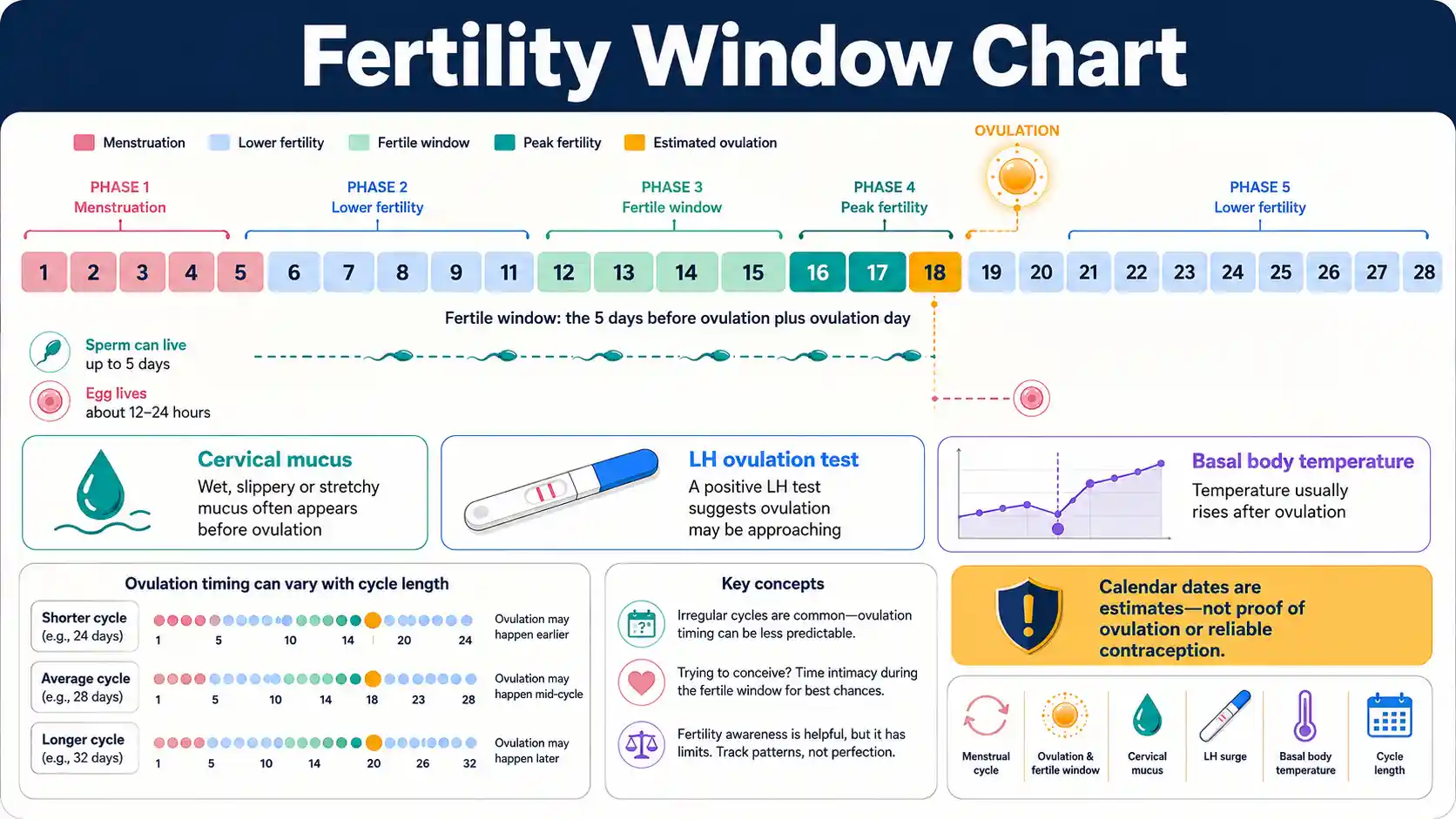
When is the fertile window?
The biological fertile window is generally the five days before ovulation plus ovulation day. Pregnancy probability is usually highest in the one or two days before egg release because viable sperm can already be present.
ASRM defines a six-day fertile window ending on ovulation day and reports the highest pregnancy rates with intercourse every one to two days during that interval.
Fertile interval
6 days
Usually the five days before ovulation plus ovulation day.
Peak timing
Before ovulation
The one or two days before egg release often carry the highest chance.
Calendar dates
Estimates
Cycle length cannot confirm the exact current ovulation day.
Contraception
Rules matter
An app date alone is not reliable pregnancy prevention.
Estimated Fertility Window by Average Cycle Length
Calendar estimates assume ovulation occurs about 14 days before the next period. Real ovulation can shift, even in people with usually regular cycles.
Swipe horizontally inside the table to view every column.
| Average cycle length | Estimated ovulation day | Estimated six-day fertile window | Highest-probability days | Key limitation |
|---|---|---|---|---|
| 21 days | Around day 7 | Days 2–7 | About days 5–7 | Bleeding may overlap the estimated fertile window |
| 24 days | Around day 10 | Days 5–10 | About days 8–10 | Short-cycle variation can move ovulation earlier |
| 26 days | Around day 12 | Days 7–12 | About days 10–12 | Calendar timing should be checked against current signs |
| 28 days | Around day 14 | Days 9–14 | About days 12–14 | Day 14 is an estimate, not a universal rule |
| 30 days | Around day 16 | Days 11–16 | About days 14–16 | A later cycle does not guarantee day-16 ovulation |
| 32 days | Around day 18 | Days 13–18 | About days 16–18 | Month-to-month changes widen uncertainty |
| 35 days | Around day 21 | Days 16–21 | About days 19–21 | Long cycles may be ovulatory or may reflect irregular ovulation |
| Variable cycles | Cannot be estimated reliably from one average | Use a wider range plus current fertility signs | Depends on actual ovulation | Calendar-only prediction becomes increasingly uncertain |
- • Cycle day 1 is the first day of full menstrual bleeding, not light spotting before the period.
- • The fertile window is commonly defined as the five days before ovulation plus the day of ovulation.
- • Some pregnancy may occur after a calendar estimate because the actual ovulation day can differ from the predicted day.
Download or export
Six-day conception window
Why the most fertile days occur before ovulation
Sperm can remain viable for several days, while the egg is available for a much shorter time. That is why having sperm present before ovulation generally matters more than trying to identify one exact release time.
Stage 1
Earlier cycle
Usually lower probability, but calendar error still matters
Stage 2
Fertile window opens
Up to five days before ovulation because sperm can survive
Stage 3
Highest probability
Often the two days before ovulation and ovulation day
Stage 4
Ovulation
Egg release; timing is rarely known to the exact hour
Stage 5
After ovulation
Fertility falls after the egg is no longer viable
Fertility by Day Relative to Ovulation
Pregnancy probability is not equal on every day. The highest chance is usually in the days immediately before ovulation.
Swipe horizontally inside the table to view every column.
| Timing | What may be happening | Relative fertility | Trying to conceive | Avoiding pregnancy |
|---|---|---|---|---|
| 6 or more days before ovulation | Sperm usually will not remain viable until the egg is released | Usually low, but prediction error matters | Continue tracking current signs | Do not assume calendar safety if ovulation timing is uncertain |
| 5 days before | Long-surviving sperm may still be present at ovulation | Fertile window begins | Intercourse may result in pregnancy | Use the chosen fertility-awareness rules or another method |
| 4 days before | Sperm survival can bridge the interval to ovulation | Increasing fertility | Reasonable timing for conception | Treat as potentially fertile |
| 3 days before | Fertile cervical mucus may support sperm survival | High fertility | Intercourse every 1–2 days is reasonable | Treat as fertile |
| 2 days before | Ovulation is approaching | Among the highest-probability days | Strong timing for conception | Treat as fertile |
| 1 day before | Live sperm can be present before egg release | Among the highest-probability days | Strong timing for conception | Treat as fertile |
| Ovulation day | The egg is released and remains viable for a limited time | High fertility | Pregnancy remains possible | Treat as fertile |
| 1 day after | The egg may no longer be viable, but timing is rarely known exactly | Falling fertility | Pregnancy may still be possible if ovulation was later | Do not rely on one prediction alone |
| 2 or more days after confirmed ovulation | The egg is generally no longer available | Usually low | Wait for the next cycle if pregnancy did not occur | Use method-specific post-ovulation rules rather than an app estimate |
- • The egg survives for about 24 hours after ovulation; sperm commonly survive about 3 days and sometimes up to 5 days.
- • A calendar or app cannot directly observe egg release unless paired with physiological or clinical information.
Download or export
Ovulation Signs and What They Can Tell You
No single sign is perfect. Combining cycle history with current cervical mucus, LH testing, and temperature patterns provides more context.
Swipe horizontally inside the table to view every column.
| Sign or test | Typical pattern | What it suggests | Best use | Important limitation |
|---|---|---|---|---|
| Cervical mucus | Becomes wetter, slippery, clear, or stretchy before ovulation | Estrogen is rising and fertility is increasing | Real-time fertile-window tracking | Infection, semen, lubricants, medicines, and breastfeeding can change observations |
| Urine LH test | Positive result after an LH rise | Ovulation may occur within roughly the next 1–2 days | Timing intercourse or insemination | An LH surge does not guarantee egg release; PCOS can complicate results |
| Basal body temperature | Small sustained rise after lower pre-ovulation temperatures | Progesterone has risen after ovulation | Confirming that ovulation likely occurred | Usually confirms after the most fertile days have begun or passed |
| Cycle calendar | Estimates ovulation from previous cycle lengths | Provides an expected range | Planning when to start observing or testing | Past cycles do not determine the exact current ovulation day |
| Cervical position | May feel higher, softer, and more open near ovulation | Possible fertile-phase change | Optional part of trained methods | Subjective and difficult to interpret consistently |
| Mid-cycle discomfort | One-sided lower abdominal ache in some cycles | May occur near ovulation | Supporting context only | Pain cannot confirm ovulation and may have another cause |
| Saliva or wearable patterns | Device-specific changes in electrolytes, temperature, or other signals | May estimate cycle phase | Supplementary trend tracking | Algorithms and validation differ among devices |
| Ultrasound and hormone testing | Follicle growth and hormone changes assessed clinically | More direct medical monitoring | Fertility treatment and diagnostic evaluation | Requires professional care and is not routine home tracking |
- • Fertile-type cervical mucus often appears before an LH test becomes positive.
- • Basal temperature is more useful for recognizing a completed pattern than predicting the exact ovulation hour.
Download or export
Current fertility signs add context that a calendar cannot
Cervical mucus can identify rising fertility in real time, urine LH tests can indicate an approaching ovulation, and a sustained basal-temperature rise can support that ovulation has already occurred. Review ACOG fertility-awareness guidance.
Fertility Tracking Methods Compared
Different methods answer different questions: some estimate the window, some identify current fertility, and some confirm ovulation afterward.
Swipe horizontally inside the table to view every column.
| Method | Main input | Predicts or confirms? | Works best when | Common limitation |
|---|---|---|---|---|
| Calendar method | Cycle lengths | Predicts an estimated range | Cycles are consistently timed and several months are recorded | Cannot detect an unexpectedly early or late ovulation |
| Standard Days Method | Cycle days 8–19 for eligible 26–32-day cycles | Defines potentially fertile days for contraception | Rules are taught and cycles remain within the eligible range | Typical-use pregnancy risk is meaningful |
| Cervical mucus method | Daily secretion observations | Identifies changing current fertility | Observations are recorded consistently and taught rules are followed | Discharge, infection, semen, and medicines can obscure the pattern |
| Basal temperature method | Daily waking temperature | Mostly confirms ovulation | Temperature is taken before activity at a consistent time | Illness, poor sleep, alcohol, travel, and shift work affect readings |
| Symptothermal method | Temperature plus mucus and other signs | Predicts and confirms using multiple rules | A trained method is followed consistently | More daily effort and interpretation are required |
| Urine LH tests | Luteinizing hormone in urine | Predicts an approaching ovulation | Testing timing matches the kit instructions | May miss short surges or show repeated positives |
| Fertility app | Calendar data and optional biomarkers | Varies by app | The algorithm is transparent and current signs are entered | An app prediction is not direct evidence of ovulation |
| Clinical monitoring | Ultrasound and hormone tests | Tracks follicle and ovulation medically | Used for evaluation or fertility treatment | Cost, access, and clinical scheduling |
- • For pregnancy prevention, use a validated method with instruction rather than choosing isolated signs informally.
- • No fertility-awareness method protects against sexually transmitted infections.
Download or export
Fertility window date calculator
Enter the first day of the most recent period and an average cycle length. The tool estimates ovulation at approximately 14 days before the next expected period and expands the dates for ordinary cycle variation.
Important: this calculator does not confirm ovulation, diagnose infertility, prescribe treatment, or provide reliable contraception. Fertility medications, postpartum cycles, breastfeeding, PCOS, perimenopause, and irregular cycles require different guidance.
Conditions That Can Shift or Obscure the Fertility Window
Ovulation may move earlier, later, or not occur in some cycles. Tracking rules need extra caution when physiology or daily routines change.
Swipe horizontally inside the table to view every column.
| Situation | How the cycle may change | Effect on prediction | Practical response |
|---|---|---|---|
| Adolescence | Cycles may be irregular after menstruation begins | Calendar predictions may be wide | Use clinical guidance when irregularity is persistent or symptoms are concerning |
| Perimenopause | Ovulation becomes less predictable | Past averages become less useful | Do not assume pregnancy is impossible while cycles continue |
| Postpartum | Ovulation can return before the first period | No bleeding history is available to predict the first ovulation | Use postpartum-specific contraception or fertility guidance |
| Breastfeeding | Ovulation may be delayed or irregular | Mucus and cycle patterns can differ | Use a validated postpartum method if avoiding pregnancy |
| Polycystic ovary syndrome | Long or irregular cycles and repeated LH elevations may occur | Calendar and LH-only tracking may be misleading | Discuss individualized evaluation and tracking |
| Thyroid or prolactin disorder | Ovulation may become irregular or absent | Fertile-window estimates become unreliable | Seek medical assessment for persistent irregularity |
| Recent hormonal contraception | Natural cycles may take time to re-establish | Early cycles may not match prior patterns | Record new baseline patterns rather than relying on old averages |
| Illness, stress, under-fueling, or major training change | Ovulation may be delayed or absent | The current cycle can differ markedly from usual | Address health factors and seek care if periods stop or symptoms persist |
| Shift work, travel, or poor sleep | Temperature timing and sleep quality change | Basal temperature may be harder to interpret | Use multiple signs and document disrupted nights |
| Fertility medication or trigger injection | Ovulation timing is deliberately altered | General charts no longer apply | Follow the clinic’s exact monitoring and timing instructions |
- • A single unusual cycle is common; persistent changes, very long cycles, or absent periods deserve clinical attention.
- • Fertility medications and assisted reproduction require protocol-specific timing rather than a general consumer calculator.
Download or export
An average cycle length can hide a wide ovulation range
Postpartum recovery, breastfeeding, PCOS, perimenopause, endocrine conditions, illness, stress, travel and under-fueling can shift or suppress ovulation. Use a broader range and seek individual guidance when cycles are irregular.
Timing Intercourse When Trying to Conceive
The goal is to have viable sperm present before the egg is released rather than trying to identify one exact ovulation hour.
Swipe horizontally inside the table to view every column.
| Approach | Suggested timing | Why it can work | Who may prefer it | Limitation |
|---|---|---|---|---|
| Every 1–2 days in the fertile window | From about five days before ovulation through ovulation day | Maintains frequent sperm availability | People comfortable with targeted timing | Can create pressure if treated as a rigid schedule |
| Two to three times per week throughout the cycle | Regularly across the month | Often covers the fertile window without intensive tracking | People who prefer less monitoring | May miss some opportunities in infrequent schedules |
| Positive LH test timing | Day of the positive test and the next day, with intercourse before the surge when possible | Targets the interval before expected ovulation | People using urine ovulation tests | Surge timing and ovulation timing vary |
| Fertile-mucus timing | During slippery or stretchy mucus days | Uses a current estrogen-linked fertility sign | People comfortable observing cervical secretions | Mucus may be difficult to interpret |
| Clinic-directed timing | Follow ultrasound, hormone, trigger, IUI, or IVF instructions | Matches treatment protocol | People receiving fertility care | General internet charts should not override clinic instructions |
| After a missed period | Use an appropriately timed pregnancy test rather than continuing ovulation prediction | Shifts the question from fertility timing to pregnancy detection | Anyone whose expected period has not arrived | Testing too early can produce a false-negative result |
- • ASRM reports that intercourse every 1–2 days during the fertile window yields the highest pregnancy rates, while two to three times weekly is nearly equivalent for many couples.
- • Timing cannot overcome every cause of infertility; sperm factors, tubal conditions, endometriosis, age, and ovulatory disorders may require evaluation.
Download or export
Fertility Window Tracking for Pregnancy Prevention
A predicted low-fertility day is not the same as zero pregnancy risk. Use a taught method and follow its complete rules.
Swipe horizontally inside the table to view every column.
| Issue | Why it matters | Safer interpretation | Next step |
|---|---|---|---|
| Typical-use effectiveness | Real-world tracking and rule errors cause pregnancies | Do not treat an app estimate as highly effective contraception | Compare fertility awareness with other contraceptive options |
| Unexpected ovulation | Stress, illness, travel, age, and natural variation can shift timing | Earlier or later ovulation can move the fertile window | Use current signs and method-specific rules |
| Cycles outside 26–32 days | Standard Days Method eligibility may not be met | Days 8–19 should not be applied universally | Choose another method or obtain trained guidance |
| Postpartum or breastfeeding | Ovulation can occur before the first period | Calendar prediction may be unavailable | Use postpartum-specific guidance |
| Irregular cycles | Averages hide a wide range of possible ovulation days | Calendar-only methods are less reliable | Use another contraceptive method or specialist instruction |
| No STI protection | Fertility-awareness methods do not block infection transmission | Pregnancy prevention and STI prevention are separate needs | Use condoms where STI protection is needed |
| Unprotected sex during a potentially fertile time | Pregnancy may occur even if an app showed low risk | Act based on timing, not reassurance from the app | Seek timely emergency-contraception advice |
| Need for very high contraceptive reliability | Small tracking errors may be unacceptable | Use a method matching the required effectiveness and preferences | Discuss long-acting or other highly effective options |
- • CDC states that approximately 13 of 100 Standard Days Method users become pregnant in the first year with typical use.
- • Emergency contraception is time-sensitive; seek local clinical or pharmacy guidance promptly after unprotected sex when pregnancy is not desired.
Download or export
A predicted low-fertility day is not a zero-risk day
The CDC Standard Days Method applies specific rules to cycles usually lasting 26–32 days and still has meaningful typical-use pregnancy risk. Read the CDC Standard Days guidance.
When to Seek Fertility Evaluation
Evaluation timing depends on age, duration of trying, cycle pattern, medical history, and known reproductive risks.
Swipe horizontally inside the table to view every column.
| Situation | Common evaluation timing | Why earlier care may be appropriate | What to bring |
|---|---|---|---|
| Female partner younger than 35 with no known risk | After 12 months of regular unprotected intercourse without pregnancy | Earlier if cycles are very irregular or a known condition exists | Cycle dates, test results, medicines, pregnancy history, and partner history |
| Female partner age 35 or older | After 6 months without pregnancy | Fertility decline makes delay more important | Cycle records and both partners’ health histories |
| Female partner older than 40 | More immediate evaluation is often appropriate | Age-related decline can be substantial | Prompt consultation rather than prolonged self-tracking |
| Absent, very infrequent, or highly irregular periods | Seek assessment without waiting a full year | Ovulation may be irregular or absent | Cycle lengths, bleeding pattern, symptoms, and test history |
| Known endometriosis, tubal disease, uterine condition, or prior pelvic infection | Earlier individualized evaluation | A known factor may reduce the chance of conception | Surgical, imaging, infection, and treatment records |
| Known or suspected sperm-factor concern | Earlier evaluation of both partners | Timing alone cannot correct sperm production or delivery problems | Semen testing history, medicines, illnesses, and exposures |
| Repeated pregnancy loss | Clinical evaluation based on pregnancy history | Loss requires a different assessment than failure to conceive | Dates, ultrasound, laboratory, and pathology records when available |
| Severe pelvic pain, very heavy bleeding, or symptoms of endocrine disease | Seek clinical assessment based on symptoms | Health problems may need treatment independent of fertility plans | Symptom timeline and relevant medical history |
- • Infertility evaluation should include both partners when applicable because reproductive factors may involve either or both.
- • Access to evaluation should not be delayed when a known condition or clinical history suggests impaired fertility.
Download or export
Do not delay evaluation when age or medical history changes the timeline
ASRM recommends evaluation after 12 months when the female partner is under 35 and after 6 months at age 35 or older, with earlier care for known risks or irregular ovulation. Review the ASRM definition and timing guidance.
Symptoms That Need Medical Assessment
Fertility tracking is not an emergency tool. Symptoms, possible pregnancy, and acute pelvic conditions require appropriate clinical care.
Swipe horizontally inside the table to view every column.
| Finding | Why it matters | Suggested urgency |
|---|---|---|
| Positive pregnancy test with severe one-sided pelvic pain | Can be a sign of ectopic pregnancy | Emergency assessment |
| Positive pregnancy test with fainting, shoulder pain, or heavy bleeding | May indicate internal bleeding or pregnancy complication | Emergency assessment |
| Sudden severe pelvic or abdominal pain | Ovarian torsion, ruptured cyst, appendicitis, or another acute condition is possible | Urgent or emergency assessment |
| Fever with pelvic pain or foul discharge | Pelvic infection may require prompt treatment | Same-day medical assessment |
| Very heavy bleeding, dizziness, or weakness | Significant blood loss may be occurring | Urgent assessment |
| No periods for 3 months when not pregnant | Amenorrhea can reflect endocrine, nutritional, ovarian, uterine, or other causes | Arrange clinical evaluation |
| Cycles repeatedly shorter than 21 or longer than 35 days | Persistent irregularity can complicate ovulation and may need assessment | Routine but timely appointment |
| New severe pain during intercourse | May reflect infection, endometriosis, pelvic-floor, ovarian, or other conditions | Arrange clinical assessment |
| Distress, compulsive tracking, or relationship strain | Fertility monitoring can affect mental and relational health | Pause rigid tracking and seek support |
- • Call local emergency services for collapse, severe bleeding, severe pain, breathing difficulty, or other life-threatening symptoms.
- • A fertility-window calculator cannot evaluate pregnancy location, pelvic infection, ovarian torsion, or bleeding severity.
Download or export
Pain, heavy bleeding and possible pregnancy override the chart
A positive pregnancy test with severe one-sided pain, fainting, shoulder pain or heavy bleeding requires emergency assessment. Sudden severe pelvic pain, fever with pelvic pain, or very heavy bleeding also needs urgent care.
Fertility window chart FAQs
How many days are in the fertile window?
The fertile window is commonly defined as the five days before ovulation plus the day of ovulation. Pregnancy may also be possible when the estimated ovulation day is wrong, so a calendar range is not an exact biological boundary.
Is ovulation always on day 14?
No. Day 14 is only a common estimate for a 28-day cycle. Ovulation timing varies by cycle length and can shift from month to month.
How do I count cycle day 1?
Cycle day 1 is the first day of full menstrual bleeding. Light spotting before the period usually is not counted as day 1.
Can I get pregnant during my period?
Yes, especially with short cycles, long bleeding, or unexpectedly early ovulation. Sperm can survive for several days, so menstrual bleeding does not guarantee infertility.
Which days have the highest pregnancy chance?
The highest probability is usually during the one or two days before ovulation and on ovulation day because sperm can already be present when the egg is released.
What does a positive ovulation test mean?
A positive urine LH test suggests an LH rise and that ovulation may occur within roughly the next one to two days. It does not prove that an egg was released.
Does basal body temperature predict ovulation?
Basal temperature usually rises after ovulation because progesterone increases. It is better for confirming a completed pattern than predicting the first fertile day.
What cervical mucus is considered fertile?
Mucus often becomes wetter, slippery, clear, or stretchy as ovulation approaches. Discharge from infection, semen, lubricants, and medicines can make interpretation difficult.
Can a fertility app prevent pregnancy?
An app prediction alone should not be treated as reliable contraception. Pregnancy-prevention use requires a validated method, correct rules, and consistent daily observations.
Does irregular menstruation mean I cannot conceive?
No. Irregular cycles may still include ovulation, but the fertile window is harder to predict and some causes of irregularity can reduce fertility. Persistent irregularity deserves assessment.
How often should intercourse occur when trying to conceive?
ASRM states that intercourse every one to two days during the fertile window gives the highest pregnancy rates, while intercourse two to three times per week is nearly equivalent for many couples.
When should I take a pregnancy test?
Testing is generally most informative after the expected period or according to the test manufacturer’s timing. Testing too early can produce a false-negative result.
When should fertility evaluation begin?
Evaluation commonly begins after 12 months of trying when the female partner is under 35 and after 6 months at age 35 or older. Earlier care is appropriate with known risk factors or irregular ovulation.
Can this fertility-window calculator diagnose ovulation?
No. It estimates dates from cycle information. It cannot see follicle development, confirm egg release, diagnose infertility, or replace a clinician’s monitoring plan.
Sources
URLs are shown as plain text for transparent reference. Table-specific source names link to this section.
American College of Obstetricians and Gynecologists — Fertility Awareness-Based Methods of Family Planning
Explains the fertile interval, sperm and egg survival, calendar tracking, cervical mucus, basal body temperature, and fertility-awareness limitations.
https://www.acog.org/womens-health/faqs/fertility-awareness-based-methods-of-family-planning
American Society for Reproductive Medicine — Optimizing Natural Fertility: A Committee Opinion
Defines the six-day fertile window ending on ovulation and reviews intercourse timing, cycle tracking, cervical mucus, and ovulation tests.
https://www.asrm.org/practice-guidance/practice-committee-documents/optimizing-natural-fertility-a-committee-opinion-2021/
Centers for Disease Control and Prevention — Standard Days Method
Describes the Standard Days Method for cycles typically lasting 26–32 days and its pregnancy-prevention limitations with typical use.
https://www.cdc.gov/contraception/hcp/usspr/standard-days-method.html
National Health Service — Natural Family Planning
Explains fertility-awareness instruction, daily observations, effectiveness limits, and situations in which cycle tracking is harder to use reliably.
https://www.nhs.uk/contraception/methods-of-contraception/natural-family-planning/
American Society for Reproductive Medicine — Definition of Infertility: A Committee Opinion
Provides current timing for fertility evaluation based on age, duration of trying, and known conditions that may impair reproduction.
https://www.asrm.org/practice-guidance/practice-committee-documents/definition-of-infertility/