Finance & Money
FIRE Number Chart
A FIRE number estimates how much invested money may be needed to support planned spending without a traditional paycheck. The basic formula is annual portfolio-funded spending divided by a chosen starting withdrawal rate.
A FIRE number is a planning benchmark, not a promise that a portfolio will last. Early retirees can face much longer withdrawal horizons than the 30-year period often associated with the classic 4% framework.
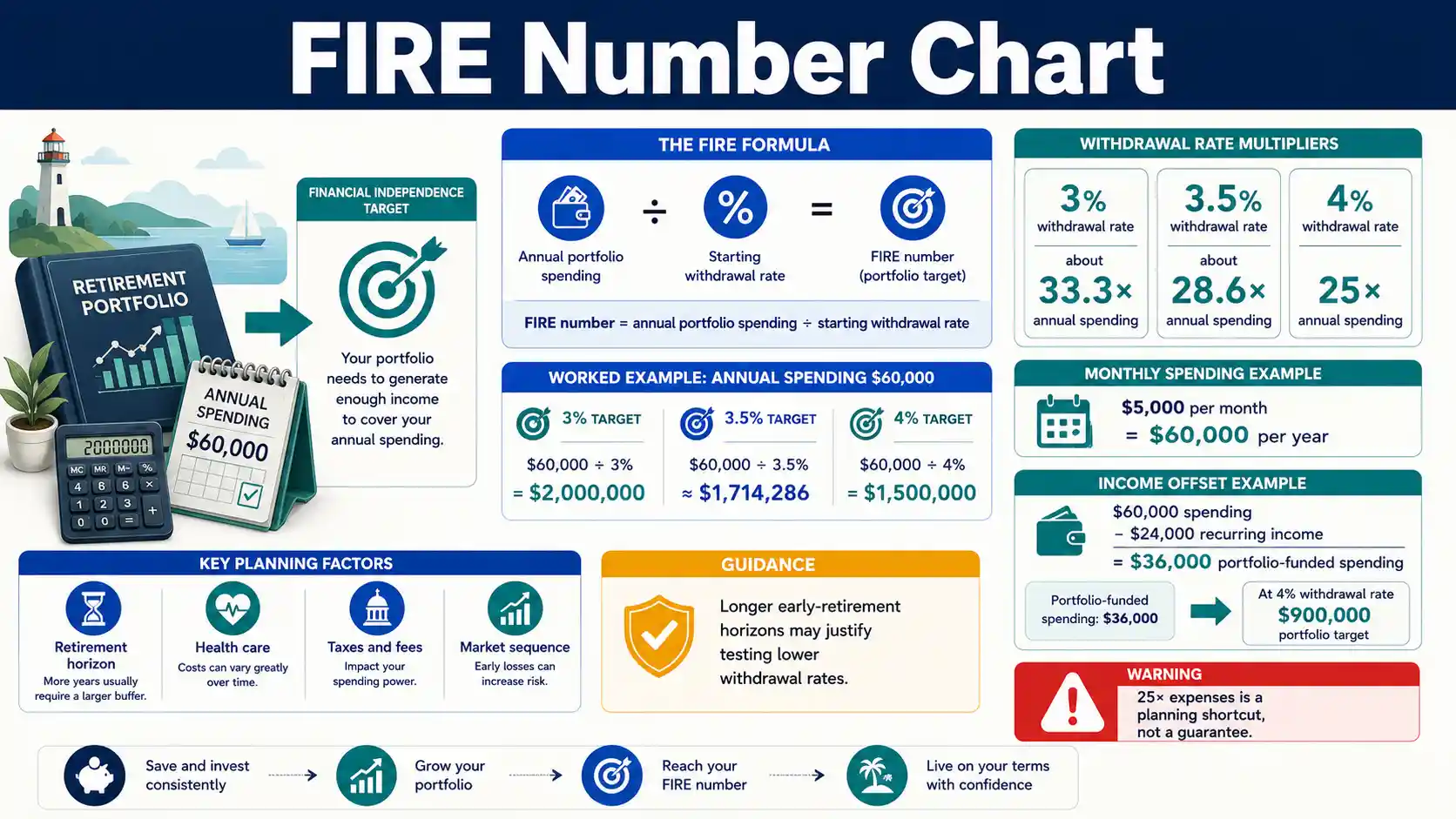
Core formula
Spending ÷ withdrawal rate
Divide annual spending that the portfolio must fund by the chosen starting withdrawal rate to create a simple FIRE target.
Classic shortcut
4% = 25× expenses
A 4% starting rate is mathematically equivalent to multiplying annual portfolio spending by 25.
Conservative example
3% ≈ 33.3× expenses
Fidelity uses about 33 times annual expenses as a quick estimate for people seeking financial independence before age 62.
Critical limit
Target is not a guarantee
Retirement length, market sequence, inflation, taxes, fees, health costs, and spending flexibility can materially change sustainability.
Direct answers to common FIRE number questions
What is a FIRE number?
A FIRE number is a portfolio target intended to support planned spending without relying on a traditional paycheck.
How do you calculate a FIRE number?
Divide annual portfolio-funded spending by the chosen starting withdrawal rate. At 4%, $60,000 of annual spending produces a $1.5 million target.
Why is 4% the same as 25 times expenses?
One divided by 4% equals 25, so $40,000 of annual spending × 25 equals a $1 million portfolio target.
What FIRE multiple corresponds to 3%?
A 3% starting withdrawal rate corresponds to about 33.3 times annual spending because 1 ÷ 0.03 = 33.33.
Is the 4% rule guaranteed to work?
No. The 4% rule is a planning framework, not a guarantee that a portfolio will survive every market path or retirement length.
Should early retirees test a lower withdrawal rate?
Yes. A 40- or 50-year retirement can justify testing lower starting rates than a conventional 30-year retirement assumption.
Do taxes belong in the FIRE number?
Include taxes when portfolio withdrawals must cover them. Gross withdrawals may need to exceed lifestyle spending to produce the required after-tax cash.
Can reliable income reduce a FIRE target?
Yes, after that income begins. Subtract only recurring income that will actually be available during the same years the portfolio is funding spending.
Should health care be included?
Yes. Early-retirement health premiums, deductibles, prescriptions, dental, vision, and out-of-pocket costs can materially change annual spending.
What is sequence-of-returns risk?
Sequence-of-returns risk occurs when poor market returns early in retirement combine with withdrawals and leave less capital available for a later recovery.
Is a FIRE number the same as net worth?
No. Net worth includes all assets minus liabilities, while a FIRE number is a target for assets expected to fund future spending.
How often should a FIRE number be updated?
Update it after major changes in spending, retirement timing, health coverage, taxes, recurring income, family obligations, or withdrawal assumptions.
FIRE Number Chart by Annual Spending and Withdrawal Rate
Multiply annual portfolio-funded spending by the reciprocal of the chosen starting withdrawal rate. These are planning illustrations, not guarantees that a portfolio will last.
Swipe horizontally inside the table to view every column.
| Annual spending | 3.0% rate (33.3×) | 3.5% rate (28.6×) | 4.0% rate (25×) | Difference: 3% vs 4% |
|---|---|---|---|---|
| $30,000 | $1,000,000 | $857,143 | $750,000 | $250,000 |
| $40,000 | $1,333,333 | $1,142,857 | $1,000,000 | $333,333 |
| $50,000 | $1,666,667 | $1,428,571 | $1,250,000 — $50,000 spending at a four percent starting rate | $416,667 |
| $60,000 | $2,000,000 | $1,714,286 | $1,500,000 | $500,000 |
| $80,000 | $2,666,667 — Long-horizon three percent example | $2,285,714 | $2,000,000 | $666,667 |
| $100,000 | $3,333,333 | $2,857,143 | $2,500,000 | $833,333 |
FIRE number = annual portfolio spending ÷ starting withdrawal rate.
- • The 4% column is the same as multiplying annual spending by 25; the 3% column is approximately 33.3 times annual spending.
- • Use spending that the portfolio must actually fund, after carefully considering reliable recurring income that will be available during the same period.
- • Longer retirement horizons, taxes, fees, health costs, poor early market returns, and legacy goals can justify a more conservative target.
Download or export
FIRE starts with spending, not salary
Fidelity defines the FI number around the assets needed to cover living expenses and suggests, for a quick estimate before age 62, multiplying expected annual expenses by 33. Read the Fidelity financial-independence guidance as a benchmark rather than a personalized forecast.
Withdrawal Rate to FIRE Multiple Chart
A lower starting withdrawal rate requires a larger portfolio for the same annual spending. The multiple is simply 1 divided by the withdrawal rate.
Swipe horizontally inside the table to view every column.
| Starting withdrawal rate | Expense multiple | $60,000 annual spending target | Planning interpretation |
|---|---|---|---|
| 2.5% | 40.0× | $2,400,000 | Large target; leaves more initial portfolio per dollar of planned spending |
| 3.0% | 33.3× — Approximately thirty-three times expenses | $2,000,000 | Conservative quick-estimate rate used in Fidelity early-FI guidance |
| 3.5% | 28.6× | $1,714,286 | Falls within the lower end of Vanguard's current 30-year starting range |
| 4.0% | 25.0× — Classic twenty-five-times shortcut | $1,500,000 | Classic rule-of-thumb multiple; historically associated with a 30-year framework |
| 4.5% | 22.2× | $1,333,333 | Smaller target but higher initial draw on the portfolio |
| 5.0% | 20.0× | $1,200,000 | Higher starting draw; needs stronger assumptions, flexibility, or shorter horizon |
Expense multiple = 1 ÷ withdrawal rate expressed as a decimal.
- • The table does not rank a rate as universally safe or unsafe.
- • Withdrawal sustainability depends on retirement length, asset allocation, market returns, inflation, fees, taxes, spending flexibility, and other income.
- • Fidelity uses 33 times annual expenses as a quick estimate for financial independence before age 62; Vanguard cautions that very long FIRE horizons may call for customizing the classic 4% framework.
Download or export
Monthly Spending to FIRE Number Chart
Monthly spending becomes annual spending by multiplying by 12. This table then applies 3%, 3.5%, and 4% starting withdrawal assumptions.
Swipe horizontally inside the table to view every column.
| Monthly portfolio spending | Annual spending | 3.0% target | 3.5% target | 4.0% target |
|---|---|---|---|---|
| $2,000 | $24,000 | $800,000 | $685,714 | $600,000 |
| $3,000 | $36,000 | $1,200,000 | $1,028,571 | $900,000 |
| $4,000 | $48,000 | $1,600,000 | $1,371,429 | $1,200,000 |
| $5,000 | $60,000 | $2,000,000 | $1,714,286 | $1,500,000 — $5,000 monthly spending at four percent |
| $6,000 | $72,000 | $2,400,000 | $2,057,143 | $1,800,000 |
| $8,000 | $96,000 | $3,200,000 | $2,742,857 | $2,400,000 |
Annual spending = monthly spending × 12. Target = annual spending ÷ withdrawal rate.
- • Include irregular expenses by converting them into an annual or monthly reserve rather than omitting them.
- • A current budget is only a starting point; early retirement can change health care, travel, taxes, housing, and transportation costs.
- • Keep all values in today's dollars when comparing them with a withdrawal rule that assumes later inflation adjustments.
Download or export
The 4% rule has a horizon problem for very early retirement
Vanguard describes the 4% rule as a first-year withdrawal framework and notes that it may fit a 30-year retirement better than a FIRE plan that could last 50 years or more. Its early-retirement guidance recommends customizing the rule rather than treating 25 times expenses as universal.
Browser-only educational tool
FIRE Number and Funding Gap Calculator
Estimate a portfolio target from annual spending, recurring income, and a starting withdrawal rate. Compare that target with current investable assets without assuming a future investment return.
Estimated FIRE number
$2,000,000
$60,000 portfolio-funded spending ÷ 3.0%.
Expense multiple
33.3×
The same target can be expressed as annual portfolio spending multiplied by this factor.
Current funding
25.0%
Current investable assets of $500,000 compared with this simplified target.
Target gap
$1,500,000
This comparison does not model taxes, fees, market returns, inflation, or portfolio survival.
Portfolio-funded spending: $60,000 − $0 = $60,000
Target: $60,000 ÷ 0.030 = $2,000,000
Starting-rate amount from current portfolio: $500,000 × 0.030 = $15,000
Important: This is a static benchmark, not a forecast of how long assets will last.
A withdrawal rate is an assumption, not a guaranteed safe rate. Longer retirements, taxes, fees, health costs, inflation, market sequence, account access, and legacy goals can materially change the amount you need.
FIRE Number With Reliable Income Offsets
This illustration starts with $60,000 of annual spending and subtracts recurring annual income that is assumed to be available during the modeled period before applying the withdrawal rate.
Swipe horizontally inside the table to view every column.
| Annual spending | Recurring income available | Portfolio must fund | 3.0% target | 4.0% target |
|---|---|---|---|---|
| $60,000 | $0 | $60,000 | $2,000,000 | $1,500,000 |
| $60,000 | $12,000 | $48,000 | $1,600,000 | $1,200,000 |
| $60,000 | $24,000 | $36,000 — Income offsets half of annual spending | $1,200,000 | $900,000 |
| $60,000 | $36,000 | $24,000 | $800,000 | $600,000 |
| $60,000 | $48,000 | $12,000 | $400,000 | $300,000 |
Portfolio-funded spending = annual spending − recurring income available during the same period.
- • Do not subtract income before it actually begins. A pension or Social Security benefit that starts years after early retirement does not fund the bridge years before it begins.
- • Use after-tax cash-flow planning when taxes materially affect the spending amount the portfolio must provide.
- • Part-time or business income may be variable; model uncertainty instead of assuming it will always continue.
Download or export
Annual Spending Items to Include in a FIRE Number
A FIRE estimate is only as useful as the spending plan behind it. Include recurring costs and realistic reserves for expenses that do not arrive every month.
Swipe horizontally inside the table to view every column.
| Spending area | Examples | How to model it | Common omission |
|---|---|---|---|
| Housing | Rent or mortgage, property tax, insurance, HOA, maintenance | Use expected retirement housing costs plus maintenance reserves | Assuming a paid-off home has no housing cost |
| Health care | Premiums, deductibles, prescriptions, dental, vision | Model the coverage period before and after Medicare separately when relevant | Using employer-era health costs for early retirement — Health care is a common early-retirement gap |
| Taxes | Income tax, capital-gain tax, property tax | Estimate based on expected account withdrawals and income sources | Treating gross withdrawals as spendable cash — Taxes can change portfolio cash needs |
| Transportation | Vehicle replacement, fuel, insurance, transit | Add an annual replacement and repair reserve | Counting only current monthly fuel expense |
| Food and utilities | Groceries, dining, power, water, internet, phone | Use a realistic annual average and inflation assumptions | Underestimating variable utility or food costs |
| Travel and hobbies | Trips, memberships, recreation, gifts | Include the lifestyle you actually plan to fund | Building a target for a lifestyle you do not want |
| Irregular costs | Home repairs, appliances, family support, large purchases | Convert expected lumpy costs into annual sinking-fund amounts | Leaving large periodic bills outside the annual total |
Use a consistent annual spending basis before applying a portfolio multiple.
- • Fidelity recommends estimating the expenses you expect in retirement, including housing, food, health care, transportation, hobbies, and travel.
- • The spending estimate should reflect the actual lifestyle and time horizon, not a generic percentage of current salary.
- • Revisit spending after major housing, health, family, tax, or insurance changes.
Download or export
Factors That Can Raise or Lower a FIRE Target
These factors change the strength of the assumptions behind a FIRE number. They do not produce one universal adjustment percentage.
Swipe horizontally inside the table to view every column.
| Factor | Why it matters | Possible planning response | Direction of pressure on target |
|---|---|---|---|
| Long retirement horizon | Money may need to support 40, 50, or more years of spending | Test lower starting rates and multiple longevity scenarios | Usually upward — Longer horizon often increases target pressure |
| Poor returns early in retirement | Withdrawals during early losses can leave less capital for a recovery — Sequence-of-returns risk | Use spending flexibility, reserves, or lower initial withdrawals | Usually upward |
| Reliable recurring income | Pension or other dependable income can reduce portfolio-funded spending once it begins | Model start date and amount separately | Can be downward after income begins |
| Flexible discretionary spending | Optional spending can be reduced during weak markets | Separate essential and discretionary expenses | Can improve resilience |
| High fees or taxes | More gross withdrawals may be needed to fund the same net spending | Model after-tax cash flow and investment costs | Usually upward |
| Legacy goal | Preserving assets limits how aggressively the portfolio can be spent down | Use a lower draw or larger target | Usually upward |
| Large future one-time expense | A home purchase, college support, or major repair may sit outside normal annual spending | Add a separate capital reserve | Usually upward |
Directional planning guide; not a formula for personalized withdrawal rates.
- • Vanguard notes that early retirees and people with significant legacy goals may want a lower withdrawal rate than a standard 30-year planning case.
- • Flexible withdrawal strategies can help reduce pressure on a portfolio during market downturns.
- • Diversification and historical studies do not guarantee future portfolio survival.
Download or export
Current retirement-income research supports using ranges, not one magic number
Vanguard's current retirement-income principles describe roughly 3.5% to 4% as a starting withdrawal range for a 30-year retirement without a significant legacy goal, while noting that early retirees or people prioritizing heirs may want a lower rate. See Vanguard's Principles for Retirement Income for the broader assumptions and trade-offs.
Common FIRE Number Mistakes and Better Checks
A precise multiplication can still produce a weak plan when the underlying spending, horizon, tax, or income assumptions are incomplete.
Swipe horizontally inside the table to view every column.
| Mistake | Why it can mislead | Better check | Risk level |
|---|---|---|---|
| Using salary instead of spending | A FIRE number is designed around the cash flow the portfolio needs to fund | Build an annual spending plan first | Moderate |
| Treating 25× as a guarantee | The 4% framework depends on assumptions and was built around a finite retirement horizon | Test several withdrawal rates and retirement lengths | High — Twenty-five times is not a guarantee |
| Ignoring taxes and fees | Gross portfolio withdrawals may exceed spendable cash | Model net spending and account tax treatment | High |
| Ignoring health care before Medicare | Early retirees can lose employer coverage years before Medicare eligibility | Price a realistic bridge coverage scenario | High |
| Subtracting future income too early | Later Social Security or pension income does not fund earlier years | Model income by start date | High |
| Forgetting irregular expenses | Repairs and replacements can create large cash needs | Use sinking funds or separate reserves | Moderate |
| Assuming constant returns | Actual market returns vary and bad early sequences can hurt sustainability | Use scenario or probabilistic planning — Constant-return assumptions miss sequence risk | High |
Risk labels describe planning importance, not probability of failure.
- • The FIRE number is a planning target, not a promise that a specific portfolio will fund every future outcome.
- • Recalculate after significant changes in spending, expected retirement date, income sources, health coverage, or investment strategy.
- • Use professional tax, legal, or financial advice when account access, tax strategy, insurance, or estate goals materially affect the plan.
Download or export
Limits, special cases, and when a simple FIRE number is not enough
Bridge years before later income
Social Security, pensions, annuities, or other income can begin after early retirement. Model the years before and after each income start date separately instead of subtracting future income from every year.
Account access and taxes
A portfolio total does not show whether the money is available when needed or what tax applies. Early retirees may need a deliberate mix of account types and a tax-aware withdrawal plan.
Health care and long-term care
Insurance premiums, out-of-pocket expenses, and long-term care can differ sharply from current working-age costs. Treat them as explicit planning variables.
Legacy, housing, and one-time goals
A major home purchase, family support, college funding, or legacy target may need a separate reserve beyond the portfolio calculated from ordinary annual spending.
Do not interpret reaching a simple expense multiple as automatic readiness to stop working. Stress-test the plan across long horizons, poor early returns, inflation, taxes, health costs, and changes in spending before making an irreversible decision.
Frequently asked questions
What is a FIRE number?
A FIRE number is a portfolio target intended to support planned spending without relying on a traditional paycheck. A simple estimate divides annual portfolio-funded spending by a chosen starting withdrawal rate.
How do I calculate my FIRE number?
Estimate annual spending that your portfolio must fund, then divide that amount by your chosen starting withdrawal rate. At 4%, $60,000 of annual spending produces a $1.5 million target.
Why does the 4% rule equal 25 times expenses?
Because 1 divided by 0.04 equals 25. Multiplying annual spending by 25 therefore gives the same target as dividing it by a 4% withdrawal rate.
Why does a 3% withdrawal rate equal about 33 times expenses?
Because 1 divided by 0.03 equals about 33.33. Fidelity uses roughly 33 times annual expenses as a quick early-financial-independence estimate.
Is the 4% rule guaranteed to work?
No. The 4% rule is a planning framework, not a guarantee. Retirement length, returns, inflation, fees, taxes, allocation, and spending flexibility can change outcomes.
Should early retirees use a lower withdrawal rate?
A longer retirement horizon can justify testing lower starting rates. Vanguard notes that FIRE investors may face 50-year-or-longer horizons, while Fidelity uses 3% in its quick estimate for retirement before age 62.
Should Social Security reduce my FIRE number?
Reliable future income can reduce the amount a portfolio must fund after that income begins. Do not subtract a later benefit from spending during earlier bridge years when the benefit is unavailable.
Do taxes belong in FIRE spending?
Yes when taxes will be paid from retirement cash flow. A portfolio may need to distribute more than your lifestyle expenses to leave the required after-tax spending amount.
Should health insurance be included in a FIRE number?
Yes. Health premiums, out-of-pocket costs, and coverage before Medicare can materially affect an early-retirement budget and should be modeled explicitly.
What is sequence-of-returns risk?
Sequence-of-returns risk is the danger that poor market returns early in retirement combine with withdrawals to reduce the portfolio before later recoveries can help.
Can part-time income lower a FIRE target?
Yes, if the income is realistically expected and available during the modeled years. Variable income should be stress-tested rather than treated as guaranteed.
Does a FIRE number include a paid-off home?
A simple withdrawal-based FIRE number usually focuses on investable assets available to fund spending. Home equity can matter, but it should not be counted as spendable portfolio value unless the plan includes a way to use it.
How often should I update my FIRE number?
Recalculate it after meaningful changes in spending, retirement timing, health care, taxes, recurring income, family obligations, or withdrawal assumptions. An annual review is also useful.
Is a FIRE number the same as net worth?
No. Net worth includes assets minus liabilities, while a FIRE number is a planning target for assets intended to fund future spending. Some net-worth assets may not be liquid or income-producing.
What happens if my spending changes after retirement?
Your required portfolio target changes with the spending the portfolio must support. Flexible discretionary spending can also be used as a risk-management lever during weak markets.
Sources
These retirement-planning resources support the financial-independence definitions, expense multiples, withdrawal-rate context, and early-retirement cautions shown on this page.
Fidelity — How to achieve financial independence
https://www.fidelity.com/learning-center/personal-finance/how-to-fi
Explains financial independence, the FI number concept, and Fidelity's quick-estimate guideline of 33 times annual expenses for people aiming for financial independence before age 62, based on a 3% withdrawal rate.
Fidelity — How to retire early in 8 steps
https://www.fidelity.com/learning-center/personal-finance/how-to-retire-early
Discusses early-retirement planning, the 33-times-expenses guideline, long retirement horizons, health care, Social Security, and the need to account for inflation and investment returns.
Vanguard — FIRE investing and the 4% rule for early retirement
https://investor.vanguard.com/investor-resources-education/retirement/early-retirement
Explains the 4% rule as a first-year withdrawal framework, notes its historical 30-year context, and cautions that FIRE investors may face retirement horizons of 50 years or more.
Vanguard — Vanguard's Principles for Retirement Income
https://corporate.vanguard.com/content/dam/corp/research/pdf/vanguard_principles_retirement_income.pdf
Provides current retirement-income principles and notes that roughly 3.5% to 4% may be a starting withdrawal range for a 30-year retirement without a significant legacy goal, with lower rates worth considering for longer horizons or legacy priorities.