Health & Medical · Adult formula reference
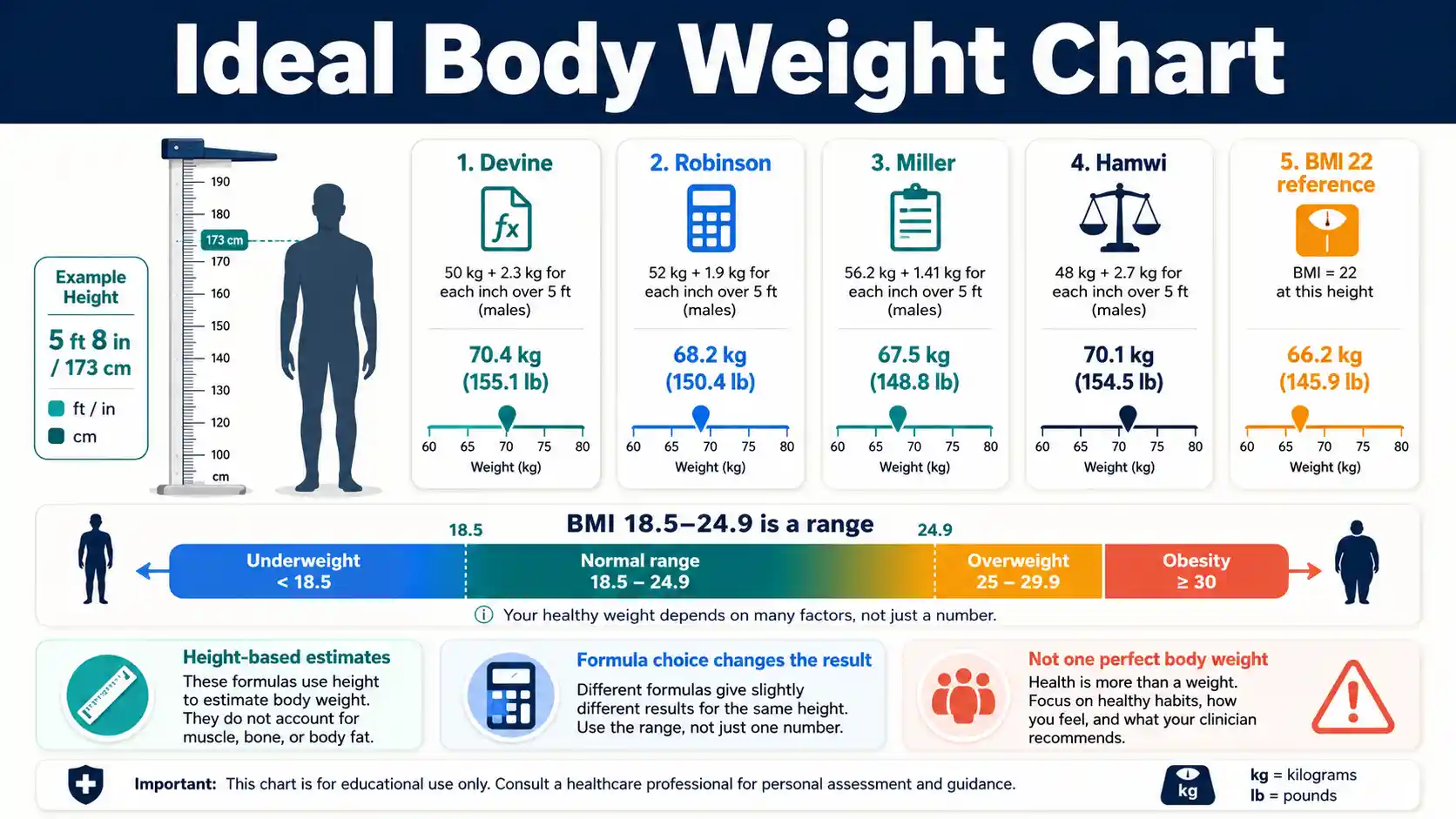
Ideal Body Weight Chart: Devine, Robinson, Miller, Hamwi and BMI
Compare historical height-based estimates, see how formula choice changes the result, understand technical clinical uses, and avoid treating one number as a universal health goal.
“Ideal body weight” is a technical historical term, not a prescription for how a body should look or what every adult should weigh. The equations do not apply to children or pregnancy and must not be substituted into medication, nutrition, or ventilator instructions unless the relevant protocol names that exact method. Read the ChartsLoom Disclaimer.
What is an ideal body weight chart?
An ideal body weight chart compares height-based formula outputs. It does not reveal one biologically perfect weight. Devine, Robinson, Miller, and Hamwi use different constants, so the same adult height can produce several legitimate formula results.
A published review of ideal-body-weight equations explains that historical formulas and BMI-based ranges are not perfectly aligned. The safest interpretation is to name the method, understand its purpose, and use personal health context separately.
Classic formula base
5 feet
Each equation adds a stated amount for every inch above the base.
Common methods
Four formulas
Devine, Robinson, Miller, and Hamwi can produce different results.
BMI comparison
18.5–24.9
Adult screening guidance describes a range rather than one exact weight.
Core limitation
Not a personal ideal
Body composition, age, illness, function, and clinical purpose matter.
Ideal Body Weight Formula Comparison
The classic equations use height and one of two historical sex-specific coefficient sets. They estimate a reference weight, not a uniquely healthy or personally ideal weight.
Swipe horizontally inside the table to view every column.
| Method | Historical male coefficient set | Historical female coefficient set | Development context | Important limitation |
|---|---|---|---|---|
| Devine | 50 kg + 2.3 kg per inch over 5 ft | 45.5 kg + 2.3 kg per inch over 5 ft | Introduced for medication-dosing calculations | Not derived as a modern personal health target |
| Robinson | 52 kg + 1.9 kg per inch over 5 ft | 49 kg + 1.7 kg per inch over 5 ft | Derived from Metropolitan Life height-weight data | A regression estimate that still ignores body composition |
| Miller | 56.2 kg + 1.41 kg per inch over 5 ft | 53.1 kg + 1.36 kg per inch over 5 ft | Based on later height-weight table data | Produces different values from other equations at the same height |
| Hamwi | 48 kg + 2.7 kg per inch over 5 ft | 45.5 kg + 2.2 kg per inch over 5 ft | A simple historical clinical rule | Original evidence and intended use are limited |
| BMI 22 reference | 22 × height in metres² | 22 × height in metres² | Midpoint-style BMI reference independent of sex coefficients | BMI 22 is one reference point within a wider adult screening range |
- • Formulas are displayed in their commonly used rounded clinical form.
- • The original equations were built around a 5-foot base; this page does not extrapolate them below 5 feet.
- • Historical male and female coefficient labels reflect the source equations and do not capture individual body composition or identity.
Download or export
Same height, different equations
An ideal-body-weight result depends on the chosen method
At the same 5 ft 8 in height, the classic formulas produce different outputs. The difference is not measurement error; it reflects different historical equations and assumptions.
At 5 ft 8 in
Devine
Historical male coefficients
68.4 kg
Historical female coefficients
63.9 kg
At 5 ft 8 in
Robinson
Historical male coefficients
67.2 kg
Historical female coefficients
62.6 kg
At 5 ft 8 in
Miller
Historical male coefficients
67.5 kg
Historical female coefficients
64.0 kg
At 5 ft 8 in
Hamwi
Historical male coefficients
69.6 kg
Historical female coefficients
63.1 kg
Browser-only educational tool
Ideal Body Weight Formula Calculator
Compare Devine, Robinson, Miller, Hamwi, BMI 22, and the adult BMI 18.5–24.9 range at one measured height. No information is stored.
Formula comparison
172.7 cm · male coefficients
Classic-formula spread: 2.4 kg / 5.3 lb
Devine
68.4 kg
150.8 lb
Robinson
67.2 kg
148.2 lb
Miller
67.5 kg
148.8 lb
Hamwi
69.6 kg
153.4 lb
BMI 22 comparison
65.6 kg
144.7 lb
Adult BMI 18.5–24.9
55.2–74.3 kg
121.7–163.8 lb
The average of the four classic formulas is 68.2 kg, but averaging does not make the result clinically preferred. Use the equation named by the relevant protocol and use broader health context for personal goals.
Ideal Body Weight Chart — Historical Male Coefficients
Values compare four classic equations and a BMI 22 reference. The spread between columns is evidence that no single formula gives a uniquely correct body weight.
Swipe horizontally inside the table to view every column.
| Height | Metric height | Devine | Robinson | Miller | Hamwi | BMI 22 |
|---|---|---|---|---|---|---|
| 5 ft 0 in | 152 cm | 50.0 kg / 110 lb | 52.0 kg / 115 lb | 56.2 kg / 124 lb | 48.0 kg / 106 lb | 51.1 kg / 113 lb |
| 5 ft 1 in | 155 cm | 52.3 kg / 115 lb | 53.9 kg / 119 lb | 57.6 kg / 127 lb | 50.7 kg / 112 lb | 52.8 kg / 116 lb |
| 5 ft 2 in | 157 cm | 54.6 kg / 120 lb | 55.8 kg / 123 lb | 59.0 kg / 130 lb | 53.4 kg / 118 lb | 54.6 kg / 120 lb |
| 5 ft 3 in | 160 cm | 56.9 kg / 125 lb | 57.7 kg / 127 lb | 60.4 kg / 133 lb | 56.1 kg / 124 lb | 56.3 kg / 124 lb |
| 5 ft 4 in | 163 cm | 59.2 kg / 131 lb | 59.6 kg / 131 lb | 61.8 kg / 136 lb | 58.8 kg / 130 lb | 58.1 kg / 128 lb |
| 5 ft 5 in | 165 cm | 61.5 kg / 136 lb | 61.5 kg / 136 lb | 63.2 kg / 139 lb | 61.5 kg / 136 lb | 60.0 kg / 132 lb |
| 5 ft 6 in | 168 cm | 63.8 kg / 141 lb | 63.4 kg / 140 lb | 64.7 kg / 143 lb | 64.2 kg / 142 lb | 61.8 kg / 136 lb |
| 5 ft 7 in | 170 cm | 66.1 kg / 146 lb | 65.3 kg / 144 lb | 66.1 kg / 146 lb | 66.9 kg / 147 lb | 63.7 kg / 140 lb |
| 5 ft 8 in | 173 cm | 68.4 kg / 151 lb | 67.2 kg / 148 lb | 67.5 kg / 149 lb | 69.6 kg / 153 lb | 65.6 kg / 145 lb |
| 5 ft 9 in | 175 cm | 70.7 kg / 156 lb | 69.1 kg / 152 lb | 68.9 kg / 152 lb | 72.3 kg / 159 lb | 67.6 kg / 149 lb |
| 5 ft 10 in | 178 cm | 73.0 kg / 161 lb | 71.0 kg / 157 lb | 70.3 kg / 155 lb | 75.0 kg / 165 lb | 69.5 kg / 153 lb |
| 5 ft 11 in | 180 cm | 75.3 kg / 166 lb | 72.9 kg / 161 lb | 71.7 kg / 158 lb | 77.7 kg / 171 lb | 71.5 kg / 158 lb |
| 6 ft 0 in | 183 cm | 77.6 kg / 171 lb | 74.8 kg / 165 lb | 73.1 kg / 161 lb | 80.4 kg / 177 lb | 73.6 kg / 162 lb |
| 6 ft 1 in | 185 cm | 79.9 kg / 176 lb | 76.7 kg / 169 lb | 74.5 kg / 164 lb | 83.1 kg / 183 lb | 75.6 kg / 167 lb |
| 6 ft 2 in | 188 cm | 82.2 kg / 181 lb | 78.6 kg / 173 lb | 75.9 kg / 167 lb | 85.8 kg / 189 lb | 77.7 kg / 171 lb |
| 6 ft 3 in | 190 cm | 84.5 kg / 186 lb | 80.5 kg / 177 lb | 77.3 kg / 171 lb | 88.5 kg / 195 lb | 79.8 kg / 176 lb |
| 6 ft 4 in | 193 cm | 86.8 kg / 191 lb | 82.4 kg / 182 lb | 78.8 kg / 174 lb | 91.2 kg / 201 lb | 82.0 kg / 181 lb |
| 6 ft 5 in | 196 cm | 89.1 kg / 196 lb | 84.3 kg / 186 lb | 80.2 kg / 177 lb | 93.9 kg / 207 lb | 84.2 kg / 186 lb |
| 6 ft 6 in | 198 cm | 91.4 kg / 202 lb | 86.2 kg / 190 lb | 81.6 kg / 180 lb | 96.6 kg / 213 lb | 86.4 kg / 190 lb |
Kilograms and rounded pounds. Height range is limited to 5 ft 0 in through 6 ft 6 in to avoid unsupported extrapolation below the equations’ 5-foot base.
- • Use these numbers as formula outputs, not as instructions to gain or lose weight.
- • Medication, ventilation, and nutrition protocols may specify a particular weight descriptor rather than whichever value looks preferable.
- • BMI 22 is shown only as a comparison point within the adult BMI 18.5–24.9 screening range.
Download or export
Ideal Body Weight Chart — Historical Female Coefficients
Values compare four classic equations and a BMI 22 reference. Differences between methods are expected and can widen with height.
Swipe horizontally inside the table to view every column.
| Height | Metric height | Devine | Robinson | Miller | Hamwi | BMI 22 |
|---|---|---|---|---|---|---|
| 5 ft 0 in | 152 cm | 45.5 kg / 100 lb | 49.0 kg / 108 lb | 53.1 kg / 117 lb | 45.5 kg / 100 lb | 51.1 kg / 113 lb |
| 5 ft 1 in | 155 cm | 47.8 kg / 105 lb | 50.7 kg / 112 lb | 54.5 kg / 120 lb | 47.7 kg / 105 lb | 52.8 kg / 116 lb |
| 5 ft 2 in | 157 cm | 50.1 kg / 110 lb | 52.4 kg / 116 lb | 55.8 kg / 123 lb | 49.9 kg / 110 lb | 54.6 kg / 120 lb |
| 5 ft 3 in | 160 cm | 52.4 kg / 116 lb | 54.1 kg / 119 lb | 57.2 kg / 126 lb | 52.1 kg / 115 lb | 56.3 kg / 124 lb |
| 5 ft 4 in | 163 cm | 54.7 kg / 121 lb | 55.8 kg / 123 lb | 58.5 kg / 129 lb | 54.3 kg / 120 lb | 58.1 kg / 128 lb |
| 5 ft 5 in | 165 cm | 57.0 kg / 126 lb | 57.5 kg / 127 lb | 59.9 kg / 132 lb | 56.5 kg / 125 lb | 60.0 kg / 132 lb |
| 5 ft 6 in | 168 cm | 59.3 kg / 131 lb | 59.2 kg / 131 lb | 61.3 kg / 135 lb | 58.7 kg / 129 lb | 61.8 kg / 136 lb |
| 5 ft 7 in | 170 cm | 61.6 kg / 136 lb | 60.9 kg / 134 lb | 62.6 kg / 138 lb | 60.9 kg / 134 lb | 63.7 kg / 140 lb |
| 5 ft 8 in | 173 cm | 63.9 kg / 141 lb | 62.6 kg / 138 lb | 64.0 kg / 141 lb | 63.1 kg / 139 lb | 65.6 kg / 145 lb |
| 5 ft 9 in | 175 cm | 66.2 kg / 146 lb | 64.3 kg / 142 lb | 65.3 kg / 144 lb | 65.3 kg / 144 lb | 67.6 kg / 149 lb |
| 5 ft 10 in | 178 cm | 68.5 kg / 151 lb | 66.0 kg / 146 lb | 66.7 kg / 147 lb | 67.5 kg / 149 lb | 69.5 kg / 153 lb |
| 5 ft 11 in | 180 cm | 70.8 kg / 156 lb | 67.7 kg / 149 lb | 68.1 kg / 150 lb | 69.7 kg / 154 lb | 71.5 kg / 158 lb |
| 6 ft 0 in | 183 cm | 73.1 kg / 161 lb | 69.4 kg / 153 lb | 69.4 kg / 153 lb | 71.9 kg / 159 lb | 73.6 kg / 162 lb |
| 6 ft 1 in | 185 cm | 75.4 kg / 166 lb | 71.1 kg / 157 lb | 70.8 kg / 156 lb | 74.1 kg / 163 lb | 75.6 kg / 167 lb |
| 6 ft 2 in | 188 cm | 77.7 kg / 171 lb | 72.8 kg / 160 lb | 72.1 kg / 159 lb | 76.3 kg / 168 lb | 77.7 kg / 171 lb |
| 6 ft 3 in | 190 cm | 80.0 kg / 176 lb | 74.5 kg / 164 lb | 73.5 kg / 162 lb | 78.5 kg / 173 lb | 79.8 kg / 176 lb |
| 6 ft 4 in | 193 cm | 82.3 kg / 181 lb | 76.2 kg / 168 lb | 74.9 kg / 165 lb | 80.7 kg / 178 lb | 82.0 kg / 181 lb |
| 6 ft 5 in | 196 cm | 84.6 kg / 187 lb | 77.9 kg / 172 lb | 76.2 kg / 168 lb | 82.9 kg / 183 lb | 84.2 kg / 186 lb |
| 6 ft 6 in | 198 cm | 86.9 kg / 192 lb | 79.6 kg / 175 lb | 77.6 kg / 171 lb | 85.1 kg / 188 lb | 86.4 kg / 190 lb |
Kilograms and rounded pounds. Height range is limited to 5 ft 0 in through 6 ft 6 in to avoid unsupported extrapolation below the equations’ 5-foot base.
- • These outputs do not account for pregnancy, muscle mass, age-related body-composition change, edema, amputation, or chronic illness.
- • A clinician may use a formula for a technical purpose even when it is not an appropriate personal goal weight.
- • BMI 22 is sex-neutral mathematically but still has the broader limitations of BMI.
Download or export
Method choice can materially change the answer
Published comparisons document meaningful variability between ideal-body-weight formulas. A result should therefore be written with its method, units, height, and intended use rather than simply labeled “ideal weight.”
BMI-Based Adult Weight Range Versus One Estimate
A BMI-based approach provides a range rather than one exact number. The BMI 22 value is included as a midpoint-style reference, not a required target.
Swipe horizontally inside the table to view every column.
| Height | Metric height | BMI 18.5 lower boundary | BMI 22 reference | BMI 24.9 upper boundary | Approximate range width |
|---|---|---|---|---|---|
| 5 ft 0 in | 152 cm | 43.0 kg / 95 lb | 51.1 kg / 113 lb | 57.8 kg / 127 lb | 14.9 kg / 33 lb wide |
| 5 ft 2 in | 157 cm | 45.9 kg / 101 lb | 54.6 kg / 120 lb | 61.8 kg / 136 lb | 15.9 kg / 35 lb wide |
| 5 ft 4 in | 163 cm | 48.9 kg / 108 lb | 58.1 kg / 128 lb | 65.8 kg / 145 lb | 16.9 kg / 37 lb wide |
| 5 ft 6 in | 168 cm | 52.0 kg / 115 lb | 61.8 kg / 136 lb | 70.0 kg / 154 lb | 18.0 kg / 40 lb wide |
| 5 ft 8 in | 173 cm | 55.2 kg / 122 lb | 65.6 kg / 145 lb | 74.3 kg / 164 lb | 19.1 kg / 42 lb wide |
| 5 ft 10 in | 178 cm | 58.5 kg / 129 lb | 69.5 kg / 153 lb | 78.7 kg / 174 lb | 20.2 kg / 45 lb wide |
| 6 ft 0 in | 183 cm | 61.9 kg / 136 lb | 73.6 kg / 162 lb | 83.3 kg / 184 lb | 21.4 kg / 47 lb wide |
| 6 ft 2 in | 188 cm | 65.4 kg / 144 lb | 77.7 kg / 171 lb | 88.0 kg / 194 lb | 22.6 kg / 50 lb wide |
| 6 ft 4 in | 193 cm | 68.9 kg / 152 lb | 82.0 kg / 181 lb | 92.8 kg / 205 lb | 23.8 kg / 53 lb wide |
| 6 ft 6 in | 198 cm | 72.6 kg / 160 lb | 86.4 kg / 190 lb | 97.7 kg / 215 lb | 25.1 kg / 55 lb wide |
- • CDC adult BMI categories apply to adults age 20 and older.
- • The healthy-weight screening category runs from BMI 18.5 to less than 25, not a single ideal value.
- • BMI does not distinguish fat, muscle, bone, body-fat distribution, pregnancy, or fluid retention.
Download or export
Adult BMI guidance describes a range, not one required number
CDC places the standard adult healthy-weight screening category at BMI 18.5 to less than 25. BMI 22 is useful here as a comparison point, but it is not an official ideal target and does not account for body composition or fat distribution.
Clinical Weight Descriptor Comparison
Clinical calculations may use different weight descriptors for different purposes. The terms are not interchangeable.
Swipe horizontally inside the table to view every column.
| Descriptor | What it represents | Common use | What it requires | Key caution |
|---|---|---|---|---|
| Actual body weight | Measured current scale weight | General assessment and many medication labels | Accurate measurement | May not be the intended dosing weight for every drug |
| Ideal body weight | Height-based formula estimate | Some medication, respiratory, and nutrition calculations | Height plus a specified equation | Equation choice can materially change the result |
| BMI-based weight | Weight corresponding to a selected BMI at a given height | Adult screening ranges and educational comparisons | Height and chosen BMI | A target BMI still does not describe body composition |
| Adjusted body weight | A protocol-specific value between actual and ideal weight | Some medication dosing in larger bodies | Actual weight, IBW, and a stated correction factor | The correction factor and trigger vary by protocol |
| Lean body weight | Estimated mass excluding most body fat | Selected pharmacokinetic and body-composition applications | A validated equation or measurement method | Not the same as IBW and not directly measured by a scale |
| Predicted body weight | Height-based respiratory reference | Ventilator tidal-volume calculations | Height and the specified respiratory formula | Often called IBW informally, but the exact formula matters |
| Personal goal weight | An individualized health or treatment goal | Shared decision-making | Health history, preferences, function, risk, and trend | Should not be copied automatically from a historical equation |
- • Always use the weight descriptor named in the relevant prescription, protocol, device guide, or clinical guideline.
- • Do not substitute this page’s calculator into medication or ventilator instructions.
- • When the specified descriptor is unclear, ask a pharmacist or clinician.
Download or export
When Ideal Body Weight May and May Not Be Useful
IBW can be a technical input in defined protocols, but it is a weak stand-alone answer to the question “What should I weigh?”
Swipe horizontally inside the table to view every column.
| Situation | Possible role of IBW | Better companion information | Safe next step |
|---|---|---|---|
| Medication dosing | May be required for a specific medicine or local protocol | Drug label, kidney function, actual weight, monitoring, and pharmacy guidance | Use only the specified dosing method |
| Mechanical ventilation | A height-based predicted weight may guide tidal volume | Measured height, lung-protective ventilation protocol, clinical status | Use the respiratory protocol’s exact equation |
| Clinical nutrition | May appear in energy or protein calculations | Actual intake, body composition, disease state, indirect calorimetry, clinician assessment | Follow the nutrition team’s method |
| General adult screening | Provides a rough height-based comparison | BMI range, waist size, health history, laboratory results, function, and trend | Interpret as one data point |
| Weight-management goal | Should not automatically become the goal | Sustainable behavior, symptoms, risk factors, preferences, and treatment plan | Set goals collaboratively |
| Children and adolescents | Not appropriate | WHO or CDC growth charts and BMI-for-age percentiles | Use age- and sex-specific growth assessment |
| Pregnancy | Not appropriate as a pregnancy target | Prepregnancy BMI and gestational weight-gain guidance | Use obstetric guidance |
| Eating-disorder concern | Can intensify fixation and should not direct self-treatment | Medical, nutritional, and mental-health assessment | Seek compassionate professional support |
- • The technical use of IBW does not make the result an aesthetic standard or universal healthy weight.
- • Different protocols can choose different equations because their goals differ.
- • Children, pregnancy, and eating-disorder care require dedicated assessment.
Download or export
Clinical calculations must use the specified weight descriptor
UCSF’s dosing guidance shows that different medicines may use actual, ideal, or adjusted body weight depending on the drug and patient context. Do not choose a formula or dosing weight from a general chart when a label, pharmacist, or clinical protocol should decide.
Height Measurement and Formula Conversion Chart
Small height errors affect every height-based estimate. Measure without shoes and convert units before applying a formula.
Swipe horizontally inside the table to view every column.
| Task | Method or conversion | Example | Common mistake |
|---|---|---|---|
| Measure standing height | Stand on a firm level surface without shoes; look straight ahead | Repeat if posture or hair changes the reading | Using a rounded self-reported height |
| Feet and inches to total inches | Feet × 12 + remaining inches | 5 ft 8 in = 68 in | Treating 5.8 feet as 5 ft 8 in |
| Inches to centimetres | Inches × 2.54 | 68 in = 172.72 cm | Rounding before the final calculation |
| Centimetres to metres | Centimetres ÷ 100 | 172.72 cm = 1.7272 m | Using centimetres directly in BMI |
| Kilograms to pounds | Kilograms × 2.20462 | 70 kg ≈ 154.3 lb | Using 2.0 as the conversion factor |
| Pounds to kilograms | Pounds ÷ 2.20462 | 154 lb ≈ 69.9 kg | Mixing pounds with kilogram formulas |
| Inches over 5 feet | Total inches − 60 | 68 in gives 8 inches over 5 ft | Adding the full height to the formula base |
| Below 5 feet | Do not assume a subtraction rule unless the protocol explicitly provides one | Use clinician or protocol guidance | Extrapolating historical formulas outside their stated base |
- • Retain enough decimal precision during conversion and round only the final displayed result.
- • The calculator on this page accepts heights from 5 ft 0 in through 7 ft 0 in.
- • A measured height is preferable when the result affects clinical care.
Download or export
Children and pregnancy need dedicated references
CDC recommends age- and sex-specific growth charts for children and adolescents. Pregnancy similarly uses prepregnancy BMI and gestational guidance rather than a fixed adult ideal-body-weight formula.
Ideal Body Weight Limitations and Next Steps
Formula outputs need context. This table identifies situations where a number may be misleading or where professional assessment is more important.
Swipe horizontally inside the table to view every column.
| Context | Why the estimate may mislead | What to consider instead | When to seek help |
|---|---|---|---|
| High muscle mass | Height-only equations cannot distinguish muscle from fat | Body composition, waist size, performance, and health markers | Discuss concerns if weight advice conflicts with health or function |
| Older age or frailty | Muscle loss and function are not captured | Strength, mobility, nutrition, recent loss, and medical history | Prompt review for weakness or unintended loss |
| Edema or fluid retention | Scale weight may rise without increased tissue mass | Swelling, breathing, heart, kidney, liver, and medication context | Urgent assessment for severe breathlessness, chest symptoms, or rapid swelling |
| Amputation or limb difference | Standard height-weight equations do not account for altered body mass | Specialist-adjusted assessment and function | Use rehabilitation or clinical guidance |
| Very short or very tall stature | Linear historical formulas may extrapolate poorly | BMI range, direct assessment, and a validated protocol | Ask which formula is appropriate for the intended use |
| Pregnancy or postpartum | Normal gestational and postpartum changes are not represented | Pregnancy-specific and postpartum guidance | Contact maternity care for warning symptoms or major concerns |
| Child or teen | Growth and puberty make adult formulas inappropriate | Repeated growth-chart percentiles and clinical context | Review crossing percentiles or growth concerns |
| Unexpected weight loss | A formula cannot identify the cause | Measured trend, appetite, symptoms, medication, and medical evaluation | Seek review for unexplained loss of about 5% over 6–12 months or less |
| Eating-disorder thoughts or behaviors | Frequent calculation can reinforce harmful fixation | Supportive medical and mental-health care | Seek help for restriction, bingeing, purging, fainting, or severe distress |
| Medication or device calculation | Using the wrong weight descriptor can cause harm | The exact label, protocol, pharmacist, or clinician instruction | Clarify before calculating or administering |
- • No formula can diagnose nutritional status, obesity-related risk, fluid overload, frailty, or an eating disorder.
- • Rapid or unexplained change generally matters more than distance from an IBW equation.
- • Emergency symptoms should be assessed based on symptoms, not a chart result.
Download or export
Symptoms and unexpected change matter more than a formula gap
MedlinePlus advises medical review for unexplained loss of about 10 pounds, 4.5 kilograms, or 5% of usual body weight over 6 to 12 months or less. Seek help sooner for fainting, severe weakness, dehydration, breathing difficulty, chest symptoms, rapid swelling, or eating-disorder behaviors.
Frequently asked questions
What is ideal body weight?
Ideal body weight is a height-based reference estimate produced by a named equation. It was developed mainly for technical clinical uses and should not be treated as a uniquely healthy, attractive, or mandatory personal weight.
Which ideal body weight formula is most accurate?
No classic formula is universally most accurate for every person or purpose. Devine, Robinson, Miller, Hamwi, and BMI-based methods can give different answers because they were developed from different assumptions and data.
Why do the formulas use male and female coefficients?
The historical equations were published with sex-specific coefficient sets. Those labels describe the source formulas, but the equations do not account for individual body composition, hormone status, gender identity, age, or many medical factors.
Is ideal body weight the same as healthy weight?
No. An IBW equation produces one estimate, while adult BMI guidance describes a wider screening range. Health also depends on body composition, waist size, fitness, symptoms, medical history, laboratory results, and other factors.
What does BMI 22 mean in this chart?
BMI 22 is used as a neutral comparison point near the middle of the standard adult BMI screening range. It is not a universal target and is not automatically better than another value within an appropriate range.
Can I use this chart to choose a weight-loss goal?
The chart can provide context, but a historical equation should not automatically determine a weight-loss goal. Safer goals consider health risk, function, symptoms, sustainability, preferences, and professional guidance.
Can ideal body weight be used for medication dosing?
Sometimes, but only when the medicine label or clinical protocol specifies it. Other medicines use actual, adjusted, or another dosing weight, so a pharmacist or clinician should resolve uncertainty.
What is adjusted body weight?
Adjusted body weight is a protocol-specific value between actual and ideal body weight. It is used in selected clinical calculations, but the trigger and correction factor vary, so it should not be improvised from a general chart.
Is ideal body weight used for ventilator settings?
Respiratory care often uses a height-based predicted body weight for tidal-volume calculations. The clinical protocol and exact equation should be followed because this is a technical safety calculation, not a personal goal weight.
Does the chart apply below 5 feet?
The classic equations are built around a 5-foot base. This page avoids extrapolating below 5 feet because subtraction rules are not consistent across sources and may not be appropriate for a given clinical protocol.
Does ideal body weight apply to children?
No. Children and teens should be assessed with age- and sex-specific growth charts, repeated measurements, and clinical context rather than adult ideal-body-weight equations.
Does ideal body weight apply during pregnancy?
No. Pregnancy uses prepregnancy BMI and pregnancy-specific weight-gain guidance. A height-only IBW result does not represent expected fetal, placental, fluid, and maternal changes.
How much can formulas differ?
The difference depends on height and coefficient set, and published comparisons show that the spread can be clinically meaningful. That variability is why the method must be named whenever an IBW result is used.
What if my current weight is far from the formula result?
Do not make rapid changes based on the number alone. Review the purpose of the calculation, your measured trend, body composition, symptoms, health history, and goals with an appropriate professional.
When can weight calculations become harmful?
Repeated calculation may be harmful when it fuels restriction, bingeing, purging, compulsive exercise, body-checking, fainting, or severe distress. Compassionate medical and mental-health support is appropriate.
Sources
These sources support the visible equations, calculated tables, clinical-use distinctions, BMI comparison, exclusions, limitations, and safety guidance. URLs are shown as plain text for transparent reference.
American Journal of Clinical Nutrition / PubMed Central — Universal Equation for Estimating Ideal Body Weight and Body Weight at Any BMI
Reviews historical ideal-body-weight equations, explains their mismatch with BMI-based ranges, and presents a height-based equation for any target BMI.
https://pmc.ncbi.nlm.nih.gov/articles/PMC4841935/
Anaesthesia Reports / PubMed Central — Ideal Body Weight: A Commentary
Reviews the history, assumptions, clinical uses, and limitations of ideal-body-weight equations.
https://pmc.ncbi.nlm.nih.gov/articles/PMC8646317/
Anaesthesia Reports / PubMed Central — Variability in Ideal Body Weight Formulae
Shows that commonly used equations can produce materially different results at the same height.
https://pmc.ncbi.nlm.nih.gov/articles/PMC10621523/
PubMed — Determination of Ideal Body Weight for Drug Dosage Calculations
Describes the Robinson equation derived from height-weight data for drug-dosage calculations.
https://pubmed.ncbi.nlm.nih.gov/6869387/
Centers for Disease Control and Prevention — Adult BMI Categories
Defines adult BMI screening categories, including the healthy-weight range from 18.5 to less than 25.
https://www.cdc.gov/bmi/adult-calculator/bmi-categories.html
Centers for Disease Control and Prevention — Body Mass Index
Explains that BMI is a screening measure rather than a direct measure of body fat or a diagnosis.
https://www.cdc.gov/bmi/index.html
National Institute of Diabetes and Digestive and Kidney Diseases — Am I at a Healthy Weight?
Explains how BMI, waist size, health history, and other factors can be considered together.
https://www.niddk.nih.gov/health-information/weight-management/adult-overweight-obesity/am-i-healthy-weight
University of California, San Francisco — Dosing Weights
Shows that the appropriate weight descriptor for medication dosing depends on the drug and patient context and may require pharmacy guidance.
https://idmp.ucsf.edu/dosing-weights/ideal-body-weight
Centers for Disease Control and Prevention — What Growth Charts Are Recommended?
Explains that children and adolescents require age- and sex-specific growth charts rather than adult ideal-body-weight equations.
https://www.cdc.gov/growth-chart-training/hcp/overview/recommended.html
Centers for Disease Control and Prevention — Weight Gain During Pregnancy
Provides pregnancy-specific weight-gain guidance based on prepregnancy BMI rather than ideal-body-weight formulas.
https://www.cdc.gov/maternal-infant-health/pregnancy-weight/index.html
MedlinePlus, U.S. National Library of Medicine — Weight Loss — Unintentional
Identifies unexplained loss of 10 pounds or about 5% of usual body weight over 6 to 12 months or less as a reason for medical review.
https://medlineplus.gov/ency/article/003107.htm
National Institute of Mental Health — Eating Disorders: What You Need to Know
Explains that fixation on weight, shape, food, or compensatory behavior can be part of a serious eating disorder.
https://www.nimh.nih.gov/health/publications/eating-disorders
Every table includes notes, source attribution, and controls for copying, CSV, PNG, PDF, and printing.