Health & Medical · Infant medicine and fever safety
Infant Tylenol Dosage Chart: Acetaminophen by Weight and Age
Check clinician-directed liquid acetaminophen weight bands, verify the 160 mg/5 mL concentration, measure with an oral syringe, prevent duplicate dosing, and recognize fever or overdose emergencies.
Do not use this chart as permission to medicate an infant. The current U.S. label says children under 24 lb or under age 2 should have the dose determined by a doctor. Fever at 100.4°F / 38°C or higher in a baby under 12 weeks needs immediate medical assessment. Read the ChartsLoom Disclaimer.
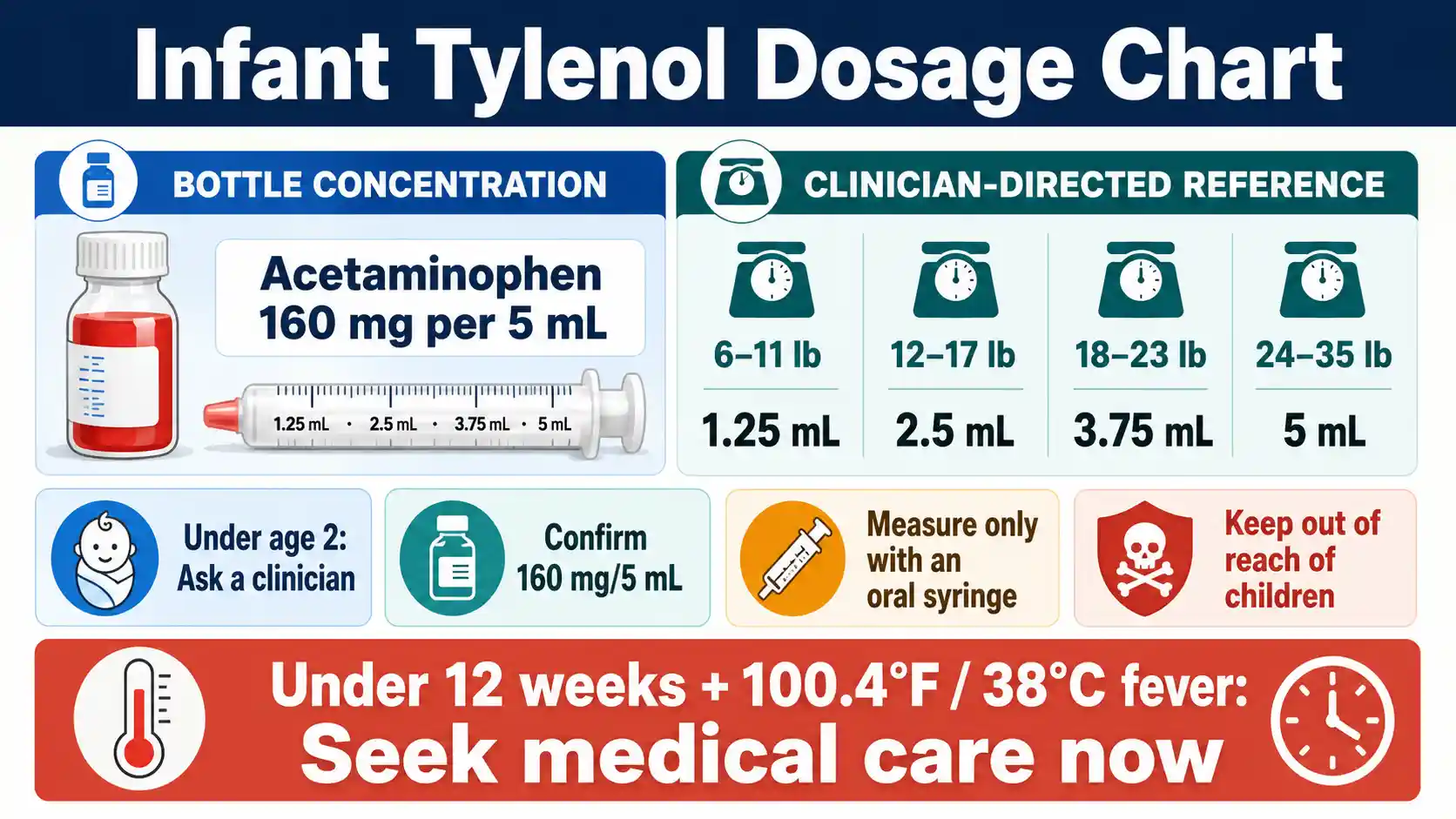
What is the infant acetaminophen dose?
For liquid acetaminophen containing exactly 160 mg per 5 mL, common clinician-directed bands are 1.25 mL for 6–11 lb, 2.5 mL for 12–17 lb, and 3.75 mL for 18–23 lb. A child younger than 2 years needs clinician confirmation before any dose.
The American Academy of Pediatrics advises clinician guidance for acetaminophen in children younger than 2 years and recommends using the syringe provided with the medicine.
Liquid strength used
160 mg/5 mL
Verify the Drug Facts label before every dose; older concentrated products are different.
Children under age 2
Ask a clinician
The current product label does not provide a self-directed infant dose.
Measurement unit
Milliliters only
Use the enclosed oral syringe, never a household spoon or a device from another bottle.
Young infant fever
Urgent assessment
A rectal temperature of 100.4°F / 38°C or higher under 12 weeks needs immediate care.
Infant Tylenol Dosage Chart by Weight
Clinician-directed weight bands for liquid acetaminophen at exactly 160 mg per 5 mL. A child younger than 2 years should receive acetaminophen only after a clinician confirms the dose and reason for use.
Swipe horizontally inside the table to view every column.
| Current weight | Approximate metric weight | Acetaminophen amount | 160 mg/5 mL liquid | Age and safety direction |
|---|---|---|---|---|
| Under 6 lb | Under 2.7 kg | No chart dose | Do not calculate | Needs individualized neonatal or pediatric guidance |
| 6–11 lb | 3–5 kg | 40 mg | 1.25 mL — Clinician-directed liquid dose | Do not use under 12 weeks unless specifically directed; under age 2 ask a clinician |
| 12–17 lb | 5–7 kg | 80 mg | 2.5 mL — Clinician-directed liquid dose | Under age 2 ask a clinician before use |
| 18–23 lb | 8–10 kg | 120 mg | 3.75 mL — Clinician-directed liquid dose | Under age 2 ask a clinician before use |
| 24–35 lb | 11–15 kg | 160 mg | 5 mL — Labeled 2-to-3-year dose | Current product label lists this band for ages 2–3; younger children still need clinician guidance |
| 36 lb or more | 16 kg or more | Outside infant chart | Use the child dosing chart or clinician instructions | Do not extrapolate from infant bands |
Liquid concentration: 160 mg acetaminophen per 5 mL, equivalent to 32 mg per mL.
- • Use current measured weight whenever possible; weight is more reliable than age for choosing a band.
- • The brand label says children under 24 lb or under 2 years should have the dose determined by a doctor.
- • Never use these mL values for an old 80 mg/0.8 mL or 80 mg/mL product.
Download or export
Confirm the bottle before reading the mL column
The current Infant’s TYLENOL Drug Facts label lists 160 mg in each 5 mL, says to use weight when possible, instructs caregivers to use the enclosed syringe, and directs those dosing a child under 24 lb or under age 2 to ask a doctor.
160 mg per 5 mL liquid only
How the clinician-directed weight bands scale
The mL values below correspond to one standardized liquid concentration. The dose must not be reused for a different concentration, and children younger than 2 years need clinician guidance.
6–11 lb
40 mg acetaminophen
12–17 lb
80 mg acetaminophen
18–23 lb
120 mg acetaminophen
24–35 lb
160 mg acetaminophen
This visual is not permission to medicate. Confirm the child’s current weight, exact bottle concentration, age-specific advice, and the dose with a pediatric clinician.
Clinician-Directed Infant Dose Checker
This browser-only tool checks the standard weight band for liquid acetaminophen at 160 mg per 5 mL. It will not display a dose for a baby under 12 weeks or without confirmation that a clinician approved acetaminophen use.
Enter a valid weight and age to begin. No information is stored or transmitted.
Possible overdose, an unknown amount, the wrong concentration, or two acetaminophen-containing medicines requires immediate Poison Control or emergency guidance—even when the child seems well.
Product Label Versus Clinician-Directed Dosing
The package label and a pediatric clinician may answer different questions. The bottle controls concentration and device use; the clinician decides whether an infant should receive acetaminophen and which dose applies.
Swipe horizontally inside the table to view every column.
| Question | Current label direction | Clinician role | Caregiver action |
|---|---|---|---|
| What concentration is in this bottle? | Drug Facts should state 160 mg in each 5 mL for the chart on this page | Confirms unusual products or compounded medicines | Read the active ingredient and strength every time |
| Child is under 24 lb or under age 2 | Ask a doctor | Confirms whether acetaminophen is appropriate and gives the dose | Do not self-select a dose from an older chart |
| Child is 24–35 lb and age 2–3 years | 5 mL of 160 mg/5 mL liquid | May alter instructions for liver disease, dehydration, other medicines, or special conditions | Use the enclosed syringe and follow the more specific clinical plan |
| Baby is under 12 weeks with fever | Package chart does not replace medical evaluation | Evaluates for serious infection | Contact pediatric care immediately for 100.4°F / 38°C or higher |
| Dose was vomited or spit out | Label does not determine how much was absorbed | Decides whether any repeat dose is safe | Do not automatically redose |
| Another medicine is being used | Do not use with another acetaminophen-containing drug | Checks active ingredients and interactions | Read every label and ask a pharmacist when uncertain |
- • Brand and generic single-ingredient acetaminophen can be equivalent only when the active ingredient and concentration match.
- • A clinician’s instruction should identify the dose in mL and the exact concentration.
- • Special medical circumstances can make a general OTC chart inappropriate.
Download or export
Acetaminophen Weight-Band Math for 160 mg/5 mL
This table shows how each standardized mL amount converts to milligrams and approximate milligrams per kilogram across its weight band.
Swipe horizontally inside the table to view every column.
| Weight band | Liquid volume | Dose in mg | Approximate mg/kg across band | Interpretation |
|---|---|---|---|---|
| 6–11 lb / 3–5 kg | 1.25 mL | 40 mg | About 8–13 mg/kg | Rounded weight-band dose; clinician direction required |
| 12–17 lb / 5–7 kg | 2.5 mL | 80 mg | About 11–16 mg/kg | Rounded weight-band dose; clinician direction required |
| 18–23 lb / 8–10 kg | 3.75 mL | 120 mg | About 12–15 mg/kg | Rounded weight-band dose; clinician direction required |
| 24–35 lb / 11–15 kg | 5 mL | 160 mg | About 11–15 mg/kg | Matches the current label’s 2–3 year band |
| Concentration conversion | 1 mL | 32 mg — Concentration conversion | Not a dose by itself | Use only to understand the product strength |
- • Weight bands intentionally use rounded practical doses that can be measured with a supplied syringe.
- • Do not calculate a custom mL amount for an infant unless a clinician or pharmacist gives that instruction.
- • The approximate mg/kg values vary because each band covers a range of weights.
Download or export
Weight bands are practical rounded doses
Stanford Medicine Children’s Health publishes current 160 mg/5 mL weight-banded values of 1.25, 2.5, 3.75, and 5 mL for the first four pediatric bands. Those values do not override the under-age-2 ask-a-clinician instruction.
Infant Acetaminophen Concentration Safety Chart
The same number of milliliters can contain very different amounts of medicine. Confirm the concentration before using any chart or syringe marking.
Swipe horizontally inside the table to view every column.
| Product strength | Acetaminophen per mL | Status or context | Main risk | Safe response |
|---|---|---|---|---|
| 160 mg/5 mL — Current standard concentration | 32 mg/mL | Current standardized pediatric liquid in the United States | Using a chart for a different concentration | Use only the chart and syringe intended for this bottle |
| 80 mg/0.8 mL | 100 mg/mL | Older concentrated infant drops | More than three times as concentrated as 160 mg/5 mL | Do not use a modern mL chart; ask a pharmacist about disposal or exact instructions |
| 80 mg/1 mL | 80 mg/mL | Older concentrated formulation | A 5 mL dose would be dangerously different | Do not convert from memory or reuse an old dropper |
| Compounded liquid | Varies | Prepared by a pharmacy for a specific prescription | Strength may not match any OTC chart | Follow the prescription label and pharmacist’s device instructions |
| Combination cold or pain product | Varies | May contain acetaminophen plus other ingredients | Duplicate acetaminophen and unnecessary ingredients | Avoid in infants unless specifically prescribed; check every active ingredient |
| Adult tablet or liquid | Varies | Not an infant product | Wrong formulation, strength, and measuring method | Do not substitute without clinician or pharmacist direction |
- • FDA changed pediatric liquid acetaminophen toward one standard concentration to reduce dosing confusion, but old products may still exist in homes.
- • Never match a syringe from one bottle to another product unless a pharmacist confirms it is appropriate.
- • Discard expired or unneeded medicines through a recommended take-back or disposal method.
Download or export
Old concentrated infant drops are not interchangeable
Older 80 mg/0.8 mL and 80 mg/mL formulations contain much more acetaminophen in each milliliter. Never apply the modern 160 mg/5 mL chart to an old bottle, imported product, or compounded liquid.
How to Measure and Give Liquid Acetaminophen Safely
Accurate administration depends on the correct bottle, syringe, unit, technique, and written record.
Swipe horizontally inside the table to view every column.
| Step | Correct method | Common mistake | Why it matters |
|---|---|---|---|
| 1. Verify the medicine | Confirm single-ingredient acetaminophen and 160 mg/5 mL on Drug Facts | Checking only the brand name or front label | Different products can share similar names |
| 2. Confirm child and weight | Use a recent measured weight and the clinician’s instruction | Estimating weight or using a sibling’s dose | Pediatric doses are weight-sensitive |
| 3. Shake suspension | Shake well exactly as the label directs | Drawing from an unshaken bottle | Suspended medicine may not be evenly distributed |
| 4. Use the enclosed oral syringe | Measure in mL at eye level with air removed — Preferred measuring method | Using a kitchen spoon, dropper from another product, or ounces | Household spoons and mismatched devices are inaccurate |
| 5. Position safely | Hold the infant upright and place the syringe toward the inner cheek | Squirting quickly toward the throat | Slow delivery reduces coughing and choking |
| 6. Record the dose | Write the time, amount, medicine, and caregiver initials | Relying on memory between caregivers | Prevents repeat or too-frequent dosing |
| 7. Store securely | Close the child-resistant cap and place medicine up and away | Leaving the syringe or bottle within reach | Prevents accidental ingestion |
- • Use mL, not teaspoon abbreviations, in written instructions and caregiver logs.
- • Ask a pharmacist for a properly sized oral syringe if the supplied device is damaged or missing.
- • Do not mix the full dose into a bottle of milk because the child may not finish it.
Download or export
The oral syringe is part of the safety system
Write the dose in mL, remove air bubbles, align the plunger with the correct marking, and deliver slowly toward the inner cheek. Never measure with a household spoon or mix the full dose into a bottle the infant may not finish.
Acetaminophen Timing, Duration and Dose-Limit Chart
The current Infant’s TYLENOL label supplies boundaries for the labeled product. A clinician may give more restrictive instructions for an infant.
Swipe horizontally inside the table to view every column.
| Safety item | Current label direction | Do not do this | When to contact care |
|---|---|---|---|
| Time between doses | Repeat every 4 hours while symptoms last — Labeled interval | Give early because the fever has not fallen yet | Ask before changing the interval |
| Maximum in 24 hours | No more than 5 doses — Maximum daily count | Count each caregiver’s doses separately | Get immediate advice after any extra or uncertain dose |
| Fever duration | Stop and ask a doctor if fever worsens or lasts more than 3 days | Continue indefinitely without reassessment | Infants often need earlier review based on age and symptoms |
| Pain duration | Stop and ask a doctor if pain worsens or lasts more than 5 days | Increase the amount when pain persists | Persistent or severe pain needs diagnosis |
| Duplicate ingredients | Use no other drug containing acetaminophen | Combine Tylenol with an acetaminophen cold medicine | Ask a pharmacist to check active ingredients |
| Liver disease | Ask a doctor before use | Assume an OTC dose is automatically safe | Use only an individualized plan |
| Missed or uncertain dose | Confirm the record and seek advice when uncertain | Give another dose “just in case” | Poison Control can advise after a possible duplicate |
| Alternating medicines | Not directed on the acetaminophen label | Create a complex alternating schedule without guidance | Use only a written clinician plan |
- • The minimum interval and maximum daily count do not mean every child should receive five doses.
- • Treat the child’s discomfort and clinical situation, not only the thermometer number.
- • A fever returning before the next permitted dose is not a reason to shorten the interval.
Download or export
Infant Fever and Symptom Action Chart
Acetaminophen can reduce discomfort or fever but cannot determine or treat the cause. Age and symptoms decide urgency.
Swipe horizontally inside the table to view every column.
| Age or situation | Temperature or symptom | Action | Medication caution |
|---|---|---|---|
| Birth to 12 weeks | Rectal temperature 100.4°F / 38°C or higher — Young infant fever threshold | Contact pediatric care immediately for medical assessment | Do not delay evaluation by treating first unless instructed |
| Any infant | Trouble breathing, blue or gray color, seizure, collapse, or cannot awaken | Call emergency services now | Do not give oral medicine to an unresponsive or severely distressed child |
| Any infant | Stiff neck, rapidly spreading purple rash, severe lethargy, or inconsolable crying | Urgent emergency assessment | A lower temperature does not remove the urgency |
| Any infant | Signs of dehydration: markedly fewer wet diapers, dry mouth, no tears, sunken soft spot | Prompt clinical assessment | Do not rely on fever medicine to correct dehydration |
| Any infant | Repeated vomiting or medicine cannot be kept down | Contact the clinician for an alternate plan | Do not automatically repeat a vomited dose |
| After vaccination | Expected mild fever or soreness | Follow vaccine-specific clinician instructions and monitor behavior | Young age still changes fever urgency |
| Fever with improved comfort after medicine | Child remains alert, drinks, and breathes comfortably | Continue observation and the approved plan | Improvement does not diagnose the cause |
| Fever or pain worsening despite treatment | New symptoms or progressive illness | Contact the child’s clinician | Do not increase dose or frequency |
- • Rectal temperature is generally the most reliable measurement for very young infants.
- • The child’s breathing, alertness, hydration, skin color, and ability to feed matter more than whether the temperature reaches normal.
- • Use local emergency and pediatric advice because access pathways differ by country.
Download or export
Do not treat a young infant fever before seeking assessment
AAP guidance says a baby 3 months or younger with a rectal temperature of 100.4°F / 38°C or higher needs immediate pediatric contact. Lowering the temperature can make the baby more comfortable but does not evaluate the infection causing it.
Possible Acetaminophen Overdose Response Chart
Quick expert guidance matters because significant acetaminophen poisoning may have few or no early symptoms.
Swipe horizontally inside the table to view every column.
| Situation | Immediate action | Information to gather | Do not |
|---|---|---|---|
| Extra dose or dose given too soon | Contact Poison Control or an urgent medical service now | Child’s age, weight, product, concentration, amount, and exact times | Wait for symptoms before asking |
| Unknown amount swallowed | Get Poison Control guidance immediately | Bottle size, amount remaining, possible time, and packaging | Guess the amount or induce vomiting |
| Wrong concentration used | Contact Poison Control even if the mL amount looked correct | Both intended and actual concentrations plus measured volume | Apply the usual chart after the error |
| Two medicines contained acetaminophen | Add all known amounts and seek immediate expert advice | Names, active ingredients, doses, and times | Assume different brand names mean different medicines |
| Repeated excessive doses over hours or days | Urgent poison or emergency evaluation | Complete written dosing history and symptoms | Stop at home and assume the risk has passed |
| Collapse, seizure, breathing trouble, or cannot awaken | Call emergency services immediately | Bring the medicine container if safe | Use an online calculator instead of emergency care |
| Skin reddening, blistering, or rash after acetaminophen | Stop the medicine and seek medical help | Timing, product, dose, and photographs if appropriate | Give another dose to test whether it recurs |
- • In the United States, Poison Control is available at 1-800-222-1222 or through poison.org; use the appropriate local service elsewhere.
- • Keep the product package and dosing device available for the poison specialist or emergency team.
- • Do not administer activated charcoal, food, milk, or another medicine unless a professional directs it.
Download or export
Possible overdose needs advice now, not after symptoms begin
Poison Control provides immediate expert guidance in the United States. Contact the appropriate poison service after an extra dose, unknown amount, wrong concentration, repeated dosing error, or duplicate acetaminophen product. Call emergency services for collapse, seizure, breathing trouble, or inability to awaken.
Frequently asked questions
How much Infant Tylenol can I give my baby?
Children younger than 2 years should receive acetaminophen only after a pediatric clinician confirms that it is appropriate and gives the dose. For 160 mg/5 mL liquid, common clinician-directed bands are 1.25 mL at 6–11 lb, 2.5 mL at 12–17 lb, and 3.75 mL at 18–23 lb.
Can I give Tylenol to a baby under 3 months?
Do not give acetaminophen to a baby under 12 weeks unless a clinician specifically instructs you. A rectal temperature of 100.4°F or 38°C or higher in this age group needs immediate medical assessment because fever can signal a serious infection.
Is Infant Tylenol the same strength as Children’s Tylenol?
Many current U.S. infant and children’s liquid acetaminophen products are both 160 mg/5 mL, but you must verify the Drug Facts label. Older concentrated infant drops and non-U.S. products may have a different strength.
Should acetaminophen dosing use weight or age?
Use a current measured weight whenever possible because pediatric dosing is weight-based. Age is a fallback on some labels, but infants younger than 2 still need clinician guidance even when their weight matches a chart band.
How often can Infant Tylenol be given?
The current Infant’s TYLENOL label says to repeat the approved dose every 4 hours while symptoms last and to give no more than 5 doses in 24 hours. A clinician may give more restrictive instructions for an infant.
Can I give another dose if my baby spits it out?
Do not automatically repeat a dose because it is difficult to know how much was swallowed. Contact the child’s clinician or pharmacist with the amount given, what was lost, and when it happened.
Can I use a kitchen teaspoon to measure Infant Tylenol?
No. Use the oral syringe supplied with the product or one provided by a pharmacist and measure in milliliters. Household spoons vary in size and can cause underdosing or overdose.
Why must I check the concentration every time?
Older infant acetaminophen drops were much more concentrated than 160 mg/5 mL. Using the correct mL amount from the wrong chart can produce a dangerous dose, so read the active ingredient and strength before every administration.
Can I alternate Tylenol and ibuprofen for an infant?
Do not create an alternating schedule unless a clinician gives a clear written plan. Timing differences increase medication-error risk, and ibuprofen is generally not approved for children younger than 6 months without medical direction.
Can I give Tylenol before infant vaccinations?
Do not routinely premedicate unless the vaccination clinician recommends it. Acetaminophen may be used afterward for significant discomfort or fever when the clinician confirms the infant’s dose and age-specific plan.
What if another medicine also contains acetaminophen?
Do not give two acetaminophen-containing medicines together. Check every active-ingredient list, including cold and prescription products, and ask a pharmacist when names or ingredients are unclear.
What are signs of acetaminophen overdose in a baby?
Early overdose may cause no obvious symptoms. Nausea, vomiting, sweating, unusual tiredness, abdominal pain, or later jaundice can occur, but caregivers should contact Poison Control immediately after any extra, unknown, or wrong-concentration dose rather than waiting for symptoms.
What should I do after an accidental extra dose?
Contact Poison Control or the appropriate local poison service immediately with the baby’s weight, product concentration, amount, and dose times. Call emergency services for collapse, seizure, breathing trouble, or inability to awaken.
Does lowering a fever mean the illness is not serious?
No. Acetaminophen may improve comfort and lower temperature without treating the cause. Breathing, alertness, hydration, feeding, skin color, age, and other symptoms determine how urgently the infant needs medical care.
When should I call the pediatrician about fever or pain?
Call immediately for fever in a baby under 12 weeks, and seek prompt care for breathing trouble, dehydration, persistent vomiting, seizure, unusual sleepiness, a concerning rash, poor feeding, worsening pain, new symptoms, or illness that is not improving.
Sources
These sources support the visible dose bands, product concentration, label directions, measurement technique, fever urgency, medication-error prevention, and overdose response. URLs are displayed as plain text for transparent reference.
American Academy of Pediatrics: Acetaminophen Dosing Tables for Fever and Pain in Children
https://www.healthychildren.org/English/safety-prevention/at-home/medication-safety/Pages/Acetaminophen-for-Fever-and-Pain.aspx
States that pediatric liquid acetaminophen is standardized at 160 mg/5 mL, recommends an oral syringe, and advises clinician guidance for children younger than 2 years.
National Library of Medicine DailyMed: Infants TYLENOL — Acetaminophen Suspension Drug Facts
https://dailymed.nlm.nih.gov/dailymed/drugInfo.cfm?setid=2143cc16-86db-4060-96da-5c228ae9207b
Provides the current 160 mg/5 mL label, under-2 ask-a-doctor direction, dosing interval, maximum daily frequency, warnings, syringe instructions, and overdose guidance.
Stanford Medicine Children’s Health: Acetaminophen and Ibuprofen Weight-Banded Dosing Tables
https://www.stanfordchildrens.org/content/dam/sch/content-public/pdf/antimicrobial-stewardship-program/pcha-acetaminophen-ibuprofen-weight-banded-dosing-tables.pdf
Provides clinician-facing weight bands for 160 mg/5 mL liquid acetaminophen, including 6–11, 12–17, 18–23, and 24–35 pound bands.
U.S. Food and Drug Administration: Important Change in Concentration for OTC Liquid Acetaminophen Marketed for Infants
https://www.fda.gov/drugs/drug-safety-and-availability/questions-and-answers-important-change-concentration-over-counter-otc-liquid-acetaminophen-marketed
Explains the transition to 160 mg/5 mL and warns that older concentrated 80 mg formulations may still create dangerous dosing confusion.
U.S. Food and Drug Administration: OTC Pediatric Oral Liquid Drug Products Containing Acetaminophen
https://www.fda.gov/files/drugs/published/Over-the-Counter-Pediatric-Oral-Liquid-Drug-Products-Containing-Acetaminophen.pdf
Recommends mL-only dosing directions, a calibrated delivery device, and package features intended to reduce pediatric medication errors.
American Academy of Pediatrics: How to Use Liquid Medicines for Children
https://www.healthychildren.org/English/safety-prevention/at-home/medication-safety/Pages/Using-Liquid-Medicines.aspx
Explains why milliliters and an oral syringe are preferred over household teaspoons and how to administer liquid medicines accurately.
American Academy of Pediatrics: Fever and Your Baby
https://www.healthychildren.org/English/health-issues/conditions/fever/Pages/Fever-and-Your-Baby.aspx
Advises immediate pediatric contact for a baby 3 months or younger with a rectal temperature of 100.4°F or 38°C or higher.
American Academy of Pediatrics: Ways to Prevent Children’s Medication Errors at Home
https://www.healthychildren.org/English/news/Pages/ways-to-prevent-home-medication-errors.aspx
Supports mL-only instructions, appropriately sized oral syringes, caregiver education, and standardized pediatric medication practices.
U.S. Food and Drug Administration: Got a Sick Kid? Do Not Guess. Read the Label
https://www.fda.gov/drugs/safe-use-over-counter-otc-medicines-children/got-sick-kid-dont-guess-read-label-make-sure-youre-giving-your-children-right-medicine-and-right
Provides practical label-reading, active-ingredient, unit, dosing-device, age, and weight safety checks for nonprescription medicines.
Poison Control: Acetaminophen: Take It Safely
https://www.poison.org/articles/acetaminophen-take-it-safely
Explains liver injury risk, duplicate active ingredients, formulation confusion, household-spoon errors, and the importance of immediate overdose advice.
Poison Control: Get Poison Control Help Online or by Phone
https://www.poison.org/
Provides free expert U.S. poisoning guidance and directs emergency calls for collapse, seizure, breathing trouble, or inability to awaken.
National Library of Medicine: Acetaminophen Drug Information
https://medlineplus.gov/druginfo/meds/a681004.html
Explains uses, label adherence, child-specific products, weight-based chart use, duplicate-product risk, and the need for urgent help after excess dosing.