Health & Medical · Infusion calculations and safety
IV Drip Rate Chart: mL per Hour, Drops per Minute and Drop Factors
Calculate prescribed IV flow rates, compare macrodrip and microdrip tubing, cross-check pump settings, and respond safely to alarms or IV-site problems.
IV therapy can cause rapid harm when the order, concentration, line, pump, or rate is wrong. Use this page to check arithmetic, not to create or change an infusion. Patients and caregivers should contact their infusion team before changing any pump, clamp, tubing, or prescribed setting. Read the ChartsLoom Disclaimer.
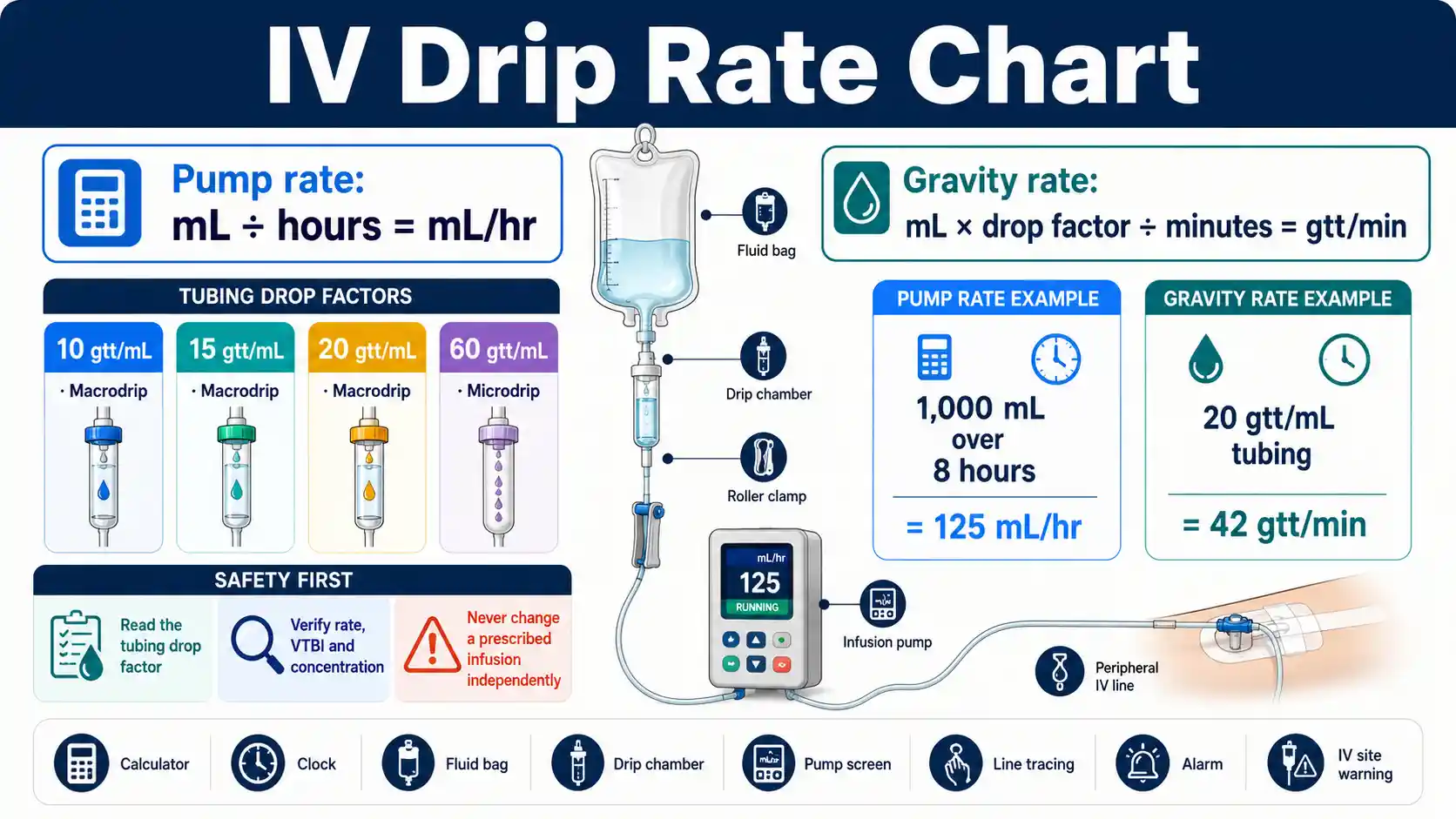
How do you calculate an IV drip rate?
For a pump, divide total volume in mL by infusion time in hours. For gravity tubing, multiply volume in mL by the set’s drop factor in gtt/mL, then divide by time in minutes.
Example: 1,000 mL over 8 hours equals 125 mL/hr. With 20 gtt/mL tubing, the gravity rate is 42 gtt/min after rounding. NCBI’s pharmacy calculation reference presents the same volume-over-time and drop-factor equations.
Pump flow rate
mL/hr
Divide the prescribed volume in mL by the prescribed time in hours.
Gravity flow rate
gtt/min
Multiply volume by the tubing drop factor, then divide by time in minutes.
Drop factor
Read the tubing
Common sets use 10, 15, 20, or 60 gtt/mL, but the package controls.
Safety priority
Verify every input
Correct arithmetic cannot fix a wrong patient, order, concentration, line, or unit.
IV Flow-Rate Formula Chart
Use the prescribed total volume, prescribed duration, and the drop factor printed on the actual tubing package.
Swipe horizontally inside the table to view every column.
| Find | Formula | Required inputs | Rounding and use |
|---|---|---|---|
| Pump rate in mL/hr | Total volume (mL) ÷ time (hr) — Pump formula | Volume and duration | Program only the ordered rate after an independent check |
| Gravity rate in gtt/min | [Volume (mL) × drop factor (gtt/mL)] ÷ time (min) — Gravity formula | Volume, duration, tubing drop factor | Drops are counted as whole drops; follow local rounding policy |
| Infusion time in hours | Volume remaining (mL) ÷ current rate (mL/hr) | Remaining volume and verified rate | Estimate only; compare with pump display and clinical plan |
| Volume infused | Rate (mL/hr) × elapsed time (hr) | Verified rate and elapsed time | Compare with pump history, bag level, and intake record |
| Concentration | Drug amount ÷ solution volume | Pharmacy-labeled amount and final volume | Keep units aligned before calculating a medication rate |
| Medication flow rate | Ordered dose per time ÷ concentration per mL | Complete order and verified concentration | High-alert infusions require protocol-based checks — Medication safety requirement |
mL = milliliters; hr = hour; min = minute; gtt = drop.
- • Convert all time values to the unit used in the formula before calculating.
- • A correct arithmetic result can still be unsafe when the order, concentration, patient weight, route, or tubing is wrong.
- • Patients and caregivers should never change a pump rate or roller clamp unless their infusion team has explicitly trained and directed them to do so.
Download or export
One flow rate, different drip counts
How drop factor changes gtt/min
A 1,000 mL infusion over 8 hours equals 125 mL/hr. The required drop count changes with the administration set’s labeled drop factor.
10 gtt/mL
Macrodrip
Same 125 mL/hr
15 gtt/mL
Macrodrip
Same 125 mL/hr
20 gtt/mL
Macrodrip
Same 125 mL/hr
60 gtt/mL
Microdrip
Same 125 mL/hr
Read the drop factor from the tubing package. Gravity flow can drift and must be reassessed; a calculated drip count does not replace patient and IV-site monitoring.
IV Drip Rate Calculator
Enter a prescribed volume and duration to calculate mL/hr and gravity drops per minute. Select the drop factor printed on the actual tubing package.
Enter a positive volume and a duration longer than zero. Minutes must be from 0 to 59. No information is stored or transmitted.
This calculator does not create an IV order or a medication dose. Patients and caregivers should not change a pump, clamp, tubing, or prescribed infusion rate without direct instruction from their infusion team.
IV Tubing Drop-Factor Chart
The drop factor is a property of the administration set, not a value chosen from memory.
Swipe horizontally inside the table to view every column.
| Tubing type | Common drop factor | Typical use | Key point |
|---|---|---|---|
| Macrodrip | 10 gtt/mL | Larger drops for many routine gravity infusions | Verify the package; not interchangeable with 15 or 20 gtt/mL |
| Macrodrip | 15 gtt/mL | Routine gravity infusion where this set is supplied | Use 15 in the formula only when printed on the set |
| Macrodrip | 20 gtt/mL | Smaller macrodrip drops | A higher drop factor needs more drops each minute for the same mL/hr |
| Microdrip | 60 gtt/mL — Microdrip factor | Small-volume or closely controlled gravity delivery | At 60 gtt/mL, the numerical gtt/min equals mL/hr |
| Blood or specialty set | Varies by product | Blood products, filtered solutions, or specialty therapy | Use the manufacturer label and facility protocol |
| Unknown or unreadable set | Do not calculate | Any setting | Replace or identify the tubing before starting or changing flow — Do not guess |
- • Common macrodrip factors are 10, 15, or 20 gtt/mL; microdrip tubing commonly uses 60 gtt/mL.
- • Filter, viscosity, catheter resistance, bag height, movement, and partial occlusion can change actual gravity delivery.
- • Count drops in the drip chamber specified by the tubing manufacturer.
Download or export
IV Pump Rate Chart in mL per Hour
These examples convert a prescribed volume and duration into a pump flow rate.
Swipe horizontally inside the table to view every column.
| Total volume | Infusion time | Exact calculation | Pump rate |
|---|---|---|---|
| 50 mL | 30 minutes | 50 ÷ 0.5 | 100 mL/hr |
| 100 mL | 30 minutes | 100 ÷ 0.5 | 200 mL/hr |
| 100 mL | 1 hour | 100 ÷ 1 | 100 mL/hr |
| 250 mL | 2 hours | 250 ÷ 2 | 125 mL/hr — Common worked example |
| 500 mL | 4 hours | 500 ÷ 4 | 125 mL/hr |
| 1,000 mL | 8 hours | 1,000 ÷ 8 | 125 mL/hr |
| 1,000 mL | 12 hours | 1,000 ÷ 12 | 83.3 mL/hr — Decimal rate |
| 1,000 mL | 24 hours | 1,000 ÷ 24 | 41.7 mL/hr |
- • Program decimal precision only as allowed by the pump, order, medication monograph, and local policy.
- • The volume to be infused may differ from the container fill volume when tubing priming, overfill, or a partial bag is involved.
- • Recalculate whenever the ordered volume or duration changes; do not carry forward an old rate.
Download or export
Gravity IV Drops per Minute Chart
The same mL/hr rate produces different drip counts when the tubing drop factor changes.
Swipe horizontally inside the table to view every column.
| Prescribed infusion | 10 gtt/mL | 15 gtt/mL | 20 gtt/mL | 60 gtt/mL |
|---|---|---|---|---|
| 50 mL over 30 min (100 mL/hr) | 17 gtt/min | 25 gtt/min | 33 gtt/min | 100 gtt/min |
| 100 mL over 30 min (200 mL/hr) | 33 gtt/min | 50 gtt/min | 67 gtt/min | 200 gtt/min |
| 100 mL over 1 hr (100 mL/hr) | 17 gtt/min | 25 gtt/min | 33 gtt/min | 100 gtt/min |
| 250 mL over 2 hr (125 mL/hr) | 21 gtt/min | 31 gtt/min | 42 gtt/min | 125 gtt/min — Microdrip equivalence |
| 500 mL over 4 hr (125 mL/hr) | 21 gtt/min | 31 gtt/min | 42 gtt/min | 125 gtt/min |
| 1,000 mL over 8 hr (125 mL/hr) | 21 gtt/min | 31 gtt/min | 42 gtt/min | 125 gtt/min |
| 1,000 mL over 12 hr (83.3 mL/hr) | 14 gtt/min | 21 gtt/min | 28 gtt/min | 83 gtt/min |
| 1,000 mL over 24 hr (41.7 mL/hr) | 7 gtt/min — Slow gravity count | 10 gtt/min | 14 gtt/min | 42 gtt/min |
Values are rounded to the nearest whole drop for illustration.
- • Gravity infusions require repeated reassessment because patient position, bag height, tubing resistance, and catheter condition can change flow.
- • Do not adjust a gravity infusion solely because the remaining bag volume looks ahead or behind; verify the order, elapsed time, site, and tubing first.
- • Use an infusion pump when required by the medication, patient population, facility policy, or prescribed precision.
Download or export
IV pump versus gravity drip
A pump controls volume in mL/hr and can provide alarms and drug-library limits. A gravity infusion depends on bag height, clamp position, catheter resistance, tubing, movement, and repeated manual drip counts.
Pump delivery
Confirm mL/hr, VTBI, concentration, dose unit, drug-library entry, channel, line attachment, alarm settings, and expected completion. A pump can deliver a wrong entry accurately, so programming still needs verification.
Gravity delivery
Confirm the labeled gtt/mL, count the drip rate, assess the IV site, and recheck after position changes or interruptions. NCBI’s IV therapy guidance emphasizes calculation and ongoing monitoring.
Remaining IV Time and Volume Chart
Use verified pump history or a measured remaining volume; visual bag estimates are imprecise.
Swipe horizontally inside the table to view every column.
| Known values | Calculation | Result | Clinical check |
|---|---|---|---|
| 250 mL remaining at 125 mL/hr | 250 ÷ 125 | 2 hours remaining — Remaining-time example | Compare with ordered stop time and pump VTBI |
| 100 mL remaining at 50 mL/hr | 100 ÷ 50 | 2 hours remaining | Confirm no pauses or boluses changed elapsed time |
| 80 mL remaining at 40 mL/hr | 80 ÷ 40 | 2 hours remaining | Check line patency and patient tolerance |
| Rate 75 mL/hr for 2 hours | 75 × 2 | 150 mL infused | Compare with pump history and intake documentation |
| Rate 125 mL/hr for 4 hours | 125 × 4 | 500 mL infused | Account for pauses, alarms, or rate changes |
| 1,000 mL over 8 hours; 3 hours elapsed | 1,000 − (125 × 3) | 625 mL expected remaining | Use as a cross-check, not a replacement for direct assessment |
| Pump says complete but fluid remains | Do not recalculate and restart automatically | Stop and investigate — Investigate mismatch | Check VTBI, container volume, tubing, pump, and order |
- • Completion estimates assume uninterrupted delivery at a constant verified rate.
- • Pump pauses, secondary infusions, boluses, occlusions, bag overfill, and line priming can explain differences.
- • Unexpected remaining volume can signal a programming or delivery problem and requires clinical review.
Download or export
Dose rate is not the same as flow rate
An order may use mg/hr, units/hr, mcg/min, or mcg/kg/min, while the pump delivers mL/hr. The conversion depends on the verified concentration and, when ordered, the correct dosing weight. ISMP’s smart-pump guidance highlights the danger of confusing dose rate with flow rate.
Do not derive a medication dose from this page. Use the complete prescription, pharmacy label, drug monograph, approved concentration, pump library, and local verification process.
Dose-Based IV Infusion Formula Chart
Medication infusions require a complete order, a verified concentration, aligned units, and protocol-specific safeguards.
Swipe horizontally inside the table to view every column.
| Order format | Flow-rate equation | Unit checks | Safety requirement |
|---|---|---|---|
| mg/hr | Ordered mg/hr ÷ concentration mg/mL = mL/hr | mg cancels; mL/hr remains | Verify final concentration on the pharmacy label |
| units/hr | Ordered units/hr ÷ concentration units/mL = mL/hr | Units cancel; mL/hr remains | Use the approved drug library when available |
| mcg/min | (Ordered mcg/min × 60) ÷ concentration mcg/mL = mL/hr — Time conversion required | Convert minutes to hours before programming | Confirm the pump displays the intended dose unit |
| mcg/kg/min | (Dose × weight kg × 60) ÷ concentration mcg/mL = mL/hr | Use current dosing weight and consistent mass units | High-alert infusions need protocol-based verification |
| mg/kg/hr | (Dose × weight kg) ÷ concentration mg/mL = mL/hr | kg and mg must match the order and concentration | Do not substitute ideal, adjusted, or actual weight without the protocol |
| Rate after concentration change | Recalculate from the unchanged ordered dose and new concentration | Never copy the old mL/hr to a new concentration — Do not reuse old rate | Pause, verify, relabel, and independently check as required |
- • Dose rate and flow rate are different quantities. Confusing them can cause severe over-infusion or under-infusion.
- • This chart shows equation structure only; it does not supply drug doses, concentrations, titration steps, or patient-specific orders.
- • Use pharmacy-prepared concentrations, smart-pump drug libraries, and institutional protocols for medication infusions.
Download or export
Why pump cross-checks matter
Infusion pumps can experience programming, software, alarm, battery, set-loading, occlusion, and air-detection problems. The FDA’s reported pump-problem examples show why the screen, physical tubing, bag progress, IV site, and patient response must agree.
Infusion Pump Programming Cross-Check
A safe setup matches the patient, order, product, route, line, pump channel, and monitoring plan.
Swipe horizontally inside the table to view every column.
| Check | Match against | Common mismatch | Required response |
|---|---|---|---|
| Patient | Two approved identifiers and current weight when weight-based | Wrong patient or stale weight | Stop and resolve before programming |
| Solution or medication | Order, pharmacy label, active ingredient, and concentration | Right drug with wrong concentration | Do not start until reconciled |
| Dose unit | mg, mcg, units, kg, minute, or hour exactly as ordered | mcg versus mg; minute versus hour — Unit mismatch | Correct the unit pathway before entry |
| Flow rate | Calculated mL/hr and expected dose display | Dose rate entered as mL/hr or vice versa | Independently recalculate |
| VTBI | Ordered volume to be infused | Full bag volume entered instead of prescribed volume | Confirm the intended endpoint |
| Duration | Order, start time, and planned completion | Rate and duration do not reproduce ordered volume | Resolve the inconsistency |
| Pump channel and line | Physical tubing from container through pump to patient | Medication connected to the wrong channel or access lumen | Trace the line by hand — Trace the line |
| Drug library | Correct care area, medication entry, concentration, and limits | Basic mode or wrong library entry | Use the approved library unless an authorized exception applies |
| Alarm and monitoring plan | Occlusion, air, battery, pressure, site, vitals, and response plan | Alarm silenced without finding the cause | Assess the patient and delivery system |
- • Smart-pump alerts reduce some errors but cannot detect all wrong entries, wrong lines, wrong patients, or bypassed libraries.
- • Independent double checks should follow local policy and focus on high-risk points rather than becoming a superficial sign-off.
- • Document rate changes, pauses, boluses, bag changes, and the clinical response.
Download or export
Home infusion: call before changing anything
When a home pump alarms, the bag progress looks wrong, tubing leaks, or the site hurts or swells, follow the trained response plan and contact the infusion service. The FDA’s home pump safety guidance advises users to understand alarms, keep instructions and contact numbers available, and report problems promptly.
IV Site, Pump Alarm and Urgent Problem Chart
Assess the patient first. A rate calculation never explains away pain, swelling, breathing symptoms, or a pump alarm.
Swipe horizontally inside the table to view every column.
| Finding | Possible concern | Immediate action | Do not |
|---|---|---|---|
| Swelling, coolness, pallor, leaking, slowing, or discomfort at a peripheral IV | Infiltration | Stop the infusion and notify the clinical team; follow the specific management protocol | Increase pressure or force fluid through |
| Burning, blistering, severe pain, skin color change, or tissue injury near the site | Extravasation, especially with an irritant or vesicant | Stop the infusion and activate the medication-specific emergency protocol — Extravasation emergency | Remove the device or apply heat/cold until the protocol directs |
| Redness, warmth, tenderness, streaking, or a palpable cord | Phlebitis or infection | Stop use of the site and obtain prompt clinical assessment | Cover the site and continue the infusion |
| Occlusion alarm | Clamp, kink, closed stopcock, positional catheter, filter resistance, or blocked line | Assess the patient and trace the line from bag to access site | Repeatedly restart or raise pressure without finding the cause |
| Air-in-line alarm | Air detected or sensor/set problem | Stop delivery and follow pump and facility procedure | Bypass the alarm or push air toward the patient |
| Unexpectedly rapid bag emptying or free flow | Clamp, door, set-loading, programming, or device failure | Clamp the line, stop delivery, assess the patient, and call for immediate help | Estimate the excess and continue at a lower rate |
| Pump stops, blank screen, repeated error, or power failure | Device or power problem with interrupted therapy | Use the trained backup plan and contact the infusion team | Ignore alarms or improvise settings |
| Shortness of breath, chest pain, blue color, fainting, seizure, or sudden severe distress | Potential life-threatening reaction or infusion complication | Stop the infusion if safe and call emergency services immediately — Emergency response | Use this chart or calculator instead of emergency care |
| Home infusion question without symptoms | Uncertain rate, tubing, alarm, or bag progress | Contact the home-infusion pharmacy or clinical service before changing anything | Change the pump program or roller clamp independently |
- • Medication-specific extravasation management varies; preserve the access device when the protocol may require aspiration or an antidote.
- • A pump alarm describes the device or delivery system, not the patient’s stability. Assess both.
- • At home, keep the pump manufacturer, infusion pharmacy, prescribing team, and emergency contact numbers available.
Download or export
Frequently asked questions
How do you calculate an IV rate in mL per hour?
Divide the prescribed total volume in milliliters by the prescribed infusion time in hours. For example, 1,000 mL over 8 hours equals 125 mL/hr. Verify the order, volume to be infused, concentration, and pump limits before programming.
How do you calculate IV drops per minute?
Multiply the prescribed volume in mL by the tubing drop factor in gtt/mL, then divide by the infusion time in minutes. Round to a whole drop according to local policy and recheck gravity flow regularly.
What does gtt per minute mean?
gtt/min means drops per minute. It is a gravity-infusion flow rate based on the visible drip count and the administration set’s labeled number of drops per milliliter.
What is the difference between mL/hr and gtt/min?
mL/hr measures liquid volume delivered each hour and is commonly programmed into a pump. gtt/min counts drops in a gravity set and changes with the tubing drop factor.
What drop factor should I use?
Use only the drop factor printed on the actual tubing package. Common macrodrip sets are 10, 15, or 20 gtt/mL, while microdrip tubing commonly uses 60 gtt/mL.
Why does 60 gtt per mL equal the mL per hour number?
With 60 gtt/mL tubing, multiplying by 60 drops per mL and dividing by 60 minutes per hour cancels the two 60s. Therefore, 75 mL/hr corresponds numerically to 75 gtt/min.
Should IV drops per minute be rounded?
A gravity drip count uses whole drops, so the calculated value is commonly rounded to a whole number according to local policy. Medication-specific rules and institutional practice may require a different approach or a pump.
Can I change an IV pump rate myself at home?
Do not change a prescribed pump rate, dose, volume, or tubing setup unless your infusion team has explicitly trained and directed you to make that exact change. Contact the home-infusion service when the bag progress, alarm, or setting seems wrong.
What is VTBI on an infusion pump?
VTBI means volume to be infused. It is the amount the pump is programmed to deliver before stopping or alarming and may be less than the full amount inside the container.
What if the IV bag is finishing too early?
Stop and investigate rather than simply slowing the rate. Check the patient, order, pump program, VTBI, tubing, line connections, elapsed time, and whether any bolus or secondary infusion changed delivery.
What if the IV bag is running behind schedule?
Do not speed up an infusion to catch up without a new clinical decision. Assess for pauses, occlusion, infiltration, tubing resistance, wrong rate, wrong drop factor, or pump problems and contact the responsible clinician.
What is the formula for a weight-based IV medication infusion?
A common structure is ordered dose per kg per time multiplied by the verified dosing weight, then divided by the labeled concentration. Time units must be converted before obtaining mL/hr. Use the drug-specific protocol and an independent check.
Can a correct IV calculation still be unsafe?
Yes. Arithmetic can be correct while the patient, medication, concentration, weight, route, line, unit, or order is wrong. Safe infusion practice verifies every input and monitors the patient and IV site.
What signs suggest IV infiltration or extravasation?
Swelling, coolness, pallor, leaking, pain, burning, blistering, color change, or a slowing infusion can signal fluid outside the vein. Stop the infusion and obtain immediate clinical assessment; vesicant extravasation needs a medication-specific emergency protocol.
When is an IV problem an emergency?
Call emergency services for shortness of breath, chest pain, blue or gray color, fainting, seizure, inability to awaken, or sudden severe distress. Rapid unintended infusion, suspected air delivery, severe reaction, or major extravasation also needs immediate professional response.
Sources
These references support the formulas, tubing factors, pump safeguards, IV-site assessment, alarm response, and home-infusion precautions used throughout this page.
NCBI Bookshelf — Pharmacy Calculations
https://www.ncbi.nlm.nih.gov/books/NBK560924/
Provides the standard volume-over-time and drops-per-minute equations used for intravenous flow-rate calculations.
NCBI Bookshelf — Chapter 5: Math Calculations
https://www.ncbi.nlm.nih.gov/books/NBK596732/
Explains dimensional analysis, macrodrip and microdrip tubing, drop factors, rounding, and gravity-infusion calculations.
NCBI Bookshelf — Chapter 23: IV Therapy Management
https://www.ncbi.nlm.nih.gov/books/NBK593209/
Supports gravity-flow setup, pump checks, site monitoring, and recognition of infiltration, extravasation, phlebitis, and infection.
NCBI Bookshelf — Chapter 1: Initiate IV Therapy
https://www.ncbi.nlm.nih.gov/books/NBK594499/
Describes required IV orders, invasive-therapy risks, peripheral-line assessment, and local complication management.
U.S. Food and Drug Administration — Infusion Pumps: Tips for Using Your Pump at Home
https://www.fda.gov/medical-devices/infusion-pumps/infusion-pumps-tips-using-your-pump-home
Provides patient-facing pump safety, alarm, tubing, power, and troubleshooting precautions for prescribed home infusions.
U.S. Food and Drug Administration — Examples of Reported Infusion Pump Problems
https://www.fda.gov/medical-devices/infusion-pumps/examples-reported-infusion-pump-problems
Documents risks from programming, alarm, occlusion, air-in-line, battery, software, and flow-delivery problems.
Institute for Safe Medication Practices — Guidelines for Optimizing Safe Implementation and Use of Smart Infusion Pumps
https://www.ismp.org/system/files/resources/2020-10/ISMP176C-Smart%20Infusion%20Pumps-100620.pdf
Supports drug-library use, standardized concentrations, selective independent double checks, and prevention of dose-rate versus flow-rate errors.
Institute for Safe Medication Practices — Medication Safety Best Practices for Hospitals
https://www.ismp.org/sites/default/files/newsletter-issues/20240222.pdf
Supports programmable pumps with dose error-reduction systems for medication and hydration infusions in hospital practice.
MedlinePlus — Intravenous
https://medlineplus.gov/ency/article/002383.htm
Defines intravenous delivery as fluid or medicine entering directly through a vein.