Health & Medical · Kidney tests and interpretation
Kidney Function Chart: eGFR, Creatinine, Urine Albumin and CKD Risk
Compare filtration and urine-damage markers, understand what one result can and cannot show, and recognize sudden changes that need urgent care.
Kidney disease may be silent, and acute kidney injury can worsen quickly. Do not diagnose yourself, restrict fluids, change medicines, or alter a prescribed diet from one number. Seek urgent care for almost no urine, breathing difficulty with swelling, chest symptoms, confusion, or rapid deterioration. Read the ChartsLoom Disclaimer.
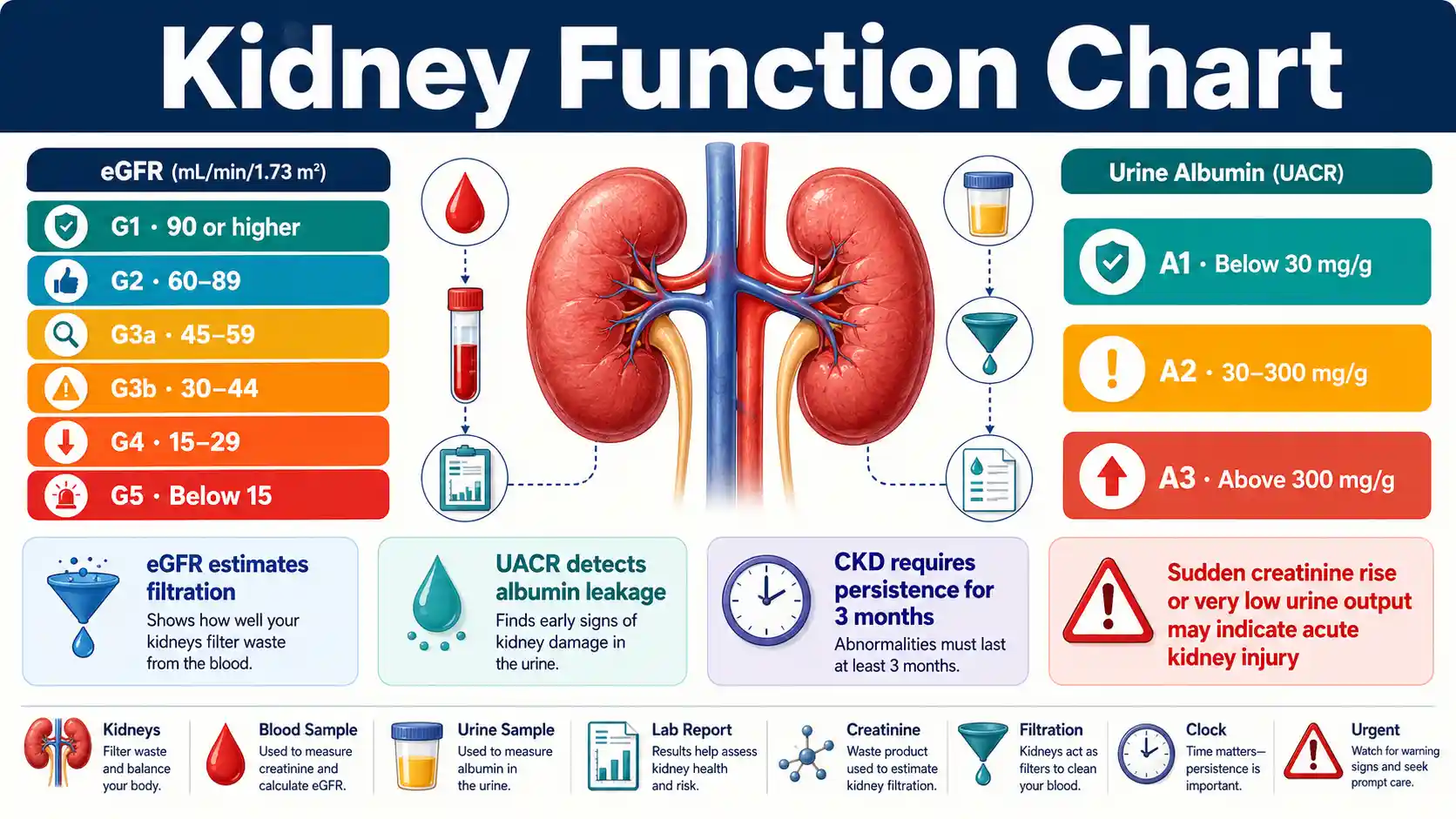
Which tests show kidney function?
eGFR estimates how well the kidneys filter blood. UACR measures albumin leaking into urine. Use both numbers, compare them with prior results, and confirm that an abnormality lasts at least three months before calling it chronic kidney disease.
The KDIGO 2024 CKD guideline classifies kidney disease by cause, GFR category, and albuminuria category.
Filtration marker
eGFR
Classified from G1 through G5; lower values indicate less estimated filtration.
Damage marker
UACR
Classified from A1 through A3; higher values indicate more urine albumin.
CKD time rule
At least 3 months
A chronic diagnosis requires persistent kidney abnormalities, not one isolated result.
Acute warning
Trend matters
A rapid creatinine rise or falling urine output may indicate acute kidney injury.
eGFR Category Chart
KDIGO G categories describe filtration level. Chronic kidney disease also depends on duration, albuminuria, structural findings, or other markers of kidney damage.
Swipe horizontally inside the table to view every column.
| Category | eGFR (mL/min/1.73 m²) | Description | Interpretation |
|---|---|---|---|
| G1 | 90 or higher | Normal or high filtration | Not CKD by eGFR alone; another kidney-damage marker must be present for at least 3 months |
| G2 | 60–89 | Mildly decreased filtration | Not CKD by eGFR alone; interpret with UACR, urine findings, imaging, history, and trend |
| G3a | 45–59 — Persistent eGFR below 60 | Mildly to moderately decreased | Persistent values meet the GFR criterion for CKD and raise cardiovascular and progression risk |
| G3b | 30–44 | Moderately to severely decreased | Complication and medication-clearance concerns become more likely; clinical review is important |
| G4 | 15–29 | Severely decreased | Very high risk category that usually needs close kidney-specialist planning and complication assessment |
| G5 | Below 15 — Kidney failure category | Kidney failure | Needs urgent specialist assessment, especially with symptoms, rapid decline, electrolyte problems, or fluid overload |
eGFR is normalized to a body surface area of 1.73 m².
- • A single eGFR cannot show whether a change is chronic, stable, or acute.
- • G1 and G2 require another marker of kidney damage to qualify as CKD.
- • Laboratories may report eGFR values above a threshold as “>90”; use the reported method and trend.
Download or export
Filtration categories
How eGFR categories step down
eGFR estimates filtration. Urine albumin and chronicity must be added before interpreting kidney-disease risk.
G1
≥90
Normal or high
G2
60–89
Mildly decreased
G3a
45–59
Mild–moderate
G3b
30–44
Moderate–severe
G4
15–29
Severely decreased
G5
<15
Kidney failure
G1 and G2 are not CKD by filtration alone. Persistent albuminuria, structural disease, abnormal urine sediment, or another kidney-damage marker may still establish CKD.
eGFR and UACR Result Guide
Enter an adult eGFR and urine albumin-to-creatinine ratio to identify the G category, A category, and combined KDIGO risk band.
Enter an eGFR from 1 to 200 and a UACR from 0 to 100,000 mg/g. No information is stored or transmitted.
This guide does not diagnose CKD or acute kidney injury. A sudden creatinine rise, falling urine output, severe swelling, breathing difficulty, chest symptoms, confusion, or rapid deterioration needs prompt medical assessment.
Urine Albumin-to-Creatinine Ratio Chart
UACR measures albumin leakage into urine and adds risk information that eGFR alone cannot provide.
Swipe horizontally inside the table to view every column.
| Category | UACR (mg/g) | UACR (mg/mmol) | Description | Meaning |
|---|---|---|---|---|
| A1 | Below 30 | Below 3 | Normal to mildly increased | Lower albumin-related risk; does not rule out kidney disease from another cause |
| A2 | 30–300 — Moderately increased albuminuria | 3–30 | Moderately increased | May indicate kidney damage; confirm persistence and consider temporary causes |
| A3 | Above 300 — Severely increased albuminuria | Above 30 | Severely increased | High-risk kidney-damage marker that needs prompt clinical evaluation |
UACR = urine albumin-to-creatinine ratio. mg/g and mg/mmol are not numerically interchangeable.
- • Exercise, fever, urinary infection, menstruation, marked hyperglycemia, and uncontrolled blood pressure can temporarily raise urine albumin.
- • A first-morning spot urine sample can reduce some biological variation when confirmation is needed.
- • Albuminuria can identify kidney damage even when eGFR is 60 or higher.
Download or export
Why eGFR and UACR answer different questions
eGFR estimates filtration, while UACR detects albumin leakage. A person can have preserved eGFR with important albuminuria, or low eGFR with little albuminuria. The NIDDK kidney-testing guide recommends blood and urine testing because early CKD often causes no symptoms.
Combined eGFR and Albuminuria Risk Chart
The same eGFR can carry different risk depending on urine albumin. This grid summarizes KDIGO risk categories, not an individual prognosis.
Swipe horizontally inside the table to view every column.
| GFR category | A1: <30 mg/g | A2: 30–300 mg/g | A3: >300 mg/g |
|---|---|---|---|
| G1: ≥90 | Low* — Low risk if no other markers | Moderately increased | High |
| G2: 60–89 | Low* | Moderately increased | High |
| G3a: 45–59 | Moderately increased | High — High risk combination | Very high |
| G3b: 30–44 | High | Very high | Very high |
| G4: 15–29 | Very high — Very high risk combination | Very high | Very high |
| G5: <15 | Very high | Very high | Very high |
- • *G1 or G2 with A1 is low risk and is not CKD unless another marker of kidney damage is present.
- • Risk rises as eGFR falls, UACR rises, or both occur together.
- • Age, cause, blood pressure, diabetes, cardiovascular disease, rate of change, and other findings also affect prognosis.
Download or export
Kidney Function Test Comparison
No single blood or urine test answers every kidney question. Results work best when interpreted together and over time.
Swipe horizontally inside the table to view every column.
| Test | Sample | What it reflects | Main limitation |
|---|---|---|---|
| Serum creatinine | Blood | Waste-product concentration used to estimate filtration | Affected by muscle mass, diet, medications, illness, and changing kidney function |
| eGFR from creatinine | Calculated from blood result | Estimated filtration normalized to 1.73 m² | An estimate; less reliable when creatinine production is unusual or function is changing rapidly |
| Cystatin C | Blood | Alternative filtration marker | Can be affected by inflammation, thyroid disease, steroids, smoking, and other factors |
| Combined creatinine-cystatin C eGFR | Calculated from two blood markers | More precise filtration estimate in many adults — Combined filtration estimate | Still an estimate and not available in every setting |
| UACR | Spot urine | Albumin leakage and glomerular damage risk — Kidney damage marker | Biological variation and temporary elevations require context or repeat testing |
| Urinalysis and microscopy | Urine | Blood, protein, cells, casts, infection clues, concentration, and chemistry | Abnormalities are not specific to one disease and may need confirmation |
| BUN | Blood | Urea nitrogen influenced by filtration and protein metabolism | Changes with hydration, protein intake, bleeding, catabolism, liver function, and medicines |
| Electrolytes and bicarbonate | Blood | Potassium, sodium, acid-base balance, and complications | Reference ranges vary; abnormalities can have non-kidney causes |
| Ultrasound or other imaging | Imaging | Kidney size, obstruction, cysts, stones, and structural findings | Does not directly measure filtration |
- • Use the laboratory reference interval for analytes such as creatinine, BUN, potassium, and bicarbonate.
- • A stable eGFR is more interpretable than a value obtained during rapidly changing acute illness.
- • Children and young adults may require age-appropriate equations rather than the adult CKD-EPI equation.
Download or export
eGFR is an estimate, not a direct measurement
Creatinine-based eGFR can be less accurate when muscle mass, diet, supplements, medicines, pregnancy, or rapidly changing illness alters creatinine independently of filtration. Current NIDDK adult eGFR equations use race-free CKD-EPI methods and can combine creatinine with cystatin C when greater precision is needed.
Creatinine and eGFR Limitation Chart
Creatinine reflects both kidney clearance and creatinine production. These factors can shift a creatinine-based eGFR away from measured filtration.
Swipe horizontally inside the table to view every column.
| Situation | Possible creatinine effect | Possible eGFR effect | Practical interpretation |
|---|---|---|---|
| High muscle mass or creatine supplements | Higher | May appear lower | Review body composition, supplements, trend, and whether cystatin C is useful |
| Low muscle mass, frailty, paralysis, or amputation | Lower | May appear higher | Creatinine-based eGFR may overestimate filtration |
| Recent cooked meat intake or intense exercise | Temporarily higher | Temporarily lower | Repeat under standard conditions when the result is unexpected |
| Rapidly changing acute kidney function | Lags behind real-time change | Can be misleading | Use serial results, urine output, clinical status, and acute-care evaluation — Acute change limitation |
| Pregnancy | Physiology changes filtration and creatinine | Standard adult equation may not apply well | Use obstetric and kidney-specialist interpretation |
| Certain medicines that alter creatinine secretion | Higher without matching filtration loss | May appear lower | Review the timing and medication list with the prescriber |
| Cystatin C affected by non-GFR factors | No direct effect | Cystatin-based estimate may shift | Combined markers and clinical context may improve confidence |
| Result near a drug or procedure cutoff | Small variation matters | Classification may change | Confirm the equation, units, trend, and whether a more accurate estimate is needed — Decision threshold |
- • Do not compare results calculated with different equations as though the method were unchanged.
- • The 2021 adult CKD-EPI equations do not use a race coefficient.
- • Drug dosing may require a specific kidney-function estimate defined by the medicine label or local protocol.
Download or export
Acute kidney injury is not staged like stable CKD
AKI develops over hours or days. A creatinine increase of at least 0.3 mg/dL within 48 hours, a rise to at least 1.5 times baseline within seven days, or urine output below 0.5 mL/kg/hour for six hours meets a KDIGO AKI criterion. Unstable kidney function needs clinical evaluation rather than a CKD stage assigned from one eGFR.
Acute Kidney Injury Criteria Chart
AKI describes a sudden decline in kidney function. It is different from CKD and may occur on top of existing CKD.
Swipe horizontally inside the table to view every column.
| Criterion | KDIGO threshold | Time window | Action |
|---|---|---|---|
| Absolute creatinine rise | Increase of at least 0.3 mg/dL (26.5 µmol/L) — AKI creatinine criterion | Within 48 hours | Needs prompt clinical assessment for AKI and its cause |
| Relative creatinine rise | Increase to at least 1.5 times known or presumed baseline | Within the prior 7 days | Treat as possible AKI until evaluated |
| Low urine output | Below 0.5 mL/kg/hour — AKI urine-output criterion | For at least 6 hours | Requires clinical measurement and urgent assessment, especially with illness or obstruction |
| No urine or near-anuria | Markedly reduced or absent output | Any sudden occurrence | Emergency assessment is appropriate |
| Falling eGFR during acute illness | No single universal cutoff | Hours to days | Do not stage CKD from one unstable estimate; evaluate the acute change |
Creatinine: mg/dL or µmol/L. Urine output: mL/kg/hour.
- • Urine output criteria require reliable measurement and clinical context.
- • Dehydration, infection, low blood pressure, obstruction, medicines, toxins, and intrinsic kidney disease can cause AKI.
- • A person can have AKI even when the creatinine remains within the laboratory reference interval.
Download or export
Kidney Result Pattern and Next-Step Chart
A pattern and its trend are more useful than one isolated number. These actions describe evaluation, not treatment.
Swipe horizontally inside the table to view every column.
| Result pattern | What it may mean | Useful next step | Urgency |
|---|---|---|---|
| eGFR ≥60 and UACR <30 | Lower-risk combination if no other kidney-damage marker exists | Continue risk-based screening and compare with prior results | Routine unless symptoms or rapid change are present |
| eGFR ≥60 and UACR ≥30 | Possible kidney damage despite preserved filtration | Repeat UACR, review temporary causes, blood pressure, diabetes, and urine findings | Timely clinical follow-up |
| eGFR <60 on one test | Could be CKD, AKI, normal variation, or an estimation issue | Compare with baseline, repeat as clinically appropriate, and assess cause | Prompt if new, falling, or symptomatic |
| eGFR <60 for more than 3 months | Meets the chronic GFR criterion for CKD | Classify G and A categories and review complications, medicines, and progression risk | Ongoing clinical care |
| Rising creatinine over hours or days | Possible AKI | Assess volume status, illness, obstruction, medicines, urine output, and repeat testing | Urgent — Urgent acute change |
| Blood plus protein in urine | May suggest glomerular or urinary-tract disease | Confirm microscopy and obtain cause-directed evaluation | Prompt; urgent with clots, heavy bleeding, or systemic illness |
| High potassium, severe acidosis, or fluid overload | Potential kidney-related complication with cardiac or respiratory risk | Immediate clinical assessment and repeat confirmation when appropriate | Urgent or emergency — Potential emergency |
| Rapid eGFR decline across serial tests | Progression, AKI, medication effect, or hemodynamic change | Verify dates, equations, creatinine trend, UACR, blood pressure, and cause | Prompt specialist review may be needed |
- • CKD is defined by kidney abnormalities present for at least three months, not by one result alone.
- • Clinical laboratories, age, pregnancy, body composition, and acute illness can change interpretation.
- • Never stop a prescribed medicine solely because a kidney result appears abnormal; contact the prescriber promptly.
Download or export
Normal urine and no symptoms do not always rule out kidney disease
Early CKD often causes no symptoms, and a standard dipstick may miss lower levels of albumin. People with diabetes, high blood pressure, cardiovascular disease, a family history of kidney failure, or a previous kidney injury should follow a clinician’s testing plan. The NIDDK CKD evaluation guide centers screening on eGFR and spot UACR in people at risk.
Kidney Warning Signs and Urgency Chart
Kidney disease can be silent. Symptoms often signal complications, obstruction, infection, or advanced dysfunction rather than an exact stage.
Swipe horizontally inside the table to view every column.
| Finding | Possible concern | Recommended action | Urgency |
|---|---|---|---|
| Sudden inability to urinate or almost no urine | Obstruction, severe AKI, or shock | Seek emergency medical care | Emergency — Emergency symptom |
| Shortness of breath with swelling or rapid weight gain | Fluid overload or heart-kidney complication | Seek urgent or emergency care, especially at rest | Urgent to emergency |
| Chest pain, severe weakness, fainting, or palpitations | Electrolyte or cardiovascular complication | Call emergency services | Emergency — Emergency symptom |
| Confusion, extreme drowsiness, or seizure | Severe metabolic disturbance, toxicity, or critical illness | Call emergency services | Emergency |
| Fever with side or back pain, vomiting, or urinary symptoms | Kidney infection or obstruction | Obtain same-day urgent medical assessment | Urgent |
| Visible blood, clots, or cola-colored urine | Bleeding, stone, infection, or glomerular disease | Prompt medical evaluation; emergency if unable to pass urine or bleeding is heavy | Prompt to emergency |
| Persistent foamy urine or new swelling | Albuminuria or fluid retention | Arrange kidney and urine testing | Timely |
| New nausea, itching, poor appetite, cramps, or sleep problems | Advanced kidney dysfunction or another illness | Discuss promptly, especially with known low eGFR | Prompt |
| One unexpected abnormal result without symptoms | May be real, temporary, or affected by test limitations | Contact the clinician, compare prior values, and follow the repeat-testing plan | Timely |
- • Do not wait for symptoms to screen people at increased risk, including those with diabetes or high blood pressure.
- • Emergency symptoms outweigh the category shown by an older laboratory result.
- • Poisoning, overdose, severe dehydration, sepsis, trauma, or pregnancy complications need immediate professional assessment.
Download or export
Frequently asked questions
What is the best number for checking kidney function?
eGFR is the main estimate of kidney filtration, but it should be paired with a urine albumin-to-creatinine ratio. eGFR shows filtration level; UACR shows kidney damage and adds independent risk information.
What eGFR is considered normal?
An eGFR of 90 or higher is category G1, but “normal” depends on age and context. An eGFR of 60–89 can occur without CKD when there is no other kidney-damage marker. Trends and UACR matter.
Does an eGFR below 60 mean chronic kidney disease?
A persistent eGFR below 60 for at least three months meets the GFR criterion for CKD. One low result may reflect acute kidney injury, dehydration, medication effects, biological variation, or estimation limits.
Can kidney disease occur with an eGFR above 60?
Yes. Persistent albuminuria, blood or abnormal cells in urine, structural abnormalities, inherited disease, or other markers can establish CKD even when eGFR is 60 or higher.
What does a UACR above 30 mg/g mean?
A UACR of 30 mg/g or higher is increased and may indicate kidney damage. Because urine albumin varies, clinicians often confirm an unexpected result and check for temporary causes such as exercise, infection, fever, or menstruation.
Why can creatinine be misleading?
Creatinine depends on muscle mass, diet, supplements, medicines, illness, and kidney clearance. A low-muscle person may have serious kidney dysfunction with a modest creatinine, while a muscular person may have a higher creatinine without the same loss of filtration.
Is cystatin C better than creatinine?
Cystatin C is less dependent on muscle mass, but it has its own non-kidney influences. A combined creatinine-cystatin C equation often improves precision when the result is close to an important decision threshold.
What is the difference between CKD and AKI?
CKD describes kidney abnormalities lasting at least three months. AKI is a sudden decline over hours or days, identified by short-term creatinine rises or low urine output. AKI can occur in someone who already has CKD.
Can dehydration lower eGFR?
Dehydration can reduce kidney blood flow and raise creatinine, which may lower the reported eGFR. A significant or persistent change still needs clinical assessment because dehydration can also trigger acute kidney injury.
Why are eGFR and UACR combined?
They measure different dimensions. Lower eGFR shows reduced filtration, while higher UACR shows albumin leakage. Combining the G and A categories gives a more useful picture of progression and cardiovascular risk.
Is eGFR a percentage of kidney function?
No. eGFR is an estimated filtration rate normalized to 1.73 square meters of body surface area. It should not be read as a literal percentage of kidney function.
Can I use eGFR to change a medication dose?
Do not change a medicine independently. Drug labels and protocols may specify a particular equation, body-size adjustment, or creatinine-clearance method. Contact the prescriber or pharmacist when kidney results change.
How often should kidney tests be repeated?
Timing depends on the result, trend, symptoms, risk factors, illness, and treatment. A sudden creatinine rise may need repeat testing within hours or days, while stable chronic monitoring may occur at longer intervals set by the care team.
What kidney result requires emergency care?
A number alone does not define every emergency. Seek urgent help for almost no urine, breathing difficulty with swelling, chest pain, severe weakness, fainting, palpitations, confusion, seizure, or a rapid laboratory deterioration.
Can this chart diagnose kidney disease?
No. It organizes standard GFR and albuminuria categories and explains patterns. Diagnosis requires clinical history, repeat testing, urine findings, medications, imaging or other studies, and assessment of whether abnormalities are acute or chronic.
Sources
These clinical guidelines and patient resources support the kidney-function categories, test interpretation, acute kidney injury criteria, limitations, and warning signs on this page.
KDIGO — 2024 Clinical Practice Guideline for the Evaluation and Management of Chronic Kidney Disease
https://kdigo.org/wp-content/uploads/2024/03/KDIGO-2024-CKD-Guideline.pdf
Defines chronic kidney disease, GFR categories, albuminuria categories, combined risk classification, evaluation principles, and monitoring concepts.
KDIGO — Top 10 Takeaways for Primary Care: CKD Evaluation
https://kdigo.org/wp-content/uploads/2024/03/KDIGO-2024-CKD-Guideline-Top-10-Takeaways-for-PCPs-Evaluation.pdf
Summarizes testing with both GFR and albuminuria, confirmation of chronicity, and cause-GFR-albuminuria classification.
National Institute of Diabetes and Digestive and Kidney Diseases — Quick Reference on UACR and GFR
https://www.niddk.nih.gov/health-information/professionals/advanced-search/quick-reference-uacr-gfr
Identifies eGFR and urine albumin as the two key CKD markers and explains spot urine albumin-to-creatinine ratio testing.
National Institute of Diabetes and Digestive and Kidney Diseases — Chronic Kidney Disease Tests and Diagnosis
https://www.niddk.nih.gov/health-information/kidney-disease/chronic-kidney-disease-ckd/tests-diagnosis
Explains blood and urine testing, eGFR, UACR, repeat evaluation, and the fact that early kidney disease often causes no symptoms.
National Kidney Foundation — How to Classify CKD
https://www.kidney.org/how-to-classify-ckd
Presents G1 through G5, A1 through A3, and the combined GFR-albuminuria risk heat map.
National Institute of Diabetes and Digestive and Kidney Diseases — eGFR Equations for Adults
https://www.niddk.nih.gov/research-funding/research-programs/kidney-clinical-research-epidemiology/laboratory/glomerular-filtration-rate-equations/adults
Provides current race-free CKD-EPI equations for adults using creatinine, cystatin C, or both.
National Institute of Diabetes and Digestive and Kidney Diseases — Clinical Measurements and eGFR Accuracy
https://www.niddk.nih.gov/research-funding/research-programs/kidney-clinical-research-epidemiology/laboratory/factors-affecting-egfr-accuracy/clinical-measurements
Describes conditions that reduce eGFR accuracy and the role of combined creatinine-cystatin C estimation.
National Kidney Foundation — Creatinine
https://www.kidney.org/kidney-topics/creatinine
Explains why serum creatinine alone can misrepresent kidney function and why eGFR or cystatin C may add context.
KDIGO — Clinical Practice Guideline for Acute Kidney Injury
https://kdigo.org/wp-content/uploads/2016/10/KDIGO-2012-AKI-Guideline-English.pdf
Defines acute kidney injury using short-term creatinine changes and reduced urine output.
MedlinePlus — Kidney Tests
https://medlineplus.gov/kidneytests.html
Summarizes GFR, creatinine, urine albumin, imaging, and other tests used to evaluate kidney health.
National Institute of Diabetes and Digestive and Kidney Diseases — Identify and Evaluate Patients with Chronic Kidney Disease
https://www.niddk.nih.gov/health-information/professionals/clinical-tools-patient-management/kidney-disease/identify-manage-patients/evaluate-ckd
Supports risk-based testing, repeat confirmation, cause evaluation, and recognition that CKD requires evidence lasting more than three months.
National Institute of Diabetes and Digestive and Kidney Diseases — What Is Kidney Failure?
https://www.niddk.nih.gov/health-information/kidney-disease/kidney-failure/what-is-kidney-failure
Describes advanced kidney dysfunction, fluid and waste accumulation, symptoms, and the need for specialist care.