Finance & Money
Loan Amortization Chart
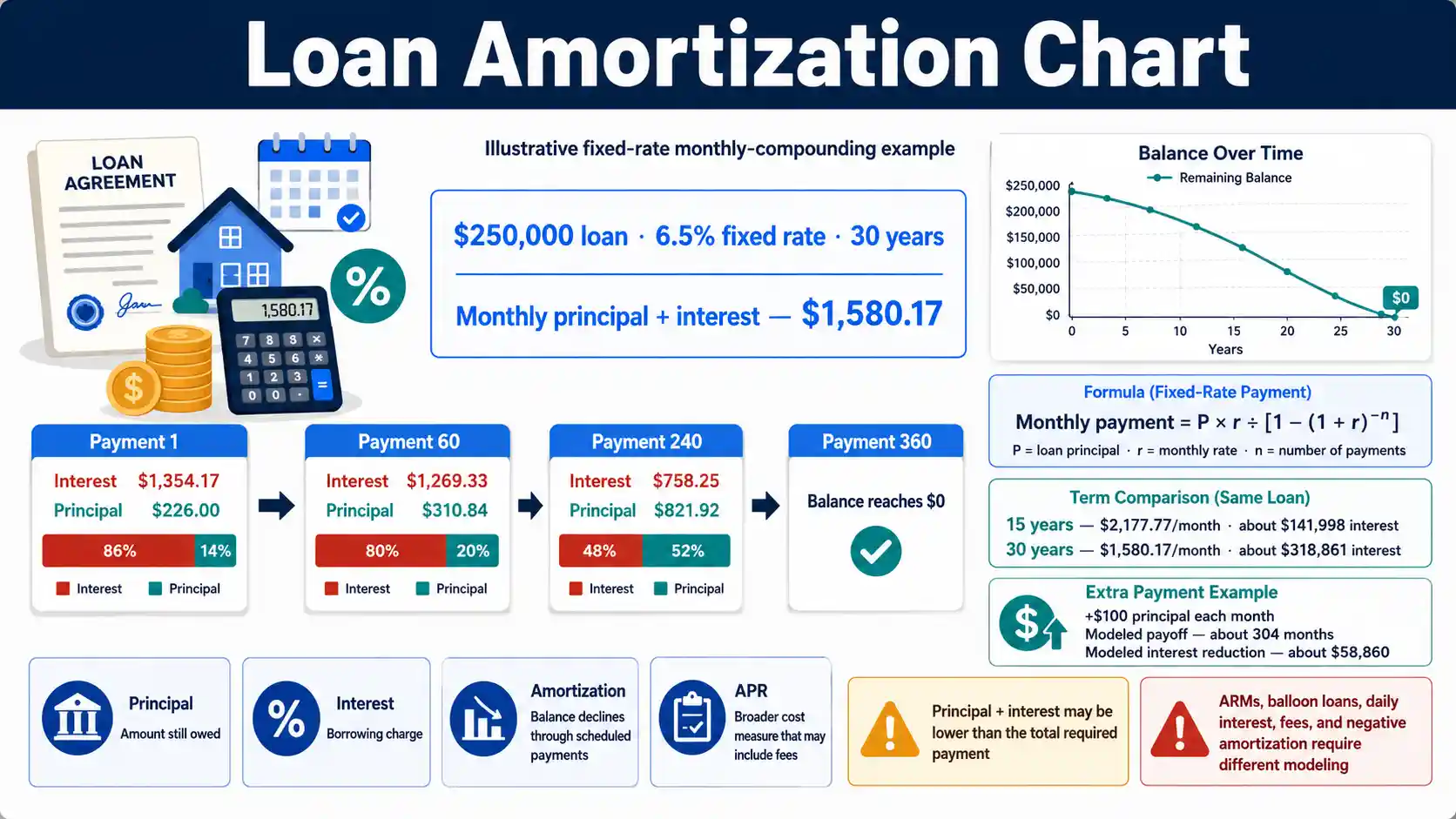
A loan amortization chart shows how each scheduled payment is split between interest and principal and how the remaining balance changes over time. In a standard fixed-rate fully amortizing loan, the principal-and-interest payment stays level while interest falls and principal reduction rises.
Use the contract, statement, Loan Estimate, or payoff quote for actual loan obligations. Daily interest, fees, escrow, adjustable rates, balloon terms, and payment timing can produce results that differ from a simple monthly model.
Payment
Principal + interest
A standard amortizing payment combines interest due for the period with principal reduction.
Early schedule
Interest is larger
The balance is highest at the beginning, so early payments usually contain more interest.
Later schedule
Principal is larger
As the balance falls, less interest accrues and more of the fixed payment reduces principal.
Extra principal
Can shorten payoff
Extra principal can reduce future interest when the contract allows it and the servicer applies it correctly.
Direct answers to common loan amortization questions
What is loan amortization?
Loan amortization repays a loan through scheduled payments that allocate money to interest and principal so the balance declines over time.
What does an amortization schedule show?
It shows each payment, the interest charged, principal paid, and the remaining loan balance.
Why do early payments contain more interest?
Interest is charged on a larger balance early in the term, so more of a level payment goes to interest at first.
What is the monthly payment formula?
For a standard fixed-rate monthly loan, payment = P × r ÷ [1 − (1 + r)^−n], where P is principal, r is the monthly rate, and n is the number of payments.
Does a longer term lower the payment?
Usually yes. A longer term spreads principal across more payments, but it generally increases total interest when the rate and amount stay the same.
Does a higher interest rate raise the payment?
Yes. For the same principal and term, a higher rate raises the scheduled principal-and-interest payment and lifetime interest.
Can extra payments save interest?
Yes when extra money is applied to principal and the loan does not impose a penalty or rule that offsets the benefit.
Is APR the same as the loan interest rate?
No. APR is a broader borrowing-cost measure that can include fees, while the note rate generally drives scheduled interest calculations.
Does mortgage amortization include taxes and insurance?
The basic amortization formula covers principal and interest. Total mortgage payments may also include taxes, homeowners insurance, and mortgage insurance.
What is negative amortization?
Negative amortization occurs when the payment is too small to cover the interest due, causing the loan balance to increase.
Can an adjustable-rate loan use a fixed schedule forever?
No. When the interest rate changes, the payment may be recalculated using the new rate and remaining term.
Is a statement balance the same as a payoff quote?
Not always. A payoff amount can include accrued interest through the payoff date and other unpaid charges.
Loan Amortization Formulas at a Glance
These formulas describe a standard fixed-rate loan with equal monthly principal-and-interest payments and monthly compounding.
Swipe horizontally inside the table to view every column.
| Measure | Formula or method | Meaning | Main caveat |
|---|---|---|---|
| Monthly rate | Annual interest rate ÷ 12 | Periodic rate used in the monthly model | Some loans accrue interest daily or use another convention |
| Number of payments | Loan term in years × 12 | Total scheduled monthly payments | Payment frequency may differ |
| Monthly P&I payment | P × r ÷ [1 − (1 + r)^−n] — Core fixed-rate monthly payment formula | Level principal-and-interest payment | Excludes taxes, insurance, and many fees |
| Monthly interest | Beginning balance × monthly rate | Interest charged for the modeled month | Actual contracts may calculate interest differently |
| Principal paid | Payment − interest | Amount reducing the loan balance | Extra amounts must be applied to principal to accelerate payoff |
| Ending balance | Beginning balance − principal paid | Remaining principal after the payment | Payoff quote can differ from statement balance |
- • P is principal, r is the periodic monthly rate, and n is the scheduled number of payments.
- • A standard amortization table is an educational model. Your promissory note and servicer records control the actual loan.
Download or export
Why the principal-and-interest split changes every month
The CFPB explains that a typical fixed-rate loan begins with more of each payment going to interest because the outstanding balance is still high. As principal falls, interest declines and more of the same payment goes toward principal. See the CFPB explanation of mortgage amortization.
$250,000 Loan at 6.5% for 30 Years — Amortization Milestones
This example shows how the same scheduled principal-and-interest payment shifts from mostly interest toward mostly principal as the balance declines.
Swipe horizontally inside the table to view every column.
| Payment number | Payment | Interest | Principal | Balance after payment |
|---|---|---|---|---|
| 1 | $1,580.17 | $1,354.17 — Interest dominates the first payment | $226.00 | $249,774.00 |
| 12 | $1,580.17 | $1,340.33 | $239.84 | $247,205.69 |
| 60 | $1,580.17 | $1,269.33 | $310.84 | $234,027.44 |
| 120 | $1,580.17 | $1,150.34 | $429.83 | $211,940.32 |
| 240 | $1,580.17 | $758.25 | $821.92 | $139,163.21 |
| 360 | About $1,580.17 | About $8.51 | About $1,571.66 — Principal dominates near payoff | $0 |
Hypothetical USD. Fixed 6.5% annual rate, monthly compounding, no fees, no extra principal, and no taxes or insurance.
- • Total modeled interest over 360 payments is about $318,861.22.
- • Rounding at the payment level can make the final payment differ slightly from the scheduled amount.
Download or export
Browser-only educational tool
Loan Amortization and Extra Payment Calculator
Estimate a level monthly principal-and-interest payment for a fixed-rate loan with monthly compounding, then compare the modeled payoff with an optional recurring extra principal payment.
Scheduled P&I payment
$1,580.17
Principal and interest only. Taxes, insurance, fees, and escrow are excluded.
Base payoff
360 months
Modeled interest: $318,861.22.
With extra principal
304 months
Modeled interest: $260,001.34.
Modeled interest difference
$58,859.89
Assumes the extra amount is applied to principal every month without penalty.
| Month | Payment | Principal | Interest | Balance |
|---|---|---|---|---|
| 1 | $1,580.17 | $226.00 | $1,354.17 | $249,774.00 |
| 2 | $1,580.17 | $227.23 | $1,352.94 | $249,546.77 |
| 3 | $1,580.17 | $228.46 | $1,351.71 | $249,318.31 |
| 4 | $1,580.17 | $229.70 | $1,350.47 | $249,088.61 |
| 5 | $1,580.17 | $230.94 | $1,349.23 | $248,857.67 |
| 6 | $1,580.17 | $232.19 | $1,347.98 | $248,625.48 |
| 7 | $1,580.17 | $233.45 | $1,346.72 | $248,392.04 |
| 8 | $1,580.17 | $234.71 | $1,345.46 | $248,157.32 |
| 9 | $1,580.17 | $235.98 | $1,344.19 | $247,921.34 |
| 10 | $1,580.17 | $237.26 | $1,342.91 | $247,684.07 |
| 11 | $1,580.17 | $238.55 | $1,341.62 | $247,445.53 |
| 12 | $1,580.17 | $239.84 | $1,340.33 | $247,205.69 |
This calculator runs in your browser and transmits no entered values. It models a standard fixed-rate, fully amortizing loan with monthly compounding. Actual contracts may use daily interest, different payment dates, fees, adjustable rates, balloon payments, or other rules.
Monthly Payment by Interest Rate for a $250,000 30-Year Loan
Holding loan amount and term constant isolates how the interest rate changes the principal-and-interest payment.
Swipe horizontally inside the table to view every column.
| Annual interest rate | Monthly P&I payment | Total modeled interest | Total modeled payments |
|---|---|---|---|
| 4.0% | $1,193.54 | $179,673.77 | $429,673.77 |
| 5.0% | $1,342.05 | $233,139.46 | $483,139.46 |
| 6.0% | $1,498.88 | $289,595.47 | $539,595.47 |
| 6.5% | $1,580.17 — Reference example used throughout this page | $318,861.22 | $568,861.22 |
| 7.0% | $1,663.26 | $348,772.25 | $598,772.25 |
| 8.0% | $1,834.41 | $410,388.12 | $660,388.12 |
Hypothetical USD. Fixed rate, monthly compounding, 360 payments, no fees, escrow, taxes, or insurance.
- • A higher interest rate increases both the monthly principal-and-interest payment and total modeled interest when other terms stay the same.
- • APR and note interest rate are not interchangeable when fees are present.
Download or export
Loan Term Comparison for $250,000 at 6.5%
A shorter term raises the scheduled monthly payment but can substantially reduce total interest in this fixed-rate example.
Swipe horizontally inside the table to view every column.
| Term | Monthly P&I payment | Total modeled interest | Total modeled payments |
|---|---|---|---|
| 10 years | $2,838.70 | $90,643.93 — Lowest modeled interest among these terms | $340,643.93 |
| 15 years | $2,177.77 | $141,998.31 | $391,998.31 |
| 20 years | $1,863.93 | $197,343.88 | $447,343.88 |
| 30 years | $1,580.17 — Lowest scheduled payment among these terms | $318,861.22 | $568,861.22 |
- • CFPB guidance notes that longer loan terms generally lower monthly payments but increase the interest paid over the life of the loan.
- • Affordability depends on the total payment and the borrower’s finances, not term length alone.
Download or export
Longer terms can lower the payment while raising total interest
CFPB guidance on auto-loan amortization notes that longer loan terms typically reduce monthly payments but increase the interest paid over the life of the loan.
Extra Principal Payment Effects on the $250,000 Example
Recurring extra principal can shorten payoff time and reduce modeled interest when the loan permits prepayment and the servicer applies the extra amount to principal.
Swipe horizontally inside the table to view every column.
| Extra principal per month | Modeled payoff time | Modeled interest | Interest difference vs base |
|---|---|---|---|
| $0 | 360 months (30.0 years) | $318,861.22 | $0 |
| $50 | 329 months (27.4 years) | $285,950.20 | -$32,911.02 |
| $100 | 304 months (25.3 years) | $260,001.34 | -$58,859.89 — Illustrative interest reduction from $100 extra principal per month |
| $200 | 265 months (22.1 years) | $221,243.10 | -$97,618.12 |
| $500 | 195 months (16.3 years) | $155,345.27 | -$163,515.95 |
Hypothetical USD. Fixed 6.5% rate; extra amount applied monthly to principal; no prepayment penalty or fee modeled.
- • Check the loan agreement and servicer instructions before assuming an extra payment will be applied to principal as intended.
- • Some loans can include prepayment penalties, especially for certain large or early payoffs.
Download or export
Interest rate and APR answer different borrowing-cost questions
The CFPB explains that the loan interest rate is the borrowing rate, while APR includes the interest rate plus certain additional fees. Do not substitute APR directly for the contract rate in a payment schedule unless the loan terms specifically call for that treatment.
Principal-and-Interest Payment Versus Total Loan Payment
An amortization schedule usually focuses on principal and interest. The cash payment for a mortgage or other loan can include additional amounts.
Swipe horizontally inside the table to view every column.
| Payment component | Included in basic amortization formula? | Can change over time? | What it represents |
|---|---|---|---|
| Principal | Yes — Included in standard amortization | Allocation changes each payment | Repays the amount borrowed |
| Interest | Yes | Allocation changes as balance falls | Lender charge for borrowing |
| Property taxes | No — Not included in the core P&I formula | Yes | Local taxes, often collected through escrow on mortgages |
| Homeowners insurance | No | Yes | Property insurance, sometimes collected through escrow |
| Mortgage insurance | No | Can change or end | Insurance required for some mortgage structures |
| HOA or condo dues | No | Yes | Separate property-related charge in many communities |
| Loan fees | Usually no | Depends on fee | Origination, servicing, late, or other contract-specific costs |
- • CFPB states that total mortgage payments commonly exceed principal and interest because taxes, homeowners insurance, and sometimes mortgage insurance are included.
- • Use the written loan estimate, statement, or contract to identify the actual required payment.
Download or export
Loan Structures That Do Not Follow a Simple Fixed Amortization Table
A standard fixed-rate schedule is useful only when the loan terms match the model. These structures require extra care.
Swipe horizontally inside the table to view every column.
| Loan feature | What changes | Why the simple table can fail | What to check |
|---|---|---|---|
| Adjustable-rate loan | Interest rate and payment may reset | Future payments cannot be known from the initial rate alone | Index, margin, caps, reset dates, remaining term |
| Balloon loan | Large balance can remain due at term end | Regular payments may not fully amortize principal | Balloon amount and due date |
| Interest-only period | Payment may cover interest without principal | Balance may not decline during the interest-only period | When amortizing payments begin |
| Negative amortization | Balance can grow despite payments — Balance can increase instead of decrease | Payment is less than accrued interest | Payment options, recast rules, maximum balance |
| Daily-interest auto or personal loan | Interest depends on exact day count and payment timing | APR/12 monthly model is only an approximation | Contract interest method and posting dates |
| Loan with prepayment penalty | Early payoff can trigger a fee | Interest savings alone do not equal net savings | Penalty conditions, amount, and expiration |
- • CFPB warns that negative amortization can increase the amount owed and that balloon loans can leave a large final payment.
- • APR is useful for comparing borrowing cost, but the amortization schedule itself is usually driven by the contract rate and loan mechanics.
Download or export
Common mistakes, limits, and special cases
Do not treat P&I as the entire housing payment
Mortgage payments can also include taxes, homeowners insurance, mortgage insurance, and escrow adjustments. HOA dues are often separate.
Do not assume every loan compounds monthly
Some auto and personal loans use daily simple interest. Payment timing can therefore change actual interest compared with a monthly model.
Do not ignore prepayment terms
Some contracts can charge a prepayment penalty. Confirm how additional money is applied before relying on modeled savings.
Do not use one schedule for a changing-rate loan
ARMs, interest-only periods, balloons, modifications, deferments, and negative amortization can require a different calculation or a new schedule.
Loan Amortization Chart FAQs
What is loan amortization?
Loan amortization is the process of repaying a loan through scheduled payments that allocate money to interest and principal so the balance declines over time.
What is an amortization schedule?
An amortization schedule lists each payment and shows how much goes to interest, how much reduces principal, and how much balance remains.
Why is more interest paid at the beginning of a loan?
Interest is calculated on a larger outstanding balance early in the term, so a larger share of a level payment goes to interest at first.
Does the principal-and-interest payment stay the same?
For a standard fixed-rate fully amortizing loan, the scheduled principal-and-interest payment is generally level, while the split between principal and interest changes.
Does an amortization payment include taxes and insurance?
Not in the basic formula. Mortgage payments can also include property taxes, homeowners insurance, mortgage insurance, and other charges.
How does a longer loan term affect interest?
A longer term generally lowers the scheduled monthly payment but increases the amount of interest paid over the full loan when other terms stay the same.
How does a higher interest rate affect amortization?
A higher rate increases the interest charged on the outstanding balance and usually raises both the scheduled payment and lifetime interest for the same amount and term.
Can extra principal reduce total interest?
Yes for a standard amortizing loan when the extra amount is applied to principal and no penalty or special contract rule offsets the benefit.
Is APR the same as the interest rate used in an amortization schedule?
No. APR is a broader borrowing-cost measure that can include certain fees, while the note interest rate is generally the rate used to calculate scheduled interest.
Can the final payment differ from the regular payment?
Yes. Rounding, payment timing, fees, or the exact payoff date can make the final payment differ from the scheduled amount.
Is my current balance the same as my payoff amount?
Not always. A payoff amount can include interest through the payoff date and other unpaid charges, so it can differ from a statement balance.
Do adjustable-rate loans use one amortization schedule for the full term?
Not necessarily. When an adjustable rate changes, the payment may be recalculated using the new rate and remaining term.
What is negative amortization?
Negative amortization occurs when a payment does not cover the interest due, causing unpaid interest to be added to the balance.
What is a balloon payment?
A balloon payment is a large final payment required when scheduled payments do not fully repay the principal by the end of the loan term.
Can I use this chart for any loan?
Use it for educational comparison of standard fixed-rate amortizing loans. Daily-interest loans, ARMs, balloons, interest-only loans, fees, and other contract terms require different modeling.
Sources
Consumer Financial Protection Bureau — How does paying down a mortgage work?
Explains principal, interest, fixed principal-and-interest payments, and how amortization shifts from more interest early to more principal later.
https://www.consumerfinance.gov/ask-cfpb/how-does-paying-down-a-mortgage-work-en-1943/
Consumer Financial Protection Bureau — What is amortization and how could it affect my auto loan?
Explains amortization schedules and why longer loan terms can lower monthly payments while increasing total interest.
https://www.consumerfinance.gov/ask-cfpb/what-is-amortization-and-how-could-it-affect-my-auto-loan-en-771/
Consumer Financial Protection Bureau — What is the difference between a loan interest rate and the APR?
Explains that the interest rate is the borrowing rate while APR is a broader cost measure that includes certain fees.
https://www.consumerfinance.gov/ask-cfpb/what-is-the-difference-between-a-loan-interest-rate-and-the-apr-en-733/
Consumer Financial Protection Bureau — What is a prepayment penalty?
Explains that some loans can charge a fee for paying off all or part of a loan early and that borrowers should check their loan terms.
https://www.consumerfinance.gov/ask-cfpb/what-is-a-prepayment-penalty-en-1957/