Health & Medical · Weight-based medication calculations
Medication Dosage by Weight Chart: mg/kg, Daily Doses and Liquid Volume
Calculate a dose only from a verified medication order, current kilogram weight, exact dosing unit, dose limit, route, frequency, and product concentration.
This page does not provide drug-specific dose rates or prescribe medication. A correct multiplication can still produce an unsafe dose when the medication, indication, age, route, concentration, frequency, maximum, organ function, or weight type is wrong. Confirm every result with a pharmacist or prescriber. Seek urgent help after a suspected overdose, wrong concentration, severe reaction, collapse, seizure, or breathing difficulty. Read the ChartsLoom Disclaimer.
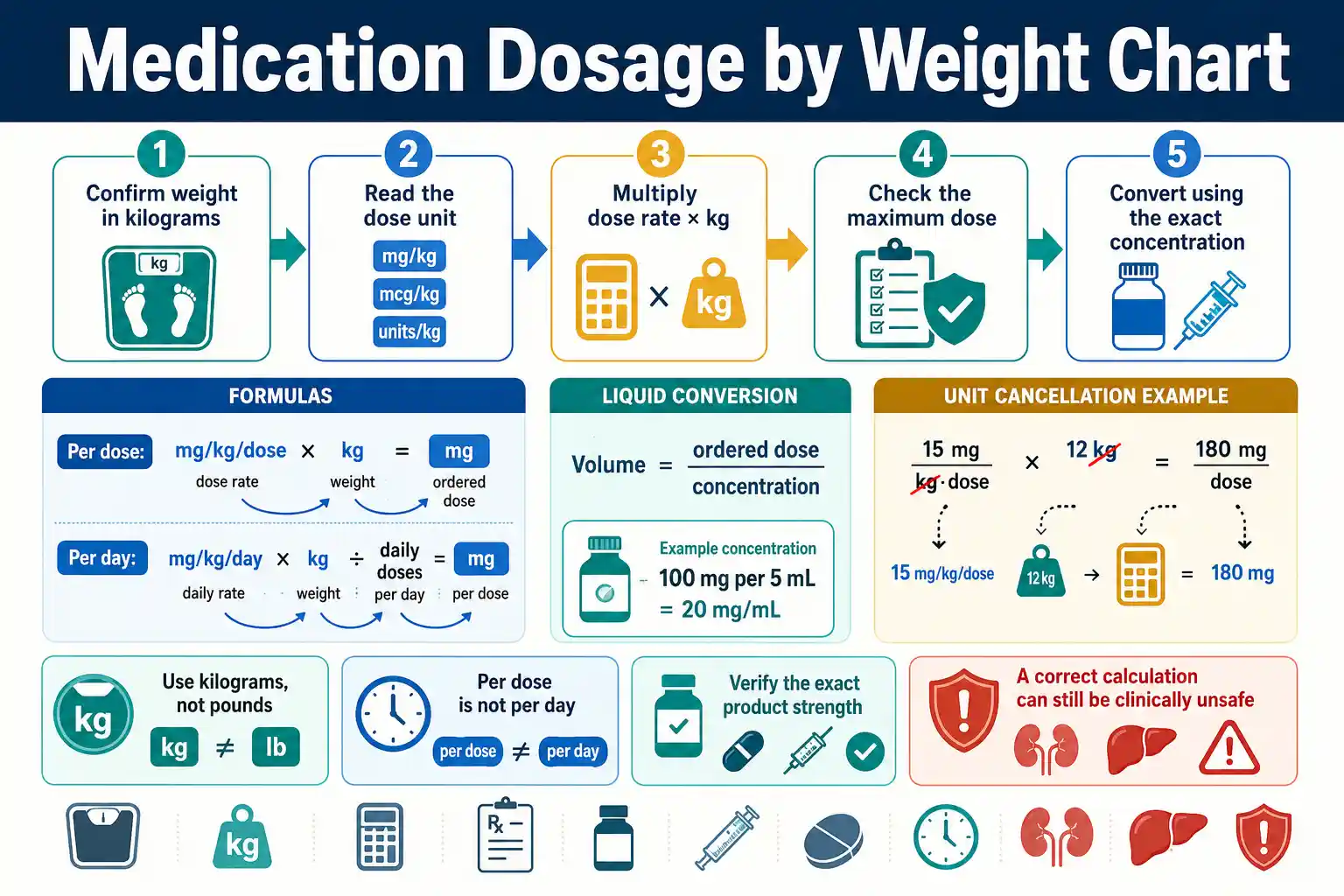
How do you calculate a medication dose by weight?
Convert the current measured weight to kilograms. Multiply by the verified dose rate. If the order is written per day, divide the daily total by the prescribed number of doses. Apply the drug-specific maximum, then use the exact product strength to convert the final dose into tablets, milliliters, or an infusion rate.
The Joint Commission pediatric medication safety guidance recommends kilogram weights and stronger safeguards because weight-based dosing creates multiple opportunities for error.
Standard weight
Kilograms
Weight-based medication orders use metric units. Confirm a current measured weight and its unit.
Core equation
Rate × kg
First identify whether the rate is per dose, per day, per hour, or per minute.
Liquid volume
Dose ÷ concentration
Read the strength on the exact product before converting milligrams, micrograms, or units to milliliters.
Final controls
Maximum + context
Age, route, indication, organ function, interactions, and dose caps can change the safe result.
Weight-Based Medication Dose Expression Chart
The denominator controls the calculation. A per-dose order, daily order, hourly rate, and minute-based infusion are not interchangeable.
Swipe horizontally inside the table to view every column.
| Order expression | Core calculation | Final dose unit | Critical clarification |
|---|---|---|---|
| mg/kg/dose | Dose rate × weight in kg — Per-dose calculation | mg per administration | Confirm the route, frequency, maximum single dose, and indication |
| mg/kg/day | Dose rate × kg = total per day; divide by prescribed doses per day | mg per administration and mg/day | Do not treat the daily amount as one dose — Daily-dose distinction |
| mcg/kg/dose | Dose rate × weight in kg | micrograms per administration | Keep mcg separate from mg; 1 mg equals 1,000 mcg |
| units/kg/dose | Dose rate × weight in kg | units per administration | Do not convert units to mg unless the product label explicitly provides a valid relationship |
| mg/kg/hour | Dose rate × weight in kg | mg per hour | Requires the ordered infusion concentration and pump rate calculation |
| mcg/kg/min | Dose rate × weight in kg | mcg per minute | Confirm minute versus hour before converting to mL/hr — Time-unit hazard |
| mg/m²/dose | Dose rate × body surface area in m² | mg per administration | Requires a verified BSA and drug-specific protocol; weight alone is insufficient |
| Weight-band dose | Select the exact labeled weight tier | Fixed amount for that band | Do not interpolate unless the official instructions allow it |
mg = milligrams; mcg = micrograms; kg = kilograms; m² = square meters.
- • The drug-specific dose rate must come from an authorized prescription, protocol, formulary, or official label.
- • Keep all units visible until they cancel. A number without its unit is incomplete.
- • Many medicines also have age, indication, route, organ-function, and maximum-dose restrictions.
Download or export
Weight-based medication calculation flow
Safe calculation moves in one direction: verified patient data, exact order, aligned units, dose limits, available product, and a final reasonableness check.
1 · Verify weight
Use a current measured weight in kilograms
2 · Read the order
Distinguish per dose, per day, per hour, or per minute
3 · Calculate dose
Multiply only after the units align and cancel correctly
4 · Apply limits
Check maximum dose, renal or hepatic changes, and route
5 · Convert form
Use the exact tablet strength or liquid concentration
Stop when the weight unit, dose unit, concentration, route, frequency, or maximum dose is unclear. Do not guess or substitute an adult dose.
Clinician-Directed Weight-Based Dose Calculator
Enter a current weight and a dose rate already supplied by a prescriber, pharmacist, protocol, or official drug label. The tool performs arithmetic only.
Complete the required fields and both verification checks. No information is stored or transmitted.
This tool does not recommend a medication or dose. A mathematically correct result can still be clinically wrong because of age, indication, route, organ function, interactions, allergy, formulation, dose limit, or a changed weight. Confirm the final dose with a pharmacist or prescriber before administration.
Pounds to Kilograms Medication Chart
Medication calculations use kilograms. Divide pounds by 2.2046 or multiply by 0.453592, then verify that the converted value is reasonable.
Swipe horizontally inside the table to view every column.
| Weight in pounds | Weight in kilograms | Quick check | Medication-safety note |
|---|---|---|---|
| 5 lb | 2.27 kg | A small newborn-sized weight | Use greater precision when neonatal protocols require it |
| 10 lb | 4.54 kg | About 4.5 kg | Do not round to 5 kg before calculating a narrow-therapeutic-index medicine |
| 15 lb | 6.80 kg | About 6.8 kg | Confirm whether the source uses actual or dosing weight |
| 20 lb | 9.07 kg | About 9.1 kg | A pounds-as-kilograms error would more than double the dose — High-risk unit error |
| 25 lb | 11.34 kg | About 11.3 kg | Document kg beside the measured value |
| 30 lb | 13.61 kg | About 13.6 kg | Use the current weight, not an old chart value |
| 40 lb | 18.14 kg | About 18.1 kg | Check any adult maximum after calculating |
| 50 lb | 22.68 kg | About 22.7 kg | Do not assume a fixed adult dose is appropriate |
| 60 lb | 27.22 kg | About 27.2 kg | Confirm dose rate and route |
| 75 lb | 34.02 kg | About 34.0 kg | Some labels switch from weight-based to fixed dosing at a threshold — Weight-threshold caution |
| 100 lb | 45.36 kg | About 45.4 kg | A pediatric or adult cap may control the final amount |
| 150 lb | 68.04 kg | About 68.0 kg | Obesity may require a drug-specific weight scalar rather than automatic actual weight |
kg = lb ÷ 2.2046226218; lb = kg × 2.2046226218.
- • Clinical systems should record and communicate medication-dosing weight in kilograms.
- • Do not estimate weight when a scale is available unless an emergency protocol explicitly permits an estimation method.
- • Reweigh after meaningful growth, fluid change, or a long treatment interval when the protocol requires it.
Download or export
Use a current measured weight in kilograms
Do not enter pounds into a mg/kg formula. The ISMP medication safety best practices support metric-only weight documentation because pounds, ounces, kilograms, and grams have been confused in harmful dosing errors.
Per-Dose, Per-Day and Dose-Frequency Chart
Words after the slash change the meaning. Calculate the total daily amount and the single dose separately whenever the order is written per day.
Swipe horizontally inside the table to view every column.
| Order wording | What the number means | Calculation sequence | Common mistake |
|---|---|---|---|
| 10 mg/kg/dose every 8 hours | 10 mg/kg at each administration | 10 × kg = one dose; frequency is three times in 24 hours | Dividing the per-dose amount by three |
| 30 mg/kg/day in 3 divided doses | 30 mg/kg across the entire day | 30 × kg = daily total; daily total ÷ 3 = one dose | Giving the daily total at each administration — Daily-dose overdose risk |
| 5 mcg/kg/min | 5 mcg/kg every minute during an infusion | 5 × kg = mcg/min; then use concentration to find mL/hr | Treating minute as hour — Minute-hour error risk |
| 2 mg/kg/hour | 2 mg/kg each hour | 2 × kg = mg/hr; then convert by concentration | Calculating a one-time bolus |
| 100 units/kg once | One administration based on weight | 100 × kg = units once | Repeating because another drug uses a schedule |
| Fixed dose twice daily | Same stated dose at two times each day | No weight multiplication unless the label says otherwise | Applying mg/kg to a fixed-dose order |
| Titrated dose | Dose changes to a measured response or protocol step | Use the ordered step and reassessment rules | Increasing from a chart without authorization — Unauthorized titration risk |
- • Frequency describes when doses are given; it does not automatically define the dose rate.
- • PRN orders also require a minimum interval and a maximum total amount when specified.
- • Continuous infusions require both dose-rate and pump-rate verification.
Download or export
Keep the units visible until they cancel
A number is incomplete without its unit. The NCBI dose-calculation guide shows that ordered and available units must match before the remaining unit can become the administration volume or tablet count.
Liquid Medication Concentration and Volume Chart
Convert a verified dose into milliliters only after reading the exact concentration on the current bottle, vial, syringe, or pharmacy label.
Swipe horizontally inside the table to view every column.
| Label format | Equivalent concentration | Volume formula | Safety check |
|---|---|---|---|
| 10 mg/mL | 10 mg in each 1 mL | Ordered mg ÷ 10 mg/mL | Confirm the product is not 10 mg in a different total volume |
| 20 mg/5 mL | 4 mg/mL | Ordered mg ÷ 4 mg/mL | Reduce the concentration before calculating |
| 100 mg/5 mL | 20 mg/mL | Ordered mg ÷ 20 mg/mL | Do not confuse total bottle volume with concentration |
| 250 mg/5 mL | 50 mg/mL | Ordered mg ÷ 50 mg/mL | Shake suspensions when the label instructs |
| 1 mg in 10 mL | 0.1 mg/mL | Ordered mg ÷ 0.1 mg/mL | A decimal-place error can create a tenfold dose — Decimal hazard |
| 500 mcg/mL | 0.5 mg/mL | Keep mcg or convert both sides to mg | Never divide mg by mcg/mL without conversion — Unit conversion hazard |
| 1,000 units/mL | 1,000 units in each 1 mL | Ordered units ÷ 1,000 units/mL | Use a device appropriate for the product and route |
| Percent strength | Drug-specific mass per volume | Convert only with the product definition | Percent solutions are not interchangeable without knowing the exact convention |
Volume to give = ordered dose ÷ concentration. Preserve the dose unit on both sides of the division.
- • The examples explain concentration formats only and are not medication recommendations.
- • Use an oral syringe or the supplied calibrated device for small oral-liquid doses; never use a household spoon.
- • Different brands or formulations of the same medicine may contain different concentrations.
Download or export
The official drug label controls the dose details
Weight-based arithmetic does not replace prescribing information. The FDA prescription-labeling overview explains that dosage sections include frequency, maximums, routes, preparation, interactions, and changes for pediatric, renal, hepatic, pregnancy, and other populations.
Maximum Dose, Rounding and Final-Form Check
A calculated weight-based amount is provisional until it is compared with drug-specific limits and the measurable dosage form.
Swipe horizontally inside the table to view every column.
| Check | Question to answer | Safe action | Why it matters |
|---|---|---|---|
| Maximum single dose | Does the label or protocol cap each administration? | Use the lower of the calculated dose and verified maximum when instructed | Weight multiplication may exceed the approved or studied single dose |
| Maximum daily dose | Is there a 24-hour limit from all products? | Add every scheduled and as-needed source of the active ingredient | Duplicate products can exceed the daily limit — Duplicate ingredient risk |
| Minimum dose | Does the protocol require a lower boundary? | Follow the drug-specific rule rather than creating one | Underdosing can also cause harm |
| Rounding | What precision can the device or dosage form measure? | Carry full precision and round only the final answer under policy | Early rounding compounds error |
| Tablet fraction | Can the tablet be safely split? | Check scoring, modified-release status, and pharmacy instructions | Some tablets must not be split or crushed |
| Liquid volume | Can the syringe measure the calculated amount? | Use the smallest appropriate calibrated device | Large devices measure tiny volumes poorly |
| Reasonableness check | Does the result fit the order, weight, dose range, and usual form? | Recalculate independently when the answer appears unexpected — Independent recheck | A calculator faithfully returns incorrect inputs |
- • Never invent a maximum dose from another medicine or another indication.
- • Leading zeros improve clarity for values below one; trailing zeros after a decimal can be misread.
- • High-alert medicines may require an independent double check under local policy.
Download or export
Actual, Ideal, Adjusted and Other Dosing Weights
The correct weight scalar is drug- and protocol-specific. Do not replace actual body weight with ideal or adjusted weight without explicit instructions.
Swipe horizontally inside the table to view every column.
| Weight measure | Definition | When it may appear | Key limitation |
|---|---|---|---|
| Actual body weight | Current measured scale weight | Many routine pediatric and adult weight-based orders | Fluid overload, obesity, or rapid change may distort its relationship to drug distribution |
| Ideal body weight | Height-based reference estimate | Some ventilator, renal, or medication protocols | Historical formulas differ and do not describe body composition |
| Adjusted body weight | Formula combining ideal and excess actual weight | Selected medicines in obesity | The correction factor varies by drug and protocol — Drug-specific adjustment |
| Lean body weight | Estimate of non-fat mass | Some pharmacokinetic models | Requires a validated equation and may be inaccurate at body-size extremes |
| Body surface area | Height-and-weight estimate in m² | Oncology and selected specialty protocols | BSA dosing is not interchangeable with mg/kg |
| Dry weight | Estimated weight without excess fluid | Dialysis, edema, or fluid-management contexts | Requires clinical assessment and can change |
| Dosing weight | Protocol-defined value used for one medicine | Institutional or drug-specific algorithms | Its meaning must be stated; the term alone is ambiguous — Ambiguous term |
- • Use the exact weight definition stated in the drug label, protocol, or pharmacist instruction.
- • Do not use a general ideal-body-weight calculator to select a medication dose independently.
- • Amputation, edema, ascites, pregnancy, and major body-composition differences require individualized review.
Download or export
Special Population Medication Dose Checks
Weight is only one dosing variable. Age, organ function, development, interactions, and clinical condition may change the dose or make a simple calculation inappropriate.
Swipe horizontally inside the table to view every column.
| Population or factor | Why weight alone is insufficient | What to verify | Unsafe shortcut |
|---|---|---|---|
| Premature infant or neonate | Clearance and distribution change rapidly with gestational and postnatal age | Neonatal formulary, age, current weight, interval, concentration, and monitoring | Using an older-child mg/kg rule — Neonatal dosing hazard |
| Child or adolescent | Dose limits and labeled age ranges may apply | Kilogram weight, indication, per-dose versus daily wording, and adult maximum | Scaling an adult dose by age alone |
| Obesity | Actual weight can overestimate exposure for some drugs and be correct for others | Drug-specific actual, ideal, adjusted, lean, or capped method | Using one obesity formula for every medication |
| Underweight or malnutrition | Low protein stores and altered distribution may change exposure | Clinical status, organ function, formulation, and monitoring | Assuming a smaller dose is always safer |
| Kidney impairment | Clearance and dosing interval may change independently of weight | Drug-specific renal method, current kidney function, and dialysis status — Renal adjustment required | Using eGFR alone without the label method |
| Liver impairment | Metabolism and protein binding may change | Drug-specific hepatic guidance, severity, interactions, and monitoring — Hepatic adjustment required | Reducing every medicine by the same percentage |
| Pregnancy or lactation | Physiology and fetal or infant exposure matter | Current label, specialist advice, indication, and timing | Using non-pregnant adult assumptions |
| Older adult or frailty | Renal function, body composition, sensitivity, and polypharmacy change risk | Current medicines, organ function, falls risk, and titration plan | Using weight as the only dose determinant |
- • Drug labeling may recommend a different dose, interval, route, monitoring plan, or complete avoidance in a special population.
- • Renal and hepatic adjustments are medicine-specific and cannot be generated from a universal percentage table.
- • Consult a pharmacist or prescriber when the patient falls outside the population studied in the reference source.
Download or export
Measure oral liquids with a calibrated device
Never use a kitchen spoon. The American Academy of Pediatrics liquid-medicine guide recommends the supplied dropper, syringe, cup, or dosing spoon and advises asking a pharmacist or doctor for a proper tool when one is not included.
Medication Dose Safety and Error-Prevention Chart
Check the complete medication-use process before administration. Calculation is only one part of a safe dose.
Swipe horizontally inside the table to view every column.
| Safety check | Confirm | Stop and clarify when | Potential harm prevented |
|---|---|---|---|
| Right patient | Two identifiers and relevant allergies | Identity or allergy status is uncertain | Wrong-patient administration and allergic reaction |
| Right medication | Generic name, formulation, and active ingredients | Names, packages, or combination products look similar | Wrong-drug and duplicate-ingredient errors |
| Right weight | Current measured kilograms and date | Only pounds, an estimate, or an old weight is available — Weight verification required | Twofold or larger weight-conversion errors |
| Right dose expression | Per dose, per day, per hour, or per minute | The denominator or frequency is missing | Daily-total and time-unit overdoses |
| Right concentration | Strength on the exact product in hand | The label differs from the order or previous bottle — Concentration mismatch | Multi-fold liquid-volume errors |
| Right route and form | Oral, IV, IM, subcutaneous, topical, or other route | The product or device does not match the route | Wrong-route injury and altered absorption |
| Right maximum and interval | Single-dose cap, daily cap, minimum interval, and duration | Limits are absent for a high-risk or unfamiliar order | Accumulation and excessive total exposure |
| Right calculation | Independent unit-based calculation and reasonableness check | The answer is unexpected or a decimal is unclear | Arithmetic, transcription, and decimal errors |
| Right monitoring | Clinical response, adverse effects, levels, labs, or vital signs when required | Monitoring cannot be performed or results are unsafe | Delayed recognition of toxicity or treatment failure |
| Suspected overdose or error | Drug, amount, time, weight, symptoms, and product label | An extra dose, wrong concentration, unknown amount, or serious symptom occurred — Urgent medication error | Delayed emergency or poison-center assessment |
- • Do not give another dose to compensate for vomiting, spitting, a missed dose, or an uncertain amount unless a clinician or official label directs it.
- • Do not double a dose after a missed administration unless the medicine-specific instructions explicitly say to do so.
- • Call emergency services for severe breathing difficulty, collapse, seizure, unresponsiveness, or rapidly worsening symptoms. Contact a poison center or urgent clinician after a suspected overdose or concentration error.
Download or export
Frequently asked questions
How do you calculate a medication dose by weight?
Use a current weight in kilograms and multiply it by the verified drug-specific dose rate. Keep the units visible. Then check whether the order is per dose or per day, apply any maximum, and convert the final amount with the exact product strength or concentration.
Why must medication weight be in kilograms?
Approved weight-based dosing commonly uses metric units such as mg/kg or units/kg. Confusing pounds with kilograms can create a dose more than twice as large as intended.
How do I convert pounds to kilograms for dosing?
Divide pounds by 2.2046 or multiply pounds by 0.453592. Record the result with kg and confirm that it matches the current measured weight before calculating a dose.
What is the difference between mg/kg/dose and mg/kg/day?
Mg/kg/dose applies at each administration. Mg/kg/day is the total amount across 24 hours and must be divided by the prescribed number of daily doses. Confusing them can multiply the intended exposure.
How do you convert a calculated milligram dose to milliliters?
Divide the verified dose in milligrams by the exact concentration in milligrams per milliliter. When a label states milligrams per 5 mL, first convert it to milligrams per 1 mL or use a dimensional-analysis setup that preserves the units.
Should the calculated dose be rounded?
Carry precision through the calculation and round only the final measurable amount according to the medication, dosage form, device, and clinical policy. Early rounding can compound error.
What happens when a weight-based dose exceeds the adult maximum?
Use the drug-specific instructions. Many pediatric and weight-based regimens require comparing the calculated amount with a maximum single or daily dose. The correct maximum depends on the medicine, indication, route, and patient.
Can I use ideal body weight for every medication?
No. Some medicines use actual weight, while selected protocols use ideal, adjusted, lean, dry, or another defined dosing weight. The correct scalar must come from the drug-specific label or protocol.
Does kidney disease change weight-based dosing?
It can. Kidney impairment may require a lower dose, longer interval, different loading strategy, monitoring, or avoidance. The adjustment method is drug-specific and cannot be replaced by a universal chart.
Does liver disease change weight-based dosing?
It can alter metabolism, protein binding, and exposure, but the response differs by medicine. Follow the current product label or specialist protocol rather than reducing every dose by the same percentage.
Can I use a household teaspoon for liquid medicine?
No. Household spoons vary in size. Use the supplied dosing device or a calibrated oral syringe marked in milliliters, especially for small volumes.
Why can the same medicine have different liquid volumes?
Different products may contain different concentrations. The dose in milligrams can be identical while the required milliliters differ. Read the concentration on the exact product every time.
Can this chart tell me which dose rate to use?
No. The dose rate must come from a prescription, pharmacist, approved protocol, formulary, or official drug label for the exact medication, indication, route, age, and patient factors.
What should I do after giving the wrong dose?
Do not wait for symptoms. Contact a poison center, pharmacist, prescriber, or emergency service promptly with the medication name, strength, amount, time, patient weight, and symptoms. Call emergency services for collapse, seizure, severe breathing difficulty, or unresponsiveness.
Is a mathematically correct medication dose always safe?
No. The inputs may be wrong or incomplete. Safety also depends on the right patient, medicine, indication, route, frequency, concentration, maximum dose, organ function, interactions, allergies, formulation, and monitoring plan.
Sources
These medication-safety, calculation, labeling, and administration resources support the formulas, unit checks, special-population cautions, and error-prevention guidance on this page.
The Joint Commission — Preventing Pediatric Medication Errors
https://digitalassets.jointcommission.org/api/public/content/cf157ef6d0e34b05b28ac4693d86bff2?v=0dcc5016
Recommends measuring and communicating pediatric weight in kilograms and strengthening safeguards for high-risk weight-based medication use.
Institute for Safe Medication Practices — Targeted Medication Safety Best Practices for Hospitals
https://online.ecri.org/hubfs/ISMP/Resources/ISMP_TargetedMedicationSafetyBestPractices_Hospitals.pdf
Supports current measured weights, metric-only weight documentation, standardized dosing units, and safeguards that reduce weight-based dosing errors.
Institute for Safe Medication Practices — Guidelines for Standard Order Sets
https://www.ismp.org/sites/default/files/attachments/2018-01/StandardOrderSets.pdf
Recommends displaying both the weight-based formula and the final calculated dose for pediatric and other weight-based orders.
National Center for Biotechnology Information — Dose Calculation: Desired Over Have Formula Method
https://www.ncbi.nlm.nih.gov/books/NBK493162/
Explains desired-dose divided by stock strength multiplied by stock quantity and emphasizes matching units before calculation.
National Center for Biotechnology Information — Nursing Skills: Math Calculations
https://www.ncbi.nlm.nih.gov/books/NBK593207/
Covers dimensional analysis, unit conversion, dose calculation, final-step rounding, and safe medication-calculation practices.
National Center for Biotechnology Information — Pharmacy Calculations
https://www.ncbi.nlm.nih.gov/books/NBK560924/
Summarizes tablet, liquid, infusion, concentration, and weight-based pharmacy calculations with attention to dimensional consistency.
U.S. Food and Drug Administration — Frequently Asked Questions About Labeling for Prescription Medicines
https://www.fda.gov/drugs/fdas-labeling-resources-human-prescription-drugs/frequently-asked-questions-about-labeling-prescription-medicines
Explains that prescribing information includes dosage, frequency, maximum dose, route, interactions, preparation, and modifications for specific populations.
U.S. Food and Drug Administration — Strength Conversion in Drug Listing
https://www.fda.gov/drugs/electronic-drug-registration-and-listing-system-edrls/strength-conversion-drug-listing
Describes how active-ingredient strength may be expressed by mass, concentration, percentage, or other standardized forms.
U.S. Food and Drug Administration — FDALabel Full-Text Search of Drug Product Labeling
https://www.fda.gov/science-research/bioinformatics-tools/fdalabel-full-text-search-drug-product-labeling
Provides access to approved labeling sections covering dosage, administration, warnings, interactions, and use in specific populations.
National Library of Medicine — DailyMed Drug Label Database
https://dailymed.nlm.nih.gov/
Provides current labeling submitted to FDA, including dosage, strengths, routes, preparation instructions, warnings, and population-specific modifications.
American Academy of Pediatrics — How to Use Liquid Medicines for Children
https://www.healthychildren.org/English/safety-prevention/at-home/medication-safety/Pages/Using-Liquid-Medicines.aspx
Advises using the supplied dosing device and avoiding household teaspoons or tablespoons for liquid medicines.
MedlinePlus — Liquid Medication Administration
https://medlineplus.gov/ency/article/002209.htm
Explains accurate liquid measurement with oral syringes, cups, and other calibrated devices.
World Health Organization — Medication Without Harm
https://www.who.int/initiatives/medication-without-harm
Frames medication errors as preventable patient harm and prioritizes safer prescribing, preparation, administration, and monitoring.
National Center for Biotechnology Information — Renal Failure Drug Dose Adjustments
https://www.ncbi.nlm.nih.gov/books/NBK560512/
Explains that some medicines require renal-function-based changes that cannot be replaced by a simple weight multiplication.