Health & Medical · Menstrual health
Menstrual Cycle Chart: Phases, Length, Bleeding and Symptoms
Compare common cycle ranges, understand the menstrual, follicular, ovulatory, and luteal phases, track bleeding and symptoms, and recognize changes that need medical care.
Seek urgent care for severe pelvic pain with possible pregnancy, fainting, collapse, sudden severe pain, or very heavy bleeding with weakness, chest pain, or breathing difficulty. Any bleeding after menopause needs evaluation. A calendar cannot diagnose a condition, confirm ovulation, or provide contraception. Read the ChartsLoom Disclaimer.
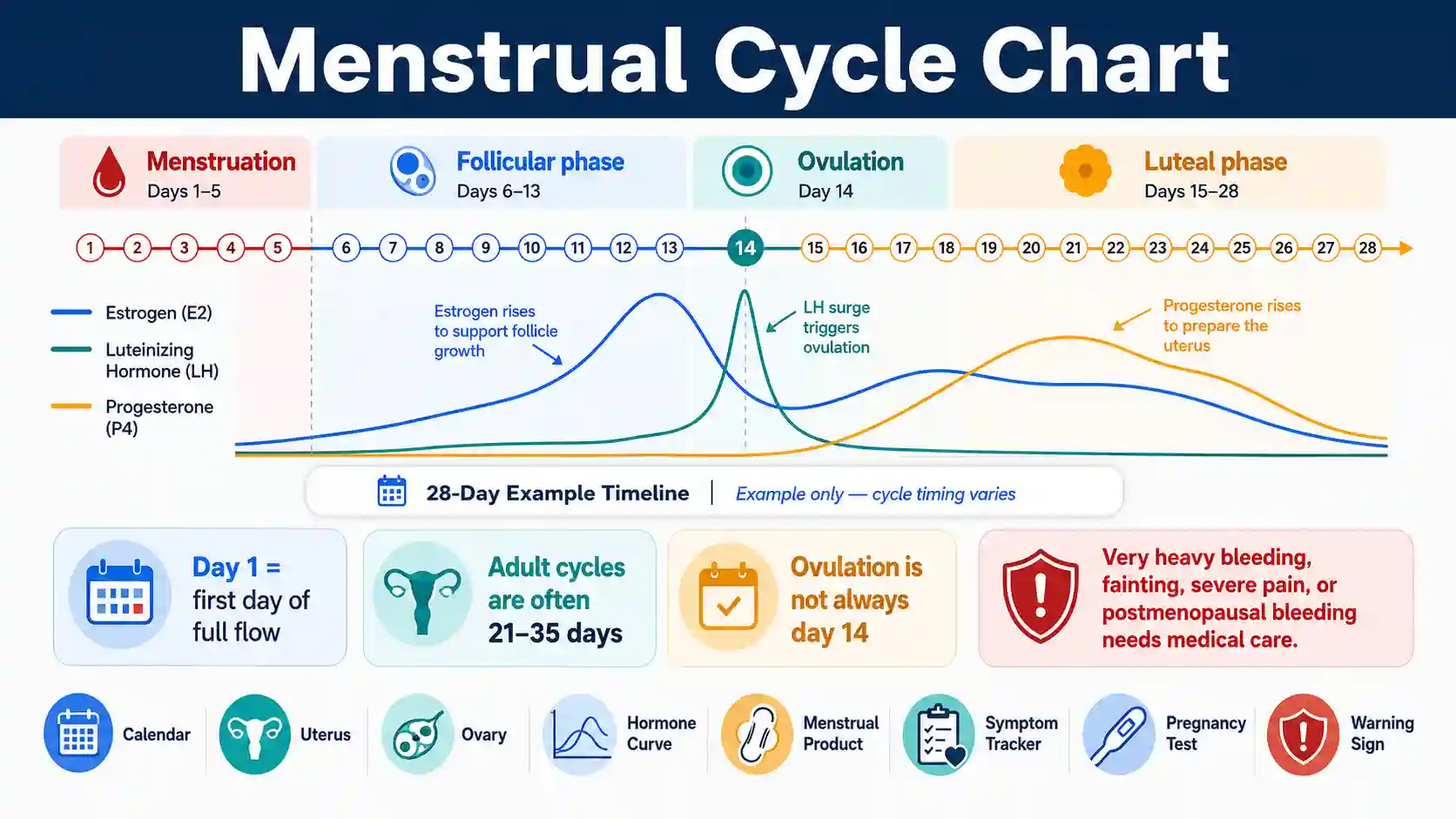
How long is a menstrual cycle?
A menstrual cycle runs from the first day of one period to the first day of the next. ACOG commonly describes adult cycles as 21–35 days and periods as lasting up to 7 days. Most adolescent cycles fall within 21–45 days, especially during the first years after menarche.
The ACOG abnormal uterine bleeding guide also emphasizes that bleeding between periods, after sex, or outside the expected pattern deserves attention.
Cycle day 1
First day of full flow
Count from the first day of one period to the first day of the next period.
Adult timing
Often 21–35 days
Some federal references use 24–38 days. Personal pattern and persistent change also matter.
Period duration
Often 2–7 days
Flow, clots, leakage, anemia symptoms, and impact on daily life add important context.
Ovulation
Timing varies
It is not fixed on day 14, and calendar estimates cannot confirm that ovulation occurred.
Menstrual Cycle Length by Life Stage Chart
Cycle timing changes across adolescence, reproductive years, hormonal treatment, pregnancy-related transitions, and perimenopause. Compare a result with the person’s age and usual pattern.
Swipe horizontally inside the table to view every column.
| Life stage or context | Common pattern | What may be expected | When to discuss it |
|---|---|---|---|
| First years after menarche | Most cycles 21–45 days — Adolescent reference | Longer or less predictable cycles are common while ovulation matures | Cycles more often than every 21 days, less often than every 45 days, or any 90-day gap |
| Reproductive-age adult | Often 21–35 days by ACOG; 24–38 days in another federal reference — Adult reference | Several-day variation can occur while the personal pattern stays recognizable | A persistent new change, frequent bleeding, long gaps, or symptoms affecting daily life |
| Pregnancy | Menstrual periods stop | Light bleeding is not a menstrual period and should be interpreted in pregnancy context | Any concerning bleeding, pain, dizziness, or pregnancy complication symptoms |
| Breastfeeding or postpartum | Return may be delayed or initially irregular | Timing depends on feeding pattern, hormones, and individual recovery | Heavy bleeding, fever, severe pain, faintness, or concern for pregnancy |
| Hormonal contraception | Bleeding may become lighter, irregular, scheduled, or absent | The pattern depends on the method and how it is used | New heavy bleeding, pregnancy concern, severe pain, or an unacceptable persistent pattern |
| Perimenopause | Cycles may shorten, lengthen, skip, or change in flow | Ovulation becomes less predictable before the final menstrual period | Very heavy bleeding, bleeding between periods, after sex, or other concerning change |
| After menopause | No menstrual cycles after 12 months without a period | Any later bleeding is postmenopausal bleeding | Arrange medical evaluation for any bleeding or spotting — Postmenopausal bleeding needs evaluation |
Cycle length is counted from day 1 of one period to day 1 of the next period.
- • Reference ranges describe populations; the direction and persistence of change in one person also matter.
- • Pregnancy, contraception, lactation, illness, and medications can change bleeding without producing a natural ovulatory cycle.
- • A calendar estimate cannot confirm whether ovulation occurred.
Download or export
How the menstrual cycle progresses
The phases overlap rather than dividing into four equal blocks. The follicular phase can change substantially from one cycle to another, which moves the ovulation date.
Menstruation
Day 1 begins with full menstrual bleeding
Follicular phase
Follicle growth and rising estrogen; length varies most
Ovulation
Egg release follows an LH surge; not always day 14
Luteal phase
Progesterone supports the lining before the next period
Calendar timing estimates cannot confirm ovulation, exclude pregnancy, or identify safe days for unprotected sex.
Cycle phases are biological, not equal calendar blocks
The Office on Women’s Health cycle guide explains how changing hormones prepare the ovary and uterine lining for a possible pregnancy. The follicular phase can vary, so a late period often reflects later ovulation rather than a fixed phase simply lasting longer.
Menstrual Cycle Phase Chart
The cycle has overlapping ovarian and uterine phases. The follicular phase varies most; ovulation is not fixed on day 14 for every person or every cycle.
Swipe horizontally inside the table to view every column.
| Phase | Begins or occurs | Main hormone pattern | What happens | Common observations |
|---|---|---|---|---|
| Menstruation | Day 1 is the first day of full menstrual bleeding — Cycle day 1 definition | Estrogen and progesterone are low | The uterine lining sheds when pregnancy has not occurred | Bleeding, cramps, fatigue, headache, bowel changes |
| Follicular phase | Starts on day 1 and continues until ovulation | FSH supports follicles; estrogen usually rises | A follicle matures and the endometrium rebuilds | Cervical mucus may gradually become wetter or more slippery |
| Ovulation | Occurs after an LH surge; timing varies — Ovulation timing varies | LH rises sharply; estrogen has recently peaked | An ovary releases an egg | Some people notice one-sided discomfort or mucus change; many notice nothing |
| Luteal phase | Begins after ovulation and ends before the next period | Progesterone rises, then falls if pregnancy does not occur | The lining is maintained temporarily and then begins to break down | Breast tenderness, bloating, mood symptoms, appetite or sleep changes may occur |
FSH = follicle-stimulating hormone; LH = luteinizing hormone.
- • Cycle phases are biological processes, not four equal calendar quarters.
- • Hormonal contraception may suppress ovulation or alter the natural hormone pattern.
- • Symptoms alone cannot prove the exact phase or confirm ovulation.
Download or export
Cycle Pattern and Next-Period Estimator
Enter at least two recent period start dates. The tool calculates the intervals between them, summarizes variation, and projects one next-period date from the average.
Enter at least two different start dates in chronological order or any order; the tool sorts them automatically. No information is stored or transmitted.
The projected date is an average-based estimate, not a guarantee. It cannot confirm ovulation, identify a fertile window, exclude pregnancy, provide contraception, or explain abnormal bleeding or pain.
Example 28-Day Menstrual Cycle Chart
This timeline illustrates one possible 28-day ovulatory cycle. It is not a universal schedule and should not be used to confirm ovulation or prevent pregnancy.
Swipe horizontally inside the table to view every column.
| Illustrative days | Cycle event | Hormone and tissue change | Important limitation |
|---|---|---|---|
| Days 1–5 | Menstrual bleeding | Hormone levels are low and the uterine lining sheds | Bleeding can be shorter or longer than five days |
| Days 1–13 | Follicular development | Estrogen generally rises as a follicle develops and the lining thickens | This is the most variable portion of many cycles |
| Around day 14 | Illustrative ovulation point | An LH surge precedes egg release | Day 14 applies only to this example; real timing can be earlier or later — Not universally day 14 |
| Days 15–28 | Luteal phase | Progesterone supports the lining after ovulation | The next period begins if hormone levels fall and pregnancy has not occurred |
| Next day 1 | New cycle starts | Full menstrual bleeding resets the cycle count | Spotting alone may not represent the first day of a new period |
Illustrative calendar days only.
- • A 28-day cycle is a teaching example, not the definition of normal.
- • Calendar-based phase estimates become less reliable when cycles vary.
- • Use a validated contraceptive method rather than a generic cycle diagram to prevent pregnancy.
Download or export
Adolescent cycles need age-specific interpretation
The ACOG adolescent menstrual-cycle guidance notes that most cycles are 21–45 days even when early cycles are irregular. A gap of 90 days, prolonged bleeding, or heavy flow should not be dismissed as routine puberty.
Period Bleeding Pattern Chart
Describe bleeding by timing, duration, flow, clots, leakage, nighttime changes, and impact on daily life rather than relying on one vague label such as “heavy.”
Swipe horizontally inside the table to view every column.
| Feature | Common or useful reference | Concerning pattern | What to record |
|---|---|---|---|
| Duration | Often 2–7 days; adult guidance generally treats more than 7 days as abnormal | Bleeding lasting longer than 7 days or a major change from the usual duration | First and last bleeding day |
| Cycle frequency | Adults often 21–35 days; teens often 21–45 days | Repeatedly outside the age-appropriate range or a 90-day gap | First day of each period |
| Hourly saturation | Product changes vary with flow and product type | Soaking through one or more pads or tampons every hour for several hours — Heavy bleeding warning | Time, product type, leakage, and whether protection was doubled |
| Nighttime flow | Some people need a planned nighttime change | Repeated nighttime changes, bed leakage, or sleep disruption from bleeding | Number of changes and leakage |
| Clots | Small clots can occur during heavier flow | Repeated clots about quarter-size or larger, especially with heavy bleeding | Approximate size and frequency |
| Bleeding between periods | Not part of a typical menstrual period | New, recurrent, after-sex, or unexplained spotting or bleeding | Timing, amount, pain, contraception, and pregnancy possibility |
| Functional impact | Mild adjustments may be manageable | Missing school, work, sleep, exercise, or normal activities | Activities affected and anemia symptoms |
| After menopause | No expected menstrual bleeding | Any spotting or bleeding — Postmenopausal bleeding | Date, amount, medications, and associated symptoms |
Flow is best documented with timing and product use rather than estimated milliliters at home.
- • Heavy menstrual bleeding is defined by excessive loss and its effect on physical, social, emotional, or material quality of life.
- • Pale skin, shortness of breath, dizziness, racing heart, and severe fatigue can indicate significant blood loss or anemia.
- • Bleeding during possible pregnancy requires a pregnancy-specific assessment.
Download or export
Heavy bleeding is measured by impact and warning signs
The ACOG heavy menstrual bleeding guide lists bleeding beyond 7 days, hourly product saturation for several hours, repeated nighttime changes, leakage, and large clots as important signs. Dizziness, breathlessness, palpitations, and marked fatigue can signal anemia or significant blood loss.
Menstrual Cycle Symptom Chart
Symptoms vary widely. Track timing, severity, recurrence, and functional impact to distinguish a predictable pattern from a new or progressive problem.
Swipe horizontally inside the table to view every column.
| Symptom or sign | Possible cycle timing | Often reported as | Discuss with a clinician when |
|---|---|---|---|
| Cramps | Just before or during bleeding | Lower abdominal or back pain | Pain is severe, worsening, lasts beyond the first days, or limits normal activity |
| Bloating | Often late luteal phase or around the period | Abdominal fullness or temporary fluid-related change | Persistent swelling, severe pain, vomiting, or a non-cyclical pattern develops |
| Breast tenderness | Often before the period | Fullness or soreness that improves after bleeding starts | A persistent lump, skin change, nipple discharge, or non-cyclical focal pain occurs |
| Headache or migraine | May cluster before or during menstruation | Headache associated with hormone change | It is sudden and severe, has neurologic symptoms, or changes substantially |
| Mood symptoms | Often in the 5 days before a period | Irritability, sadness, anxiety, concentration or sleep change | Symptoms impair life, involve self-harm thoughts, or do not follow a cyclical pattern — Mood safety |
| Bowel changes | Often during the period | Looser stools, constipation, nausea, or cramping | There is blood in stool, severe pain, weight loss, or cyclical bowel pain suggestive of endometriosis |
| Pelvic pain outside bleeding | Any phase | Mid-cycle one-sided discomfort or pain at other times | Pain is severe, persistent, occurs with pregnancy possibility, fever, fainting, sex, urination, or bowel movements — Urgent pelvic pain context |
| Fatigue or dizziness | During heavy bleeding or premenstrually | Low energy or lightheadedness | Symptoms are marked, recurrent, or occur with heavy bleeding, shortness of breath, or palpitations |
Symptom timing is approximate and differs among individuals.
- • PMS symptoms recur before menstruation and improve after the period begins; symptoms throughout the month need broader evaluation.
- • Severe or progressive period pain may occur with endometriosis, fibroids, adenomyosis, infection, or other pelvic conditions.
- • A cycle chart cannot determine the cause of pain or mood symptoms.
Download or export
Irregular or Missed Period Causes Chart
Irregular or absent periods have many possible causes. Pregnancy is an early consideration when biologically possible, but it is not the only explanation.
Swipe horizontally inside the table to view every column.
| Possible context or cause | How the cycle may change | Other clues | Typical next step |
|---|---|---|---|
| Pregnancy | A period may be late or absent | Breast changes, nausea, fatigue, or no symptoms | Use a pregnancy test at an appropriate time and seek care for pain, fainting, or heavy bleeding — Pregnancy first consideration |
| Adolescence after menarche | Longer and less predictable cycles may occur | The pattern often becomes more regular with maturation | Review gaps of 90 days, very frequent cycles, heavy flow, or significant symptoms |
| Perimenopause | Cycles may become shorter, longer, skipped, heavier, or lighter | Hot flashes, sleep disturbance, or vaginal changes may occur | Discuss concerning bleeding; evaluate any bleeding after menopause — Postmenopausal bleeding distinction |
| PCOS or chronic anovulation | Infrequent, irregular, light, or absent periods | Acne, increased hair growth, scalp hair thinning, or metabolic features may occur | Clinical assessment rather than diagnosis from cycle length alone |
| Thyroid or prolactin disorder | Heavy, light, irregular, or absent periods | Temperature intolerance, weight change, neck symptoms, breast discharge, or headaches may occur | History, examination, pregnancy testing, and targeted laboratory evaluation |
| Stress, under-fueling, weight change, or intense exercise | Cycles may lengthen or stop | Energy deficit, training increase, illness, sleep disruption, or eating concerns | Address the cause and assess bone, nutrition, and overall health when persistent |
| Hormonal contraception or other medication | Scheduled, irregular, lighter, or absent bleeding | Pattern relates to method, dose, adherence, or drug effect | Check expected effects, pregnancy possibility, interactions, and concerning symptoms |
| Pelvic condition | Heavy, painful, frequent, or intermenstrual bleeding | Pressure, pain, painful sex, bowel or urinary symptoms | Clinical evaluation may include examination, tests, or imaging |
| Chronic illness or bleeding disorder | Irregular or heavy bleeding | Easy bruising, nosebleeds, fatigue, systemic symptoms, or treatment effects | Evaluate the underlying condition and blood-loss consequences |
This table lists contexts, not diagnoses.
- • Pregnancy testing is appropriate after a missed period when pregnancy is possible.
- • No single pattern proves PCOS, thyroid disease, endometriosis, or another cause.
- • Bring a medication list and cycle record to the appointment.
Download or export
Irregular periods describe a pattern, not a diagnosis
The Office on Women’s Health period-problems guide lists pregnancy, PCOS, thyroid disease, weight change, stress, medicines, contraception, and bleeding disorders among possible explanations. Clinical context and targeted testing are needed to identify the cause.
Menstrual Cycle Tracking Chart
A useful record captures dates, bleeding, symptoms, context, and impact. Tracking several cycles is more informative than relying on memory.
Swipe horizontally inside the table to view every column.
| Track this item | How to record it | Why it matters | Example entry |
|---|---|---|---|
| Period start — Core cycle date | First day of full menstrual flow | Defines cycle day 1 and the interval to the next cycle | 3 March |
| Period end | Last day of bleeding or spotting, labeled separately if useful | Shows bleeding duration and tail-end spotting | 8 March; light spotting on day 6 |
| Flow | Light, moderate, heavy; product changes; leakage; clots | Makes “heavy” measurable and identifies blood-loss patterns | Changed overnight pad twice; one leak |
| Pain | 0–10 score, location, duration, medicines, effect on activity | Shows severity, progression, and response | 7/10 pelvic pain; missed class |
| Other symptoms | Mood, headache, breast, bowel, sleep, energy, skin | Reveals recurring premenstrual or menstrual patterns | Migraine one day before flow |
| Cycle context | Illness, travel, stress, training, weight change, postpartum status | May explain temporary timing changes | Respiratory illness during follicular phase |
| Medicines and contraception | Method, doses, missed pills, new medicines or supplements | Bleeding may reflect expected or unexpected treatment effects | Started progestin-only pill |
| Pregnancy possibility or testing | Sexual exposure, contraception issue, test date and result when relevant | Changes how missed periods, pain, and bleeding are assessed | Home test negative on expected period day |
| Functional impact | School, work, sleep, exercise, social activity | Shows clinical significance even when exact blood loss is unknown — Functional impact matters | Left work early because of bleeding and dizziness |
Cycle interval = next period start date − previous period start date.
- • Use a private method you can maintain consistently, such as a calendar, notebook, or trusted app.
- • A tracking app estimate cannot confirm ovulation, pregnancy status, or contraceptive safety.
- • Share several cycles when seeking care for a persistent pattern.
Download or export
Menstrual Cycle Warning Signs Chart
Urgency depends on bleeding amount, pain, pregnancy possibility, vital symptoms, age, and whether the pattern is new or persistent.
Swipe horizontally inside the table to view every column.
| Finding | Possible concern | Recommended response | Do not rely on |
|---|---|---|---|
| Soaking one or more pads or tampons hourly for several hours | Heavy blood loss and anemia | Contact urgent medical care; use emergency services for fainting, chest pain, severe weakness, or breathing difficulty — Urgent heavy bleeding response | Waiting for a cycle app to classify the flow |
| Severe pelvic or abdominal pain with possible pregnancy | Ectopic pregnancy or another urgent condition | Seek urgent assessment, especially with shoulder pain, dizziness, fainting, or bleeding — Pregnancy-related pain response | A negative early test when symptoms are severe |
| Sudden severe pelvic pain, fever, vomiting, or collapse | Torsion, ruptured cyst, infection, or another acute cause | Seek emergency care | Assuming all pelvic pain is menstrual cramping |
| No period for 90 days when not pregnant | Amenorrhea or significant cycle disruption | Arrange clinical evaluation even if earlier cycles were irregular | Repeated calendar prediction without assessment |
| Bleeding longer than 7 days or frequent large clots | Heavy menstrual bleeding | Arrange medical review and assess for anemia symptoms | Estimating blood loss by appearance alone |
| Bleeding between periods or after sex | Hormonal, cervical, uterine, infectious, pregnancy-related, or other cause | Discuss recurrent or unexplained bleeding with a clinician | Assuming spotting always equals ovulation |
| Pain that worsens over time or prevents normal activity | Secondary dysmenorrhea, endometriosis, adenomyosis, fibroids, or another condition | Seek evaluation rather than repeatedly normalizing severe pain | Pain tolerance comparisons with other people |
| Any bleeding after menopause | Postmenopausal bleeding requires evaluation | Arrange prompt medical assessment — Postmenopausal bleeding response | Calling it a late period |
| Self-harm thoughts or severe premenstrual mood symptoms | PMDD, depression, or another mental-health emergency | Use emergency or crisis support for immediate danger and seek clinical care | Waiting for the period to pass when safety is at risk |
Emergency services vary by location.
- • Symptoms and pregnancy possibility can make a small amount of bleeding urgent.
- • Persistent irregularity deserves review even when no single episode is an emergency.
- • Bring dates, product-use details, pain scores, medicines, and pregnancy-test information when available.
Download or export
Frequently asked questions
What counts as day 1 of the menstrual cycle?
Day 1 is the first day of full menstrual bleeding. Light spotting before full flow may be recorded separately so cycle intervals are measured consistently.
How long is a normal menstrual cycle?
ACOG commonly describes adult cycles as 21–35 days, while the Office on Women’s Health uses 24–38 days. Most adolescent cycles fall within 21–45 days. A persistent change from the person’s usual pattern also matters.
Is a 28-day cycle required for health?
No. Twenty-eight days is a teaching example and an average-like reference, not a requirement. Healthy cycles can be shorter or longer and can vary by several days.
Does ovulation always happen on day 14?
No. Day 14 applies only to an illustrative 28-day cycle. The follicular phase varies, so ovulation can occur earlier or later and may not occur in every cycle.
How many days should a period last?
Many periods last 2–7 days. Bleeding beyond 7 days, a major new change, or bleeding that disrupts daily life should be discussed with a clinician.
What is considered a heavy period?
Heavy menstrual bleeding includes flow that interferes with daily life. Warning signs include soaking through a pad or tampon every hour for several hours, bleeding longer than 7 days, repeated large clots, leakage, nighttime changes, or anemia symptoms.
How irregular are teen periods allowed to be?
Cycles are often less predictable during the first years after menarche, but most fall within 21–45 days. A 90-day gap, very frequent cycles, prolonged bleeding, or heavy flow warrants evaluation.
When should a missed period prompt a pregnancy test?
A missed period is a common early pregnancy sign. When pregnancy is possible, follow the test instructions for timing and repeat or seek clinical testing when uncertainty remains.
Can stress change the menstrual cycle?
Yes. Psychological stress, illness, travel, sleep disruption, under-fueling, major weight change, or intense exercise can affect hormonal signaling and cycle timing. Persistent changes still deserve assessment.
Can hormonal birth control stop periods?
Yes. Some hormonal methods make bleeding lighter, irregular, scheduled, or absent. The expected pattern depends on the method, but pregnancy concern, severe pain, or new heavy bleeding still requires attention.
When is period pain not normal?
Seek evaluation when pain is severe, worsening, starts after previously manageable periods, lasts beyond the first days, occurs during sex or bowel or bladder activity, or repeatedly prevents normal activities.
What causes irregular periods besides pregnancy?
Possible causes include adolescence, perimenopause, PCOS, thyroid or prolactin disorders, stress, energy deficiency, weight change, intense exercise, medicines, contraception, pelvic conditions, chronic illness, and bleeding disorders.
Can a cycle chart diagnose PCOS or endometriosis?
No. A chart can reveal patterns, but PCOS and endometriosis require a clinical assessment that considers symptoms, history, examination, and selected tests.
Is bleeding after menopause ever a normal period?
No. After 12 months without a period, new spotting or bleeding is postmenopausal bleeding and should be medically evaluated.
Can a period tracker be used as birth control?
A generic period tracker or average-cycle estimate cannot reliably identify every fertile day or confirm ovulation. Use a validated contraceptive method and professional guidance when pregnancy prevention matters.
Sources
These gynecology and public-health resources support the cycle ranges, phase descriptions, bleeding criteria, symptom guidance, and warning signs presented on this page.
American College of Obstetricians and Gynecologists — Abnormal Uterine Bleeding
https://www.acog.org/womens-health/faqs/abnormal-uterine-bleeding
Defines typical adult cycle length, period duration, abnormal bleeding patterns, and common evaluation methods.
American College of Obstetricians and Gynecologists — Heavy and Abnormal Periods
https://www.acog.org/womens-health/faqs/heavy-and-abnormal-periods
Explains normal teen cycle timing, heavy-flow warning signs, anemia symptoms, and when medical review is needed.
American College of Obstetricians and Gynecologists — Menstruation in Girls and Adolescents: Using the Menstrual Cycle as a Vital Sign
https://www.acog.org/clinical/clinical-guidance/committee-opinion/articles/2015/12/menstruation-in-girls-and-adolescents-using-the-menstrual-cycle-as-a-vital-sign
Provides adolescent cycle ranges, bleeding-duration guidance, and patterns that warrant evaluation after menarche.
American College of Obstetricians and Gynecologists — Amenorrhea: Absence of Periods
https://www.acog.org/womens-health/faqs/amenorrhea-absence-of-periods
Covers absent periods, pregnancy, hormonal causes, medication effects, and clinical evaluation.
American College of Obstetricians and Gynecologists — Painful Periods
https://www.acog.org/womens-health/faqs/painful-periods
Distinguishes common menstrual cramps from pain patterns that may reflect an underlying condition.
American College of Obstetricians and Gynecologists — Premenstrual Syndrome
https://www.acog.org/womens-health/faqs/Premenstrual-Syndrome
Describes recurring premenstrual symptoms, timing, tracking, and the impact of symptoms on daily life.
American College of Obstetricians and Gynecologists — Perimenopausal Bleeding and Bleeding After Menopause
https://www.acog.org/womens-health/faqs/perimenopausal-bleeding-and-bleeding-after-menopause
Explains changing cycles during perimenopause and why bleeding after menopause requires evaluation.
Office on Women’s Health — Your Menstrual Cycle
https://womenshealth.gov/menstrual-cycle/your-menstrual-cycle
Explains cycle counting, hormones, life-stage variation, tracking, and a commonly cited adult range of 24–38 days.
Office on Women’s Health — Period Problems
https://womenshealth.gov/menstrual-cycle/period-problems
Summarizes irregular, heavy, painful, and absent periods and common causes such as PCOS, thyroid disease, weight change, and bleeding disorders.
Eunice Kennedy Shriver National Institute of Child Health and Human Development — Menstruation and Menstrual Problems
https://www.nichd.nih.gov/health/topics/factsheets/menstruation
Describes the hormonal cycle, follicle development, ovulation, uterine-lining changes, symptoms, and menstrual irregularities.
Eunice Kennedy Shriver National Institute of Child Health and Human Development — What Are Menstrual Irregularities?
https://www.nichd.nih.gov/health/topics/menstruation/conditioninfo/irregularities
Defines absent and irregular periods, including cycle-to-cycle variation and prolonged gaps without menstruation.
Eunice Kennedy Shriver National Institute of Child Health and Human Development — About Polycystic Ovary Syndrome
https://www.nichd.nih.gov/health/topics/pcos/conditioninfo
Explains how ovulatory and hormonal changes can cause irregular or absent periods alongside other PCOS features.
Eunice Kennedy Shriver National Institute of Child Health and Human Development — Endometriosis Symptoms
https://www.nichd.nih.gov/health/topics/endometri/conditioninfo/symptoms
Lists period-related pelvic pain, painful sex, bowel or urinary pain during menstruation, fatigue, and infertility symptoms.
MedlinePlus — Pregnancy Test
https://medlineplus.gov/lab-tests/pregnancy-test/
Explains that a missed period is a common early pregnancy sign and that urine or blood testing detects hCG.