Fitness & Sports · Exercise Intensity
MET Values Chart for Exercise, Sports and Daily Activities
Compare standardized metabolic equivalent values, identify adult absolute-intensity bands, calculate MET-minutes, and convert a matched activity into oxygen and calorie estimates.
A MET value is a standardized activity estimate, not a personal exercise test. It cannot determine whether an activity is safe, sustainable, or medically appropriate for you. Read the ChartsLoom Disclaimer.
What is a MET value?
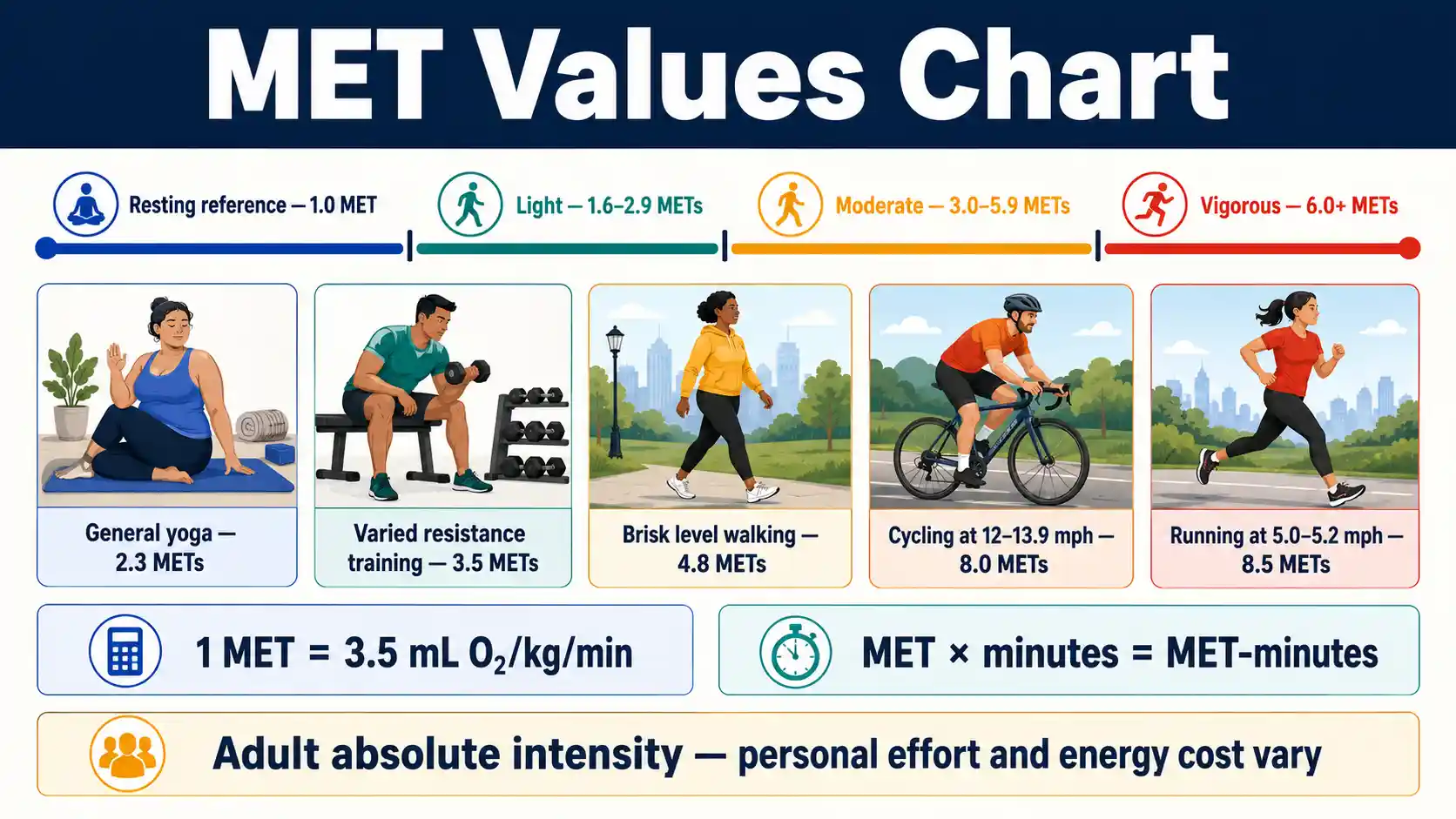
A MET is the ratio of an activity’s metabolic rate to the standardized resting rate. One MET equals 3.5 mL of oxygen per kilogram per minute and is commonly approximated as 1 kcal per kilogram per hour.
A 4-MET activity has an estimated energy rate four times the standardized resting reference. The 2024 Adult Compendium of Physical Activities assigns values to precise activity descriptions for adults ages 19–59. Select the description that matches speed, power, grade, mode, load, and effort.
Resting reference
1 MET
Equal to 3.5 mL O₂/kg/min under the standardized Compendium definition.
Moderate threshold
3.0 METs
Adult absolute moderate intensity extends from 3.0 through 5.9 METs.
Vigorous threshold
6.0 METs
Six METs begins the adult vigorous absolute-intensity band.
Activity volume
MET × minutes
A 4-MET activity performed for 30 minutes equals 120 MET-minutes.
Adult MET intensity levels and reference ranges
Absolute intensity classifies the energy cost of the activity. It does not classify how difficult the activity feels to a particular person.
Swipe horizontally inside the table to view every column.
| Reference or band | MET range | Adult absolute intensity | Standardized oxygen cost | How to interpret it |
|---|---|---|---|---|
| Resting reference | 1.0 MET | Reference point | 3.5 mL O₂/kg/min | Standard denominator used to express activity energy cost |
| Low-energy waking range | 1.0–1.5 METs | Below light intensity | 3.5–5.25 mL O₂/kg/min | Sedentary behavior only when awake and sitting, reclining, or lying |
| Light intensity | 1.6–2.9 METs | Light | 5.6 to <10.5 mL O₂/kg/min | More energy than the low-energy range but below the adult moderate threshold |
| Moderate intensity | 3.0–5.9 METs | Moderate | 10.5 to <21.0 mL O₂/kg/min | Fixed adult absolute-intensity band; personal effort can still differ |
| Vigorous intensity | 6.0 METs or more | Vigorous | 21.0 mL O₂/kg/min or more | Fixed adult absolute-intensity band; not a universal safe prescription |
1 MET is the standardized resting reference: 3.5 mL O₂/kg/min and approximately 1 kcal/kg/hour.
- • Standing quietly may fall within the 1.0–1.5-MET range, but it is not sedentary behavior because sedentary behavior requires a sitting, reclining, or lying posture.
- • The bands describe absolute intensity for adults. Relative intensity describes the task in relation to an individual’s capacity.
Table sources: U.S. Department of Health and Human Services — Background and Key Physical Activity Concepts; Compendium of Physical Activities — 2024 Adult Compendium of Physical Activities; Compendium of Physical Activities — MET, Oxygen, Energy, and Work Unit Conversions
Download or export
MET, MET-minutes, oxygen, and calorie calculator
Select the closest activity description or enter a known MET value. The calculator converts one standardized MET assumption into adult absolute intensity, activity volume, oxygen cost, and estimated gross and above-rest calories.
Walking, 2.8–3.4 mph, level · 3.8 METs · 70.0 kg · 30 minutes
Adult absolute intensityModerate
Gross MET volume114.0 MET-min1.90 MET-hours
Net activity volume84.0 net MET-min
Standardized oxygen cost13.3 mL/kg/min0.93 L/min at the entered weight
Gross calorie estimate140 kcal
Above-rest calorie estimate103 kcal
Gross kcal = MET × 3.5 × weight in kg ÷ 200 × minutes. Above-rest calories use MET − 1. Oxygen values are standardized conversions, not measured VO₂ or VO₂max. Adult intensity bands do not determine whether an activity is safe or appropriately difficult for an individual.
MET formulas, conversions, and a worked example
Use one consistent formula from the activity code to the final result. Keep unrounded values during the calculation and round only the displayed estimate.
Standardized oxygen cost
mL O₂/kg/min = MET × 3.5
An 8-MET activity corresponds to 28 mL/kg/min under the standard conversion. This is not a measured VO₂ or VO₂max.
Activity volume
Gross MET-minutes = MET × minutes
A 5-MET activity for 40 minutes equals 200 MET-minutes or 3.33 MET-hours. It does not require body weight.
Gross calorie estimate
kcal = MET × 3.5 × kg ÷ 200 × minutes
Gross energy includes the resting component that would have occurred during the same minutes.
Above-rest estimate
kcal = (MET − 1) × 3.5 × kg ÷ 200 × minutes
Subtracting one MET estimates only the activity component above the standardized resting reference.
Worked example: brisk walking for 30 minutes
Brisk level walking at 3.5–3.9 mph is 4.8 METs. For 30 active minutes, volume equals 4.8 × 30 = 144 MET-minutes. Standardized oxygen cost equals 4.8 × 3.5 = 16.8 mL/kg/min. At 70 kg, gross energy equals 4.8 × 3.5 × 70 ÷ 200 × 30 = 176.4 kcal. Above-rest energy uses 3.8 net METs and equals 139.7 kcal.
Why two MET calorie shortcuts can differ
“1 MET ≈ 1 kcal/kg/hour” is a convenient approximation. The oxygen-based equation uses 3.5 mL/kg/min and an energy equivalent of about 5 kcal per litre of oxygen, which produces a value about 5% higher. Use one method consistently instead of mixing them. All calorie results on this page use the oxygen-based equation.
The Compendium unit-conversion reference lists the MET-to-oxygen and MET-to-kilocalorie equations used by the calculator.
Exercise and fitness MET values chart
Values retain the activity descriptors used by the 2024 Adult Compendium. Match speed, watts, exercise mode, and effort instead of selecting a broad label.
Swipe horizontally inside the table to view every column.
| Exercise | Exact activity descriptor | MET | Adult absolute intensity | MET-minutes in 30 min |
|---|---|---|---|---|
| Pilates | Traditional mat | 1.8 | Light | 54 |
| Stretching | Mild | 2.3 | Light | 69 |
| Yoga | General | 2.3 | Light | 69 |
| Yoga | Vinyasa | 2.7 | Light | 81 |
| Pilates | General | 2.8 | Light | 84 |
| Bodyweight resistance | General | 3.0 | Moderate | 90 |
| Resistance training | Multiple exercises, 8–15 reps, varied resistance | 3.5 | Moderate | 105 |
| Calisthenics | Moderate effort | 3.8 | Moderate | 114 |
| Home exercise | General | 3.8 | Moderate | 114 |
| Yoga | Power | 4.0 | Moderate | 120 |
| Elliptical trainer | Moderate effort | 5.0 | Moderate | 150 |
| Rowing ergometer | Under 100 W, moderate effort | 5.0 | Moderate | 150 |
| Water aerobics | Water calisthenics or exercise | 5.3 | Moderate | 159 |
| Health club exercise | General | 5.5 | Moderate | 165 |
| Stationary cycling | 70–80 W | 5.8 | Moderate | 174 |
| Circuit training | Bodyweight exercises | 6.0 | Vigorous | 180 |
| Resistance training | Power lifting or bodybuilding, vigorous | 6.0 | Vigorous | 180 |
| Stationary cycling | 90–100 W | 6.0 | Vigorous | 180 |
| Bodyweight resistance | High intensity | 6.5 | Vigorous | 195 |
| Stationary cycling | General | 6.8 | Vigorous | 204 |
| Rowing ergometer | General, vigorous effort | 7.3 | Vigorous | 219 |
| Calisthenics | Vigorous effort | 7.5 | Vigorous | 225 |
| Cycling outdoors | 12–13.9 mph, moderate effort | 8.0 | Vigorous | 240 |
| Running | 5.0–5.2 mph, about 12 min/mile | 8.5 | Vigorous | 255 |
| Stationary cycling | RPM or spin-bike class | 9.0 | Vigorous | 270 |
| Elliptical trainer | Vigorous effort | 9.0 | Vigorous | 270 |
| Running | 6.0–6.3 mph, about 10 min/mile | 9.3 | Vigorous | 279 |
| Kettlebell exercise | Kettlebell swings | 9.8 | Vigorous | 294 |
| Cycling outdoors | 14–15.9 mph, fast effort | 10.0 | Vigorous | 300 |
| Rope skipping | General | 11.0 | Vigorous | 330 |
| High-intensity intervals | Burpees, mountain climbers, squat jumps, or Tabata | 11.0 | Vigorous | 330 |
| Stationary cycling | 230–250 W, very vigorous | 12.5 | Vigorous | 375 |
MET-minutes equal MET value multiplied by active minutes.
- • A whole workout may include several MET values. Calculate warm-up, work, recovery, and rest segments separately when their activity descriptors differ.
- • The same exercise name can have multiple values. For example, stationary cycling ranges widely because watts and class format change the work rate.
Table sources: Compendium of Physical Activities — 2024 Adult Compendium of Physical Activities; U.S. Department of Health and Human Services — Background and Key Physical Activity Concepts
Download or export
How to choose the correct MET value
Match the activity attributes before using the number. “Cycling,” “weights,” or “swimming” alone is not specific enough.
- 1. Identify the activity mode. Separate outdoor cycling from stationary cycling, lap swimming from water aerobics, and running from walking.
- 2. Match the measurable descriptor. Use speed, pace, watts, grade, stroke rate, carried load, or exact game format when the row provides it.
- 3. Match the effort label only when needed. “Moderate” and “vigorous” inside an activity description help distinguish entries. They are not a substitute for a listed speed or power band.
- 4. Count active time. Do not assign a vigorous exercise MET to changing clothes, instruction, long rests, substitutions, or waiting between attempts.
- 5. Split mixed sessions. Calculate warm-up, steady work, intervals, recovery, and cool-down with their own values, then add the MET-minutes.
- 6. Keep the source version. Record that the value came from the 2024 Adult Compendium so a later comparison can reproduce the method.
Sports and outdoor activity MET values chart
Game format, competitive level, pace, water conditions, and active playing time define the applicable activity description.
Swipe horizontally inside the table to view every column.
| Sport or activity | Exact activity descriptor | MET | Adult absolute intensity | MET-minutes in 30 min |
|---|---|---|---|---|
| Billiards | General play | 2.5 | Light | 75 |
| Darts | Wall or lawn | 2.5 | Light | 75 |
| Bowling | General | 3.0 | Moderate | 90 |
| Frisbee | General play | 3.0 | Moderate | 90 |
| Golf | Using a power cart | 3.5 | Moderate | 105 |
| Golf | Walking and carrying clubs | 4.3 | Moderate | 129 |
| Cricket | Batting, bowling, or fielding | 4.8 | Moderate | 144 |
| Baseball or softball | General, moderate effort | 5.0 | Moderate | 150 |
| Basketball | Shooting baskets | 5.0 | Moderate | 150 |
| Kayaking | Moderate effort | 5.0 | Moderate | 150 |
| Snorkeling | General | 5.0 | Moderate | 150 |
| Hiking | Fields and hills, normal pace, no load | 5.3 | Moderate | 159 |
| Badminton | Social singles or doubles | 5.5 | Moderate | 165 |
| Boxing | Punching bag | 5.8 | Moderate | 174 |
| Swimming | Freestyle laps, slow recreational | 5.8 | Moderate | 174 |
| Basketball | Non-game, general | 6.0 | Vigorous | 180 |
| Hiking | Cross-country | 6.0 | Vigorous | 180 |
| Tennis | Doubles | 6.0 | Vigorous | 180 |
| Water skiing | Water skiing or wakeboarding | 6.0 | Vigorous | 180 |
| Stand-up paddleboarding | General | 6.5 | Vigorous | 195 |
| Tennis | General, moderate effort | 6.8 | Vigorous | 204 |
| Badminton | Competitive | 7.0 | Vigorous | 210 |
| Soccer | Casual, general | 7.0 | Vigorous | 210 |
| Squash | General | 7.3 | Vigorous | 219 |
| Basketball | General | 7.5 | Vigorous | 225 |
| Boxing | Sparring | 7.8 | Vigorous | 234 |
| Futsal | General | 7.8 | Vigorous | 234 |
| Basketball | Game | 8.0 | Vigorous | 240 |
| Football | Touch or flag, general | 8.0 | Vigorous | 240 |
| Tennis | Singles | 8.0 | Vigorous | 240 |
| Cross-country skiing | 4.0–4.9 mph, moderate speed | 8.5 | Vigorous | 255 |
| Orienteering | General | 9.0 | Vigorous | 270 |
| Soccer | Competitive | 9.5 | Vigorous | 285 |
| Swimming | Freestyle laps, fast | 9.8 | Vigorous | 294 |
| Water polo | General | 10.0 | Vigorous | 300 |
| Martial arts | Moderate pace | 10.3 | Vigorous | 309 |
| Squash | Taylor Code 530 entry | 12.0 | Vigorous | 360 |
| Boxing | In ring, general | 12.3 | Vigorous | 369 |
| Swimming | Butterfly, general | 13.8 | Vigorous | 414 |
MET values describe active performance of the listed activity.
- • Elapsed session time may include substitutions, instruction, waiting, breaks, or stoppages. Use active time for an activity-specific calculation.
- • Competitive labels identify the Compendium activity description; they do not guarantee that every competition produces the same metabolic rate.
Table sources: Compendium of Physical Activities — 2024 Adult Compendium of Physical Activities; U.S. Department of Health and Human Services — Background and Key Physical Activity Concepts
Download or export
Common MET value questions answered
These short answers use adult absolute-intensity bands and 2024 Adult Compendium activity descriptions. A listed value remains an estimate until the individual activity is measured.
What does one MET mean?
The standardized resting reference
One MET equals 3.5 mL of oxygen per kilogram per minute and is commonly approximated as 1 kcal per kilogram per hour.
Is 2 METs light intensity?
Yes, for adult absolute intensity
Two METs falls within the 1.6–2.9-MET light-intensity band. It may still feel difficult to someone with low exercise capacity.
Is 3 METs moderate intensity?
Yes, it is the adult threshold
Adult absolute moderate intensity begins at 3.0 METs and extends through 5.9 METs.
Is 6 METs vigorous intensity?
Yes, for adult absolute intensity
Six METs is the lower boundary of the vigorous adult absolute-intensity band.
What is the MET value for desk work?
About 1.3 METs
The 2024 Adult Compendium lists sitting desk work, typing, and computer work at about 1.3 METs.
What is the MET value for walking?
About 2.3–7.0 METs in common level rows
Level walking rises from 2.3 METs below 2 mph to 7.0 METs at 4.5–4.9 mph. Match the actual speed and surface.
What is the MET value for brisk walking?
4.8 METs
Level walking at 3.5–3.9 mph on a firm surface is listed at 4.8 METs.
What is the MET value for running at 5 mph?
8.5 METs
Running at 5.0–5.2 mph, or about a 12-minute mile, is listed at 8.5 METs.
What is the MET value for cycling?
It depends on speed or power
Outdoor cycling is 6.8 METs at 10–11.9 mph, 8.0 at 12–13.9 mph, and 10.0 at 14–15.9 mph.
What is the MET value for weight training?
About 3.5 or 6.0 METs in common entries
Multiple exercises at varied resistance are 3.5 METs; vigorous power lifting or bodybuilding is 6.0 METs.
What is the MET value for yoga?
The style changes the value
General yoga is 2.3 METs, Vinyasa 2.7, and power yoga 4.0 in the 2024 Adult Compendium.
What is the MET value for swimming?
5.8 METs slow; 9.8 METs fast
Slow recreational freestyle laps are 5.8 METs, while fast vigorous freestyle laps are 9.8 METs.
How many MET-minutes is 30 minutes at 4 METs?
120 MET-minutes
Multiply 4 METs by 30 minutes. MET-minutes measure activity volume, not calories or personal effort.
How many calories is 5 METs for 30 minutes?
About 184 gross kcal at 70 kg
Using 5 × 3.5 × 70 ÷ 200 × 30 gives 183.75 kcal, rounded to about 184 gross kcal.
How do you convert oxygen uptake to METs?
Divide mL/kg/min by 3.5
An oxygen uptake of 28 mL/kg/min equals 8 METs under the standard conversion.
What is a net MET value?
Activity MET minus one resting MET
A 5-MET activity has 4 net METs. Net values estimate the activity component above the standard resting reference.
Does one MET feel equally easy to everyone?
No
MET is an absolute activity-cost reference. Relative effort depends on fitness, age, health, disability, medication, and current condition.
Is a higher MET workout always better?
No
A higher MET means a higher absolute energy rate, not greater safety, suitability, skill, recovery quality, or health value for every person.
Daily activities, walking, and chores MET chart
Everyday activity values depend on posture, pace, carried load, equipment, and effort. Only active periods should be counted for intermittent tasks.
Swipe horizontally inside the table to view every column.
| Daily activity | Exact activity descriptor | MET | Adult absolute intensity | MET-minutes in 30 min |
|---|---|---|---|---|
| Sleeping | Sleeping | 1.0 | Resting reference | 30 |
| Quiet sitting | Sitting quietly, general | 1.0 | Low-energy | 30 |
| Computer work | Sitting and typing | 1.3 | Low-energy | 39 |
| Standing | Standing quietly | 1.3 | Low-energy | 39 |
| Office work | Sitting tasks, light effort | 1.5 | Low-energy | 45 |
| Ironing | Standing, general | 1.8 | Light | 54 |
| Cooking | Standing or sitting, light effort | 2.0 | Light | 60 |
| Laundry | Folding or hanging clothes while sitting | 2.0 | Light | 60 |
| Washing dishes | Standing, general | 2.0 | Light | 60 |
| Showering | Showering and toweling off, standing | 2.0 | Light | 60 |
| Animal care | Household animals, general | 2.3 | Light | 69 |
| Laundry | Fold or hang clothes, implied standing | 2.3 | Light | 69 |
| Household walking | General movement around the home | 2.3 | Light | 69 |
| Child care | Infant care, general | 2.5 | Light | 75 |
| Dusting | Dusting or polishing furniture | 2.5 | Light | 75 |
| House tasks | Straightening, changing linen, or trash, light | 2.5 | Light | 75 |
| Walking | 2.0–2.4 mph, level, slow pace | 2.8 | Light | 84 |
| Making a bed | Making bed or changing linens | 3.0 | Moderate | 90 |
| Vacuuming | General, moderate effort | 3.0 | Moderate | 90 |
| Walking the dog | No speed specified | 3.0 | Moderate | 90 |
| Food shopping | With or without cart, standing or walking | 3.3 | Moderate | 99 |
| House cleaning | General, moderate effort | 3.3 | Moderate | 99 |
| Kitchen activity | Cooking, dishes, and cleanup, moderate | 3.3 | Moderate | 99 |
| Carrying groceries | Level ground, walking | 3.5 | Moderate | 105 |
| Child play | Walking or running, moderate, active periods | 3.5 | Moderate | 105 |
| Scrubbing | Floors or bathroom, moderate effort | 3.5 | Moderate | 105 |
| Gardening | General, moderate effort | 3.8 | Moderate | 114 |
| Walking | 2.8–3.4 mph, level, moderate pace | 3.8 | Moderate | 114 |
| Raking | Lawn or leaves, moderate effort | 4.0 | Moderate | 120 |
| Walking | 3.5–3.9 mph, level, brisk | 4.8 | Moderate | 144 |
| Lawn mowing | Walking with power mower, moderate or vigorous | 5.0 | Moderate | 150 |
| Carrying groceries | Upstairs | 5.3 | Moderate | 159 |
| Shoveling snow | By hand, moderate effort | 5.3 | Moderate | 159 |
| Moving furniture | Household items or carrying boxes | 5.8 | Moderate | 174 |
| Lawn mowing | Hand mower, vigorous effort | 6.0 | Vigorous | 180 |
| Shoveling snow | By hand, vigorous effort | 7.5 | Vigorous | 225 |
| Moving household items | Upstairs, boxes or furniture | 9.0 | Vigorous | 270 |
MET-minutes equal MET value multiplied by time spent doing the described task.
- • A 1.0–1.5-MET activity is sedentary behavior only when it is performed while awake and sitting, reclining, or lying.
- • Do not assign the same MET to an entire day. Segment desk work, standing, walking, lifting, chores, and exercise when estimating activity volume.
Table sources: Compendium of Physical Activities — 2024 Adult Compendium of Physical Activities; U.S. Department of Health and Human Services — Background and Key Physical Activity Concepts
Download or export
MET-minutes, net METs, and calorie examples
Worked examples use a 70 kg adult and the oxygen-based MET calorie formula. Gross values include the resting component; above-rest values subtract one MET.
Swipe horizontally inside the table to view every column.
| Activity example | MET | Duration | Gross MET-min | Net MET-min | Gross kcal at 70 kg | Above-rest kcal at 70 kg |
|---|---|---|---|---|---|---|
| Quiet sitting | 1.0 | 30 min | 30 | 0 | 37 | 0 |
| Walking, 2.0–2.4 mph | 2.8 | 30 min | 84 | 54 | 103 | 66 |
| Walking, 2.8–3.4 mph | 3.8 | 30 min | 114 | 84 | 140 | 103 |
| Resistance training, varied | 3.5 | 45 min | 157.5 | 112.5 | 193 | 138 |
| Yoga, general | 2.3 | 60 min | 138 | 78 | 169 | 96 |
| Cycling, 12–13.9 mph | 8.0 | 30 min | 240 | 210 | 294 | 257 |
| Running, 5.0–5.2 mph | 8.5 | 30 min | 255 | 225 | 312 | 276 |
| Swimming freestyle, slow | 5.8 | 30 min | 174 | 144 | 213 | 176 |
| Tennis singles | 8.0 | 60 min | 480 | 420 | 588 | 515 |
| HIIT, vigorous effort | 11.0 | 20 min | 220 | 200 | 270 | 245 |
| House cleaning, moderate | 3.3 | 45 min | 148.5 | 103.5 | 182 | 127 |
| Power-mower lawn mowing | 5.0 | 45 min | 225 | 180 | 276 | 221 |
| Soccer, casual | 7.0 | 60 min | 420 | 360 | 515 | 441 |
| Rope skipping, general | 11.0 | 15 min | 165 | 150 | 202 | 184 |
Gross MET-min = MET × minutes. Net MET-min = max(MET − 1, 0) × minutes. Gross kcal = MET × 3.5 × kg ÷ 200 × minutes.
- • The shorthand 1 MET ≈ 1 kcal/kg/hour and the oxygen-based formula are both approximations. The displayed calorie examples consistently use MET × 3.5 × kg ÷ 200.
- • Round only the final calorie estimate. MET-minutes may retain a decimal when the MET value or duration produces one.
Table sources: Compendium of Physical Activities — 2024 Adult Compendium of Physical Activities; Compendium of Physical Activities — MET, Oxygen, Energy, and Work Unit Conversions
Download or export
Gross METs versus net METs
Gross and net values answer different questions. State which one you use before comparing a chart, study, app, or exercise log.
Gross MET value
Full activity rate
A listed 5-MET activity includes one resting MET plus four METs above rest. Compendium activity tables normally display gross MET values.
Net MET value
Activity rate above rest
Net MET equals gross MET minus one. The 5-MET example therefore has 4 net METs. Net MET-minutes and above-rest calories remove the standardized resting component.
Do not subtract twice. If an app already reports active or above-rest calories, do not subtract another resting value. Device definitions can differ, so check the product’s documentation before comparing totals.
Absolute MET intensity versus relative effort
METs describe the activity. Relative intensity describes how hard the activity is for the person performing it.
Absolute intensity
Adult absolute bands use fixed MET cutoffs: 1.6–2.9 is light, 3.0–5.9 is moderate, and 6.0 or more is vigorous. This makes activities comparable at the population level.
Relative intensity
Perceived exertion, the talk test, percentage of aerobic capacity, and an appropriate heart-rate measure can describe individual effort. The same 4-MET task may feel easy to one adult and hard to another.
The HHS physical activity concepts report explains both measures. As a practical guide, talking becomes more limited as relative effort rises, but symptoms, medication, and individual capacity can change that response.
Why a MET estimate can differ from actual energy cost
A table matches a standardized activity description. A real session adds individual physiology, equipment, environment, and measurement choices.
Speed and pace
A faster speed often maps to a higher activity code.
Walking, running, cycling, swimming, and rowing include speed- or pace-specific values.
Apply it: Record speed, pace, or distance and active time instead of writing only the activity name.
Power and resistance
Watts can separate activities that look similar by speed.
Stationary cycling and rowing entries change materially across measured power bands.
Apply it: Use average power and the correct machine mode when a reliable power reading is available.
Grade and terrain
Uphill grade, trails, sand, stairs, and load can raise energy cost.
The same walking speed can carry a different MET value on level ground and on a hill.
Apply it: Record grade, elevation, surface, and whether the route is level, downhill, rolling, or steep.
Work and rest structure
Long rests lower the average for the whole session.
An exercise MET describes time spent performing that activity, not every minute inside the gym or field booking.
Apply it: Calculate warm-up, work intervals, recovery, substitutions, instruction, and rest separately.
External load
A pack, child, groceries, tools, or equipment can change the code.
Walking and occupational entries distinguish both the mass carried and the route.
Apply it: Record the carried load, carrying method, and whether stairs or grade were involved.
Technique and economy
People can use different oxygen amounts for the same external task.
Training status, skill, biomechanics, and movement efficiency create individual variation around a group value.
Apply it: Treat the chart as a standardized estimate and use the same method for repeat comparisons.
Environment
Wind, water, temperature, altitude, and surface alter demand.
Outdoor speed alone may not show resistance, heat strain, or technical conditions.
Apply it: Keep environmental notes when comparing sessions performed in different conditions.
Equipment and assistance
Motor support, bike type, ergometer, poles, or a cart can change the task.
The Compendium separates some assisted and unassisted modes because external work differs.
Apply it: Match the equipment description and support level rather than using the nearest activity name.
Individual resting metabolism
The standard 3.5 mL/kg/min denominator is not every person’s measured rest.
Age, body size, sex, and body composition can shift resting metabolic rate and therefore an individualized ratio.
Apply it: Use corrected or measured methods when a clinical or research question requires individual precision.
Population and mobility
Adult, older-adult, youth, and wheelchair activity costs are not interchangeable.
The primary table on this page comes from the Adult Compendium for ages 19–59.
Apply it: Use the compendium or assessment designed for the relevant age and mobility context.
How to calculate METs for a mixed workout
Calculate each segment’s MET-minutes, add them, then divide by total session minutes for a time-weighted average MET.
| Segment | MET | Minutes | Gross MET-min | Net MET-min |
|---|---|---|---|---|
| Moderate walking warm-up | 3.8 | 10 | 38 | 28 |
| Vigorous work interval block | 8.0 | 20 | 160 | 140 |
| Light recovery | 2.3 | 10 | 23 | 13 |
Total gross volume is 221 MET-minutes across 40 minutes. The time-weighted average is 221 ÷ 40 = 5.525 METs, reported as about 5.5 METs. At 70 kg, the oxygen-based equation estimates about 271 gross kcal. Net volume is 181 MET-minutes, or about 222 kcal above rest.
Do not take the simple mean of 3.8, 8.0, and 2.3. That would give every segment equal weight even though the vigorous segment lasts twice as long.
MET chart accuracy and limitations
A listed MET is not a personal measurement
The value represents a standardized activity cost derived from evidence and activity coding. Individual oxygen consumption can be higher or lower.
One resting MET is not everyone’s resting rate
The 3.5 mL/kg/min reference can overstate or understate a person’s measured rest. Corrected-MET methods change the denominator using an estimated individual resting rate.
MET-to-calorie values are estimates
Body mass and duration scale the formula, but body composition, movement economy, environment, and measurement error remain.
METs do not measure aerobic capacity
Converting a row to mL/kg/min gives a standardized activity oxygen cost. It does not test VO₂max, lactate threshold, cardiac function, or training readiness.
Use corrected or measured methods when individual precision changes a clinical, occupational, or research decision. Do not apply both a corrected MET value and a second resting-rate adjustment to the same calculation.
How to use MET values in an activity log
- 1. Write the full activity description. Include speed, watts, grade, surface, load, stroke, game format, or exercise mode.
- 2. Record active minutes. Separate warm-up, work, recovery, rest, and cool-down when their values differ.
- 3. Calculate volume. Multiply MET by minutes for each segment, then add the MET-minutes.
- 4. Label the output. Distinguish gross MET-minutes, net MET-minutes, gross calories, and above-rest calories.
- 5. Record relative effort separately. Add a talk test, perceived-exertion score, symptoms, or an appropriate heart-rate measure rather than assuming the MET tells the full story.
- 6. Compare like with like. Keep the same activity code, formula, device, and time basis when evaluating a trend.
MET values, safety, and population limits
Do not select an exercise intensity only because a chart places it in a desired MET band.
- Adults ages 19–59: the primary activity values on this page come from the 2024 Adult Compendium for this age range.
- Adults ages 60 and older: older-adult activity values and relative effort may provide a better basis than an automatic adult-table substitution.
- Children and adolescents: use a youth-specific compendium or assessment because adult values are not assumed to transfer directly.
- Wheelchair users: use wheelchair-specific activity codes rather than walking, running, or able-bodied sport values.
- Pregnancy, disability, symptoms, illness, injury, or medical conditions: obtain individualized exercise guidance when these factors affect safe participation.
- Acute warning signs: stop activity and seek urgent medical help for chest pressure or pain, fainting, severe breathing difficulty, or another rapidly worsening symptom.
Frequently asked questions
What does MET stand for?
MET stands for metabolic equivalent. It expresses an activity’s standardized metabolic rate as a multiple of the reference resting rate.
What is the formula for MET-minutes?
Multiply the activity MET value by active minutes. A 4-MET activity performed for 45 minutes equals 180 gross MET-minutes. Calculate different activity segments separately, then add their MET-minutes.
What is the difference between gross and net METs?
Gross METs include the one-MET resting component. Net METs subtract that component: net MET = activity MET minus 1, with values below zero treated as zero for this page’s above-rest calculation.
How do METs convert to calories?
Estimated gross kcal per minute equals MET × 3.5 × body weight in kilograms ÷ 200. Multiply by active minutes. The result is an estimate based on a standardized oxygen-cost assumption.
Are MET values measured or estimated?
Compendium values summarize evidence and standardized activity codes. A listed MET is not a direct measurement of the person using the chart. Laboratory indirect calorimetry can measure oxygen consumption for a specific test.
Why does the same activity have several MET values?
Speed, power, grade, load, stroke, competitive format, exercise mode, and effort create different activity descriptions. Select the row that matches those attributes instead of averaging unrelated rows.
What is the difference between absolute and relative intensity?
Absolute intensity describes the activity’s energy rate in METs. Relative intensity describes how hard the activity is for the individual, using capacity, heart-rate response, perceived exertion, or the talk test.
Can MET values estimate VO₂?
They can convert to a standardized oxygen-cost estimate: MET × 3.5 mL/kg/min. This is not the same as measuring VO₂ during the activity or testing VO₂max.
Can I average MET values across a mixed workout?
Yes, but weight each segment by time. Add the MET-minutes for all segments, then divide by total session minutes to obtain a time-weighted average MET. Do not take a simple mean when segment durations differ.
Can children or adults over 60 use this chart?
Use caution. The activity table is based mainly on the Adult Compendium for ages 19–59. Youth and older adults may require population-specific compendia or individualized measurement.
Can wheelchair users use standard walking and running METs?
No. Wheelchair propulsion and wheelchair sports have distinct movement and energy costs. Use the Wheelchair Compendium or an individualized assessment rather than substituting walking or running entries.
Can a MET chart tell me which exercise is safe?
No. A MET value describes estimated energy rate, not medical suitability. Symptoms, diagnosis, medication, pregnancy, disability, injury, environment, and current capacity may require individualized guidance.
Sources
Compendium of Physical Activities — 2024 Adult Compendium of Physical Activities
https://pacompendium.com/adult-compendium/
Compendium of Physical Activities — MET, Oxygen, Energy, and Work Unit Conversions
https://pacompendium.com/unite-conversions/
U.S. Department of Health and Human Services — Background and Key Physical Activity Concepts
https://odphp.health.gov/sites/default/files/2019-09/04_C_Background_and_Key_Physical_Activity_Concepts.pdf
Compendium of Physical Activities — Corrected MET Values for Individual Resting Metabolic Rate
https://pacompendium.com/corrected-mets/
Compendium of Physical Activities — Adult, Older Adult, and Wheelchair Activity Compendia
https://pacompendium.com/