Finance & Money
Mortgage Rates Chart
Freddie Mac reported an average 6.58% 30-year fixed mortgage rate and 5.96% 15-year fixed rate for the week of July 23, 2026. These are national survey benchmarks for a defined conventional conforming borrower profile, not rates that every buyer can obtain.
A mortgage rate directly affects principal-and-interest cost. On a $300,000 30-year loan, 6.58% produces about $1,912.02 per month in principal and interest. Property taxes, homeowners insurance, mortgage insurance, HOA fees, utilities, and maintenance sit outside that P&I figure.
Freddie Mac's July 23 PMMS release states that the 30-year average rose from 6.55% the prior week but remained below the 6.74% average a year earlier.
Mortgage rates can change quickly. Use a dated benchmark to understand the market, then compare actual Loan Estimates using similar loan amounts, terms, points, lock periods, and property assumptions.
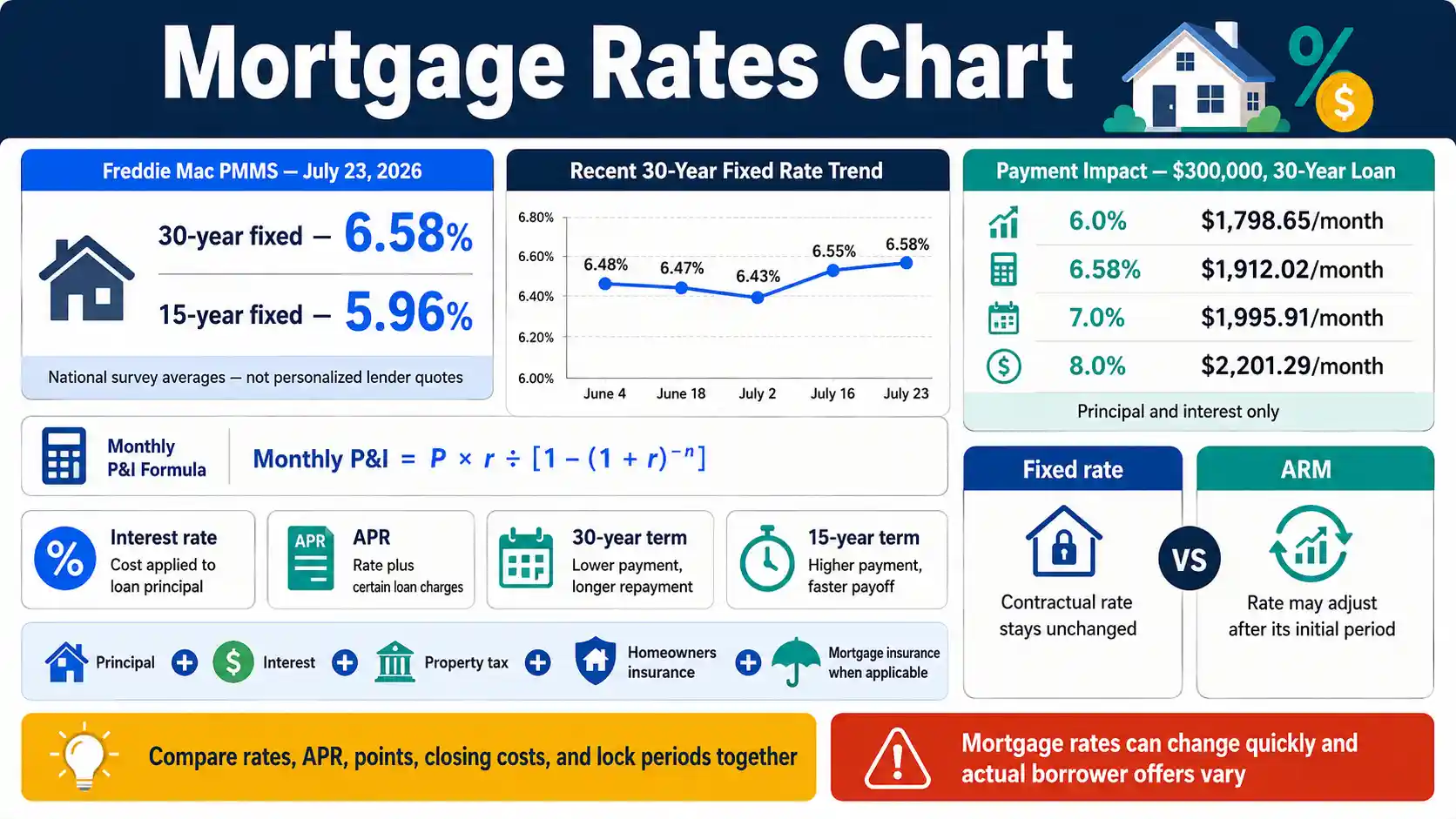
30-year fixed
6.58%
Freddie Mac PMMS average as of July 23, 2026; not a personalized lender quote.
15-year fixed
5.96%
The July 23, 2026 PMMS 15-year average was lower than the 30-year benchmark but carries a faster repayment schedule.
$300k at 6.58%
$1,912.02 P&I
Modeled 30-year principal-and-interest payment before taxes, insurance, mortgage insurance, HOA fees, or maintenance.
Total housing cost
More than P&I
Property tax, homeowners insurance, mortgage insurance, HOA fees, and upkeep can materially increase monthly housing outflow.
How to read mortgage rates before comparing offers
The note rate controls scheduled interest on the loan balance. APR is broader: it reflects the mortgage rate plus certain points, broker fees, and other charges. CFPB explains why APR is usually higher than the note rate.
A lower monthly payment can come from a lower rate, a smaller loan, or a longer term. A longer term can reduce the payment while increasing total interest if the loan remains outstanding for the full schedule.
A fixed-rate mortgage keeps its contractual interest rate unchanged. An adjustable-rate mortgage can change after its initial period according to an index, margin, and contractual caps. CFPB recommends evaluating how high an ARM payment could rise.
A national average is not a borrower's approval rate. Credit profile, down payment, occupancy, loan program, property, points, lender pricing, and lock timing can all change the offered terms.
Current U.S. Mortgage Rate Benchmark
Freddie Mac PMMS averages for conventional, conforming, fully amortizing purchase loans from applications submitted by borrowers with excellent credit and 20% down.
Swipe horizontally inside the table to view every column.
| Benchmark | July 23, 2026 | Prior week | Year ago | Weekly change |
|---|---|---|---|---|
| 30-year fixed-rate mortgage | 6.58% — Latest 30-year PMMS average | 6.55% | 6.74% | +0.03 percentage points |
| 15-year fixed-rate mortgage | 5.96% — Latest 15-year PMMS average | 5.93% | 5.87% | +0.03 percentage points |
Average contract mortgage rates. These survey averages are not personalized rate quotes.
- • The latest PMMS release available for this page is July 23, 2026.
- • Actual offers vary with borrower, property, loan, points, lender, and market conditions.
Download or export
Recent Weekly Mortgage Rate Trend
Eight Freddie Mac PMMS observations show how the 30-year and 15-year fixed-rate benchmarks moved from early June through July 23, 2026.
Swipe horizontally inside the table to view every column.
| Survey week | 30-year fixed | 15-year fixed | 30-year change from prior row |
|---|---|---|---|
| July 23, 2026 | 6.58% — Latest 30-year average | 5.96% | +0.03 pp vs July 16 |
| July 16, 2026 | 6.55% | 5.93% | +0.06 pp vs July 9 |
| July 9, 2026 | 6.49% | 5.82% | +0.06 pp vs July 2 |
| July 2, 2026 | 6.43% | 5.79% | -0.06 pp vs June 25 |
| June 25, 2026 | 6.49% | 5.84% | +0.02 pp vs June 18 |
| June 18, 2026 | 6.47% | 5.81% | -0.05 pp vs June 11 |
| June 11, 2026 | 6.52% | 5.84% | +0.04 pp vs June 4 |
| June 4, 2026 | 6.48% | 5.79% | Starting point shown |
- • A weekly average can move differently from a lender quote received on a specific day.
- • One percentage point equals 100 basis points; 0.03 percentage points equals 3 basis points.
Download or export
How Mortgage Rates Change a $300,000 Payment
This table isolates interest-rate effects on a $300,000, 30-year fully amortizing fixed-rate loan. Taxes, insurance, mortgage insurance, HOA fees, and closing costs are excluded.
Swipe horizontally inside the table to view every column.
| Interest rate | Monthly principal + interest | Total interest over 30 years | Monthly change vs 6.58% |
|---|---|---|---|
| 5.50% | $1,703.37 | $313,212.12 | -$208.65 |
| 6.00% | $1,798.65 | $347,514.57 | -$113.36 |
| 6.50% | $1,896.20 | $382,633.47 | -$15.81 |
| 6.58% | $1,912.02 — Payment at the July 23, 2026 30-year PMMS benchmark | $388,325.45 | $0.00 |
| 7.00% | $1,995.91 | $418,526.69 | +$83.89 |
| 7.50% | $2,097.64 | $455,151.67 | +$185.63 |
| 8.00% | $2,201.29 | $492,465.74 — Higher modeled lifetime interest | +$289.28 |
U.S. dollars. Standard monthly amortization; 360 scheduled payments.
- • Higher rates increase both the required principal-and-interest payment and lifetime interest when loan amount and term stay unchanged.
- • These are mathematical examples, not lender quotes.
Download or export
Mortgage Term Comparison at the Same 6.58% Rate
Holding the loan amount and interest rate constant isolates the effect of term length on monthly principal-and-interest cost and modeled lifetime interest.
Swipe horizontally inside the table to view every column.
| Loan term | Monthly principal + interest | Total interest | Trade-off |
|---|---|---|---|
| 10 years | $3,418.66 | $110,239.60 | Highest monthly payment; lowest modeled interest |
| 15 years | $2,626.53 | $172,776.09 | Higher monthly payment; faster payoff |
| 20 years | $2,250.87 | $240,209.11 | Middle payment and interest trade-off |
| 30 years | $1,912.02 — 30-year payment at the selected comparison rate | $388,325.45 | Lowest payment shown; highest modeled interest |
Illustrative $300,000 loan at a constant 6.58% nominal annual rate.
- • The actual market rate offered on a 10-, 15-, 20-, or 30-year loan may differ, so this is a term-only comparison.
- • A shorter term does not guarantee a better overall mortgage if fees, cash-flow needs, or other loan features differ.
Download or export
Browser-only educational tool
Mortgage Rate and Monthly Cost Calculator
Enter a loan amount, rate, term, and monthly housing-cost estimates. The calculator separates principal and interest from taxes, insurance, mortgage insurance, and HOA costs.
Principal + interest
$1,912.02
Scheduled monthly P&I for the entered fixed-rate assumptions.
Modeled housing outflow
$2,512.02
P&I plus the monthly costs entered above. HOA may be billed separately.
Modeled total interest
$388,325.45
Assumes every scheduled payment is made for the full term with no refinance or extra principal.
Rate sensitivity
5.58% → $1,718.46
7.58% → $2,114.10
Same loan amount and term, one percentage point lower or higher.
Formula: monthly P&I = P × r ÷ [1 − (1 + r)−n], where P is principal, r is the monthly interest rate, and n is the number of monthly payments.
This is not a rate quote: the entered rate does not include points or establish APR, qualification, approval, closing costs, taxes, insurance premiums, or future ARM adjustments.
The calculation runs only in your browser. No loan amount, rate, property cost, or other entry is transmitted or stored by this tool.
Mortgage Interest Rate, APR, Points and Credits
Rate and APR answer different questions. A low note rate can still come with higher upfront costs, so compare the complete Loan Estimate.
Swipe horizontally inside the table to view every column.
| Item | What it measures | Can change cash due at closing? | Best use |
|---|---|---|---|
| Interest rate | Annual borrowing rate applied to principal | Not by itself | Calculate scheduled loan interest and principal-and-interest payments |
| APR | Broader annualized borrowing-cost measure — APR is broader than the note rate | Reflects certain charges | Compare borrowing cost across similar loan offers |
| Discount points | Upfront amount paid for a lower rate when offered | Yes | Evaluate rate-versus-upfront-cost trade-off |
| Lender credits | Credit that can offset some closing costs, often with a higher rate | Yes | Evaluate lower upfront cost versus higher ongoing interest |
| Closing costs | Origination and third-party transaction charges | Yes | Estimate cash needed to close and total borrowing cost |
- • APR usually exceeds the note rate because it includes certain additional loan costs.
- • APR on an ARM does not show the maximum possible future ARM rate.
Download or export
Fixed-Rate Mortgage vs. Adjustable-Rate Mortgage
A fixed-rate mortgage keeps the contractual rate unchanged. An ARM can reset after its initial period according to its index, margin, and caps.
Swipe horizontally inside the table to view every column.
| Feature | Fixed-rate mortgage | Adjustable-rate mortgage | Why it matters |
|---|---|---|---|
| Interest rate | Set at closing and does not change — Fixed contractual rate | Can change after the fixed introductory period | Future principal-and-interest payment risk differs |
| Initial rate period | Entire loan term | Specified introductory period | ARM payment risk begins after the initial period |
| Reset formula | Not applicable | Index + margin, subject to contract terms and caps | Market rates can affect future payments |
| Initial adjustment cap | Not applicable | Limits first adjustment | Controls the first rate jump |
| Subsequent cap | Not applicable | Limits later periodic adjustments | Controls each later change |
| Lifetime cap | Not applicable | Limits cumulative rate movement under the contract — ARM lifetime cap matters | Defines maximum contractual rate exposure |
- • Do not assume you will be able to refinance before an ARM adjusts.
- • Compare the maximum possible payment, not only the introductory rate.
Download or export
What Can Be Included in a Monthly Housing Payment
Principal and interest are only part of many homeowners’ monthly housing costs. Escrow and separately billed costs can materially change affordability.
Swipe horizontally inside the table to view every column.
| Cost component | Usually paid monthly? | Included in P&I? | Can change over time? |
|---|---|---|---|
| Principal | Yes | Yes | Scheduled share changes as loan amortizes |
| Interest | Yes | Yes | Fixed-rate amount declines within the payment as balance falls; ARM rate can change |
| Property taxes | Often through escrow | No — Property tax is outside P&I | Yes |
| Homeowners insurance | Often through escrow | No — Homeowners insurance is outside P&I | Yes |
| Mortgage insurance | When required | No | Can change or end under applicable loan rules |
| HOA or condo fees | Often paid separately | No | Yes |
| Utilities and maintenance | Usually separate | No | Yes |
- • Total monthly housing outflow can be much higher than principal and interest alone.
- • Escrow amounts can change even when the note rate on a fixed-rate mortgage does not.
Download or export
Common mortgage-rate mistakes and important limits
Do not compare rate with APR
A 6.5% interest rate and a 6.5% APR are not equivalent disclosures. Compare rates with rates and APRs with APRs while also checking points and closing costs.
Do not budget from P&I alone
Taxes, insurance, mortgage insurance, HOA fees, utilities, and maintenance can make total monthly housing cost much higher than the advertised principal-and-interest payment.
Do not treat an ARM teaser rate as permanent
ARM payments can rise after the introductory period. Review the index, margin, first adjustment, later adjustment caps, lifetime cap, floor, and maximum payment.
Do not assume today's quote will still exist at closing
Mortgage markets move and rate locks expire. Verify the rate, points, lock period, extension terms, and changed-circumstance rules on the lender's written disclosures.
Jumbo, FHA, VA, USDA, construction, manufactured-home, second-lien, HELOC, investment-property, non-QM, and other products can price differently from the Freddie Mac benchmark shown here. Refinance decisions also require closing-cost and break-even analysis rather than a rate comparison alone.
Frequently asked questions
What is the average 30-year mortgage rate right now?
Freddie Mac reported a 6.58% average for the 30-year fixed-rate mortgage as of July 23, 2026. That survey average is a market benchmark, not a personalized offer.
What is the current 15-year mortgage rate?
Freddie Mac reported a 5.96% average for the 15-year fixed-rate mortgage as of July 23, 2026.
Does everyone get the Freddie Mac average mortgage rate?
No. Actual mortgage offers vary with credit profile, loan-to-value ratio, property, loan program, points, lender pricing, and market conditions.
How much is a $300,000 mortgage at 6.58%?
A $300,000 30-year fixed loan at 6.58% has a modeled principal-and-interest payment of about $1,912.02 per month, excluding taxes, insurance, mortgage insurance, HOA fees, and other costs.
What is the difference between mortgage rate and APR?
The interest rate is the borrowing rate applied to principal. APR is a broader annualized cost measure that includes the rate plus certain points, broker fees, and other loan charges.
Is a lower mortgage rate always the cheapest loan?
No. A lower rate can require more upfront points or fees, so compare APR, closing costs, monthly payment, and how long you expect to keep the loan.
Why is a 15-year mortgage payment higher?
A 15-year mortgage repays principal in half the time of a 30-year loan, so each monthly payment must retire more principal even when its interest rate is lower.
Do mortgage rates change every day?
Mortgage pricing can change during the day, while Freddie Mac publishes a weekly survey benchmark. A lender quote is tied to a specific borrower, property, product, date, and lock status.
What does it mean to lock a mortgage rate?
A rate lock is a lender commitment to hold specified mortgage terms for a stated period, subject to the lock agreement and unchanged qualifying conditions.
What is the difference between fixed and adjustable mortgage rates?
A fixed mortgage keeps the contractual rate unchanged for the loan term. An ARM can reset after its introductory period using the contract index, margin, and caps.
Can an ARM payment rise even if I made every payment on time?
Yes. After the initial fixed period, an ARM rate can increase when its index and contract terms produce a higher rate, subject to applicable caps.
Does the mortgage payment shown by a rate calculator include taxes and insurance?
Not unless those costs are entered. Principal-and-interest calculations do not automatically include property tax, homeowners insurance, mortgage insurance, HOA fees, or maintenance.
How much does one percentage point change a mortgage payment?
On a $300,000 30-year loan, 6% produces about $1,798.65 in monthly principal and interest while 7% produces about $1,995.91, a difference of roughly $197.26 per month.
Should I compare mortgage offers on the same day?
Yes. Mortgage markets move, so comparing written Loan Estimates with similar lock periods and loan assumptions helps separate lender pricing from market timing.
Can I use a national mortgage rate average as my budget rate?
Use a national average as a benchmark only. Build your purchase budget from real quotes plus taxes, insurance, mortgage insurance when applicable, HOA fees, and a reserve for homeownership costs.
Sources
Freddie Mac — Primary Mortgage Market Survey — July 23, 2026
https://freddiemac.gcs-web.com/news-releases/news-release-details/mortgage-rates-average-658
Reports a 6.58% average for the 30-year fixed-rate mortgage and 5.96% for the 15-year fixed-rate mortgage as of July 23, 2026, with prior-week and prior-year comparisons.
Freddie Mac — Mortgage Market Survey Archive
https://www.freddiemac.com/pmms/archive
Provides weekly PMMS averages for 30-year and 15-year fixed-rate mortgages across 2026 and earlier periods.
Consumer Financial Protection Bureau — Mortgage Interest Rate vs. APR
https://www.consumerfinance.gov/ask-cfpb/what-is-the-difference-between-a-mortgage-interest-rate-and-an-apr-en-135/
Explains that the interest rate is the borrowing rate, while APR is a broader cost measure that also reflects certain points, broker fees, and other charges.
Consumer Financial Protection Bureau — Principal and Interest vs. Total Monthly Payment
https://www.consumerfinance.gov/ask-cfpb/on-a-mortgage-whats-the-difference-between-my-principal-and-interest-payment-and-my-total-monthly-payment-en-1941/
Explains that a total mortgage payment can include principal, interest, property taxes, homeowners insurance, and mortgage insurance.
Consumer Financial Protection Bureau — Fixed-Rate vs. Adjustable-Rate Mortgage
https://www.consumerfinance.gov/ask-cfpb/what-is-the-difference-between-a-fixed-rate-and-adjustable-rate-mortgage-arm-loan-en-100/
Explains that fixed-rate mortgage rates remain fixed, while ARM rates can change after an initial period based on an index, margin, and contractual caps.
Consumer Financial Protection Bureau — Adjustable-Rate Mortgage Caps
https://www.consumerfinance.gov/ask-cfpb/what-are-rate-caps-with-an-adjustable-rate-mortgage-arm-and-how-do-they-work-en-1951/
Describes initial, subsequent, and lifetime ARM adjustment caps and why borrowers should compare maximum-payment exposure.