Health & Medical · Blood glucose
Normal Blood Sugar Levels Chart: Fasting, After Meals, A1C and CGM
Compare laboratory diagnostic ranges with daily diabetes targets, pregnancy goals, CGM bands, low-glucose levels, measurement methods, and warning signs.
Call emergency services for seizure, unconsciousness, inability to swallow, severe confusion, deep or difficult breathing, repeated vomiting, or possible ketoacidosis. Do not change insulin or another medicine from this chart. Use the personal emergency and sick-day plans when available. Read the ChartsLoom Disclaimer.
What is a normal blood sugar level?
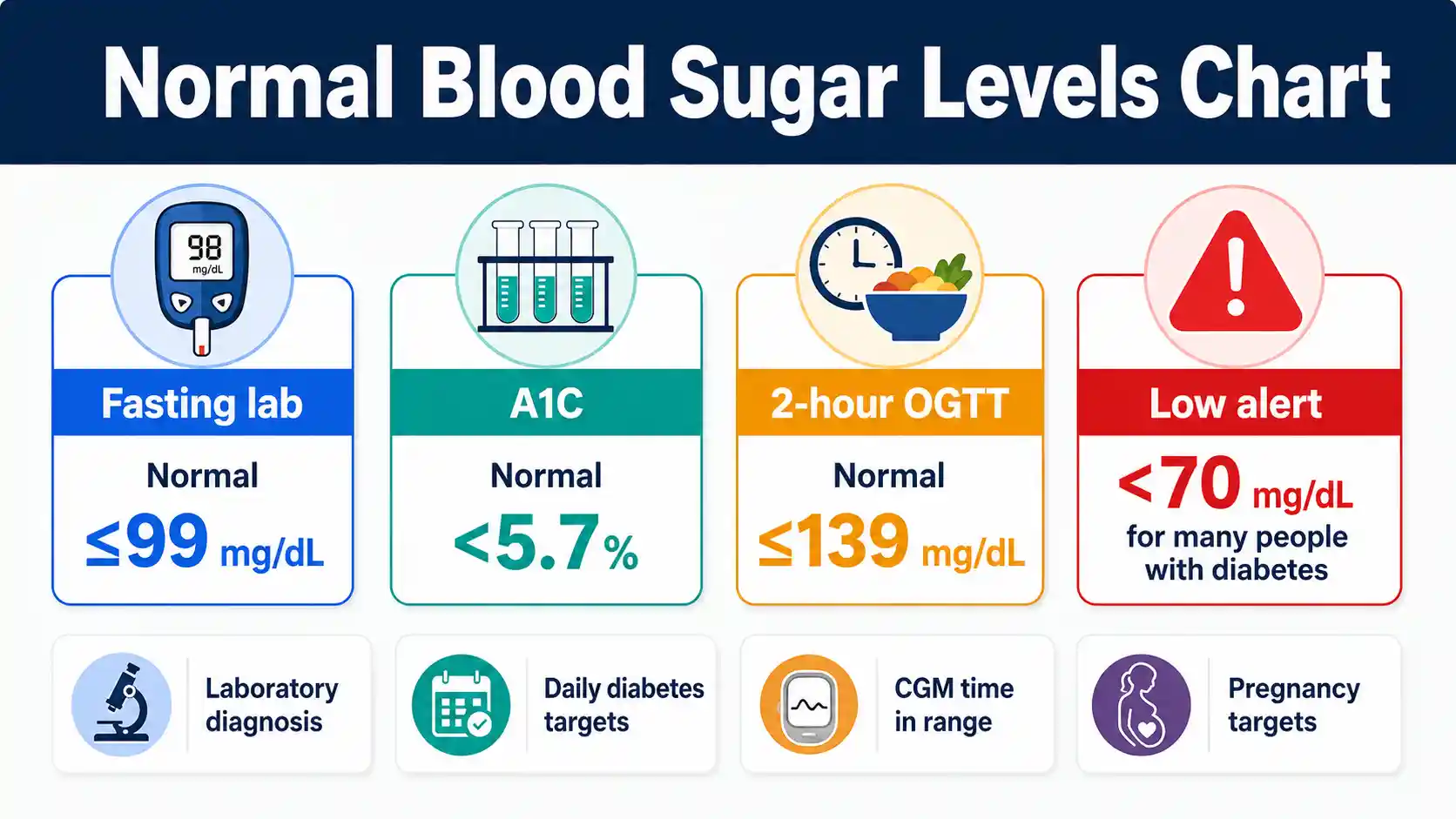
For diabetes screening in a nonpregnant person, normal laboratory results are a fasting plasma glucose of 99 mg/dL or below, a 2-hour 75 g oral glucose tolerance value of 139 mg/dL or below, and an A1C below 5.7%.
The NIDDK diabetes testing guide separates diagnostic laboratory ranges from home monitoring. A home meter target, pregnancy goal, or CGM band answers a different question.
Fasting lab
Normal ≤99 mg/dL
This screening threshold applies to venous plasma after at least 8 hours without calories.
A1C
Normal <5.7%
A1C estimates average glucose exposure over roughly 2–3 months and has important limitations.
2-hour OGTT
Normal ≤139 mg/dL
This value follows a standardized 75 g glucose drink, not an ordinary meal.
Low alert
Often <70 mg/dL
For many people with diabetes, this calls for the prescribed low-glucose response.
Blood Sugar Diagnostic Levels Chart
These laboratory thresholds classify diabetes screening results in people who are not pregnant. A result in the diabetes range usually needs confirmation on another day unless clear symptoms are present.
Swipe horizontally inside the table to view every column.
| Laboratory test | Normal result | Prediabetes range | Diabetes range | Test conditions |
|---|---|---|---|---|
| A1C | Below 5.7% | 5.7%–6.4% | 6.5% or higher — Diabetes diagnostic threshold | No fasting; reflects roughly 2–3 months and requires an appropriate laboratory method for diagnosis |
| Fasting plasma glucose | 99 mg/dL or below (≤5.5 mmol/L) | 100–125 mg/dL (5.6–6.9 mmol/L) — Prediabetes fasting range | 126 mg/dL or higher (≥7.0 mmol/L) — Diabetes fasting threshold | Venous plasma sample after at least 8 hours without calories |
| 2-hour 75 g oral glucose tolerance test | 139 mg/dL or below (≤7.7 mmol/L) | 140–199 mg/dL (7.8–11.0 mmol/L) | 200 mg/dL or higher (≥11.1 mmol/L) — Diabetes oral glucose tolerance threshold | Venous plasma glucose 2 hours after a standardized glucose drink |
| Random plasma glucose | No diagnostic “normal” cutoff | No diagnostic prediabetes cutoff | 200 mg/dL or higher (≥11.1 mmol/L) with classic symptoms | Used for diagnosis when symptoms of high glucose are present |
mg/dL = milligrams per deciliter; mmol/L = millimoles per liter; A1C is reported as a percentage.
- • Do not apply routine nonpregnancy criteria to gestational diabetes screening or pregnancy treatment targets.
- • A home meter or CGM reading is useful for monitoring but does not replace a diagnostic laboratory test.
- • Different tests can disagree, especially early in disease; a clinician may repeat or confirm the abnormal result.
Download or export
Start with the purpose of the glucose number
The same value can mean something different when it comes from a fasting laboratory test, a finger-stick after a meal, a CGM sensor, or pregnancy monitoring.
Screening and diagnosis
Use standardized laboratory A1C, fasting plasma glucose, or a 2-hour oral glucose tolerance test.
Daily diabetes targets
Use the personal premeal, postmeal, A1C, and low-glucose plan set with the diabetes team.
CGM interpretation
Review time in range, time below range, time above range, trends, and symptoms together.
Pregnancy
Use tighter pregnancy-specific targets and the testing protocol selected by the maternity team.
Do not diagnose diabetes from a home meter, compare an ordinary meal with a laboratory glucose drink, or change medicine from a generic chart.
Blood Sugar Levels by Test Time Chart
The meaning of a glucose number changes with test timing, sample type, pregnancy, diabetes status, and whether the number is being used for screening or daily management.
Swipe horizontally inside the table to view every column.
| When or how measured | What the number can show | Common reference | What it cannot establish |
|---|---|---|---|
| Fasting laboratory test | Baseline plasma glucose after an overnight fast | Normal screening result is 99 mg/dL or below — Normal fasting screening result | One unconfirmed result usually does not establish a diagnosis |
| Before a meal at home | Current meter glucose before eating | Many nonpregnant adults with diabetes use an individualized target around 80–130 mg/dL | It is not interchangeable with a fasting diagnostic laboratory result |
| 1–2 hours after starting a meal | The meal-related glucose response | A common upper target for many nonpregnant adults with diabetes is below 180 mg/dL | It is not the same as a 2-hour 75 g oral glucose tolerance test |
| 2 hours after a 75 g glucose drink | Standardized laboratory glucose tolerance | Normal screening result is 139 mg/dL or below | It does not describe an ordinary mixed meal |
| Random laboratory test | Plasma glucose regardless of last meal | 200 mg/dL or higher can support diagnosis when classic symptoms are present — Symptomatic random diagnostic threshold | There is no single random cutoff that defines normal or prediabetes |
| Overnight or during sleep | Patterns that may reveal lows or sustained highs | Use the personal meter or CGM plan set by the diabetes team | One overnight value does not explain the cause of a pattern |
| During illness, stress, or steroid treatment | A temporary or sustained glucose change | Follow the condition-specific monitoring plan | A generic chart cannot replace sick-day or medication instructions |
| After exercise | The immediate and delayed effect of activity | Response varies with activity, food, medicines, and starting glucose | A post-exercise number is not a diagnostic fasting result |
Time all after-meal checks from the beginning of the meal unless the care plan says otherwise.
- • “Normal,” “diagnostic threshold,” and “treatment target” answer different questions and should not be used as synonyms.
- • Meters measure capillary blood; laboratory diagnostic criteria are based on standardized venous samples.
- • Write down the time, relation to food, symptoms, medicines, and unusual activity when a reading is unexpected.
Download or export
Blood Sugar Context and Unit Converter
Convert mg/dL and mmol/L, then compare the value with one clearly selected laboratory, diabetes-management, CGM, or pregnancy reference.
Enter a positive glucose value up to 1000 mg/dL or 55.5 mmol/L. The calculation runs only in your browser; no value is stored or transmitted.
This tool cannot diagnose diabetes, confirm a home reading, assess ketones, or recommend insulin or medicine. Use the prescribed emergency plan for severe symptoms, very low glucose, or possible ketoacidosis.
Diabetes Blood Sugar Target Chart
These are common starting goals for many nonpregnant adults with diabetes. Personal goals may be tighter or less strict based on age, hypoglycemia risk, health conditions, treatment, and preferences.
Swipe horizontally inside the table to view every column.
| Measure | Common goal for many nonpregnant adults | Timing | Why it may be individualized |
|---|---|---|---|
| A1C | Below 7% | Laboratory average over about 2–3 months | Pregnancy, age, complications, severe lows, and red-blood-cell conditions can change the goal or interpretation |
| Estimated average glucose | Below 154 mg/dL | Calculated from an A1C near 7% | It is an estimate and may not match the meter average |
| Premeal plasma glucose | 80–130 mg/dL (4.4–7.2 mmol/L) — Common premeal target | Before eating | Medicine timing, hypoglycemia risk, age, and daily routine matter |
| Postmeal plasma glucose | Below 180 mg/dL (<10.0 mmol/L) — Common postmeal upper target | 1–2 hours after the meal begins | Meal content, pregnancy, medicines, and the reason for checking matter |
| Low-glucose alert level | Below 70 mg/dL (<3.9 mmol/L) for many people — Low glucose alert | Any time | Symptoms, medications, and an individual care plan determine the response |
| CGM target range | 70–180 mg/dL (3.9–10.0 mmol/L) | Across the full day | Pregnancy and high-risk groups use different ranges or time goals |
These values are management goals, not diagnostic criteria for someone without diabetes.
- • Never change insulin or another glucose-lowering medicine from this chart alone.
- • Repeated lows, wide swings, or values outside the personal plan should be reviewed with the diabetes care team.
- • Children, adolescents, older adults, pregnancy, and people with major health conditions need individualized targets.
Download or export
Diabetes targets guide treatment; they do not diagnose diabetes
The American Diabetes Association glucose-monitoring guide gives 80–130 mg/dL before meals and below 180 mg/dL one to two hours after eating as common goals for many nonpregnant adults. Age, health, severe-low risk, treatment, and personal priorities can change those goals.
Pregnancy Blood Sugar Target Chart
Pregnancy uses tighter and pregnancy-specific glucose goals. The obstetric and diabetes teams should set the exact plan for preexisting diabetes or gestational diabetes.
Swipe horizontally inside the table to view every column.
| Measurement time | Commonly recommended target | Metric equivalent | Important context |
|---|---|---|---|
| Fasting, before meals, bedtime, and overnight | 70–95 mg/dL — Pregnancy fasting target | 3.9–5.3 mmol/L | The personal lower limit and overnight plan should be confirmed with the care team |
| 1 hour after eating | 110–140 mg/dL — Pregnancy one-hour target | 6.1–7.8 mmol/L | Time from the start of the meal and use the plan chosen by the pregnancy team |
| 2 hours after eating | 100–120 mg/dL — Pregnancy two-hour target | 5.6–6.7 mmol/L | Do not substitute a one-hour limit for a two-hour limit |
| CGM pregnancy range | 63–140 mg/dL | 3.5–7.8 mmol/L | Time-in-range goals depend on diabetes type, treatment, and pregnancy plan |
| A1C during pregnancy | Individualized; not the best day-to-day monitor | Reported as % or mmol/mol | Pregnancy changes A1C interpretation, and glucose challenge or tolerance testing diagnoses gestational diabetes |
| After delivery | Targets and medicine needs may change quickly | Use the postpartum plan | Glucose can fall rapidly after delivery, especially when insulin was used |
Pregnancy targets are treatment goals, not the screening thresholds used to diagnose gestational diabetes.
- • Gestational diabetes tests use a defined glucose drink and protocol; screening thresholds depend on the protocol.
- • Contact the maternity or diabetes team for repeated readings outside the personal range.
- • Do not use nonpregnancy meter targets to self-adjust treatment during pregnancy.
Download or export
Pregnancy needs a separate glucose plan
The NIDDK diabetes and pregnancy guide lists tighter fasting, after-meal, and CGM targets. Gestational diabetes screening follows a defined protocol, while treatment monitoring follows the individualized maternity and diabetes plan.
CGM Time in Range Chart
Continuous glucose monitoring is interpreted by time spent in ranges, glucose variability, data completeness, symptoms, and treatment context—not by one isolated sensor value.
Swipe horizontally inside the table to view every column.
| CGM band or metric | Glucose range | Consensus goal for many adults with type 1 or type 2 diabetes | Interpretation |
|---|---|---|---|
| Time in range | 70–180 mg/dL (3.9–10.0 mmol/L) | More than 70% of readings — Common time-in-range goal | The main day-to-day target band for many nonpregnant adults |
| Time below range, level 1 | 54–69 mg/dL (3.0–3.8 mmol/L) | Part of less than 4% below 70 mg/dL | Signals clinically important exposure to low glucose |
| Time below range, level 2 | Below 54 mg/dL (<3.0 mmol/L) — Very low CGM range | Less than 1% | Requires prompt attention because risk rises at very low glucose |
| Time above range, level 1 | 181–250 mg/dL (10.1–13.9 mmol/L) | Part of less than 25% above 180 mg/dL | Shows time above the common target band |
| Time above range, level 2 | Above 250 mg/dL (>13.9 mmol/L) — Very high CGM range | Less than 5% | Shows exposure to very high sensor glucose |
| Pregnancy CGM target range | 63–140 mg/dL (3.5–7.8 mmol/L) | Set with the pregnancy diabetes team | Pregnancy uses a different range and condition-specific time goals |
| Older or high-risk person | Individualized | May prioritize reducing time below range | Frailty, cognitive impairment, comorbidity, and severe-low risk change goals |
CGM measures interstitial glucose and may lag behind blood glucose when levels change rapidly.
- • Review several days of sufficient CGM data rather than judging control from one reading.
- • Confirm an unexpected sensor result with the device-recommended method when symptoms and the sensor do not match.
- • Alarm settings are safety tools and should follow the prescribed plan.
Download or export
Low Blood Sugar Levels Chart
Low glucose is especially relevant for people using insulin or medicines that can cause hypoglycemia. Symptoms and ability to self-treat determine urgency.
Swipe horizontally inside the table to view every column.
| Level or event | Glucose reference | Possible signs | What to do |
|---|---|---|---|
| Low-glucose alert | Below 70 mg/dL (<3.9 mmol/L) for many people with diabetes — Low glucose alert | Shaking, sweating, hunger, headache, fast heartbeat, dizziness, irritability | Follow the prescribed low-glucose plan promptly and recheck as directed |
| Clinically significant low | Below 54 mg/dL (<3.0 mmol/L) — Clinically significant low glucose | Confusion, weakness, impaired speech or vision; symptoms may be absent | Treat promptly according to the diabetes plan and review recurrent episodes with the care team |
| Severe hypoglycemia | No glucose number is required | The person needs help because of confusion, seizure, unconsciousness, or inability to swallow safely | Use prescribed rescue glucagon if available and get emergency help; never give food or drink to an unconscious person — Emergency response |
| Nighttime low | Below the personal lower limit during sleep | Sweating, nightmares, restless sleep, morning headache, unusual fatigue or confusion | Review the overnight pattern, medicines, food, activity, and alarms with the diabetes team |
| Symptoms with a “normal” reading | Reading may be above 70 mg/dL | Low-like symptoms during rapid glucose decline or after long periods of high glucose | Check again using proper technique and seek clinical advice if symptoms are severe or persistent |
| Low reading without diabetes medicine | Below the laboratory or meter reference | Symptoms may or may not be present | Unexpected or recurrent lows need medical evaluation rather than self-diagnosis from a chart |
The personal low threshold may differ. Use the emergency and treatment plan supplied by the health care team.
- • NIDDK advises 15–20 grams of glucose or carbohydrate for many people who are below their target or below 70 mg/dL, followed by a recheck after 15 minutes; individual instructions can differ.
- • Do not delay emergency care for seizure, unconsciousness, inability to swallow, or failure to recover.
- • Repeated lows may require changes to medicines, meals, activity, alcohol use, or monitoring.
Download or export
Symptoms and ability to self-treat determine low-glucose urgency
The NIDDK hypoglycemia guide identifies below 70 mg/dL as low for many people with diabetes. A seizure, unconsciousness, inability to swallow, or need for another person to assist is a severe event even when no glucose number is available.
Blood Glucose Measurement Methods Chart
Laboratory plasma glucose, finger-stick meters, CGMs, and A1C answer different questions. Results should be compared only when the method and timing are understood.
Swipe horizontally inside the table to view every column.
| Method | Sample or signal | Best use | Key limitation |
|---|---|---|---|
| Fasting plasma glucose | Venous plasma measured by a laboratory | Diabetes and prediabetes screening or diagnosis — Diagnostic method | Requires an 8-hour fast and usually confirmation of an abnormal result |
| Oral glucose tolerance test | Venous plasma before and after a standardized glucose drink | Detecting impaired glucose tolerance and protocol-based pregnancy testing | Time-consuming; ordinary meals are not equivalent to the glucose drink |
| Random plasma glucose | Venous plasma without fasting | Rapid assessment when classic high-glucose symptoms are present | No standard random cutoff defines normal or prediabetes |
| Finger-stick glucose meter | Capillary blood applied to a test strip | Immediate self-monitoring and treatment decisions under a care plan | Technique, strip quality, substances, circulation, and environment can affect the result |
| Continuous glucose monitor | Sensor estimate from interstitial fluid | Trends, alerts, overnight patterns, and time in range | May lag during rapid change; a sensor value is not a diagnostic laboratory result |
| A1C laboratory test | Percentage of hemoglobin with attached glucose | Average glucose exposure over about 2–3 months | Anemia, blood loss, transfusion, kidney disease, pregnancy, and hemoglobin variants can alter accuracy |
| Point-of-care A1C | Office or clinic device | Convenient monitoring when appropriate | NIDDK says point-of-care A1C should not be used to diagnose diabetes — Not for diagnosis |
| Noninvasive watch or ring claim | No skin-piercing glucose estimate | No FDA-authorized standalone smartwatch or smart ring measures glucose | Do not rely on unauthorized devices for glucose decisions — Unauthorized measurement risk |
U.S. meters usually report mg/dL; many other systems report mmol/L.
- • Use the same method and consistent timing when comparing trends.
- • If symptoms do not match a meter or sensor result, repeat the test using device instructions and seek help when symptoms are serious.
- • Bring the meter, CGM report, medicine list, and written context to clinical visits.
Download or export
Repeat an unexpected meter result with careful technique
The FDA glucose-monitoring device guide advises washing and drying hands, using valid compatible strips, following device instructions, and considering dehydration, anemia, medicines, altitude, temperature, humidity, storage, and alternate-site testing.
Blood Sugar Warning Signs Chart
A glucose value gains urgency from symptoms, pregnancy, diabetes type, medicines, ketones, hydration, and the person’s written care plan.
Swipe horizontally inside the table to view every column.
| Situation | Possible warning signs | Why it matters | Next step |
|---|---|---|---|
| Severe low glucose | Seizure, unconsciousness, inability to swallow, severe confusion, or need for another person’s help | The brain may not have enough glucose to function safely | Use prescribed rescue treatment and call emergency services — Emergency low-glucose response |
| High glucose with possible ketoacidosis | Vomiting, abdominal pain, deep or difficult breathing, fruity breath, severe dehydration, drowsiness, or confusion | Ketoacidosis can become life-threatening, especially with type 1 diabetes | Follow the emergency and ketone plan and seek urgent medical care — Possible ketoacidosis emergency |
| High glucose with severe dehydration | Extreme thirst, frequent urination, weakness, dry mouth, altered alertness | Very high glucose can cause dangerous fluid and electrolyte loss | Use the sick-day plan and obtain urgent care for marked symptoms or confusion |
| Pregnancy with repeated out-of-range readings | Repeated highs or lows, vomiting, inability to eat, reduced fetal movement, or feeling acutely unwell | Pregnancy targets are tighter and treatment needs may change quickly | Contact the maternity or diabetes team promptly; use emergency services for severe symptoms |
| Child or teen with diabetes symptoms | Excessive thirst, frequent urination, weight loss, fatigue, vomiting, or rapid breathing | Type 1 diabetes can develop quickly and may first appear with ketoacidosis | Arrange urgent medical assessment; use emergency care for vomiting, breathing change, or drowsiness — Urgent pediatric assessment |
| Unexpected meter result | The value conflicts with symptoms or changes sharply without explanation | Food on fingers, strip problems, dehydration, anemia, medicines, temperature, or site choice can distort readings | Wash and dry hands, repeat with valid supplies, follow device instructions, and seek care if symptoms remain concerning |
| Repeated fasting or A1C result in a high-risk range | Often no symptoms | Prediabetes and type 2 diabetes can be silent | Arrange standardized testing and clinical interpretation rather than relying on home readings alone |
| New recurrent lows | Shaking, sweating, confusion, nighttime symptoms, or readings below the personal limit | The medicine, meal, activity, alcohol, kidney function, or illness plan may need adjustment | Review the pattern promptly with the prescribing or diabetes team |
Emergency symptoms take priority over calculator output or a generic reference range.
- • Do not drive when glucose is low or when confusion, impaired vision, or severe weakness is present.
- • People with diabetes should use their written low-glucose, high-glucose, ketone, and sick-day plans.
- • A chart cannot determine whether an abnormal reading comes from diabetes, another illness, a medicine, or measurement error.
Download or export
Frequently asked questions
What is a normal fasting blood sugar level?
For diabetes screening in a person who is not pregnant, a laboratory fasting plasma glucose of 99 mg/dL or below is classified as normal. That is about 5.5 mmol/L or below. The test requires at least 8 hours without calories.
Is 100 mg/dL a normal fasting blood sugar?
A fasting laboratory value of 100 mg/dL is the lower boundary of the prediabetes range used in U.S. criteria. One result does not diagnose a condition, and home meter values are not interchangeable with standardized laboratory testing.
What is a normal blood sugar two hours after a glucose test?
For a standardized 75 g oral glucose tolerance test in a nonpregnant person, a 2-hour laboratory value of 139 mg/dL or below is classified as normal. Ordinary meals do not reproduce this diagnostic test.
What should blood sugar be after eating?
There is no single after-meal number that applies to everyone. A common goal for many nonpregnant adults with diabetes is below 180 mg/dL one to two hours after the meal starts. Pregnancy and individual care plans use different targets.
Is a blood sugar below 70 mg/dL dangerous?
Below 70 mg/dL is a low-glucose alert level for many people with diabetes, while below 54 mg/dL is clinically significant. Severe confusion, seizure, unconsciousness, or inability to swallow is an emergency regardless of the displayed number.
Does a random blood sugar of 200 mg/dL mean diabetes?
A random plasma glucose of 200 mg/dL or higher can diagnose diabetes when classic high-glucose symptoms are present. Without that symptom context, clinicians usually use or repeat standardized testing before making a diagnosis.
Are normal blood sugar levels different by age?
The standard laboratory thresholds used to diagnose diabetes do not simply rise with age. Daily treatment goals can differ for children, older adults, pregnancy, people at high risk of hypoglycemia, and people with complex health conditions.
Are pregnancy blood sugar targets different?
Yes. NIDDK lists commonly recommended pregnancy targets of 70–95 mg/dL fasting or before meals, 110–140 mg/dL one hour after eating, and 100–120 mg/dL two hours after eating. The pregnancy care team should set the personal plan.
Can a home glucose meter diagnose diabetes?
No. Home meters support monitoring, but diagnosis uses standardized laboratory testing and usually requires confirmation. Technique, strip quality, temperature, dehydration, anemia, medicines, and other factors can affect meter results.
Why is my CGM different from my finger-stick meter?
A CGM estimates glucose in interstitial fluid, while a meter analyzes a capillary blood sample. Sensor lag, rapid glucose change, compression, timing, and normal device variation can create differences. Follow the device instructions when results conflict with symptoms.
What does 70–180 mg/dL mean on a CGM?
For many nonpregnant adults with type 1 or type 2 diabetes, 70–180 mg/dL is the standard CGM target range. Consensus goals often emphasize spending more than 70% of time in that band while minimizing lows and very high readings.
Can A1C be normal when glucose readings are high?
Yes. A1C and glucose tests can disagree. Recent changes, anemia, blood loss, transfusion, kidney disease, pregnancy, hemoglobin variants, and differences in red-blood-cell lifespan can affect A1C. Clinicians may repeat or compare tests.
How do I convert mg/dL to mmol/L?
For glucose, divide mg/dL by about 18 to estimate mmol/L. Multiply mmol/L by about 18 to estimate mg/dL. The converter on this page uses 18.0182 and rounds the displayed result.
Why can blood sugar change from one check to the next?
Food, activity, stress, sleep, illness, hormones, medicines, hydration, alcohol, and test technique can all change a reading. Compare values taken under similar conditions and focus on repeated patterns rather than one isolated number.
When should an abnormal blood sugar reading get urgent help?
Get emergency help for seizure, unconsciousness, inability to swallow, severe confusion, deep or difficult breathing, repeated vomiting, marked dehydration, or possible ketoacidosis. Follow the personal emergency plan when one is available.
Sources
These diabetes, laboratory-testing, pregnancy, hypoglycemia, CGM, and device-safety resources support the ranges and interpretation guidance presented on this page.
National Institute of Diabetes and Digestive and Kidney Diseases — Diabetes Tests & Diagnosis
https://www.niddk.nih.gov/health-information/diabetes/overview/tests-diagnosis
Defines laboratory A1C, fasting plasma glucose, 2-hour oral glucose tolerance, and symptomatic random plasma glucose criteria for normal results, prediabetes, and diabetes.
Centers for Disease Control and Prevention — Diabetes Testing
https://www.cdc.gov/diabetes/diabetes-testing/index.html
Explains diabetes screening tests, diagnostic cutoffs, fasting requirements, gestational diabetes screening, and how each test is performed.
American Diabetes Association — Check Your Blood Glucose
https://diabetes.org/living-with-diabetes/treatment-care/checking-your-blood-sugar
Provides common A1C, premeal, and postmeal glucose targets for many nonpregnant adults with diabetes while emphasizing individualized goals.
National Institute of Diabetes and Digestive and Kidney Diseases — Low Blood Glucose (Hypoglycemia)
https://www.niddk.nih.gov/health-information/diabetes/overview/preventing-problems/low-blood-glucose-hypoglycemia
Defines low glucose for many people with diabetes, describes symptoms and severe events, and gives immediate response guidance.
National Institute of Diabetes and Digestive and Kidney Diseases — Pregnancy if You Have Diabetes
https://www.niddk.nih.gov/health-information/diabetes/diabetes-pregnancy
Lists commonly recommended glucose targets during pregnancy and explains why pregnancy targets and monitoring differ.
National Institute of Diabetes and Digestive and Kidney Diseases — Clinical Targets for Continuous Glucose Monitoring Data
https://www.niddk.nih.gov/health-information/professionals/diabetes-discoveries-practice/clinical-targets-for-continuous-glucose-monitoring-data
Summarizes consensus CGM time-in-range, time-below-range, and time-above-range goals for many people with type 1 or type 2 diabetes.
U.S. Food and Drug Administration — Blood Glucose Monitoring Devices
https://www.fda.gov/medical-devices/in-vitro-diagnostics/blood-glucose-monitoring-devices
Explains meter use, units, testing technique, strip handling, alternate-site limitations, and medical or environmental factors that can affect a reading.
National Institute of Diabetes and Digestive and Kidney Diseases — The A1C Test & Diabetes
https://www.niddk.nih.gov/health-information/diagnostic-tests/a1c-test
Explains what A1C measures, diagnostic thresholds, confirmation requirements, and conditions that can make A1C misleading.