Health & Medical · Reproductive health
Ovulation Chart for Fertile Days, Signs, LH Tests and Timing
Compare cycle-day estimates, fertile-window timing, hormone changes, cervical mucus, ovulation predictor kits, basal temperature patterns, symptoms, and reasons ovulation may shift.
Seek urgent care for sudden or severe pelvic pain, fainting, shoulder pain, fever, persistent vomiting, or heavy bleeding—especially when pregnancy is possible. A cycle estimate cannot exclude an ectopic pregnancy or identify the cause of acute pain. Read the ChartsLoom Disclaimer.
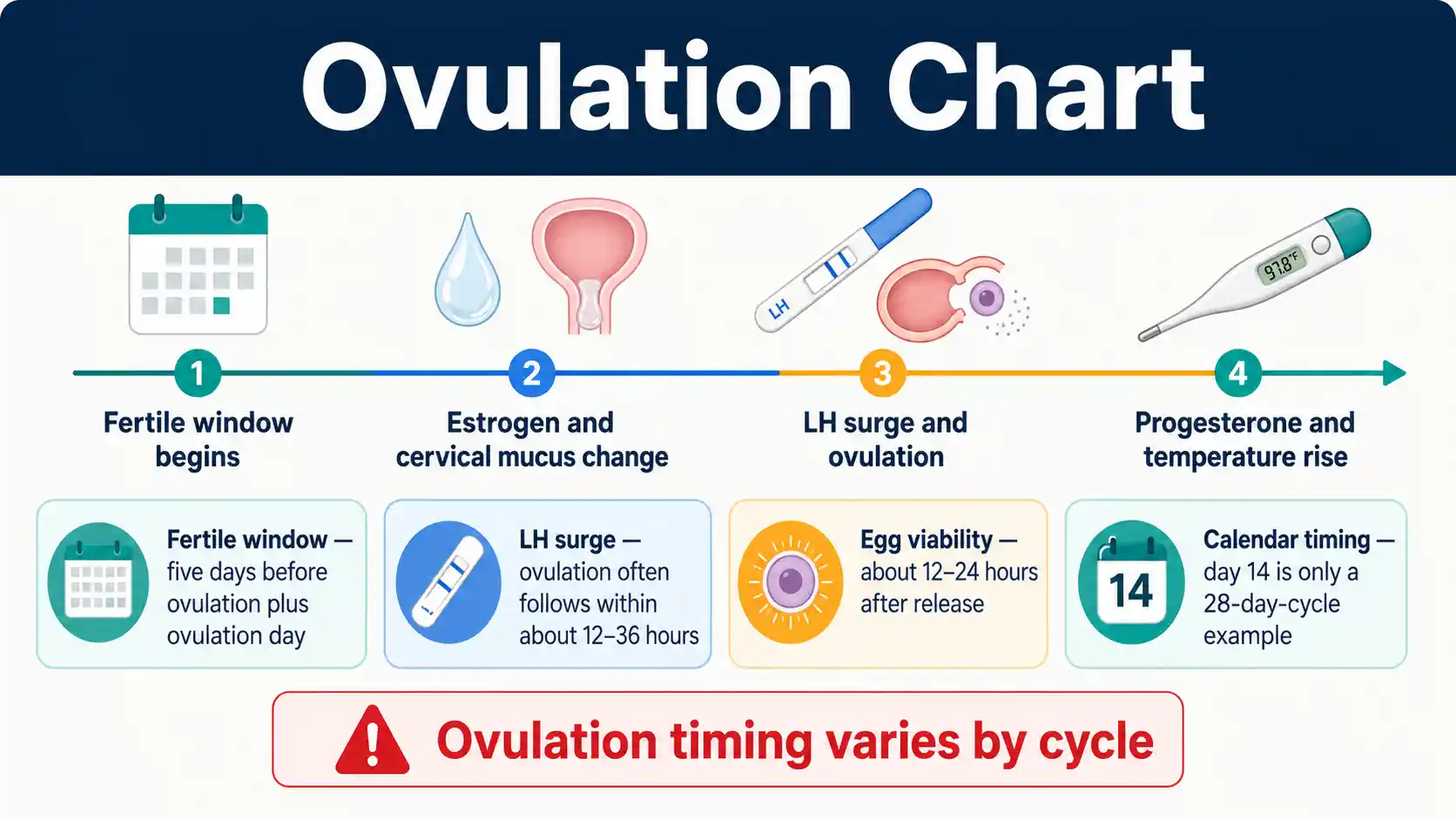
When does ovulation occur?
Ovulation often occurs about 14 days before the next menstrual period, not necessarily on cycle day 14. The fertile window commonly includes ovulation day and the five days before it.
The ACOG guide to fertile timing explains why sex before ovulation can lead to pregnancy: sperm may survive for several days, while the released egg remains viable for a much shorter period.
Calendar estimate
Next period − 14 days
A planning rule of thumb, not a confirmed date or a guarantee of ovulation.
Fertile window
Six-day interval
Commonly defined as the five days before ovulation plus ovulation day.
Urine LH test
Predictive signal
A positive result often precedes ovulation by roughly 12–36 hours.
Temperature shift
Retrospective clue
A sustained rise generally appears after ovulation as progesterone increases.
Estimated Ovulation Timing by Cycle Length Chart
This calendar example subtracts 14 days from the expected next period. It gives a planning estimate, not a confirmed ovulation date.
Swipe horizontally inside the table to view every column.
| Usual cycle length | Estimated ovulation day | Estimated six-day fertile window | Important limitation |
|---|---|---|---|
| 21 days | Cycle day 7 | Days 2–7 | Short cycles can move fertile days close to menstrual bleeding — Fertile timing may overlap bleeding |
| 24 days | Cycle day 10 | Days 5–10 | Ovulation can occur earlier or later than this estimate |
| 26 days | Cycle day 12 | Days 7–12 | A single cycle may differ from the usual length |
| 28 days | Cycle day 14 | Days 9–14 | Day 14 is an example, not a universal ovulation day — Day 14 is only an example |
| 30 days | Cycle day 16 | Days 11–16 | Calendar timing does not detect an LH surge or egg release |
| 32 days | Cycle day 18 | Days 13–18 | The follicular phase can shift between cycles |
| 35 days | Cycle day 21 | Days 16–21 | Longer cycles may still ovulate at a different time |
| 38 days | Cycle day 24 | Days 19–24 | Variable or infrequent cycles make the estimate less reliable — Calendar estimate is less reliable with variable cycles |
Cycle day 1 is the first day of full menstrual bleeding. Estimated ovulation day = usual cycle length − 14.
- • The fertile window shown is the estimated ovulation day plus the five preceding days.
- • Real luteal-phase length and follicular timing vary; even regular cycles do not guarantee one fixed date.
- • Do not use a generic calendar estimate as proof of ovulation or as a stand-alone contraceptive method.
Download or export
How the fertile window surrounds ovulation
The fertile window begins before egg release. Predictive signs such as cervical mucus and urinary LH appear before ovulation, while a sustained temperature rise is usually observed afterward.
Five days before
Fertile window can begin because sperm may remain viable
Approaching ovulation
Estrogen rises, cervical mucus changes, and the LH surge develops
Ovulation
A mature follicle releases an egg after the LH surge
After ovulation
Progesterone rises and basal temperature may shift upward
One calendar date, symptom, or test result cannot prove the exact moment of ovulation. Combine observations when useful and interpret them across several cycles.
Fertile Window Relative to Ovulation Chart
Pregnancy can result from sex before ovulation because sperm may remain viable while waiting for the egg. The highest-fertility days are generally close to ovulation.
Swipe horizontally inside the table to view every column.
| Timing | Biological context | Fertility interpretation | Tracking implication |
|---|---|---|---|
| 5 days before ovulation | Sperm may survive until egg release | Possible fertile day | The fertile window can begin earlier than symptoms or an LH result |
| 4 days before | Viable sperm may remain in the reproductive tract | Fertile day | Calendar prediction alone may miss a shifted window |
| 3 days before | Cervical mucus may become wetter and more sperm-friendly | Higher-fertility interval | Mucus change can precede a positive urine LH test |
| 2 days before | Ovulation is approaching in an ovulatory cycle | Often among the most fertile days — High-fertility interval | Combining mucus and LH observations can improve timing awareness |
| 1 day before | Sperm can be present before egg release | Often among the most fertile days — High-fertility interval | A positive LH test commonly appears near this interval |
| Ovulation day | The egg is released and remains fertilizable for a limited time | Fertile day | LH predicts; temperature rise usually confirms only afterward |
| 1 day after estimated ovulation | The egg usually survives only about 12–24 hours | Fertility falls quickly | An estimated date may be wrong, so timing cannot establish a safe day — Estimated timing cannot define a safe day |
Timing is expressed relative to the actual ovulation event, which may not be known at home.
- • ASRM defines the fertile window for counseling as the six-day interval ending on ovulation day.
- • An egg usually remains viable for about 12–24 hours, while sperm can survive for several days.
- • Pregnancy probability varies with age, reproductive health, semen factors, timing, and chance.
Download or export
Ovulation Window Estimator
Estimate ovulation and fertile-window dates
Enter the first day of full menstrual bleeding and a usual cycle length. The estimator assumes ovulation about 14 days before the next period and a six-day fertile window ending on the estimated ovulation day.
Enter a whole number from 20 to 45. Use your average only when cycles are reasonably consistent.
Enter a start date and cycle length
All calculations stay in your browser. No period date or cycle information is stored or transmitted by this tool.
This is an educational calendar estimate. Actual ovulation can occur earlier, later, or not at all. The result cannot confirm ovulation, diagnose infertility, exclude pregnancy, or identify safe days for unprotected sex.
A calendar estimate is useful for planning, not confirmation
The ASRM guidance on natural fertility notes that calendar apps assume stable timing even though fertile windows vary. Use a calendar to understand trends, then add real-time signs such as cervical mucus or urine LH when more timing context is needed.
Ovulation Hormone and Ovarian Event Timeline
Ovulation is a sequence involving follicle development, rising estrogen, an LH surge, egg release, and progesterone production after ovulation.
Swipe horizontally inside the table to view every column.
| Stage | Hormone pattern | Ovarian or uterine event | What a person may observe |
|---|---|---|---|
| Early follicular phase | FSH supports a group of developing follicles | Menstruation begins and the next follicle cohort develops | Bleeding; often little fertile-type mucus |
| Dominant follicle develops | Estrogen rises as one follicle matures | The uterine lining rebuilds | Mucus may become wetter, clearer, and more slippery |
| Pre-ovulatory interval | Sustained high estrogen helps trigger the LH surge — Estrogen precedes the LH surge | The follicle completes final maturation | Peak-type mucus; urine LH may turn positive |
| LH surge | LH rises sharply, with a smaller FSH rise | The surge triggers processes leading to follicle rupture — LH predicts an approaching event | A urine predictor test may detect the surge |
| Ovulation | Occurs after the LH surge begins | The follicle releases an egg into the fallopian tube | Some feel brief one-sided discomfort; many feel nothing |
| Luteal phase | The corpus luteum produces progesterone | The endometrium becomes secretory and supportive | Basal temperature usually shifts upward after ovulation — Temperature changes after ovulation |
| If pregnancy does not occur | Progesterone and estrogen fall | The corpus luteum regresses and a new period begins | Premenstrual symptoms and then menstrual bleeding may occur |
FSH = follicle-stimulating hormone; LH = luteinizing hormone.
- • A home symptom is an indirect clue; it does not show the follicle releasing an egg.
- • Hormonal contraception can suppress or change this natural sequence.
- • Bleeding can occur in some cycles without ovulation.
Download or export
Ovulation Tracking Methods Comparison Chart
Tracking methods answer different questions. Some estimate fertile days, some predict ovulation, and others provide retrospective or clinical evidence.
Swipe horizontally inside the table to view every column.
| Method | What it measures | Timing | Strength | Main limitation |
|---|---|---|---|---|
| Calendar or app | Past cycle lengths and assumed timing | Estimates before ovulation | Simple overview of personal patterns | Cannot account reliably for a shifted or anovulatory cycle — Calendar estimates can miss shifted ovulation |
| Cervical mucus | Estrogen-related changes in secretion | Fertile signs often begin before ovulation | Low-cost, real-time body sign | Infection, semen, medicines, and inconsistent observation can confuse it |
| Urine LH predictor kit | Rise in urinary luteinizing hormone | Usually predicts ovulation within roughly 12–36 hours — LH predicts approaching ovulation | Useful advance warning in many ovulatory cycles | An LH surge does not guarantee egg release and may be difficult to interpret in PCOS |
| Basal body temperature | Progesterone-related temperature shift | Changes after ovulation — Temperature is retrospective | Can support a retrospective pattern across cycles | Illness, poor sleep, alcohol, shift work, and measurement timing affect readings |
| Mid-luteal progesterone | Progesterone after expected ovulation | Blood test after ovulation | Can support that recent ovulation occurred | One value does not precisely date ovulation or judge egg quality |
| Transvaginal ultrasound | Follicle growth and changes around release | Serial clinical monitoring | Directly observes follicular development | Requires appointments, equipment, cost, and professional interpretation |
Prediction occurs before egg release; confirmation or support generally occurs afterward.
- • Combining cycle history, mucus, and LH may provide more context than one signal alone.
- • Follow the specific kit instructions because test timing, urine concentration, and result display vary.
- • Clinical evaluation may use history, progesterone, ultrasound, or other tests based on the reason for assessment.
Download or export
A positive LH test predicts an approaching event
A urine kit detects the hormonal surge that usually comes before egg release. According to the MedlinePlus ovulation home-test guide, ovulation often follows a positive result within about 24–36 hours, but this does not happen in every person or every positive cycle.
Ovulation Predictor Kit Results Chart
Urine ovulation predictor kits detect an LH rise. Read the control and test indicators exactly as the product instructions describe.
Swipe horizontally inside the table to view every column.
| Result pattern | Usual meaning | Practical interpretation | When to seek guidance |
|---|---|---|---|
| Valid negative | No qualifying LH surge detected in that sample | Continue testing as directed; the surge may be later or brief | Repeated cycles without a positive result or with very irregular periods |
| Approaching high reading on a multi-hormone device | The device detects a pre-surge fertility pattern | Follow the device-specific display and continue testing | Results do not fit the cycle or remain unusual for multiple cycles |
| Valid positive / peak | Urinary LH has reached the kit threshold | Ovulation often follows within about 12–36 hours — Common post-positive timing | A positive result repeats for many days or conflicts with symptoms and cycle history |
| Positive but no later temperature shift | An LH rise occurred, but home signs do not confirm release | The surge may have been followed by ovulation, delayed ovulation, or no release — LH does not confirm egg release | The pattern recurs or conception is not occurring |
| Several positive days | The LH signal may stay above the threshold or fluctuate | Use the first clear positive according to the kit instructions | PCOS, fertility medicine, pregnancy, or other factors may affect results |
| Invalid test | The control indicator failed or the test was not performed correctly — Invalid test needs repeating | Repeat with a new test and follow timing and urine instructions | Frequent invalid results despite correct use |
| No positive result all cycle | The surge may have been missed, occurred outside testing, or not occurred | Review start day, testing time, urine dilution, and cycle variability | No result across repeated cycles, absent periods, or fertility concern |
The exact visual or digital threshold is product-specific.
- • A positive home LH test predicts a hormonal signal; it does not prove follicle rupture or pregnancy.
- • Very dilute urine, missed test days, short surges, and starting too late can miss a rise.
- • Do not change prescribed fertility medicine or injection timing from a generic chart.
Download or export
Basal Body Temperature Ovulation Chart
Basal body temperature is measured immediately after waking and before activity. A sustained upward shift can support that ovulation has already occurred.
Swipe horizontally inside the table to view every column.
| Chart pattern | Possible interpretation | What to record | Important limitation |
|---|---|---|---|
| Lower pre-ovulatory baseline | Follicular-phase temperatures form a personal baseline | Daily value, exact time, and cycle day | There is no universal normal fertility temperature |
| Small sustained rise | Progesterone after ovulation can raise the baseline — Sustained post-ovulatory shift | First higher day and at least the following days | The shift confirms only retrospectively and may be subtle |
| One isolated spike | Illness, alcohol, poor sleep, late measurement, or environment may explain it | Mark the disturbance beside the value | One temperature does not establish ovulation — One spike is not confirmation |
| Interrupted sleep or shift work | Timing and sleep duration can make values difficult to compare | Wake time, sleep interruption, and work schedule | A consistent daily baseline may be hard to obtain |
| Fever or acute illness | Temperature reflects illness rather than reproductive hormones — Fever confounds interpretation | Symptoms, measured fever, and medicine use | Exclude disturbed values from pattern interpretation |
| No clear shift | Ovulation may be delayed, absent, or obscured by measurement factors | Continue the full-cycle record | BBT alone cannot diagnose anovulation |
| Higher values continue past expected period | Can occur in pregnancy but is not diagnostic | Period timing and pregnancy-test date | Use a pregnancy test; temperature cannot confirm pregnancy |
Use the same thermometer, method, approximate time, and site each day.
- • Compare the pattern with the person’s own earlier temperatures rather than a universal cutoff.
- • Take the measurement before getting up, talking, eating, drinking, or using the bathroom.
- • BBT is better for recognizing a past shift than predicting the start of the fertile window.
Download or export
Ovulation Signs and Symptoms Chart
Many people feel no distinct ovulation symptom. When signs occur, timing and recurrence matter more than any single sensation.
Swipe horizontally inside the table to view every column.
| Sign or symptom | Common timing or pattern | What it may suggest | What it cannot prove |
|---|---|---|---|
| Clear, slippery cervical mucus | Often increases in the days before ovulation | Estrogen-related fertile-type secretion — Common pre-ovulatory sign | The exact moment of egg release |
| Positive urine LH test | Usually before expected ovulation | An LH surge is underway | That ovulation definitely occurred |
| Basal temperature shift | Usually after ovulation | Progesterone-related post-ovulatory change | The fertile window before the rise |
| One-sided lower abdominal discomfort | May occur near mid-cycle and last briefly | Possible ovulation pain | That another pelvic cause is absent — Pain has other possible causes |
| Light spotting | Can occur near mid-cycle in some people | A possible cycle-related change | That pregnancy, infection, or another cause is excluded |
| Breast tenderness or bloating | May occur after ovulation or premenstrually | A hormone-related luteal-phase symptom | Ovulation date or pregnancy |
| Increased sexual desire | May cluster near the fertile interval | A subjective cycle-related pattern | A reliable fertility test |
| No symptoms | Common in ovulatory cycles | Nothing abnormal by itself — No symptom can still be normal | That ovulation did or did not happen |
Symptoms are qualitative observations, not laboratory measurements.
- • Track the first and last day of mucus changes, test results, temperatures, bleeding, and pain in the same record.
- • Severe or persistent pelvic pain, fever, fainting, vomiting, or pain with possible pregnancy needs prompt assessment.
- • Vaginal infection, semen, lubricants, medicines, and cervical conditions can change discharge.
Download or export
Estimated non-fertile days are not guaranteed safe days
Ovulation can move even when cycles usually appear regular, and sperm can survive across several days. A generic calculator or chart should not replace a validated contraceptive method or method-specific fertility-awareness instruction.
Delayed or Absent Ovulation Causes Chart
Delayed or absent ovulation can be temporary, medication-related, life-stage related, or associated with an endocrine or reproductive condition.
Swipe horizontally inside the table to view every column.
| Context or possible cause | Cycle clue | Other possible clues | Useful next step |
|---|---|---|---|
| Pregnancy | A period is late or absent | Pregnancy symptoms may be absent or present | Use a pregnancy test when pregnancy is possible — Check pregnancy when possible |
| Postpartum or breastfeeding | Ovulation and periods may return unpredictably | Feeding pattern and time since birth affect timing — Ovulation can precede the first postpartum period | Remember ovulation can occur before the first postpartum period |
| Polycystic ovary syndrome (PCOS) | Long, irregular, or absent cycles | Acne, excess hair growth, or metabolic features may occur | Discuss persistent irregularity and fertility goals with a clinician |
| Thyroid or prolactin disorder | Cycles may become irregular or absent | Weight, energy, temperature tolerance, or milk discharge may change | Clinical history and targeted laboratory testing may be appropriate |
| Low energy availability, major weight change, or intense exercise | Periods may become infrequent or stop | Stress injury, fatigue, or nutrition concerns may coexist | Seek medical and nutrition assessment rather than self-diagnosing |
| Severe stress or acute illness | Ovulation may shift later in one or more cycles | Sleep, appetite, and other symptoms may change | Track recovery and seek care if irregularity persists |
| Perimenopause or primary ovarian insufficiency | Skipped or changing cycles | Hot flashes, sleep change, or vaginal symptoms may occur | Age and symptoms guide timely evaluation |
| Hormonal contraception or fertility medicine | Natural ovulation may be suppressed, altered, or medically timed | Bleeding may not reflect a natural ovulatory cycle | Follow the prescriber’s instructions; generic timing rules do not apply — Use prescriber guidance |
Anovulation means no egg is released during that cycle.
- • Regular bleeding often suggests ovulation but does not prove it, and bleeding can occur without ovulation.
- • A home LH test can be difficult to interpret when baseline LH is elevated or cycles are highly variable.
- • Do not start, stop, or change hormones or fertility medicine based on this chart.
Download or export
Do not label severe pelvic pain as ovulation pain
Brief mild one-sided discomfort can occur near ovulation, but severe, persistent, or worsening pain has other possible causes. Pregnancy possibility, fainting, shoulder pain, fever, vomiting, or heavy bleeding increases the need for urgent assessment.
When to Seek Ovulation or Fertility Care Chart
The appropriate timing depends on age, cycle pattern, symptoms, pregnancy history, known conditions, and how long pregnancy has been attempted.
Swipe horizontally inside the table to view every column.
| Situation | Suggested timing | Why assessment may help | Safety note |
|---|---|---|---|
| Under age 35, no known risk factor | After 12 months of regular unprotected intercourse without pregnancy | A complete fertility evaluation considers both partners | Seek earlier care if cycles or symptoms are concerning |
| Age 35 or older | After 6 months without pregnancy — Six-month evaluation point | Evaluation is accelerated because fertility changes with age | Do not wait for a full year |
| Over age 40 | More immediate consultation may be appropriate | Time-sensitive evaluation can guide options | Arrange individualized advice |
| Irregular, very long, or absent periods | Without delay when trying to conceive or when the pattern is unexplained | The pattern may indicate inconsistent ovulation or another condition | Pregnancy should be considered when biologically possible |
| Known endometriosis, uterine or tubal concern, prior gonadotoxic treatment, or known partner factor | Without delay | A known risk can change the evaluation plan | Assessment is broader than ovulation alone |
| Severe one-sided pelvic pain, fainting, shoulder pain, or heavy bleeding with pregnancy possibility | Urgent or emergency assessment — Emergency pregnancy-related symptoms | These can be warning signs of a serious pregnancy complication | Do not rely on a cycle estimate |
| Sudden severe pelvic pain, fever, persistent vomiting, or rapidly worsening symptoms | Urgent assessment — Urgent pelvic symptoms | Acute pelvic conditions need examination | Home ovulation tracking cannot determine the cause |
Time trying to conceive is counted from regular unprotected intercourse, not from the first tracking cycle.
- • Fertility evaluation includes ovulation, reproductive anatomy, and semen factors when applicable.
- • Earlier assessment is reasonable whenever medical history, symptoms, or prior treatment suggests a fertility risk.
- • This timing guidance does not replace urgent care for severe symptoms.
Download or export
Frequently asked questions
What is ovulation?
Ovulation is the release of a mature egg from an ovarian follicle. It follows a coordinated rise in estrogen and luteinizing hormone and marks the transition from the follicular phase to the luteal phase.
What day does ovulation usually happen?
Ovulation often occurs about 14 days before the next period, but it is not always on cycle day 14. A shorter, longer, or variable follicular phase can move ovulation earlier or later.
How long is the fertile window?
For counseling, the fertile window is commonly defined as the six days ending on ovulation day. Sperm can survive for several days, while the egg is usually fertilizable for about 12 to 24 hours after release.
Can I get pregnant five days before ovulation?
Yes. Pregnancy is possible because sperm may remain viable in the reproductive tract until the egg is released. The probability generally rises as intercourse occurs closer to ovulation.
Does a positive ovulation test mean I definitely ovulated?
No. A positive urine test detects an LH surge and usually predicts that ovulation is approaching, but it does not prove that the follicle released an egg. Repeated patterns or clinical tests may provide additional evidence.
How soon after a positive LH test does ovulation occur?
Ovulation commonly occurs within roughly 12 to 36 hours after a urinary LH surge is detected, but individual timing and kit thresholds vary. Follow the instructions supplied with the test.
Does basal body temperature predict ovulation?
Basal body temperature is mainly retrospective. Progesterone usually produces a small sustained rise after ovulation, so the chart can support that ovulation already occurred but may not identify the fertile window early enough by itself.
What does fertile cervical mucus look like?
Near ovulation, cervical mucus often becomes wetter, clearer, slippery, and stretchable. Infection, semen, lubricants, medicines, and other factors can alter discharge, so appearance alone does not confirm ovulation.
Can ovulation cause one-sided pelvic pain?
Some people notice brief one-sided mid-cycle discomfort, sometimes called mittelschmerz. Severe, persistent, or worsening pain, especially with fever, fainting, vomiting, heavy bleeding, or possible pregnancy, needs prompt assessment.
Can I ovulate without noticing any symptoms?
Yes. Many ovulatory cycles produce no obvious pain, discharge change, or other symptom. The absence of symptoms alone does not show whether ovulation occurred.
Can I have a period without ovulating?
Bleeding can occur without ovulation, although regular predictable cycles often suggest ovulatory cycles. Persistent irregular, very long, or absent cycles deserve clinical discussion.
Why might I not ovulate every month?
Pregnancy, breastfeeding, PCOS, thyroid or prolactin disorders, low energy availability, major weight change, intense exercise, stress, illness, perimenopause, ovarian insufficiency, and some medicines can alter ovulation.
Can an ovulation calculator prevent pregnancy?
No. A calculator estimates dates from past or assumed cycle timing and cannot identify a safe day with certainty. Use a validated contraceptive method and method-specific guidance when pregnancy prevention is the goal.
When should I seek help for irregular ovulation?
Seek assessment without delay when periods are absent or markedly irregular, a known condition may affect fertility, or concerning pain or bleeding occurs. When trying to conceive, evaluation is generally recommended after 12 months if under 35 and after 6 months if 35 or older.
Can I ovulate before my first postpartum period?
Yes. Ovulation can return before the first postpartum menstrual period, so pregnancy is possible before bleeding resumes. Breastfeeding can delay ovulation but does not always suppress it reliably.
Sources
These reproductive-health resources support the ovulation timing, fertile-window, hormone, tracking, home-test, symptom, anovulation, and fertility-evaluation guidance.
American College of Obstetricians and Gynecologists — Trying to Get Pregnant? Here’s When to Have Sex
https://www.acog.org/womens-health/experts-and-stories/the-latest/trying-to-get-pregnant-heres-when-to-have-sex
Explains the fertile interval, survival of sperm and the egg, cycle-day counting, and why ovulation timing varies.
American College of Obstetricians and Gynecologists — Fertility Awareness-Based Methods of Family Planning
https://www.acog.org/womens-health/faqs/fertility-awareness-based-methods-of-family-planning
Describes calendar, cervical-mucus, temperature, and standard-days approaches, including limitations and pregnancy-prevention context.
Office on Women’s Health — Your Menstrual Cycle
https://womenshealth.gov/menstrual-cycle/your-menstrual-cycle
Covers cycle length, ovulation, cervical mucus, egg and sperm survival, hormones, and normal variation.
Office on Women’s Health — Trying to Conceive
https://womenshealth.gov/pregnancy/you-get-pregnant/trying-conceive
Explains calendar tracking, basal body temperature, cervical mucus, and factors that can distort temperature observations.
MedlinePlus Medical Encyclopedia — Ovulation Home Test
https://medlineplus.gov/ency/article/007062.htm
Explains urinary LH testing, common result interpretation, timing, and why a positive result does not guarantee ovulation.
American Society for Reproductive Medicine — Ovulation Detection
https://www.reproductivefacts.org/news-and-publications/fact-sheets-and-infographics/ovulation-detection/
Compares urinary LH kits, basal body temperature, progesterone testing, and ultrasound for predicting or confirming ovulation.
American Society for Reproductive Medicine — Optimizing Natural Fertility
https://www.asrm.org/practice-guidance/practice-committee-documents/optimizing-natural-fertility-a-committee-opinion-2021/
Defines the six-day fertile window ending on ovulation and reviews the accuracy and limits of fertility-tracking methods.
American Society for Reproductive Medicine — Fertility Evaluation of Infertile Women
https://www.asrm.org/practice-guidance/practice-committee-documents/fertility-evaluation-of-infertile-women-a-committee-opinion-2021/
Provides evidence-based timing for fertility evaluation and situations that warrant assessment without delay.