Biology and botany reference
Plant Classification Chart
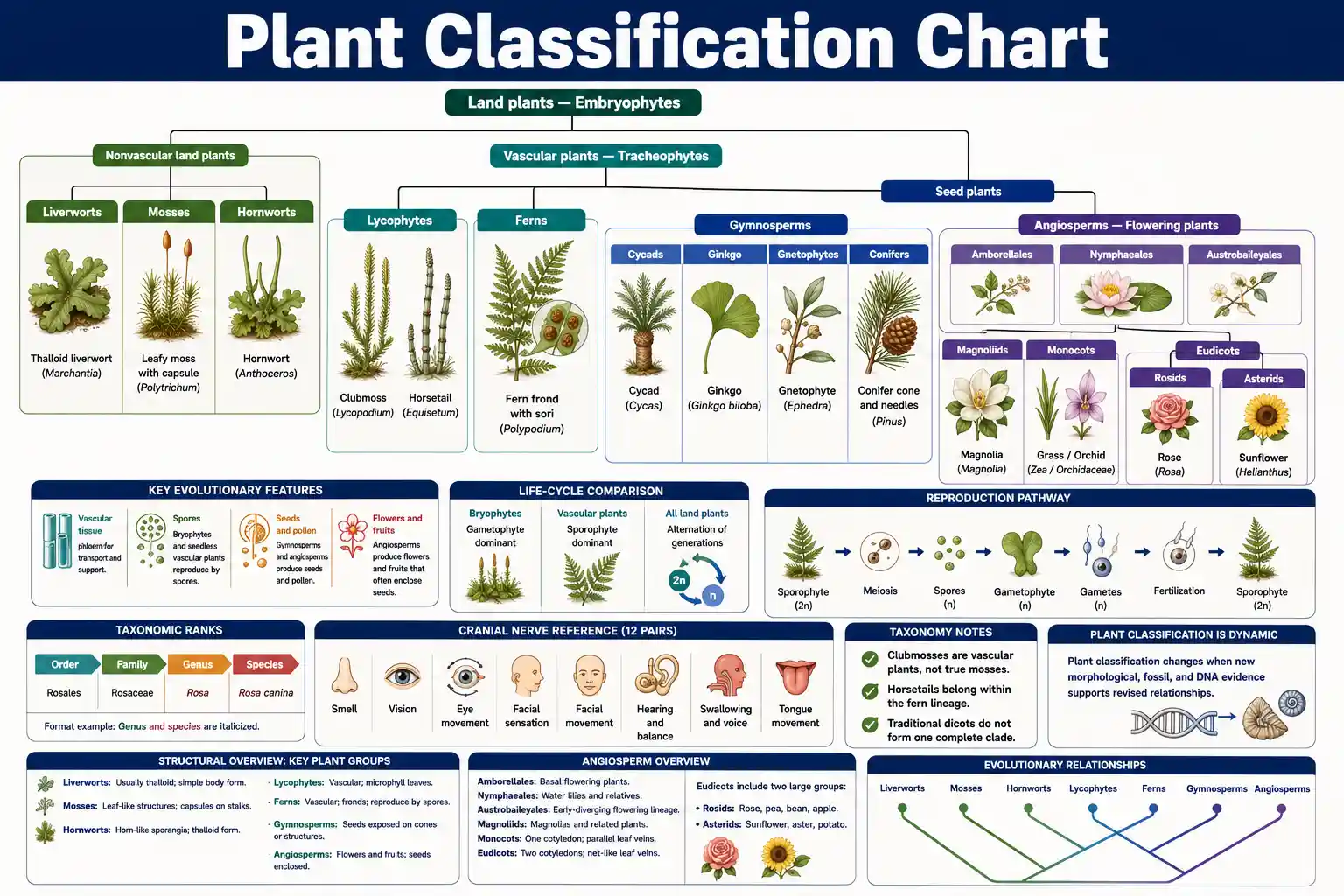
This plant classification chart compares bryophytes, lycophytes, ferns, gymnosperms, and flowering plants through vascular tissue, spores, seeds, flowers, life cycles, clades, and taxonomic ranks.
Plant classification changes as new morphological, fossil, and molecular evidence becomes available. Use an authoritative current backbone for accepted names and precise family, genus, or species placement.
How are plants classified?
Modern plant classification groups organisms by common ancestry. Broad educational charts compare vascular tissue, spores, seeds, pollen, flowers, fruits, and life-cycle dominance, while formal taxonomy assigns accepted names and ranks such as order, family, genus, and species.
Land plants
Embryophytes
Land plants retain and nourish a multicellular embryo during early development.
Vascular plants
Tracheophytes
Lycophytes, ferns, gymnosperms, and angiosperms possess specialized xylem and phloem.
Seed plants
Gymnosperms + angiosperms
Pollen and seeds protect reproductive stages and reduce dependence on free water.
Flowering plants
Angiosperms
Flowers contain carpels that enclose ovules, and mature seeds are usually enclosed by fruit.
Essential plant-classification questions
These direct answers establish the distinctions needed to read the detailed charts correctly.
What are the main plant groups?
Major land-plant lineages include liverworts, mosses, hornworts, lycophytes, ferns, gymnosperms, and angiosperms.
What makes a plant vascular?
Vascular plants contain specialized xylem and phloem that transport water, minerals, and sugars through the plant body.
Which plants reproduce with spores?
Bryophytes, lycophytes, and ferns disperse through spores rather than seeds.
Which plants produce seeds?
Gymnosperms and angiosperms are seed plants.
Which plants produce flowers?
Only angiosperms produce true flowers and ovary-derived fruits.
Are bryophytes one formal taxon?
Not necessarily. Bryophytes is a useful collective term for liverworts, mosses, and hornworts, which are three distinct lineages.
Are clubmosses true mosses?
No. Clubmosses are vascular lycophytes, while true mosses are nonvascular bryophytes.
Are horsetails ferns?
Yes. PPG I places horsetails within the fern lineage Polypodiopsida.
What separates gymnosperms and angiosperms?
Gymnosperm ovules remain unenclosed, while angiosperm ovules develop inside carpels.
Are all flowering plants monocots or eudicots?
No. Several early-diverging angiosperm lineages and magnoliids lie outside one or both categories.
What does a clade mean?
A clade includes a common ancestor and all of its descendants.
Can plant classification change?
Yes. Accepted names, family boundaries, and relationships can change when new evidence supports a revised classification.
Major Land-Plant Groups and Defining Traits
This broad chart organizes living land plants by vascular tissue, spores or seeds, flowers, and dominant life-cycle generation.
Swipe horizontally inside the table to view every column.
| Group | Vascular tissue | Main dispersal unit | Dominant generation | Representative examples | Key distinction |
|---|---|---|---|---|---|
| Liverworts | No true xylem or phloem | Spores | Gametophyte — Gametophyte dominant | Marchantia and leafy liverworts | Thalloid or leafy gametophytes; sporophytes remain attached |
| Mosses | No true xylem or phloem | Spores | Gametophyte | Sphagnum and Polytrichum | Leafy shoots with capsule-bearing sporophytes |
| Hornworts | No true xylem or phloem | Spores | Gametophyte | Anthoceros and relatives | Horn-like sporophyte grows from a basal meristem |
| Lycophytes | Present — Vascular tissue present | Spores | Sporophyte | Clubmosses, spikemosses, quillworts | Early-diverging vascular lineage with microphylls |
| Ferns | Present | Spores | Sporophyte | True ferns, horsetails, whisk ferns | Seedless vascular lineage with diverse leaves and sporangia |
| Gymnosperms | Present | Seeds not enclosed by true fruit | Sporophyte | Conifers, cycads, Ginkgo, gnetophytes | Ovules are not enclosed within an ovary |
| Angiosperms | Present | Seeds usually enclosed by fruit | Sporophyte | Flowering plants | Flowers, carpels, double fertilization, and enclosed ovules — Flowering-plant innovation |
These are broad educational groups, not equal taxonomic ranks. “Bryophytes” and “seedless vascular plants” are useful collective terms with important phylogenetic limits.
- • Green algae are close relatives of land plants, but a land-plant chart should not automatically place every green alga inside Embryophyta.
- • All land plants alternate multicellular gametophyte and sporophyte generations.
- • Seed plants are nested within vascular plants, and flowering plants are nested within seed plants.
Download or export
Evolutionary branching map
Major plant groups are nested clades and grades, not equal ranks
A broad classroom chart can organize plants by vascular tissue, spores versus seeds, and flowers, but modern systematics uses common ancestry and DNA evidence to define natural groups.
Land plants
Embryophytes
Multicellular embryos are retained and nourished on the parent gametophyte.
Vascular plants
Tracheophytes
Specialized xylem and phloem support long-distance transport and larger sporophytes.
Seed plants
Spermatophytes
Pollen and seeds reduce dependence on free water for fertilization and protect the embryo.
Flowering plants
Angiosperms
Ovules develop inside carpels, and mature seeds are usually enclosed by fruit.
Bryophytes are a grade
Liverworts, mosses, and hornworts are three distinct lineages of nonvascular land plants.
“Pteridophytes” are not one clade
Lycophytes and ferns are seedless vascular lineages, but seed plants are more closely related to ferns than to lycophytes.
“Dicot” is outdated as one formal clade
Eudicots form a natural clade, while some early-diverging flowering plants lie outside monocots and eudicots.
Modern classification follows ancestry rather than one visible trait
The World Flora Online taxonomic backbone connects accepted names and synonyms with a global classification. Similar leaves or growth forms can evolve independently, so reliable placement combines morphology, reproductive structures, fossils, geography, and DNA evidence.
Liverwort, Moss, and Hornwort Comparison
The three living bryophyte lineages lack the lignified vascular system characteristic of tracheophytes and retain a dominant gametophyte.
Swipe horizontally inside the table to view every column.
| Lineage | Typical gametophyte | Sporophyte | Rhizoids | Common identifying clue | Classification caution |
|---|---|---|---|---|---|
| Liverworts — Marchantiophyta — Liverwort lineage | Thalloid or leafy | Usually short-lived and nutritionally dependent | Unicellular in common teaching distinction | Oil bodies in many cells; flattened thalli or leaves in rows | Bryophyta in the strict sense does not include liverworts |
| Mosses — Bryophyta sensu stricto | Usually leafy shoots | Seta and capsule in many species | Multicellular in common teaching distinction | Leafy gametophyte with capsule elevated above it | Some mosses have conducting cells, but not true tracheophyte vascular tissue |
| Hornworts — Anthocerotophyta | Usually thalloid | Elongated horn-like structure with prolonged basal growth — Horn-like sporophyte | Unicellular | One large chloroplast per cell in many species; horn-like sporophytes | The visible “horn” is the sporophyte, not a leaf |
Morphological clues are typical, not universal. Microscopic anatomy, reproductive structures, and regional floras may be needed for identification.
- • Bryophyte fertilization generally depends on motile sperm moving through a film of water.
- • The sporophyte remains physically attached to and nutritionally dependent on the gametophyte.
- • Liverworts, mosses, and hornworts are separate lineages rather than three classes of one universally accepted division.
Download or export
Lycophyte and Fern Lineages
PPG I separates living seedless vascular plants into lycophytes and ferns, with horsetails and whisk ferns included within the fern lineage.
Swipe horizontally inside the table to view every column.
| Lineage | PPG I placement | Leaf or stem trait | Spore-bearing structure | Examples | Key relationship |
|---|---|---|---|---|---|
| Clubmosses | Lycopodiopsida — Lycopodiales | Microphylls; often creeping stems | Sporangia on specialized leaves, often in strobili | Lycopodium relatives | Lycophyte lineage |
| Spikemosses | Lycopodiopsida — Selaginellales | Microphylls, often with ligules | Microsporangia and megasporangia | Selaginella | Heterosporous lycophytes |
| Quillworts | Lycopodiopsida — Isoetales | Quill-like microphylls from a corm-like base | Sporangia at leaf bases | Isoetes | Heterosporous lycophytes |
| Horsetails | Polypodiopsida — Equisetidae | Jointed stems with whorled reduced leaves | Terminal strobili | Equisetum | Nested within the fern lineage — Horsetails are ferns |
| Whisk ferns and relatives | Polypodiopsida — Ophioglossidae | Reduced or unusual leaves in some lineages | Fused or specialized sporangial structures | Psilotum and Ophioglossum | Early-diverging fern lineages |
| Marattioid ferns | Polypodiopsida — Marattiidae | Large fronds and thick rhizomes | Eusporangiate sporangia | Marattia relatives | Distinct fern lineage |
| Leptosporangiate ferns | Polypodiopsida — Polypodiidae | Fronds often unfurl as fiddleheads | Sporangia often grouped in sori — Sori are common | Most familiar ferns and tree ferns | Largest living fern radiation |
“Pteridophyte” remains useful informally for seedless vascular plants, but it does not describe one complete clade because seed plants arose within the broader vascular-plant tree.
- • Lycophytes are not mosses despite common names such as clubmoss and spikemoss.
- • Horsetails are treated as ferns in PPG I rather than as a separate major vascular-plant division.
- • Most seedless vascular plants produce spores and require free water for sperm movement during fertilization.
Download or export
Living Gymnosperm Groups
Living gymnosperms comprise four major lineages. Their ovules and seeds are not enclosed inside an angiosperm ovary-derived fruit.
Swipe horizontally inside the table to view every column.
| Group | Representative genera | Leaf or growth form | Reproductive structures | Distinctive feature | Classification note |
|---|---|---|---|---|---|
| Cycads | Cycas, Zamia, Encephalartos | Palm-like crown of compound leaves; woody stem | Large pollen and seed cones | Many species have separate pollen- and seed-bearing individuals | Cycads are not palms |
| Ginkgo | Ginkgo | Deciduous tree with fan-shaped leaves | Pollen structures and paired ovules on stalks | One living species — One living species | Fleshy outer seed coat is not a true fruit |
| Gnetophytes | Gnetum, Ephedra, Welwitschia | Highly diverse shrubs, vines, and unusual desert forms | Compound reproductive structures | Vessel elements occur in some members | Three morphologically distinct living lineages |
| Conifers | Pinus, Abies, Picea, Cupressus | Mostly woody trees or shrubs; needle- or scale-like leaves common | Pollen cones and seed cones or cone-like structures | Largest living gymnosperm radiation — Largest living gymnosperm group | Not every conifer is evergreen and not every seed cone is woody |
Gymnosperm means “naked seed” in the historical sense that ovules are not enclosed within a carpel before fertilization.
- • Gymnosperms produce pollen and seeds but do not produce true flowers or fruits in the angiosperm sense.
- • The four living groups are distinct evolutionary lineages rather than one uniform body plan.
- • Cone morphology varies greatly; Ginkgo and some gnetophytes do not match the familiar pine-cone image.
Download or export
Major Angiosperm Clades in APG IV
APG IV classifies flowering plants using evolutionary relationships and recognizes informal major clades alongside formal orders and families.
Swipe horizontally inside the table to view every column.
| Clade or grade | Representative orders or groups | Common examples | Typical teaching traits | Important limit |
|---|---|---|---|---|
| Amborellales | Amborellaceae | Amborella | Woody shrub from New Caledonia | One living lineage sister to the remaining living angiosperms |
| Nymphaeales | Water-lily lineages | Water lilies and relatives | Mostly aquatic herbs | Early-diverging angiosperms, not monocots |
| Austrobaileyales | Austrobaileyaceae, Schisandraceae, Trimeniaceae | Star anise relatives and vines | Woody plants with diverse floral structures | Part of the informal ANA grade |
| Magnoliids | Magnoliales, Laurales, Piperales, Canellales | Magnolias, avocado, cinnamon, black pepper | Often aromatic; floral parts may be numerous | A natural clade separate from monocots and eudicots |
| Monocots — Major angiosperm clade | Acorales, Alismatales, Poales, Asparagales and others | Grasses, orchids, palms, lilies | One cotyledon typical; parallel veins and 3-part flowers common | Traits have exceptions and should not replace phylogeny |
| Eudicots | Many orders including Ranunculales, Rosales, Fabales, Asterales | Buttercups, roses, beans, oaks, sunflowers | Tricolpate or derived pollen is defining | “Dicot” is broader and not one natural clade — Dicot caution |
| Rosids | Fabids and malvids within eudicots | Roses, legumes, oaks, citrus, cabbages | Large molecularly supported clade | Rosids are nested within eudicots |
| Asterids | Lamiids and campanulids within eudicots | Mints, tomatoes, coffee, carrots, sunflowers | Fused petals are common but not universal | Asterids are nested within eudicots — Nested in eudicots |
APG IV recognizes 64 orders and 416 families. Major clade labels such as monocots, eudicots, rosids, and asterids are widely used but do not all correspond to formal Linnaean ranks.
- • APG IV is focused on flowering-plant orders and families; genus and species placement may follow later specialized studies.
- • Monocots and eudicots do not exhaust all angiosperms because several early-diverging lineages and magnoliids lie outside those two clades.
- • Rosids and asterids are subgroups of eudicots, not alternatives at the same depth as angiosperms.
Download or export
APG IV organizes flowering-plant orders and families
The APG IV classification recognizes 64 angiosperm orders and 416 families. It uses informal clade names such as monocots, eudicots, rosids, and asterids without forcing every major branch into a traditional class rank.
Browser-only educational tool
Plant Group Comparison Explorer
Compare two major plant lineages by vascular tissue, reproductive unit, dominant life-cycle generation, defining traits, and familiar examples.
Bryophyte-grade land plants
Mosses
Vascular tissue
No true vascular system
Reproductive unit
Spores
Dominant generation
Gametophyte
Examples
Sphagnum, Polytrichum
Defining traits
Leafy shoots with rhizoids; capsule-bearing sporophyte.
Major angiosperm clade
Monocots
Vascular tissue
Xylem and phloem present
Reproductive unit
Flowers and enclosed seeds
Dominant generation
Sporophyte
Examples
Grasses, orchids, palms, lilies
Defining traits
One cotyledon is typical; parallel venation and flower parts in threes are common but not universal.
Classification systems summarize evolutionary relationships. Names and ranks can change when new phylogenetic evidence supports a revised circumscription.
Plant Life-Cycle and Reproduction Comparison
All land plants alternate multicellular haploid gametophytes and diploid sporophytes, but their relative size and independence differ.
Swipe horizontally inside the table to view every column.
| Plant group | Dominant visible generation | Gamete delivery | Dispersal structure | Embryo protection | Key reproductive feature |
|---|---|---|---|---|---|
| Liverworts, mosses, hornworts | Gametophyte — Gametophyte dominant | Flagellated sperm generally require surface water | Spores | Embryo retained on gametophyte | Sporophyte remains attached and dependent |
| Lycophytes and ferns | Sporophyte | Flagellated sperm generally require water | Spores | Embryo begins within archegonium | Independent vascular sporophyte |
| Gymnosperms | Sporophyte | Pollen transports male gametophyte; pollen tube delivers sperm in most | Seeds and pollen | Seed protects embryo | Ovules not enclosed in an ovary |
| Angiosperms | Sporophyte | Pollen tube delivers nonmotile sperm in typical flowering plants | Seeds, fruits, and pollen | Seed and often fruit protect and disperse embryo | Double fertilization forms embryo and endosperm — Double fertilization |
| Homosporous condition | Varies by lineage | One spore type usually forms bisexual gametophytes | One spore size class | No seed | Common in many bryophytes and ferns |
| Heterosporous condition | Sporophyte | Microspores and megaspores form separate gametophytes | Two spore types or their seed-plant derivatives | Leads toward retention and protection of megagametophyte | Occurs in some lycophytes, water ferns, and all seed plants — Seed-plant evolutionary context |
Gametophytes produce gametes by mitosis. Sporophytes produce spores by meiosis. Fertilization restores the diploid sporophyte generation.
- • Spores are usually single reproductive cells; seeds contain a multicellular embryo, stored resources, and a protective coat.
- • Pollen is a male gametophyte or male-gametophyte stage, not a seed.
- • Fruit develops from the ovary and sometimes accessory tissues; it is unique to angiosperms.
Download or export
Plant Taxonomic Ranks and Scientific Names
Taxonomic ranks organize named groups, while phylogenetic clades express common ancestry and may be named without a formal Linnaean rank.
Swipe horizontally inside the table to view every column.
| Rank or term | Meaning | Plant example | Naming pattern | Important note |
|---|---|---|---|---|
| Kingdom | Very broad traditional rank | Plantae | Capitalized, not italicized | The boundary of Plantae differs among classification systems |
| Clade | Ancestor and all descendants | Angiosperms or eudicots | Usually not italicized | A clade does not require a formal rank |
| Order | Group of related families | Rosales | Plant-order names commonly end in -ales | APG IV emphasizes orders and families |
| Family | Group of related genera | Rosaceae | Plant-family names usually end in -aceae | Family circumscription may change with phylogenetic evidence |
| Genus | Group containing one or more closely related species | Rosa | Capitalized and italicized — Genus formatting | A genus name can change when a group is split or merged |
| Species | Basic named taxonomic unit | Rosa canina | Genus capitalized; specific epithet lowercase; both italicized — Binomial formatting | A species name is a binomial, not the epithet alone |
| Author citation | Identifies who validly published a name | Rosa canina L. | Author is not italicized | Parentheses indicate transfer to a different genus or rank |
| Synonym | Different scientific name applied to the same taxon | Database-dependent | Displayed according to nomenclatural rules | Accepted names differ among taxonomic backbones and update over time — Database-dependent acceptance |
Nomenclature governs names; taxonomy decides how organisms are circumscribed and classified. The two processes are related but not identical.
- • Use an authoritative taxonomic backbone when checking whether a plant name is accepted or treated as a synonym.
- • Italicize genus and species names, but not family, order, clade, or author names.
- • Cultivar names follow a separate code and are not formatted as botanical species epithets.
Download or export
Plant Identification Traits and Their Uses
Reliable identification combines several independent characters rather than relying on one leaf, flower color, growth form, or common name.
Swipe horizontally inside the table to view every column.
| Character | What to observe | Why it helps | Common limitation | Useful tool |
|---|---|---|---|---|
| Leaves | Arrangement, venation, margin, shape, surface, stipules | Often narrows family or genus | Leaves change with age, environment, and position | Hand lens and regional key |
| Stems | Cross-section, nodes, hairs, bark, branching, latex | Separates similar vegetative plants | Young and old stems differ | Hand lens or dissecting microscope |
| Flowers | Symmetry, number and fusion of parts, ovary position, inflorescence | Critical for many angiosperm families — High-value angiosperm traits | Flowers may be absent or short-lived | Floral key and dissection |
| Fruits | Dry or fleshy, dehiscence, chambers, wings, hooks | Often confirms family and genus | Immature fruits can mislead | Mature specimen and key |
| Seeds | Number, shape, coat, appendages, embryo features | Supports reproductive classification | Small seeds require magnification | Microscope or seed guide |
| Spores and sporangia | Sori, strobili, capsule form, spore type | Essential for bryophytes and seedless vascular plants | Seasonal and sometimes microscopic | Hand lens or microscope |
| Roots and underground organs | Rhizomes, bulbs, corms, tubers, root systems | Distinguishes growth forms and persistence strategies | Collecting may damage plants or be illegal | Photographs and permitted specimens |
| Habitat and range | Elevation, substrate, moisture, geography, associates | Tests whether an identification is plausible | Introduced plants can occur outside native ranges — Range is supportive, not absolute | Flora, herbarium, distribution database |
| Microscopic anatomy | Trichomes, stomata, pollen, spores, tissues | Separates cryptic or closely related taxa | Requires preparation and expertise | Compound microscope |
| DNA evidence | Standard loci or genomic data | Tests relationships and difficult identifications | Reference libraries and sampling quality matter — Reference-library limit | Validated molecular workflow |
Identification keys are regional and taxon-specific. A photograph may be insufficient when reproductive or microscopic characters are required.
- • Common names can refer to several unrelated species and differ by language or region.
- • Do not collect protected plants or remove underground structures without permission.
- • A machine-learning identification should be confirmed with diagnostic characters and a reliable regional reference.
Download or export
Classification names, ranks, and boundaries can change
A broad chart cannot display every extinct lineage, hybrid, polyploid, synonym, cultivar, or uncertain relationship. Different databases may also update at different times, so apparent disagreement does not always mean that one source is careless.
Ranks are conventions
A clade can be scientifically useful without being assigned a class, division, or other formal rank.
Traits have exceptions
Parallel veins, flower-part numbers, growth form, and cone shape are helpful clues but not universal definitions.
Databases update asynchronously
Accepted names and family placement may differ until taxonomic backbones incorporate the same evidence.
Common Plant Classification Mistakes and Safety Limits
These corrections prevent outdated groupings, false certainty, and unsafe use of a classification chart for wild-plant consumption or treatment.
Swipe horizontally inside the table to view every column.
| Mistake | Why it is inaccurate | Better interpretation | Risk | Recommended action |
|---|---|---|---|---|
| Calling every green organism a plant | Green algae, cyanobacteria, lichens, and photosynthetic protists belong to different lineages | Check cellular organization and taxonomic backbone | Conceptual error | Use accepted group definitions |
| Treating bryophytes as one formal division | Liverworts, mosses, and hornworts are distinct lineages | Use bryophytes as a collective educational term | Outdated taxonomy | Name the three lineages when precision matters |
| Calling clubmosses true mosses | Clubmosses are vascular lycophytes | Separate common-name resemblance from ancestry | Misidentification | Check vascular tissue and sporangia |
| Treating pteridophytes as one complete clade | Seed plants are nested more closely with ferns than with lycophytes | Use seedless vascular plants as a grade | Phylogenetic error | Show branching relationships |
| Treating all non-monocots as dicots | Traditional dicots include several lineages outside the eudicot clade | Use eudicot only when the clade is intended | Outdated classification | Confirm pollen or phylogenetic placement |
| Identifying a plant from flower color alone | Unrelated plants can share color and one species can vary | Combine floral structure, leaves, fruit, habitat, and range | Wrong species identification | Use a regional key |
| Assuming an AI image result is final | Models may confuse look-alikes or miss diagnostic structures | Treat the result as a hypothesis | Potentially dangerous error | Verify with an expert or authoritative flora |
| Eating a wild plant because it resembles an edible species | Toxic look-alikes can share leaves, flowers, or fruits | Edibility requires positive expert identification | Poisoning — Poisoning risk | Do not consume based on this chart or an app |
| Using plant taxonomy as medical advice | Taxonomic relationship does not establish safety, dose, or efficacy | Separate classification from clinical evidence | Health harm or interactions | Consult qualified medical and poison-control services — Professional guidance required |
For suspected plant poisoning, contact the local poison-control service or emergency system and retain a photograph or sample only when safe to do so.
- • Never taste an unknown plant as an identification test.
- • Do not rely on one photograph to distinguish toxic and edible species.
- • Taxonomic closeness does not guarantee similar chemistry, allergenicity, or medicinal effect.
Download or export
Do not use a classification chart to decide whether a wild plant is edible
The USDA PLANTS resources can support name and distribution checks, but positive identification may require flowers, fruits, microscopic characters, and local expertise. Never taste an unknown plant, and contact local poison-control or emergency services after a suspected exposure.
Frequently asked questions
What are the main groups of land plants?
Land plants include liverworts, mosses, hornworts, lycophytes, ferns, gymnosperms, and angiosperms. These groups form a branching evolutionary tree rather than equal steps on a ladder.
What separates vascular from nonvascular plants?
Vascular plants possess specialized xylem and phloem for long-distance transport. Liverworts, mosses, and hornworts lack the true lignified vascular system of tracheophytes.
Are mosses and clubmosses closely related?
No. Mosses are nonvascular bryophytes, while clubmosses are vascular lycophytes. Their common names reflect appearance, not close ancestry.
Are ferns seedless plants?
Yes. Ferns are vascular plants that reproduce through spores rather than seeds, flowers, or fruits.
Are horsetails a type of fern?
Yes. PPG I places horsetails within the fern class Polypodiopsida, even though they look very different from familiar broad-leaved ferns.
What is the difference between gymnosperms and angiosperms?
Gymnosperm ovules are not enclosed inside an ovary. Angiosperm ovules develop inside carpels, and their mature seeds are usually enclosed by fruit.
Do gymnosperms produce flowers?
No. Gymnosperms produce pollen and seeds but do not make true flowers or fruits in the angiosperm sense.
What are monocots?
Monocots are a major flowering-plant clade that includes grasses, orchids, palms, and lilies. One cotyledon is typical, but identification should use several traits.
What are eudicots?
Eudicots are a major angiosperm clade defined by tricolpate or derived pollen. They include rosids, asterids, and many other flowering-plant lineages.
Are all flowering plants monocots or eudicots?
No. Amborellales, water-lily lineages, Austrobaileyales, magnoliids, Chloranthales, and Ceratophyllales lie outside one or both of those familiar categories.
Why is the term dicot considered outdated?
Traditional dicots do not form one complete clade. Eudicots are a natural subgroup, but several early-diverging angiosperms and magnoliids are not monocots or eudicots.
What is alternation of generations?
Alternation of generations is the plant life cycle in which multicellular haploid gametophytes alternate with multicellular diploid sporophytes.
What is the difference between a spore and a seed?
A spore is usually one reproductive cell. A seed contains a multicellular embryo, stored resources, and a protective seed coat.
What does APG IV classify?
APG IV provides a phylogenetic classification of flowering-plant orders and families. It recognizes 64 orders and 416 families.
Can plant scientific names change?
Yes. Names and accepted placements can change when nomenclatural research or new phylogenetic evidence supports a revised classification.
Can this chart identify an edible wild plant?
No. A classification chart cannot safely establish edibility. Toxic look-alikes require expert identification using complete diagnostic characters and local knowledge.
Sources
These taxonomic backbones, phylogenetic classifications, botanical nomenclature resources, life-cycle references, and identification databases support the groups and distinctions used throughout the page.
World Flora Online — WFO Plant List and Taxonomic Backbone
https://wfoplantlist.org/
Provides a global consensus taxonomic backbone for accepted plant names, synonyms, families, genera, and species used by World Flora Online.
Royal Botanic Gardens, Kew — Plants of the World Online
https://powo.science.kew.org/
Provides accepted names, synonymy, classification, distribution, and descriptive information for vascular plants and bryophytes.
Angiosperm Phylogeny Group — APG IV Classification of Flowering-Plant Orders and Families
https://academic.oup.com/botlinnean/article/181/1/1/2416499
Recognizes 64 orders and 416 families of angiosperms and provides the widely used phylogenetic framework for flowering-plant classification.
Missouri Botanical Garden — Angiosperm Phylogeny Website
https://www.mobot.org/mobot/research/APweb/
Summarizes current ideas about seed-plant and angiosperm phylogeny and follows APG IV while documenting later evidence and areas of uncertainty.
Pteridophyte Phylogeny Group — Community-Derived Classification for Extant Lycophytes and Ferns
https://onlinelibrary.wiley.com/doi/full/10.1111/jse.12229
Provides the PPG I community classification for living lycophytes and ferns, including major classes, subclasses, orders, families, and genera.
OpenStax — Seedless Plants and Seed Plants
https://openstax.org/books/biology-2e/pages/25-introduction
Introduces land-plant adaptations, bryophytes, seedless vascular plants, gymnosperms, angiosperms, and alternation of generations.
OpenStax — Seedless Plants
https://openstax.org/books/biology-2e/pages/25-3-bryophytes
Explains bryophyte and seedless vascular-plant structure, reproduction, dominant generations, spores, and water-dependent fertilization.
OpenStax — Gymnosperms
https://openstax.org/books/biology-2e/pages/26-2-gymnosperms
Reviews cycads, Ginkgo, gnetophytes, conifers, pollen, cones, ovules, and exposed seeds.
OpenStax — Angiosperms
https://openstax.org/books/biology-2e/pages/26-3-angiosperms
Explains flowers, fruits, double fertilization, monocots, eudicots, and major flowering-plant reproductive innovations.
NCBI Bookshelf — Plant Life Cycles
https://www.ncbi.nlm.nih.gov/books/NBK9980/
Explains alternation of generations, sporophytes, gametophytes, spores, gametes, meiosis, fertilization, and shifts in generation dominance.
International Association for Plant Taxonomy — International Code of Nomenclature for Algae, Fungi, and Plants
https://www.iaptglobal.org/icn
Sets rules for valid publication, priority, typification, author citation, and scientific naming of plants, algae, and fungi.
United States Department of Agriculture — Plant Identification and Taxonomy Resources
https://plants.usda.gov/home
Provides plant profiles, accepted names, distributions, images, and identification resources for the United States and its territories.