Family & Parenting
Potty Training Chart
Check developmental readiness, build a predictable toilet routine, handle accidents without shame, support bowel comfort, and know when symptoms need pediatric review.
Toilet learning is developmental, not a test of behavior or parenting. Painful urination, persistent constipation, blood in stool, vomiting, weight loss, constant abdominal pain, marked bloating, or a sudden persistent regression should be evaluated as health concerns rather than treated as misbehavior.
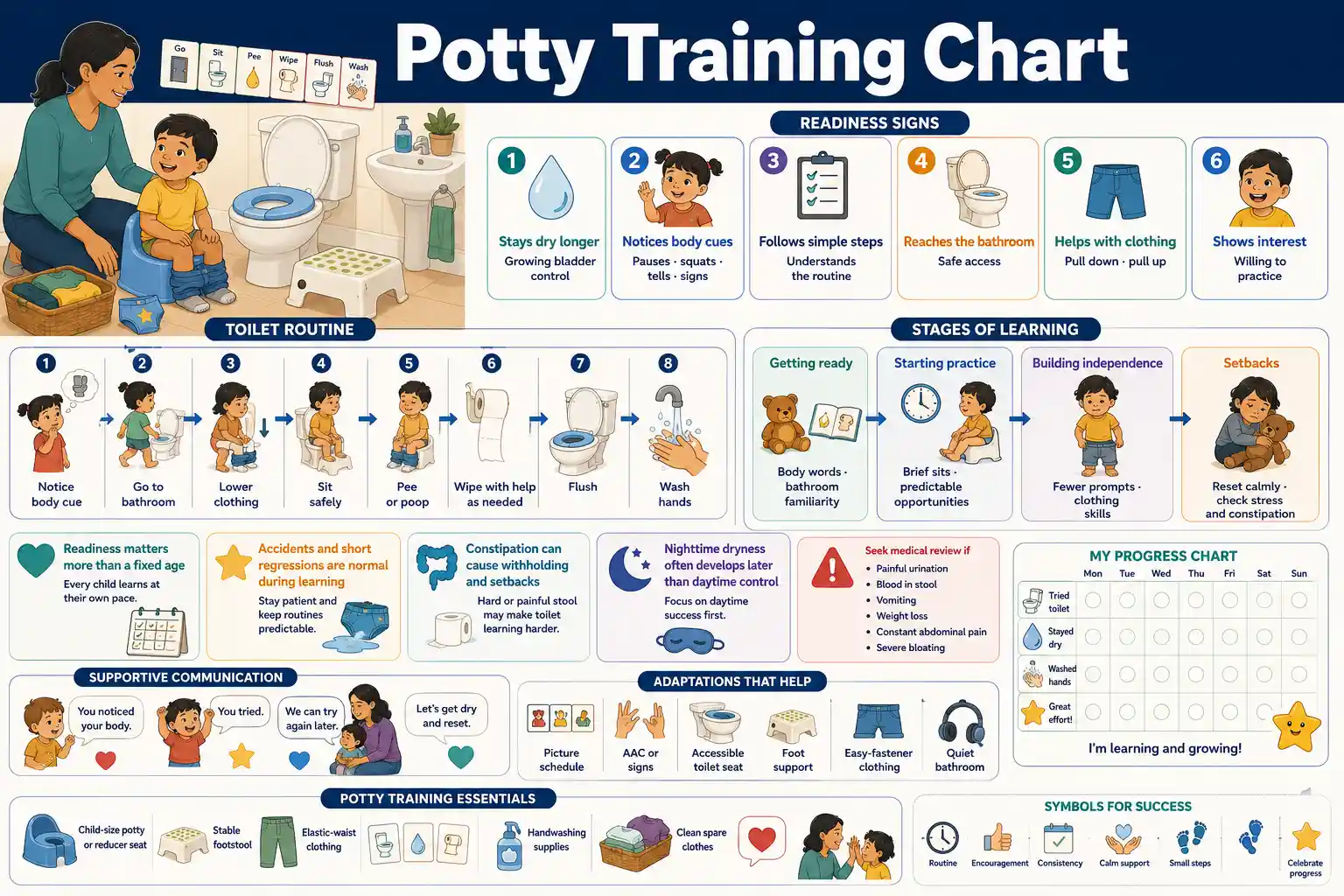
When is a child ready for potty training?
Readiness is a pattern of skills, not one birthday. The American Academy of Pediatrics readiness guidance highlights bladder and bowel awareness, simple instructions, safe bathroom access, clothing skills, and willingness. Many children in the United States begin between ages 2 and 3, but individual timing varies.
Starting point
Readiness before age
Look for body awareness, communication, mobility, clothing skills, and willingness rather than using one birthday as a deadline.
Method
Teach one skill at a time
Recognizing the urge, reaching the toilet, managing clothing, wiping, flushing, and handwashing do not have to appear all at once.
Accidents
Stay calm and neutral
Accidents and short regressions are common. Shame and punishment do not teach bladder or bowel awareness.
Health check
Treat pain and constipation
Hard or painful stool, withholding, urinary symptoms, or sudden regression can interfere with training and may need pediatric review.
Direct answers to common potty training questions
When should potty training start?
Start when developmental readiness signs are present, not because a child reached one exact age.
What age do many children start?
Many children in the United States begin toilet training between ages 2 and 3, but healthy timing varies.
What is a strong readiness sign?
Staying dry for longer periods and recognizing the urge to pee or poop are useful signs of growing body awareness and control.
Should accidents be punished?
No. Clean accidents calmly, restate the routine, and praise effort or communication instead of shaming the child.
Should a child sit until something happens?
No. Keep toilet practice brief and low pressure rather than forcing prolonged sitting.
When are useful potty times?
Useful routine opportunities include after waking, after meals, before leaving home, before sleep, and whenever body cues appear.
Can constipation cause potty problems?
Yes. Hard or painful stool can lead to withholding, stool accidents, resistance, and regression.
Should training continue through constipation?
Reduce training pressure when constipation is active and address bowel comfort first.
Is nighttime dryness the same as daytime training?
No. Nighttime dryness has a separate developmental timeline and often develops later than daytime control.
Can regression happen after progress?
Yes. Stress, illness, a new sibling, a move, a new care setting, constipation, or urinary problems can trigger temporary regression.
Can children with disabilities toilet train?
Many can, with visual supports, adapted equipment, AAC or signs, smaller steps, sensory adjustments, or professional support when needed.
When should a clinician be contacted?
Contact a clinician for persistent constipation, painful urination, recurrent stool accidents, sudden regression, blood, vomiting, weight loss, or significant abdominal symptoms.
Potty Training Readiness Signs Chart
Readiness is a combination of body awareness, motor ability, communication, cooperation, and interest. Age alone does not establish readiness.
Swipe horizontally inside the table to view every column.
| Readiness sign | What it can look like | Why it matters | What to do |
|---|---|---|---|
| Stays dry for longer periods | Often dry for about 2 hours or after a nap | Suggests growing bladder control | Notice the pattern without pressuring the child |
| Signals before peeing or pooping | Pauses, squats, hides, grunts, tells you, signs, or points | Shows awareness of body signals | Name the cue and offer the potty calmly |
| Follows simple directions | Can complete one- or two-step requests | Supports the toileting sequence | Use short consistent directions |
| Gets to the bathroom | Walks, crawls, or uses mobility support to reach the toilet | Makes timely toilet access possible | Adapt the route and equipment as needed |
| Manages clothing | Can help lower and raise simple clothing | Reduces delays and frustration | Choose elastic-waist clothes during learning |
| Dislikes being wet or soiled | Asks for a change or notices discomfort | May increase motivation | Use neutral words such as wet, dry, pee, and poop |
| Shows interest in the toilet | Watches caregivers, asks questions, or wants underwear | Supports willingness to practice | Introduce equipment and routines without force |
| Can sit safely | Can sit on a potty or supported toilet comfortably | Makes practice safe and stable | Use a footstool or adapted seat when helpful |
Developmental signs; no minimum number of signs guarantees success.
- • Children may be ready in one domain before another.
- • Special health, developmental, sensory, or mobility needs may change how readiness is expressed.
Download or export
Potty Training Age and Stage Reference
This is a developmental guide, not a deadline. Many children begin between ages 2 and 3, while readiness and completion vary widely.
Swipe horizontally inside the table to view every column.
| Stage | Common focus | Useful caregiver goal | Avoid |
|---|---|---|---|
| Before readiness | Body words, diaper changes, bathroom familiarity | Build vocabulary and comfort | Forced sitting or comparisons |
| Emerging readiness | Recognizing urges and staying dry longer | Offer low-pressure practice | Assuming one success means training is complete |
| Active daytime learning | Potty trips, clothing, wiping help, handwashing | Use routines and praise effort | Punishment for accidents |
| Growing independence | Self-initiated trips and fewer reminders | Gradually transfer responsibility | Withholding support too quickly |
| Nighttime development | Longer overnight dryness as the body matures | Protect sleep and use practical nighttime support | Treating bedwetting as defiance |
| Regression or setback | Accidents after progress | Check stress, constipation, infection, and routine changes | Shame or starting over from zero |
Age is context only; readiness and medical factors matter more.
- • AAP reports that many U.S. children begin toilet training between ages 2 and 3.
- • Nighttime dryness often develops later than daytime control.
Download or export
Simple Potty Training Routine Chart
Predictable opportunities help children connect body signals with the bathroom without turning toilet use into a power struggle.
Swipe horizontally inside the table to view every column.
| Routine moment | Suggested action | Language example | Success measure |
|---|---|---|---|
| After waking | Offer the potty or toilet | “Bathroom first, then breakfast.” | Child sits or tries without distress |
| Before leaving home | Offer a quick bathroom stop | “Let’s try before we go.” | Routine becomes familiar |
| After meals | Offer a relaxed toilet sit | “Your body may be ready to poop after eating.” | Child learns bowel timing |
| Before nap | Offer without delaying sleep | “Potty, then story.” | Simple sequence |
| After nap | Offer soon after waking | “Let’s check if your body needs the potty.” | Body-awareness practice |
| Before bath or bedtime | Offer a final daytime trip | “Potty, pajamas, book.” | Predictable end-of-day routine |
| When cues appear | Respond promptly | “I see you pausing. Do you need to go?” | Child connects cue with action |
| After an accident | Clean up calmly and reset | “Pee goes in the potty. We’ll try again.” | No shame; routine resumes |
Use cues and household routines rather than rigid minute-by-minute scheduling.
- • Avoid prolonged sitting.
- • For some children with special needs, a more structured schedule may be useful with professional guidance.
Download or export
Toilet Skills Learning Sequence
Toilet independence is a chain of smaller skills. A child can master one step while still needing help with another.
Swipe horizontally inside the table to view every column.
| Skill | Early learning | Growing independence | Support option |
|---|---|---|---|
| Notice urge | Caregiver identifies cues | Child signals before going | Use consistent words, signs, or pictures |
| Reach bathroom | Adult prompts and escorts | Child goes when needed | Keep route clear and accessible |
| Manage clothing | Adult helps | Child lowers and raises clothing | Use elastic waistbands and easy fasteners |
| Sit or position | Adult helps child get stable | Child positions independently | Use a potty, reducer seat, rails, or foot support |
| Urinate or stool | Child relaxes and tries | Child responds to body signals | Avoid pressure and prolonged sitting |
| Wipe | Adult performs or finishes | Child practices age-appropriate wiping | Teach front-to-back wiping where relevant |
| Flush | Adult models | Child flushes when comfortable | Delay if flushing noise causes fear |
| Wash hands | Adult guides each step | Child completes routine | Use a visual sequence and reachable sink setup |
Skills can develop in different orders.
- • Teach one step at a time when the full sequence is overwhelming.
- • Independence can include adaptive equipment or caregiver assistance.
Download or export
Potty training readiness guide
Check developmental signs and common barriers. This tool supports planning; it does not certify readiness or diagnose bowel or bladder problems.
Treat accidents and regression as information
A child may have more accidents when routines change, stress rises, constipation develops, or a urinary problem appears. The AAP regression guidance recommends looking for practical and physical causes before increasing pressure.
Accidents and Potty Training Regression Chart
Accidents are expected during learning. A sudden increase after progress can reflect stress, routine changes, constipation, infection, or other medical issues.
Swipe horizontally inside the table to view every column.
| Situation | Possible explanation | Helpful response | When to escalate |
|---|---|---|---|
| Occasional daytime accident | Skill is still becoming automatic | Stay neutral, change clothes, remind routine | Track if frequency rises or pain appears |
| Accidents during play | Child delays leaving an activity | Offer transitions and bathroom opportunities | Review if persistent despite support |
| Accidents at new school or care setting | Unfamiliar bathroom or routine | Coordinate prompts and access with caregivers | Check anxiety, constipation, or urinary symptoms |
| Return to diapers after progress | Stress, fatigue, new sibling, move, illness, or readiness mismatch | Reduce pressure and rebuild routine | Discuss persistent regression with pediatrician |
| Stool accidents | Constipation or stool withholding may overflow | Address bowel comfort and seek guidance | Medical review if recurrent or painful |
| Painful urination or urgency | Possible urinary irritation or infection | Do not blame behavior | Seek medical assessment |
| New bedwetting after established dryness | Stress, constipation, illness, or medical concern | Protect sleep and avoid shame | Discuss recurrent new-onset bedwetting with clinician |
Accident frequency alone does not diagnose a condition.
- • Regression often improves after the trigger is addressed.
- • Physical causes should be considered when regression is sudden or persistent.
Download or export
Break the pain-and-withholding cycle early
Hard or painful stool can make a child avoid pooping, which can worsen constipation and create stool accidents. The NIDDK constipation guidance supports routine toilet opportunities after meals and advises taking a break from potty training until constipation stops when it is interfering.
Constipation and Stool-Withholding Warning Chart
Painful stool can create a withholding cycle that makes toilet training harder. Treat comfort and bowel health as part of the training plan.
Swipe horizontally inside the table to view every column.
| Sign | What it may mean | Home-support principle | Medical threshold |
|---|---|---|---|
| Hard, dry, or lumpy stool | Constipation | Support fluids, fiber, and routine | Ask clinician if persistent or painful |
| Fewer than 2 bowel movements a week | Possible constipation | Track stool pattern | Discuss with clinician |
| Tiptoe, stiffen, hide, or clench | Possible withholding | Reduce pressure and address pain | Seek help if recurrent |
| Pain with stool | Can reinforce withholding | Prioritize comfortable stooling | Review ongoing pain |
| Stool smears or “diarrhea” in underwear | Overflow around retained stool can occur | Do not punish | Medical review is appropriate |
| Bloating or constant abdominal pain | May need medical assessment | Pause pressure | Seek prompt medical care |
| Vomiting, weight loss, rectal bleeding, or blood in stool | Red-flag symptoms | Do not treat as a training problem | Seek medical care promptly |
Bowel patterns vary; symptoms and comfort matter.
- • NIDDK advises taking a break from potty training until constipation stops when constipation is interfering.
- • Do not give a child laxatives or enemas unless advised by a clinician.
Download or export
Positive Language and Reward Chart
Praise effort, practice, and body awareness. Rewards should support learning without turning toileting into a contest or punishment system.
Swipe horizontally inside the table to view every column.
| Moment | Helpful wording | Optional reinforcement | Avoid |
|---|---|---|---|
| Child tells you they need to go | “You noticed your body signal.” | Praise or sticker | Rushing or overreacting |
| Child sits but does not go | “You tried. We can try later.” | Praise participation | Keeping child seated until something happens |
| Child pees or poops in potty | “You got it into the potty.” | Celebration, high-five, sticker | Huge rewards that create pressure |
| Accident | “You’re wet. Let’s get dry and try next time.” | Calm cleanup | Shame, teasing, anger |
| Child refuses | “Your body is yours. We’ll try again later.” | Offer a choice of potty or toilet | Power struggles |
| Regression | “Learning can have ups and downs.” | Return to simple goals | Taking away affection or privileges |
Reinforcement should be simple, immediate, and sustainable.
- • Some children respond well to charts or small tangible rewards.
- • Do not make affection conditional on toileting success.
Download or export
Potty Training Adaptations for Different Needs
Children with developmental, sensory, communication, or mobility differences may need the same skill broken into smaller steps or taught with adapted equipment.
Swipe horizontally inside the table to view every column.
| Need or barrier | Possible adaptation | What to monitor | Support partner |
|---|---|---|---|
| Limited spoken language | Use signs, pictures, AAC, or one-word cues | Consistent meaning across caregivers | Family, school, speech-language team |
| Sensory sensitivity | Reduce noise, odors, cold surfaces, and harsh lighting | Distress around bathroom environment | Occupational therapist when needed |
| Mobility limitation | Use accessible route, rails, foot support, or adaptive seating | Safe transfers and stable position | Physical or occupational therapist |
| Difficulty with transitions | Use visual schedule and predictable sequence | Resistance around activity changes | Caregivers and school team |
| Reduced urge awareness | Use scheduled opportunities | Patterns after meals or drinks | Pediatrician or continence team |
| Clothing difficulty | Use elastic waist and easy fasteners | Independence without delay | Occupational therapist |
| Constipation risk | Prioritize bowel comfort before training intensity | Pain, withholding, stool pattern | Pediatrician |
| Anxiety or fear | Slow exposure and avoid forced sitting | Fear of flushing, seat, or bathroom | Pediatrician or behavioral health professional if persistent |
Adapt the environment to the child rather than judging readiness by a single age.
- • Children with special needs may take longer and still make meaningful progress.
- • Professional support can help select equipment and routines.
Download or export
Daytime Training and Nighttime Dryness Chart
Daytime toilet learning and nighttime dryness are related but separate developmental processes. Night wetting can persist after daytime success.
Swipe horizontally inside the table to view every column.
| Area | What families may notice | Practical approach | Avoid |
|---|---|---|---|
| Daytime urine control | Increasing warning before peeing | Respond to cues and routines | Frequent testing or pressure |
| Daytime bowel control | More predictable stool timing | Offer toilet after meals and address constipation | Ignoring painful stool |
| Nap dryness | May emerge before overnight dryness | Offer potty before and after nap | Waking child repeatedly |
| Nighttime wetting during training | Common while sleep and bladder control mature | Use practical nighttime protection | Calling it laziness |
| Temporary return of bedwetting | Can occur with stress, illness, or constipation | Address trigger and protect sleep | Punishment |
| Persistent or new concerning symptoms | Pain, thirst, urinary symptoms, daytime accidents, or sudden change | Seek pediatric assessment | Assuming every case is developmental |
Nighttime dryness has its own developmental timeline.
- • AAP notes that many children wet the bed during toilet training.
- • Use nighttime training pants when needed without framing them as failure.
Download or export
When to Pause, Adjust, or Seek Medical Help
Training problems are often solved by reducing pressure, treating constipation, improving access, or checking for a medical cause.
Swipe horizontally inside the table to view every column.
| Situation | Next step | Why | Urgency |
|---|---|---|---|
| Child strongly resists every attempt | Pause and reassess readiness | Repeated conflict can turn practice into a power struggle | Routine |
| Constipation or painful stool | Pause pressure and contact clinician if ongoing | Pain promotes withholding and setbacks | Soon |
| Regression after move, sibling, school change, or illness | Restore routine and emotional support | Stress can temporarily disrupt learned skills | Routine unless symptoms suggest illness |
| Painful urination, urgency, or fever with urinary symptoms | Contact pediatric clinician | Possible infection or irritation | Prompt |
| Constipation lasts more than 2 weeks | Arrange medical review | Persistent constipation may need treatment | Prompt |
| Blood in stool, rectal bleeding, vomiting, weight loss, constant abdominal pain, or marked bloating | Seek medical care | These are red-flag constipation symptoms | Prompt or urgent depending on severity |
| Child cannot safely access or use toilet | Request equipment or therapy support | Accessibility is part of toileting independence | Planned |
| Immediate severe illness or child cannot stay safe | Use emergency medical services | Safety takes priority over training | Emergency |
This table is educational and does not diagnose the cause of accidents or bowel symptoms.
- • A toilet-training setback is not a moral or behavioral failure.
- • Medical symptoms should be evaluated on their own merits.
Download or export
Common potty training mistakes
Starting because of a deadline
Use readiness signs and family context instead of comparing children by age.
Punishing accidents
Neutral cleanup and short reminders teach more effectively than shame.
Ignoring constipation
Painful stool can drive withholding, refusal, and stool accidents.
Expecting every skill at once
Break the sequence into body awareness, bathroom access, clothing, sitting, wiping, flushing, and handwashing.
Forcing long toilet sits
Keep practice brief and positive; stop if the child becomes distressed.
Treating nighttime wetting as defiance
Nighttime dryness is a separate developmental process and often comes later.
Using inaccessible equipment
Stable foot support, adaptive seats, rails, visual cues, or AAC can make the task possible.
Assuming regression is deliberate
Check stress, illness, constipation, urinary symptoms, and routine changes first.
Frequently asked questions
What age should potty training start?
Start when readiness signs are present, not on a fixed birthday. Many children in the United States begin between ages 2 and 3, but healthy timing varies.
What are the strongest potty training readiness signs?
Useful signs include longer dry periods, awareness before peeing or pooping, following simple directions, reaching the bathroom, helping with clothing, and showing interest or willingness.
Should I make my child sit until they pee?
No. Keep practice brief and low pressure. Prolonged or forced sitting can create resistance and make the bathroom feel stressful.
How often should I take my child to the potty?
Use predictable moments such as after waking, after meals, before leaving home, before sleep, and when body cues appear. Some children need a more structured schedule.
Are accidents normal during potty training?
Yes. Accidents are expected while the skill becomes automatic. Respond calmly, clean up, and return to the routine without shame.
What causes potty training regression?
Regression can follow stress, a move, a new sibling, illness, a new child-care routine, constipation, urinary infection, or a mismatch between expectations and readiness.
Should potty training stop during constipation?
Reduce training pressure when constipation is active. NIDDK specifically advises taking a break from potty training until constipation stops when it is interfering.
Can stool accidents be caused by constipation?
Yes. Retained stool can lead to overflow soiling that may look like diarrhea. Recurrent stool accidents deserve medical review rather than punishment.
Is nighttime dryness part of daytime potty training?
Not exactly. Nighttime dryness has a separate developmental timeline and often comes later than daytime control.
Should I punish accidents?
No. Punishment and shame do not teach bladder or bowel awareness. Use neutral cleanup, specific praise for effort, and predictable practice.
Can autistic or disabled children be potty trained?
Many can. They may benefit from visual schedules, AAC or signs, adapted equipment, smaller teaching steps, sensory adjustments, and professional support.
What clothes make potty training easier?
Simple elastic-waist clothing is usually easier to lower and raise quickly than overalls, complicated buttons, belts, or tight layers.
When should I call the pediatrician about regression?
Contact the pediatrician when regression is sudden, persistent, painful, associated with urinary symptoms, or accompanied by constipation or another physical concern.
When should constipation be medically reviewed?
Seek medical review when constipation lasts more than 2 weeks or does not improve with home measures, and seek prompt care for blood, vomiting, weight loss, constant abdominal pain, or marked bloating.
Does a reward chart help potty training?
It can. Simple immediate praise, stickers, or another modest reward may reinforce participation, especially when the focus is effort rather than perfection.
What if my child refuses the potty?
Reduce pressure, check readiness, offer simple choices, identify fears or discomfort, and consider a short pause if the process has become consistently negative.
Sources
These pediatric toilet-training and childhood constipation references support the readiness, routine, regression, bowel-health, adaptation, and warning guidance used on this page.
American Academy of Pediatrics — The Right Age to Potty Train
https://www.healthychildren.org/English/ages-stages/toddler/toilet-training/Pages/the-right-age-to-toilet-train.aspx
Explains developmental readiness, bladder and bowel control, clothing skills, willingness, and typical U.S. training timing.
American Academy of Pediatrics — How to Tell When Your Child Is Ready
https://www.healthychildren.org/English/ages-stages/toddler/toilet-training/Pages/How-to-Tell-When-Your-Child-is-Ready.aspx
Emphasizes that readiness appears across physical, cognitive, language, motor, and emotional domains rather than at one fixed birthday.
American Academy of Pediatrics — Potty Training Regression
https://www.healthychildren.org/English/ages-stages/toddler/toilet-training/Pages/Regression.aspx
Describes common regression triggers, medical causes to rule out, supportive responses, and when a temporary training break may help.
American Academy of Pediatrics — Potty Training Children with Special Needs
https://www.healthychildren.org/English/ages-stages/toddler/toilet-training/Pages/toilet-training-children-with-special-needs.aspx
Covers readiness, visual schedules, communication, accessibility, sensory needs, regular schedules, and individualized support.
National Institute of Diabetes and Digestive and Kidney Diseases — Symptoms and Causes of Constipation in Children
https://www.niddk.nih.gov/health-information/digestive-diseases/constipation-children/symptoms-causes
Lists hard or painful stools, withholding behaviors, fewer than two bowel movements weekly, bloating, and symptoms needing medical review.
National Institute of Diabetes and Digestive and Kidney Diseases — Treatment for Constipation in Children
https://www.niddk.nih.gov/health-information/digestive-diseases/constipation-children/treatment
Supports routine toilet sitting after meals, adequate fluids and fiber, reward systems, and pausing toilet training when constipation is active.
American Academy of Pediatrics — Bedwetting: Common Reasons and What Families Can Do
https://www.healthychildren.org/English/ages-stages/toddler/toilet-training/Pages/Bedwetting.aspx
Explains that nighttime dryness often develops later than daytime control and that temporary bedwetting can recur with stress, illness, or constipation.
American Academy of Pediatrics — Potty Training
https://www.healthychildren.org/english/ages-stages/toddler/toilet-training/pages/default.aspx
Provides AAP toilet-training guidance on readiness, positive methods, setbacks, public bathrooms, stages, and older children.