Health & Medical · Pregnancy timing
Pregnancy Due Date Chart by LMP, Conception and IVF
Estimate an EDD, compare pregnancy dating methods, convert gestational weeks into a due-date countdown, and review trimester, term, ultrasound, testing, and safety timing.
A due date is an estimate and cannot confirm pregnancy, viability, fetal growth, or when labor will begin. Use the EDD documented by the prenatal or fertility team. Seek immediate care for pregnancy warning signs regardless of the calculated week. Read the ChartsLoom Disclaimer.
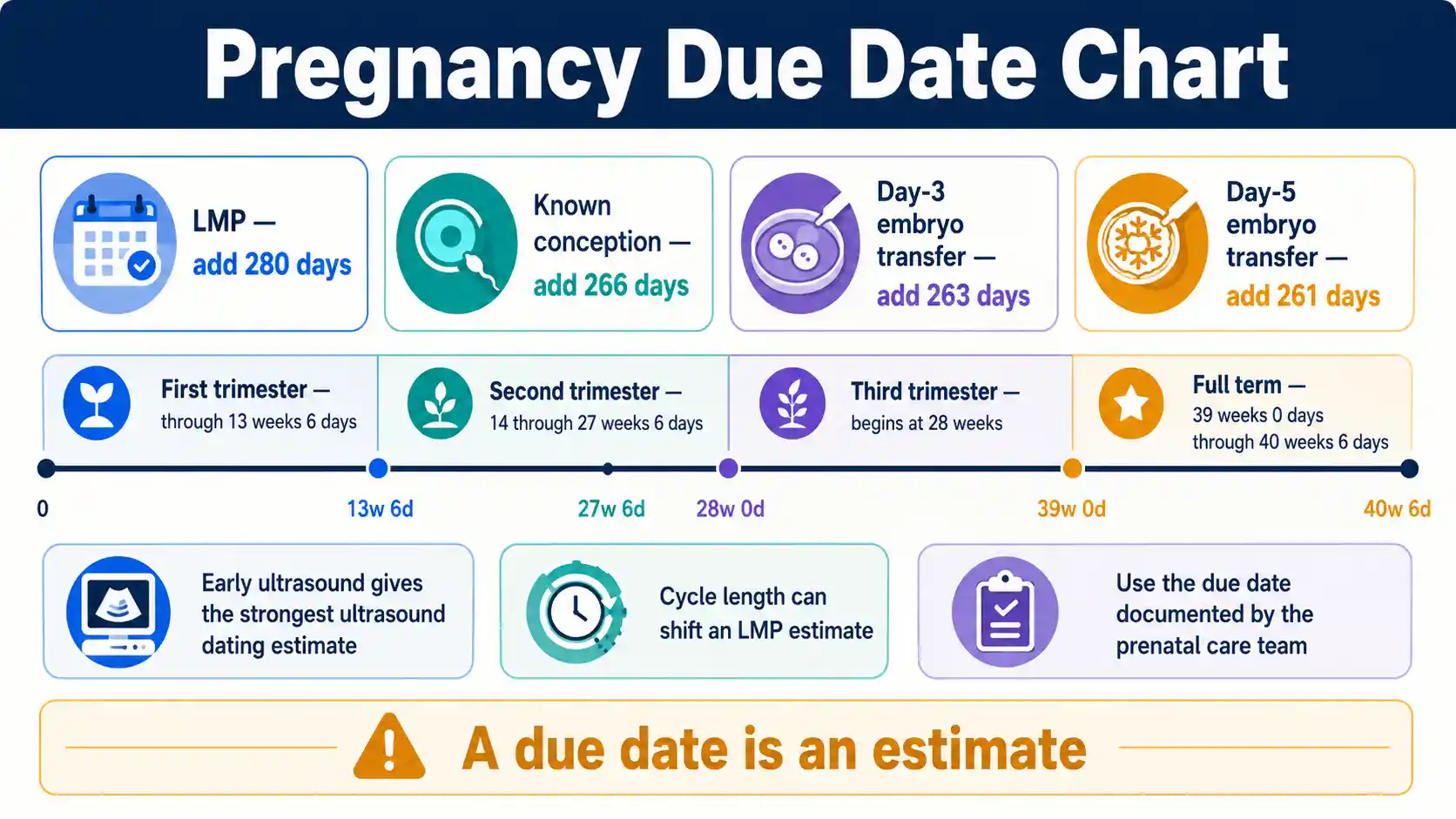
How do you calculate a pregnancy due date?
Add 280 days to the first day of a reliable LMP, or add 266 days to a truly known conception date. IVF pregnancies use the embryo’s age and transfer date.
The ACOG pregnancy-dating guidance recommends assigning and documenting the EDD when the LMP, first accurate ultrasound, or ART information becomes available. Later changes should be uncommon.
Standard LMP
LMP + 280 days
The 40-week method assumes a certain LMP, a regular 28-day cycle, and ovulation near day 14.
Known conception
+266 days
Gestational age remains about 2 weeks ahead of conceptional age under clinical week counting.
Best ultrasound timing
First trimester
Crown–rump length through 13 weeks 6 days is the most accurate ultrasound dating method.
Full term
39 0/7–40 6/7
The EDD at 40 weeks 0 days is one point inside a 14-day full-term range.
Pregnancy Due Date Calculation Methods Chart
An estimated due date can be calculated from the last menstrual period, a known conception date, assisted reproduction, or ultrasound. The clinician-documented best obstetric estimate guides care.
Swipe horizontally inside the table to view every column.
| Dating information | Basic calculation | Gestational-age basis | Best use and limitation |
|---|---|---|---|
| First day of the last menstrual period (LMP) | LMP + 280 days (40 weeks) — Standard LMP calculation | Gestational age starts on the first day of the LMP | Useful with a certain LMP and regular 28-day cycles; ovulation timing may differ |
| LMP with a regular non-28-day cycle | LMP + 280 days + (cycle length − 28 days) | Adjusts the assumed ovulation day by the cycle-length difference | A calendar estimate only; irregular cycles and variable ovulation reduce reliability |
| Known conception or ovulation date | Conception + 266 days (38 weeks) | Clinical gestational age is still about 2 weeks ahead of conceptional age | Conception is rarely known exactly outside carefully timed treatment |
| Day-3 embryo transfer | Transfer date + 263 days — Day-3 transfer formula | Uses embryo age and the transfer date | Use the fertility clinic’s ART-derived date rather than the LMP |
| Day-5 embryo transfer | Transfer date + 261 days — Day-5 transfer formula | Uses embryo age and the transfer date | Use the fertility clinic’s documented transfer and embryo age |
| First-trimester ultrasound | Clinician calculates EDD from crown–rump length through 13 weeks 6 days | Ultrasound estimates gestational age from embryo or fetal size | The most accurate ultrasound period for dating; clinical redating rules still apply — Most accurate ultrasound period |
| Established clinician-recorded EDD | Use the documented best obstetric estimate | Reconciles LMP, early ultrasound, ART, and clinical history | Later growth scans do not automatically create a new due date |
EDD means estimated due date; LMP means last menstrual period; ART means assisted reproductive technology.
- • Naegele’s rule is commonly expressed as LMP + 7 days − 3 months + 1 year, but adding 280 days avoids calendar-month ambiguity.
- • A calculated date does not confirm a pregnancy, implantation date, fetal age, or delivery day.
- • For ART pregnancies, use embryo age and transfer date supplied by the fertility clinic.
Download or export
How to use a pregnancy due date chart
Start with the most reliable dating information, calculate one estimate, and compare it with early clinical dating. Pregnancy weeks and time-sensitive care should follow the EDD recorded by the prenatal or fertility team.
1
Choose the best anchor
Use the reliable LMP, a known conception date, ART records, or the established EDD.
2
Apply one method
Do not mix an LMP formula with IVF dating or silently average conflicting dates.
3
Compare early dating
The first accurate ultrasound and clinical history help establish the best estimate.
4
Keep the official EDD
Use the clinician-recorded date for pregnancy weeks, tests, and delivery planning.
A 40-week EDD is a planning point. Full term spans 39 weeks 0 days through 40 weeks 6 days, and labor may begin before or after the estimated date.
Pregnancy Due Date Estimator
Estimate an EDD from LMP, conception, IVF, or a known due date
Choose the most reliable date you have. Calculations stay in your browser and produce a planning estimate—not confirmation of pregnancy, viability, or the day labor will begin.
Use this adjustment only for a regular usual cycle. Irregular cycles need clinical dating rather than an averaged calendar correction.
Select a method and enter a date
The estimate will show the EDD, gestational age today, conception estimate, and full-term calendar range.
Use the EDD documented by your prenatal or fertility care team. Do not change an official due date because a later scan, app, or calculator shows a different result.
Cycle Length Due Date Adjustment Chart
When cycles are regular but not 28 days long, the LMP estimate can be shifted by the difference between the usual cycle length and 28 days.
Swipe horizontally inside the table to view every column.
| Usual cycle length | Adjustment to LMP-based EDD | Approximate ovulation assumption | Interpretation |
|---|---|---|---|
| 21 days | 7 days earlier — Seven days earlier | Cycle day 7 | Short-cycle estimate |
| 22 days | 6 days earlier | Cycle day 8 | Short-cycle estimate |
| 23 days | 5 days earlier | Cycle day 9 | Short-cycle estimate |
| 24 days | 4 days earlier | Cycle day 10 | Short-cycle estimate |
| 25 days | 3 days earlier | Cycle day 11 | Short-cycle estimate |
| 26 days | 2 days earlier | Cycle day 12 | Short-cycle estimate |
| 27 days | 1 day earlier | Cycle day 13 | Slightly shorter cycle |
| 28 days | No adjustment — No adjustment | Cycle day 14 | Standard calendar assumption |
| 29 days | 1 day later | Cycle day 15 | Slightly longer cycle |
| 30 days | 2 days later | Cycle day 16 | Longer-cycle estimate |
| 31 days | 3 days later | Cycle day 17 | Longer-cycle estimate |
| 32 days | 4 days later | Cycle day 18 | Longer-cycle estimate |
| 33 days | 5 days later | Cycle day 19 | Longer-cycle estimate |
| 34 days | 6 days later | Cycle day 20 | Longer-cycle estimate |
| 35 days | 7 days later — Seven days later | Cycle day 21 | Longer-cycle estimate |
Adjustment = usual cycle length − 28 days.
- • This shortcut assumes ovulation occurs about 14 days before the next period; real ovulation can vary.
- • Do not average highly irregular cycles to create a precise due date.
- • An early ultrasound and the complete clinical history can establish a more reliable EDD.
Download or export
Gestational age starts before conception
Clinical pregnancy weeks start from the first day of the LMP, even though conception commonly occurs about 2 weeks later. This convention lets clinicians use one consistent calendar when the exact day of fertilization is unknown.
Pregnancy Trimester and Term Range Chart
Pregnancy is counted in completed weeks and days from the gestational starting point. Term labels describe ranges, not a single guaranteed delivery day.
Swipe horizontally inside the table to view every column.
| Gestational range | Common label | Position relative to 40-week EDD | Meaning |
|---|---|---|---|
| 0 weeks 0 days–13 weeks 6 days | First trimester | 40 to about 26 weeks before EDD | Early dating and initial prenatal assessment commonly occur here |
| 14 weeks 0 days–27 weeks 6 days | Second trimester | About 26 to 12 weeks before EDD | Anatomy assessment and several screening windows occur here |
| 28 weeks 0 days–36 weeks 6 days | Third trimester, preterm period | 12 to just over 3 weeks before EDD | Delivery before 37 completed weeks is preterm |
| 37 weeks 0 days–38 weeks 6 days | Early term — Early term | 21 to 8 days before EDD | Term has begun, but this is not the full-term range |
| 39 weeks 0 days–40 weeks 6 days | Full term — Full term | 7 days before to 6 days after EDD | The EDD at 40 weeks 0 days sits inside this range |
| 41 weeks 0 days–41 weeks 6 days | Late term | 7 to 13 days after EDD | Additional monitoring or delivery planning may be discussed |
| 42 weeks 0 days and later | Postterm — Postterm | 14 or more days after EDD | Requires clinician-led assessment and management |
The notation 39 weeks 0 days is also written 39 0/7 weeks.
- • Gestational age is about 2 weeks greater than conceptional age in a standard LMP-based pregnancy.
- • The first day of week 40 is 39 weeks 0 days; completed-week notation can differ from casual “in week” language.
- • Term definitions apply to gestational age and do not predict the exact date labor will begin.
Download or export
Early ultrasound gives the strongest ultrasound dating estimate
Crown–rump length through 13 weeks 6 days is the most accurate sonographic method for pregnancy dating. A clinician compares it with LMP reliability and any ART records. Later ultrasound is increasingly less precise for assigning age, so a growth difference does not automatically create a new EDD.
Ultrasound and LMP Redating Threshold Chart
These professional thresholds describe discrepancies that may support changing an LMP-based EDD. A clinician applies them with LMP reliability, prior scans, fetal growth, and the full record.
Swipe horizontally inside the table to view every column.
| Ultrasound gestational age | Dating measurement | Difference supporting redating | Important context |
|---|---|---|---|
| Up to 8 weeks 6 days | Crown–rump length (CRL) | More than 5 days — More than five days | Very early ultrasound has the narrowest redating threshold |
| 9 weeks 0 days–13 weeks 6 days | Crown–rump length (CRL) | More than 7 days | First-trimester ultrasound is the most accurate sonographic dating method — Most accurate ultrasound period |
| 14 weeks 0 days–15 weeks 6 days | Head, abdomen, and femur biometry | More than 7 days | Use with LMP reliability and any earlier ultrasound |
| 16 weeks 0 days–21 weeks 6 days | Head, abdomen, and femur biometry | More than 10 days | An earlier consistent scan normally retains priority |
| 22 weeks 0 days–27 weeks 6 days | Head, abdomen, and femur biometry | More than 14 days | Dating precision is lower later in pregnancy |
| 28 weeks 0 days and later | Head, abdomen, and femur biometry | More than 21 days | Third-trimester dating is least reliable and needs careful clinical judgment — Least reliable dating period |
Threshold means the discrepancy must be greater than the listed number, not equal to it.
- • These are clinician redating guidelines, not instructions to overwrite a due date in a personal calendar.
- • A pregnancy without ultrasound confirmation or revision before 22 weeks 0 days is considered suboptimally dated in ACOG guidance.
- • A late size difference can reflect fetal growth rather than an incorrect due date.
Download or export
Pregnancy Week to Due Date Countdown Chart
The countdown shows calendar distance from a 40-week EDD. It does not predict when labor will begin.
Swipe horizontally inside the table to view every column.
| Gestational age | Time until 40 weeks 0 days | Pregnancy stage | Calendar interpretation |
|---|---|---|---|
| 4 weeks 0 days | 36 weeks | Early first trimester | About 252 days remain to the EDD |
| 8 weeks 0 days | 32 weeks | First trimester | About 224 days remain |
| 12 weeks 0 days | 28 weeks | Late first trimester | About 196 days remain |
| 14 weeks 0 days | 26 weeks | Start of second trimester | About 182 days remain |
| 20 weeks 0 days | 20 weeks — Halfway by calendar count | Midpregnancy | Half of the 40-week count is complete |
| 24 weeks 0 days | 16 weeks | Second trimester | About 112 days remain |
| 28 weeks 0 days | 12 weeks | Start of third trimester | About 84 days remain |
| 32 weeks 0 days | 8 weeks | Third trimester | About 56 days remain |
| 36 weeks 0 days | 4 weeks | Late third trimester | About 28 days remain |
| 37 weeks 0 days | 3 weeks | Early term begins | About 21 days remain |
| 39 weeks 0 days | 1 week | Full term begins — Full term begins | About 7 days remain |
| 40 weeks 0 days | EDD reached | Full term | The date is an estimate, not an expiration date — Estimated date |
One gestational week equals 7 calendar days.
- • “20 weeks pregnant” usually means 20 completed weeks have elapsed from the gestational start date.
- • A provider may use a recorded EDD to calculate gestational age even when the original LMP is unknown.
- • Follow the maternity team’s plan near and after the due date.
Download or export
The official EDD anchors time-sensitive pregnancy care
Common screening, ultrasound, and culture windows are based on gestational age. The ACOG routine-testing overview places glucose screening at 24–28 weeks and group B streptococcus culture at 36–38 weeks for many pregnancies. Individual schedules can differ.
Pregnancy Timing and Common Test Window Chart
A reliable EDD helps place time-sensitive discussions and tests. Exact care differs by health history, pregnancy, local guidance, and patient preference.
Swipe horizontally inside the table to view every column.
| Approximate window | Common care item | Why the date matters | Important qualification |
|---|---|---|---|
| Before 10 weeks when feasible | Initial prenatal assessment — Early assessment | Confirms history, medicines, risk factors, symptoms, and a dating plan | Seek care sooner for pain, bleeding, severe symptoms, or a high-risk condition |
| Up to 13 weeks 6 days | First-trimester dating ultrasound when indicated | Crown–rump length provides the most accurate ultrasound dating | The scan date and clinical indication vary |
| 10–13 weeks | Chorionic villus sampling when chosen and appropriate | This diagnostic test has a specific gestational window | It is optional and requires counseling |
| 10 weeks onward | Cell-free DNA screening when chosen | Gestational age determines when screening can begin | Screening is optional and is not diagnostic |
| 15–22 weeks | Second-trimester serum screening when chosen | Timing affects test interpretation | Local programs and preferred timing vary |
| 18–22 weeks — Anatomy ultrasound window | Anatomy ultrasound | Reviews major fetal structures and growth around midpregnancy | It is not primarily used to replace a reliable earlier EDD |
| 24–28 weeks — Glucose screening window | Gestational diabetes screening for many pregnancies | The common screening window is set by gestational age | Earlier or different testing may be used for individual risk |
| Around 28 weeks when indicated | Rh immune globulin for an unsensitized Rh-negative patient | Timing is based on gestational age and clinical circumstances | Blood type, antibody results, bleeding, and procedures affect the plan |
| 36–38 weeks — GBS culture window | Group B streptococcus culture for many pregnancies | Results help guide antibiotics during labor when indicated | Some planned cesarean or other circumstances may change the plan |
Windows are educational examples from U.S. guidance, not a universal appointment schedule.
- • Testing choices should follow informed discussion with the prenatal care team.
- • A due date supports scheduling but does not replace symptoms, examination, or clinician judgment.
- • High-risk and multiple pregnancies often follow different monitoring and delivery plans.
Download or export
LMP Due Date Reliability Chart
LMP dating works best when the first day is certain and cycles are regular. Several common situations make the 280-day shortcut less dependable.
Swipe horizontally inside the table to view every column.
| Situation | Effect on the estimate | Useful information | Next step |
|---|---|---|---|
| Certain LMP and regular 28-day cycles | Supports the standard 280-day estimate — Best fit for LMP method | Exact first day and an early ultrasound | Compare LMP with the first accurate scan |
| Regular cycles shorter or longer than 28 days | May shift the estimate by the cycle-length difference | Usual cycle length and ovulation information | Use a cautious cycle adjustment and confirm clinically |
| Irregular or highly variable cycles | Ovulation may not have occurred near cycle day 14 | Cycle history, pregnancy-test timing, and early ultrasound | Do not treat the LMP result as precise |
| Uncertain or unknown LMP | The starting date may be wrong | Earliest ultrasound and clinical history | Use clinician-assigned ultrasound dating |
| Bleeding mistaken for a menstrual period | Can make the pregnancy appear younger than it is | Bleeding pattern, test date, symptoms, and ultrasound | Contact a clinician for dating and symptom assessment — Bleeding needs clinical context |
| Recent hormonal contraception, postpartum period, or breastfeeding | Cycles and ovulation may not follow the previous pattern | Medication, delivery, feeding, and cycle history | Early clinical dating is especially useful |
| Assisted reproduction | LMP is not the preferred dating anchor | Retrieval, fertilization, embryo age, and transfer date | Use the ART-derived EDD from the fertility clinic — Use ART-derived date |
| Late or no confirming ultrasound | Dating uncertainty remains wider | All prior records and the best clinical estimate | The maternity team manages the pregnancy as suboptimally dated when criteria apply |
Reliability describes the dating input, not the health or viability of the pregnancy.
- • Implantation timing cannot be determined from the first positive home test alone.
- • A due-date discrepancy does not by itself diagnose abnormal growth or pregnancy loss.
- • Bring the earliest ultrasound report and fertility-treatment records when care transfers between clinics.
Download or export
An established due date should rarely change
The care team reconciles LMP, ART information, and the earliest accurate ultrasound into one best obstetric estimate. Once documented, it should not be moved simply because a later scan estimates a different fetal size or the pregnancy reaches the EDD.
When a Pregnancy Due Date May Change Chart
A due date is assigned from the best information available. Once established, later changes should be uncommon and documented by the maternity team.
Swipe horizontally inside the table to view every column.
| Dating scenario | Usual approach | Why | What the patient should do |
|---|---|---|---|
| ART pregnancy with documented embryo age and transfer date | Use the ART-derived gestational age and EDD — ART-derived dating | Fertilization and embryo timing are known more precisely | Keep the fertility clinic’s dated records |
| Reliable LMP agrees with early ultrasound | Keep the LMP-supported EDD | Two early dating sources are consistent | Use the documented EDD for pregnancy-week counting |
| LMP and first-trimester ultrasound exceed the redating threshold | The clinician may use the ultrasound EDD | Early ultrasound is more accurate than later biometric dating | Ask which EDD is now the official record |
| A reliable early EDD and a later size discrepancy | Do not automatically redate — Do not automatically redate | Later size differences can reflect growth rather than age | Follow growth evaluation and surveillance recommendations |
| No confirming or revising ultrasound before 22 weeks 0 days | Treat as a suboptimally dated pregnancy — Suboptimally dated | The uncertainty affects decisions tied to gestational age | Follow the individualized monitoring and delivery plan |
| Multiple EDDs appear in different records | Reconcile to one best obstetric estimate | Conflicting dates can cause scheduling and treatment errors | Ask the care team to document the final EDD clearly |
| Due date reached or passed | Do not move the EDD forward to match the current date | The EDD remains the original estimate | Contact the maternity team and follow its late-term plan |
Only the treating clinical team should revise the official EDD.
- • The earliest accurate dating information generally has the greatest value.
- • Third-trimester ultrasound is the least reliable ultrasound method for assigning gestational age.
- • EDD changes should be discussed and documented, not made silently in a personal calculator.
Download or export
Warning signs matter at every pregnancy week
The CDC urgent maternal warning-sign guidance advises immediate medical care for symptoms including bleeding or fluid leakage, severe persistent pain, breathing trouble, chest pain, severe headache, vision change, fever, extreme swelling, or reduced fetal movement.
Pregnancy Warning Signs and Action Chart
A due-date calculator cannot assess symptoms. Urgent maternal warning signs require medical care regardless of the estimated week.
Swipe horizontally inside the table to view every column.
| Warning sign | Action | Why timing cannot reassure you | What to report |
|---|---|---|---|
| Vaginal bleeding more than spotting or fluid leaking | Get immediate medical care — Immediate care | Bleeding or fluid can be important at any gestational age | Amount, color, clots, pain, odor, and time of onset |
| Severe belly pain that does not go away | Get immediate medical care | Serious pregnancy and nonpregnancy causes are possible | Location, onset, bleeding, shoulder pain, dizziness, and fever |
| Trouble breathing, chest pain, or fast-beating heart | Get immediate medical care; use emergency services for severe symptoms — Emergency if severe | Cardiac or respiratory complications can occur during pregnancy | Onset, ability to speak, fainting, swelling, and medical history |
| Severe headache, vision change, or extreme face or hand swelling | Get immediate medical care | These can be warning signs of a serious hypertensive complication | Blood pressure if already measured, onset, vision, pain, and swelling |
| Fever of 100.4°F (38°C) or higher | Contact urgent medical care | Infection can affect the pregnant person and pregnancy | Temperature, duration, pain, rash, exposures, and other symptoms |
| Severe nausea and vomiting with inability to keep fluids down | Get prompt medical care | Dehydration and another serious cause may need treatment | Fluid intake, urination, dizziness, fever, pain, and duration |
| Baby’s movement stops or slows from the usual pattern | Contact the maternity unit or clinician immediately — Contact maternity care now | Change from the individual movement pattern matters | When the change began and the last usual movement pattern |
| One-sided leg or arm swelling, redness, or pain | Get immediate medical care | A blood clot is possible | Side, swelling, warmth, breathing symptoms, and onset |
| Feeling that something is seriously wrong | Contact a healthcare professional and state that you are pregnant | Warning-sign lists cannot cover every complication | Symptoms, gestational age, EDD, medical history, and your concern |
Use local emergency services when symptoms are severe, rapidly worsening, or life-threatening.
- • This chart does not replace instructions from the maternity unit, obstetric clinician, or emergency service.
- • Tell every healthcare professional that you are pregnant and provide the clinician-recorded EDD when known.
- • Thoughts of harming yourself or the baby also require immediate emergency or crisis support.
Download or export
Frequently asked questions
How is a pregnancy due date calculated from the last period?
The standard LMP estimate adds 280 days, or 40 weeks, to the first day of the last menstrual period. It assumes a certain LMP, a regular 28-day cycle, and ovulation near cycle day 14. An early ultrasound and clinical history can confirm or revise the estimate.
Why does pregnancy start before conception in week counting?
Clinical gestational age starts on the first day of the last menstrual period, usually about 2 weeks before conception in a 28-day cycle. This shared convention allows pregnancy weeks to be counted even when the exact conception date is unknown.
How do I adjust a due date for a longer or shorter cycle?
For a regular non-28-day cycle, add the difference between the usual cycle length and 28 days to the standard LMP due date. A 30-day cycle shifts it 2 days later; a 26-day cycle shifts it 2 days earlier. This remains an estimate because ovulation can vary.
How is an IVF due date calculated?
ART dating uses the embryo’s age and transfer date. ACOG gives transfer date plus 263 days for a day-3 embryo and plus 261 days for a day-5 embryo. Use the fertility clinic’s official date and embryo record rather than an LMP estimate.
Is a conception-date due date more accurate than an LMP due date?
A truly known conception date is calculated by adding 266 days, but natural conception is rarely known to one exact day. Intercourse, ovulation, fertilization, and implantation occur on different timelines. ART records provide more precise timing than a guessed natural-conception date.
Can an ultrasound change my due date?
Yes, the first accurate ultrasound can support redating when it differs from LMP dating by more than professional thresholds. The threshold depends on gestational age. First-trimester crown–rump length is the most accurate ultrasound method for dating.
Why did my provider keep the old due date after a later ultrasound?
Once a reliable EDD is established, later size differences do not automatically mean the pregnancy age is wrong. Third-trimester ultrasound is less accurate for dating, and a size difference may instead need growth assessment. EDD changes should be rare and documented.
What does 40 weeks pregnant mean?
Forty weeks 0 days means 280 days have elapsed from the gestational starting point and the EDD has been reached. It does not mean labor must begin that day. Full term spans 39 weeks 0 days through 40 weeks 6 days.
What is the difference between early term, full term, late term, and postterm?
Early term is 37 weeks 0 days through 38 weeks 6 days; full term is 39 weeks 0 days through 40 weeks 6 days; late term is 41 weeks 0 days through 41 weeks 6 days; and postterm begins at 42 weeks 0 days.
How accurate is a pregnancy due date?
A due date is an estimate, not a predicted birth appointment. Dating is most reliable when a certain LMP, ART timing, or an early ultrasound supports one documented EDD. Only about 1 in 20 births occur on the exact EDD according to ACOG patient guidance.
What if I do not know my last menstrual period?
Tell the prenatal care team that the LMP is uncertain. The earliest suitable ultrasound, pregnancy-test timing, cycle history, examination, and any fertility records can help establish the best obstetric estimate. Do not invent an LMP to make a calculator work.
Does spotting count as the last menstrual period?
Not necessarily. Implantation-related, cervical, pregnancy-related, and other bleeding can be mistaken for a period. Bleeding with a positive pregnancy test, pain, dizziness, or uncertainty needs clinical assessment rather than calendar dating alone.
What is a suboptimally dated pregnancy?
ACOG describes a pregnancy without an ultrasound that confirms or revises the EDD before 22 weeks 0 days as suboptimally dated. The care team uses the best clinical estimate and may individualize surveillance and delivery planning because dating uncertainty is greater.
What happens if pregnancy goes past the due date?
Reaching the EDD does not automatically mean a problem. At 41 weeks the pregnancy is late term, and at 42 weeks it is postterm. Contact the maternity team and follow its plan for monitoring and delivery timing rather than recalculating a later EDD.
When should I seek urgent care during pregnancy?
Get immediate medical care for warning signs such as vaginal bleeding more than spotting, fluid leakage, severe persistent belly pain, trouble breathing, chest pain, fainting, severe headache, vision changes, fever, extreme swelling, reduced fetal movement, or feeling that something is seriously wrong.
Sources
These obstetric, prenatal-care, gestational-age, and maternal-safety resources support the formulas, term definitions, dating thresholds, timing windows, and warning signs.
American College of Obstetricians and Gynecologists — Methods for Estimating the Due Date
https://www.acog.org/clinical/clinical-guidance/committee-opinion/articles/2017/05/methods-for-estimating-the-due-date
Defines standardized LMP, ultrasound, and assisted-reproduction dating methods, IVF transfer formulas, redating thresholds, and the best obstetric estimate.
National Library of Medicine — Committee Opinion No. 700: Methods for Estimating the Due Date
https://pubmed.ncbi.nlm.nih.gov/28426621/
Indexes the ACOG, AIUM, and SMFM committee opinion on documenting gestational age and reserving later changes to the due date for rare circumstances.
American College of Obstetricians and Gynecologists — Definition of Term Pregnancy
https://www.acog.org/clinical/clinical-guidance/committee-opinion/articles/2013/11/definition-of-term-pregnancy
Defines early term, full term, late term, and postterm gestational-age ranges and notes the 40-week average from the first day of the LMP.
American College of Obstetricians and Gynecologists — When Pregnancy Goes Past Your Due Date
https://www.acog.org/womens-health/faqs/when-pregnancy-goes-past-your-due-date
Explains that the EDD is a guide, describes late-term and postterm pregnancy, and notes that an established due date usually does not change.
American College of Obstetricians and Gynecologists — How Your Fetus Grows During Pregnancy
https://www.acog.org/womens-health/faqs/how-your-fetus-grows-during-pregnancy
Explains LMP-based gestational counting, first-trimester ultrasound dating when LMP is uncertain, trimesters, and the estimated nature of a due date.
American College of Obstetricians and Gynecologists — Routine Tests During Pregnancy
https://www.acog.org/womens-health/faqs/routine-tests-during-pregnancy
Provides common timing windows for pregnancy testing, including glucose screening and group B streptococcus culture.
American College of Obstetricians and Gynecologists — Prenatal Genetic Testing Timing
https://www.acog.org/womens-health/infographics/prenatal-genetic-testing-timing
Summarizes common gestational windows for optional prenatal screening, diagnostic testing, and the 18–22-week anatomy ultrasound.
American College of Obstetricians and Gynecologists — Tailored Prenatal Care Delivery for Pregnant Individuals
https://www.acog.org/clinical/clinical-guidance/clinical-consensus/articles/2025/04/tailored-prenatal-care-delivery-for-pregnant-individuals
Supports early prenatal assessment and individualized visit and testing schedules based on medical, obstetric, and social needs.
Centers for Disease Control and Prevention — Urgent Maternal Warning Signs and Symptoms
https://www.cdc.gov/hearher/maternal-warning-signs/index.html
Lists warning signs during pregnancy and after delivery that need immediate medical care, including bleeding, fluid leakage, severe pain, breathing trouble, and reduced movement.
MedlinePlus Medical Encyclopedia — Gestational Age
https://medlineplus.gov/ency/article/002367.htm
Defines gestational age as completed time counted from the first day of the last menstrual cycle and describes ultrasound assessment.
MedlinePlus Medical Encyclopedia — When You Pass Your Due Date
https://medlineplus.gov/ency/patientinstructions/000515.htm
Explains that a due date is an estimate, reviews reasons dates may be inaccurate, and describes monitoring when pregnancy continues beyond the EDD.