Health & Medical · Pregnancy stages
Pregnancy Trimester Chart by Week, Milestone and Care
Compare first-, second-, and third-trimester weeks, pregnancy months, developmental context, common test windows, prenatal-care priorities, term ranges, and warning signs.
A trimester chart cannot confirm gestational age, fetal development, pregnancy health, or whether a symptom is safe. Use the dating and care plan documented by the prenatal or fertility team. Seek immediate care for pregnancy warning signs at any week. Read the ChartsLoom Disclaimer.
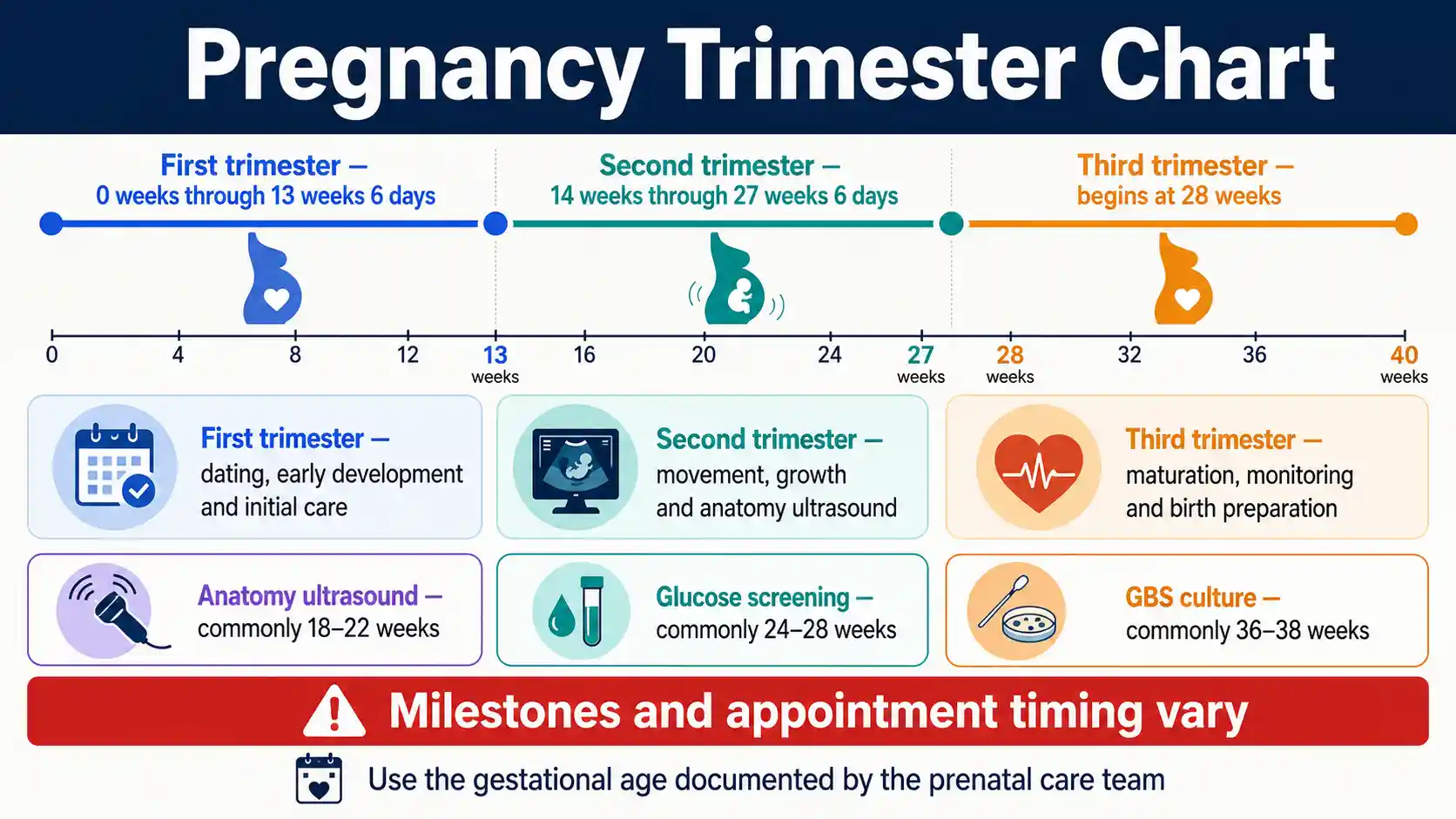
What weeks are each pregnancy trimester?
The first trimester ends at 13 weeks 6 days, the second spans 14 weeks 0 days through 27 weeks 6 days, and the third begins at 28 weeks 0 days.
These are the boundaries in the ACOG fetal-growth overview. Some consumer apps round trimester changes differently, so clinical communication should use completed gestational weeks and days.
First trimester
Through 13 6/7
The first trimester runs from the gestational start through 13 weeks 6 days in this chart.
Second trimester
14 0/7–27 6/7
Second trimester begins at 14 weeks 0 days and ends immediately before 28 weeks.
Third trimester
Starts at 28 0/7
Third trimester continues through birth, including preterm and term ranges where applicable.
Full term
39 0/7–40 6/7
Full term is a defined 14-day range; the EDD at 40 weeks is one estimated day within it.
Pregnancy Trimester Weeks and Term Range Chart
This page uses ACOG week boundaries. Some books and apps round trimester transitions differently, so compare the completed gestational week rather than a month label.
Swipe horizontally inside the table to view every column.
| Pregnancy stage | Gestational-age range | What the range means | Key qualification |
|---|---|---|---|
| First trimester | 0 weeks 0 days–13 weeks 6 days — First-trimester range | Pregnancy dating begins from the gestational start date | The first 2 gestational weeks usually precede conception |
| Second trimester | 14 weeks 0 days–27 weeks 6 days — Second-trimester range | A period of rapid fetal growth and continued organ development | The change occurs at 14 weeks 0 days in this chart |
| Third trimester | 28 weeks 0 days–40 weeks 6 days — Third-trimester range | Growth, maturation, and preparation for birth continue | Pregnancy can end before or extend beyond this interval |
| Preterm | Before 37 weeks 0 days | Birth before the term range | Possible labor or membrane rupture needs immediate maternity assessment — Urgent assessment for possible preterm labor |
| Early term | 37 weeks 0 days–38 weeks 6 days | Term pregnancy, but earlier than the full-term range | Each completed week still has clinical meaning |
| Full term | 39 weeks 0 days–40 weeks 6 days | The full-term range surrounding the EDD | The due date at 40 weeks 0 days is one estimated day |
| Late term | 41 weeks 0 days–41 weeks 6 days | Pregnancy has continued beyond the EDD | Follow the maternity team’s monitoring and delivery plan |
| Postterm | 42 weeks 0 days and later | Pregnancy is 2 or more weeks past a 40-week EDD | This is a clinical category, not a reason to recalculate the EDD |
Gestational age is written as completed weeks plus completed days; 13 weeks 6 days is 13 6/7 weeks.
- • Gestational age commonly starts from the first day of the last menstrual period or an equivalent clinician-assigned date.
- • Use the due date and gestational age documented by the prenatal or fertility care team.
- • A trimester boundary does not predict an individual symptom, test result, or developmental event.
Download or export
How to use a pregnancy trimester chart
Anchor the timeline to the clinician-recorded gestational age, use exact week boundaries, and interpret milestones as broad context. A chart can organize questions but cannot assess fetal development, pregnancy health, or symptoms.
1
Use the official dating
Start with the gestational age or EDD documented by the prenatal or fertility team.
2
Read weeks and days
A boundary such as 14 weeks 0 days is more precise than a rounded month label.
3
Treat milestones as ranges
Symptoms, movement, scan findings, growth, and appointments vary by pregnancy.
4
Let symptoms override the chart
Warning signs need medical assessment regardless of trimester or week.
This chart uses ACOG boundaries: first trimester through 13 weeks 6 days, second trimester from 14 weeks 0 days, and third trimester from 28 weeks 0 days.
Pregnancy Trimester Locator
Locate a trimester from an EDD or gestational age
Enter the clinician-recorded due date or a known gestational age. Calculations stay in your browser and organize the timeline; they do not confirm dating, fetal development, or pregnancy health.
Use the EDD in the prenatal record, not a date recalculated from a later scan or personal app.
Enter the established due date
The locator will show the calculated gestational age, trimester, upcoming boundary, full-term start, and EDD.
Use the gestational age and EDD documented by the prenatal or fertility care team. A trimester result cannot assess bleeding, pain, fluid leakage, fetal movement, or another symptom.
Pregnancy Weeks to Months by Trimester Chart
Pregnancy care is scheduled by gestational weeks, not calendar months. The month groupings below are approximate because months are not all 4 weeks long.
Swipe horizontally inside the table to view every column.
| Gestational weeks | Approximate pregnancy month | Trimester | How to use the label |
|---|---|---|---|
| Weeks 1–4 | Month 1 | First trimester | Week counting starts before conception in typical LMP dating |
| Weeks 5–8 | Month 2 | First trimester | A positive test and first prenatal contact often occur in this period |
| Weeks 9–13 | Month 3 | First trimester — First trimester ends during week 13 | The trimester continues through 13 weeks 6 days |
| Weeks 14–17 | Month 4 | Second trimester — Second trimester begins | Second trimester begins at 14 weeks 0 days |
| Weeks 18–22 | Month 5 | Second trimester | The common anatomy-ultrasound window falls here |
| Weeks 23–27 | Month 6 | Second trimester | The trimester ends at 27 weeks 6 days |
| Weeks 28–31 | Month 7 | Third trimester — Third trimester begins | Third trimester begins at 28 weeks 0 days |
| Weeks 32–35 | Month 8 | Third trimester | Birth before 37 weeks remains preterm |
| Weeks 36–40 | Month 9 | Third trimester | Term categories begin at 37 weeks |
| Week 41 and later | Beyond the estimated month 9 | Late third trimester | Use the established EDD and the maternity team’s plan |
Approximate month labels are for orientation only; clinical decisions use weeks and days.
- • Forty gestational weeks equal 280 days, which is longer than nine 4-week blocks.
- • A person at 20 weeks has completed 20 gestational weeks, not necessarily exactly 5 calendar months.
- • Do not use a month label to decide whether a symptom can wait.
Download or export
Pregnancy months are useful labels, not exact clinical units
Calendar months range from 28 to 31 days, while each gestational week is exactly 7 days. That is why a 40-week pregnancy can be described as about 9 months even though it contains ten 4-week blocks. Tests and decisions should follow weeks and days.
First Trimester Week and Milestone Chart
First-trimester development is rapid, but exact ultrasound findings and symptoms depend on true dating and individual circumstances.
Swipe horizontally inside the table to view every column.
| Gestational time | Developmental context | Common care focus | Important qualification |
|---|---|---|---|
| Weeks 0–2 | Gestational counting usually begins before fertilization | Review medicines, supplements, exposures, and preconception health when possible | A person is not yet pregnant during much of this LMP-based interval |
| Weeks 3–4 | Fertilization and implantation may occur; hormone levels begin changing | Confirm a pregnancy with an appropriate test and contact care for concerning symptoms | A home test cannot locate the pregnancy or confirm viability — A test does not confirm location or viability |
| Weeks 5–6 | The embryo stage is underway; early structures form | Arrange early prenatal care and discuss dating — Early prenatal care | Ultrasound visibility varies with dates, equipment, and the clinical question |
| Weeks 7–8 | Brain, limb, facial, and organ development continues | Review nutrition, health history, medicines, and screening choices | Developmental descriptions are broad, not a test of an individual pregnancy |
| Weeks 9–10 | The transition from embryo to fetus occurs during this period | Follow the clinician’s dating and prenatal-testing plan | Gestational age is about 2 weeks ahead of age from fertilization |
| Weeks 11–12 | Growth and differentiation continue | Some optional screening or diagnostic windows occur around this time | Screening estimates chance; it does not diagnose a condition |
| Week 13 through 13 weeks 6 days | The first trimester is ending | Confirm the next visit and second-trimester care plan | The second trimester begins at 14 weeks 0 days in this chart — Trimester boundary |
All weeks are gestational age, not weeks since conception.
- • Early pregnancy symptoms can be mild, strong, intermittent, or absent.
- • Bleeding, severe or one-sided pain, fainting, shoulder pain, fever, or feeling very unwell needs prompt assessment.
- • Exposure risk depends on the substance, dose, timing, and individual pregnancy; contact a qualified clinician or teratology information service.
Download or export
Second Trimester Week and Milestone Chart
The second trimester spans 14 weeks 0 days through 27 weeks 6 days. Movement, growth, and care timing vary between pregnancies.
Swipe horizontally inside the table to view every column.
| Gestational time | Developmental context | Common care focus | Important qualification |
|---|---|---|---|
| Weeks 14–16 | Fetal growth and movement continue | Review symptoms, results, and any optional second-trimester screening | A change in symptoms does not measure fetal health |
| Weeks 17–19 | Movement may become noticeable for some people — Movement may be noticed | Prepare for or complete the midpregnancy anatomy ultrasound | First movement can be earlier or later, especially by pregnancy history and placenta position |
| Weeks 20–22 | The pregnancy reaches the midpoint of a 40-week count | The 18–22-week anatomy ultrasound commonly occurs — Anatomy ultrasound window | A normal ultrasound cannot exclude every condition |
| Weeks 23–24 | Growth and organ maturation continue | Discuss preterm-labor symptoms and the upcoming glucose-screening window | Developmental summaries cannot predict outcome after a very preterm birth — Do not infer outcome |
| Weeks 25–26 | Movement patterns may become more recognizable | Glucose screening commonly occurs between 24 and 28 weeks | Do not diagnose gestational diabetes from symptoms alone |
| Week 27 through 27 weeks 6 days | The second trimester is ending | Confirm third-trimester visits, tests, and support needs | The third trimester begins at 28 weeks 0 days — Trimester boundary |
Milestones are approximate educational ranges, not required achievements.
- • Contact the maternity team for bleeding, fluid leakage, regular painful contractions, severe pain, fever, or another warning sign.
- • Ask how and when your care team wants you to report a change in fetal movement.
- • Multiple and high-risk pregnancies can follow different ultrasound, visit, and delivery schedules.
Download or export
Third Trimester Week and Milestone Chart
The third trimester begins at 28 weeks 0 days. Fetal growth, maturation, movement awareness, birth preparation, and individualized monitoring continue.
Swipe horizontally inside the table to view every column.
| Gestational time | Pregnancy stage | Common care focus | Important qualification |
|---|---|---|---|
| Weeks 28–31 | Early third trimester; still preterm | Review movement guidance, test results, vaccination plan, and preterm-labor symptoms | Routine timing varies with risks, history, and local guidance |
| Weeks 32–34 | Preterm; growth and maturation continue | Discuss feeding, newborn care, support, and delivery preferences | A birth plan records preferences but cannot guarantee events |
| Weeks 35–36 | Late preterm until 37 weeks 0 days | Review labor signs, route to care, and group B streptococcus testing plans | Contractions or fluid leakage before 37 weeks need immediate assessment — Possible preterm labor needs assessment |
| Weeks 37–38 | Early term | Confirm when to call, where to go, and how movement changes should be reported | Early term is not the same category as full term |
| Weeks 39–40 | Full term — Full term | Follow the delivery and monitoring plan tied to the established EDD | Labor can begin before, on, or after the due date |
| Week 41 | Late term | Follow the maternity team’s surveillance and delivery recommendations | Do not move the due date forward because it has passed |
| Week 42 and later | Postterm | Use the clinician’s immediate management plan — Clinical management required | Postterm pregnancy requires clinical management, not a home chart |
Term categories use completed gestational weeks and days.
- • The usual movement pattern is individual; a clear decrease or stopping needs immediate contact with maternity care.
- • Braxton Hicks contractions do not make it safe to ignore regular, intensifying, painful contractions or fluid leakage.
- • Seek immediate care for urgent maternal warning signs at any week.
Download or export
Prenatal care should follow the person, not a rigid calendar
The ACOG tailored prenatal-care guidance supports an early assessment and an individualized plan for visits, tests, communication, education, and support. Symptoms, risks, results, access, and preferences can all change that plan.
Common Pregnancy Tests and Care Windows Chart
These are common U.S. timing windows, not a universal checklist. A prenatal team tailors testing to the pregnancy, preferences, health history, results, and local practice.
Swipe horizontally inside the table to view every column.
| Approximate timing | Care item | Purpose | Choice or timing note |
|---|---|---|---|
| Before 10 weeks when feasible | Initial prenatal assessment — Early assessment | Reviews dating, health history, medicines, symptoms, needs, and care plan | Contact care earlier for symptoms or a high-risk condition |
| First trimester | Initial blood and urine testing | May assess blood type, anemia, infections, immunity, urine, and other risks | The exact panel varies by setting and history |
| Up to 13 weeks 6 days when indicated | Dating ultrasound | Can establish or support gestational age using crown–rump length | Not every pregnancy needs the same number of scans |
| 10 weeks onward when chosen | Cell-free DNA screening | Screens for the chance of selected chromosome conditions | Optional screening; not a diagnostic test |
| 10–13 weeks when chosen | Chorionic villus sampling | Diagnostic sampling for selected genetic questions | Optional invasive testing requires counseling |
| 15–22 weeks when chosen | Second-trimester serum screening | Screens for selected chromosome conditions and neural tube defects | Program availability and preferred timing vary |
| 18–22 weeks — Common anatomy ultrasound window | Anatomy ultrasound | Examines fetal structures and often placenta, fluid, and growth | Cannot detect every condition or predict all outcomes |
| 24–28 weeks for many pregnancies — Common glucose screening window | Gestational diabetes screening | Checks for glucose intolerance developing during pregnancy | Earlier or different testing may be used for individual risk |
| Around 28 weeks when indicated | Rh immune globulin | Helps prevent Rh sensitization in eligible unsensitized Rh-negative patients | Blood type, antibody results, bleeding, and procedures affect timing |
| 36–38 weeks for many pregnancies — Common GBS culture window | Group B streptococcus culture | Guides antibiotics during labor when indicated | Clinical circumstances can change whether or when it is done |
Timing windows follow cited U.S. guidance and may differ in other health systems.
- • Screening tests estimate chance; diagnostic tests answer different questions.
- • A result, symptom, exposure, multiple pregnancy, or chronic condition may change the standard plan.
- • Use the care schedule documented by the prenatal team rather than building one from this chart.
Download or export
Prenatal Care Focus by Trimester Chart
Prenatal care is a continuous, individualized process. These broad goals show how the emphasis may evolve without prescribing a fixed visit count.
Swipe horizontally inside the table to view every column.
| Trimester | Maternal health focus | Pregnancy and fetal focus | Planning and support focus |
|---|---|---|---|
| First trimester: early | Confirm health history, symptoms, medicines, exposures, nutrition, and mental health — Early comprehensive assessment | Establish pregnancy dating and evaluate symptoms or risk factors | Identify care access, language, transport, safety, and social needs |
| First trimester: later | Review initial results and symptom management | Discuss screening and diagnostic options based on informed choice | Set an individualized visit and communication plan |
| Second trimester: early | Monitor blood pressure, symptoms, wellbeing, and chronic conditions | Review screening results and plan the anatomy examination — Anatomy examination planning | Discuss work, activity, travel, dental care, and support questions |
| Second trimester: later | Review glucose screening and other indicated tests | Track growth and discuss movement expectations | Prepare for third-trimester education and practical needs |
| Third trimester: early | Monitor symptoms and individualized risks more closely as needed | Review movement guidance, growth, position, and indicated surveillance | Discuss feeding, newborn care, birth preferences, and support |
| Third trimester: late | Assess labor or complication symptoms and delivery readiness | Use the established EDD and clinical findings for delivery planning | Confirm when to call, where to go, transport, and postpartum support — Delivery and postpartum readiness |
Visit number, timing, format, and testing are individualized.
- • ACOG supports tailoring prenatal care rather than assuming one rigid schedule fits every pregnancy.
- • High-risk conditions, multiple gestation, new symptoms, or abnormal results may require more visits or monitoring.
- • Mental health, substance use, safety, nutrition, and social support can be addressed in every trimester.
Download or export
Common Pregnancy Changes and Context Chart
A common symptom can still be severe, and a complication can begin with a familiar symptom. Pattern, intensity, duration, associated signs, and individual history matter.
Swipe horizontally inside the table to view every column.
| Change or symptom | Often reported timing | Usually discuss at routine or prompt contact | Escalate sooner when |
|---|---|---|---|
| Nausea or vomiting | Often first trimester; may continue | Discuss hydration, food intake, triggers, and safe treatment options | Unable to keep fluids down, faint, confused, feverish, or urinating very little — Dehydration or systemic signs |
| Fatigue | Common throughout pregnancy | Review sleep, activity, nutrition, mood, and anemia risk | Sudden overwhelming weakness, fainting, breathing trouble, or chest symptoms |
| Breast tenderness or enlargement | Often begins early | Discuss comfort and any focal breast concern | Redness with fever, a new concerning mass, or severe localized pain |
| Constipation or bloating | Can occur in any trimester | Discuss fluids, fiber, activity, medicines, and safe options | Severe persistent pain, vomiting, fever, or inability to pass stool or gas |
| Heartburn | Often increases later in pregnancy | Discuss meal pattern and pregnancy-safe treatment | Chest pressure, breathing trouble, fainting, or pain unlike usual heartburn |
| Back, pelvic, or ligament discomfort | Often second and third trimesters | Discuss location, triggers, function, posture, and support | Severe or persistent pain, weakness, fever, bleeding, fluid, contractions, or urinary symptoms |
| Mild ankle or foot swelling | Often later pregnancy | Compare sides and discuss gradual changes | Sudden or extreme face or hand swelling, one-sided limb pain, headache, or vision change — Concerning swelling pattern |
| Irregular uterine tightening | Can occur later in pregnancy | Track duration, frequency, strength, hydration, and response to rest | Regular, painful, intensifying, before 37 weeks, or accompanied by bleeding or fluid |
| Fetal movement pattern | Usually becomes noticeable in the second trimester | Learn the individual baseline and the team’s reporting method | Movement clearly slows or stops compared with the usual pattern — Report reduced movement immediately |
This table provides context, not symptom diagnosis or triage.
- • Contact the prenatal team when a symptom is new, worsening, persistent, or concerning to you.
- • Do not delay urgent assessment because a symptom appears in a “common changes” list.
- • Follow condition-specific instructions if the care team has provided them.
Download or export
Warning signs matter in every trimester
The CDC urgent maternal warning-sign guidance advises immediate medical care for concerning symptoms such as bleeding, fluid leakage, severe persistent pain, breathing trouble, chest pain, severe headache, vision change, fever, extreme swelling, fainting, or reduced fetal movement.
Urgent Pregnancy Warning Signs by Action Chart
Urgent warning signs override the trimester timeline. Seek medical care immediately when one occurs, and use emergency services for severe or life-threatening symptoms.
Swipe horizontally inside the table to view every column.
| Warning sign | Action | Why the trimester cannot reassure you | Useful details to report |
|---|---|---|---|
| Vaginal bleeding more than spotting or fluid leaking | Get immediate medical care — Immediate medical care | Bleeding and fluid can signal important problems at any gestational age | Amount, color, clots, odor, pain, and onset |
| Severe belly pain that does not go away | Get immediate medical care | Pregnancy and nonpregnancy emergencies are possible in every trimester | Location, onset, bleeding, shoulder pain, dizziness, and fever |
| Trouble breathing, chest pain, or a fast-beating heart | Use emergency care for severe symptoms — Emergency care if severe | Cardiac or respiratory complications can occur during or after pregnancy | Onset, ability to speak, fainting, swelling, and history |
| Severe headache, vision change, or extreme face or hand swelling | Get immediate medical care | A serious hypertensive complication may be possible | Onset, blood pressure if already measured, pain, vision, and swelling |
| Fever of 100.4°F (38°C) or higher | Contact urgent medical care | Infection can affect the pregnant person and pregnancy | Temperature, duration, pain, rash, exposures, and other symptoms |
| Severe vomiting or inability to keep fluids down | Get prompt medical care | Dehydration and other serious causes may need treatment | Fluid intake, urination, dizziness, fever, pain, and duration |
| Fetal movement stops or clearly slows from the usual pattern | Contact the maternity unit or clinician immediately — Contact maternity care immediately | Change from the individual pattern matters more than a universal number | When the change began and the last usual pattern |
| One-sided leg or arm swelling, redness, or pain | Get immediate medical care | A blood clot may be possible | Side, swelling, warmth, breathing symptoms, and onset |
| Fainting, ongoing dizziness, confusion, or sudden overwhelming weakness | Get immediate medical care | These can accompany serious pregnancy or nonpregnancy conditions | Timing, injuries, bleeding, intake, medicines, and other symptoms |
| Thoughts of harming yourself or the baby, or feeling something is seriously wrong | Seek immediate emergency or professional help — Immediate safety support | Safety concerns and severe distress need care regardless of week | State clearly that you are pregnant and describe the immediate concern |
Use local emergency services when symptoms are severe, rapidly worsening, or life-threatening.
- • This list is not exhaustive. Contact a healthcare professional when you are worried or something feels wrong.
- • Tell the healthcare team that you are pregnant and provide the clinician-recorded gestational age or EDD when known.
- • Urgent symptoms also matter during the year after delivery.
Download or export
Frequently asked questions
What weeks are the first, second, and third trimesters?
Using ACOG boundaries, the first trimester runs through 13 weeks 6 days, the second runs from 14 weeks 0 days through 27 weeks 6 days, and the third begins at 28 weeks 0 days. Other consumer resources may round the transition differently.
Why do some pregnancy apps show different trimester start weeks?
There is more than one convention in consumer resources. Some divide 40 weeks into roughly equal thirds or use month-based rounding. For clinical care, use completed gestational weeks and the convention used by your prenatal team; this chart uses ACOG boundaries.
Is pregnancy 9 months or 10 months?
Pregnancy is about 40 gestational weeks, or 280 days, from the clinical starting point. That is roughly 9 calendar months plus about a week, but it also equals ten 4-week blocks. Month labels are approximate, so healthcare teams schedule care by weeks and days.
Why are weeks 1 and 2 counted before conception?
Gestational age traditionally begins on the first day of the last menstrual period, about 2 weeks before fertilization in a typical 28-day cycle. This convention provides a consistent starting point when the exact day of conception is unknown.
When does the second trimester start?
In this ACOG-based chart, the second trimester starts at 14 weeks 0 days and continues through 27 weeks 6 days. An app using another convention may show a slightly different boundary.
When does the third trimester start?
The third trimester starts at 28 weeks 0 days in this chart. It continues through the remainder of pregnancy, including preterm, early-term, full-term, late-term, and postterm ranges where applicable.
What is the difference between gestational age and fetal age?
Gestational age counts from the clinical pregnancy start date, usually the LMP or an equivalent assigned date. Age from fertilization is commonly about 2 weeks less in a typical cycle. Prenatal appointments and test windows use gestational age.
When is the anatomy ultrasound usually done?
A standard anatomy ultrasound is commonly performed between 18 and 22 gestational weeks. Its exact timing and purpose depend on the pregnancy and care plan, and it cannot detect every condition.
When is gestational diabetes screening usually done?
Many pregnancies are screened between 24 and 28 weeks. Earlier or different testing may be recommended based on prior results, history, symptoms, or individual risk. Follow the prenatal team’s plan.
When should fetal movement begin?
Movement is often first noticed during the second trimester, but timing varies with pregnancy history, placenta position, and individual perception. Ask the maternity team when and how it wants changes from the usual movement pattern reported.
Does reaching a new trimester mean miscarriage or preterm-birth risk is gone?
No trimester boundary removes all risk or guarantees an outcome. The types and likelihood of complications change over pregnancy, but symptoms and individual history remain important. Seek assessment for warning signs regardless of week.
What is full term?
Full term is 39 weeks 0 days through 40 weeks 6 days. Early term is 37 weeks 0 days through 38 weeks 6 days, late term is 41 weeks 0 days through 41 weeks 6 days, and postterm begins at 42 weeks 0 days.
How often should prenatal appointments occur in each trimester?
There is no single schedule for every pregnancy. ACOG supports an individualized prenatal-care plan based on medical and obstetric risk, test results, symptoms, access, preferences, and support needs. Use the schedule your care team documents.
Can a trimester chart tell whether fetal development is normal?
No. Milestones are broad educational descriptions, not a growth or diagnostic assessment. Dating, ultrasound, examination, laboratory results, and clinical context are needed to evaluate an individual pregnancy.
When should I seek urgent care during pregnancy?
Seek immediate care for warning signs such as bleeding more than spotting, fluid leakage, severe persistent pain, trouble breathing, chest pain, fainting, severe headache, vision change, fever, extreme swelling, reduced fetal movement, or feeling that something is seriously wrong.
Sources
These obstetric, prenatal-care, fetal-development, gestational-age, and maternal-safety resources support the week boundaries, milestone context, care windows, term ranges, and warning signs.
American College of Obstetricians and Gynecologists — How Your Fetus Grows During Pregnancy
https://www.acog.org/womens-health/faqs/how-your-fetus-grows-during-pregnancy
Defines ACOG trimester boundaries, explains gestational-age counting, and summarizes fetal development across pregnancy.
American College of Obstetricians and Gynecologists — Routine Tests During Pregnancy
https://www.acog.org/womens-health/faqs/routine-tests-during-pregnancy
Supports common prenatal laboratory, glucose-screening, and group B streptococcus testing windows.
American College of Obstetricians and Gynecologists — Prenatal Genetic Screening Tests
https://www.acog.org/womens-health/faqs/prenatal-genetic-screening-tests
Explains optional prenatal genetic screening and diagnostic testing, including timing for serum screening and the anatomy ultrasound.
American College of Obstetricians and Gynecologists — Tailored Prenatal Care Delivery for Pregnant Individuals
https://www.acog.org/clinical/clinical-guidance/clinical-consensus/articles/2025/04/tailored-prenatal-care-delivery-for-pregnant-individuals
Supports an early prenatal assessment and individualized visit, monitoring, testing, education, and support plans.
American College of Obstetricians and Gynecologists — Definition of Term Pregnancy
https://www.acog.org/clinical/clinical-guidance/committee-opinion/articles/2013/11/definition-of-term-pregnancy
Defines early term, full term, late term, and postterm gestational-age ranges.
American College of Obstetricians and Gynecologists — Ultrasound Exams
https://www.acog.org/womens-health/faqs/ultrasound-exams
Explains the purposes of pregnancy ultrasound and the common 18–22-week standard examination window.
American College of Obstetricians and Gynecologists — Methods for Estimating the Due Date
https://www.acog.org/clinical/clinical-guidance/committee-opinion/articles/2017/05/methods-for-estimating-the-due-date
Supports standardized gestational-age dating and use of one documented best obstetric estimate.
Centers for Disease Control and Prevention — Urgent Maternal Warning Signs and Symptoms
https://www.cdc.gov/hearher/maternal-warning-signs/index.html
Lists symptoms during pregnancy and after delivery that require immediate medical care.
Office on Women’s Health — Stages of Pregnancy
https://womenshealth.gov/pregnancy/youre-pregnant-now-what/stages-pregnancy
Describes pregnancy as about 40 gestational weeks grouped into three trimesters and summarizes common changes.
Eunice Kennedy Shriver National Institute of Child Health and Human Development — About Pregnancy
https://www.nichd.nih.gov/health/topics/pregnancy/conditioninfo
Summarizes the three trimesters and major developmental events across an approximately 40-week pregnancy.
MedlinePlus Medical Encyclopedia — Fetal Development
https://medlineplus.gov/ency/article/002398.htm
Provides an educational week-grouped overview of embryo and fetal development throughout pregnancy.
MotherToBaby — Critical Periods of Development
https://www.ncbi.nlm.nih.gov/books/NBK582659/
Explains gestational-age counting and why the timing and effect of exposures can differ across pregnancy.