Health & Medical · Pregnancy nutrition
Pregnancy Weight Gain Chart by Pre-Pregnancy BMI
Compare total pregnancy weight-gain ranges for one baby and twins, later-pregnancy averages, BMI calculation, consistent tracking, nutrition context, and warning signs.
A weight-gain chart cannot assess nutrition, fluid shifts, fetal growth, or pregnancy health. Use the individualized goal documented by the prenatal team, and seek immediate care for urgent maternal warning signs regardless of weight. Read the ChartsLoom Disclaimer.
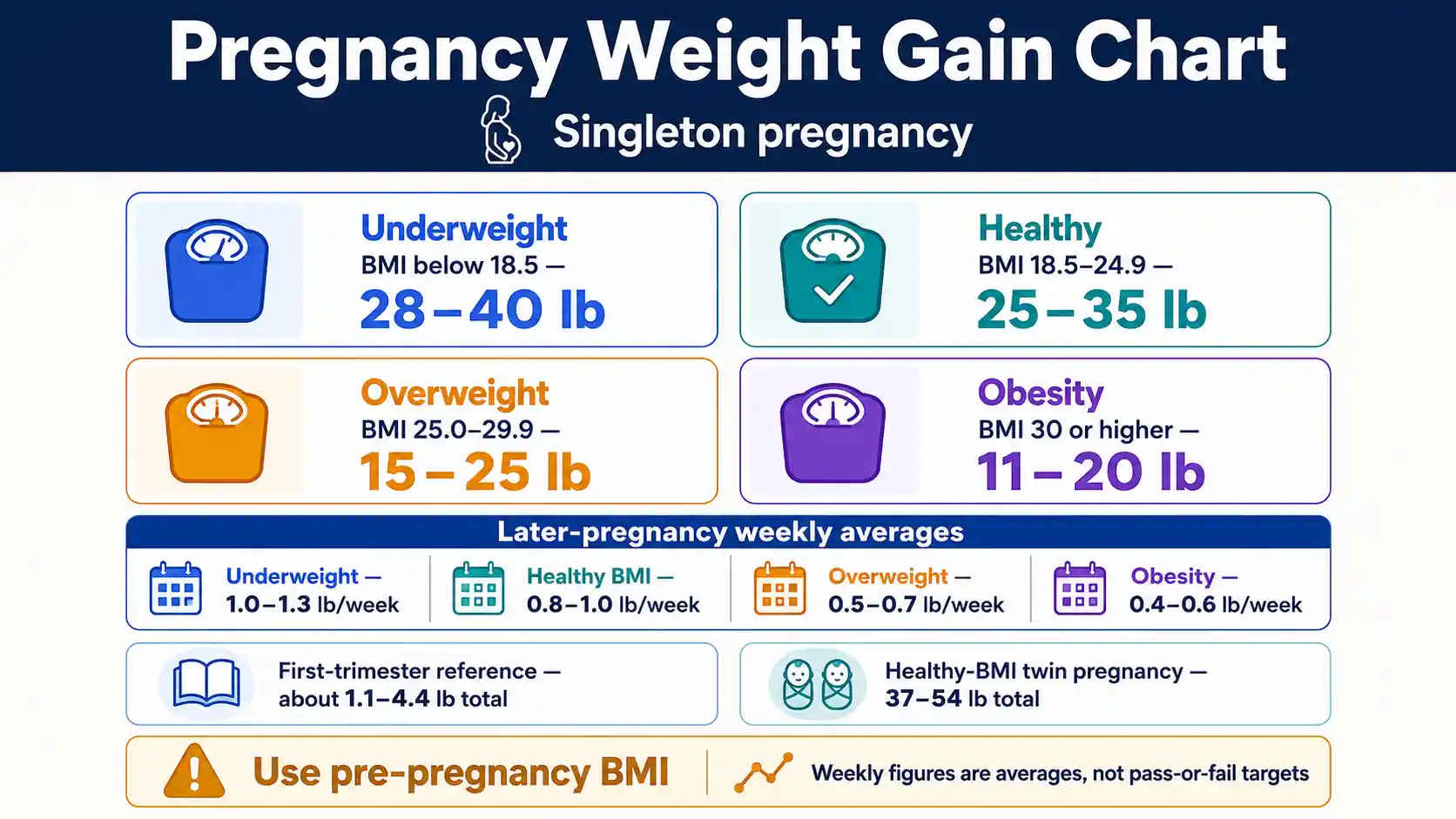
How much weight should you gain during pregnancy?
For one baby, total gain is 28–40 lb with an underweight pre-pregnancy BMI, 25–35 lb at a healthy BMI, 15–25 lb with overweight, and 11–20 lb with obesity.
The current CDC pregnancy weight-gain guidance uses adult BMI before pregnancy and provides separate total ranges for twins. These numbers are broad goals to discuss with prenatal care, not a prediction of what one person should weigh on an exact day.
Healthy BMI · one baby
25–35 lb
The singleton total range is 11.5–16 kg when pre-pregnancy BMI is 18.5–24.9.
First-trimester model
1.1–4.4 lb
The IOM reference assumes 0.5–2 kg total, but early gain can be smaller or absent.
Later weekly figures
BMI-specific
Second- and third-trimester rates are averages for singleton pregnancy, not weekly grades.
Healthy BMI · twins
37–54 lb
Twin total ranges are higher and require an individualized prenatal growth and nutrition plan.
Singleton Pregnancy Weight Gain by Pre-Pregnancy BMI
For a pregnancy with one baby, the recommended total and later-pregnancy rate depend on adult BMI before pregnancy. The rate is an average across the second and third trimesters, not a weekly pass-or-fail test.
Swipe horizontally inside the table to view every column.
| Pre-pregnancy BMI category | BMI | Recommended total gain | Average gain in trimesters 2 and 3 |
|---|---|---|---|
| Underweight | Below 18.5 | 28–40 lb (12.5–18 kg) — Underweight singleton total range | 1.0–1.3 lb/week (0.44–0.58 kg/week) |
| Healthy weight | 18.5–24.9 | 25–35 lb (11.5–16 kg) — Healthy-weight singleton total range | 0.8–1.0 lb/week (0.35–0.50 kg/week) |
| Overweight | 25.0–29.9 | 15–25 lb (7–11.5 kg) — Overweight singleton total range | 0.5–0.7 lb/week (0.23–0.33 kg/week) |
| Obesity | 30.0 or higher | 11–20 lb (5–9 kg) — Obesity singleton total range | 0.4–0.6 lb/week (0.17–0.27 kg/week) |
BMI is weight in kilograms divided by height in meters squared. Pound and kilogram ranges are rounded guideline equivalents.
- • Use measured or best-estimate weight immediately before pregnancy, not the current pregnancy weight, to choose the BMI row.
- • The obesity row is one broad guideline category; BMI class, fetal growth, medical conditions, and other factors may change the clinical plan.
- • Do not intentionally lose weight during pregnancy unless a qualified prenatal clinician directs and supervises a specific plan.
Download or export
How to use a pregnancy weight gain chart
Select the row from adult pre-pregnancy BMI and pregnancy type, then review the pattern across time. The chart gives population guidance; it cannot evaluate nutrition, fluid shifts, fetal growth, or pregnancy complications.
1
Start before pregnancy
Use adult height and the best available weight immediately before pregnancy.
2
Choose one baby or twins
Singleton and twin pregnancies have different total-gain ranges.
3
Read the trend
Later weekly figures are averages; several consistent measurements matter more.
4
Add clinical context
Symptoms, blood pressure, nutrition, fetal growth, and history can change the plan.
The second- and third-trimester rate is an average for singleton pregnancy, not a target that must be met every week.
Pregnancy Weight Gain Planner
Find the guideline range from pre-pregnancy BMI
Enter adult height and pre-pregnancy weight, then choose one baby or twins. A current weight is optional and is used only to calculate the numerical change. Calculations stay in your browser and do not determine whether your weight pattern is healthy.
Adult pre-pregnancy BMI
22.5
Healthy weight · one baby
Recommended total gain
25–35 lb
11.3–15.9 kg
Later-pregnancy average
0.8–1.0 lb/week
0.36–0.45 kg/week
Entered week
Week 24 · Second trimester
Use the BMI-specific weekly figure as an average across time.
This planner does not assess fetal growth, fluid retention, nutrition, pregnancy complications, or whether current gain is appropriate. Use the goal documented by the prenatal team, especially for adolescents, multiples, BMI 30 or higher, or a medical condition.
Twin Pregnancy Total Weight Gain by Pre-Pregnancy BMI
Twin pregnancies use higher total-gain ranges than singleton pregnancies. CDC lists the ranges below; trimester-specific weekly targets are not supplied in this table.
Swipe horizontally inside the table to view every column.
| Pre-pregnancy BMI category | BMI | Recommended total gain | Important qualification |
|---|---|---|---|
| Underweight | Below 18.5 | 50–62 lb (22.7–28.1 kg) | CDC lists this range from twin-pregnancy evidence outside the 2009 IOM recommendations — Evidence qualification |
| Healthy weight | 18.5–24.9 | 37–54 lb (16.8–24.5 kg) — Healthy-weight twin total range | Use an individualized twin-pregnancy nutrition and growth-monitoring plan |
| Overweight | 25.0–29.9 | 31–50 lb (14.1–22.7 kg) | A broad total range does not replace serial fetal-growth assessment |
| Obesity | 30.0 or higher | 25–42 lb (11.3–19.1 kg) | BMI class and pregnancy complications may require closer review — Individual review needed |
Total gain is measured from pre-pregnancy weight to the last pregnancy weight.
- • CDC notes that the underweight twin range is not one of the original Institute of Medicine recommendations.
- • For triplets or higher-order multiples, ask the maternal-fetal medicine or prenatal team for a specific goal.
- • Do not apply a singleton weekly rate to a twin pregnancy.
Download or export
Pregnancy Weight Gain Pattern by Trimester
Pregnancy weight does not rise in a perfectly straight line. The chart describes a broad singleton pattern and should be interpreted across several measurements.
Swipe horizontally inside the table to view every column.
| Pregnancy stage | General pattern | Reference point | How to interpret it |
|---|---|---|---|
| Before pregnancy | Establish baseline height and weight | Calculate adult pre-pregnancy BMI | Use this baseline to select the guideline range |
| First trimester | Gain may be small, variable, or absent | The IOM model assumes about 1.1–4.4 lb (0.5–2 kg) total — First-trimester reference range | Nausea, starting BMI, fluid, and individual health affect the pattern |
| Second trimester | Gain is often more consistent | Use the BMI-specific weekly-average range for singleton pregnancy — Use BMI-specific average | Review the trend over several weeks rather than one weigh-in |
| Third trimester | Gain usually continues but can fluctuate | Use the same BMI-specific later-pregnancy average as context | Fluid shifts, fetal growth, delivery timing, and complications can alter the line — Fluid and clinical factors matter |
Trimester timing and weight-gain patterns are approximate clinical context.
- • ACOG notes that some people gain 1–5 lb in the first 12 weeks and some gain no weight.
- • The IOM first-trimester assumption helps construct a reference trajectory; it is not a required result by a precise week.
- • A prenatal clinician considers weight together with blood pressure, symptoms, nutrition, fetal growth, and test results.
Download or export
Pre-Pregnancy BMI Category and Calculation Chart
The pregnancy weight-gain guideline uses adult BMI calculated from height and weight before pregnancy. BMI is a screening measure, not a direct measure of body fat or individual health.
Swipe horizontally inside the table to view every column.
| BMI category | Adult BMI range | Formula | Pregnancy-guideline use |
|---|---|---|---|
| Underweight | Below 18.5 | kg ÷ m² | Select the underweight gain range |
| Healthy weight | 18.5–24.9 — Healthy adult BMI range | kg ÷ m² | Select the healthy-weight gain range |
| Overweight | 25.0–29.9 | kg ÷ m² | Select the overweight gain range — Use corresponding guideline |
| Obesity | 30.0 or higher | kg ÷ m² | Select the broad obesity gain range and individualize care — Individualization important |
U.S. formula: BMI = 703 × weight in pounds ÷ height in inches squared.
- • Use an adult BMI category only for someone who was an adult before pregnancy; adolescents need age-aware clinical assessment.
- • BMI does not account for muscle mass, bone density, body composition, disability, or every health factor.
- • If pre-pregnancy weight is uncertain, the prenatal team can choose the most useful documented baseline.
Download or export
A weight trend starts a conversation; it does not grade a pregnancy
The ACOG weight-gain guidance recommends setting a goal from pre-pregnancy BMI, monitoring the overall pattern, and using clinical judgment. Before changing nutrition or activity, confirm the measurement and review symptoms, fetal growth, medical conditions, medicines, resources, and the person’s wellbeing.
How to Track Pregnancy Weight Consistently
Consistent technique reduces noise in a weight log. The clinical trend is more useful than repeatedly checking throughout the day.
Swipe horizontally inside the table to view every column.
| Tracking step | Practical method | Why it matters | Common source of variation |
|---|---|---|---|
| Choose the baseline — Establish the baseline | Record the best pre-pregnancy weight and measured height | The baseline determines BMI and total gain | Late recall or an early-pregnancy weight may differ |
| Use one scale when possible | Place the scale on a hard, level surface | Different scales can have different calibration | Carpet, uneven flooring, or moving the scale |
| Use a similar time | Weigh at a consistent time under similar conditions | Food, drinks, and bladder contents change scale weight | Morning versus evening comparison |
| Keep clothing similar | Use light, comparable clothing and no shoes | Clothes can obscure a small change | Coats, shoes, or full pockets |
| Follow the care plan | Use the frequency recommended by the prenatal team | Too-frequent weighing can magnify normal noise | Multiple checks in one day |
| Record context | Note week, weight, swelling, vomiting, illness, and scale changes | Context helps explain unusual readings — Context explains a change | A number without symptoms or conditions |
| Review the pattern — Review the trend | Compare several measurements with the individualized goal | A trend is more informative than one point | Reacting to one isolated increase or decrease |
1 kilogram = 2.2046 pounds; 1 pound = 0.4536 kilogram.
- • Clinic and home scales may differ; avoid treating a cross-scale difference as true gain or loss.
- • People with a history of disordered eating or weight-related distress can ask for blind weights or another monitoring approach.
- • Do not delay symptom care while waiting for another weight reading.
Download or export
Pregnancy Weight Pattern and Follow-Up Chart
Being below or above a reference line does not diagnose a problem. Confirm the measurement, review the pattern, and consider symptoms and the whole pregnancy assessment.
Swipe horizontally inside the table to view every column.
| Observed pattern | Possible context to review | Useful next step | Do not assume |
|---|---|---|---|
| One higher reading | Scale, clothing, food, fluid, constipation, or swelling | Repeat only as the care plan recommends and document context | That the gain is body fat or a complication |
| One lower reading | Different scale, time, clothing, hydration, vomiting, or reduced intake | Confirm the measurement and mention ongoing loss | That fetal growth has changed |
| Little or no early gain | Nausea, vomiting, starting BMI, and individual variation | Discuss intake, hydration, symptoms, and medicines | That every first-trimester person must gain |
| Gain tracking below the planned range | Nutrition access, vomiting, illness, baseline error, or medical factors | Review with prenatal care rather than self-prescribing calories — Clinical review rather than self-treatment | That one cause or one remedy applies |
| Gain tracking above the planned range | Baseline error, intake, activity, medicines, fluid, or medical factors | Review the trend and clinical findings with the care team | That dieting or weight loss is automatically safe — Do not start weight loss |
| Rapid change with swelling | Fluid retention or another pregnancy complication may be possible | Contact prenatal care promptly; use urgent care for warning signs — Prompt or urgent assessment | That the change is routine weight gain |
| Weight pattern plus abnormal fetal growth | Placental, fetal, maternal, dating, or measurement factors | Follow ultrasound and specialist recommendations | That maternal weight alone explains fetal size |
No single weight-change threshold diagnoses a pregnancy complication.
- • ACOG recommends clinical judgment when gain falls outside a guideline, especially when fetal growth is appropriate.
- • Nutrition counseling should be supportive, practical, culturally appropriate, and free of stigma.
- • The recommended range is a population guide; the prenatal team may document a different goal for an individual pregnancy.
Download or export
Situations That Need an Individual Weight-Gain Goal
A broad BMI table cannot cover every pregnancy. These situations merit direct goal-setting with prenatal, nutrition, or maternal-fetal medicine professionals.
Swipe horizontally inside the table to view every column.
| Situation | Why the standard chart may be insufficient | Care-plan focus | Safety note |
|---|---|---|---|
| Twin pregnancy | Total ranges differ and fetal growth is monitored separately | Use the twin BMI range and specialist plan | Do not apply singleton weekly rates |
| Triplets or higher-order multiples | Standard BMI tables do not provide a complete goal | Use maternal-fetal medicine and nutrition guidance | Do not extrapolate the twin range — Do not extrapolate a range |
| Pregnant adolescent | Adult BMI categories do not reflect ongoing growth | Use age, growth, nutrition, and pregnancy context | Avoid an adult-calculator-only target |
| BMI 30 or higher | One guideline range covers several obesity classes | Consider BMI class, nutrition, fetal growth, and comorbidities | Do not pursue unsupervised weight loss |
| Previous bariatric surgery | Absorption, intake tolerance, and nutrient status may differ | Coordinate obstetric, surgical, and dietitian monitoring | Supplement doses require professional review |
| Diabetes or gestational diabetes | Glucose goals and nutrition planning add another layer | Coordinate carbohydrate pattern, glucose monitoring, and fetal growth | Do not cut food groups without guidance |
| Persistent vomiting or weight loss | Dehydration and inadequate intake may need treatment | Assess hydration, electrolytes, medicines, and nutrition | Inability to keep fluids down can be urgent — Vomiting and dehydration warning |
| Eating disorder or weight-related distress | Frequent weighing and number-focused advice may cause harm | Use trauma-informed care, blind weights, and mental-health support when helpful — Trauma-informed care | Immediate help is needed for safety concerns |
| Food insecurity or limited access | The barrier may be resources rather than knowledge | Connect nutrition assistance, social work, and culturally relevant foods | Avoid blaming language or unrealistic plans |
Individualization can change monitoring, support, and goals without changing the need for prenatal care.
- • A registered dietitian with pregnancy expertise can help translate a clinical goal into an accessible eating plan.
- • Medicine changes, supplements, and restrictive diets should be reviewed for pregnancy safety.
- • A 2026 National Academies workshop reviewed emerging evidence and gaps but did not replace the current CDC and ACOG ranges.
- • Ask for weight-neutral communication or alternate weighing practices when standard monitoring is distressing.
Download or export
Nutrition and Activity Context for Healthy Pregnancy Gain
Energy and activity guidance supports health; it does not translate into one universal meal plan. Needs vary with pre-pregnancy intake, BMI, activity, multiples, symptoms, and medical conditions.
Swipe horizontally inside the table to view every column.
| Topic | General guidance | Useful focus | Important limit |
|---|---|---|---|
| First-trimester energy | Extra calories are generally not required | Nutrient density, tolerance, hydration, and food safety | Individual needs can differ |
| Second-trimester energy | About 340 additional calories per day is a common reference — Second-trimester energy reference | Add balanced, nutrient-rich food rather than “eating for two” | Not a personal prescription |
| Third-trimester energy | About 450 additional calories per day is a common reference — Third-trimester energy reference | Adjust with the prenatal nutrition plan | Twin and higher-risk needs differ |
| Eating pattern | Include vegetables, fruit, whole grains, protein foods, and appropriate dairy or alternatives | Variety, fiber, iron, folate, protein, calcium, and other nutrients | Food access, culture, allergies, and conditions matter |
| Prenatal vitamins | Use the supplement recommended by prenatal care | Fill specific nutrient gaps | A supplement does not replace food and excess can be harmful |
| Hydration | Drink regularly and respond to thirst and clinical guidance | Urine, heat, vomiting, activity, and illness affect needs | Fluid restrictions require clinician direction |
| Physical activity | For many healthy pregnancies, work toward 150 minutes of moderate activity weekly | Walking and other approved activities can be split into shorter sessions | Follow restrictions and stop for warning signs |
| Restrictive diets | Review vegan, allergy, elimination, fasting, or weight-control plans | Protect energy, protein, vitamin, and mineral intake | Do not start a pregnancy weight-loss diet independently — Avoid unsupervised restriction |
Calorie figures are population-level daily estimates, not a meal plan.
- • Quality, access, symptoms, and medical context matter more than chasing an exact daily calorie number.
- • A prenatal clinician can advise whether activity is safe for a specific pregnancy.
- • Nutrition support should be realistic and should not use fear, shame, or moral labels for food or body size.
Download or export
Symptoms matter more than the number on the scale
The CDC urgent maternal warning-sign guidance advises immediate care for symptoms such as extreme face or hand swelling, severe headache, vision change, breathing trouble, chest pain, severe vomiting, fainting, severe persistent pain, bleeding, fluid leakage, fever, or reduced fetal movement.
Pregnancy Weight Changes and Urgent Warning Signs
A weight reading does not determine urgency. Symptoms override the chart: seek medical care immediately for urgent maternal warning signs.
Swipe horizontally inside the table to view every column.
| Warning sign or pattern | Action | Why it matters | Useful details to report |
|---|---|---|---|
| Extreme swelling of the face or hands | Get immediate medical care — Immediate medical care | This differs from mild, gradual swelling and can accompany a serious condition | Onset, blood pressure if known, headache, vision, and breathing |
| Severe headache or vision change | Get immediate medical care | A hypertensive or neurologic emergency may be possible | Onset, severity, measured blood pressure, swelling, and pain |
| Trouble breathing, chest pain, or fast heartbeat | Use emergency care for severe symptoms — Emergency care if severe | Heart, lung, or clot-related complications may be possible | Onset, ability to speak, fainting, and one-sided swelling |
| Severe vomiting or inability to keep fluids down | Get prompt medical care | Dehydration, electrolyte problems, and ongoing weight loss may need treatment | Last fluids, urination, dizziness, fever, pain, and duration |
| Dizziness, fainting, confusion, or overwhelming weakness | Get immediate medical care | These can accompany serious pregnancy or nonpregnancy conditions | Timing, injury, intake, bleeding, medicines, and other symptoms |
| Severe belly pain that does not go away | Get immediate medical care | Urgent pregnancy and nonpregnancy causes are possible | Location, onset, bleeding, shoulder pain, fever, and vomiting |
| Vaginal bleeding more than spotting or fluid leaking | Get immediate medical care | Pregnancy complications may be possible at any weight or week | Amount, color, clots, odor, pain, and onset |
| Fetal movement stops or clearly slows | Contact maternity care immediately — Immediate maternity contact | Change from the individual movement pattern needs assessment | When the change began and the last usual pattern |
| Fever of 100.4°F (38°C) or higher | Contact urgent medical care | Infection can affect the pregnant person and pregnancy | Temperature, duration, pain, rash, exposures, and other symptoms |
| Thoughts of harming yourself or the baby | Seek immediate emergency or professional help — Immediate safety support | Immediate mental-health safety support is needed | State clearly that you are pregnant and describe the immediate concern |
Use local emergency services for severe, rapidly worsening, or life-threatening symptoms.
- • This list is not exhaustive. If something feels seriously wrong, seek care and say that you are pregnant.
- • A sudden scale change without symptoms still deserves discussion when it is persistent or concerning.
- • Urgent maternal warning signs also matter during the year after delivery.
Download or export
Frequently asked questions
How much weight should I gain during pregnancy?
For one baby, the broad U.S. total-gain range depends on adult pre-pregnancy BMI: 28–40 lb if underweight, 25–35 lb at a healthy weight, 15–25 lb if overweight, and 11–20 lb with obesity. A prenatal clinician may individualize the goal.
How much weight should someone with a healthy BMI gain?
For a singleton pregnancy and pre-pregnancy BMI of 18.5–24.9, the recommended total is 25–35 lb, or about 11.5–16 kg. The average second- and third-trimester rate is about 0.8–1.0 lb per week, but individual weeks fluctuate.
How much weight should an underweight person gain?
For one baby and pre-pregnancy BMI below 18.5, the total guideline is 28–40 lb, or 12.5–18 kg. Because nutrition needs, nausea, health conditions, and fetal growth differ, set the specific target with prenatal care.
How much weight should an overweight person gain?
For one baby and pre-pregnancy BMI of 25.0–29.9, the total guideline is 15–25 lb, or 7–11.5 kg. Do not use the lower range as a reason to restrict food or attempt weight loss without professional guidance.
How much weight should someone with obesity gain?
For one baby and pre-pregnancy BMI of 30 or higher, the broad guideline is 11–20 lb, or 5–9 kg. One range covers several BMI classes, so the prenatal team should also consider fetal growth, nutrition, health conditions, and the overall pregnancy course.
How much weight is recommended for a twin pregnancy?
CDC lists total twin-pregnancy ranges of 50–62 lb for underweight, 37–54 lb for healthy weight, 31–50 lb for overweight, and 25–42 lb for obesity. Twin care requires individualized nutrition and fetal-growth monitoring.
How much weight should I gain in the first trimester?
Early gain is variable. The IOM reference model assumes about 1.1–4.4 lb, or 0.5–2 kg, during the first trimester, while ACOG notes that some people gain 1–5 lb and some gain no weight. Ongoing loss or severe vomiting needs review.
How much weight should I gain per week in pregnancy?
For singleton pregnancies, the second- and third-trimester average ranges are about 1.0–1.3 lb if underweight, 0.8–1.0 lb at a healthy weight, 0.5–0.7 lb if overweight, and 0.4–0.6 lb with obesity. These are averages, not weekly deadlines.
How is pre-pregnancy BMI calculated?
Divide pre-pregnancy weight in kilograms by height in meters squared. With U.S. units, multiply weight in pounds by 703 and divide by height in inches squared. BMI is a screening tool and does not directly measure body composition or health.
Can a pregnancy weight chart tell whether my gain is healthy?
It can provide population-level context, but it cannot assess an individual pregnancy. A clinician interprets weight alongside the baseline, gestational age, measurement method, symptoms, nutrition, blood pressure, fetal growth, laboratory results, and medical history.
Is losing weight during pregnancy safe?
Do not start an intentional weight-loss plan during pregnancy unless a qualified prenatal clinician recommends and supervises it for a specific medical reason. Unplanned loss, persistent vomiting, reduced intake, dehydration, or food insecurity needs prompt support.
Does sudden weight gain mean preeclampsia?
No single weight change diagnoses preeclampsia. Fluid shifts and measurement differences can change scale weight. Extreme face or hand swelling, severe headache, vision changes, upper abdominal pain, breathing trouble, or feeling very unwell requires immediate medical care.
How often should pregnancy weight be checked?
Follow the schedule recommended by the prenatal team. Clinic measurements may be enough for many people. If home tracking is advised, use the same scale, similar clothing, a consistent time, and review the trend rather than checking repeatedly during the day.
Do I need to eat for two during pregnancy?
No. CDC and ACOG commonly note no extra calories in the first trimester, about 340 extra daily calories in the second, and about 450 in the third for many people. These are general estimates; multiples, BMI, activity, symptoms, and health conditions change needs.
When should weight loss or vomiting be reported during pregnancy?
Contact prenatal care for ongoing loss, difficulty eating, reduced urination, or repeated vomiting. Seek prompt or immediate care if you cannot keep fluids down, feel faint or confused, have fever or severe pain, or develop another urgent maternal warning sign.
Sources
These maternal-health, obstetric, nutrition, BMI, and safety resources support the total-gain ranges, trimester averages, tracking guidance, individualization, and warning signs.
Centers for Disease Control and Prevention — Weight Gain During Pregnancy
https://www.cdc.gov/maternal-infant-health/pregnancy-weight/index.html
Provides current U.S. total weight-gain ranges for singleton and twin pregnancies by pre-pregnancy BMI, plus nutrition, activity, and tracking guidance.
National Academies of Sciences, Engineering, and Medicine — Weight Gain During Pregnancy: Reexamining the Guidelines
https://www.ncbi.nlm.nih.gov/books/NBK32801/
Explains the evidence and implementation behind the 2009 Institute of Medicine total-gain ranges, first-trimester assumption, and second- and third-trimester rates.
National Academies of Sciences, Engineering, and Medicine — Prepregnancy BMI and Gestational Weight Gain
https://www.ncbi.nlm.nih.gov/books/NBK621627/
Summarizes a 2025 workshop, published in 2026, that examined new evidence, limitations of the 2009 ranges, weight stigma, social context, and whether updated recommendations are needed.
American College of Obstetricians and Gynecologists — Weight Gain During Pregnancy
https://www.acog.org/clinical/clinical-guidance/committee-opinion/articles/2013/01/weight-gain-during-pregnancy
Supports setting a weight-gain goal from pre-pregnancy BMI, monitoring the overall pattern, and individualizing care when gain falls outside a range.
American College of Obstetricians and Gynecologists — How Much Weight Should I Gain During Pregnancy?
https://www.acog.org/womens-health/experts-and-stories/ask-acog/how-much-weight-should-i-gain-during-pregnancy
Offers patient-facing context for early-pregnancy gain, later weekly gain, and additional energy needs.
National Heart, Lung, and Blood Institute — Calculate Your BMI
https://www.nhlbi.nih.gov/calculate-your-bmi
Defines the adult BMI formula and categories while noting that BMI does not directly measure body composition or health.
Centers for Disease Control and Prevention — Urgent Maternal Warning Signs and Symptoms
https://www.cdc.gov/hearher/maternal-warning-signs/index.html
Lists symptoms during pregnancy and the year after birth that require immediate medical care.
American College of Obstetricians and Gynecologists — Morning Sickness: Nausea and Vomiting of Pregnancy
https://www.acog.org/womens-health/faqs/morning-sickness-nausea-and-vomiting-of-pregnancy
Explains when vomiting, inability to keep food or fluids down, dehydration, or weight loss needs medical evaluation.
American College of Obstetricians and Gynecologists — Healthy Eating During Pregnancy
https://www.acog.org/womens-health/faqs/healthy-eating-during-pregnancy
Supports nutrient-focused eating, prenatal nutrition, food safety, and individualized calorie needs during pregnancy.
American College of Obstetricians and Gynecologists — Obesity and Pregnancy
https://www.acog.org/womens-health/faqs/obesity-and-pregnancy
Provides context for BMI categories, pregnancy risks, healthy behaviors, and individualized care for people who enter pregnancy with obesity.
Office on Women’s Health — Staying Healthy and Safe During Pregnancy
https://womenshealth.gov/pregnancy/youre-pregnant-now-what/staying-healthy-and-safe
Provides consumer pregnancy guidance on gradual weight gain, healthy eating, activity, and care-team follow-up.