Health & Medical · Nutrition
Protein Intake Chart by Age, Weight, and Life Stage
Compare protein RDAs, weight-based examples, calorie percentages, food portions, exercise and aging references, plant-protein planning, and medical cautions.
A protein chart cannot determine an individual nutrition prescription. Kidney or liver disease, dialysis, pregnancy complications, growth concerns, surgery, wounds, severe illness, edema, or an eating disorder requires qualified care. Read the ChartsLoom Disclaimer.
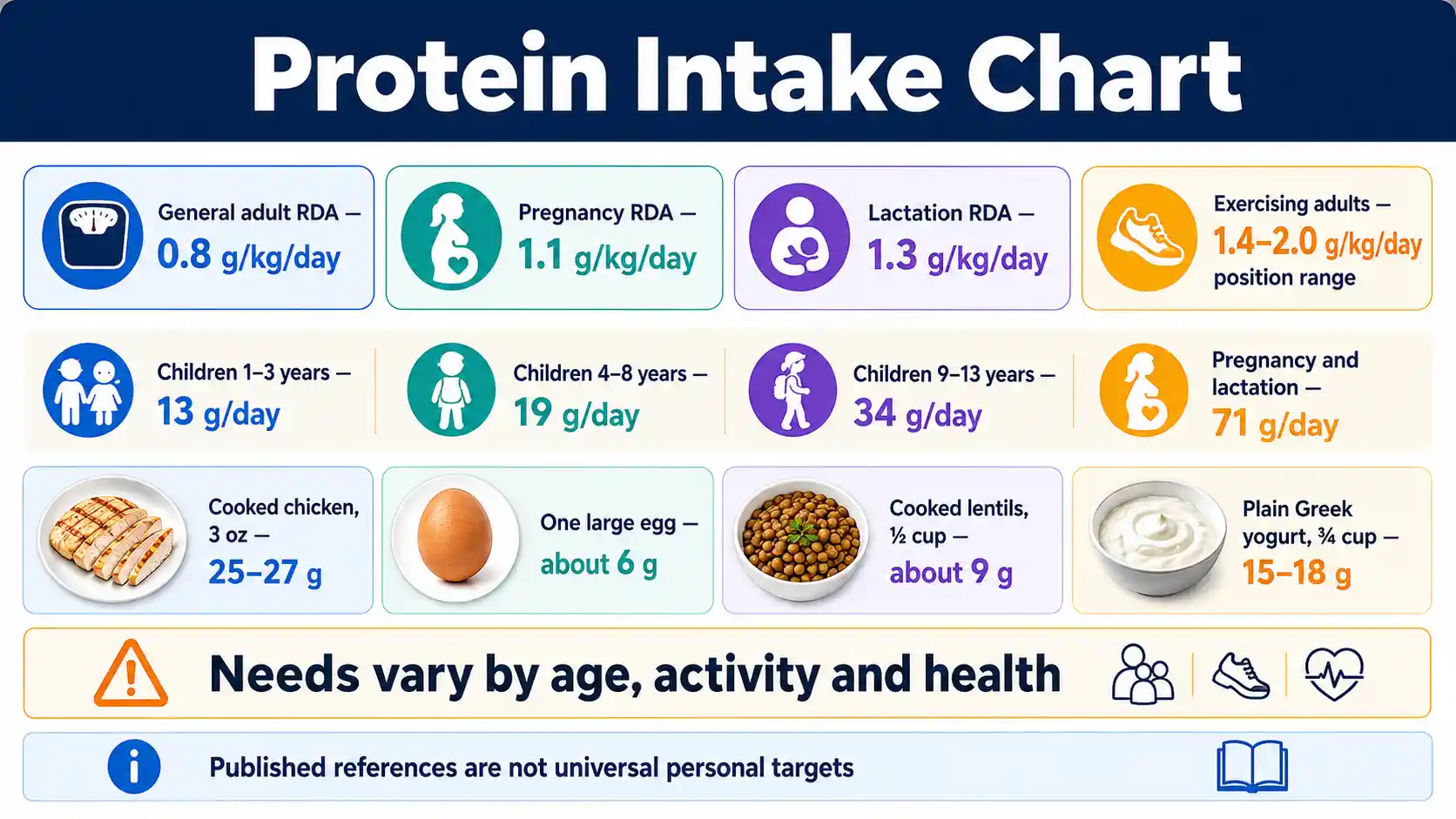
How much protein do you need each day?
The general adult RDA is 0.8 g/kg/day, but age, pregnancy, lactation, exercise, aging, illness, healing, and the body-weight basis can change the useful reference.
The National Academies DRI summary lists fixed gram values by age, sex, pregnancy, and lactation. Those values use reference body weights, so they do not always equal current weight multiplied by a coefficient.
General adult RDA
0.8 g/kg
The fixed U.S. RDA is 56 g for men and 46 g for women using reference body weights.
Pregnancy and lactation
71 g/day
Both fixed RDAs are 71 g, while their weight-based coefficients differ: 1.1 and 1.3 g/kg.
Exercising adults
1.4–2.0 g/kg
This ISSN position range is not the general RDA and should match training and health.
Adult calorie range
10–35%
The AMDR is a broad share of calories, not one required gram target.
Protein RDA and AI by Age and Life Stage
These U.S. Dietary Reference Intakes apply to generally healthy people. Infant values are Adequate Intakes; values from age 1 onward are Recommended Dietary Allowances.
Swipe horizontally inside the table to view every column.
| Life stage | Reference intake | Weight-based basis | How to read it |
|---|---|---|---|
| Infants 0–6 months | 9.1 g/day (AI) | 1.52 g/kg/day | Based on average intake of healthy breastfed infants |
| Infants 7–12 months | 11 g/day (RDA) | 1.2 g/kg/day | Feeding and growth require age-specific pediatric guidance |
| Children 1–3 years | 13 g/day | 1.05 g/kg/day | RDA based on a reference body weight |
| Children 4–8 years | 19 g/day | 0.95 g/kg/day | Needs rise with body size and growth |
| Children 9–13 years | 34 g/day | 0.95 g/kg/day | Same RDA for boys and girls |
| Boys 14–18 years | 52 g/day | 0.85 g/kg/day | Reference value, not a sports target |
| Girls 14–18 years | 46 g/day | 0.85 g/kg/day | Reference value, not a sports target |
| Men 19–70 years | 56 g/day | 0.8 g/kg/day — Adult RDA coefficient | Uses a 70 kg reference body weight |
| Men over 70 years | 56 g/day | 0.8 g/kg/day | Official RDA is unchanged; geriatric guidance may be higher |
| Women 19–70 years | 46 g/day | 0.8 g/kg/day | Uses a 57.5 kg reference body weight |
| Women over 70 years | 46 g/day | 0.8 g/kg/day | Official RDA is unchanged; geriatric guidance may be higher |
| Pregnancy, ages 14–50 | 71 g/day — Pregnancy RDA | 1.1 g/kg/day | Uses a pregnancy reference body weight and added need |
| Lactation, ages 14–50 | 71 g/day — Lactation RDA | 1.3 g/kg/day | Uses a lactation reference body weight and added need |
g/day = grams per day; g/kg/day = grams per kilogram of body weight per day.
- • An RDA is designed to meet the needs of nearly all healthy people in a life-stage group; it is not an upper limit or a personalized prescription.
- • The fixed gram values use standard reference weights. Multiplying a current weight by a coefficient can give a different result.
- • Prematurity, poor growth, illness, surgery, wounds, disability, or tube feeding requires individualized pediatric or clinical nutrition care.
Download or export
How to use a protein intake chart
Start with the reference that actually matches the person and purpose. Then confirm the formula, weight basis, food portions, and medical context before treating the result as a useful planning number.
1
Choose the right group
Use age, sex, pregnancy or lactation status, activity, and health context.
2
Check the weight basis
A formula may use reference, current, ideal, dry, or pre-pregnancy weight.
3
Count real portions
Use grams per serving; food weight is not the same as protein weight.
4
Add clinical context
Kidney, liver, growth, healing, and eating concerns can change the plan.
The adult RDA, food-label Daily Value, calorie-based AMDR, sports range, and medical prescription answer different questions. They are not interchangeable.
Protein Reference Calculator
Compare a weight-based reference with the adult RDA
Choose a published reference and enter body weight. Add an appropriate calorie estimate only if you also want to convert that group’s acceptable protein percentage into grams. Calculations stay in your browser.
Enter calories only when the estimate is appropriate. Protein provides about 4 kcal per gram.
General adult
RDA coefficient: 0.80 g/kg/day
58 g/day
From 72.6 kg × 0.80 g/kg.
58 g/day
Mathematical comparison at 0.8 g/kg; not applicable as an adult target for children.
Qualification: The fixed adult RDAs use reference weights: 56 g for men and 46 g for women.
Do not use this calculator for infants or medical treatment.
Kidney disease, dialysis, liver disease, pregnancy complications, poor growth, surgery, wounds, tube feeding, edema, severe illness, and eating disorders need qualified assessment and may use a different body-weight basis.
Adult Protein RDA Examples by Body Weight
The examples multiply body weight by the general adult RDA of 0.8 g/kg/day. They show arithmetic, not a goal for every body size, athlete, older adult, or medical condition.
Swipe horizontally inside the table to view every column.
| Body weight | Weight in kilograms | 0.8 g/kg calculation | Rounded daily result |
|---|---|---|---|
| 100 lb | 45.4 kg | 45.4 × 0.8 | 36 g/day |
| 120 lb | 54.4 kg | 54.4 × 0.8 | 44 g/day |
| 140 lb | 63.5 kg | 63.5 × 0.8 | 51 g/day — Example at 140 pounds |
| 160 lb | 72.6 kg | 72.6 × 0.8 | 58 g/day |
| 180 lb | 81.6 kg | 81.6 × 0.8 | 65 g/day — Example at 180 pounds |
| 200 lb | 90.7 kg | 90.7 × 0.8 | 73 g/day |
| 220 lb | 99.8 kg | 99.8 × 0.8 | 80 g/day |
| 250 lb | 113.4 kg | 113.4 × 0.8 | 91 g/day |
| 275 lb | 124.7 kg | 124.7 × 0.8 | 100 g/day |
| 300 lb | 136.1 kg | 136.1 × 0.8 | 109 g/day — Clinical weight basis may differ |
1 kilogram = 2.2046 pounds. Results are rounded to the nearest whole gram.
- • The National Academies fixed adult RDAs of 56 g for men and 46 g for women use reference body weights rather than every person’s current weight.
- • For higher body weights, edema, amputation, pregnancy, or clinical nutrition, a dietitian may use adjusted, ideal, dry, or pre-pregnancy weight instead.
- • Do not use this arithmetic to start a therapeutic low- or high-protein diet.
Download or export
Protein Acceptable Macronutrient Distribution Range
The AMDR describes the share of total calories that may come from protein while supporting adequate nutrient intake. It is broader than the RDA.
Swipe horizontally inside the table to view every column.
| Age group | Protein AMDR | At 2,000 kcal | Important context |
|---|---|---|---|
| Children 1–3 years | 5–20% of calories — Toddler AMDR | 25–100 g/day | Energy needs usually differ from 2,000 kcal; example is mathematical only |
| Children and teens 4–18 years | 10–30% of calories | 50–150 g/day | Growth, body size, and activity determine the useful intake |
| Adults 19 years and older | 10–35% of calories — Adult protein AMDR | 50–175 g/day | The lower end can still exceed or fall below a weight-based RDA |
Protein provides about 4 kilocalories per gram. Grams = calories × percentage ÷ 4.
- • The AMDR is not a reason to choose the highest number and does not replace the age- and life-stage RDA.
- • A calorie estimate must be appropriate before converting a percentage to grams.
- • Overall food quality, energy adequacy, fiber, carbohydrate, fat, and micronutrients still matter.
Download or export
Protein References for Exercise, Aging, and Recovery
These ranges come from professional position statements or clinical guidance, not the general RDA. The correct target depends on training, energy intake, health, and the weight basis used.
Swipe horizontally inside the table to view every column.
| Situation | Published reference | What it means | Who should individualize it |
|---|---|---|---|
| General adult RDA | 0.8 g/kg/day | Baseline population reference for healthy adults | Anyone with a medical condition or unusual body-composition context |
| Most exercising adults | 1.4–2.0 g/kg/day — Exercise position range | ISSN position range considered sufficient for most people who exercise | Competitive athletes, energy restriction, or complex training blocks |
| Athletic nutrition planning | Sport- and phase-specific | ACSM joint statement emphasizes type, amount, timing, and total energy | A sports dietitian should set a personalized performance plan |
| Older adults | At least 1.0 g/kg/day — Older-adult guidance | ESPEN guidance; adjust for nutrition, activity, disease, and tolerance | Frailty, kidney disease, wounds, or acute and chronic illness |
| After surgery, major injury, or wounds | Condition-specific | Needs can rise, but illness and organ function alter the target | Clinical dietitian and treating team |
| Cirrhosis | Often 1.2–1.5 g/kg ideal body weight/day — Cirrhosis clinical range | AASLD guidance avoids routine protein restriction | Hepatology and clinical nutrition team |
Ranges apply to grams of protein per kilogram of the specified body-weight basis per day.
- • Exercise ranges are not automatically appropriate for adolescents, pregnancy, kidney disease, liver disease, or people with eating disorders.
- • Adequate total energy and carbohydrate help keep protein available for tissue repair rather than energy.
- • A clinical target may use ideal, dry, adjusted, or pre-illness weight instead of scale weight.
Download or export
Protein grams depend on the exact food and portion
A food’s weight is not its protein weight. Three ounces of cooked chicken weighs about 85 grams but supplies roughly 25–27 grams of protein. Product formulation, water, cooking, and serving size change the result, so use the label or a matching USDA FoodData Central entry when precision matters.
Approximate Protein in Common Food Portions
Protein varies by food type, brand, cut, water content, preparation, and serving size. Use a package label or a matching FoodData Central record for a precise entry.
Swipe horizontally inside the table to view every column.
| Food | Example portion | Approximate protein | Useful comparison |
|---|---|---|---|
| Chicken breast, cooked | 3 oz (85 g) | 25–27 g — Chicken portion estimate | About a palm-size cooked portion |
| Lean beef, cooked | 3 oz (85 g) | 22–25 g | Cut and fat content change the value |
| Salmon, cooked | 3 oz (85 g) | 20–22 g | Also supplies omega-3 fats in many species |
| Tuna, canned and drained | 3 oz (85 g) | 20–22 g | Check sodium and species-specific guidance |
| Egg | 1 large | About 6 g | Two eggs provide about 12 g |
| Dairy milk | 1 cup (240 mL) | About 8 g | Lactose-free dairy milk is similar |
| Greek yogurt, plain | 3/4 cup (170 g) | 15–18 g | Brands and fat levels vary |
| Cottage cheese | 1/2 cup | 12–14 g | Sodium varies widely by product |
| Firm tofu | 1/2 cup | 10–22 g — Tofu values vary | Water content and brand cause a wide range |
| Tempeh | 3 oz (85 g) | 15–17 g | Fermented whole-soy food |
| Lentils, cooked | 1/2 cup | About 9 g — Lentil portion estimate | Also supplies fiber and iron |
| Beans or chickpeas, cooked | 1/2 cup | 7–8 g | Canned values change after draining |
| Edamame, cooked and shelled | 1/2 cup | About 9 g | Soy provides all essential amino acids |
| Peanut butter | 2 tablespoons | About 7 g | Energy-dense; use the label serving |
| Almonds | 1 oz (28 g) | About 6 g | Roughly a small handful |
| Quinoa, cooked | 1 cup | About 8 g | A grain-like seed with carbohydrate and fiber |
oz = ounces by weight; mL = milliliters; all values are approximate.
- • Restaurant portions and household cups can differ substantially from the examples.
- • Protein grams are not the same as the weight of the food: 3 oz of chicken does not equal 85 g of protein.
- • Choose foods within an overall pattern that also considers saturated fat, sodium, fiber, allergies, culture, access, and preference.
Download or export
Plant Protein, Essential Amino Acids, and Variety
A well-planned vegetarian or vegan pattern can meet protein needs. Variety across the day supports essential amino-acid intake without requiring precise pairing at every meal.
Swipe horizontally inside the table to view every column.
| Concept | Practical meaning | Examples | Avoid this misconception |
|---|---|---|---|
| Essential amino acids | The body must obtain nine amino acids from food | Soy foods, legumes, grains, nuts, seeds, dairy, eggs, meat, and fish contribute | Protein is only about total grams |
| Complete protein | Contains all essential amino acids in useful proportions | Soy, dairy, eggs, fish, poultry, and meat — Complete protein examples | Only animal foods can be complete |
| Complementary patterns | Different plant foods contribute different amino-acid profiles — Complementary proteins over the day | Beans with rice; hummus with whole-grain pita | The foods must be eaten in the same bite |
| Legumes | Often rich in lysine and useful as a daily anchor | Lentils, beans, peas, chickpeas, peanuts, soy | Vegetables alone provide the same concentration |
| Grains, nuts, and seeds | Add protein and balance a varied pattern | Oats, wheat, quinoa, almonds, pumpkin seeds | One food must supply the entire day |
| Digestibility and processing | Preparation and food matrix affect usable protein | Cooked legumes, tofu, tempeh, textured soy protein | A gram from every source is nutritionally identical |
| Vegan planning | Meet energy needs and include reliable vitamin B12 sources | Fortified foods or an appropriate B12 supplement | Protein is the only nutrient to plan — Plan nutrients beyond protein |
Food quality includes amino acids, digestibility, and the full nutrient package.
- • Most people can meet needs with food; plant-based athletes or people with low energy intake may benefit from dietitian review.
- • Children, pregnancy, older age, food allergy, gastrointestinal disease, and restrictive eating require extra planning.
- • Variety over the day is more practical than rigidly combining two specific foods at each meal.
Download or export
How to Plan and Track Protein Across the Day
A daily total can be divided among meals and snacks in many ways. Distribution is a planning tool, while the total diet, training, appetite, and clinical needs remain important.
Swipe horizontally inside the table to view every column.
| Step | What to do | Why it helps | Example |
|---|---|---|---|
| Choose the correct reference — Start with the correct reference | Use age, life stage, activity, and health—not a social-media target | Prevents mixing an RDA with an athlete or medical range | Adult RDA versus sports-dietitian goal |
| Confirm the weight basis | Check whether the formula uses current, reference, ideal, dry, or pre-pregnancy weight — Weight basis matters | Different weight bases produce different gram totals | Edema can make scale weight misleading |
| Count actual grams | Read protein grams per serving and multiply by servings eaten | Food weight and protein weight are not the same | Two servings of 8 g each = 16 g |
| Include several meals | Place a protein food at breakfast, lunch, and dinner if practical | Avoids leaving the full total for one meal | Eggs at breakfast, lentils at lunch, fish at dinner |
| Add plant variety | Rotate legumes, soy, whole grains, nuts, and seeds | Broadens amino acids, fiber, and micronutrients | Tofu, beans, oats, and pumpkin seeds |
| Check the full package | Review energy, fiber, sodium, saturated fat, and micronutrients | A high-protein label does not make a food balanced | Compare two products per serving |
| Review the pattern | Use several days when assessing usual intake | One unusual day does not show the habitual pattern | Three-day food record for a dietitian |
| Adjust with qualified help | Use a registered dietitian for medical, performance, or growth goals — Qualified individualization | Targets can change with treatment and progress | Renal, pediatric, prenatal, or sports dietitian |
Planning examples are flexible and do not prescribe a protein amount per meal.
- • There is no universal requirement to eat an identical protein amount at every meal.
- • App and restaurant estimates can be inaccurate; packaged labels and weighed recipe ingredients improve precision.
- • Tracking should not intensify anxiety, rigid eating, or an eating disorder; seek appropriate support if it does.
Download or export
Kidney, liver, and illness targets require individual care
Protein needs can move in opposite directions across predialysis kidney disease, dialysis, recovery, wounds, and cirrhosis. The National Kidney Foundation recommends medical nutrition therapy that uses disease stage, laboratory results, nutrition status, treatment, and other conditions instead of a general internet target.
When Protein Needs Medical Individualization
Some conditions change protein needs or the body-weight value used in calculations. Do not self-prescribe restriction or supplementation from a general chart.
Swipe horizontally inside the table to view every column.
| Situation | Why the target may change | Best next step | Avoid |
|---|---|---|---|
| Chronic kidney disease before dialysis | Stage, filtration, diabetes, labs, nutrition, and progression matter | Use a renal dietitian’s medical nutrition therapy plan — Renal dietitian plan | Starting a low-protein diet without adequate energy and monitoring |
| Hemodialysis or peritoneal dialysis | Treatment can increase losses and protein needs | Follow the dialysis team’s protein and phosphorus plan | Applying a predialysis restriction |
| Kidney transplant | Needs change across recovery and long-term medication use | Use transplant-team and dietitian guidance | Continuing an old dialysis target automatically |
| Cirrhosis or hepatic encephalopathy | Malnutrition and muscle loss are common | Use hepatology guidance; protein is not routinely restricted | Cutting protein to treat confusion without medical care — Do not routinely restrict protein in cirrhosis |
| Pregnancy or lactation | Growth and milk production increase reference needs | Use prenatal or postpartum nutrition guidance | Using an athlete formula as a pregnancy target |
| Child or adolescent growth | Age, size, puberty, activity, and growth trajectory matter | Use pediatric growth and dietary assessment | Using an adult calculator for an infant or child |
| Surgery, burns, wounds, infection, or cancer | Inflammation and healing may raise needs while tolerance changes | Use the treating team and clinical dietitian — Clinical nutrition assessment | Relying on powders instead of medical assessment |
| Food allergy, dysphagia, or malabsorption | Available foods, swallowing safety, and absorption affect intake | Use allergy, speech-language, gastroenterology, and dietitian care as relevant | Removing major food groups without replacements |
| Eating disorder or severe dietary restriction | Tracking and high-protein rules can worsen rigid eating | Seek eating-disorder-informed medical and nutrition care | Pursuing a calculator target at the expense of recovery |
Clinical protein prescriptions may use ideal, adjusted, dry, pre-illness, or pre-pregnancy weight.
- • Kidney disease does not have one protein number: predialysis, dialysis, transplant, and acute illness differ.
- • Confusion, rapid decline, dehydration, inability to eat, or severe weakness needs medical assessment rather than a protein calculation.
- • A dietitian can account for calories, laboratory results, medicines, food access, culture, symptoms, and treatment goals.
Download or export
Protein Labels, Powders, and Supplement Safety
Nutrition Facts and Supplement Facts can help compare products, but a label value is not proof that a product is necessary, complete, effective, or appropriate.
Swipe horizontally inside the table to view every column.
| Label or product issue | What it means | What to check | Safer interpretation |
|---|---|---|---|
| Protein Daily Value | FDA uses 50 g/day for labeling — FDA protein Daily Value | Grams per serving and serving size | The Daily Value is not your individualized RDA |
| Percent Daily Value | Protein %DV is often not required for adult foods | Use actual grams when %DV is absent | Do not assume missing %DV means no protein |
| Serving size | Label values apply to the stated amount | Servings per container and amount eaten | Two scoops may not equal one serving |
| Protein concentrate or isolate | Processing changes protein concentration | Ingredient, allergen, sodium, sugar, and total calories | Higher concentration is not automatically healthier |
| Multi-ingredient powder | May contain stimulants, herbs, sweeteners, or proprietary blends | Every ingredient, dose, medication interaction, and sport rules — Check every ingredient | Protein grams do not describe the whole product |
| Third-party certification | Can reduce some quality and banned-substance uncertainty | Certification scope and current lot or product listing | Certification does not prove benefit or medical suitability |
| Food-first option | Many people can meet needs with ordinary foods | Cost, convenience, appetite, allergies, and dietary pattern | A supplement is optional unless clinically indicated |
| Concerning reaction | Allergy, contamination, or interaction may be possible | Breathing, swelling, faintness, vomiting, or severe symptoms | Stop use and seek urgent care for severe reactions — Urgent reaction action |
The FDA protein Daily Value is 50 g for adults and children age 4 and older on labeling.
- • Dietary supplements do not undergo FDA premarket approval for safety and effectiveness in the same way as medicines.
- • Children, pregnancy, lactation, kidney disease, liver disease, and medication use require extra product review.
- • A product marketed for bodybuilding or performance may include undeclared or poorly studied ingredients.
Download or export
Frequently asked questions
How much protein does an average adult need each day?
The U.S. adult RDA is 0.8 grams per kilogram of reference body weight per day. Fixed RDA values are 56 grams for adult men and 46 grams for adult women, but pregnancy, lactation, training, aging, illness, and the weight basis used can change the useful target.
How do I calculate protein from body weight in pounds?
Divide pounds by 2.2046 to convert to kilograms, then multiply by the applicable grams-per-kilogram reference. For the general adult RDA, the shortcut is about 0.36 grams per pound. This arithmetic is not a clinical prescription.
Is 100 grams of protein a day too much?
One number cannot answer that question. One hundred grams may fall within an adult calorie distribution range or a training plan for one person but be unsuitable for another. Body size, total calories, age, activity, pregnancy, kidney or liver disease, and the rest of the diet matter.
Do athletes need more protein?
Many exercising adults use more than the 0.8 g/kg RDA. The ISSN position stand describes 1.4–2.0 g/kg/day as sufficient for most exercising adults, while sport, training phase, energy intake, and health should guide an individualized plan.
Do older adults need more than the adult RDA?
The official U.S. RDA remains 0.8 g/kg/day after age 70, but ESPEN guidance recommends at least 1.0 g/kg/day with adjustment for nutrition status, activity, disease, and tolerance. Kidney disease and other conditions require individualized care.
How much protein is recommended during pregnancy?
The U.S. pregnancy RDA is 71 grams per day and 1.1 g/kg/day using pregnancy reference assumptions. A prenatal clinician or dietitian may adjust the plan for multiple pregnancy, adolescent pregnancy, poor growth, severe vomiting, diabetes, kidney disease, or other conditions.
How much protein is recommended while breastfeeding?
The U.S. lactation RDA is 71 grams per day and 1.3 g/kg/day using reference body weight. Milk production, recovery, appetite, dietary pattern, and medical conditions can affect an individual plan.
Can a vegan diet provide enough protein?
Yes. A varied vegan pattern can provide adequate protein through legumes, soy foods, grains, nuts, seeds, and other foods. Meet total energy needs, include several sources across the day, and plan vitamin B12 and other nutrients that need special attention.
Do plant proteins need to be combined at every meal?
No. Eating a variety of plant foods across the day generally supplies complementary essential amino acids. Pairings such as beans and rice are convenient examples, not a rule that both foods must be eaten together each time.
Is the 50-gram Daily Value my personal protein target?
No. FDA uses 50 grams as a reference Daily Value for food labeling. It helps compare products, while the RDA and an individualized target depend on age, sex, life stage, body size, activity, and health.
How much protein is in a 3-ounce portion of meat or fish?
A cooked 3-ounce portion commonly supplies about 20–27 grams, depending on the food, cut, species, water content, and preparation. Check a matching FoodData Central record or Nutrition Facts label for a more precise value.
Should protein be spread evenly across meals?
Protein can be divided among meals and snacks in many ways. Including protein at several eating times may be practical, especially for appetite or training, but there is no universal requirement for an identical gram amount at every meal.
Is a high-protein diet safe with kidney disease?
Do not use a general high-protein plan with kidney disease without medical guidance. Protein needs differ before dialysis, during hemodialysis or peritoneal dialysis, and after transplant. A renal dietitian uses kidney function, labs, nutrition status, and treatment to set the plan.
Should people with cirrhosis restrict protein?
Routine protein restriction is not recommended in current AASLD guidance, including for hepatic encephalopathy, because malnutrition and muscle loss are common. Cirrhosis nutrition should be managed with hepatology and clinical nutrition care.
Do I need protein powder to meet my protein needs?
Most people can meet protein needs with food. A powder may be convenient or clinically useful in some situations, but check the serving, full ingredient list, allergens, interactions, certification, cost, and whether a qualified professional recommends it.
Sources
Reference values, food-composition context, performance ranges, and clinical cautions were checked against the following organizations and publications.
National Academies of Sciences, Engineering, and Medicine — Dietary Reference Intakes for Macronutrients
Establishes protein Estimated Average Requirements, Recommended Dietary Allowances, Adequate Intakes, and acceptable macronutrient distribution ranges.
https://nap.nationalacademies.org/catalog/10490/dietary-reference-intakes-for-energy-carbohydrate-fiber-fat-fatty-acids-cholesterol-protein-and-amino-acids
National Academies of Sciences, Engineering, and Medicine — Dietary Reference Intake Summary Tables
Provides age-, sex-, pregnancy-, and lactation-specific protein reference values and explains that adult 0.8 g/kg values use reference body weights.
https://nap.nationalacademies.org/skim.php?chap=1103-1116&record_id=13050
U.S. Department of Agriculture, National Agricultural Library — DRI Calculator for Healthcare Professionals
Calculates nutrient recommendations from National Academies DRIs and notes that an individual requirement may be higher or lower.
https://www.nal.usda.gov/human-nutrition-and-food-safety/dri-calculator
U.S. Department of Health and Human Services — Dietary Guidelines for Americans, 2025–2030
Identifies the current federal dietary guidance and emphasizes nutrient-dense foods within an overall eating pattern.
https://odphp.health.gov/our-work/nutrition-physical-activity/dietary-guidelines
U.S. Department of Agriculture, Agricultural Research Service — FoodData Central
Provides food-composition data used to contextualize approximate protein amounts in common portions.
https://fdc.nal.usda.gov/
U.S. Food and Drug Administration — Daily Value on Nutrition and Supplement Facts Labels
Defines the 50 g protein Daily Value used for labeling and explains how Daily Values differ from individualized nutrient needs.
https://www.fda.gov/food/nutrition-facts-label/daily-value-nutrition-and-supplement-facts-labels
MedlinePlus, U.S. National Library of Medicine — Dietary Proteins
Explains protein functions, essential amino acids, complete proteins, and the value of varied protein sources.
https://medlineplus.gov/dietaryproteins.html
Academy of Nutrition and Dietetics, Dietitians of Canada, and ACSM — Nutrition and Athletic Performance Joint Position Statement
Supports sport-specific nutrition planning and referral to a qualified sports dietitian for a personalized plan.
https://pubmed.ncbi.nlm.nih.gov/26891166/
International Society of Sports Nutrition — Position Stand: Protein and Exercise
Describes a 1.4–2.0 g/kg/day evidence-based range as sufficient for most exercising adults, with context for training and energy intake.
https://pubmed.ncbi.nlm.nih.gov/28642676/
European Society for Clinical Nutrition and Metabolism — Clinical Nutrition and Hydration in Geriatrics
Recommends at least 1.0 g/kg/day for older adults with individual adjustment for nutrition, activity, disease, and tolerance.
https://pubmed.ncbi.nlm.nih.gov/35306388/
National Kidney Foundation — Medical Nutrition Therapy for Kidney Disease
Explains why protein needs in kidney disease depend on disease stage, laboratory results, treatment, and an individualized renal dietitian plan.
https://www.kidney.org/kidney-topics/medical-nutrition-therapy-mnt-kidney-disease
American Association for the Study of Liver Diseases — Outpatient Management of Cirrhosis
Explains that cirrhosis commonly increases protein needs and that protein should not be routinely restricted for hepatic encephalopathy.
https://www.aasld.org/liver-fellow-network/core-series/back-basics/back-basics-outpatient-management-cirrhosis
National Institutes of Health, Office of Dietary Supplements — Dietary Supplements for Exercise and Athletic Performance
Reviews protein and amino-acid supplements, product regulation, ingredient uncertainty, interactions, and safety considerations.
https://ods.od.nih.gov/factsheets/ExerciseAndAthleticPerformance-HealthProfessional/